BIO 106
Lecture 13
Genetic Engineering and Biotechnology
GENETIC ENGINEERING & BIOTECHNOLOGY
A. Recombinant DNA/ Genetic
Engineering
B. Applications of Genetic
Engineering
1. Researches on Human Genes
2. Researches on Animal Genes
3. Researches on Plant Genes
4. Researches on Microbial Genes 2cces2015
GENETIC ENGINEERING & BIOTECHNOLOGY
C. The Release of Genetically
Engineered Organisms
1. Biosafety and Ecological
Implications
1.1 Potential Ecological Concerns
1.2 Regulatory Policies
3cces2015
GENETIC ENGINEERING & BIOTECHNOLOGY
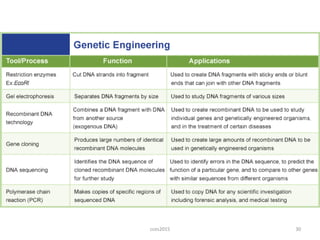
Genetic Engineering: technology that
involves manipulating the DNA of one
organism in order to insert the DNA of
another organism, called exogenous DNA.
Genetically engineered organisms are used to:
study the expression of a particular gene.
investigate cellular processes.
study the development of a certain disease.
select traits that might be beneficial to humans.
4cces2015
GENETIC ENGINEERING & BIOTECHNOLOGY
Biotechnology:
the use of living cells to make products
such as pharmaceuticals, food and
beverages
the use of organisms such as bacteria to
protect the environment
the use of DNA science for the
production of materials for diagnostics
and research
5cces2015
GENETIC ENGINEERING & BIOTECHNOLOGY
Biotechnology helps to meet our basic
needs: food, clothing, shelter, health
and safety
6cces2015
GENETIC ENGINEERING & BIOTECHNOLOGY
Recombinant DNA
• The manipulation and combination of
DNA from 2 sources
Bacterial DNA + human gene for insulin
Plant DNA + bacterial DNA
(Agrobacterium tumefaciens)
Mouse DNA + human DNA = transgenic
7cces2015
GENETIC ENGINEERING & BIOTECHNOLOGY
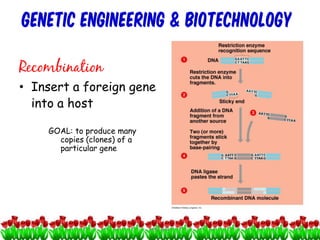
Recombination
• Insert a foreign gene
into a host
GOAL: to produce many
copies (clones) of a
particular gene
8cces2015
GENETIC ENGINEERING & BIOTECHNOLOGY
Vectors
A vector is an entity that transmits a disease or parasite from one
animal or plant to another.
• Plasmids
• Viruses
• Particles ( DNA coated bullets)
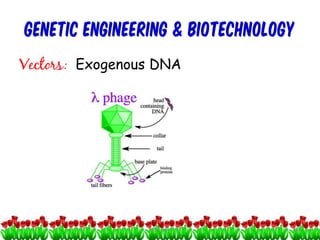
• Exogenous DNA
9cces2015
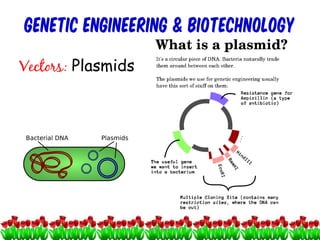
GENETIC ENGINEERING & BIOTECHNOLOGY
Vectors: Plasmids
10cces2015
GENETIC ENGINEERING & BIOTECHNOLOGY
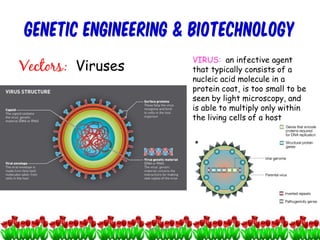
Vectors: Viruses
VIRUS: an infective agent
that typically consists of a
nucleic acid molecule in a
protein coat, is too small to be
seen by light microscopy, and
is able to multiply only within
the living cells of a host
11cces2015
GENETIC ENGINEERING & BIOTECHNOLOGY
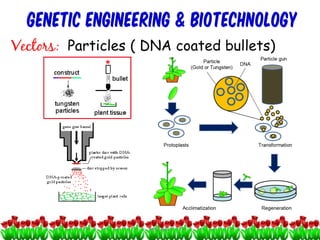
Vectors: Particles ( DNA coated bullets)
12cces2015
GENETIC ENGINEERING & BIOTECHNOLOGY
Vectors: Exogenous DNA
13cces2015
GENETIC ENGINEERING & BIOTECHNOLOGY
Characteristics of a Vector
• Can replicate independently in the host cell –
contains an Ori
• Has restriction sites in the polylinker cloning
region
• Has a reporter gene that will announce its
presence in the host cell
• small in size as compared to the host
chromosome for ease of isolation
14cces2015
GENETIC ENGINEERING & BIOTECHNOLOGY
Restriction enzymes & Vectors
• Cut Plasmid with restriction enzyme
[RESTRICTION ENZYME: DNA-cutting enzymes found in
bacteria (and harvested from them for use). Because they
cut within the molecule, they are often called restriction
endonucleases.]
• Cut gene of interest with restriction
enzyme
• Splice together gene of interest and
vector
15cces2015
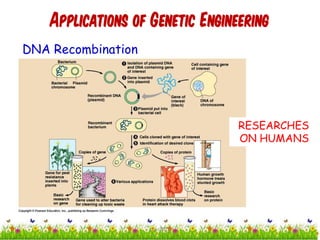
Applications of Genetic Engineering
DNA Recombination
RESEARCHES
ON HUMANS
16cces2015
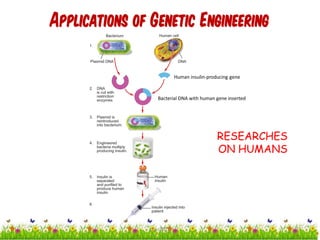
Applications of Genetic Engineering
RESEARCHES
ON HUMANS
Human insulin-producing gene
Bacterial DNA with human gene inserted
17cces2015
Applications of Genetic Engineering
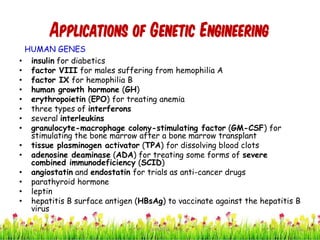
• insulin for diabetics
• factor VIII for males suffering from hemophilia A
• factor IX for hemophilia B
• human growth hormone (GH)
• erythropoietin (EPO) for treating anemia
• three types of interferons
• several interleukins
• granulocyte-macrophage colony-stimulating factor (GM-CSF) for
stimulating the bone marrow after a bone marrow transplant
• tissue plasminogen activator (TPA) for dissolving blood clots
• adenosine deaminase (ADA) for treating some forms of severe
combined immunodeficiency (SCID)
• angiostatin and endostatin for trials as anti-cancer drugs
• parathyroid hormone
• leptin
• hepatitis B surface antigen (HBsAg) to vaccinate against the hepatitis B
virus
HUMAN GENES
18cces2015
Applications of Genetic Engineering
19cces2015
Applications of Genetic Engineering
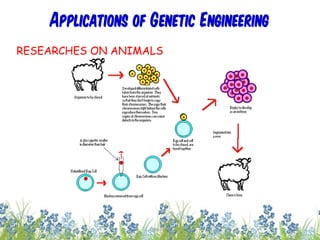
RESEARCHES ON ANIMALS
20cces2015
Applications of Genetic Engineering
RESEARCHES
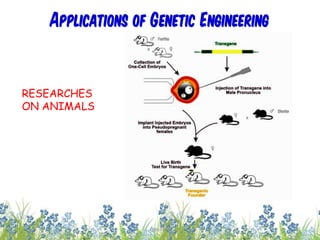
ON ANIMALS
21cces2015
Applications of Genetic Engineering
22cces2015
Applications of Genetic Engineering
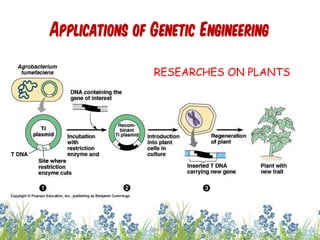
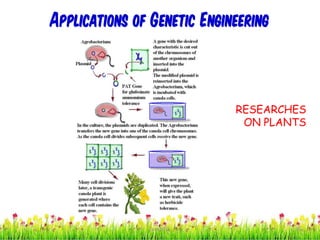
RESEARCHES ON PLANTS
23cces2015
Applications of Genetic Engineering
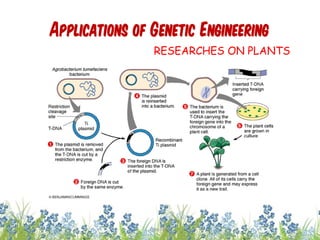
RESEARCHES ON PLANTS
24cces2015
Applications of Genetic Engineering
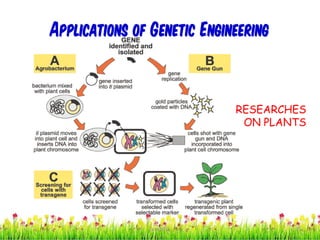
RESEARCHES
ON PLANTS
25cces2015
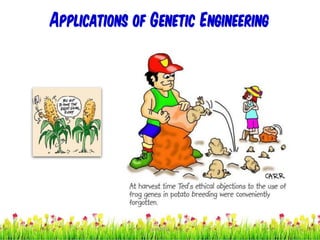
Applications of Genetic Engineering
RESEARCHES
ON PLANTS
26cces2015
Applications of Genetic Engineering
27cces2015
Applications of Genetic Engineering
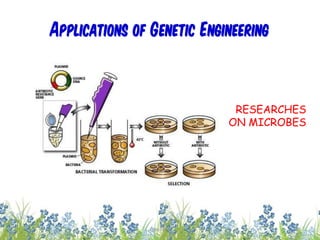
RESEARCHES
ON MICROBES
28cces2015
Applications of Genetic Engineering
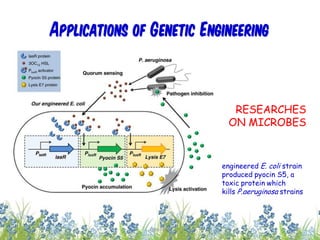
RESEARCHES
ON MICROBES
engineered E. coli strain
produced pyocin S5, a
toxic protein which
kills P.aeruginosa strains
29cces2015
30cces2015
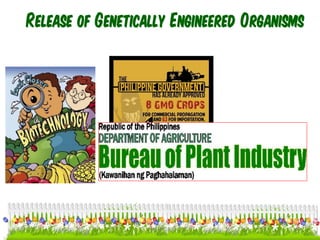
Release of Genetically Engineered Organisms
Genetically engineered organism (GEO) or
Genetically modified organism (GMO):
organism whose genome has been engineered in
the laboratory in order to favor the
expression of desired physiological traits or
the production of desired biological products
31cces2015
Release of Genetically Engineered Organisms
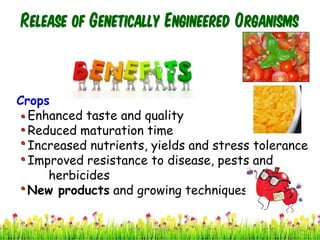
Crops
Enhanced taste and quality
Reduced maturation time
Increased nutrients, yields and stress tolerance
Improved resistance to disease, pests and
herbicides
New products and growing techniques
32cces2015
Release of Genetically Engineered Organisms
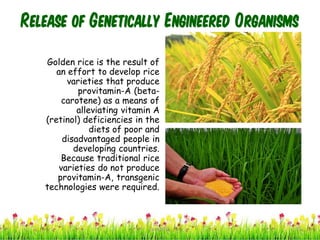
Golden rice is the result of
an effort to develop rice
varieties that produce
provitamin-A (beta-
carotene) as a means of
alleviating vitamin A
(retinol) deficiencies in the
diets of poor and
disadvantaged people in
developing countries.
Because traditional rice
varieties do not produce
provitamin-A, transgenic
technologies were required.
33cces2015
Release of Genetically Engineered Organisms
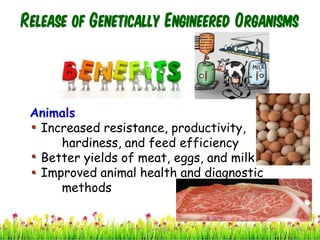
Animals
Increased resistance, productivity,
hardiness, and feed efficiency
Better yields of meat, eggs, and milk
Improved animal health and diagnostic
methods
34cces2015
Release of Genetically Engineered Organisms
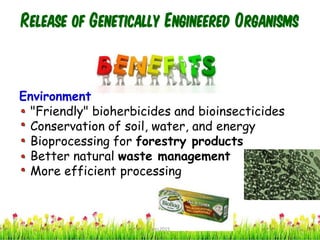
Environment
"Friendly" bioherbicides and bioinsecticides
Conservation of soil, water, and energy
Bioprocessing for forestry products
Better natural waste management
More efficient processing
35cces2015
Release of Genetically Engineered Organisms
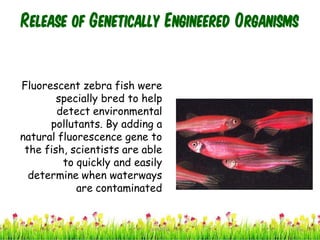
Fluorescent zebra fish were
specially bred to help
detect environmental
pollutants. By adding a
natural fluorescence gene to
the fish, scientists are able
to quickly and easily
determine when waterways
are contaminated
36cces2015
Release of Genetically Engineered Organisms
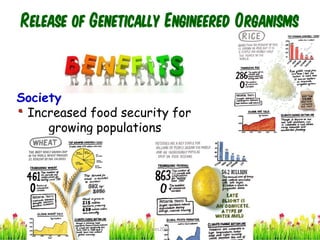
Society
Increased food security for
growing populations
37cces2015
Release of Genetically Engineered Organisms
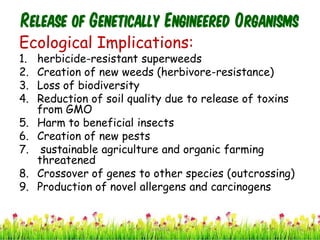
Ecological Implications:
1. herbicide-resistant superweeds
2. Creation of new weeds (herbivore-resistance)
3. Loss of biodiversity
4. Reduction of soil quality due to release of toxins
from GMO
5. Harm to beneficial insects
6. Creation of new pests
7. sustainable agriculture and organic farming
threatened
8. Crossover of genes to other species (outcrossing)
9. Production of novel allergens and carcinogens
38cces2015
Release of Genetically Engineered Organisms
Regulation in the US
GMOs are regulated pursuant to health, safety, and environmental
legislation governing conventional products. The US approach to
regulating GMOs is premised on the assumption that regulation
should focus on the nature of the products, rather than the process
in which they were produced.
FDA regulates the safety of all human and animal food products in the
US (other than meat, poultry, and eggs), as well as drugs and biological
products;
EPA regulates pesticides and microorganisms developed through genetic
engineering.
39cces2015
Release of Genetically Engineered Organisms
Regulation in Canada
Manufacturers and importers who wish to sell or advertise a
GM food in Canada, must submit data to Health Canada for a
pre-market safety assessment, as required under Division 28 of
Part B of the Food and Drugs Regulations (Novel Foods). This
safety assessment provides assurance that the food is safe
when prepared or consumed according to its intended use.
40cces2015
Release of Genetically Engineered Organisms
Regulation in EU
Six Member States currently apply safeguard clauses on GMO
events: Austria, France, Greece, Hungary, Germany and
Luxembourg.
Deliberate Release of Genetically Modified Organisms based on
the precautionary principle. Applicants who wished to conduct
field tests of GMOs were required to apply and submit an
environmental risk assessment to the "competent authority" of
the country where testing will occur. It further required
another application to each Member State to market
genetically-modified products and granted each Member States
the right to object to such marketing within their borders.
41cces2015
Regulation in South Asia
Regular updating and review of policies governing GMO
cultivation and safety assessment not only to
consumers but also to the environment
Release of Genetically Engineered Organisms
Regulation in Australia / New Zealand
Australia has one of the most developed regulatory systems for GMOs. All
'dealings' with GMOs are regulated by the Gene Technology Act
(2000), which, inter alia, set up the office of the Gene Technology
Regulator monitors and enforces the legislation. Safety assessment and
strict labelling of GM foods. All GM food should be assessed regarding
safety for human consumption and approved before sale and use. All
GM food and ingredients should be labelled where they contain novel
DNA and/or novel protein in the final food, or have altered
characteristics.
42cces2015
Release of Genetically Engineered Organisms
43cces2015
If for the whole sem you were thinking this…
44cces2015
45cces2015
46cces2015

Genetic Engineering and Biotechnology

  • 1.
    BIO 106 Lecture 13 GeneticEngineering and Biotechnology
  • 2.
    GENETIC ENGINEERING &BIOTECHNOLOGY A. Recombinant DNA/ Genetic Engineering B. Applications of Genetic Engineering 1. Researches on Human Genes 2. Researches on Animal Genes 3. Researches on Plant Genes 4. Researches on Microbial Genes 2cces2015
  • 3.
    GENETIC ENGINEERING &BIOTECHNOLOGY C. The Release of Genetically Engineered Organisms 1. Biosafety and Ecological Implications 1.1 Potential Ecological Concerns 1.2 Regulatory Policies 3cces2015
  • 4.
    GENETIC ENGINEERING &BIOTECHNOLOGY Genetic Engineering: technology that involves manipulating the DNA of one organism in order to insert the DNA of another organism, called exogenous DNA. Genetically engineered organisms are used to: study the expression of a particular gene. investigate cellular processes. study the development of a certain disease. select traits that might be beneficial to humans. 4cces2015
  • 5.
    GENETIC ENGINEERING &BIOTECHNOLOGY Biotechnology: the use of living cells to make products such as pharmaceuticals, food and beverages the use of organisms such as bacteria to protect the environment the use of DNA science for the production of materials for diagnostics and research 5cces2015
  • 6.
    GENETIC ENGINEERING &BIOTECHNOLOGY Biotechnology helps to meet our basic needs: food, clothing, shelter, health and safety 6cces2015
  • 7.
    GENETIC ENGINEERING &BIOTECHNOLOGY Recombinant DNA • The manipulation and combination of DNA from 2 sources Bacterial DNA + human gene for insulin Plant DNA + bacterial DNA (Agrobacterium tumefaciens) Mouse DNA + human DNA = transgenic 7cces2015
  • 8.
    GENETIC ENGINEERING &BIOTECHNOLOGY Recombination • Insert a foreign gene into a host GOAL: to produce many copies (clones) of a particular gene 8cces2015
  • 9.
    GENETIC ENGINEERING &BIOTECHNOLOGY Vectors A vector is an entity that transmits a disease or parasite from one animal or plant to another. • Plasmids • Viruses • Particles ( DNA coated bullets) • Exogenous DNA 9cces2015
  • 10.
    GENETIC ENGINEERING &BIOTECHNOLOGY Vectors: Plasmids 10cces2015
  • 11.
    GENETIC ENGINEERING &BIOTECHNOLOGY Vectors: Viruses VIRUS: an infective agent that typically consists of a nucleic acid molecule in a protein coat, is too small to be seen by light microscopy, and is able to multiply only within the living cells of a host 11cces2015
  • 12.
    GENETIC ENGINEERING &BIOTECHNOLOGY Vectors: Particles ( DNA coated bullets) 12cces2015
  • 13.
    GENETIC ENGINEERING &BIOTECHNOLOGY Vectors: Exogenous DNA 13cces2015
  • 14.
    GENETIC ENGINEERING &BIOTECHNOLOGY Characteristics of a Vector • Can replicate independently in the host cell – contains an Ori • Has restriction sites in the polylinker cloning region • Has a reporter gene that will announce its presence in the host cell • small in size as compared to the host chromosome for ease of isolation 14cces2015
  • 15.
    GENETIC ENGINEERING &BIOTECHNOLOGY Restriction enzymes & Vectors • Cut Plasmid with restriction enzyme [RESTRICTION ENZYME: DNA-cutting enzymes found in bacteria (and harvested from them for use). Because they cut within the molecule, they are often called restriction endonucleases.] • Cut gene of interest with restriction enzyme • Splice together gene of interest and vector 15cces2015
  • 16.
    Applications of GeneticEngineering DNA Recombination RESEARCHES ON HUMANS 16cces2015
  • 17.
    Applications of GeneticEngineering RESEARCHES ON HUMANS Human insulin-producing gene Bacterial DNA with human gene inserted 17cces2015
  • 18.
    Applications of GeneticEngineering • insulin for diabetics • factor VIII for males suffering from hemophilia A • factor IX for hemophilia B • human growth hormone (GH) • erythropoietin (EPO) for treating anemia • three types of interferons • several interleukins • granulocyte-macrophage colony-stimulating factor (GM-CSF) for stimulating the bone marrow after a bone marrow transplant • tissue plasminogen activator (TPA) for dissolving blood clots • adenosine deaminase (ADA) for treating some forms of severe combined immunodeficiency (SCID) • angiostatin and endostatin for trials as anti-cancer drugs • parathyroid hormone • leptin • hepatitis B surface antigen (HBsAg) to vaccinate against the hepatitis B virus HUMAN GENES 18cces2015
  • 19.
    Applications of GeneticEngineering 19cces2015
  • 20.
    Applications of GeneticEngineering RESEARCHES ON ANIMALS 20cces2015
  • 21.
    Applications of GeneticEngineering RESEARCHES ON ANIMALS 21cces2015
  • 22.
    Applications of GeneticEngineering 22cces2015
  • 23.
    Applications of GeneticEngineering RESEARCHES ON PLANTS 23cces2015
  • 24.
    Applications of GeneticEngineering RESEARCHES ON PLANTS 24cces2015
  • 25.
    Applications of GeneticEngineering RESEARCHES ON PLANTS 25cces2015
  • 26.
    Applications of GeneticEngineering RESEARCHES ON PLANTS 26cces2015
  • 27.
    Applications of GeneticEngineering 27cces2015
  • 28.
    Applications of GeneticEngineering RESEARCHES ON MICROBES 28cces2015
  • 29.
    Applications of GeneticEngineering RESEARCHES ON MICROBES engineered E. coli strain produced pyocin S5, a toxic protein which kills P.aeruginosa strains 29cces2015
  • 30.
  • 31.
    Release of GeneticallyEngineered Organisms Genetically engineered organism (GEO) or Genetically modified organism (GMO): organism whose genome has been engineered in the laboratory in order to favor the expression of desired physiological traits or the production of desired biological products 31cces2015
  • 32.
    Release of GeneticallyEngineered Organisms Crops Enhanced taste and quality Reduced maturation time Increased nutrients, yields and stress tolerance Improved resistance to disease, pests and herbicides New products and growing techniques 32cces2015
  • 33.
    Release of GeneticallyEngineered Organisms Golden rice is the result of an effort to develop rice varieties that produce provitamin-A (beta- carotene) as a means of alleviating vitamin A (retinol) deficiencies in the diets of poor and disadvantaged people in developing countries. Because traditional rice varieties do not produce provitamin-A, transgenic technologies were required. 33cces2015
  • 34.
    Release of GeneticallyEngineered Organisms Animals Increased resistance, productivity, hardiness, and feed efficiency Better yields of meat, eggs, and milk Improved animal health and diagnostic methods 34cces2015
  • 35.
    Release of GeneticallyEngineered Organisms Environment "Friendly" bioherbicides and bioinsecticides Conservation of soil, water, and energy Bioprocessing for forestry products Better natural waste management More efficient processing 35cces2015
  • 36.
    Release of GeneticallyEngineered Organisms Fluorescent zebra fish were specially bred to help detect environmental pollutants. By adding a natural fluorescence gene to the fish, scientists are able to quickly and easily determine when waterways are contaminated 36cces2015
  • 37.
    Release of GeneticallyEngineered Organisms Society Increased food security for growing populations 37cces2015
  • 38.
    Release of GeneticallyEngineered Organisms Ecological Implications: 1. herbicide-resistant superweeds 2. Creation of new weeds (herbivore-resistance) 3. Loss of biodiversity 4. Reduction of soil quality due to release of toxins from GMO 5. Harm to beneficial insects 6. Creation of new pests 7. sustainable agriculture and organic farming threatened 8. Crossover of genes to other species (outcrossing) 9. Production of novel allergens and carcinogens 38cces2015
  • 39.
    Release of GeneticallyEngineered Organisms Regulation in the US GMOs are regulated pursuant to health, safety, and environmental legislation governing conventional products. The US approach to regulating GMOs is premised on the assumption that regulation should focus on the nature of the products, rather than the process in which they were produced. FDA regulates the safety of all human and animal food products in the US (other than meat, poultry, and eggs), as well as drugs and biological products; EPA regulates pesticides and microorganisms developed through genetic engineering. 39cces2015
  • 40.
    Release of GeneticallyEngineered Organisms Regulation in Canada Manufacturers and importers who wish to sell or advertise a GM food in Canada, must submit data to Health Canada for a pre-market safety assessment, as required under Division 28 of Part B of the Food and Drugs Regulations (Novel Foods). This safety assessment provides assurance that the food is safe when prepared or consumed according to its intended use. 40cces2015
  • 41.
    Release of GeneticallyEngineered Organisms Regulation in EU Six Member States currently apply safeguard clauses on GMO events: Austria, France, Greece, Hungary, Germany and Luxembourg. Deliberate Release of Genetically Modified Organisms based on the precautionary principle. Applicants who wished to conduct field tests of GMOs were required to apply and submit an environmental risk assessment to the "competent authority" of the country where testing will occur. It further required another application to each Member State to market genetically-modified products and granted each Member States the right to object to such marketing within their borders. 41cces2015
  • 42.
    Regulation in SouthAsia Regular updating and review of policies governing GMO cultivation and safety assessment not only to consumers but also to the environment Release of Genetically Engineered Organisms Regulation in Australia / New Zealand Australia has one of the most developed regulatory systems for GMOs. All 'dealings' with GMOs are regulated by the Gene Technology Act (2000), which, inter alia, set up the office of the Gene Technology Regulator monitors and enforces the legislation. Safety assessment and strict labelling of GM foods. All GM food should be assessed regarding safety for human consumption and approved before sale and use. All GM food and ingredients should be labelled where they contain novel DNA and/or novel protein in the final food, or have altered characteristics. 42cces2015
  • 43.
    Release of GeneticallyEngineered Organisms 43cces2015
  • 44.
    If for thewhole sem you were thinking this… 44cces2015
  • 45.
  • 46.