Genetic
mapping and
QTL detection
QTL Mapping
 Qualitative traits
 Quantitative traits
 Genes
 Locus/loci
 Epistasis
 Linkage groups
 Markers
Quantitative vs Qualitative traits
What is a quantitative trait?
Discontinuous variation Continuous variation
QTLs
 A quantitative trait is generally controlled by
several genes called QTL (quantitative trait
locus).
 The observed phenotype is the result of the
genotype, the environment and the genotype
x environment interactions.
QTL - Quantitative Trait Loci
 A quantitative trait locus is the location of a gene
(or genes) that affects a trait that is measured on
aquantitative (linear) scale.
 Examples of quantitative traits are plant height
(measured on a ruler) and grain yield (measured
on a balance).
 These traits are typically affected by more than
one gene, and also by the environment. Thus,
mapping QTL is more complex than mapping a
single gene that affects a qualitative trait (such as
flower colour).
Advantage of molecular markers
on conventional genetics
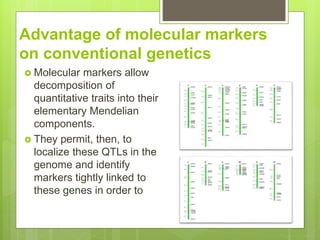
 Molecular markers allow
decomposition of
quantitative traits into their
elementary Mendelian
components.
 They permit, then, to
localize these QTLs in the
genome and identify
markers tightly linked to
these genes in order to
QTL Mapping
 QTLs are identified on the basis of statistical
association between the segregation of a phenotypic
trait and the segregation of genetic markers.
 In principle, any class of markers can be used, but
modern breeding programs rely almost exclusively on
maps built with DNA markers (RFLPs, RAPDs, SSRs,
SNPs) because:
 they provide full genome coverage
 they are robust, and
 they are efficient.
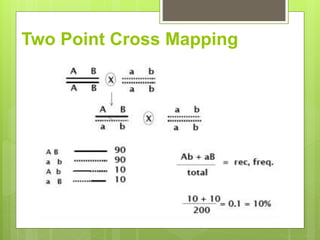
Two Point Cross Mapping
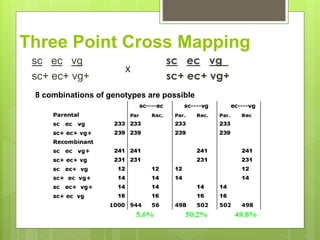
Three Point Cross Mapping
sc ec vg
sc+ ec+ vg+
X
8 combinations of genotypes are possible
Three Point Cross Mapping----2nd
example v cv ct
v+cv ct X
v cv ct
v cv ct
8 combinations of genotypes are possible
Grouping
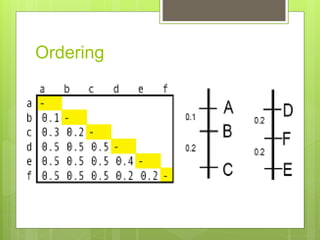
Ordering
Basic issue of QTL analysis
Is there is a statistical relationship between alleles
at markers and plant phenotypes?
If the answer is positive, one tries to determine:
- the number of locus involved,
- their chromosomal location,
- their effects
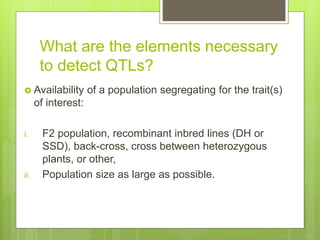
What are the elements necessary
to detect QTLs?
 Availability of a population segregating for the trait(s)
of interest:
i. F2 population, recombinant inbred lines (DH or
SSD), back-cross, cross between heterozygous
plants, or other,
ii. Population size as large as possible.
Populations commonly used in QTL
mapping
 Genotype of all individuals constituting the segregating
population
 For each individual of the population, it is necessary to
know which allele it carries at a set of markers regularly
spaced on the chromosomes
 A good quality genetic map is useful
 5 to 10 cM spacing between markers
 few missing data
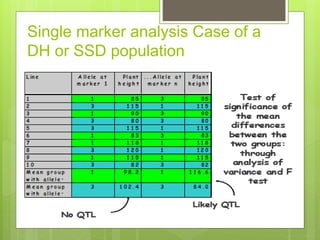
Single marker analysis Case of a
DH or SSD population
New Strategies to map QTL
• Interval Mapping (Maximum likelihood)
(regression) Significance threshold by permutations
• Composite interval mapping
• Simplified composite interval mapping
• Multiple environments
• An integrated approach
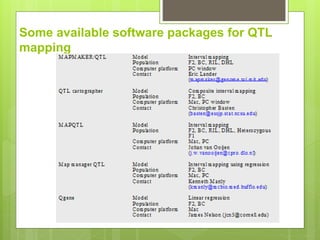
Some available software packages for QTL
mapping
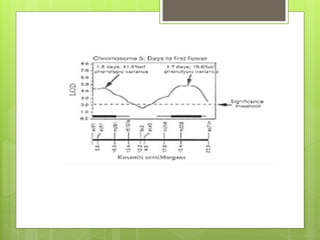
How to describe the QTLs?
Putative QTLs detected for relative root length (RRL)
What is evaluated once a QTL
is detected?
 - QTL position with its confidence interval,
 - its effect (in phenotypic units) for the various
genetic parameters (ex: additivity, dominance)
 - its direction (+/- sign of the effects)
 - the phenotypic variance explained by the
QTL (= r2)
Applications of QTL Mapping
 Marker Assisted Selection
 Traits can easily be transferred into a wide variety of
population
can reduce
 breeding population sizes
 continuous recurrent testing
 time to develop superior variety
 Study of genetic diversity
 Germplasm characterization and conservation

Genetic mapping and qtl detection

  • 1.
  • 2.
    QTL Mapping  Qualitativetraits  Quantitative traits  Genes  Locus/loci  Epistasis  Linkage groups  Markers
  • 3.
  • 4.
    What is aquantitative trait? Discontinuous variation Continuous variation
  • 5.
    QTLs  A quantitativetrait is generally controlled by several genes called QTL (quantitative trait locus).  The observed phenotype is the result of the genotype, the environment and the genotype x environment interactions.
  • 6.
    QTL - QuantitativeTrait Loci  A quantitative trait locus is the location of a gene (or genes) that affects a trait that is measured on aquantitative (linear) scale.  Examples of quantitative traits are plant height (measured on a ruler) and grain yield (measured on a balance).  These traits are typically affected by more than one gene, and also by the environment. Thus, mapping QTL is more complex than mapping a single gene that affects a qualitative trait (such as flower colour).
  • 7.
    Advantage of molecularmarkers on conventional genetics  Molecular markers allow decomposition of quantitative traits into their elementary Mendelian components.  They permit, then, to localize these QTLs in the genome and identify markers tightly linked to these genes in order to
  • 8.
    QTL Mapping  QTLsare identified on the basis of statistical association between the segregation of a phenotypic trait and the segregation of genetic markers.  In principle, any class of markers can be used, but modern breeding programs rely almost exclusively on maps built with DNA markers (RFLPs, RAPDs, SSRs, SNPs) because:  they provide full genome coverage  they are robust, and  they are efficient.
  • 9.
  • 10.
    Three Point CrossMapping sc ec vg sc+ ec+ vg+ X 8 combinations of genotypes are possible
  • 11.
    Three Point CrossMapping----2nd example v cv ct v+cv ct X v cv ct v cv ct 8 combinations of genotypes are possible
  • 12.
  • 13.
  • 14.
    Basic issue ofQTL analysis Is there is a statistical relationship between alleles at markers and plant phenotypes? If the answer is positive, one tries to determine: - the number of locus involved, - their chromosomal location, - their effects
  • 15.
    What are theelements necessary to detect QTLs?  Availability of a population segregating for the trait(s) of interest: i. F2 population, recombinant inbred lines (DH or SSD), back-cross, cross between heterozygous plants, or other, ii. Population size as large as possible.
  • 16.
  • 17.
     Genotype ofall individuals constituting the segregating population  For each individual of the population, it is necessary to know which allele it carries at a set of markers regularly spaced on the chromosomes  A good quality genetic map is useful  5 to 10 cM spacing between markers  few missing data
  • 19.
    Single marker analysisCase of a DH or SSD population
  • 20.
    New Strategies tomap QTL • Interval Mapping (Maximum likelihood) (regression) Significance threshold by permutations • Composite interval mapping • Simplified composite interval mapping • Multiple environments • An integrated approach
  • 21.
    Some available softwarepackages for QTL mapping
  • 23.
    How to describethe QTLs? Putative QTLs detected for relative root length (RRL)
  • 24.
    What is evaluatedonce a QTL is detected?  - QTL position with its confidence interval,  - its effect (in phenotypic units) for the various genetic parameters (ex: additivity, dominance)  - its direction (+/- sign of the effects)  - the phenotypic variance explained by the QTL (= r2)
  • 25.
    Applications of QTLMapping  Marker Assisted Selection  Traits can easily be transferred into a wide variety of population can reduce  breeding population sizes  continuous recurrent testing  time to develop superior variety  Study of genetic diversity  Germplasm characterization and conservation