CONTENT
Central dogma
Discoverer of central dogma
Reason why its called “Central Dogma”
DNA
RNA
Proteins
Functions of proteins
Types of RNA
DNA replication
Protein synthesis
Transcription
Translation
Exceptions to central dogma
Reverse transcription
Reason of reverse transcription as
exception to central dogma
Process of reverse transcription
Prions
Prions as exception to central dogma
Genetic code
Mutation
Types of mutations
Causes of mutation
References
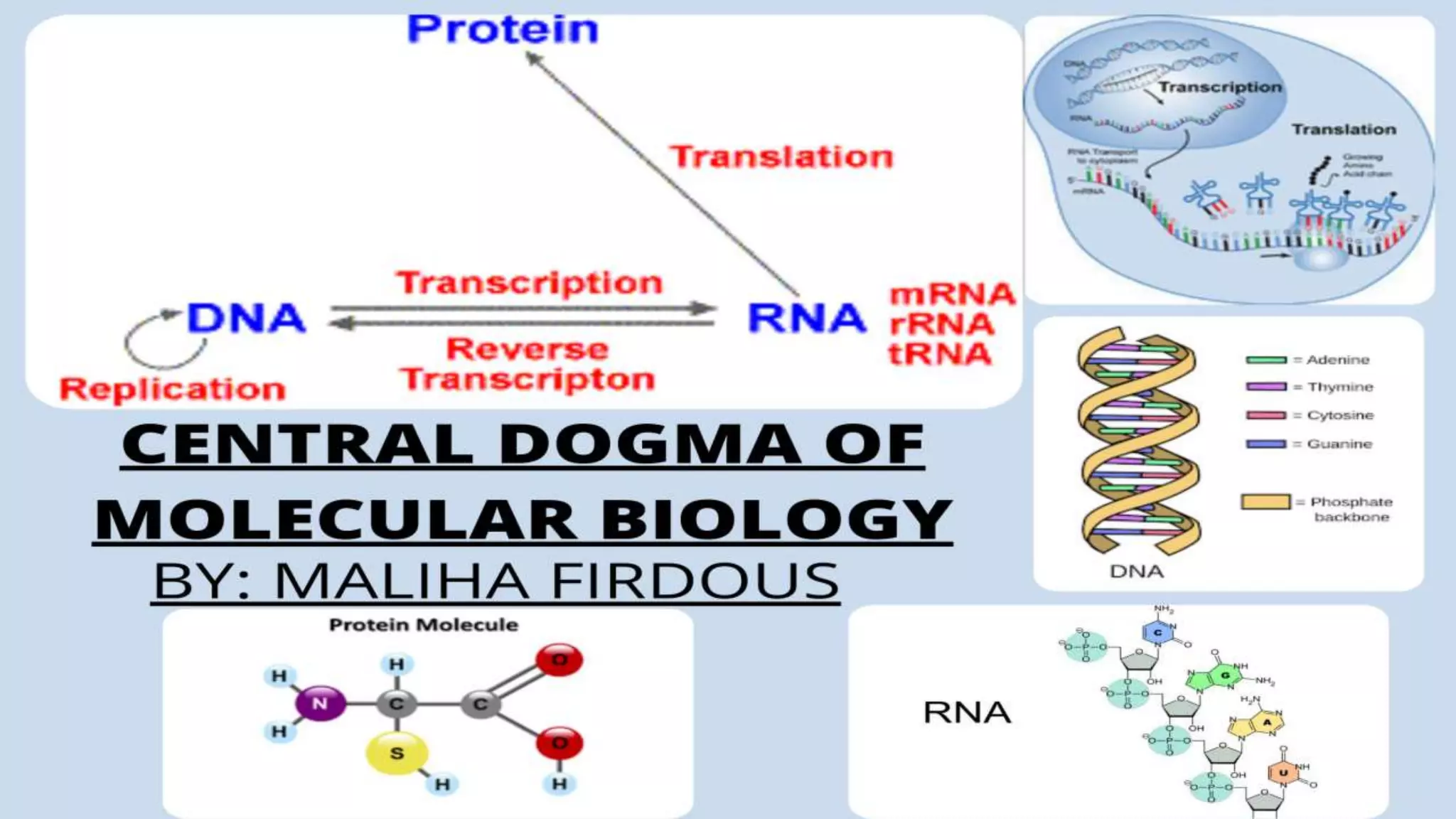
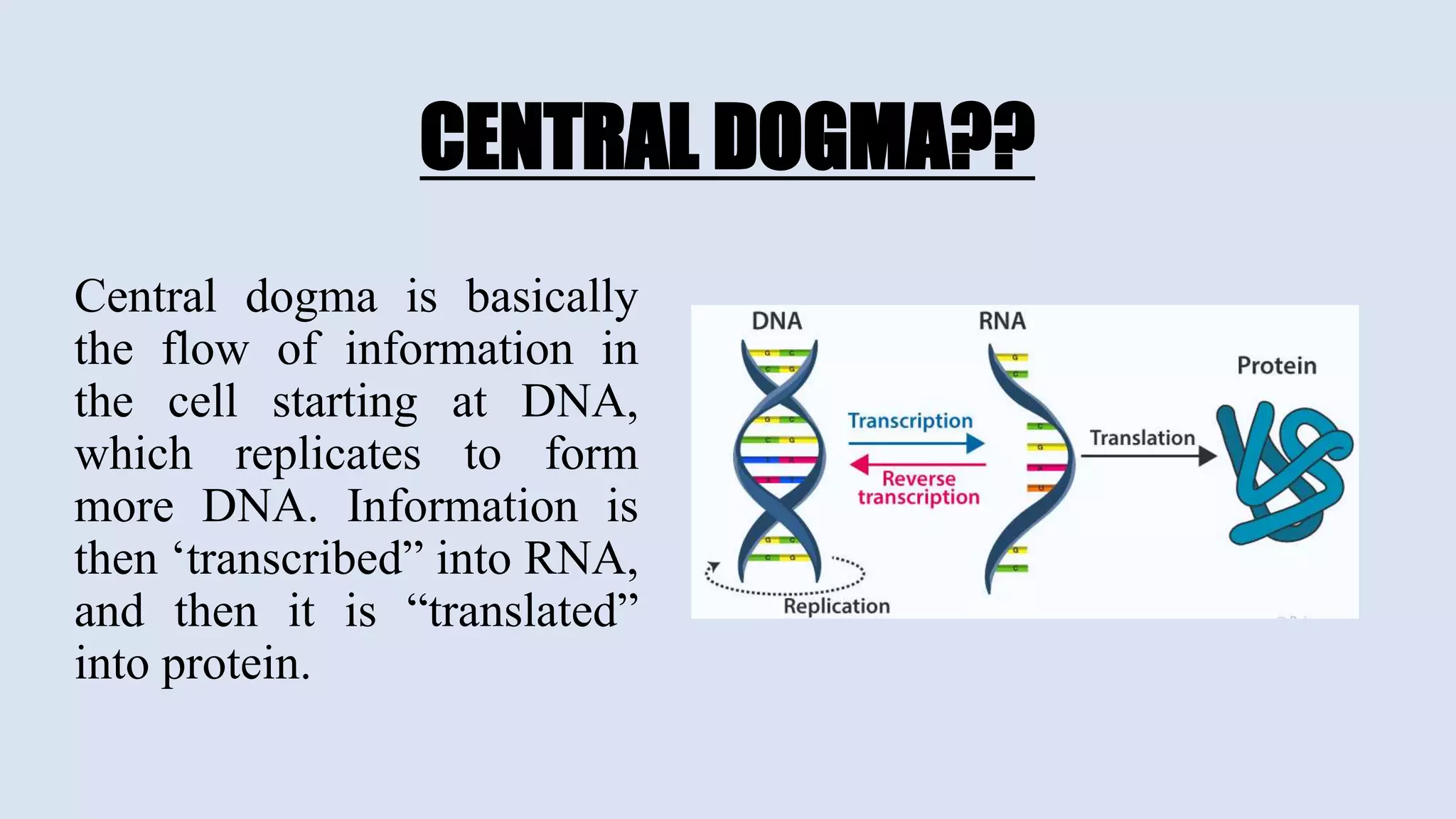
CENTRAL DOGMA??
Central dogma is basically
the flow of information in
the cell starting at DNA,
which replicates to form
more DNA. Information is
then ‘transcribed” into RNA,
and then it is “translated”
into protein.
DICOVERER OF CENTRAL DOGMA
Francis Crick
1958
REASON WHY CRICK CALLED IT
CENTRAL DOGMA
Francis Crick stated;
"I called this idea the central dogma, for two
reasons, I suspect. I had already used the obvious
word hypothesis in the sequence hypothesis, and
in addition I wanted to suggest that this new
assumption was more central and more
powerful."
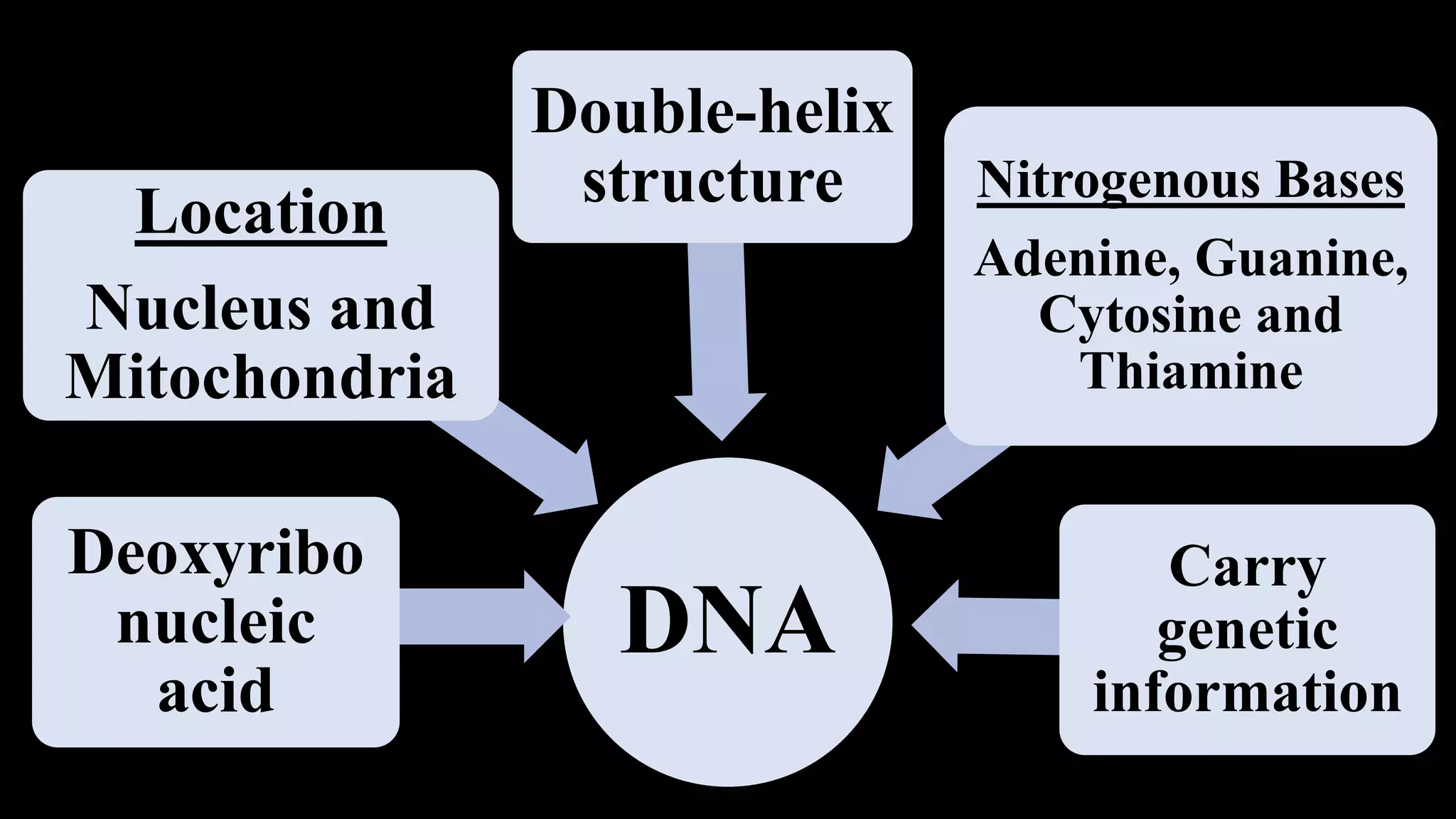
DNA
Deoxyribo
nucleic
acid
Location
Nucleus and
Mitochondria
Double-helix
structure Nitrogenous Bases
Adenine, Guanine,
Cytosine and
Thiamine
Carry
genetic
information
RNARibonucleic
acid
Helps in
Protein synthesis
Single
stranded
Nitrogenous Bases
Adenine, Guanine,
Cytosine and Uracil
Location
Cytoplasm
TYPES OF RNA
PROTEINS
Polymers of
amino acid
Macro-
molecules
Abundant
substance
FUNCTIONS OF
PROTEIN
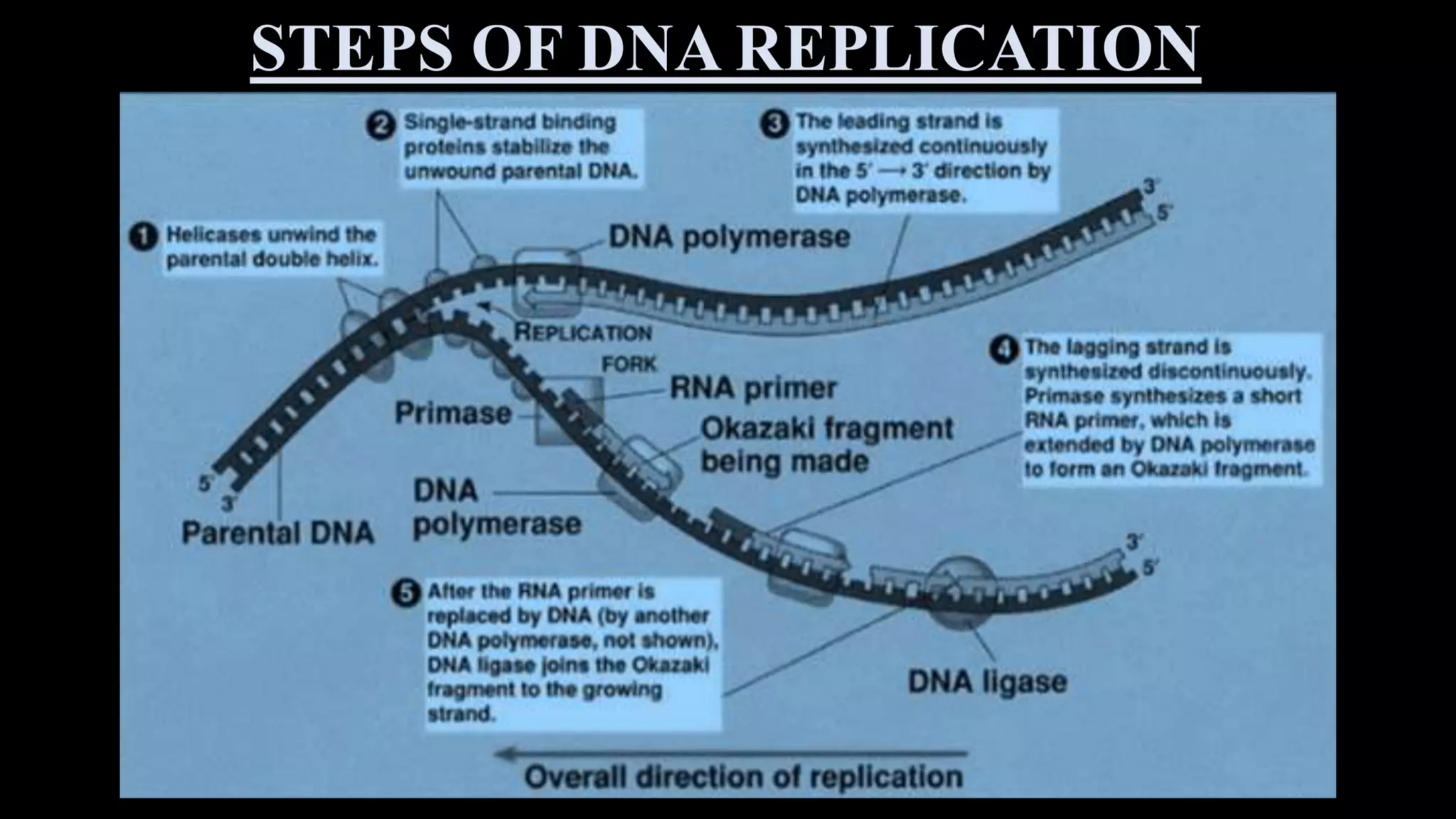
DNA REPLICATION
“It is the process by which DNA makes a copy of itself during cell
division”
PURPOSE:
To produce two identical copies of a DNA molecule
Essential for cell division during growth or repair of damaged
tissues
STEPS OF DNA REPLICATION
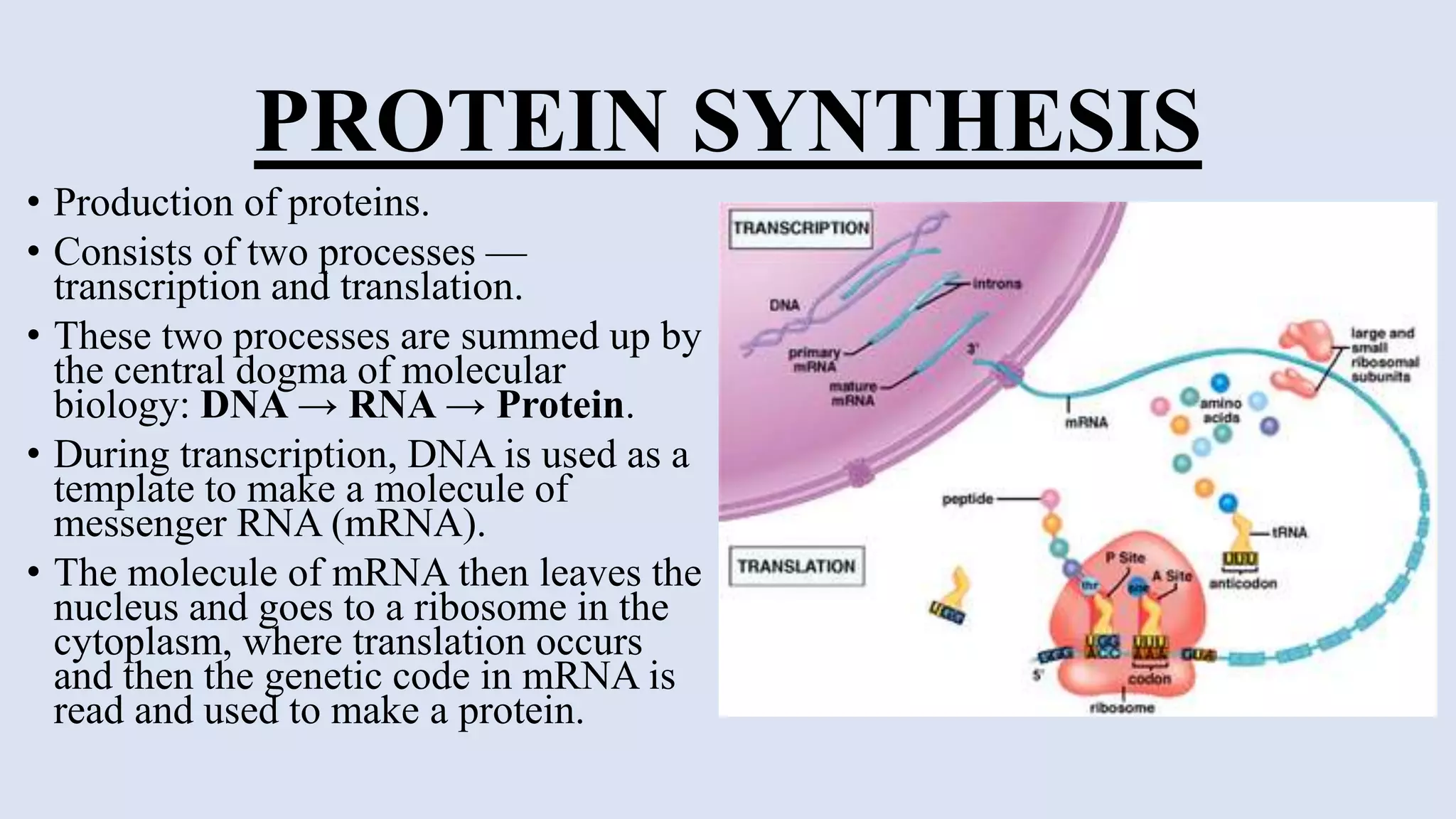
PROTEIN SYNTHESIS
• Production of proteins.
• Consists of two processes —
transcription and translation.
• These two processes are summed up by
the central dogma of molecular
biology: DNA → RNA → Protein.
• During transcription, DNA is used as a
template to make a molecule of
messenger RNA (mRNA).
• The molecule of mRNA then leaves the
nucleus and goes to a ribosome in the
cytoplasm, where translation occurs
and then the genetic code in mRNA is
read and used to make a protein.
TRANSCRIPTION
 Process by which the
information in a strand of
DNA is copied into a new
molecule of messenger
RNA (mRNA).
 Occurs: nucleus
 Transcription is carried out
by:
 An enzyme RNA
polymerase
 Accessory proteins
transcription factors
PROCESS
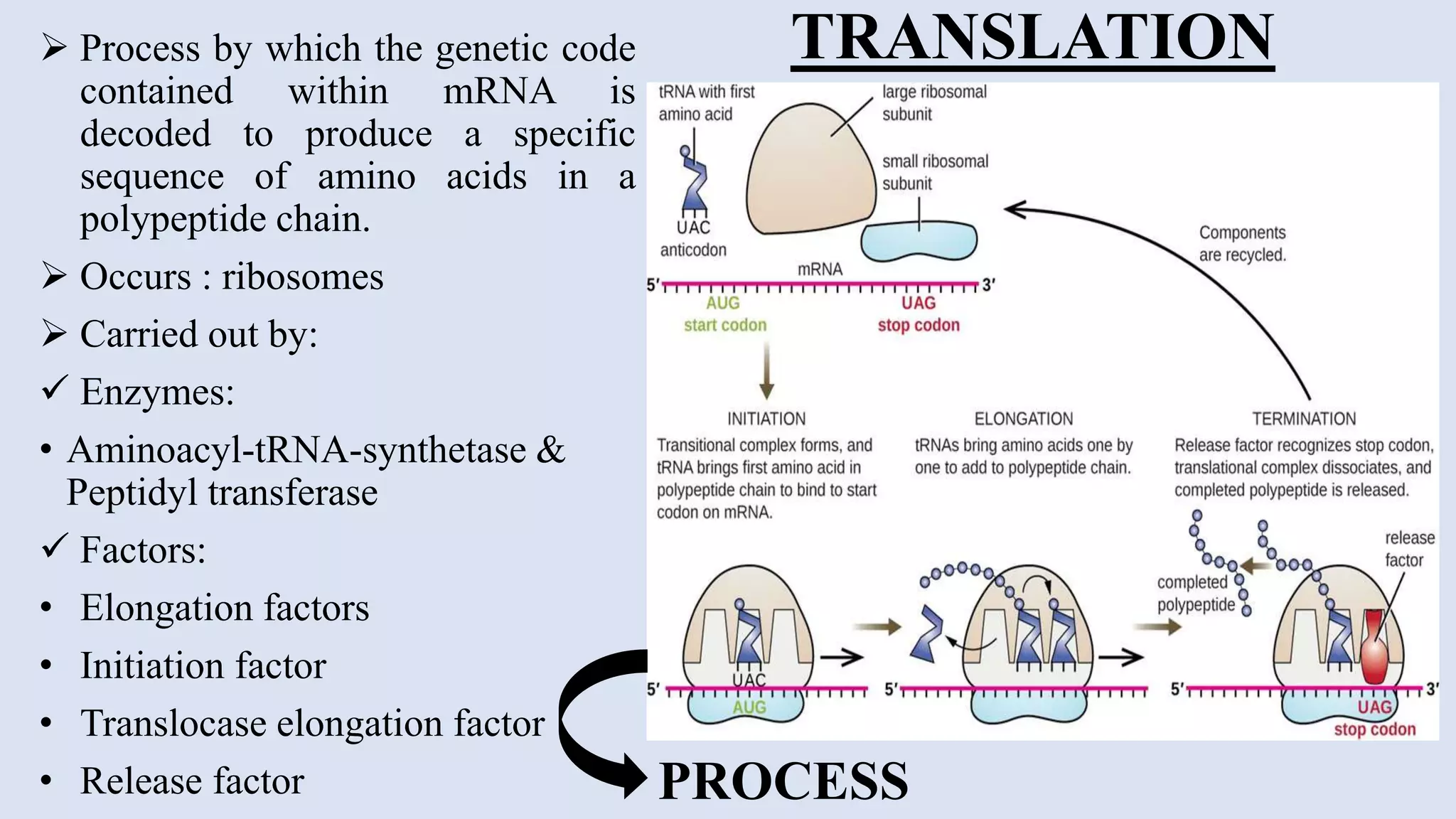
TRANSLATION Process by which the genetic code
contained within mRNA is
decoded to produce a specific
sequence of amino acids in a
polypeptide chain.
 Occurs : ribosomes
 Carried out by:
 Enzymes:
• Aminoacyl-tRNA-synthetase &
Peptidyl transferase
 Factors:
• Elongation factors
• Initiation factor
• Translocase elongation factor
• Release factor PROCESS
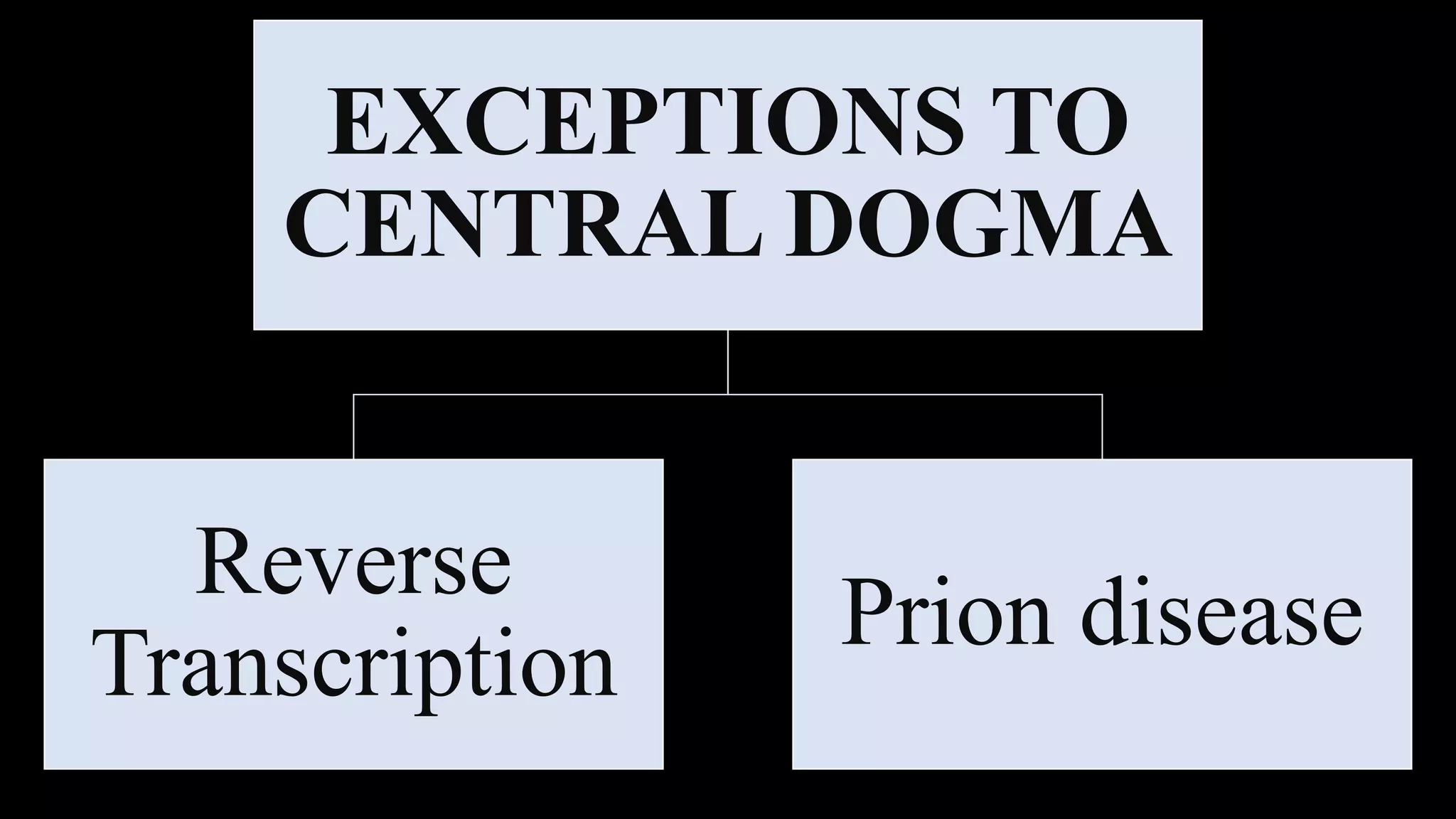
EXCEPTIONS TO
CENTRAL DOGMA
Reverse
Transcription
Prion disease
REVERSE
TRANSCRIPTION
Conversion of RNA
template into its
complementary DNA
strand
Reverse
transcriptase
Discovery of Retroviruses
Transcription of RNA into
DNA by Reverse transcriptase
Primitive virus species that don’t
have developed DNA use only
RNA → proteins
Reverse
transcription as
an exception to
central dogma
(REASON):
PROCESS OF REVERSE TRANSCRIPTION
PRIONS
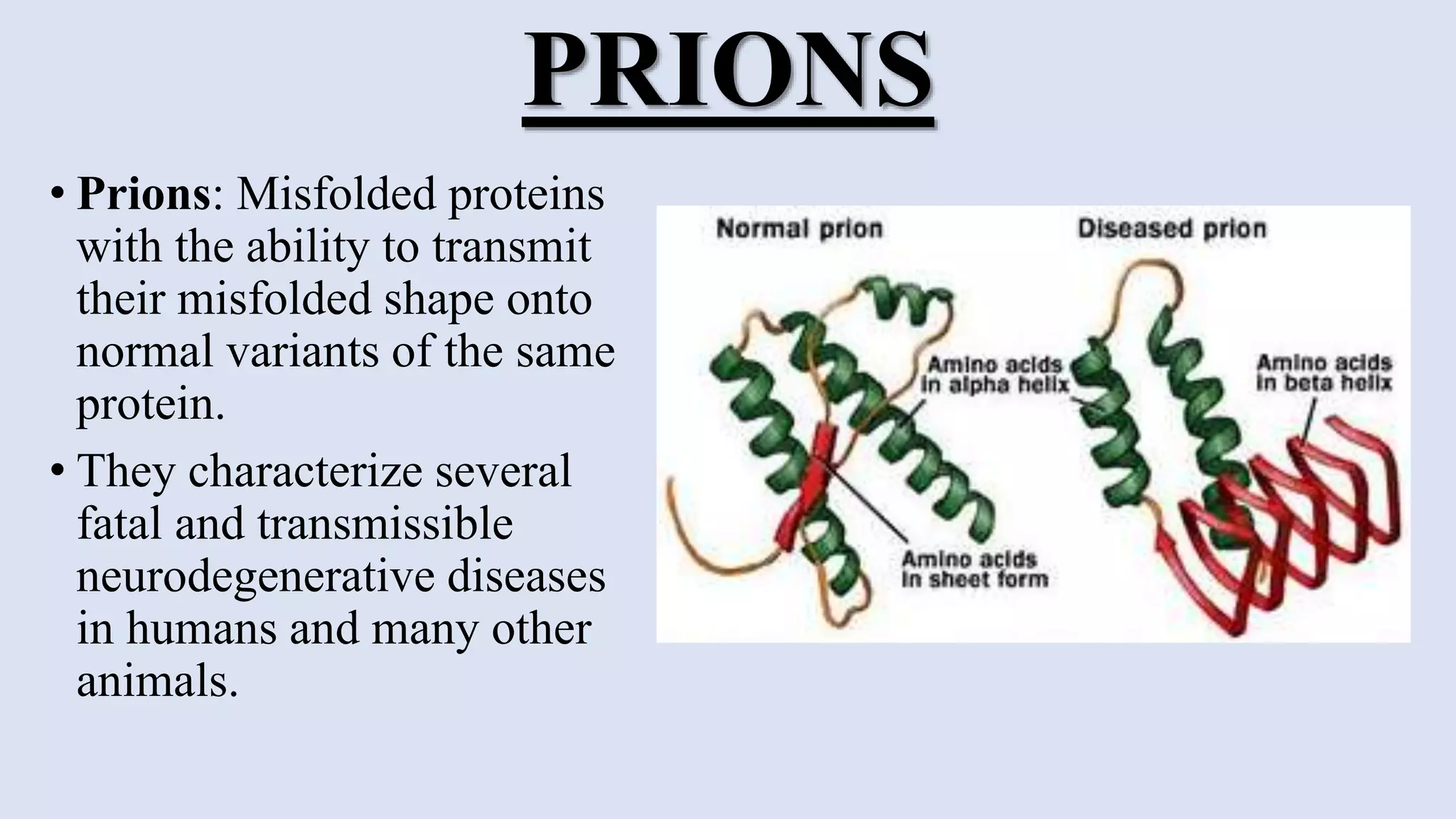
• Prions: Misfolded proteins
with the ability to transmit
their misfolded shape onto
normal variants of the same
protein.
• They characterize several
fatal and transmissible
neurodegenerative diseases
in humans and many other
animals.
PRION AS AN EXCEPTION TO
CENTRAL DOGMA
Prion agent is a self-replicating
protein and this does not fit with
our modern understanding of
proteins. "A self-replicating
protein" is a major violation of the
"Central Dogma", which says that
only nucleic acids can "self-
replicate". These proteins actually
directly replicate themselves by
making conformational changes in
other proteins.
GENETIC
CODE
Genetic information carried by living
cell in a codon
64
codons
TERM:
George Gamow
CODON: Set of 3
Nitrogenous bases
Code for 20
Amino acids
1 Start codon
AUG
3 Stop codons
UAA, UGA,
UAG
MUTATION
Change in nucleotide-sequence
of DNA
OCCUR
Somatic cells and Gametes
Individual with it=Mutant
Factor causing it=Mutagen
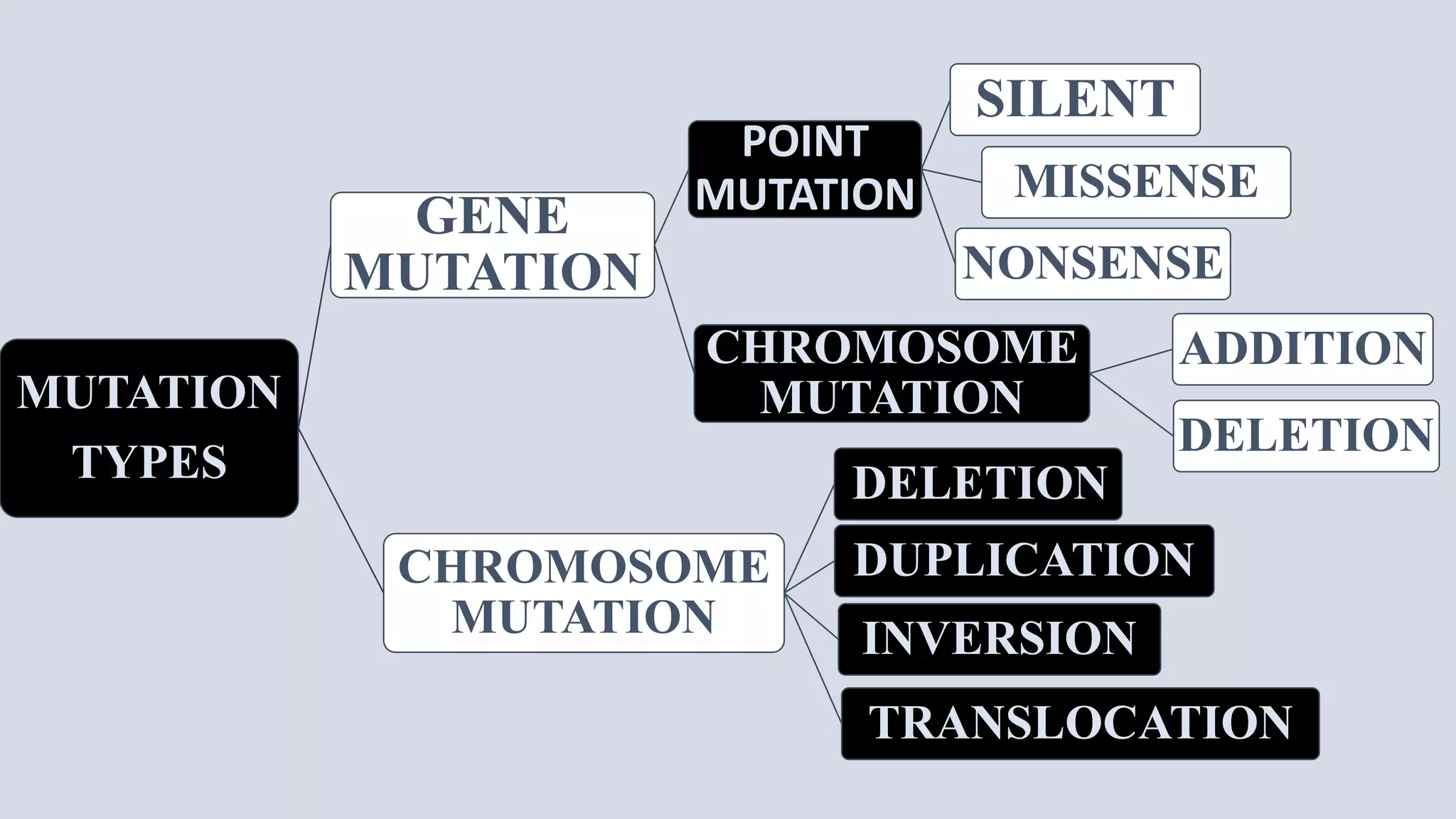
MUTATION
TYPES
GENE
MUTATION
POINT
MUTATION
SILENT
MISSENSE
NONSENSE
CHROMOSOME
MUTATION
ADDITION
DELETION
CHROMOSOME
MUTATION
DELETION
DUPLICATION
INVERSION
TRANSLOCATION
CAUSES
OF
MUTATION
REFERENCES
• https://www.slideshare.net/jackomar/central-dogma-of-molecular-biology-22678177
• https://www.slideshare.net/RISHAVDROLIA/central-dogma-65865947
• https://www.slideshare.net/ijazulhaqrana/central-dogma-of-molecular-biology-130904436
• https://www.slideshare.net/AnilBatta/central-dogma-of-molecular-biology-30829674
• https://socratic.org/questions/what-is-the-enzyme-used-in-translation
• https://www.nature.com/scitable/definition/transcription-dna-transcription-
87/#:~:text=Transcription%20is%20the%20process%20by,as%20a%20reference%2C%20or%20template.
• https://www.sciencedirect.com/topics/biochemistry-genetics-and-molecular-biology/reverse-
transcription#:~:text=Reverse%20transcription%20is%20the%20enzyme,a%20template%20for%20PCR%20amplification.&t
ext=RNA%20template%3A%20RNA%20can%20be,variety%20of%20biological%20sample%20types.
• https://teachmephysiology.com/biochemistry/protein-synthesis/dna-
translation/#:~:text=Translation%20is%20a%20process%20by,%3A%20initiation%2C%20elongation%20and%20termination.
• https://www.google.com/search?q=mutation+causes&rlz=1C1CHBF_enPK824PK824&sxsrf=ALeKk014jS3LIh9GVewa8iKn
EnE6EbxYSA:1606645090929&source=lnms&tbm=isch&sa=X&ved=2ahUKEwik2rKvw6ftAhW0QkEAHZgGA_4Q_AUo
AXoECAYQAw&biw=1280&bih=577
• https://www.google.com/search?q=genetic+code+slideshare&tbm=isch&ved=2ahUKEwj1-KSYxKftAhVgDGMBHXhTAbUQ2-
cCegQIABAA&oq=genetic+code+&gs_lcp=CgNpbWcQARgJMgQIABBDMgQIABBDMgQIABBDMgQIABBDMgQIABBDMgQIABBD
MgQIABBDMgQIABBDMgIIADICCABQgwpYgwpgsRtoAHAAeACAAccBiAHHAZIBAzAuMZgBAKABAaoBC2d3cy13aXotaW1nwAE
B&sclient=img&ei=PnbDX_XhNuCYjLsP-KaFqAs&bih=577&biw=1280&rlz=1C1CHBF_enPK824PK824#imgrc=QoxMcaNrSS7luM
Central dogma of molecular biology

Central dogma of molecular biology

  • 2.
    CONTENT Central dogma Discoverer ofcentral dogma Reason why its called “Central Dogma” DNA RNA Proteins Functions of proteins Types of RNA DNA replication Protein synthesis Transcription Translation Exceptions to central dogma Reverse transcription Reason of reverse transcription as exception to central dogma Process of reverse transcription Prions Prions as exception to central dogma Genetic code Mutation Types of mutations Causes of mutation References
  • 3.
    CENTRAL DOGMA?? Central dogmais basically the flow of information in the cell starting at DNA, which replicates to form more DNA. Information is then ‘transcribed” into RNA, and then it is “translated” into protein.
  • 4.
    DICOVERER OF CENTRALDOGMA Francis Crick 1958
  • 5.
    REASON WHY CRICKCALLED IT CENTRAL DOGMA Francis Crick stated; "I called this idea the central dogma, for two reasons, I suspect. I had already used the obvious word hypothesis in the sequence hypothesis, and in addition I wanted to suggest that this new assumption was more central and more powerful."
  • 6.
    DNA Deoxyribo nucleic acid Location Nucleus and Mitochondria Double-helix structure NitrogenousBases Adenine, Guanine, Cytosine and Thiamine Carry genetic information
  • 8.
    RNARibonucleic acid Helps in Protein synthesis Single stranded NitrogenousBases Adenine, Guanine, Cytosine and Uracil Location Cytoplasm
  • 10.
  • 12.
  • 13.
  • 14.
    DNA REPLICATION “It isthe process by which DNA makes a copy of itself during cell division” PURPOSE: To produce two identical copies of a DNA molecule Essential for cell division during growth or repair of damaged tissues
  • 15.
    STEPS OF DNAREPLICATION
  • 16.
    PROTEIN SYNTHESIS • Productionof proteins. • Consists of two processes — transcription and translation. • These two processes are summed up by the central dogma of molecular biology: DNA → RNA → Protein. • During transcription, DNA is used as a template to make a molecule of messenger RNA (mRNA). • The molecule of mRNA then leaves the nucleus and goes to a ribosome in the cytoplasm, where translation occurs and then the genetic code in mRNA is read and used to make a protein.
  • 17.
    TRANSCRIPTION  Process bywhich the information in a strand of DNA is copied into a new molecule of messenger RNA (mRNA).  Occurs: nucleus  Transcription is carried out by:  An enzyme RNA polymerase  Accessory proteins transcription factors PROCESS
  • 18.
    TRANSLATION Process bywhich the genetic code contained within mRNA is decoded to produce a specific sequence of amino acids in a polypeptide chain.  Occurs : ribosomes  Carried out by:  Enzymes: • Aminoacyl-tRNA-synthetase & Peptidyl transferase  Factors: • Elongation factors • Initiation factor • Translocase elongation factor • Release factor PROCESS
  • 19.
  • 20.
    REVERSE TRANSCRIPTION Conversion of RNA templateinto its complementary DNA strand Reverse transcriptase
  • 21.
    Discovery of Retroviruses Transcriptionof RNA into DNA by Reverse transcriptase Primitive virus species that don’t have developed DNA use only RNA → proteins Reverse transcription as an exception to central dogma (REASON):
  • 22.
    PROCESS OF REVERSETRANSCRIPTION
  • 23.
    PRIONS • Prions: Misfoldedproteins with the ability to transmit their misfolded shape onto normal variants of the same protein. • They characterize several fatal and transmissible neurodegenerative diseases in humans and many other animals.
  • 24.
    PRION AS ANEXCEPTION TO CENTRAL DOGMA Prion agent is a self-replicating protein and this does not fit with our modern understanding of proteins. "A self-replicating protein" is a major violation of the "Central Dogma", which says that only nucleic acids can "self- replicate". These proteins actually directly replicate themselves by making conformational changes in other proteins.
  • 25.
    GENETIC CODE Genetic information carriedby living cell in a codon 64 codons TERM: George Gamow CODON: Set of 3 Nitrogenous bases Code for 20 Amino acids 1 Start codon AUG 3 Stop codons UAA, UGA, UAG
  • 27.
    MUTATION Change in nucleotide-sequence ofDNA OCCUR Somatic cells and Gametes Individual with it=Mutant Factor causing it=Mutagen
  • 28.
  • 29.
  • 30.
    REFERENCES • https://www.slideshare.net/jackomar/central-dogma-of-molecular-biology-22678177 • https://www.slideshare.net/RISHAVDROLIA/central-dogma-65865947 •https://www.slideshare.net/ijazulhaqrana/central-dogma-of-molecular-biology-130904436 • https://www.slideshare.net/AnilBatta/central-dogma-of-molecular-biology-30829674 • https://socratic.org/questions/what-is-the-enzyme-used-in-translation • https://www.nature.com/scitable/definition/transcription-dna-transcription- 87/#:~:text=Transcription%20is%20the%20process%20by,as%20a%20reference%2C%20or%20template. • https://www.sciencedirect.com/topics/biochemistry-genetics-and-molecular-biology/reverse- transcription#:~:text=Reverse%20transcription%20is%20the%20enzyme,a%20template%20for%20PCR%20amplification.&t ext=RNA%20template%3A%20RNA%20can%20be,variety%20of%20biological%20sample%20types. • https://teachmephysiology.com/biochemistry/protein-synthesis/dna- translation/#:~:text=Translation%20is%20a%20process%20by,%3A%20initiation%2C%20elongation%20and%20termination. • https://www.google.com/search?q=mutation+causes&rlz=1C1CHBF_enPK824PK824&sxsrf=ALeKk014jS3LIh9GVewa8iKn EnE6EbxYSA:1606645090929&source=lnms&tbm=isch&sa=X&ved=2ahUKEwik2rKvw6ftAhW0QkEAHZgGA_4Q_AUo AXoECAYQAw&biw=1280&bih=577 • https://www.google.com/search?q=genetic+code+slideshare&tbm=isch&ved=2ahUKEwj1-KSYxKftAhVgDGMBHXhTAbUQ2- cCegQIABAA&oq=genetic+code+&gs_lcp=CgNpbWcQARgJMgQIABBDMgQIABBDMgQIABBDMgQIABBDMgQIABBDMgQIABBD MgQIABBDMgQIABBDMgIIADICCABQgwpYgwpgsRtoAHAAeACAAccBiAHHAZIBAzAuMZgBAKABAaoBC2d3cy13aXotaW1nwAE B&sclient=img&ei=PnbDX_XhNuCYjLsP-KaFqAs&bih=577&biw=1280&rlz=1C1CHBF_enPK824PK824#imgrc=QoxMcaNrSS7luM