TOOLS USED IN GENETIC ENGINEERING
Genes under engineering
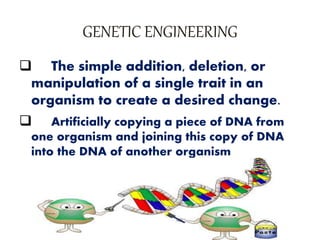
GENETIC ENGINEERING
 The simple addition, deletion, or
manipulation of a single trait in an
organism to create a desired change.
 Artificially copying a piece of DNA from
one organism and joining this copy of DNA
into the DNA of another organism
ENZYMES
• RESTRICTION ENDONUCLEASES
• DNA LIGASES
• ALKALINE PHOSPHATASE
• POLYMERASES
Restriction Enzymes
 Enzymes that recognize a specific base
sequence in DNA and cleave at that site
 Isolated from bacteria that leaves
phosphate group on 5’ end & OH group
on the 3’ end
 “Molecular scissors”
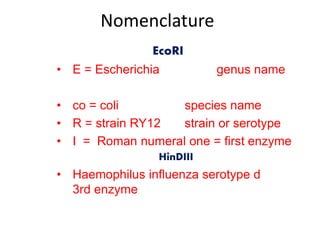
Nomenclature
EcoRI
• E = Escherichia genus name
• co = coli species name
• R = strain RY12 strain or serotype
• I = Roman numeral one = first enzyme
HinDIII
• Haemophilus influenza serotype d
3rd enzyme
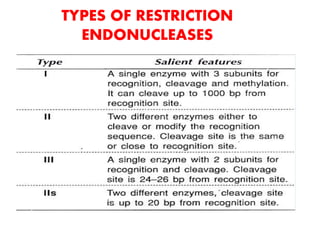
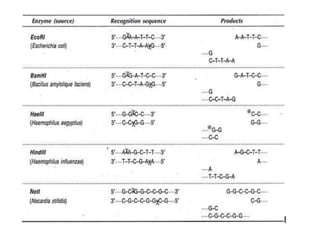
TYPES OF RESTRICTION
ENDONUCLEASES
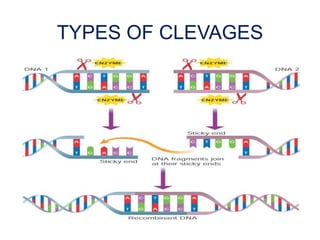
TYPES OF CLEVAGES
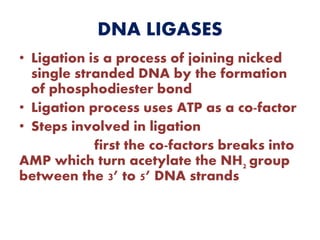
DNA LIGASES
• Ligation is a process of joining nicked
single stranded DNA by the formation
of phosphodiester bond
• Ligation process uses ATP as a co-factor
• Steps involved in ligation
first the co-factors breaks into
AMP which turn acetylate the NH2 group
between the 3’ to 5’ DNA strands
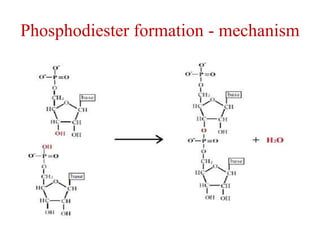
Phosphodiester formation - mechanism
ALKALINE PHOSPHATASE
• Alkaline phosphatase is an enzyme involved
in the removal phosphate groups
• This enzyme is useful to prevent unwanted
ligation of DNA molecules which is a
frequent problem encountered by cloning
experiments
POLYMERASES
• The group of enzymes that catalyse the
synthesis of nucleic acid molecules are
collectively referred to as polymerases
• DNA dependent DNA polymerase that
copies of DNA from RNA
• RNA dependent DNA polymerase (reverse
transcriptase) that synthesis DNA from RNA
• DNA dependent RNA polymerase that
produces RNA from DNA
VECTORS
Allowing the exogenous DNA to
be inserted, stored, and
manipulated mainly at DNA level
• Plasmid vectors
• Bacteriophage vectors
• Cosmids
• BACs & YACs
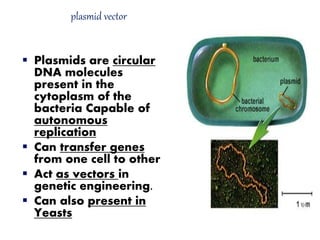
plasmid vector
 Plasmids are circular
DNA molecules
present in the
cytoplasm of the
bacteria Capable of
autonomous
replication
 Can transfer genes
from one cell to other
 Act as vectors in
genetic engineering.
 Can also present in
Yeasts
Plasmid vectors
Plasmid vectors are double-stranded,
circular, self-replicating, extra-chromosomal DNA
molecules.
• Advantages:
– Small, easy to handle
– Straightforward selection strategies
– Useful for cloning small DNA fragments
(< 10kbp)
• Disadvantages:
– Less useful for cloning large DNA fragments
(> 10kbp)
Bacteriophage vectors
Bacteriophages or phages are the viruses that
replicate within the bacteria
Phage vectors can accept short fragments of
foreign DNA into their genome
Bacteriophage
bacteriophage lambda is virus of E.coli, has
been most thoroughly studied and developed as a
vector
Phage M13 vectors
Phage M13 (bacteriophage M13) is a single
stranded DNA phage of E.coli
Inside the host cell,M13 synthesizes the
complementary strand to form a double
stranded DNA
If M13 used as a cloning vector replicative
form of DNA is isolated and foreign DNA can
be inserted on it
COSMIDS
Cosmids are the vectors possessing the
characteristics of both plasmid and
bacteriophage lambda
Recombinant cosmid is injected into the
bacterial cell where the cosmid arranges into a
circle and replicates as a plasmid. It can be
maintained and recovered just as plasmids.
Bacterial artificial chromosome(BAC)
• BACs can hold up to 300 kbs
• The F factor of E.coli is capable of handling
large segments of DNA.
• Recombinant BACs are introduced into E.coli by
electroporation ( a brief high-voltage current).
Once in the cell, the rBAC replicates like an F
factor
Example: Pbac108
• A chloramphenicol resistance gene, and a
cloning segment.
Yeast artificial chromosome(YAC)
 YACs can hold up to 500 kbs.
 YACs are designed to replicate as plasmids in
bacteria when no foreign DNA is present. Once a
fragment is inserted, YACs are transferred to cells,
they then replicate as eukaryotic chromosomes.
 DNA is inserted to a unique restriction site, and
cleaves the plasmid with another restriction
endonuclease that removes a fragment of DNA and
causes the YAC to become linear. Once in the cell, the
rYAC replicates as a chromosome, also replicating the
foreign DNA.
THANK YOU

Tools used in genetic engineering

  • 1.
    TOOLS USED INGENETIC ENGINEERING Genes under engineering
  • 2.
    GENETIC ENGINEERING  Thesimple addition, deletion, or manipulation of a single trait in an organism to create a desired change.  Artificially copying a piece of DNA from one organism and joining this copy of DNA into the DNA of another organism
  • 3.
    ENZYMES • RESTRICTION ENDONUCLEASES •DNA LIGASES • ALKALINE PHOSPHATASE • POLYMERASES
  • 4.
    Restriction Enzymes  Enzymesthat recognize a specific base sequence in DNA and cleave at that site  Isolated from bacteria that leaves phosphate group on 5’ end & OH group on the 3’ end  “Molecular scissors”
  • 5.
    Nomenclature EcoRI • E =Escherichia genus name • co = coli species name • R = strain RY12 strain or serotype • I = Roman numeral one = first enzyme HinDIII • Haemophilus influenza serotype d 3rd enzyme
  • 6.
  • 7.
  • 9.
    DNA LIGASES • Ligationis a process of joining nicked single stranded DNA by the formation of phosphodiester bond • Ligation process uses ATP as a co-factor • Steps involved in ligation first the co-factors breaks into AMP which turn acetylate the NH2 group between the 3’ to 5’ DNA strands
  • 10.
  • 11.
    ALKALINE PHOSPHATASE • Alkalinephosphatase is an enzyme involved in the removal phosphate groups • This enzyme is useful to prevent unwanted ligation of DNA molecules which is a frequent problem encountered by cloning experiments
  • 12.
    POLYMERASES • The groupof enzymes that catalyse the synthesis of nucleic acid molecules are collectively referred to as polymerases • DNA dependent DNA polymerase that copies of DNA from RNA • RNA dependent DNA polymerase (reverse transcriptase) that synthesis DNA from RNA • DNA dependent RNA polymerase that produces RNA from DNA
  • 13.
    VECTORS Allowing the exogenousDNA to be inserted, stored, and manipulated mainly at DNA level • Plasmid vectors • Bacteriophage vectors • Cosmids • BACs & YACs
  • 14.
    plasmid vector  Plasmidsare circular DNA molecules present in the cytoplasm of the bacteria Capable of autonomous replication  Can transfer genes from one cell to other  Act as vectors in genetic engineering.  Can also present in Yeasts
  • 15.
    Plasmid vectors Plasmid vectorsare double-stranded, circular, self-replicating, extra-chromosomal DNA molecules. • Advantages: – Small, easy to handle – Straightforward selection strategies – Useful for cloning small DNA fragments (< 10kbp) • Disadvantages: – Less useful for cloning large DNA fragments (> 10kbp)
  • 16.
    Bacteriophage vectors Bacteriophages orphages are the viruses that replicate within the bacteria Phage vectors can accept short fragments of foreign DNA into their genome Bacteriophage bacteriophage lambda is virus of E.coli, has been most thoroughly studied and developed as a vector
  • 17.
    Phage M13 vectors PhageM13 (bacteriophage M13) is a single stranded DNA phage of E.coli Inside the host cell,M13 synthesizes the complementary strand to form a double stranded DNA If M13 used as a cloning vector replicative form of DNA is isolated and foreign DNA can be inserted on it
  • 18.
    COSMIDS Cosmids are thevectors possessing the characteristics of both plasmid and bacteriophage lambda Recombinant cosmid is injected into the bacterial cell where the cosmid arranges into a circle and replicates as a plasmid. It can be maintained and recovered just as plasmids.
  • 19.
    Bacterial artificial chromosome(BAC) •BACs can hold up to 300 kbs • The F factor of E.coli is capable of handling large segments of DNA. • Recombinant BACs are introduced into E.coli by electroporation ( a brief high-voltage current). Once in the cell, the rBAC replicates like an F factor Example: Pbac108 • A chloramphenicol resistance gene, and a cloning segment.
  • 20.
    Yeast artificial chromosome(YAC) YACs can hold up to 500 kbs.  YACs are designed to replicate as plasmids in bacteria when no foreign DNA is present. Once a fragment is inserted, YACs are transferred to cells, they then replicate as eukaryotic chromosomes.  DNA is inserted to a unique restriction site, and cleaves the plasmid with another restriction endonuclease that removes a fragment of DNA and causes the YAC to become linear. Once in the cell, the rYAC replicates as a chromosome, also replicating the foreign DNA.
  • 21.