06/19/131
DNA AS GENETIC
MATERIAL
BY
Dr. Ichha Purak
University Professor
Department of Botany
Ranchi Women’s College,Ranchi
http://www.dripurak.com/
It is well known fact that transmission of traits takes place from
one generation to other. The offsprings are similar to both the
parents in some traits
Gregor Johann Mendel (1866 ) on the basis of his hybridization
experiments on Sweet pea gave the idea that transmission of
traits over generations take place through Factor or Determiner
or Gene which carries information for expression of trait or
phenotype.
Genes are present on the chromosomes which are distributed
equally into the two daughter cells during cell division. The
biochemical studies reveal that chromosomes are composed of
proteins (60% ) and DNA (40% )
06/19/132
Genetic material must be capable of
• Replication ( Make its copy )
• Storage of information for expression of trait
• Control expression of traits
• Change in controlled way (undergo mutation)
• Must be stable
06/19/133
Topic of Discussion till 1944 was which chromosomal
component DNA or Protein carries hereditary information
or is the genetic material
Untill 1940 Proteins were considered as genetic material
as Proteins are polymer of 20 protein amino acids and
present in larger quantity, encode more and variety of
information.
DNA is polymer of only 4 different deoxyribonucleotides
(ATP, CTP, GTP & TTP) and is present in smaller quantity
Most geneticists focused on “transmission genetics” and
passively accepted proteins as the genetic material
06/19/134
Is the Genetic Material Protein or DNA
But On the basis of certain experiments conducted from time to
time ,it was ultimately demonstrated that DNA carries genetic
information and not the proteins
There are some direct evidences and some indirect evidences
which prove DNA as Genetic Material
06/19/135
Direct evidences come from :
• Frederick Griffith’s (1928) experiment on Bacterial
Transformation
• Oswald Avery, Colin Macleod and Maclyn McCarty’s
(1944 ) experiment on Transformation
• Alfred D. Hershey and Martha Chase (1952 )
experiment on T- Even (2,4 ) Bacteriophage
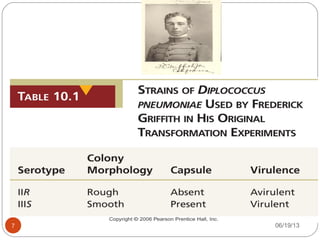
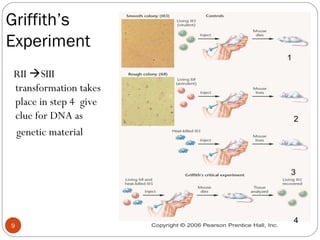
Frederick Griffith (1928) Studied Diplococcus
pneumoniae, having Two strains
SIII strain was virulent, possessed a lipopolysaccharide
capsule and could kill mice by causing disease Pneumonia
and made round colonies on a culture plate
RII strain was avirulent and lacked a Lipopolysaccharide
(LPS) capsule, growing in rough–shaped colonies on a
culture plate
06/19/136
06/19/137
06/19/138
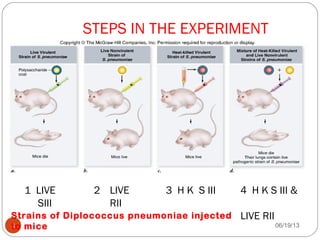
STEPS IN THE EXPERIMENT
1 LIVE
SIII
2 LIVE
RII
3 H K S III 4 H K S III &
LIVE RIIStrains of Diplococcus pneumoniae injected
to mice
Griffith’s
Experiment
06/19/139
RII SIII
transformation takes
place in step 4 give
clue for DNA as
genetic material
1
2
3
4
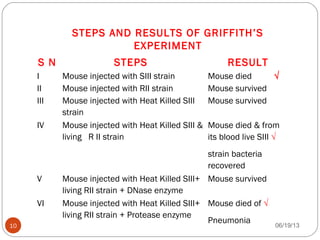
S N STEPS RESULT
I Mouse injected with SIII strain Mouse died √
II Mouse injected with RII strain Mouse survived
III Mouse injected with Heat Killed SIII
strain
Mouse survived
IV Mouse injected with Heat Killed SIII &
living R II strain
Mouse died & from
its blood live SIII √
strain bacteria
recovered
V Mouse injected with Heat Killed SIII+
living RII strain + DNase enzyme
Mouse survived
VI Mouse injected with Heat Killed SIII+
living RII strain + Protease enzyme
Mouse died of √
Pneumonia
STEPS AND RESULTS OF GRIFFITH’S
EXPERIMENT
06/19/1310
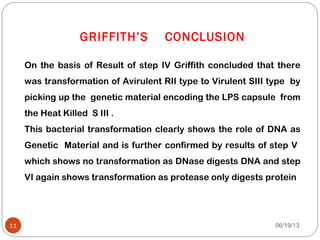
GRIFFITH’S CONCLUSION
On the basis of Result of step IV Griffith concluded that there
was transformation of Avirulent RII type to Virulent SIII type by
picking up the genetic material encoding the LPS capsule from
the Heat Killed S III .
This bacterial transformation clearly shows the role of DNA as
Genetic Material and is further confirmed by results of step V
which shows no transformation as DNase digests DNA and step
VI again shows transformation as protease only digests protein
06/19/1311
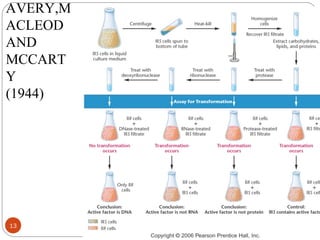
Avery, MacLeod, & McCarty, 1944 repeated Griffith’s
experiment of transformation using purified cell extracts and
concluded
Removal of all protein from the transforming material did not
destroy its ability to transform R strain cells
DNA-digesting enzymes destroyed all transforming ability
The transforming material is DNA
06/19/1312
AVERY,M
ACLEOD
AND
MCCART
Y
(1944)
06/19/1313
06/19/1314
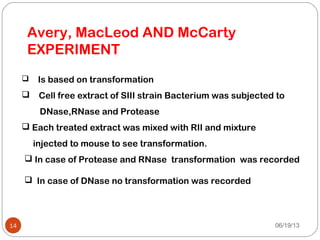
Avery, MacLeod AND McCarty
EXPERIMENT
 Is based on transformation
 Cell free extract of SIII strain Bacterium was subjected to
DNase,RNase and Protease
 Each treated extract was mixed with RII and mixture
injected to mouse to see transformation.
 In case of Protease and RNase transformation was recorded
 In case of DNase no transformation was recorded
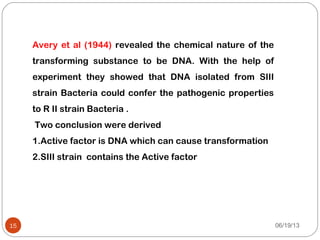
Avery et al (1944) revealed the chemical nature of the
transforming substance to be DNA. With the help of
experiment they showed that DNA isolated from SIII
strain Bacteria could confer the pathogenic properties
to R II strain Bacteria .
Two conclusion were derived
1.Active factor is DNA which can cause transformation
2.SIII strain contains the Active factor
06/19/1315
06/19/1316
Hershey AND Chase Experiment
Alfred Hershey and Martha Chase, 1952 investigated
bacteriophages: viruses that infect bacteria
- the bacteriophage was composed of only DNA and protein
- they wanted to determine which of these molecules is the
genetic material that enters into the bacteria
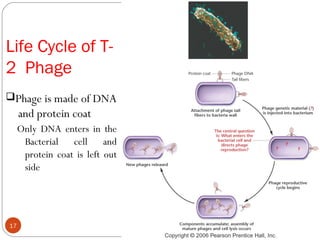
Life Cycle of T-
2 Phage
Phage is made of DNA
and protein coat
Only DNA enters in the
Bacterial cell and
protein coat is left out
side
06/19/1317
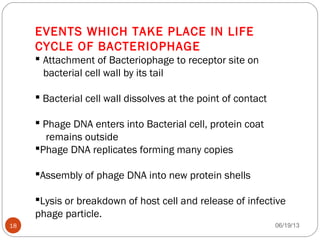
EVENTS WHICH TAKE PLACE IN LIFE
CYCLE OF BACTERIOPHAGE
 Attachment of Bacteriophage to receptor site on
bacterial cell wall by its tail
 Bacterial cell wall dissolves at the point of contact
 Phage DNA enters into Bacterial cell, protein coat
remains outside
Phage DNA replicates forming many copies
Assembly of phage DNA into new protein shells
Lysis or breakdown of host cell and release of infective
phage particle.
06/19/1318
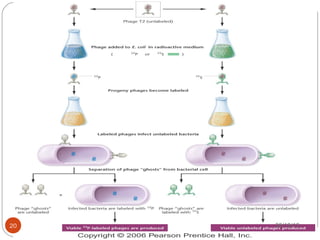
HERSHEY & CHASE (1952) EXPERIMENT WITH T2
BACTERIOPHAGE
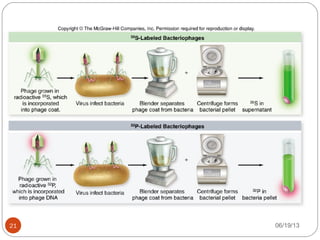
In culture I Bacteriophage was grown in medium containing Radioactive
Phosphorus (32
P))To make DNA Radioactive
In culture II Bacteriophage was grown in medium containing radioactive
Sulphur (35
S) To make proteins Radioactive
Both kinds of Bacteriophage particles were allowed to infect Bacteria
The infected bacteria were observed for radioactivity
Radioactive Phosphorus was found with bacterial cells
Radioactive Sulphur was not traced in bacterial cells ( Only in Ghosts)
Bacteriophage progeny carried only radioactive phosphorus and not radioactive
sulphur
06/19/1319
06/19/1320
06/19/1321
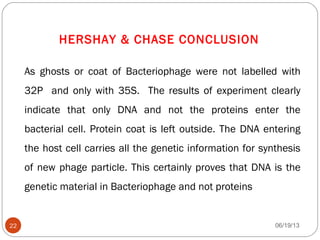
HERSHAY & CHASE CONCLUSION
As ghosts or coat of Bacteriophage were not labelled with
32P and only with 35S. The results of experiment clearly
indicate that only DNA and not the proteins enter the
bacterial cell. Protein coat is left outside. The DNA entering
the host cell carries all the genetic information for synthesis
of new phage particle. This certainly proves that DNA is the
genetic material in Bacteriophage and not proteins
06/19/1322
06/19/1323
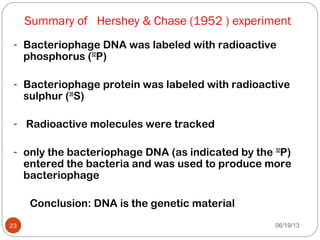
- Bacteriophage DNA was labeled with radioactive
phosphorus (32
P)
- Bacteriophage protein was labeled with radioactive
sulphur (35
S)
- Radioactive molecules were tracked
- only the bacteriophage DNA (as indicated by the 32
P)
entered the bacteria and was used to produce more
bacteriophage
Conclusion: DNA is the genetic material
Summary of Hershey & Chase (1952 ) experiment
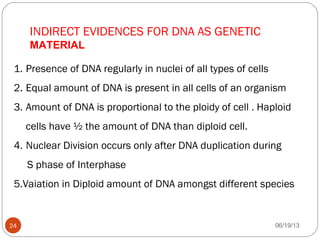
INDIRECT EVIDENCES FOR DNA AS GENETIC
MATERIAL
1. Presence of DNA regularly in nuclei of all types of cells
2. Equal amount of DNA is present in all cells of an organism
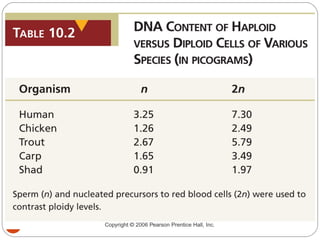
3. Amount of DNA is proportional to the ploidy of cell . Haploid
cells have ½ the amount of DNA than diploid cell.
4. Nuclear Division occurs only after DNA duplication during
S phase of Interphase
5.Vaiation in Diploid amount of DNA amongst different species
06/19/1324
6. DNA has same physical and chemical properties in
all organisms yet allow to produce great diversity of
organisms
7. Indefinite number of combinations are possible
with four bases A T G C
8. Of all macromolecules DNA is metabolically most
stable
9. In prokaryotes DNA is not linked with proteins still
characters are inherited
06/19/1325
06/19/1326
SOME ORGANISMS HAVE RNA AS GENETIC
MATERIAL
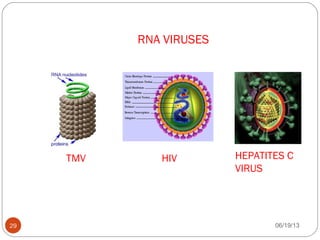
Some Viruses have RNA as Genetic Material
RNA Virus ( Ribo Virus ) may have ssRNA or dsRNA
enveloped by Protein Coat
Notable human diseases caused by RNA viruses include
SARS, Influenza ,Hepatitis C, Measels, Mumps and Rabies
Rous Sarcoma Virus (causing cancer ) and HIV (causing
AIDS) both are Retrovirus using Reverse Transcription for
DNA synthesis in host cell
06/19/1327
EXAMPLES OF PLANT RNA VIRUSES
Tobbaco Mosaic Virus (TMV ) was crystallized by Stanley
(1935) for the first time
TMV causes Tobacco mosaic disease
TMV can also cause disease in Tomato, Pepper,
Petunia, Snapdragon, Delphinium, and Marigold.
Papaya Ring Spot virus (PRV)
Potato Leaf Roll Virus (PLRV)
Holmesrib-grass Virus (HRV) –Plantago
Alfa-alfa Mosaic Virus (AMV)
06/19/1328
TMV HIV HEPATITES C
VIRUS
RNA VIRUSES
06/19/1329
EVIDENCE IN FAVOUR OF RNA AS
GENETIC MATERIAL
A Gierer and G Schramm ( 1956 ) when inoculated
tobacco plants with Purified RNA isolated from TMV -
Leisons appeared on leaves of healthy plant
H Fraenkel Conrat and B Singer (1957) separated
RNA from protein of TMV in first step .
In second step reconstituted virus with protein from
mutant strain of TMV
06/19/1330
Inoculated Hybrid TMV into healthy tobacco plant
Tobacco Mosaic disease appeared
TMV progeny isolated from diseased plant showed
parental RNA only but not parental proteins
This provided evidence that RNA carries information for
assembly of Virus particles and not proteins
RNA thus is the Genetic Material in TMV
06/19/1331
SUMMARY OF THE PRESENTAION ON
DNA AS GENETIC MATERIAL
Gene (Mendelian Factor) carries information for expression
of Phenotype
Genes are present on chromosomes
The chromosomes contain 60% protein and 40% DNA
Genetic Material must be stable, capable of replication,
storing information for expression and undergo mutation
06/19/1332
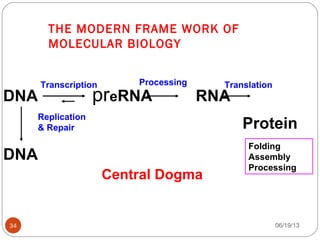
Expression is controlled through Central Dogma of
Molecular Biology involving Replication,Transcription
and Translation
Results of Experiments performed by Griffith’s
(1928), Avery et al (1944) and Hershey and Chase
(1952) provide direct evidences in favour of DNA as
Genetic Material
There are some indirect evidences also in favour of
DNA as Genetic Material
In some organisms RNA is the Genetic Material
Evidences are given by Experiments on TMV
06/19/1333
DNA preRNA RNA
Protein
DNA
Replication
& Repair
Transcription Processing Translation
Folding
Assembly
Processing
Central Dogma
THE MODERN FRAME WORK OF
MOLECULAR BIOLOGY
06/19/1334
06/19/1335
END OF
PRESENTATION

Dna as genetic material

  • 1.
    06/19/131 DNA AS GENETIC MATERIAL BY Dr.Ichha Purak University Professor Department of Botany Ranchi Women’s College,Ranchi http://www.dripurak.com/
  • 2.
    It is wellknown fact that transmission of traits takes place from one generation to other. The offsprings are similar to both the parents in some traits Gregor Johann Mendel (1866 ) on the basis of his hybridization experiments on Sweet pea gave the idea that transmission of traits over generations take place through Factor or Determiner or Gene which carries information for expression of trait or phenotype. Genes are present on the chromosomes which are distributed equally into the two daughter cells during cell division. The biochemical studies reveal that chromosomes are composed of proteins (60% ) and DNA (40% ) 06/19/132
  • 3.
    Genetic material mustbe capable of • Replication ( Make its copy ) • Storage of information for expression of trait • Control expression of traits • Change in controlled way (undergo mutation) • Must be stable 06/19/133
  • 4.
    Topic of Discussiontill 1944 was which chromosomal component DNA or Protein carries hereditary information or is the genetic material Untill 1940 Proteins were considered as genetic material as Proteins are polymer of 20 protein amino acids and present in larger quantity, encode more and variety of information. DNA is polymer of only 4 different deoxyribonucleotides (ATP, CTP, GTP & TTP) and is present in smaller quantity Most geneticists focused on “transmission genetics” and passively accepted proteins as the genetic material 06/19/134 Is the Genetic Material Protein or DNA
  • 5.
    But On thebasis of certain experiments conducted from time to time ,it was ultimately demonstrated that DNA carries genetic information and not the proteins There are some direct evidences and some indirect evidences which prove DNA as Genetic Material 06/19/135 Direct evidences come from : • Frederick Griffith’s (1928) experiment on Bacterial Transformation • Oswald Avery, Colin Macleod and Maclyn McCarty’s (1944 ) experiment on Transformation • Alfred D. Hershey and Martha Chase (1952 ) experiment on T- Even (2,4 ) Bacteriophage
  • 6.
    Frederick Griffith (1928)Studied Diplococcus pneumoniae, having Two strains SIII strain was virulent, possessed a lipopolysaccharide capsule and could kill mice by causing disease Pneumonia and made round colonies on a culture plate RII strain was avirulent and lacked a Lipopolysaccharide (LPS) capsule, growing in rough–shaped colonies on a culture plate 06/19/136
  • 7.
  • 8.
    06/19/138 STEPS IN THEEXPERIMENT 1 LIVE SIII 2 LIVE RII 3 H K S III 4 H K S III & LIVE RIIStrains of Diplococcus pneumoniae injected to mice
  • 9.
    Griffith’s Experiment 06/19/139 RII SIII transformation takes placein step 4 give clue for DNA as genetic material 1 2 3 4
  • 10.
    S N STEPSRESULT I Mouse injected with SIII strain Mouse died √ II Mouse injected with RII strain Mouse survived III Mouse injected with Heat Killed SIII strain Mouse survived IV Mouse injected with Heat Killed SIII & living R II strain Mouse died & from its blood live SIII √ strain bacteria recovered V Mouse injected with Heat Killed SIII+ living RII strain + DNase enzyme Mouse survived VI Mouse injected with Heat Killed SIII+ living RII strain + Protease enzyme Mouse died of √ Pneumonia STEPS AND RESULTS OF GRIFFITH’S EXPERIMENT 06/19/1310
  • 11.
    GRIFFITH’S CONCLUSION On thebasis of Result of step IV Griffith concluded that there was transformation of Avirulent RII type to Virulent SIII type by picking up the genetic material encoding the LPS capsule from the Heat Killed S III . This bacterial transformation clearly shows the role of DNA as Genetic Material and is further confirmed by results of step V which shows no transformation as DNase digests DNA and step VI again shows transformation as protease only digests protein 06/19/1311
  • 12.
    Avery, MacLeod, &McCarty, 1944 repeated Griffith’s experiment of transformation using purified cell extracts and concluded Removal of all protein from the transforming material did not destroy its ability to transform R strain cells DNA-digesting enzymes destroyed all transforming ability The transforming material is DNA 06/19/1312
  • 13.
  • 14.
    06/19/1314 Avery, MacLeod ANDMcCarty EXPERIMENT  Is based on transformation  Cell free extract of SIII strain Bacterium was subjected to DNase,RNase and Protease  Each treated extract was mixed with RII and mixture injected to mouse to see transformation.  In case of Protease and RNase transformation was recorded  In case of DNase no transformation was recorded
  • 15.
    Avery et al(1944) revealed the chemical nature of the transforming substance to be DNA. With the help of experiment they showed that DNA isolated from SIII strain Bacteria could confer the pathogenic properties to R II strain Bacteria . Two conclusion were derived 1.Active factor is DNA which can cause transformation 2.SIII strain contains the Active factor 06/19/1315
  • 16.
    06/19/1316 Hershey AND ChaseExperiment Alfred Hershey and Martha Chase, 1952 investigated bacteriophages: viruses that infect bacteria - the bacteriophage was composed of only DNA and protein - they wanted to determine which of these molecules is the genetic material that enters into the bacteria
  • 17.
    Life Cycle ofT- 2 Phage Phage is made of DNA and protein coat Only DNA enters in the Bacterial cell and protein coat is left out side 06/19/1317
  • 18.
    EVENTS WHICH TAKEPLACE IN LIFE CYCLE OF BACTERIOPHAGE  Attachment of Bacteriophage to receptor site on bacterial cell wall by its tail  Bacterial cell wall dissolves at the point of contact  Phage DNA enters into Bacterial cell, protein coat remains outside Phage DNA replicates forming many copies Assembly of phage DNA into new protein shells Lysis or breakdown of host cell and release of infective phage particle. 06/19/1318
  • 19.
    HERSHEY & CHASE(1952) EXPERIMENT WITH T2 BACTERIOPHAGE In culture I Bacteriophage was grown in medium containing Radioactive Phosphorus (32 P))To make DNA Radioactive In culture II Bacteriophage was grown in medium containing radioactive Sulphur (35 S) To make proteins Radioactive Both kinds of Bacteriophage particles were allowed to infect Bacteria The infected bacteria were observed for radioactivity Radioactive Phosphorus was found with bacterial cells Radioactive Sulphur was not traced in bacterial cells ( Only in Ghosts) Bacteriophage progeny carried only radioactive phosphorus and not radioactive sulphur 06/19/1319
  • 20.
  • 21.
  • 22.
    HERSHAY & CHASECONCLUSION As ghosts or coat of Bacteriophage were not labelled with 32P and only with 35S. The results of experiment clearly indicate that only DNA and not the proteins enter the bacterial cell. Protein coat is left outside. The DNA entering the host cell carries all the genetic information for synthesis of new phage particle. This certainly proves that DNA is the genetic material in Bacteriophage and not proteins 06/19/1322
  • 23.
    06/19/1323 - Bacteriophage DNAwas labeled with radioactive phosphorus (32 P) - Bacteriophage protein was labeled with radioactive sulphur (35 S) - Radioactive molecules were tracked - only the bacteriophage DNA (as indicated by the 32 P) entered the bacteria and was used to produce more bacteriophage Conclusion: DNA is the genetic material Summary of Hershey & Chase (1952 ) experiment
  • 24.
    INDIRECT EVIDENCES FORDNA AS GENETIC MATERIAL 1. Presence of DNA regularly in nuclei of all types of cells 2. Equal amount of DNA is present in all cells of an organism 3. Amount of DNA is proportional to the ploidy of cell . Haploid cells have ½ the amount of DNA than diploid cell. 4. Nuclear Division occurs only after DNA duplication during S phase of Interphase 5.Vaiation in Diploid amount of DNA amongst different species 06/19/1324
  • 25.
    6. DNA hassame physical and chemical properties in all organisms yet allow to produce great diversity of organisms 7. Indefinite number of combinations are possible with four bases A T G C 8. Of all macromolecules DNA is metabolically most stable 9. In prokaryotes DNA is not linked with proteins still characters are inherited 06/19/1325
  • 26.
  • 27.
    SOME ORGANISMS HAVERNA AS GENETIC MATERIAL Some Viruses have RNA as Genetic Material RNA Virus ( Ribo Virus ) may have ssRNA or dsRNA enveloped by Protein Coat Notable human diseases caused by RNA viruses include SARS, Influenza ,Hepatitis C, Measels, Mumps and Rabies Rous Sarcoma Virus (causing cancer ) and HIV (causing AIDS) both are Retrovirus using Reverse Transcription for DNA synthesis in host cell 06/19/1327
  • 28.
    EXAMPLES OF PLANTRNA VIRUSES Tobbaco Mosaic Virus (TMV ) was crystallized by Stanley (1935) for the first time TMV causes Tobacco mosaic disease TMV can also cause disease in Tomato, Pepper, Petunia, Snapdragon, Delphinium, and Marigold. Papaya Ring Spot virus (PRV) Potato Leaf Roll Virus (PLRV) Holmesrib-grass Virus (HRV) –Plantago Alfa-alfa Mosaic Virus (AMV) 06/19/1328
  • 29.
    TMV HIV HEPATITESC VIRUS RNA VIRUSES 06/19/1329
  • 30.
    EVIDENCE IN FAVOUROF RNA AS GENETIC MATERIAL A Gierer and G Schramm ( 1956 ) when inoculated tobacco plants with Purified RNA isolated from TMV - Leisons appeared on leaves of healthy plant H Fraenkel Conrat and B Singer (1957) separated RNA from protein of TMV in first step . In second step reconstituted virus with protein from mutant strain of TMV 06/19/1330
  • 31.
    Inoculated Hybrid TMVinto healthy tobacco plant Tobacco Mosaic disease appeared TMV progeny isolated from diseased plant showed parental RNA only but not parental proteins This provided evidence that RNA carries information for assembly of Virus particles and not proteins RNA thus is the Genetic Material in TMV 06/19/1331
  • 32.
    SUMMARY OF THEPRESENTAION ON DNA AS GENETIC MATERIAL Gene (Mendelian Factor) carries information for expression of Phenotype Genes are present on chromosomes The chromosomes contain 60% protein and 40% DNA Genetic Material must be stable, capable of replication, storing information for expression and undergo mutation 06/19/1332
  • 33.
    Expression is controlledthrough Central Dogma of Molecular Biology involving Replication,Transcription and Translation Results of Experiments performed by Griffith’s (1928), Avery et al (1944) and Hershey and Chase (1952) provide direct evidences in favour of DNA as Genetic Material There are some indirect evidences also in favour of DNA as Genetic Material In some organisms RNA is the Genetic Material Evidences are given by Experiments on TMV 06/19/1333
  • 34.
    DNA preRNA RNA Protein DNA Replication &Repair Transcription Processing Translation Folding Assembly Processing Central Dogma THE MODERN FRAME WORK OF MOLECULAR BIOLOGY 06/19/1334
  • 35.