Assignment Topic: Generation and Conduction of Action
Potential
Submitted To: Professor Dr Saghir
Submitted By; Shahzaib Khurshid
Roll Number: 23815
College Roll Number: 853
Session: 2017-2021 BS Zoology 5TH
Semester
Government College of Science Wahdat Road Lahore
References of Assignment Taken;
 Guyton and Hall Medical Physiology
 Miller and Harley ..
 Internet Kenhub,,
 .Hodgkin AL, Huxley AF. A quantitative description of
membrane current and its application to conduction and
excitation in nerve. 1952. Bull. Math. Barnett MW,
Larkman PM. The action potential. Pract Neurol. 2007
Jun;7(3):192-7. [PubMed]
 Rutecki PA. Neuronal excitability: voltage-dependent
currents and synaptic transmission. J Clin
Neurophysiol. 1992 Apr;9(2):195-211. [PubMed]
Outline:
 Introduction
 Generation and conduction of Action Potential
 Phases of Action Potential
 Depolarization
 Repolarization
 Hyperpolarization
 Synapse
 Conduction and Propagation
 Saltatory Nerve Impulse
 Nerve Conduction Disorders
 CONCLUSION
Generation and Conduction
of Action Potential:
Introduction;
Nerve signals are transmitted by action potentials, which
are rapid changes in the membrane potential that spread
rapidly along the nerve fiber membrane. Each action
potential begins with a sudden change from the normal
resting negative membrane potential to a positive potential
and then ends with an almost equally rapid change back to
the negative potential. To conduct a nerve signal, the action
potential moves along the nerve fiber until it comes to the
fiber’s end.
Phases of Action Potential:
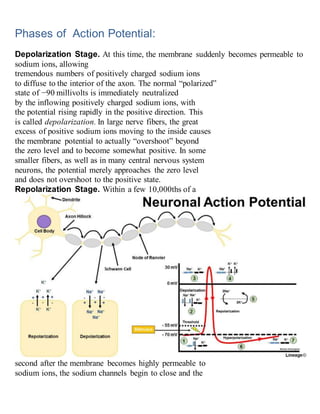
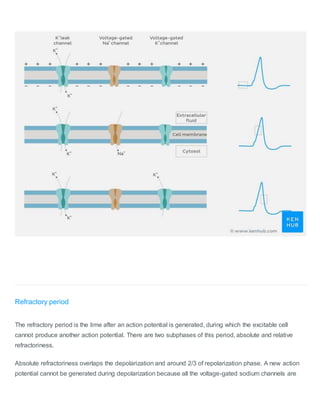
Depolarization Stage. At this time, the membrane suddenly becomes permeable to
sodium ions, allowing
tremendous numbers of positively charged sodium ions
to diffuse to the interior of the axon. The normal “polarized”
state of −90 millivolts is immediately neutralized
by the inflowing positively charged sodium ions, with
the potential rising rapidly in the positive direction. This
is called depolarization. In large nerve fibers, the great
excess of positive sodium ions moving to the inside causes
the membrane potential to actually “overshoot” beyond
the zero level and to become somewhat positive. In some
smaller fibers, as well as in many central nervous system
neurons, the potential merely approaches the zero level
and does not overshoot to the positive state.
Repolarization Stage. Within a few 10,000ths of a
second after the membrane becomes highly permeable to
sodium ions, the sodium channels begin to close and the
potassium channels open more than normal. Then, rapid
diffusion of potassium ions to the exterior re-establishes
the normal negative resting membrane potential. This is
called repolarization of the membrane.
To explain more fully the factors that cause both depolarization
and repolarization, we will describe the special
characteristics of two other types of transport channels
through the nerve membrane: the voltage-gated sodium
and potassium channels.
Voltage-Gated Sodium and Potassium Channels
The necessary actor in causing both depolarization and
repolarization of the nerve membrane during the action
potential is the voltage-gated sodium channel. A voltagegated
potassium channel also plays an important role in
increasing the rapidity of repolarization of the membrane.
These two voltage-gated channels are in addition to the
Na+-K+ pump and the K+ leak channels.
Voltage-Gated Sodium Channel—Activation
and Inactivation of the Channel
Research Method for Measuring the Effect of Voltage on
Opening and Closing of the Voltage-Gated Channels—The
“Voltage Clamp.” The original research that led to quantitative
understanding of the sodium and potassium channels
was so ingenious that it led to Nobel Prizes for the scientists
responsible, Hodgkin and Huxley. The essence of these studies
an experimental apparatus called a voltage
clamp, which is used to measure flow of ions through the
different channels. In using this apparatus, two electrodes are
inserted into the nerve fiber. One of these is to measure the
voltage of the membrane potential, and the other is to conduct
electrical current into or out of the nerve fiber. This apparatus
is used in the following way: The investigator decides which
voltage he or she wants to establish inside the nerve fiber.
The electronic portion of the apparatus is then adjusted to
the desired voltage, and this automatically injects either positive
or negative electricity through the current electrode at
whatever rate is required to hold the voltage, as measured by
the voltage electrode, at the level set by the operator. When
the membrane potential is suddenly increased by this voltage
clamp from −90 millivolts to zero, the voltage-gated sodium
and potassium channels open and sodium and potassium
ions begin to pour through the channel
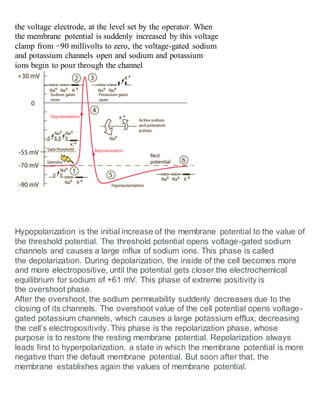
Hypopolarization is the initial increase of the membrane potential to the value of
the threshold potential. The threshold potential opens voltage-gated sodium
channels and causes a large influx of sodium ions. This phase is called
the depolarization. During depolarization, the inside of the cell becomes more
and more electropositive, until the potential gets closer the electrochemical
equilibrium for sodium of +61 mV. This phase of extreme positivity is
the overshoot phase.
After the overshoot, the sodium permeability suddenly decreases due to the
closing of its channels. The overshoot value of the cell potential opens voltage-
gated potassium channels, which causes a large potassium efflux, decreasing
the cell’s electropositivity. This phase is the repolarization phase, whose
purpose is to restore the resting membrane potential. Repolarization always
leads first to hyperpolarization, a state in which the membrane potential is more
negative than the default membrane potential. But soon after that, the
membrane establishes again the values of membrane potential.
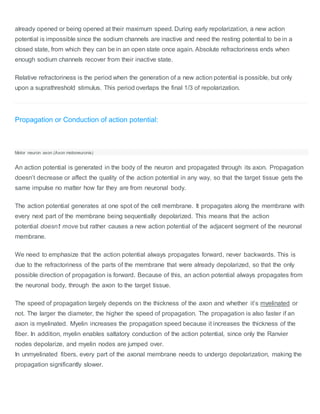
Refractory period
The refractory period is the time after an action potential is generated, during which the excitable cell
cannot produce another action potential. There are two subphases of this period, absolute and relative
refractoriness.
Absolute refractoriness overlaps the depolarization and around 2/3 of repolarization phase. A new action
potential cannot be generated during depolarization because all the voltage-gated sodium channels are
already opened or being opened at their maximum speed. During early repolarization, a new action
potential is impossible since the sodium channels are inactive and need the resting potential to be in a
closed state, from which they can be in an open state once again. Absolute refractoriness ends when
enough sodium channels recover from their inactive state.
Relative refractoriness is the period when the generation of a new action potential is possible, but only
upon a suprathreshold stimulus. This period overlaps the final 1/3 of repolarization.
Propagation or Conduction of action potential:
Motor neuron axon (Axon motoneuronis)
An action potential is generated in the body of the neuron and propagated through its axon. Propagation
doesn’t decrease or affect the quality of the action potential in any way, so that the target tissue gets the
same impulse no matter how far they are from neuronal body.
The action potential generates at one spot of the cell membrane. It propagates along the membrane with
every next part of the membrane being sequentially depolarized. This means that the action
potential doesn’t move but rather causes a new action potential of the adjacent segment of the neuronal
membrane.
We need to emphasize that the action potential always propagates forward, never backwards. This is
due to the refractoriness of the parts of the membrane that were already depolarized, so that the only
possible direction of propagation is forward. Because of this, an action potential always propagates from
the neuronal body, through the axon to the target tissue.
The speed of propagation largely depends on the thickness of the axon and whether it’s myelinated or
not. The larger the diameter, the higher the speed of propagation. The propagation is also faster if an
axon is myelinated. Myelin increases the propagation speed because it increases the thickness of the
fiber. In addition, myelin enables saltatory conduction of the action potential, since only the Ranvier
nodes depolarize, and myelin nodes are jumped over.
In unmyelinated fibers, every part of the axonal membrane needs to undergo depolarization, making the
propagation significantly slower.
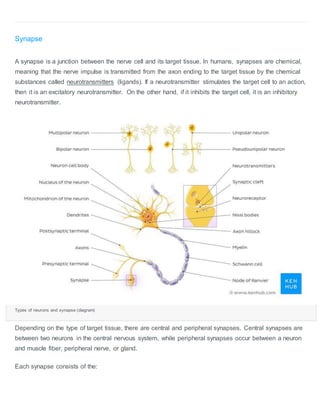
Synapse
A synapse is a junction between the nerve cell and its target tissue. In humans, synapses are chemical,
meaning that the nerve impulse is transmitted from the axon ending to the target tissue by the chemical
substances called neurotransmitters (ligands). If a neurotransmitter stimulates the target cell to an action,
then it is an excitatory neurotransmitter. On the other hand, if it inhibits the target cell, it is an inhibitory
neurotransmitter.
Types of neurons and synapse (diagram)
Depending on the type of target tissue, there are central and peripheral synapses. Central synapses are
between two neurons in the central nervous system, while peripheral synapses occur between a neuron
and muscle fiber, peripheral nerve, or gland.
Each synapse consists of the:
SSSS.
When a nerve impulse reaches an end bulb, it causes storage
vesicles (containing the chemical neurotransmitter) to fuse with
the plasma membrane.The vesicles release the neurotransmitter
by exocytosis into the synaptic cleft (figure 24.6). One common
neurotransmitter is the chemical acetylcholine; anotheris norepinephrine.
(More than 50 other possible transmitters are known.)
When the released neurotransmitter (e.g., acetylcholine)
binds with receptorprotein sites in the postsynaptic membrane,it
causes a depolarization similar to that of the presynaptic cell. As a
result, the impulse continues its path to an eventual effector.
Once acetylcholine has crossed the synaptic cleft,the enzyme
acetylcholinesterase quickly inactivates it. Without this breakdown,
acetylcholine would remain and would continually stimulate
the postsynaptic cell, leading to a diseased state.
Saltatory Conduction Of Action Potential:
The action potential is conducted along the axon membrane by contiguous conduction and by saltatory
conduction.
Contiguous conduction
This is the main process occurring in non-myelinated fibers. The action potential spreads in a fashion
similar to graded potentials:
1. REMEMBER The action potential
1. The outside of the cell is more negative than inside the cell
2. The action potential is self limiting
2. Therefore,the area in front of the action potential
1. The outside of the cell is more positive than the inside of the cell
1. Positive charges will move towards the adjacent area of opposite charge
2. This will beginto depolarise this area of the membrane until it reaches threshold
potential.
3. Once threshold is reached,the action potential is fired and this is the area of the AP.
3. The area behind the action potential
1. Still in the last stage of the action potential i.e. potassium channels are still open.
2. This is known as the relative refractory period (see below) and the consequenceis that
the membrane potential can only hyperpolarise (since the permeabilityto K is still high
and the equilibrium potential of K is -90mV).
1. This prevents retrograde conductionof the action potential.
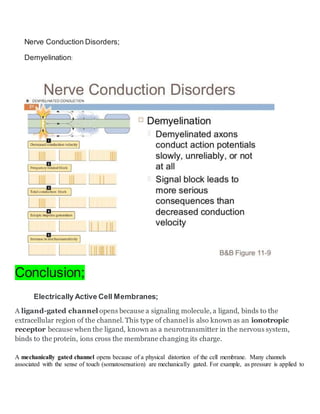
Nerve Conduction Disorders;
Demyelination:
Conclusion;
Electrically Active Cell Membranes;
A ligand-gated channel opens because a signaling molecule, a ligand, binds to the
extracellular region of the channel. This type of channel is also known as an ionotropic
receptor because when the ligand, known as a neurotransmitter in the nervous system,
binds to the protein, ions cross the membrane changing its charge.
A mechanically gated channel opens because of a physical distortion of the cell membrane. Many channels
associated with the sense of touch (somatosensation) are mechanically gated. For example, as pressure is applied to
the skin, these channels open and allow ions to enter the cell. Similar to this type of channel would be the channel
that opens on the basis of temperature changes, as in testing the water in the show
A voltage-gated channel is a channel that responds to changes in the electrical properties
of the membrane in which it is embedded. Normally, the inner portion of the membrane is at
a negative voltage. When that voltage becomes less negative, the channel begins to allow ions
to cross the membrane.
A leakage channel is randomly gated, meaning that it opens and closes at random, hence
the reference to leaking. There is no actual event that opens the channel; instead, it has an
intrinsic rate of switching between the open and closed states. Leakage channels contribute to
the resting transmembrane voltage of the excitable membrane .
In this way the action potential is generated travelled in the form of nerve through the entire
body .As it is a complex phenomenon to be observed.
SHAHZAIB KHURSHID

Generation and conduction of action potential.

  • 1.
    Assignment Topic: Generationand Conduction of Action Potential Submitted To: Professor Dr Saghir Submitted By; Shahzaib Khurshid Roll Number: 23815 College Roll Number: 853 Session: 2017-2021 BS Zoology 5TH Semester Government College of Science Wahdat Road Lahore References of Assignment Taken;  Guyton and Hall Medical Physiology
  • 2.
     Miller andHarley ..  Internet Kenhub,,  .Hodgkin AL, Huxley AF. A quantitative description of membrane current and its application to conduction and excitation in nerve. 1952. Bull. Math. Barnett MW, Larkman PM. The action potential. Pract Neurol. 2007 Jun;7(3):192-7. [PubMed]  Rutecki PA. Neuronal excitability: voltage-dependent currents and synaptic transmission. J Clin Neurophysiol. 1992 Apr;9(2):195-211. [PubMed] Outline:  Introduction
  • 3.
     Generation andconduction of Action Potential  Phases of Action Potential  Depolarization  Repolarization  Hyperpolarization  Synapse  Conduction and Propagation  Saltatory Nerve Impulse  Nerve Conduction Disorders  CONCLUSION Generation and Conduction of Action Potential: Introduction; Nerve signals are transmitted by action potentials, which are rapid changes in the membrane potential that spread rapidly along the nerve fiber membrane. Each action potential begins with a sudden change from the normal resting negative membrane potential to a positive potential and then ends with an almost equally rapid change back to the negative potential. To conduct a nerve signal, the action potential moves along the nerve fiber until it comes to the fiber’s end.
  • 4.
    Phases of ActionPotential: Depolarization Stage. At this time, the membrane suddenly becomes permeable to sodium ions, allowing tremendous numbers of positively charged sodium ions to diffuse to the interior of the axon. The normal “polarized” state of −90 millivolts is immediately neutralized by the inflowing positively charged sodium ions, with the potential rising rapidly in the positive direction. This is called depolarization. In large nerve fibers, the great excess of positive sodium ions moving to the inside causes the membrane potential to actually “overshoot” beyond the zero level and to become somewhat positive. In some smaller fibers, as well as in many central nervous system neurons, the potential merely approaches the zero level and does not overshoot to the positive state. Repolarization Stage. Within a few 10,000ths of a second after the membrane becomes highly permeable to sodium ions, the sodium channels begin to close and the
  • 5.
    potassium channels openmore than normal. Then, rapid diffusion of potassium ions to the exterior re-establishes the normal negative resting membrane potential. This is called repolarization of the membrane. To explain more fully the factors that cause both depolarization and repolarization, we will describe the special characteristics of two other types of transport channels through the nerve membrane: the voltage-gated sodium and potassium channels. Voltage-Gated Sodium and Potassium Channels The necessary actor in causing both depolarization and repolarization of the nerve membrane during the action potential is the voltage-gated sodium channel. A voltagegated potassium channel also plays an important role in increasing the rapidity of repolarization of the membrane. These two voltage-gated channels are in addition to the Na+-K+ pump and the K+ leak channels. Voltage-Gated Sodium Channel—Activation and Inactivation of the Channel Research Method for Measuring the Effect of Voltage on Opening and Closing of the Voltage-Gated Channels—The “Voltage Clamp.” The original research that led to quantitative understanding of the sodium and potassium channels was so ingenious that it led to Nobel Prizes for the scientists responsible, Hodgkin and Huxley. The essence of these studies an experimental apparatus called a voltage clamp, which is used to measure flow of ions through the different channels. In using this apparatus, two electrodes are inserted into the nerve fiber. One of these is to measure the voltage of the membrane potential, and the other is to conduct electrical current into or out of the nerve fiber. This apparatus is used in the following way: The investigator decides which voltage he or she wants to establish inside the nerve fiber. The electronic portion of the apparatus is then adjusted to the desired voltage, and this automatically injects either positive or negative electricity through the current electrode at whatever rate is required to hold the voltage, as measured by
  • 6.
    the voltage electrode,at the level set by the operator. When the membrane potential is suddenly increased by this voltage clamp from −90 millivolts to zero, the voltage-gated sodium and potassium channels open and sodium and potassium ions begin to pour through the channel Hypopolarization is the initial increase of the membrane potential to the value of the threshold potential. The threshold potential opens voltage-gated sodium channels and causes a large influx of sodium ions. This phase is called the depolarization. During depolarization, the inside of the cell becomes more and more electropositive, until the potential gets closer the electrochemical equilibrium for sodium of +61 mV. This phase of extreme positivity is the overshoot phase. After the overshoot, the sodium permeability suddenly decreases due to the closing of its channels. The overshoot value of the cell potential opens voltage- gated potassium channels, which causes a large potassium efflux, decreasing the cell’s electropositivity. This phase is the repolarization phase, whose purpose is to restore the resting membrane potential. Repolarization always leads first to hyperpolarization, a state in which the membrane potential is more negative than the default membrane potential. But soon after that, the membrane establishes again the values of membrane potential.
  • 7.
    Refractory period The refractoryperiod is the time after an action potential is generated, during which the excitable cell cannot produce another action potential. There are two subphases of this period, absolute and relative refractoriness. Absolute refractoriness overlaps the depolarization and around 2/3 of repolarization phase. A new action potential cannot be generated during depolarization because all the voltage-gated sodium channels are
  • 8.
    already opened orbeing opened at their maximum speed. During early repolarization, a new action potential is impossible since the sodium channels are inactive and need the resting potential to be in a closed state, from which they can be in an open state once again. Absolute refractoriness ends when enough sodium channels recover from their inactive state. Relative refractoriness is the period when the generation of a new action potential is possible, but only upon a suprathreshold stimulus. This period overlaps the final 1/3 of repolarization. Propagation or Conduction of action potential: Motor neuron axon (Axon motoneuronis) An action potential is generated in the body of the neuron and propagated through its axon. Propagation doesn’t decrease or affect the quality of the action potential in any way, so that the target tissue gets the same impulse no matter how far they are from neuronal body. The action potential generates at one spot of the cell membrane. It propagates along the membrane with every next part of the membrane being sequentially depolarized. This means that the action potential doesn’t move but rather causes a new action potential of the adjacent segment of the neuronal membrane. We need to emphasize that the action potential always propagates forward, never backwards. This is due to the refractoriness of the parts of the membrane that were already depolarized, so that the only possible direction of propagation is forward. Because of this, an action potential always propagates from the neuronal body, through the axon to the target tissue. The speed of propagation largely depends on the thickness of the axon and whether it’s myelinated or not. The larger the diameter, the higher the speed of propagation. The propagation is also faster if an axon is myelinated. Myelin increases the propagation speed because it increases the thickness of the fiber. In addition, myelin enables saltatory conduction of the action potential, since only the Ranvier nodes depolarize, and myelin nodes are jumped over. In unmyelinated fibers, every part of the axonal membrane needs to undergo depolarization, making the propagation significantly slower.
  • 9.
    Synapse A synapse isa junction between the nerve cell and its target tissue. In humans, synapses are chemical, meaning that the nerve impulse is transmitted from the axon ending to the target tissue by the chemical substances called neurotransmitters (ligands). If a neurotransmitter stimulates the target cell to an action, then it is an excitatory neurotransmitter. On the other hand, if it inhibits the target cell, it is an inhibitory neurotransmitter. Types of neurons and synapse (diagram) Depending on the type of target tissue, there are central and peripheral synapses. Central synapses are between two neurons in the central nervous system, while peripheral synapses occur between a neuron and muscle fiber, peripheral nerve, or gland. Each synapse consists of the:
  • 10.
    SSSS. When a nerveimpulse reaches an end bulb, it causes storage vesicles (containing the chemical neurotransmitter) to fuse with the plasma membrane.The vesicles release the neurotransmitter by exocytosis into the synaptic cleft (figure 24.6). One common neurotransmitter is the chemical acetylcholine; anotheris norepinephrine. (More than 50 other possible transmitters are known.) When the released neurotransmitter (e.g., acetylcholine) binds with receptorprotein sites in the postsynaptic membrane,it causes a depolarization similar to that of the presynaptic cell. As a result, the impulse continues its path to an eventual effector. Once acetylcholine has crossed the synaptic cleft,the enzyme acetylcholinesterase quickly inactivates it. Without this breakdown, acetylcholine would remain and would continually stimulate the postsynaptic cell, leading to a diseased state. Saltatory Conduction Of Action Potential: The action potential is conducted along the axon membrane by contiguous conduction and by saltatory conduction. Contiguous conduction This is the main process occurring in non-myelinated fibers. The action potential spreads in a fashion similar to graded potentials: 1. REMEMBER The action potential 1. The outside of the cell is more negative than inside the cell 2. The action potential is self limiting 2. Therefore,the area in front of the action potential 1. The outside of the cell is more positive than the inside of the cell 1. Positive charges will move towards the adjacent area of opposite charge 2. This will beginto depolarise this area of the membrane until it reaches threshold potential. 3. Once threshold is reached,the action potential is fired and this is the area of the AP. 3. The area behind the action potential 1. Still in the last stage of the action potential i.e. potassium channels are still open. 2. This is known as the relative refractory period (see below) and the consequenceis that the membrane potential can only hyperpolarise (since the permeabilityto K is still high and the equilibrium potential of K is -90mV). 1. This prevents retrograde conductionof the action potential.
  • 11.
    Nerve Conduction Disorders; Demyelination: Conclusion; ElectricallyActive Cell Membranes; A ligand-gated channel opens because a signaling molecule, a ligand, binds to the extracellular region of the channel. This type of channel is also known as an ionotropic receptor because when the ligand, known as a neurotransmitter in the nervous system, binds to the protein, ions cross the membrane changing its charge. A mechanically gated channel opens because of a physical distortion of the cell membrane. Many channels associated with the sense of touch (somatosensation) are mechanically gated. For example, as pressure is applied to
  • 12.
    the skin, thesechannels open and allow ions to enter the cell. Similar to this type of channel would be the channel that opens on the basis of temperature changes, as in testing the water in the show A voltage-gated channel is a channel that responds to changes in the electrical properties of the membrane in which it is embedded. Normally, the inner portion of the membrane is at a negative voltage. When that voltage becomes less negative, the channel begins to allow ions to cross the membrane. A leakage channel is randomly gated, meaning that it opens and closes at random, hence the reference to leaking. There is no actual event that opens the channel; instead, it has an intrinsic rate of switching between the open and closed states. Leakage channels contribute to the resting transmembrane voltage of the excitable membrane . In this way the action potential is generated travelled in the form of nerve through the entire body .As it is a complex phenomenon to be observed. SHAHZAIB KHURSHID