Neural Control Mechanisms Section AJohn Paul L. Oliveros, MD
Neural TissueNeuron: basic unit of the nervous systemServes  as integratorsNeurotransmitters: chemical messengers released by nerve cellsParts:Cell bodyDendritesAxonAxon terminals
Neural TissueParts of a neuronCell BodyContains nucleus and ribosomesGenetic information and machinery for protein synthesisDendritesReceive inputs from other neuronsBranching increases  the cell’s receptive surface areaAxonAKA nerve fiberSingle long process that extends  from the cell body to its target cellsINITIAL SEGMENTAKA axon hillockPortion of axon closest to the cell body plus parts of the cell body“Trigger zone”CollateralsMain branches of the axonAxon TerminalEnding of each branch of axonReleases neurotransmittersVaricositiesBulging areas along the axonAlso releases neurotransmitters
Neural TissueMyelin SheathLayers of plasma membrane wrapped around the axon by a nearby supporting cellSpeeds up conduction of electrical signals along the axons and conserves energyOligodendroglia: CNSSchwann cells: PNSNodes of RanvierSpaces between adjacent sections of myelinAxons plasma is exposed to ECF
Neural TissueAxon TransportMovement of various organelles and materials from cell body to axon and its terminalTo maintain structure and function of the axonMicrotubulesRails along which transport occursLinking proteinsLink organelles and materials to microtubulesFunction as motors of axon transport and ATPase  enzymesProvide energy  from split ATP to the motorsAxon Terminalcell bodyOpposite route of transportRoute for growth factors and other chemical signals picked up at the terminalsRoute of tetanus toxins and polio and herpes virus
Neural Tissue
Neural TissuesynapseSpecialized junction between two neurons where one alters the activity of the otherPresynaptic neuronConducting signals toward a synapsePostsynaptic neuronConducts signals away from a synapse
Neural tissueGlial Cells/Neuroglia90% of cells in the CNSOccupy only 50% of CNSPhysically and metabolically support neuronsTypes:OligodendrogliaForm myelin covering of CNS axonsAstrogliaRegulate composition of ECF in the CNSRemove K+ ions and neurotransmitters around syapsesSustain neurons metabolically (provide glucose and remove ammonia)Embryo: guide neuron migration and stimulate neuron growthMany neuron like characteristicsMicrogliaPerform immune functions in te CNSSchwann cellsGlial cells of the PNSProduce myelin sheath of the peripheral nerve fibers
Neural Growth and degenerationEmbryo:Precursor cells: develop into neurons or glial cellsNeuron cell migrates to its final location and sends out processesGrowth cone: specialized tip of axons that finds the correct route and final target of the processesNeurotropic factors: growth factors for neural tissue in the ECF surrounding the growth cone or distant targetSynapses are then formed once target tissues are reachedNeural development occurs in all trimesters of pregnancy and upto infancy permanent damage by alcohol, drugs, radiation, malnutrition, and virusesFine tuning:Degeneration of neurons and synapses after growth and projection of axons50-70% of neurons die by apoptosisRefining  of connectivity in the nervous system
Neural growth and regenerationNeuron damageOutside CNSDoes not affect cell bodySevered axon can repair itself and regain significant functionDistal axons degeneratesProximal axon develops growth cone  and grows back to target organWithin CNSNo significant regeneration of the axon occurs at the damage siteNo significant return of function
Section BMembrane Potentials
Basic principles of electricityElectric potentialPotential of work obtained when separated electric charges  of opposite signs are allowed to come together Potential differences/potentialDifference in the amount of charge between two pointsVolts: unit of electric potentialMillivolts:  measurement in biological systemsCurrentMovement of electric chargeDepends on the potential differences between charges and the material on which they are movingResistanceHindrance to electric charge movementOhms law: I= E/RInsulatorMaterials with high electrical resistanceConductorMaterials with low electrical resistancee.g. water
Resting Membrane PotentialResting membrane potentialThe potential difference across the plasma membrane  under resting conditionsInside  cell: negative charge  (-70mV)
Resting membrane potentialMagnitude of membrane potential is determined by:Differences of specific ion concentrations in the intracellular and extracellular fluidsDifferences in membrane permeabilities to the different ions
Resting membrane potentialEquilibrium potential: the membrane potential at which  flux due to concentration gradient is equal to the flux due to electrical potential but at opposite directionsNo net movement of ion because opposing fluxes are equalMembrane potential will not undergo further changeIts value depends on the concentration gradient  of an ion across the membrane
Resting membrane potential
Resting Membrane PotentialIn a resting cell, Na+ and K+ ion concentrations don’t change because  the ions moved in and out by the Na+,K+-atpase pump equals that moved by the membrane channels electrical potential across membranes remain constantElectrogenic pumpPump that moves net charge across the membrane  and contributes to the membrane potentialNa+,K+-ATPase pump:Sends out 3 Na+ ions for  moving in 2K+ ionsMakes the inside of the cell more negative
Graded Potentials and Action PotentialsNerve cells transmit and process information through transient changes in the membrane potential from it s resting levelTwo forms of signalsGraded potentialOver short distancesAction potentialLong distance signalsDepolarizedPotential is less negative than the resting levelOvershootA reversal of the membrane potential polarityCell inside becomes positive relative to the outsideRepolarizeWhen the depolarized membranepotential returns toward the resting valuehyperpolarizeThe  potential is more negative than the resting lavel
Graded potentialChanges in the membrane potential confined to a relatively small region of the plasma membraneDie out within 1-2 mm of siteProduced by a specific change in the cell’s environment acting on a specialized region of the membraneMagnitude  of the potential change can varyLocal current is decrementalAmplitude decreases with increasing distance from the origin
Graded Potential
Graded Potential
Action PotentialsRapid and large alterations in the membrane potential 100mV from -70mV then reporalize to its resting membraneExcitable  membranes: Plasma membranes capable of producing  action potentialse.g. Neurons, muscle cells, endocrine cells, immune cells, reproductive cellsOnly cells in the body that can conduct action potentialsExcitability:Ability to generate action potentials
Ionic basis of action potentialsResting state:K+ and Cl- ion membranes openClose to K+ equilibriumDepolarizing phaseOpening of  voltage-gated Na+ channels 100xMore + Na ions enter the cellMay overshoot: inside on the cell becomes positvely chargedShort duration of action potentialsResting membrane returns rapidly to resting potential becauseNa+ channels undergo inactivation near the peak of the action potential to then closeVoltage gated K+ channels begin to open
Ionic basis of action PotentialsAfterhyperpolarizationSmall hyperpolarization of the membrane potential beyond the resting levelSome of voltage gated K+ ions are still open after all Na+ have closedChloride permeability does’t change during action potentialThe amount of ions involve is extremely small and produces infinitesimal changes in the intracellular ion concentrationNa+,K+-ATPase pump makes sure that concentration gradient of each ions are  restored to generate  future action potentials
Mechanism of ion-channel changes1st part of depolarization: Due to local current opens up voltage gated channels sodium influx  increase in cell’s positive charge  increase depolarization (positive feedback)Delayed opening of K+ channelsInactivation of Na+ channels:Due to change in the conformation channel proteinsLocal anestheticse.g. Procaine, lidocaineBlock voltage gated Na+ channelsPrevent sensation of painAnimal toxins:Puffer fish: tetrodotoxinPrevent na+ component of action potentialIn some cells: Ca++ gates open prolonged action potential
Threshold and the all-or-none responseThe event that initiates the membrane depolarization provides an ionic current that adds positive charge to the inside of the cellEvents:K+ efflux increasesDue to  weaker inside negativityNa+ influx increasesOpening of voltage gated channels by initial depolarizationAs depolarization increaes mor voltage gated channels openNa+influx eventually exceeds  K+ efflux positive feedback starts action potentialThreshold potentialMembrane potential when the net movement of positive charge through ion channels is inwardAction potential only occurs after this is reachedAbout 15mV less neative than Threshold Stimuli strong enough to depolarize the membrane to threshold potentialSubthreshold  potentialsWeak depolarizationsMembrane returnsto resting level as soon as stimuli is removedNo action potential generatedSubthreshold stimulusStimuli that causes subthreshold potentials
Threshold and the all-or-none responseStimuli more than threshold  magnitude elicit action potentialswith exactly the same amplitude with that of a threshold  stimulusThreshold: membrane events not dependent on stimulus strengthDepolarization generates action potential because the positive feedback is operatingAll-or-none responseAction potentials occur maximally or they do not occur at allFiring of the gun analogy
Refractory periodsAbsolute refractory periodDuring action potential, a  2nd stimulus, no matter how strong, will not produce a 2nd action potentialNa+ channels undergo a closes and  inactive  state at the peak of the action potentialMembrane must be repolarized  to return Na+ channels to a state which they can be opened againRelative refractory periodInterval followng the refractory period  during which a 2nd action potential can be  producedStimulus must be greater than usual10-15ms longer in neuronsCoincides with the period of hyperpolarizationLingering inactivation of Na+ channels and increased number of potassium channels openAdditional action potentials firedDepolarization exceeds the increased thresholdDepolarization outlasr the refractory period
Action Potential PropagationThe difference in potentials betwen active and resting regions causes ions to flowLocal current depolarizes the membrane adjacent to the action potential site to its threshold potential producing another action potential action potential propagationGunpowder trail analogyAction potentials are not conducted decrementallyDirection of the propagation is away from a region of the membrane that has been recently activeDue to refractory period
Action potential propagationMuscle cellsAction potentials are initiated near the middle  of these cylindrical cells and propagate towards the 2 endsNerve cellsInitiation at one end and propagate towards the other endVelocity of action potential propagation depends onFiber diameterThe larger, the fasterMyelinationMyelin is an insulatorAction potential only in the nodes of ranvierConcentration of Na+ channels is highSaltatory conduction/ jumping of action potentials from one node to the other as they propagate Faster conduction
Initiation of action potentialAfferent neuronsInitial depolarization threshold achieved by a graded potential             (receptor potential) generated by sensory receptors at the peripheral endsEfferent neurons/ interneuronsDepolarization threshold due toGraded potential generated by synaptic input Spontaneous change in the neurons membrane potential (pacemaker potential)Occurs in absence of external stimulie.g. Smooth muscle, cardiac musclesContnuous change in membrane permeability no stable resting membrane potentialImplicated in breathing, heart beat, GIT movements
Section CSynapses
SynapsesAnatomically  specialized junction between 2 neuronsElectrical activity of a presynaptic neuron influences  the elcetrical/metabolic activity of a postsynaptic neuron100 quadrillion synapses in the CNSExcitatory synapseMembrane potential of postsynaptic neurons is brought closer to the thresholdInhibitory synapsePostsynaptic neuron  membrane potential is  brought further away from the threshold or stabilizedConvergenceNeural input from many neurons affect one neuronDivergenceNeural input from one neuron affects many other neurons
Functional anatomy of synapses2 types of synapses:Electrical synapsesPre and postsynaptic cells joined by gap junctionsNumerous in cardiac and smooth muscle cellsRare in mammalian nervous systemChemical synapses Synaptic cleftSeparates pre and post synaptic neuronsPrevents direct propagation of electric currentSignals transmitted by means of neurotransmitterCo-transmittersAdditional neurotransmitter simultaneously released with another neurotransmitterSynaptic vesiclesStore neurotransmitter in the terminals
Functional anatomy of synapsesPresynaptic cell:Action potential axon terminal depolarization  voltage-gated Ca++ channels open Ca++ enters  fusion of synaptic vesicles to PM  release of transmitters by exocytosisPostsynaptic cell:Binding  of neurotransmitters to receptors  opening or closing of  specific ligand sensitive -ion channelsOne way conduction across synapses in generalBrief synaptic delay (0.2 sec) from action potential at presynaptic neuron to  membrane potential changes in post synaptic cell
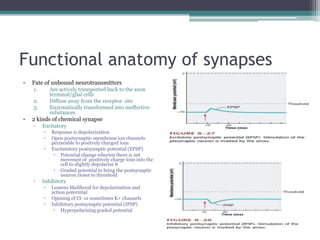
Functional anatomy of synapsesFate of unbound neurotransmittersAre actively transported back to the axon terminal/glial cellsDiffuse away from the receptor  siteEnzymatically transformed into ineffective substances 2 kinds of chemical synapseExcitatoryResponse is depolarizationOpen postsynaptic-membrane ion channels permeable to positvely charged ionsExcitatatory postsynaptic potential (EPSP)Potential change wherien there is net movemnt of  positively charge ions into the cell to slightly depolarize itGraded potential to bring the postsynaptic neuron closer to thresholdInhibitoryLessens likelihood for depolarization and action poterntialOpening of Cl- or sometimes K+ channelsInhibitory postsynaptic potential (IPSP)Hyperpolarizing graded potential
Activation of a postsynaptic cellIn most neurons, one excitatory  synaptic event by itself is not enough to cause threshold to be reached in the postsynaptic neuronTemporal summation:Axon stimulated before the 1st EPSP has died awayThe 2nd EPSP adds  to the previous one and creates  a greater input  than from 1 input aloneInput signals arrive at the same cell  at different timesThe potentials summate because there is a greater number of open ion channelsSpatial summation:2 inputs occured at different locations on the same cell
Activation of a postsynaptic cell
Synaptic effectivenessA presynaptic terminal does not release a constant amount of neurotransmitters everytime it is activatedPresynaptic synapse (axon-axon synapse)Axon terminal of one ends on an axon terminal of another Effects:Presynaptic inhibitionDecrease the amount of neurotransmitter secreted Presynaptic facilitationIncrease the amount of neurotransmitter secreted
Modification of Synaptic transmission by Drugs and DiseaseAll synaptic mechanisms are vulnerable to drugsAgonist:Drugs that  bind to a receptor and produces a response  similar to normal activation of a receptorAntagonis:Drugs that bind to the receptor but aren’t able to activate itDiseases:Tetanus toxinProtease that destroys certain proteins in the synaptic-vesicle  docking mechanism of inhibitory neurons to neurons supplying the skeletal muscleBotulinum toxin and spider venomAffect neurotransmitter release from synaptic vesiclesInterfere with docking proteinsAct on axons different  from those acted upon by tetanus toxin
Synaptic effectiveness
Neurotransmitters and NeuromodulatorsNeuromodulatorsMessengers that cause complex responses/modulationAlter effectiveness of synapseModify postsynaptic cell’s response to  neurotransmittersChange the presynaptic cell’s release, release, re-uptake, or metabolism of a transmitterReceptors for neuromodulators bring about changes  in the metabolic processes in neurons  via  G-proteinsChanges occur  within minutes, hours, or daysenzyme activityProtein synthesisAssociated with slower eventsLearning DevelopmentMotivational statesSensory/motor activities
Neurotransmitters and neuromodulatorsAcetylcholine (ACh)Synthesized from choline and acetyl coenzyme AReducing enzyme: acetylcholinesteraseMostly in the PNS, also in CNSNerve fibers: cholinergicReceptors: nicotinic, muscarinicFunction: attention, learning, memoryPathology: AlzheimersBiogenic aminesSynthesized from AA and contain an amino groupMC: dopamine, norepinphrine, serotonin, histamineEpinephrine: biogenic  amine hormone secreted by adrenal medullaNorepinephrine: important neurotransmitter in CNS and PNS
Neurotransmitters and neuromodulatorsCatecholaminesDopamine, norepinephrine, epinephrineContain a catechol ring and an amine groupSynthesized from tyrosineReducing enzyme: Monoamine oxidase Catecholamine releasing neurons mostly in brainstem and hypothalamus but axons go to all parts of the CNSFunction: state of consciousness, mood, motivation, directed attention, movement, blood-pressure regulation, and hormone releaseCatecholaminesFibers: adrenergic, noradrenergicReceptors:  Alpha, BetaFurther divide in Alpha1, alpha2, Beta1 and Beta2 receptors
Neurotransmitters and neuromodulators
Neurotransmitters and neuromodulatorsSerotoninBiogenic amine synthesized from trytophanEffects have slow onset and innervate  virtually every structure of the brain and spinal cord.Has 16 different receptor typesFunction:Motor: excitatorySensation: inhibitoryLowest activity during sleep and highest  during alert wakefulnessMotor activity, sleep, food intake, reproductive behavior, mood and anxietyPresent in non-neural cells (e.g. Platelets, GI tract, immune system)Amino Acid NeurotransmittersAmino acids that function as neurotransmittersMost prevalent neurotransmitter in the CNS and affect virtually all neurons thereExcitatory Amino Acids	GlutamateAspartateFunction: learning, memory, neural developmentPathology: epilepsy, alzheimers, parkinsons disease,Neural damage after stroke, brain traumaDrugs: phencylidine (angel dust)Inhibitory Amino AcidsGABA (gamma-aminobutyric acid)GlycineDrugs: valium
Neurotransmitters and neuromodulatorsNeuropeptidesComposed of 2 or more AA linked together by peptide bondsFunction as hormones or paracrine agentsSynthesis: from large proteins produced by ribosomesFibers: peptidergicEndogenous opioidsB-endorphin, dynorphins, enkephalinsReceptors are site of action of  opiate drugs (morphine, codeine)Function: analgesia, “jogger’s high”, eating and drinking behavior, CVS regulation, mood and behaviorSubstance PReleased by afferent neuronsRelay sensory information into the CNSNitric OxideDiffuse into the intracellular fluid of nearby cells from cells of originMessenger between neurons and effector cellsActivate cGMPFunction: learning, development, drug tolerance,  penile erection, sensory and motor modulationATPVery fast acting excitatory transmitterAdenine

Human Physiology Part 4

  • 1.
    Neural Control MechanismsSection AJohn Paul L. Oliveros, MD
  • 2.
    Neural TissueNeuron: basicunit of the nervous systemServes as integratorsNeurotransmitters: chemical messengers released by nerve cellsParts:Cell bodyDendritesAxonAxon terminals
  • 3.
    Neural TissueParts ofa neuronCell BodyContains nucleus and ribosomesGenetic information and machinery for protein synthesisDendritesReceive inputs from other neuronsBranching increases the cell’s receptive surface areaAxonAKA nerve fiberSingle long process that extends from the cell body to its target cellsINITIAL SEGMENTAKA axon hillockPortion of axon closest to the cell body plus parts of the cell body“Trigger zone”CollateralsMain branches of the axonAxon TerminalEnding of each branch of axonReleases neurotransmittersVaricositiesBulging areas along the axonAlso releases neurotransmitters
  • 4.
    Neural TissueMyelin SheathLayersof plasma membrane wrapped around the axon by a nearby supporting cellSpeeds up conduction of electrical signals along the axons and conserves energyOligodendroglia: CNSSchwann cells: PNSNodes of RanvierSpaces between adjacent sections of myelinAxons plasma is exposed to ECF
  • 5.
    Neural TissueAxon TransportMovementof various organelles and materials from cell body to axon and its terminalTo maintain structure and function of the axonMicrotubulesRails along which transport occursLinking proteinsLink organelles and materials to microtubulesFunction as motors of axon transport and ATPase enzymesProvide energy from split ATP to the motorsAxon Terminalcell bodyOpposite route of transportRoute for growth factors and other chemical signals picked up at the terminalsRoute of tetanus toxins and polio and herpes virus
  • 6.
  • 7.
    Neural TissuesynapseSpecialized junctionbetween two neurons where one alters the activity of the otherPresynaptic neuronConducting signals toward a synapsePostsynaptic neuronConducts signals away from a synapse
  • 8.
    Neural tissueGlial Cells/Neuroglia90%of cells in the CNSOccupy only 50% of CNSPhysically and metabolically support neuronsTypes:OligodendrogliaForm myelin covering of CNS axonsAstrogliaRegulate composition of ECF in the CNSRemove K+ ions and neurotransmitters around syapsesSustain neurons metabolically (provide glucose and remove ammonia)Embryo: guide neuron migration and stimulate neuron growthMany neuron like characteristicsMicrogliaPerform immune functions in te CNSSchwann cellsGlial cells of the PNSProduce myelin sheath of the peripheral nerve fibers
  • 9.
    Neural Growth anddegenerationEmbryo:Precursor cells: develop into neurons or glial cellsNeuron cell migrates to its final location and sends out processesGrowth cone: specialized tip of axons that finds the correct route and final target of the processesNeurotropic factors: growth factors for neural tissue in the ECF surrounding the growth cone or distant targetSynapses are then formed once target tissues are reachedNeural development occurs in all trimesters of pregnancy and upto infancy permanent damage by alcohol, drugs, radiation, malnutrition, and virusesFine tuning:Degeneration of neurons and synapses after growth and projection of axons50-70% of neurons die by apoptosisRefining of connectivity in the nervous system
  • 10.
    Neural growth andregenerationNeuron damageOutside CNSDoes not affect cell bodySevered axon can repair itself and regain significant functionDistal axons degeneratesProximal axon develops growth cone and grows back to target organWithin CNSNo significant regeneration of the axon occurs at the damage siteNo significant return of function
  • 11.
  • 12.
    Basic principles ofelectricityElectric potentialPotential of work obtained when separated electric charges of opposite signs are allowed to come together Potential differences/potentialDifference in the amount of charge between two pointsVolts: unit of electric potentialMillivolts: measurement in biological systemsCurrentMovement of electric chargeDepends on the potential differences between charges and the material on which they are movingResistanceHindrance to electric charge movementOhms law: I= E/RInsulatorMaterials with high electrical resistanceConductorMaterials with low electrical resistancee.g. water
  • 13.
    Resting Membrane PotentialRestingmembrane potentialThe potential difference across the plasma membrane under resting conditionsInside cell: negative charge (-70mV)
  • 14.
    Resting membrane potentialMagnitudeof membrane potential is determined by:Differences of specific ion concentrations in the intracellular and extracellular fluidsDifferences in membrane permeabilities to the different ions
  • 15.
    Resting membrane potentialEquilibriumpotential: the membrane potential at which flux due to concentration gradient is equal to the flux due to electrical potential but at opposite directionsNo net movement of ion because opposing fluxes are equalMembrane potential will not undergo further changeIts value depends on the concentration gradient of an ion across the membrane
  • 16.
  • 17.
    Resting Membrane PotentialIna resting cell, Na+ and K+ ion concentrations don’t change because the ions moved in and out by the Na+,K+-atpase pump equals that moved by the membrane channels electrical potential across membranes remain constantElectrogenic pumpPump that moves net charge across the membrane and contributes to the membrane potentialNa+,K+-ATPase pump:Sends out 3 Na+ ions for moving in 2K+ ionsMakes the inside of the cell more negative
  • 18.
    Graded Potentials andAction PotentialsNerve cells transmit and process information through transient changes in the membrane potential from it s resting levelTwo forms of signalsGraded potentialOver short distancesAction potentialLong distance signalsDepolarizedPotential is less negative than the resting levelOvershootA reversal of the membrane potential polarityCell inside becomes positive relative to the outsideRepolarizeWhen the depolarized membranepotential returns toward the resting valuehyperpolarizeThe potential is more negative than the resting lavel
  • 19.
    Graded potentialChanges inthe membrane potential confined to a relatively small region of the plasma membraneDie out within 1-2 mm of siteProduced by a specific change in the cell’s environment acting on a specialized region of the membraneMagnitude of the potential change can varyLocal current is decrementalAmplitude decreases with increasing distance from the origin
  • 20.
  • 21.
  • 22.
    Action PotentialsRapid andlarge alterations in the membrane potential 100mV from -70mV then reporalize to its resting membraneExcitable membranes: Plasma membranes capable of producing action potentialse.g. Neurons, muscle cells, endocrine cells, immune cells, reproductive cellsOnly cells in the body that can conduct action potentialsExcitability:Ability to generate action potentials
  • 23.
    Ionic basis ofaction potentialsResting state:K+ and Cl- ion membranes openClose to K+ equilibriumDepolarizing phaseOpening of voltage-gated Na+ channels 100xMore + Na ions enter the cellMay overshoot: inside on the cell becomes positvely chargedShort duration of action potentialsResting membrane returns rapidly to resting potential becauseNa+ channels undergo inactivation near the peak of the action potential to then closeVoltage gated K+ channels begin to open
  • 24.
    Ionic basis ofaction PotentialsAfterhyperpolarizationSmall hyperpolarization of the membrane potential beyond the resting levelSome of voltage gated K+ ions are still open after all Na+ have closedChloride permeability does’t change during action potentialThe amount of ions involve is extremely small and produces infinitesimal changes in the intracellular ion concentrationNa+,K+-ATPase pump makes sure that concentration gradient of each ions are restored to generate future action potentials
  • 25.
    Mechanism of ion-channelchanges1st part of depolarization: Due to local current opens up voltage gated channels sodium influx  increase in cell’s positive charge  increase depolarization (positive feedback)Delayed opening of K+ channelsInactivation of Na+ channels:Due to change in the conformation channel proteinsLocal anestheticse.g. Procaine, lidocaineBlock voltage gated Na+ channelsPrevent sensation of painAnimal toxins:Puffer fish: tetrodotoxinPrevent na+ component of action potentialIn some cells: Ca++ gates open prolonged action potential
  • 26.
    Threshold and theall-or-none responseThe event that initiates the membrane depolarization provides an ionic current that adds positive charge to the inside of the cellEvents:K+ efflux increasesDue to weaker inside negativityNa+ influx increasesOpening of voltage gated channels by initial depolarizationAs depolarization increaes mor voltage gated channels openNa+influx eventually exceeds K+ efflux positive feedback starts action potentialThreshold potentialMembrane potential when the net movement of positive charge through ion channels is inwardAction potential only occurs after this is reachedAbout 15mV less neative than Threshold Stimuli strong enough to depolarize the membrane to threshold potentialSubthreshold potentialsWeak depolarizationsMembrane returnsto resting level as soon as stimuli is removedNo action potential generatedSubthreshold stimulusStimuli that causes subthreshold potentials
  • 27.
    Threshold and theall-or-none responseStimuli more than threshold magnitude elicit action potentialswith exactly the same amplitude with that of a threshold stimulusThreshold: membrane events not dependent on stimulus strengthDepolarization generates action potential because the positive feedback is operatingAll-or-none responseAction potentials occur maximally or they do not occur at allFiring of the gun analogy
  • 28.
    Refractory periodsAbsolute refractoryperiodDuring action potential, a 2nd stimulus, no matter how strong, will not produce a 2nd action potentialNa+ channels undergo a closes and inactive state at the peak of the action potentialMembrane must be repolarized to return Na+ channels to a state which they can be opened againRelative refractory periodInterval followng the refractory period during which a 2nd action potential can be producedStimulus must be greater than usual10-15ms longer in neuronsCoincides with the period of hyperpolarizationLingering inactivation of Na+ channels and increased number of potassium channels openAdditional action potentials firedDepolarization exceeds the increased thresholdDepolarization outlasr the refractory period
  • 29.
    Action Potential PropagationThedifference in potentials betwen active and resting regions causes ions to flowLocal current depolarizes the membrane adjacent to the action potential site to its threshold potential producing another action potential action potential propagationGunpowder trail analogyAction potentials are not conducted decrementallyDirection of the propagation is away from a region of the membrane that has been recently activeDue to refractory period
  • 30.
    Action potential propagationMusclecellsAction potentials are initiated near the middle of these cylindrical cells and propagate towards the 2 endsNerve cellsInitiation at one end and propagate towards the other endVelocity of action potential propagation depends onFiber diameterThe larger, the fasterMyelinationMyelin is an insulatorAction potential only in the nodes of ranvierConcentration of Na+ channels is highSaltatory conduction/ jumping of action potentials from one node to the other as they propagate Faster conduction
  • 31.
    Initiation of actionpotentialAfferent neuronsInitial depolarization threshold achieved by a graded potential (receptor potential) generated by sensory receptors at the peripheral endsEfferent neurons/ interneuronsDepolarization threshold due toGraded potential generated by synaptic input Spontaneous change in the neurons membrane potential (pacemaker potential)Occurs in absence of external stimulie.g. Smooth muscle, cardiac musclesContnuous change in membrane permeability no stable resting membrane potentialImplicated in breathing, heart beat, GIT movements
  • 33.
  • 34.
    SynapsesAnatomically specializedjunction between 2 neuronsElectrical activity of a presynaptic neuron influences the elcetrical/metabolic activity of a postsynaptic neuron100 quadrillion synapses in the CNSExcitatory synapseMembrane potential of postsynaptic neurons is brought closer to the thresholdInhibitory synapsePostsynaptic neuron membrane potential is brought further away from the threshold or stabilizedConvergenceNeural input from many neurons affect one neuronDivergenceNeural input from one neuron affects many other neurons
  • 35.
    Functional anatomy ofsynapses2 types of synapses:Electrical synapsesPre and postsynaptic cells joined by gap junctionsNumerous in cardiac and smooth muscle cellsRare in mammalian nervous systemChemical synapses Synaptic cleftSeparates pre and post synaptic neuronsPrevents direct propagation of electric currentSignals transmitted by means of neurotransmitterCo-transmittersAdditional neurotransmitter simultaneously released with another neurotransmitterSynaptic vesiclesStore neurotransmitter in the terminals
  • 36.
    Functional anatomy ofsynapsesPresynaptic cell:Action potential axon terminal depolarization  voltage-gated Ca++ channels open Ca++ enters  fusion of synaptic vesicles to PM  release of transmitters by exocytosisPostsynaptic cell:Binding of neurotransmitters to receptors  opening or closing of specific ligand sensitive -ion channelsOne way conduction across synapses in generalBrief synaptic delay (0.2 sec) from action potential at presynaptic neuron to membrane potential changes in post synaptic cell
  • 37.
    Functional anatomy ofsynapsesFate of unbound neurotransmittersAre actively transported back to the axon terminal/glial cellsDiffuse away from the receptor siteEnzymatically transformed into ineffective substances 2 kinds of chemical synapseExcitatoryResponse is depolarizationOpen postsynaptic-membrane ion channels permeable to positvely charged ionsExcitatatory postsynaptic potential (EPSP)Potential change wherien there is net movemnt of positively charge ions into the cell to slightly depolarize itGraded potential to bring the postsynaptic neuron closer to thresholdInhibitoryLessens likelihood for depolarization and action poterntialOpening of Cl- or sometimes K+ channelsInhibitory postsynaptic potential (IPSP)Hyperpolarizing graded potential
  • 38.
    Activation of apostsynaptic cellIn most neurons, one excitatory synaptic event by itself is not enough to cause threshold to be reached in the postsynaptic neuronTemporal summation:Axon stimulated before the 1st EPSP has died awayThe 2nd EPSP adds to the previous one and creates a greater input than from 1 input aloneInput signals arrive at the same cell at different timesThe potentials summate because there is a greater number of open ion channelsSpatial summation:2 inputs occured at different locations on the same cell
  • 39.
    Activation of apostsynaptic cell
  • 40.
    Synaptic effectivenessA presynapticterminal does not release a constant amount of neurotransmitters everytime it is activatedPresynaptic synapse (axon-axon synapse)Axon terminal of one ends on an axon terminal of another Effects:Presynaptic inhibitionDecrease the amount of neurotransmitter secreted Presynaptic facilitationIncrease the amount of neurotransmitter secreted
  • 41.
    Modification of Synaptictransmission by Drugs and DiseaseAll synaptic mechanisms are vulnerable to drugsAgonist:Drugs that bind to a receptor and produces a response similar to normal activation of a receptorAntagonis:Drugs that bind to the receptor but aren’t able to activate itDiseases:Tetanus toxinProtease that destroys certain proteins in the synaptic-vesicle docking mechanism of inhibitory neurons to neurons supplying the skeletal muscleBotulinum toxin and spider venomAffect neurotransmitter release from synaptic vesiclesInterfere with docking proteinsAct on axons different from those acted upon by tetanus toxin
  • 42.
  • 43.
    Neurotransmitters and NeuromodulatorsNeuromodulatorsMessengersthat cause complex responses/modulationAlter effectiveness of synapseModify postsynaptic cell’s response to neurotransmittersChange the presynaptic cell’s release, release, re-uptake, or metabolism of a transmitterReceptors for neuromodulators bring about changes in the metabolic processes in neurons via G-proteinsChanges occur within minutes, hours, or daysenzyme activityProtein synthesisAssociated with slower eventsLearning DevelopmentMotivational statesSensory/motor activities
  • 44.
    Neurotransmitters and neuromodulatorsAcetylcholine(ACh)Synthesized from choline and acetyl coenzyme AReducing enzyme: acetylcholinesteraseMostly in the PNS, also in CNSNerve fibers: cholinergicReceptors: nicotinic, muscarinicFunction: attention, learning, memoryPathology: AlzheimersBiogenic aminesSynthesized from AA and contain an amino groupMC: dopamine, norepinphrine, serotonin, histamineEpinephrine: biogenic amine hormone secreted by adrenal medullaNorepinephrine: important neurotransmitter in CNS and PNS
  • 45.
    Neurotransmitters and neuromodulatorsCatecholaminesDopamine,norepinephrine, epinephrineContain a catechol ring and an amine groupSynthesized from tyrosineReducing enzyme: Monoamine oxidase Catecholamine releasing neurons mostly in brainstem and hypothalamus but axons go to all parts of the CNSFunction: state of consciousness, mood, motivation, directed attention, movement, blood-pressure regulation, and hormone releaseCatecholaminesFibers: adrenergic, noradrenergicReceptors: Alpha, BetaFurther divide in Alpha1, alpha2, Beta1 and Beta2 receptors
  • 46.
  • 47.
    Neurotransmitters and neuromodulatorsSerotoninBiogenicamine synthesized from trytophanEffects have slow onset and innervate virtually every structure of the brain and spinal cord.Has 16 different receptor typesFunction:Motor: excitatorySensation: inhibitoryLowest activity during sleep and highest during alert wakefulnessMotor activity, sleep, food intake, reproductive behavior, mood and anxietyPresent in non-neural cells (e.g. Platelets, GI tract, immune system)Amino Acid NeurotransmittersAmino acids that function as neurotransmittersMost prevalent neurotransmitter in the CNS and affect virtually all neurons thereExcitatory Amino Acids GlutamateAspartateFunction: learning, memory, neural developmentPathology: epilepsy, alzheimers, parkinsons disease,Neural damage after stroke, brain traumaDrugs: phencylidine (angel dust)Inhibitory Amino AcidsGABA (gamma-aminobutyric acid)GlycineDrugs: valium
  • 48.
    Neurotransmitters and neuromodulatorsNeuropeptidesComposedof 2 or more AA linked together by peptide bondsFunction as hormones or paracrine agentsSynthesis: from large proteins produced by ribosomesFibers: peptidergicEndogenous opioidsB-endorphin, dynorphins, enkephalinsReceptors are site of action of opiate drugs (morphine, codeine)Function: analgesia, “jogger’s high”, eating and drinking behavior, CVS regulation, mood and behaviorSubstance PReleased by afferent neuronsRelay sensory information into the CNSNitric OxideDiffuse into the intracellular fluid of nearby cells from cells of originMessenger between neurons and effector cellsActivate cGMPFunction: learning, development, drug tolerance, penile erection, sensory and motor modulationATPVery fast acting excitatory transmitterAdenine