MEMBRANE FLUIDITY
DEEPIKA JALAL
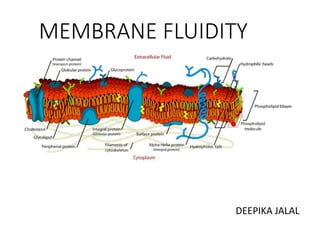
• All cells are surrounded by a cell membrane
that forms a barrier between the cell and its
surroundings.
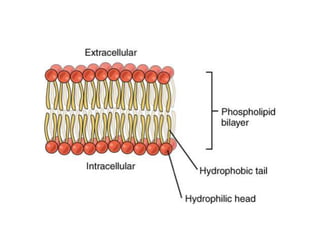
• This membrane is often referred to as the
phospholipid bilayer.
• The name, a phospholipid bilayer is made up of
two layers of lipids.
• The fluidity of this membrane must be
maintained within a certain range for the cell to
function properly.
• There are a number of factors that help
influence membrane fluidity.
•The length of the fatty acid tail
• The length of the fatty acid tail impacts the
fluidity of the membrane.
• This is because the intermolecular interactions
between the phospholipid tails add rigidity to
the membrane.
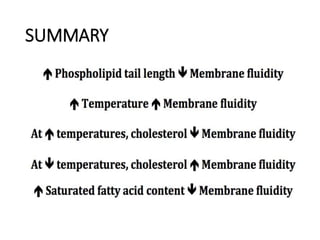
• As a result, the longer the phospholipid tails,
the more interactions between the tails are
possible and the less fluid the membrane will
be.
•Temperature
• As temperature increases, so does phospholipid
bilayer fluidity.
• At lower temperatures, phospholipids in the
bilayer do not have as much kinetic energy and
they cluster together more closely, increasing
intermolecular interactions and decreasing
membrane fluidity.
• At high temperatures the opposite process
occurs, phospholipids have enough kinetic
energy to overcome the intermolecular forces
holding the membrane together, which
increases membrane fluidity.
Cholesterol content of the
bilayer
• Cholesterol has a somewhat more complicated
relationship with membrane fluidity. it is a buffer
that helps keep membrane fluidity from getting too
high or too low at high and low temperatures.
• At low temperatures, phospholipids tend to cluster
together, but steroids in the phospholipid bilayer
fill in between the phospholipids, disrupting their
intermolecular interactions and increasing fluidity.
• At high temperatures, the phospholipids are
further apart. In this case, cholesterol in the
membrane has the opposite effect and pulls
phospholipids together, increasing intermolecular
forces and decreasing fluidity.
• The degree of saturation of fatty
acids tails
• Phospholipid tails can be saturated or
unsaturated.
• The terms saturated and unsaturated refer to
whether or not double bonds are present
between the carbons in the fatty acid tails.
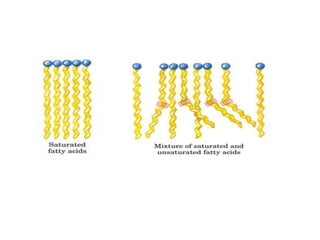
• Saturated tails have no double bonds and as a
result have straight, unkinked tails.
• Unsaturated tails have double bonds and, as a
result, have crooked, kinked tails.
• Saturated fatty acids tails are arranged in a way that
maximizes interactions between the tails.
• These interactions decrease bilayer fluidity.
• Unsaturated fatty acids, on the other hand, have
more distance between the tails and thus fewer
intermolecular interactions and more membrane
fluidity.
SUMMARY
Membrane fluidity

Membrane fluidity

  • 1.
  • 2.
    • All cellsare surrounded by a cell membrane that forms a barrier between the cell and its surroundings. • This membrane is often referred to as the phospholipid bilayer. • The name, a phospholipid bilayer is made up of two layers of lipids. • The fluidity of this membrane must be maintained within a certain range for the cell to function properly. • There are a number of factors that help influence membrane fluidity.
  • 4.
    •The length ofthe fatty acid tail • The length of the fatty acid tail impacts the fluidity of the membrane. • This is because the intermolecular interactions between the phospholipid tails add rigidity to the membrane. • As a result, the longer the phospholipid tails, the more interactions between the tails are possible and the less fluid the membrane will be.
  • 5.
    •Temperature • As temperatureincreases, so does phospholipid bilayer fluidity. • At lower temperatures, phospholipids in the bilayer do not have as much kinetic energy and they cluster together more closely, increasing intermolecular interactions and decreasing membrane fluidity. • At high temperatures the opposite process occurs, phospholipids have enough kinetic energy to overcome the intermolecular forces holding the membrane together, which increases membrane fluidity.
  • 6.
    Cholesterol content ofthe bilayer • Cholesterol has a somewhat more complicated relationship with membrane fluidity. it is a buffer that helps keep membrane fluidity from getting too high or too low at high and low temperatures. • At low temperatures, phospholipids tend to cluster together, but steroids in the phospholipid bilayer fill in between the phospholipids, disrupting their intermolecular interactions and increasing fluidity. • At high temperatures, the phospholipids are further apart. In this case, cholesterol in the membrane has the opposite effect and pulls phospholipids together, increasing intermolecular forces and decreasing fluidity.
  • 7.
    • The degreeof saturation of fatty acids tails • Phospholipid tails can be saturated or unsaturated. • The terms saturated and unsaturated refer to whether or not double bonds are present between the carbons in the fatty acid tails. • Saturated tails have no double bonds and as a result have straight, unkinked tails. • Unsaturated tails have double bonds and, as a result, have crooked, kinked tails.
  • 9.
    • Saturated fattyacids tails are arranged in a way that maximizes interactions between the tails. • These interactions decrease bilayer fluidity. • Unsaturated fatty acids, on the other hand, have more distance between the tails and thus fewer intermolecular interactions and more membrane fluidity.
  • 10.