Mariam Zaheer
Assistant Professor
Zoology Department
Govt. Graduate College of Science Wahdat Road,
Lahore
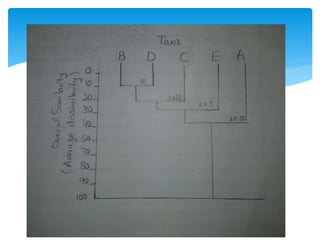
 A diagram depicting taxonomic
relationship among organisms based on
overall similarity of many characteristics
without any regard to evolutionary history.
Phenogram
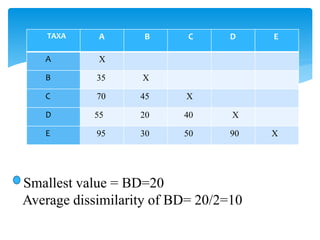
TAXA A B C D E
A X
B 35 X
C 70 45 X
D 55 20 40 X
E 95 30 50 90 X
Smallest value = BD=20
Average dissimilarity of BD= 20/2=10
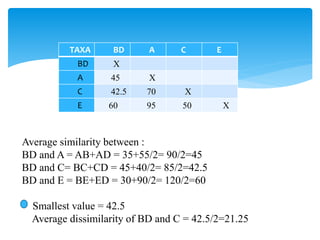
Average similarity between :
BD and A = AB+AD = 35+55/2= 90/2=45
BD and C= BC+CD = 45+40/2= 85/2=42.5
BD and E = BE+ED = 30+90/2= 120/2=60
Smallest value = 42.5
Average dissimilarity of BD and C = 42.5/2=21.25
TAXA BD A C E
BD X
A 45 X
C 42.5 70 X
E 60 95 50 X
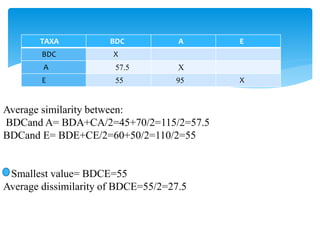
TAXA BDC A E
BDC X
A 57.5 X
E 55 95 X
Average similarity between:
BDCand A= BDA+CA/2=45+70/2=115/2=57.5
BDCand E= BDE+CE/2=60+50/2=110/2=55
Smallest value= BDCE=55
Average dissimilarity of BDCE=55/2=27.5
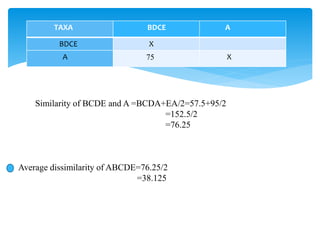
TAXA BDCE A
BDCE X
A 75 X
Similarity of BCDE and A =BCDA+EA/2=57.5+95/2
=152.5/2
=76.25
Average dissimilarity of ABCDE=76.25/2
=38.125
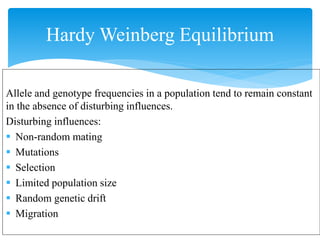
Allele and genotype frequencies in a population tend to remain constant
in the absence of disturbing influences.
Disturbing influences:
 Non-random mating
 Mutations
 Selection
 Limited population size
 Random genetic drift
 Migration
Hardy Weinberg Equilibrium
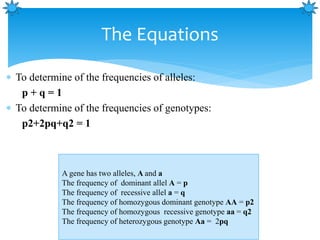
 To determine of the frequencies of alleles:
p + q = 1
 To determine of the frequencies of genotypes:
p2+2pq+q2 = 1
The Equations
A gene has two alleles, A and a
The frequency of dominant allel A = p
The frequency of recessive allel a = q
The frequency of homozygous dominant genotype AA = p2
The frequency of homozygous recessive genotype aa = q2
The frequency of heterozygous genotype Aa = 2pq
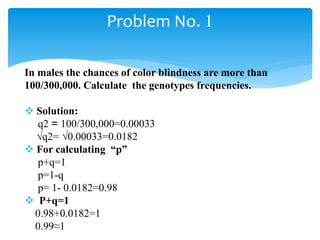
In males the chances of color blindness are more than
100/300,000. Calculate the genotypes frequencies.
 Solution:
q2 = 100/300,000=0.00033
√q2= √0.00033=0.0182
 For calculating “p”
p+q=1
p=1-q
p= 1- 0.0182=0.98
 P+q=1
0.98+0.0182=1
0.99≈1
Problem No. 1
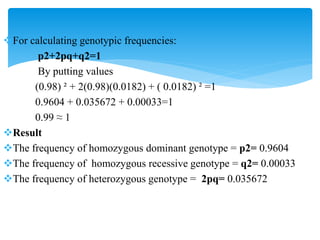
For calculating genotypic frequencies:
p2+2pq+q2=1
By putting values
(0.98) ² + 2(0.98)(0.0182) + ( 0.0182) ² =1
0.9604 + 0.035672 + 0.00033=1
0.99 ≈ 1
Result
The frequency of homozygous dominant genotype = p2= 0.9604
The frequency of homozygous recessive genotype = q2= 0.00033
The frequency of heterozygous genotype = 2pq= 0.035672
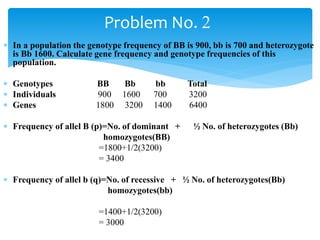
 In a population the genotype frequency of BB is 900, bb is 700 and heterozygote
is Bb 1600. Calculate gene frequency and genotype frequencies of this
population.
 Genotypes BB Bb bb Total
 Individuals 900 1600 700 3200
 Genes 1800 3200 1400 6400
 Frequency of allel B (p)=No. of dominant + ½ No. of heterozygotes (Bb)
homozygotes(BB)
=1800+1/2(3200)
= 3400
 Frequency of allel b (q)=No. of recessive + ½ No. of heterozygotes(Bb)
homozygotes(bb)
=1400+1/2(3200)
= 3000
Problem No. 2
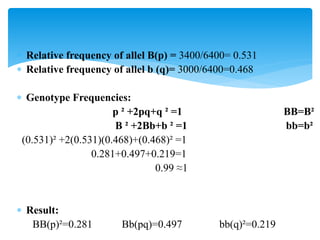
 Relative frequency of allel B(p) = 3400/6400= 0.531
 Relative frequency of allel b (q)= 3000/6400=0.468
 Genotype Frequencies:
p ² +2pq+q ² =1 BB=B²
B ² +2Bb+b ² =1 bb=b²
(0.531)² +2(0.531)(0.468)+(0.468)² =1
0.281+0.497+0.219=1
0.99 ≈1
 Result:
BB(p)²=0.281 Bb(pq)=0.497 bb(q)²=0.219
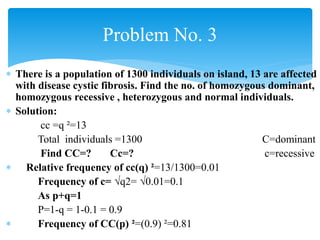
 There is a population of 1300 individuals on island, 13 are affected
with disease cystic fibrosis. Find the no. of homozygous dominant,
homozygous recessive , heterozygous and normal individuals.
 Solution:
cc =q ²=13
Total individuals =1300 C=dominant
Find CC=? Cc=? c=recessive
 Relative frequency of cc(q) ²=13/1300=0.01
Frequency of c= √q2= √0.01=0.1
As p+q=1
P=1-q = 1-0.1 = 0.9
 Frequency of CC(p) ²=(0.9) ²=0.81
Problem No. 3
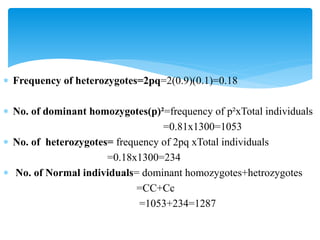
 Frequency of heterozygotes=2pq=2(0.9)(0.1)=0.18
 No. of dominant homozygotes(p)²=frequency of p²xTotal individuals
=0.81x1300=1053
 No. of heterozygotes= frequency of 2pq xTotal individuals
=0.18x1300=234
 No. of Normal individuals= dominant homozygotes+hetrozygotes
=CC+Cc
=1053+234=1287
Phenogram and hardy weinberg equillibrum

Phenogram and hardy weinberg equillibrum

  • 2.
    Mariam Zaheer Assistant Professor ZoologyDepartment Govt. Graduate College of Science Wahdat Road, Lahore
  • 3.
     A diagramdepicting taxonomic relationship among organisms based on overall similarity of many characteristics without any regard to evolutionary history. Phenogram
  • 4.
    TAXA A BC D E A X B 35 X C 70 45 X D 55 20 40 X E 95 30 50 90 X Smallest value = BD=20 Average dissimilarity of BD= 20/2=10
  • 5.
    Average similarity between: BD and A = AB+AD = 35+55/2= 90/2=45 BD and C= BC+CD = 45+40/2= 85/2=42.5 BD and E = BE+ED = 30+90/2= 120/2=60 Smallest value = 42.5 Average dissimilarity of BD and C = 42.5/2=21.25 TAXA BD A C E BD X A 45 X C 42.5 70 X E 60 95 50 X
  • 6.
    TAXA BDC AE BDC X A 57.5 X E 55 95 X Average similarity between: BDCand A= BDA+CA/2=45+70/2=115/2=57.5 BDCand E= BDE+CE/2=60+50/2=110/2=55 Smallest value= BDCE=55 Average dissimilarity of BDCE=55/2=27.5
  • 7.
    TAXA BDCE A BDCEX A 75 X Similarity of BCDE and A =BCDA+EA/2=57.5+95/2 =152.5/2 =76.25 Average dissimilarity of ABCDE=76.25/2 =38.125
  • 9.
    Allele and genotypefrequencies in a population tend to remain constant in the absence of disturbing influences. Disturbing influences:  Non-random mating  Mutations  Selection  Limited population size  Random genetic drift  Migration Hardy Weinberg Equilibrium
  • 10.
     To determineof the frequencies of alleles: p + q = 1  To determine of the frequencies of genotypes: p2+2pq+q2 = 1 The Equations A gene has two alleles, A and a The frequency of dominant allel A = p The frequency of recessive allel a = q The frequency of homozygous dominant genotype AA = p2 The frequency of homozygous recessive genotype aa = q2 The frequency of heterozygous genotype Aa = 2pq
  • 11.
    In males thechances of color blindness are more than 100/300,000. Calculate the genotypes frequencies.  Solution: q2 = 100/300,000=0.00033 √q2= √0.00033=0.0182  For calculating “p” p+q=1 p=1-q p= 1- 0.0182=0.98  P+q=1 0.98+0.0182=1 0.99≈1 Problem No. 1
  • 12.
    For calculating genotypicfrequencies: p2+2pq+q2=1 By putting values (0.98) ² + 2(0.98)(0.0182) + ( 0.0182) ² =1 0.9604 + 0.035672 + 0.00033=1 0.99 ≈ 1 Result The frequency of homozygous dominant genotype = p2= 0.9604 The frequency of homozygous recessive genotype = q2= 0.00033 The frequency of heterozygous genotype = 2pq= 0.035672
  • 13.
     In apopulation the genotype frequency of BB is 900, bb is 700 and heterozygote is Bb 1600. Calculate gene frequency and genotype frequencies of this population.  Genotypes BB Bb bb Total  Individuals 900 1600 700 3200  Genes 1800 3200 1400 6400  Frequency of allel B (p)=No. of dominant + ½ No. of heterozygotes (Bb) homozygotes(BB) =1800+1/2(3200) = 3400  Frequency of allel b (q)=No. of recessive + ½ No. of heterozygotes(Bb) homozygotes(bb) =1400+1/2(3200) = 3000 Problem No. 2
  • 14.
     Relative frequencyof allel B(p) = 3400/6400= 0.531  Relative frequency of allel b (q)= 3000/6400=0.468  Genotype Frequencies: p ² +2pq+q ² =1 BB=B² B ² +2Bb+b ² =1 bb=b² (0.531)² +2(0.531)(0.468)+(0.468)² =1 0.281+0.497+0.219=1 0.99 ≈1  Result: BB(p)²=0.281 Bb(pq)=0.497 bb(q)²=0.219
  • 15.
     There isa population of 1300 individuals on island, 13 are affected with disease cystic fibrosis. Find the no. of homozygous dominant, homozygous recessive , heterozygous and normal individuals.  Solution: cc =q ²=13 Total individuals =1300 C=dominant Find CC=? Cc=? c=recessive  Relative frequency of cc(q) ²=13/1300=0.01 Frequency of c= √q2= √0.01=0.1 As p+q=1 P=1-q = 1-0.1 = 0.9  Frequency of CC(p) ²=(0.9) ²=0.81 Problem No. 3
  • 16.
     Frequency ofheterozygotes=2pq=2(0.9)(0.1)=0.18  No. of dominant homozygotes(p)²=frequency of p²xTotal individuals =0.81x1300=1053  No. of heterozygotes= frequency of 2pq xTotal individuals =0.18x1300=234  No. of Normal individuals= dominant homozygotes+hetrozygotes =CC+Cc =1053+234=1287