1. An action potential is a brief change in the membrane potential of a muscle or nerve cell triggered by the stimulation of voltage-gated ion channels.
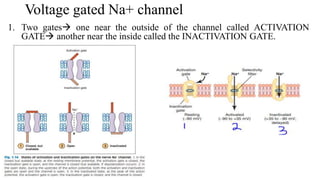
2. During an action potential, sodium channels open allowing sodium ions to enter the cell, causing rapid depolarization. Then, potassium channels open and sodium channels close, repolarizing the membrane back to its resting potential.
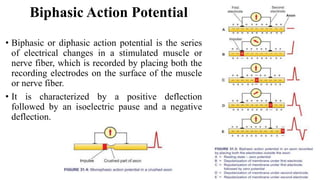
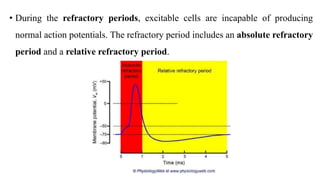
3. The stages of an action potential are resting, depolarization, and repolarization. After an action potential occurs, the cell enters an absolute refractory period where it cannot generate another action potential, followed by a relative refractory period.