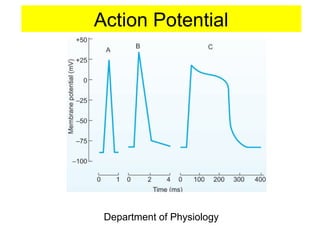
Action Potential
Department of Physiology
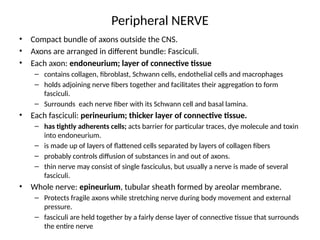
Peripheral NERVE
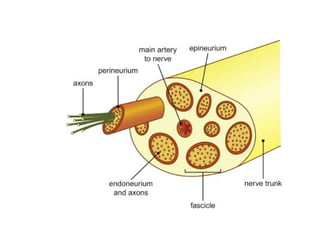
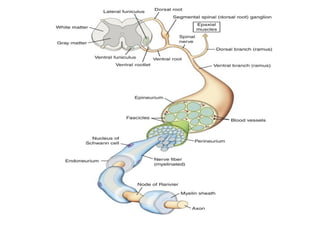
• Compact bundle of axons outside the CNS.
• Axons are arranged in different bundle: Fasciculi.
• Each axon: endoneurium; layer of connective tissue
– contains collagen, fibroblast, Schwann cells, endothelial cells and macrophages
– holds adjoining nerve fibers together and facilitates their aggregation to form
fasciculi.
– Surrounds each nerve fiber with its Schwann cell and basal lamina.
• Each fasciculi: perineurium; thicker layer of connective tissue.
– has tightly adherents cells; acts barrier for particular traces, dye molecule and toxin
into endoneurium.
– is made up of layers of flattened cells separated by layers of collagen fibers
– probably controls diffusion of substances in and out of axons.
– thin nerve may consist of single fasciculus, but usually a nerve is made of several
fasciculi.
• Whole nerve: epineurium, tubular sheath formed by areolar membrane.
– Protects fragile axons while stretching nerve during body movement and external
pressure.
– fasciculi are held together by a fairly dense layer of connective tissue that surrounds
the entire nerve
Clinical correlation of neuronal structure
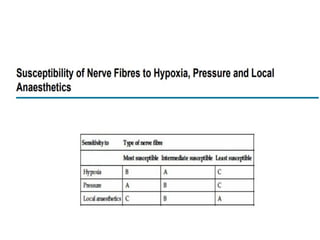
• The epineurium contains nerve fibers. Loss of
this fat in bedridden patients can lead to
pressure on nerve fibers and paralysis.
• Blood vessels to a nerve travel through the
connective tissue that surrounds it. Severe
reduction in blood supply can lead to ischemic
neuritis and pain.
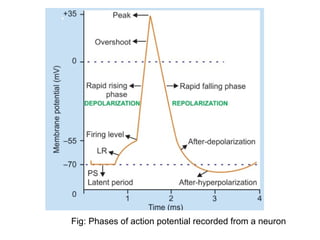
Fig: Phases of action potential recorded from a neuron
Roles of other ions during Action potential
• Impermeant Negatively Charged Ions (Anions) Inside the Nerve
Axon.
• anions of protein molecules and of many organic phosphate compounds,
sulfate compounds, and so forth.
• any deficit of positive ions inside the membrane responsible for the negative
charge inside the fiber
• Calcium ion
• voltage-gated calcium channels slightly permeable to sodium ions as well as
to calcium ions.
• 10-20 times slow for activation than sodium channel.
• increased Permeability of the Sodium Channels When there Is a Deficit of
Calcium Ions.
– spontaneous discharge occurs in some peripheral nerves, often causing muscle “tetany.
– tetanic contraction of the respiratory muscles can be lethal.
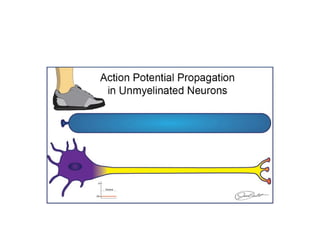
Propagation of the Action Potential
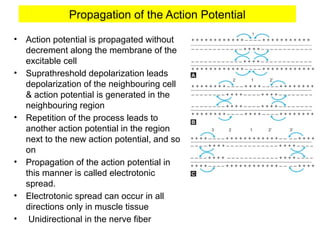
• Action potential is propagated without
decrement along the membrane of the
excitable cell
• Suprathreshold depolarization leads
depolarization of the neighbouring cell
& action potential is generated in the
neighbouring region
• Repetition of the process leads to
another action potential in the region
next to the new action potential, and so
on
• Propagation of the action potential in
this manner is called electrotonic
spread.
• Electrotonic spread can occur in all
directions only in muscle tissue
• Unidirectional in the nerve fiber
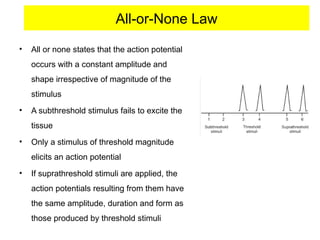
All-or-None Law
• All or none states that the action potential
occurs with a constant amplitude and
shape irrespective of magnitude of the
stimulus
• A subthreshold stimulus fails to excite the
tissue
• Only a stimulus of threshold magnitude
elicits an action potential
• If suprathreshold stimuli are applied, the
action potentials resulting from them have
the same amplitude, duration and form as
those produced by threshold stimuli
Inhibition of Excitability— “Stabilizers” and Local Anesthetics
• Calcium ion as stabilizer: For instance, a high extracellular fluid calcium ion
concentration decreases membrane permeability to sodium ions and simultaneously
reduces excitability
• Local Anesthetics:including procaine and tetracaine; act directly on the activation
gates of the sodium channels, making difficult for gates to open, thereby reducing
membrane excitability.
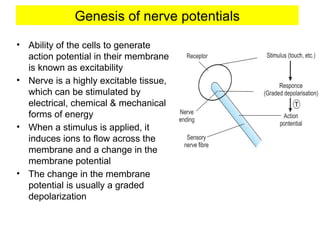
Genesis of nerve potentials
• Ability of the cells to generate
action potential in their membrane
is known as excitability
• Nerve is a highly excitable tissue,
which can be stimulated by
electrical, chemical & mechanical
forms of energy
• When a stimulus is applied, it
induces ions to flow across the
membrane and a change in the
membrane potential
• The change in the membrane
potential is usually a graded
depolarization
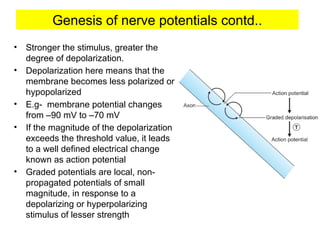
• Stronger the stimulus, greater the
degree of depolarization.
• Depolarization here means that the
membrane becomes less polarized or
hypopolarized
• E.g- membrane potential changes
from –90 mV to –70 mV
• If the magnitude of the depolarization
exceeds the threshold value, it leads
to a well defined electrical change
known as action potential
• Graded potentials are local, non-
propagated potentials of small
magnitude, in response to a
depolarizing or hyperpolarizing
stimulus of lesser strength
Genesis of nerve potentials contd..
Action Potential
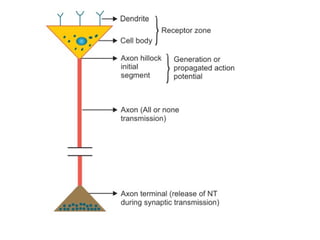
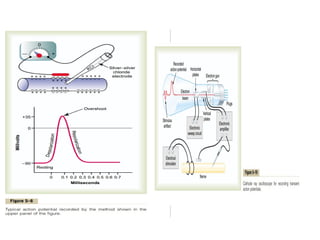
• A transient change in membrane potential of about 100 mV,
which is conducted along the axon in an all-or-none fashion
• Features:
– characterized by a gradual depolarization to threshold,
and a rapid ascent in the membrane potential followed by
a phase of repolarization
– Travels along the axon with the same shape and
amplitude being regenerated at regular intervals.
– Also known as an impulse or spike potential
• Latent Period
– Action potential is always preceded by a latent period,
which is the interval between the application of a stimulus
and the onset of action potential
Phases of action potential
• Depolarization
– recorded as a sharp upward wave during which the
membrane potential approaches zero and then attains a
positive value
– It of slow depolarization to threshold, rapid rising phase,
overshoot and peak
• Repolarization
– Recorded as downstroke during which the membrane
potential returns to the resting level.
– includes a rapid falling phase & slower terminal part called
after-depolarization.
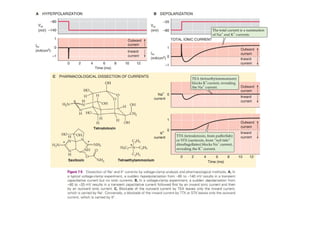
Ionic Basis of Action Potential
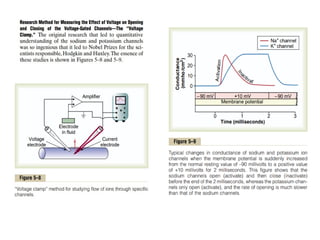
• Action potential is generated by sequential changes in membrane
permeability to ions, principally Na & K ions
• Depolarization is due to an increase in permeability to Na+
which is
favoured by concentration gradient as well as the electrical gradient which
leads to a rapid entry of sodium ions
• Positively charged sodium ions leads to depolarization lasts only a short
while
• When the Na permeability starts declining, the membrane permeability to
potassium ions starts increasing. Since the concentration of K is higher
inside the cell, and the outside of the cell is negative at the peak of the
action potential, potassium ions diffuse outwards
• Decline in sodium permeability coupled with increase in potassium
permeability brings about repolarization
• At the end of an action potential, the excitable cell has more sodium ions
and less potassium ions than at the beginning
• Bringing the concentration back towards the original is the job of the
sodium pump, which it does slowly
• Depolarization
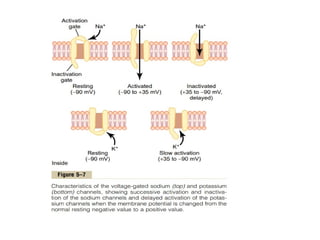
– When a threshold stimulus is applied, the influx of Na+
through leaky channels & later through opening of few
voltage-gated Na+
channels decreases the membrane
potential from –70 mV to –55 mV (threshold level)
– At this threshold potential, there occurs opening of a large
n.o of the voltage-gated Na+ channels, ↑ing the membrane
permeability to Na+
ions several 100x fold leads to massive
influx of sodium ions producing a swift, large & steep
depolarization, changing the membrane potential to +35
mV
– concentration gradient as well as electrical gradient favors
the entry of sodium ions across the membrane
• Repolarization
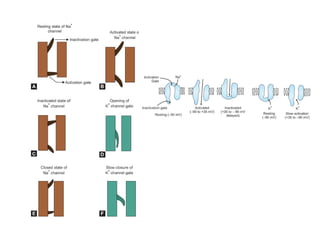
– Due to opening of voltage-gated K+ channels, causing
membrane permeability to potassium ions increases
several times causing increased potassium efflux
– At the peak of the action potential, voltage-gated Na+
channels enter a closed state whereas the voltage gated
K+ channels are fully open
– Termination of action potential due to activation of voltage-
gated potassium channels is a negative feedback process
Fig: Ionic basis of action potential
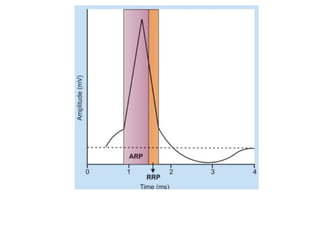
Refractory Period
• During the action potential, the stimulated area of the
membrane happens to be unresponsive to a second stimulus
in most part, and later it requires a stronger stimulus to get
excited again.
• The length of time during which the membrane is
unresponsive to a second stimulus no matter how strong is
the stimulus, is known as refractory period
• 2 types
– Absolute refractory periods
– Relative refractory periods
Absolute Refractory Period
• Period in the action potential during which, application of a second
stimulus of any strength and duration does not produce another
action potential
• ARP corresponds to the period from the time the firing level is
reached until repolarization is about one-third complete
• Mechanism- inactivation gates of the voltage-gated sodium
channels close and they remain in that inactivated state for some
time before returning to the resting state & can reopen in response
to a second stimulus, only after attaining the resting state
Relative Refractory Period
• Period following ARP during which, application of a
suprathreshold stimulus can elicit a second action potential
• RRP starts from the end of ARP to the start of after-
depolarization
• Mechanism- all the sodium channels present at the site of
stimulus do not achieve the open state or inactivated state or
resting state, exactly at the same time
action potential and properties.....pptx

  • 1.
  • 2.
    Peripheral NERVE • Compactbundle of axons outside the CNS. • Axons are arranged in different bundle: Fasciculi. • Each axon: endoneurium; layer of connective tissue – contains collagen, fibroblast, Schwann cells, endothelial cells and macrophages – holds adjoining nerve fibers together and facilitates their aggregation to form fasciculi. – Surrounds each nerve fiber with its Schwann cell and basal lamina. • Each fasciculi: perineurium; thicker layer of connective tissue. – has tightly adherents cells; acts barrier for particular traces, dye molecule and toxin into endoneurium. – is made up of layers of flattened cells separated by layers of collagen fibers – probably controls diffusion of substances in and out of axons. – thin nerve may consist of single fasciculus, but usually a nerve is made of several fasciculi. • Whole nerve: epineurium, tubular sheath formed by areolar membrane. – Protects fragile axons while stretching nerve during body movement and external pressure. – fasciculi are held together by a fairly dense layer of connective tissue that surrounds the entire nerve
  • 6.
    Clinical correlation ofneuronal structure • The epineurium contains nerve fibers. Loss of this fat in bedridden patients can lead to pressure on nerve fibers and paralysis. • Blood vessels to a nerve travel through the connective tissue that surrounds it. Severe reduction in blood supply can lead to ischemic neuritis and pain.
  • 21.
    Fig: Phases ofaction potential recorded from a neuron
  • 28.
    Roles of otherions during Action potential • Impermeant Negatively Charged Ions (Anions) Inside the Nerve Axon. • anions of protein molecules and of many organic phosphate compounds, sulfate compounds, and so forth. • any deficit of positive ions inside the membrane responsible for the negative charge inside the fiber • Calcium ion • voltage-gated calcium channels slightly permeable to sodium ions as well as to calcium ions. • 10-20 times slow for activation than sodium channel. • increased Permeability of the Sodium Channels When there Is a Deficit of Calcium Ions. – spontaneous discharge occurs in some peripheral nerves, often causing muscle “tetany. – tetanic contraction of the respiratory muscles can be lethal.
  • 32.
    Propagation of theAction Potential • Action potential is propagated without decrement along the membrane of the excitable cell • Suprathreshold depolarization leads depolarization of the neighbouring cell & action potential is generated in the neighbouring region • Repetition of the process leads to another action potential in the region next to the new action potential, and so on • Propagation of the action potential in this manner is called electrotonic spread. • Electrotonic spread can occur in all directions only in muscle tissue • Unidirectional in the nerve fiber
  • 34.
    All-or-None Law • Allor none states that the action potential occurs with a constant amplitude and shape irrespective of magnitude of the stimulus • A subthreshold stimulus fails to excite the tissue • Only a stimulus of threshold magnitude elicits an action potential • If suprathreshold stimuli are applied, the action potentials resulting from them have the same amplitude, duration and form as those produced by threshold stimuli
  • 35.
    Inhibition of Excitability—“Stabilizers” and Local Anesthetics • Calcium ion as stabilizer: For instance, a high extracellular fluid calcium ion concentration decreases membrane permeability to sodium ions and simultaneously reduces excitability • Local Anesthetics:including procaine and tetracaine; act directly on the activation gates of the sodium channels, making difficult for gates to open, thereby reducing membrane excitability.
  • 38.
    Genesis of nervepotentials • Ability of the cells to generate action potential in their membrane is known as excitability • Nerve is a highly excitable tissue, which can be stimulated by electrical, chemical & mechanical forms of energy • When a stimulus is applied, it induces ions to flow across the membrane and a change in the membrane potential • The change in the membrane potential is usually a graded depolarization
  • 39.
    • Stronger thestimulus, greater the degree of depolarization. • Depolarization here means that the membrane becomes less polarized or hypopolarized • E.g- membrane potential changes from –90 mV to –70 mV • If the magnitude of the depolarization exceeds the threshold value, it leads to a well defined electrical change known as action potential • Graded potentials are local, non- propagated potentials of small magnitude, in response to a depolarizing or hyperpolarizing stimulus of lesser strength Genesis of nerve potentials contd..
  • 40.
    Action Potential • Atransient change in membrane potential of about 100 mV, which is conducted along the axon in an all-or-none fashion • Features: – characterized by a gradual depolarization to threshold, and a rapid ascent in the membrane potential followed by a phase of repolarization – Travels along the axon with the same shape and amplitude being regenerated at regular intervals. – Also known as an impulse or spike potential
  • 41.
    • Latent Period –Action potential is always preceded by a latent period, which is the interval between the application of a stimulus and the onset of action potential
  • 42.
    Phases of actionpotential • Depolarization – recorded as a sharp upward wave during which the membrane potential approaches zero and then attains a positive value – It of slow depolarization to threshold, rapid rising phase, overshoot and peak • Repolarization – Recorded as downstroke during which the membrane potential returns to the resting level. – includes a rapid falling phase & slower terminal part called after-depolarization.
  • 43.
    Ionic Basis ofAction Potential • Action potential is generated by sequential changes in membrane permeability to ions, principally Na & K ions • Depolarization is due to an increase in permeability to Na+ which is favoured by concentration gradient as well as the electrical gradient which leads to a rapid entry of sodium ions • Positively charged sodium ions leads to depolarization lasts only a short while • When the Na permeability starts declining, the membrane permeability to potassium ions starts increasing. Since the concentration of K is higher inside the cell, and the outside of the cell is negative at the peak of the action potential, potassium ions diffuse outwards • Decline in sodium permeability coupled with increase in potassium permeability brings about repolarization • At the end of an action potential, the excitable cell has more sodium ions and less potassium ions than at the beginning • Bringing the concentration back towards the original is the job of the sodium pump, which it does slowly
  • 44.
    • Depolarization – Whena threshold stimulus is applied, the influx of Na+ through leaky channels & later through opening of few voltage-gated Na+ channels decreases the membrane potential from –70 mV to –55 mV (threshold level) – At this threshold potential, there occurs opening of a large n.o of the voltage-gated Na+ channels, ↑ing the membrane permeability to Na+ ions several 100x fold leads to massive influx of sodium ions producing a swift, large & steep depolarization, changing the membrane potential to +35 mV – concentration gradient as well as electrical gradient favors the entry of sodium ions across the membrane
  • 45.
    • Repolarization – Dueto opening of voltage-gated K+ channels, causing membrane permeability to potassium ions increases several times causing increased potassium efflux – At the peak of the action potential, voltage-gated Na+ channels enter a closed state whereas the voltage gated K+ channels are fully open – Termination of action potential due to activation of voltage- gated potassium channels is a negative feedback process
  • 46.
    Fig: Ionic basisof action potential
  • 49.
    Refractory Period • Duringthe action potential, the stimulated area of the membrane happens to be unresponsive to a second stimulus in most part, and later it requires a stronger stimulus to get excited again. • The length of time during which the membrane is unresponsive to a second stimulus no matter how strong is the stimulus, is known as refractory period • 2 types – Absolute refractory periods – Relative refractory periods
  • 50.
    Absolute Refractory Period •Period in the action potential during which, application of a second stimulus of any strength and duration does not produce another action potential • ARP corresponds to the period from the time the firing level is reached until repolarization is about one-third complete • Mechanism- inactivation gates of the voltage-gated sodium channels close and they remain in that inactivated state for some time before returning to the resting state & can reopen in response to a second stimulus, only after attaining the resting state
  • 51.
    Relative Refractory Period •Period following ARP during which, application of a suprathreshold stimulus can elicit a second action potential • RRP starts from the end of ARP to the start of after- depolarization • Mechanism- all the sodium channels present at the site of stimulus do not achieve the open state or inactivated state or resting state, exactly at the same time