Download as PDF, PPTX
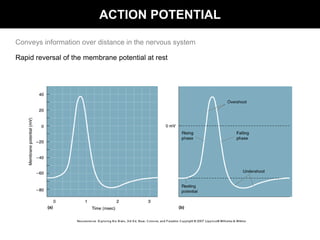
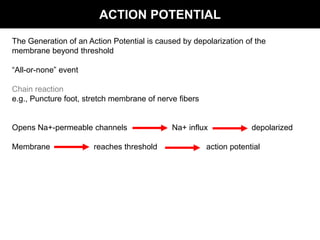


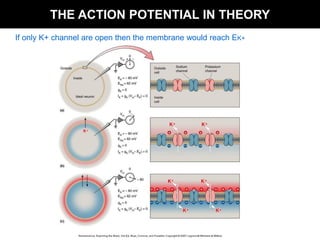

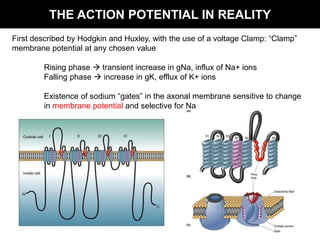


The action potential conveys information over distance in the nervous system through a rapid reversal of the membrane potential at rest. It is generated when the membrane potential is depolarized beyond a threshold, causing an "all-or-nothing" event. The rising phase of the action potential is caused by sodium influx through voltage-gated sodium channels, while the falling phase occurs via potassium efflux through voltage-gated potassium channels. The action potential is able to propagate down the axon due to its unique ion channel properties and myelination of axons, which facilitates faster saltatory conduction.


