MELTING AND BOILING SEC 3 PHYSICS
On the Molecular Level We have learnt previously that when molecules absorb heat energy, they will start to move faster.  When the molecules have reached a certain speed, the energy that they absorb will now be used to break the attractive forces between them.
On a Molecular Level (cont’d) When the energy absorbed is used to break the attractive forces between them, there is no increase in speed. Which means energy absorbed can only be used for either one of the purpose (break attractive forces OR increase in speed). Only one change is taking place at any time.
So what do we see? When the energy is used to increase the speed of the molecule, we see a rise in temperature of the substance. When the energy is used to break attractive forces between molecules, we see the substance changing in state. This energy which brings about a change in state is known as  LATENT HEAT
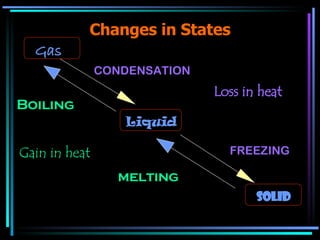
Changes in States melting Boiling CONDENSATION FREEZING Gain in heat Loss in heat Solid Gas Liquid
MELTING AND SOLIDIFICATION When a  solid changes to a liquid  on heating, we call it  melting In this instance, heat is  ABSORBED  by the substance When a  liquid changes to a solid  on cooling, we call it  solidification (freezing) In this instance, heat is  LOST  by the substance
MELTING AND SOLIDIFICATION In both cases, the heat that is absorbed or lost is known as the  latent heat of fusion. When this latent heat is absorbed or lost, there is no change in temperature. This means when a substance is undergoing a change in state, the temperature will remain constant.
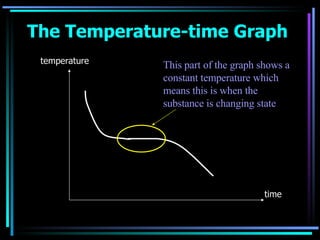
The Temperature-time Graph temperature time This part of the graph shows a constant temperature which means this is when the substance is changing state
Effect of Impurities on Freezing Point When impurities are added to water, it would lower the freezing point of water. This means that water now freezes at a lower temperature.
Effect of Impurities on Freezing Point Example:   I have 2 cups of water, A and B. I add salt to B. When I try to freeze the water in both cups, A would freeze at 0 o C but B would freeze maybe at –10 o C. This means B would stay as a liquid even at 0 o C or lower until the temperature reaches –10 o C. When A becomes solid ice at 0 o C, B is still liquid.
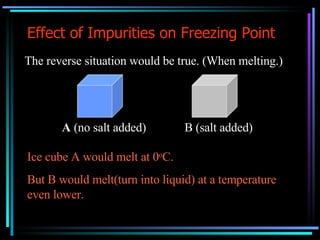
Effect of Impurities on Freezing Point The reverse situation would be true. (When melting.) A  (no salt added) B (salt added) Ice cube A would melt at 0 o C.  But B would melt(turn into liquid) at a temperature even lower.
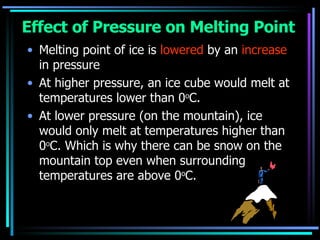
Effect of Pressure on Melting Point Melting point of ice is  lowered  by an  increase  in pressure At higher pressure, an ice cube would melt at temperatures lower than 0 o C. At lower pressure (on the mountain), ice would only melt at temperatures higher than 0 o C. Which is why there can be snow on the mountain top even when surrounding temperatures are above 0 o C.
Example of pressing two ice cubes together. When pressed together, the pressure they experience is higher, so the melting point is lowered causing the ice to melt.  When hand releases, the pressure they experience is lowered, so the water will now freeze at higher temperature.  Another example is walking on ice. And ice skating.  Effect of Pressure on Melting Point
boiling AND condensation When a  liquid changes to a gas  on heating, we call it  boiling In this instance, heat is  ABSORBED  by the substance When a  gas changes to a liquid  on cooling, we call it  condensation. In this instance, heat is  LOST  by the substance
Boiling AND condensation In both cases, the heat that is absorbed or lost is known as the  latent heat of vaporisation. When this latent heat is absorbed or lost, there is no change in temperature. This means when a substance is undergoing a change in state, the temperature will remain constant.
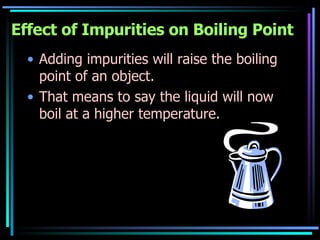
Effect of Impurities on Boiling Point Adding impurities will raise the boiling point of an object. That means to say the liquid will now boil at a higher temperature.
Effect of Pressure On Boiling Point Lower pressure would lower the boiling point of water. Water will boil very quickly on the mountain top but the temperature reached is lower than 100 o C. Increasing pressure would raise the boiling point of water. Water will boil at a higher temperature above 100 o C.
Specific Latent Heat Recall that the energy absorbed or released causing a change in state is known as latent heat.  Example:  latent heat of fusion   latent heat of vaporisation
Specific Latent Heat This is the heat absorbed or released when 1 kg of the substance undergoes a change in state. There are 2 types of specific latent heat: Specific latent heat of fusion Specific latent heat of vaporisation
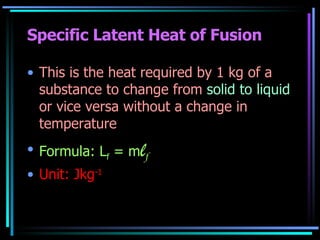
Specific Latent Heat of Fusion This is the heat required by 1 kg of a substance to change from  solid to liquid  or vice versa without a change in temperature Formula: L f  = m l f Unit: Jkg -1
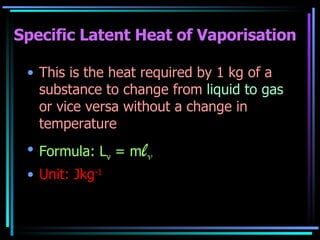
Specific Latent Heat of Vaporisation This is the heat required by 1 kg of a substance to change from  liquid to gas  or vice versa without a change in temperature Formula: L v  = m l v Unit: Jkg -1
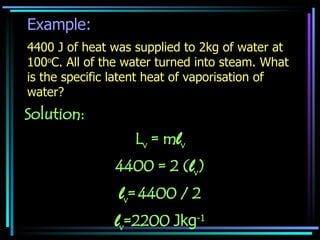
Example: 4400 J of heat was supplied to 2kg of water at 100 o C. All of the water turned into steam. What is the specific latent heat of vaporisation of water? Solution: L v  = m l v 4400 = 2 ( l v ) l v =   4400 / 2 l v =2200  Jkg -1
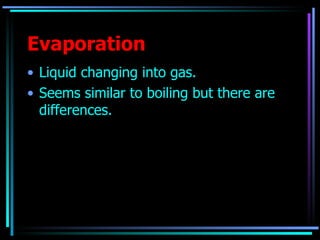
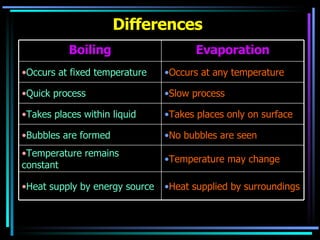
Evaporation Liquid changing into gas. Seems similar to boiling but there are differences.
Differences   Heat supplied by surroundings Heat supply by energy source Temperature may change Temperature remains constant No bubbles are seen Bubbles are formed Takes places only on surface Takes places within liquid Slow process Quick process Occurs at any temperature Occurs at fixed temperature Evaporation Boiling
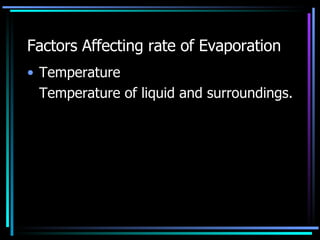
Factors Affecting rate of Evaporation Temperature Temperature of liquid and surroundings.

Changes of state

  • 1.
    MELTING AND BOILINGSEC 3 PHYSICS
  • 2.
    On the MolecularLevel We have learnt previously that when molecules absorb heat energy, they will start to move faster. When the molecules have reached a certain speed, the energy that they absorb will now be used to break the attractive forces between them.
  • 3.
    On a MolecularLevel (cont’d) When the energy absorbed is used to break the attractive forces between them, there is no increase in speed. Which means energy absorbed can only be used for either one of the purpose (break attractive forces OR increase in speed). Only one change is taking place at any time.
  • 4.
    So what dowe see? When the energy is used to increase the speed of the molecule, we see a rise in temperature of the substance. When the energy is used to break attractive forces between molecules, we see the substance changing in state. This energy which brings about a change in state is known as LATENT HEAT
  • 5.
    Changes in Statesmelting Boiling CONDENSATION FREEZING Gain in heat Loss in heat Solid Gas Liquid
  • 6.
    MELTING AND SOLIDIFICATIONWhen a solid changes to a liquid on heating, we call it melting In this instance, heat is ABSORBED by the substance When a liquid changes to a solid on cooling, we call it solidification (freezing) In this instance, heat is LOST by the substance
  • 7.
    MELTING AND SOLIDIFICATIONIn both cases, the heat that is absorbed or lost is known as the latent heat of fusion. When this latent heat is absorbed or lost, there is no change in temperature. This means when a substance is undergoing a change in state, the temperature will remain constant.
  • 8.
    The Temperature-time Graphtemperature time This part of the graph shows a constant temperature which means this is when the substance is changing state
  • 9.
    Effect of Impuritieson Freezing Point When impurities are added to water, it would lower the freezing point of water. This means that water now freezes at a lower temperature.
  • 10.
    Effect of Impuritieson Freezing Point Example: I have 2 cups of water, A and B. I add salt to B. When I try to freeze the water in both cups, A would freeze at 0 o C but B would freeze maybe at –10 o C. This means B would stay as a liquid even at 0 o C or lower until the temperature reaches –10 o C. When A becomes solid ice at 0 o C, B is still liquid.
  • 11.
    Effect of Impuritieson Freezing Point The reverse situation would be true. (When melting.) A (no salt added) B (salt added) Ice cube A would melt at 0 o C. But B would melt(turn into liquid) at a temperature even lower.
  • 12.
    Effect of Pressureon Melting Point Melting point of ice is lowered by an increase in pressure At higher pressure, an ice cube would melt at temperatures lower than 0 o C. At lower pressure (on the mountain), ice would only melt at temperatures higher than 0 o C. Which is why there can be snow on the mountain top even when surrounding temperatures are above 0 o C.
  • 13.
    Example of pressingtwo ice cubes together. When pressed together, the pressure they experience is higher, so the melting point is lowered causing the ice to melt. When hand releases, the pressure they experience is lowered, so the water will now freeze at higher temperature. Another example is walking on ice. And ice skating. Effect of Pressure on Melting Point
  • 14.
    boiling AND condensationWhen a liquid changes to a gas on heating, we call it boiling In this instance, heat is ABSORBED by the substance When a gas changes to a liquid on cooling, we call it condensation. In this instance, heat is LOST by the substance
  • 15.
    Boiling AND condensationIn both cases, the heat that is absorbed or lost is known as the latent heat of vaporisation. When this latent heat is absorbed or lost, there is no change in temperature. This means when a substance is undergoing a change in state, the temperature will remain constant.
  • 16.
    Effect of Impuritieson Boiling Point Adding impurities will raise the boiling point of an object. That means to say the liquid will now boil at a higher temperature.
  • 17.
    Effect of PressureOn Boiling Point Lower pressure would lower the boiling point of water. Water will boil very quickly on the mountain top but the temperature reached is lower than 100 o C. Increasing pressure would raise the boiling point of water. Water will boil at a higher temperature above 100 o C.
  • 18.
    Specific Latent HeatRecall that the energy absorbed or released causing a change in state is known as latent heat. Example: latent heat of fusion latent heat of vaporisation
  • 19.
    Specific Latent HeatThis is the heat absorbed or released when 1 kg of the substance undergoes a change in state. There are 2 types of specific latent heat: Specific latent heat of fusion Specific latent heat of vaporisation
  • 20.
    Specific Latent Heatof Fusion This is the heat required by 1 kg of a substance to change from solid to liquid or vice versa without a change in temperature Formula: L f = m l f Unit: Jkg -1
  • 21.
    Specific Latent Heatof Vaporisation This is the heat required by 1 kg of a substance to change from liquid to gas or vice versa without a change in temperature Formula: L v = m l v Unit: Jkg -1
  • 22.
    Example: 4400 Jof heat was supplied to 2kg of water at 100 o C. All of the water turned into steam. What is the specific latent heat of vaporisation of water? Solution: L v = m l v 4400 = 2 ( l v ) l v = 4400 / 2 l v =2200 Jkg -1
  • 23.
    Evaporation Liquid changinginto gas. Seems similar to boiling but there are differences.
  • 24.
    Differences Heat supplied by surroundings Heat supply by energy source Temperature may change Temperature remains constant No bubbles are seen Bubbles are formed Takes places only on surface Takes places within liquid Slow process Quick process Occurs at any temperature Occurs at fixed temperature Evaporation Boiling
  • 25.
    Factors Affecting rateof Evaporation Temperature Temperature of liquid and surroundings.