





Ch.6.2 Diffusion
Lesson objective
• To Give a brief definition of diffusion.
• To study the diffusion in liquids.
• To study the diffusion in gases.
• to study the factors affecting the rate of
diffusion
Diffusion
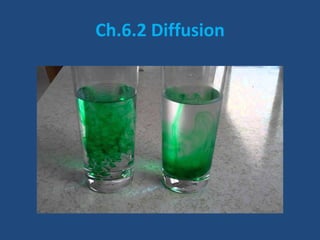
If you very carefully put a drop of food dye into a glass of water,
you can see the dye very slowly spread out.
Eventually the dye spreads throughout the water.
Explaining Diffusion in liquids
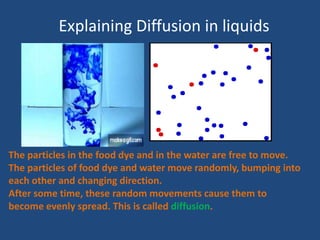
The particles in the food dye and in the water are free to move.
The particles of food dye and water move randomly, bumping into
each other and changing direction.
After some time, these random movements cause them to
become evenly spread. This is called diffusion.
Diffusion in Gases
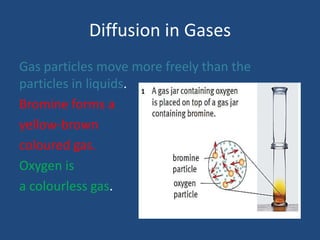
Gas particles move more freely than the
particles in liquids.
Bromine forms a
yellow-brown
coloured gas.
Oxygen is
a colourless gas.
Diffusion in Gases
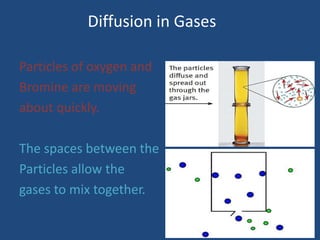
Particles of oxygen and
Bromine are moving
about quickly.
The spaces between the
Particles allow the
gases to mix together.
Think
1. Give a brief definition of diffusion.
2. Why is diffusion faster in a gas than in a
liquid?
ANSWERS
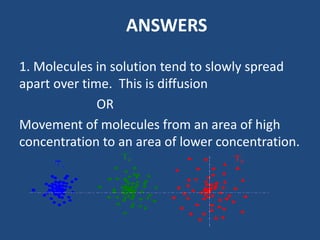
1. Molecules in solution tend to slowly spread
apart over time. This is diffusion
OR
Movement of molecules from an area of high
concentration to an area of lower concentration.
ANSWERS
2. Diffusion occurs quickly in a gas than in a
liquid because the space between the
constituent particles in gases are higher
than in liquids.
Thus particles in gas possess higher kinetic
energy and move with higher speeds
What are the factors that speed up or
slow down diffusion?
1. changes in temperature
diffusion will be quicker if we increase the
temperature because the particles will
have more energy and can move more
quickly.
Factors affecting diffusion
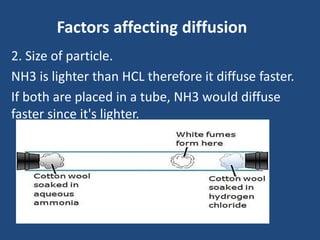
2. Size of particle.
NH3 is lighter than HCL therefore it diffuse faster.
If both are placed in a tube, NH3 would diffuse
faster since it's lighter.
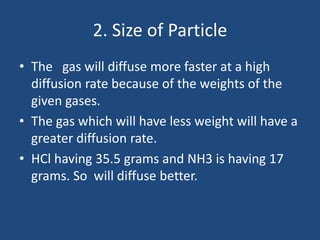
2. Size of Particle
• The gas will diffuse more faster at a high
diffusion rate because of the weights of the
given gases.
• The gas which will have less weight will have a
greater diffusion rate.
• HCl having 35.5 grams and NH3 is having 17
grams. So will diffuse better.
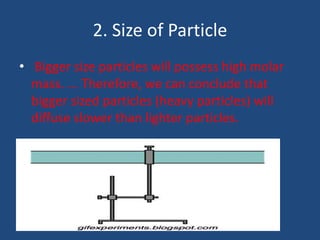
2. Size of Particle
• Bigger size particles will possess high molar
mass. ... Therefore, we can conclude that
bigger sized particles (heavy particles) will
diffuse slower than lighter particles.
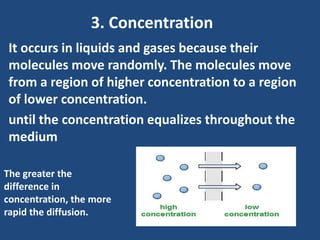
3. Concentration
It occurs in liquids and gases because their
molecules move randomly. The molecules move
from a region of higher concentration to a region
of lower concentration.
until the concentration equalizes throughout the
medium
The greater the
difference in
concentration, the more
rapid the diffusion.
Summary
• The rateof diffusion can be affected by a
number of factors
• Such as changes in temperature,
concentration and size of particle.
Grade 7 diffusion PPT

Grade 7 diffusion PPT

  • 3.
  • 4.
    Lesson objective • ToGive a brief definition of diffusion. • To study the diffusion in liquids. • To study the diffusion in gases. • to study the factors affecting the rate of diffusion
  • 5.
    Diffusion If you verycarefully put a drop of food dye into a glass of water, you can see the dye very slowly spread out. Eventually the dye spreads throughout the water.
  • 6.
    Explaining Diffusion inliquids The particles in the food dye and in the water are free to move. The particles of food dye and water move randomly, bumping into each other and changing direction. After some time, these random movements cause them to become evenly spread. This is called diffusion.
  • 7.
    Diffusion in Gases Gasparticles move more freely than the particles in liquids. Bromine forms a yellow-brown coloured gas. Oxygen is a colourless gas.
  • 8.
    Diffusion in Gases Particlesof oxygen and Bromine are moving about quickly. The spaces between the Particles allow the gases to mix together.
  • 9.
    Think 1. Give abrief definition of diffusion. 2. Why is diffusion faster in a gas than in a liquid?
  • 10.
    ANSWERS 1. Molecules insolution tend to slowly spread apart over time. This is diffusion OR Movement of molecules from an area of high concentration to an area of lower concentration.
  • 11.
    ANSWERS 2. Diffusion occursquickly in a gas than in a liquid because the space between the constituent particles in gases are higher than in liquids. Thus particles in gas possess higher kinetic energy and move with higher speeds
  • 12.
    What are thefactors that speed up or slow down diffusion? 1. changes in temperature diffusion will be quicker if we increase the temperature because the particles will have more energy and can move more quickly.
  • 13.
    Factors affecting diffusion 2.Size of particle. NH3 is lighter than HCL therefore it diffuse faster. If both are placed in a tube, NH3 would diffuse faster since it's lighter.
  • 14.
    2. Size ofParticle • The gas will diffuse more faster at a high diffusion rate because of the weights of the given gases. • The gas which will have less weight will have a greater diffusion rate. • HCl having 35.5 grams and NH3 is having 17 grams. So will diffuse better.
  • 15.
    2. Size ofParticle • Bigger size particles will possess high molar mass. ... Therefore, we can conclude that bigger sized particles (heavy particles) will diffuse slower than lighter particles.
  • 16.
    3. Concentration It occursin liquids and gases because their molecules move randomly. The molecules move from a region of higher concentration to a region of lower concentration. until the concentration equalizes throughout the medium The greater the difference in concentration, the more rapid the diffusion.
  • 17.
    Summary • The rateofdiffusion can be affected by a number of factors • Such as changes in temperature, concentration and size of particle.