Transfer of Thermal Energy
Sec 3 Physics
What we are going to learn
How heat spreads from one region to another.
Examples:
Howthe wholecopperrod get hot whenwe heat one end
Howdoes theheat spread throughout the whole pot of waterwhenwe are
onlyheatingthe bottom
Howdoes theheat fromthe Sun reachesus
What is happening?
All things are made up of molecules
When things get heated, they absorb heat energy.
This means that the molecules are absorbing the
heat energy
With more energy, the molecules are able to
move faster
When the molecules move faster, the temperature
of the object increases.
Temperature increase means the object gets
hotter.
3 Processes of Heat Transfer
Conduction
Convection
Radiation
CONDUCTION
 Occurs mainly in solids
 Two types of conduction
Molecular vibration
Free electron diffusion
Note: Conduction is not the main form of heat
transfer in liquids and gases because their
molecules are spaced further apart.
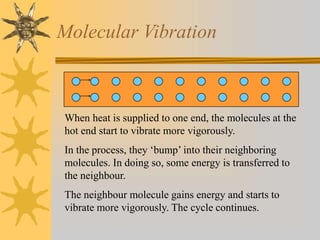
Molecular Vibration
When heat is supplied to one end, the molecules at the
hot end start to vibrate more vigorously.
In the process, they ‘bump’ into their neighboring
molecules. In doing so, some energy is transferred to
the neighbour.
The neighbour molecule gains energy and starts to
vibrate more vigorously. The cycle continues.
Conduction Animation
The conduction animation is on the left.
Notice the movement of the molecules
along the rod.
Click here for animation
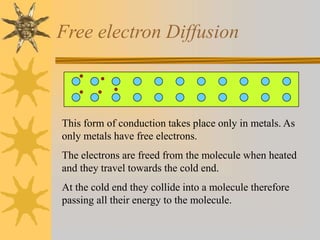
Free electron Diffusion
This form of conduction takes place only in metals. As
only metals have free electrons.
The electrons are freed from the molecule when heated
and they travel towards the cold end.
At the cold end they collide into a molecule therefore
passing all their energy to the molecule.
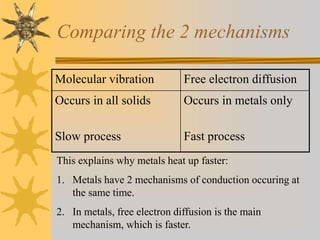
Comparing the 2 mechanisms
Molecular vibration Free electron diffusion
Occurs in all solids
Slow process
Occurs in metals only
Fast process
This explains why metals heat up faster:
1. Metals have 2 mechanisms of conduction occuring at
the same time.
2. In metals, free electron diffusion is the main
mechanism, which is faster.
Conductors and Insulators
Materials that can conduct heat easily and
readily (eg. Metals) are known as
conductors.
Materials that do not conduct heat easily
(eg. Water, air, plastic) are known as
insulators.
Applications of conduction
Trapping air as insulation
Different sensations from conductors and
insulators
Uses of good conductors: cooking utensils
Uses of good insulators: table mats,
handles
Convection
Occurs in liquids and gases
Does not occur in solids because the
molecules are not free to move around
What happens during convection
Taking the example of heating water
Water at the bottom is heated first
Heated water expands
When water expands density decreases
Heated water of lower density starts to rise
Cooler water of higher density rushes in from
sides to take its place
The cooler water gets heated and the cycle
repeats.
Convection currents are set up.
Convection Animation
Refer to the animation on the right.
The animation shows the process of
convection taking place.
The blue circles represent unheated
molecules.
The redder the molecules get the more heat
they are absorbing.
Applications of convection
Air con is usually placed at the top of a
room.
Heating coil of a kettle is usually at the
bottom
Formation of land and sea breezes
Radiation
Radiation does not require a medium to
transfer heat. (can occur in a vacuum)
Sun releases electromagnetic waves (heat
is contained in the waves as infra-red)
Hotter objects radiates more heat.
Emitters and absorbers
The Sun gives out the heat.
It is known as an emitter / radiator
The Earth takes in the heat.
It is known as an absorber.
Good and Bad
Emitters/Absorbers
A good emitter would also be a good absorber.
A poor emitter would be a poor absorber.
Good emitter/absorber Poor emitter/absorber
Dull, black surface
Rough surface
Shiny, silver surface
Smooth surface
Factors affecting radiation
Colour and texture of the surface (refer to
previous slide)
Surface temperature
Higher surface temperature, higher rate of
transfer.
Surface area
Larger surface area, higher rate of transfer
Applications of radiation
Teapots
The greenhouse
Colour and texture of clothings
Skin cancer
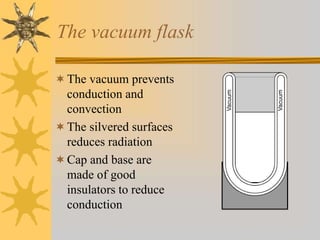
The vacuum flask
The vacuum prevents
conduction and
convection
The silvered surfaces
reduces radiation
Cap and base are
made of good
insulators to reduce
conduction

Transfer of Heat

  • 1.
    Transfer of ThermalEnergy Sec 3 Physics
  • 2.
    What we aregoing to learn How heat spreads from one region to another. Examples: Howthe wholecopperrod get hot whenwe heat one end Howdoes theheat spread throughout the whole pot of waterwhenwe are onlyheatingthe bottom Howdoes theheat fromthe Sun reachesus
  • 3.
    What is happening? Allthings are made up of molecules When things get heated, they absorb heat energy. This means that the molecules are absorbing the heat energy With more energy, the molecules are able to move faster When the molecules move faster, the temperature of the object increases. Temperature increase means the object gets hotter.
  • 4.
    3 Processes ofHeat Transfer Conduction Convection Radiation
  • 5.
    CONDUCTION  Occurs mainlyin solids  Two types of conduction Molecular vibration Free electron diffusion Note: Conduction is not the main form of heat transfer in liquids and gases because their molecules are spaced further apart.
  • 6.
    Molecular Vibration When heatis supplied to one end, the molecules at the hot end start to vibrate more vigorously. In the process, they ‘bump’ into their neighboring molecules. In doing so, some energy is transferred to the neighbour. The neighbour molecule gains energy and starts to vibrate more vigorously. The cycle continues.
  • 7.
    Conduction Animation The conductionanimation is on the left. Notice the movement of the molecules along the rod. Click here for animation
  • 8.
    Free electron Diffusion Thisform of conduction takes place only in metals. As only metals have free electrons. The electrons are freed from the molecule when heated and they travel towards the cold end. At the cold end they collide into a molecule therefore passing all their energy to the molecule.
  • 9.
    Comparing the 2mechanisms Molecular vibration Free electron diffusion Occurs in all solids Slow process Occurs in metals only Fast process This explains why metals heat up faster: 1. Metals have 2 mechanisms of conduction occuring at the same time. 2. In metals, free electron diffusion is the main mechanism, which is faster.
  • 10.
    Conductors and Insulators Materialsthat can conduct heat easily and readily (eg. Metals) are known as conductors. Materials that do not conduct heat easily (eg. Water, air, plastic) are known as insulators.
  • 11.
    Applications of conduction Trappingair as insulation Different sensations from conductors and insulators Uses of good conductors: cooking utensils Uses of good insulators: table mats, handles
  • 12.
    Convection Occurs in liquidsand gases Does not occur in solids because the molecules are not free to move around
  • 13.
    What happens duringconvection Taking the example of heating water Water at the bottom is heated first Heated water expands When water expands density decreases Heated water of lower density starts to rise Cooler water of higher density rushes in from sides to take its place The cooler water gets heated and the cycle repeats. Convection currents are set up.
  • 14.
    Convection Animation Refer tothe animation on the right. The animation shows the process of convection taking place. The blue circles represent unheated molecules. The redder the molecules get the more heat they are absorbing.
  • 15.
    Applications of convection Aircon is usually placed at the top of a room. Heating coil of a kettle is usually at the bottom Formation of land and sea breezes
  • 16.
    Radiation Radiation does notrequire a medium to transfer heat. (can occur in a vacuum) Sun releases electromagnetic waves (heat is contained in the waves as infra-red) Hotter objects radiates more heat.
  • 17.
    Emitters and absorbers TheSun gives out the heat. It is known as an emitter / radiator The Earth takes in the heat. It is known as an absorber.
  • 18.
    Good and Bad Emitters/Absorbers Agood emitter would also be a good absorber. A poor emitter would be a poor absorber. Good emitter/absorber Poor emitter/absorber Dull, black surface Rough surface Shiny, silver surface Smooth surface
  • 19.
    Factors affecting radiation Colourand texture of the surface (refer to previous slide) Surface temperature Higher surface temperature, higher rate of transfer. Surface area Larger surface area, higher rate of transfer
  • 20.
    Applications of radiation Teapots Thegreenhouse Colour and texture of clothings Skin cancer
  • 21.
    The vacuum flask Thevacuum prevents conduction and convection The silvered surfaces reduces radiation Cap and base are made of good insulators to reduce conduction