MEC323:PRIMARY MANUFACTURING
Unit I
General introduction to manufacturing
processes
Dr. L K Bhagi,
Associate Professor,
Mechanical Engineering Department, LPU
Need
1. To create goods for human being to support
living and improve standard of life.
2. Producing more goods using less resource is
the target to cater needs of public in general
3. So productivity is of prime importance and is
achieved by reducing wastage in the form of
scrap and defective products
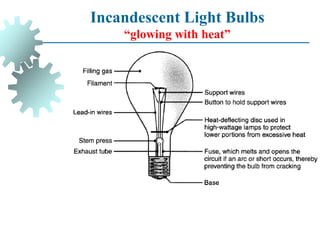
Incandescent Light Bulbs
“glowing with heat”
The first incandescent lamp was made by TA.
Edison (1847-1931) in New Jersey and was first
lit in 1879. A typical bulb then had a life of only
about 13.5 hours.
main purpose
increasing their life and reducing production
costs.
materials and production methods
Incandescent Light Bulbs
“glowing with heat”
The light-emitting component is the filament,
which, by the passage of current and due to its
electrical resistance, is heated to incandescence
to a temperature of 2200°-3000°C.
Edison’s first successful lamp had a carbon
filament, although he and others also had
experimented with carbonized paper and metals
such as osmium, itidium, and tantalum.
Incandescent Light Bulbs
“glowing with heat”
However, none of these materials has the
strength, resistance to high temperature, and long
life as has tungsten, which is now the most
commonly used filament material.
Incandescent Light Bulbs
“glowing with heat”
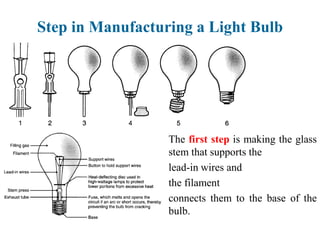
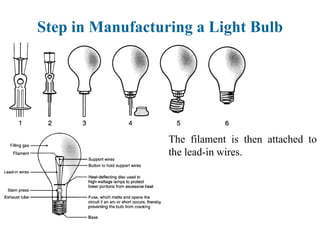
The first step is making the glass
stem that supports the
lead-in wires and
the filament
connects them to the base of the
bulb.
Step in Manufacturing a Light Bulb
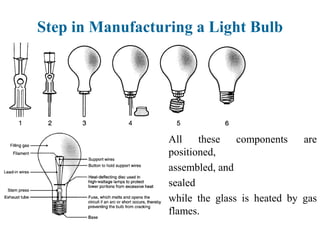
All these components are
positioned,
assembled, and
sealed
while the glass is heated by gas
flames.
Step in Manufacturing a Light Bulb
The filament is then attached to
the lead-in wires.
Step in Manufacturing a Light Bulb
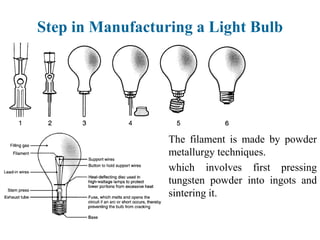
The filament is made by powder
metallurgy techniques.
which involves first pressing
tungsten powder into ingots and
sintering it.
Step in Manufacturing a Light Bulb
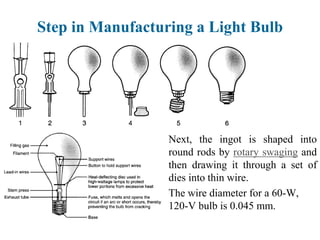
Next, the ingot is shaped into
round rods by rotary swaging and
then drawing it through a set of
dies into thin wire.
The wire diameter for a 60-W,
120-V bulb is 0.045 mm.
Step in Manufacturing a Light Bulb
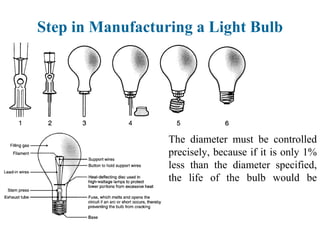
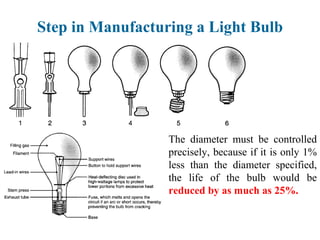
The diameter must be controlled
precisely, because if it is only 1%
less than the diameter specified,
the life of the bulb would be
reduced by as much as 25%.
R = p (L / A)
Step in Manufacturing a Light Bulb
The diameter must be controlled
precisely, because if it is only 1%
less than the diameter specified,
the life of the bulb would be
reduced by as much as 25%.
R = p (L / A)
Step in Manufacturing a Light Bulb
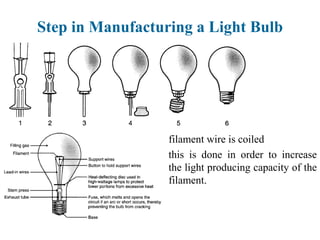
filament wire is coiled
this is done in order to increase
the light producing capacity of the
filament.
Step in Manufacturing a Light Bulb
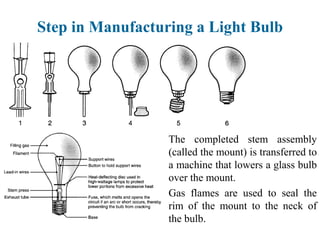
The completed stem assembly
(called the mount) is transferred to
a machine that lowers a glass bulb
over the mount.
Gas flames are used to seal the
rim of the mount to the neck of
the bulb.
Step in Manufacturing a Light Bulb
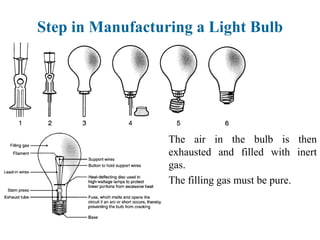
The air in the bulb is then
exhausted and filled with inert
gas.
The filling gas must be pure.
Step in Manufacturing a Light Bulb
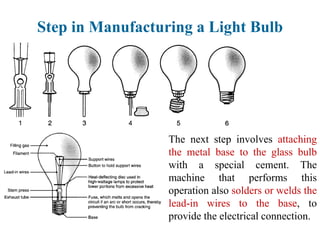
The next step involves attaching
the metal base to the glass bulb
with a special cement. The
machine that performs this
operation also solders or welds the
lead-in wires to the base, to
provide the electrical connection.
Step in Manufacturing a Light Bulb
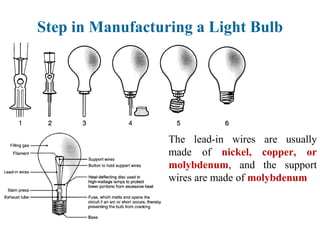
The lead-in wires are usually
made of nickel, copper, or
molybdenum, and the support
wires are made of molybdenum
Step in Manufacturing a Light Bulb
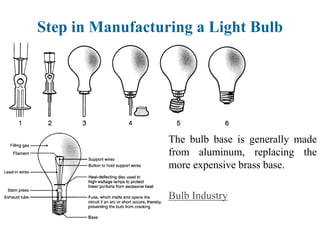
The bulb base is generally made
from aluminum, replacing the
more expensive brass base.
Bulb Industry
Step in Manufacturing a Light Bulb
Resources for manufacturing
In manufacturing for producing goods used are
the resources in the form of
– Natural resources (air, water, animal, wheat,
minerals etc.)
– Machine tool: plants, machines, tool, robots,
automation
Creation of goods for human being:
(Natural Resources) × (Man power)machine tool
Manufacturing
Today, production methods have advanced to such an
extent that
(a) aluminum beverage cans are made at rates of more
than 500 per minute, with each can costing about Rs
1.2 to make,
(b) holes in sheet metal are punched at rates of 800 holes
per minute, and
(c) incandescent light bulbs are made at rates of more
than 2000 bulbs per minute.
Manufacturing
The word manufacture first appeared in English in 1567
and is derived from the Latin manu factus, meaning
“made by hand”.
The word manufacturing first appeared in 1683, and the
word production, which is often used interchangeably
with the word manufacturing, first appeared sometime
during the 15th century.
Manufacturing
– Technologically: Physical and chemical processes to
alter size, shape and properties of material suitable for
service use.
– Economically: (value addition) A step to convert raw
material into useful product of high value.
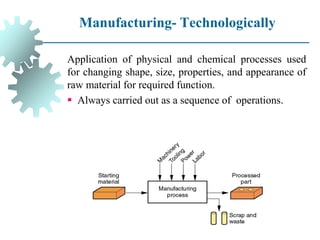
Manufacturing- Technologically
Application of physical and chemical processes used
for changing shape, size, properties, and appearance of
raw material for required function.
▪ Always carried out as a sequence of operations.
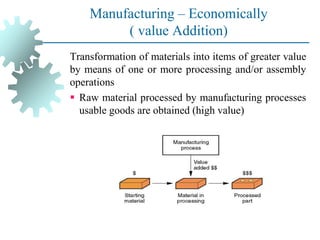
Manufacturing – Economically
( value Addition)
Transformation of materials into items of greater value
by means of one or more processing and/or assembly
operations
▪ Raw material processed by manufacturing processes
usable goods are obtained (high value)
Purpose of Manufacturing
Fundamental Approaches of
Manufacturing
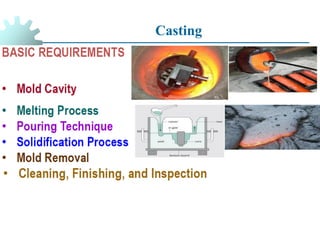
Casting
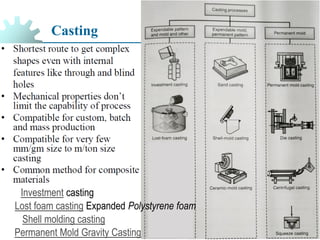
Casting
Investment casting
Lost foam casting Expanded Polystyrene foam
Shell molding casting
Permanent Mold Gravity Casting
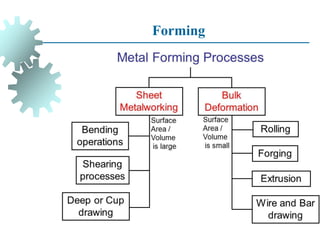
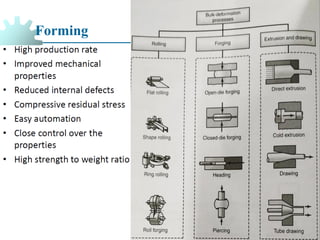
Forming
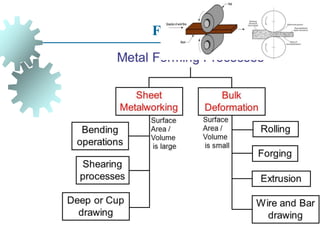
Forming
Forming
Forming
Forming
Forming
Forming
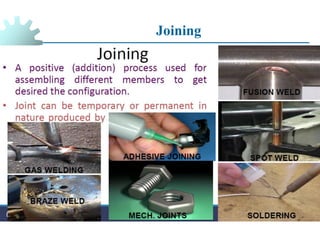
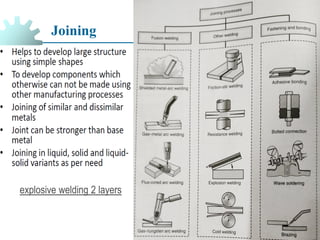
Joining
Joining
explosive welding 2 layers
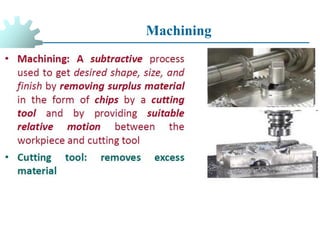
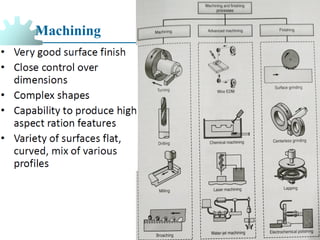
Machining
Machining
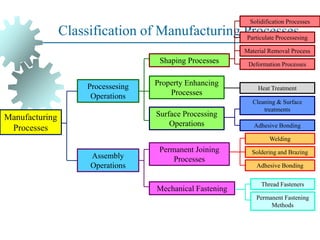
Classification of Manufacturing Processes
Manufacturing
Processes
Processesing
Operations
Assembly
Operations
Shaping Processes
Surface Processing
Operations
Property Enhancing
Processes
Permanent Joining
Processes
Mechanical Fastening
Solidification Processes
Deformation Processes
Particulate Processesing
Material Removal Process
Welding
Soldering and Brazing
Adhesive Bonding
Heat Treatment
Cleaning & Surface
treatments
Adhesive Bonding
Thread Fasteners
Permanent Fastening
Methods
Materials in Manufacturing
Most engineering materials can be classified
into one of three basic categories:
1. Metals
2. Ceramics
3. Polymers
▪ Their chemistries are different.
▪ Their mechanical and physical properties are
dissimilar.
▪ These differences affect the manufacturing
processes that can be used to produce products
from them.
Metals
Two basic groups:
1. Ferrous metals - based on iron:
▪ Steel = Fe - C alloy (0.08 to 2.1%C)
▪ Cast iron = Fe - C alloy (2.1% to 6.76%C)
2. Non-ferrous metals - all other metallic elements
and their alloys: aluminum, copper, magnesium,
nickel, silver, tin, zinc, brass, gold, titanium, etc.
Ceramics
Ceramic materials are inorganic, non-metallic materials
made from compounds of a metal and a non metal.
▪ Typical non-metallic elements are oxygen,
nitrogen, and carbon
▪ For processing, ceramics divide into:
1. Crystalline ceramics – includes:
▪ Traditional ceramics, such as clay (hydrous
aluminum silicates)
▪ Modern ceramics, such as alumina (Al2O3),
silicon carbide (SiC), etc.
2. Glasses – mostly based on silica (SiO2)
Ceramics>Characteristics of Ceramics
▪ Low density compared to metals
▪ High melting point or decomposition temperature
▪ High hardness and very brittle
▪ High elastic modulus and moderate strength
▪ Low toughness
▪ High electrical resistivity
▪ Low thermal conductivity
▪ High temperature wear resistance
▪ Thermal Shock resistance
▪ High corrosion resistance
Main drawback is brittleness and low toughness
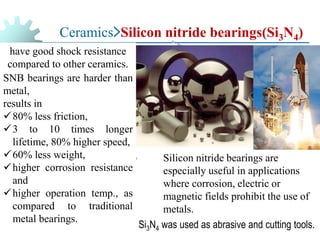
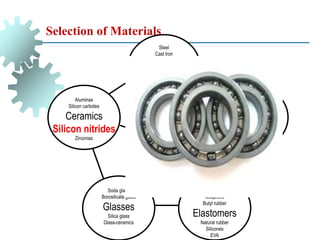
Ceramics>Silicon nitride bearings(Si3N4)
have good shock resistance
compared to other ceramics.
SNB bearings are harder than
metal,
results in
✓80% less friction,
✓3 to 10 times longer
lifetime, 80% higher speed,
✓60% less weight,
✓higher corrosion resistance
and
✓higher operation temp., as
compared to traditional
metal bearings.
Silicon nitride bearings are
especially useful in applications
where corrosion, electric or
magnetic fields prohibit the use of
metals.
Si3N4 was used as abrasive and cutting tools.
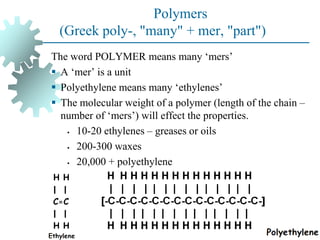
Polymers
(Greek poly-, "many" + mer, "part")
The word POLYMER means many ‘mers’
▪ A ‘mer’ is a unit
▪ Polyethylene means many ‘ethylenes’
▪ The molecular weight of a polymer (length of the chain –
number of ‘mers’) will effect the properties.
• 10-20 ethylenes – greases or oils
• 200-300 waxes
• 20,000 + polyethylene
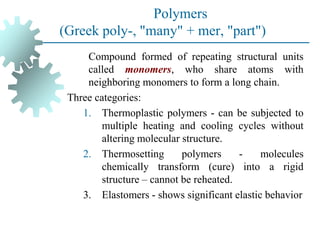
Polymers
(Greek poly-, "many" + mer, "part")
Compound formed of repeating structural units
called monomers, who share atoms with
neighboring monomers to form a long chain.
Three categories:
1. Thermoplastic polymers - can be subjected to
multiple heating and cooling cycles without
altering molecular structure.
2. Thermosetting polymers - molecules
chemically transform (cure) into a rigid
structure – cannot be reheated.
3. Elastomers - shows significant elastic behavior
Polymers
(Greek poly-, "many" + mer, "part")
Compound formed of repeating structural units
called monomers, who share atoms with
neighboring monomers to form a long chain.
Three categories:
1. Thermoplastic polymers - can be subjected to
multiple heating and cooling cycles without
altering molecular structure.
2. Thermosetting polymers - molecules
chemically transform (cure) into a rigid
structure – cannot be reheated.
3. Elastomers - shows significant elastic behavior
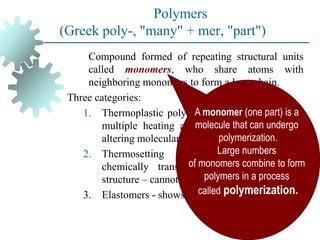
A monomer (one part) is a
molecule that can undergo
polymerization.
Large numbers
of monomers combine to form
polymers in a process
called polymerization.
Polymers
(Greek poly-, "many" + mer, "part")
Compound formed of repeating structural units
called monomers, who share atoms with
neighboring monomers to form a long chain.
Three categories:
1. Thermoplastic polymers - can be subjected to
multiple heating and cooling cycles without
altering molecular structure.
2. Thermosetting polymers - molecules
chemically transform (cure) into a rigid
structure – cannot be reheated.
3. Elastomers - shows significant elastic behavior
A monomer (one part) is a
molecule that can undergo
polymerization.
Large numbers
of monomers combine to form
polymers in a process
called polymerization.
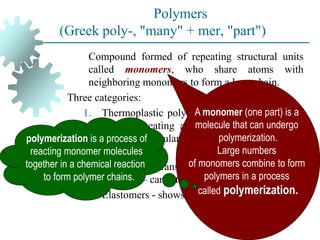
polymerization is a process of
reacting monomer molecules
together in a chemical reaction
to form polymer chains.
Polymers
(Greek poly-, "many" + mer, "part")
Compound formed of repeating structural units
called monomers, who share atoms with
neighboring monomers to form a long chain.
Three categories:
1. Thermoplastic polymers - can be subjected to
multiple heating and cooling cycles without
altering molecular structure.
2. Thermosetting polymers - molecules
chemically transform (cure) into a rigid
structure – cannot be reheated.
3. Elastomers - shows significant elastic behavior
A monomer (one part) is a
molecule that can undergo
polymerization.
Large numbers
of monomers combine to form
polymers in a process
called polymerization.
polymerization is a process of
reacting monomer molecules
together in a chemical reaction
to form polymer chains.
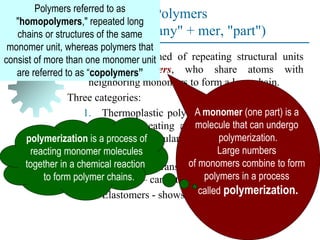
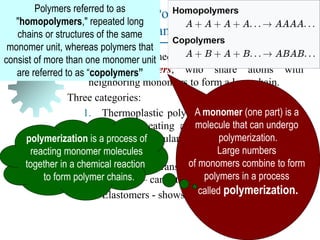
Polymers referred to as
"homopolymers," repeated long
chains or structures of the same
monomer unit, whereas polymers that
consist of more than one monomer unit
are referred to as “copolymers”
Polymers
(Greek poly-, "many" + mer, "part")
Compound formed of repeating structural units
called monomers, who share atoms with
neighboring monomers to form a long chain.
Three categories:
1. Thermoplastic polymers - can be subjected to
multiple heating and cooling cycles without
altering molecular structure.
2. Thermosetting polymers - molecules
chemically transform (cure) into a rigid
structure – cannot be reheated.
3. Elastomers - shows significant elastic behavior
A monomer (one part) is a
molecule that can undergo
polymerization.
Large numbers
of monomers combine to form
polymers in a process
called polymerization.
polymerization is a process of
reacting monomer molecules
together in a chemical reaction
to form polymer chains.
Polymers referred to as
"homopolymers," repeated long
chains or structures of the same
monomer unit, whereas polymers that
consist of more than one monomer unit
are referred to as “copolymers”
Polymers
(Greek poly-, "many" + mer, "part")
Compound formed of repeating structural units
called monomers, who share atoms with
neighboring monomers to form a long chain.
Three categories:
1. Thermoplastic polymers - can be subjected to
multiple heating and cooling cycles without
altering molecular structure.
2. Thermosetting polymers - molecules
chemically transform (cure) into a rigid
structure – cannot be reheated.
3. Elastomers - shows significant elastic behavior
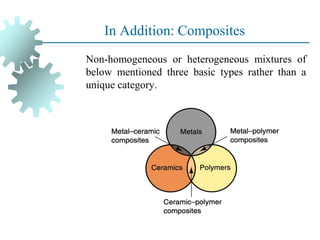
In Addition: Composites
Non-homogeneous or heterogeneous mixtures of
below mentioned three basic types rather than a
unique category.
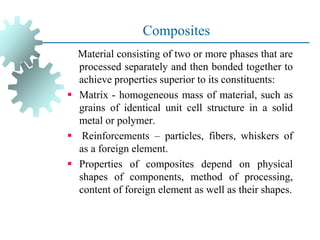
Composites
Material consisting of two or more phases that are
processed separately and then bonded together to
achieve properties superior to its constituents:
▪ Matrix - homogeneous mass of material, such as
grains of identical unit cell structure in a solid
metal or polymer.
▪ Reinforcements – particles, fibers, whiskers of
as a foreign element.
▪ Properties of composites depend on physical
shapes of components, method of processing,
content of foreign element as well as their shapes.
Post-Manufacturing Processes
Alters a material’s shape, physical properties,
or appearance in order to add value.
Four categories of processing operations:
1. Shaping operations – to alter the geometry
of the starting work material
2. Property enhancer operations – to improve
physical properties without changing shape
3. Surface processing operations - to clean,
coat, or deposit material on exterior surface
of the work
4. Assembly
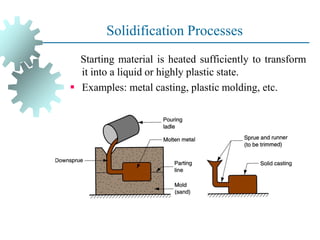
Solidification Processes
Starting material is heated sufficiently to transform
it into a liquid or highly plastic state.
▪ Examples: metal casting, plastic molding, etc.
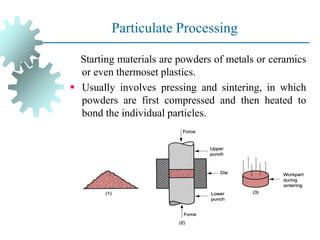
Particulate Processing
Starting materials are powders of metals or ceramics
or even thermoset plastics.
▪ Usually involves pressing and sintering, in which
powders are first compressed and then heated to
bond the individual particles.
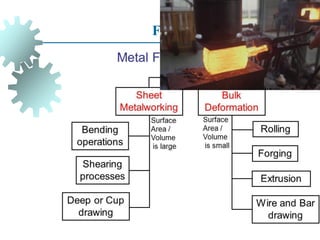
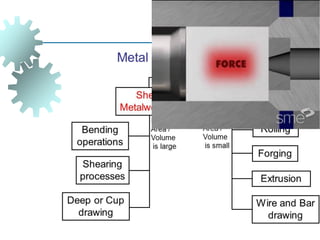
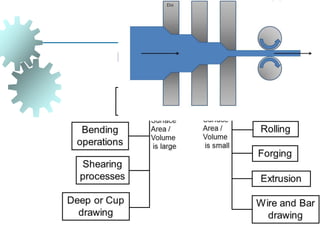
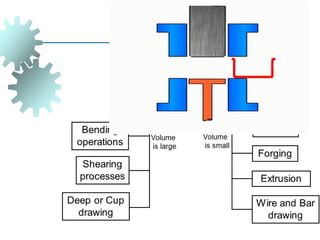
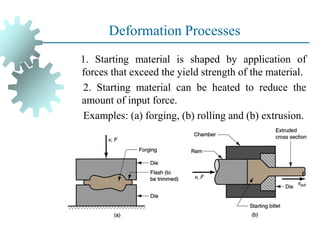
Deformation Processes
1. Starting material is shaped by application of
forces that exceed the yield strength of the material.
2. Starting material can be heated to reduce the
amount of input force.
Examples: (a) forging, (b) rolling and (b) extrusion.
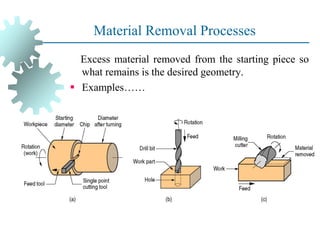
Material Removal Processes
Excess material removed from the starting piece so
what remains is the desired geometry.
▪ Examples……
Waste Problem While Manufacturing
Desirable to minimize waste in part shaping.
▪ Material removal processes are wasteful in unit operations,
simply by the way they work.
▪ Most casting, molding and particulate processing operations
waste little material.
▪ Almost zero waste in metal forming processes.
Terminology for minimum waste processes:
▪ Net-shape processes - when most of the starting material
is used and no subsequent machining is required (3D
printing and powder metallurgy.
▪ Near-net shape processes - when minimum amount of
machining is required (forging, rolling, sheet metal
operations).
Surface Processing Operations
▪ Cleaning - chemical and mechanical processes to remove
dirt, oil, and other contaminants from the surface
▪ Surface roughness treatments - mechanical working such
as sand blasting, barrel finishing and simply rubbing with
files or emery papers.
Assembly Operations
Two or more separate parts are joined to form a new entity
▪ Types of assembly operations:
▪ Permanent joints.
Examples: welding, soldering, brazing and use of
adhesives.
▪ Temporary joints.
Examples: screws, bolts, nuts, press fitting, and
expansion fits.
▪ Semi-permanent joints.
Examples: rivets, and clamps
Types of Productions
Low/Job Production
Job shop is the term used for this type of production
facility.
▪ A job shop makes low quantities of specialized and
customized products.
▪ Products are typically complex, e.g., space capsules,
prototype aircraft and special machinery .
▪ Equipment in a job shop are flexible.
▪ Designed for maximum flexibility.
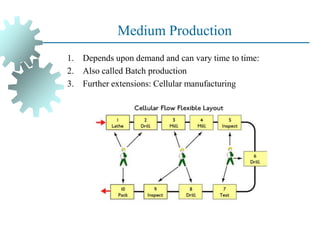
Medium Production
1. Depends upon demand and can vary time to time:
2. Also called Batch production
3. Further extensions: Cellular manufacturing
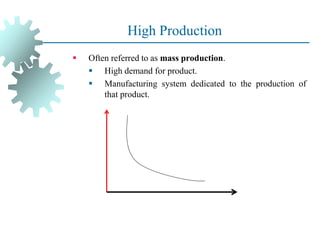
High Production
▪ Often referred to as mass production.
▪ High demand for product.
▪ Manufacturing system dedicated to the production of
that product.
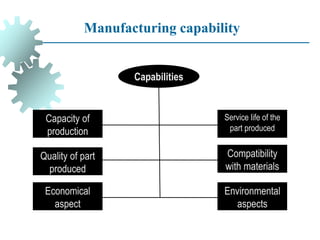
Manufacturing capability
Capabilities
Capacity of
production
Service life of the
part produced
Quality of part
produced
Economical
aspect
Environmental
aspects
Compatibility
with materials
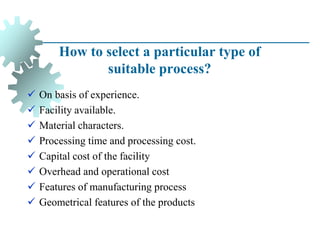
How to select a particular type of
suitable process?
✓ On basis of experience.
✓ Facility available.
✓ Material characters.
✓ Processing time and processing cost.
✓ Capital cost of the facility
✓ Overhead and operational cost
✓ Features of manufacturing process
✓ Geometrical features of the products
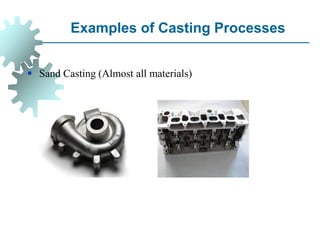
Examples of Casting Processes
▪ Sand Casting (Almost all materials)
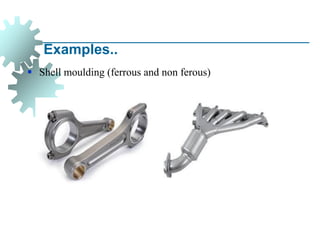
Examples..
▪ Shell moulding (ferrous and non ferous)
Examples..
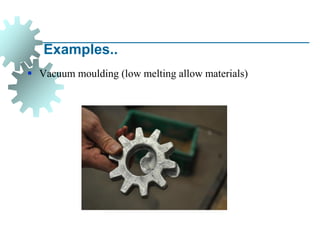
▪ Vacuum moulding (low melting allow materials)
Examples..
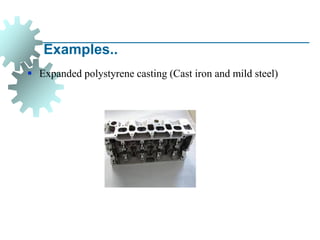
▪ Expanded polystyrene casting (Cast iron and mild steel)
Examples..
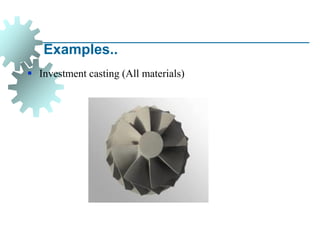
▪ Investment casting (All materials)
Examples..
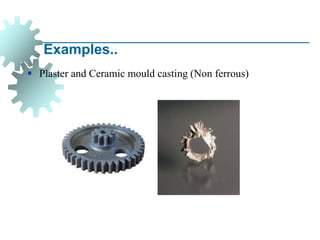
▪ Plaster and Ceramic mould casting (Non ferrous)
Examples..
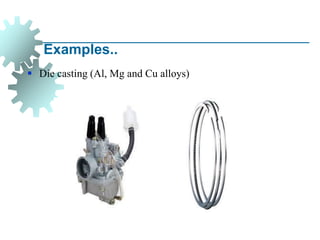
▪ Die casting (Al, Mg and Cu alloys)
Examples..
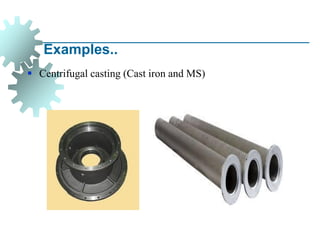
▪ Centrifugal casting (Cast iron and MS)
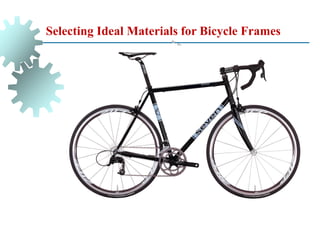
Selecting Ideal Materials for Bicycle Frames
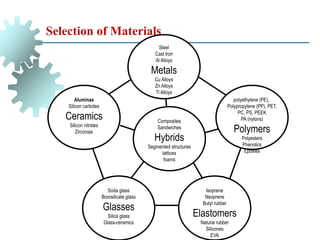
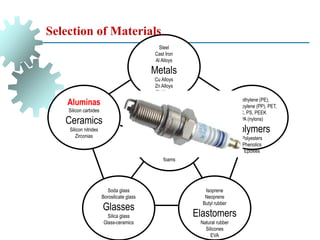
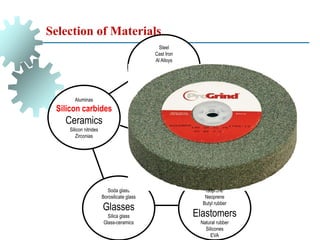
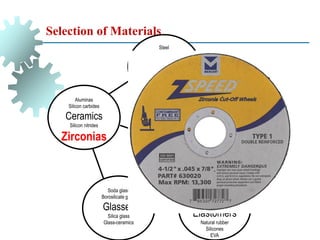
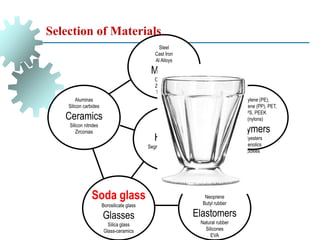
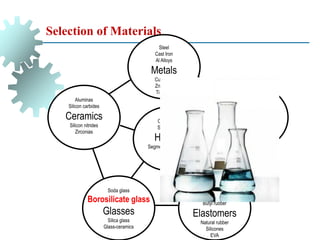
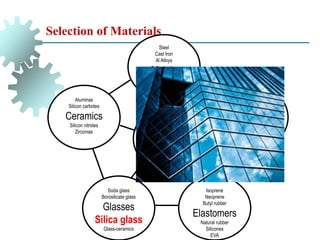
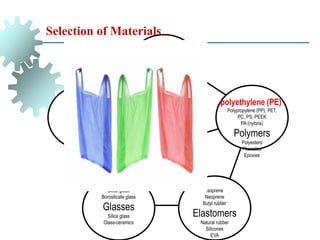
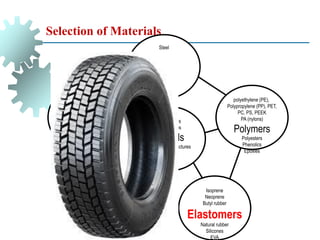
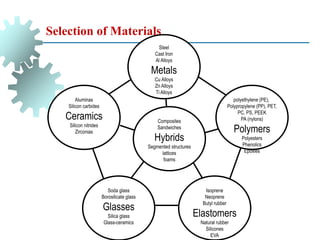
Selection of Materials
Aluminas
Silicon carbides
Ceramics
Silicon nitrides
Zirconias
Soda glass
Borosilicate glass
Glasses
Silica glass
Glass-ceramics
Isoprene
Neoprene
Butyl rubber
Elastomers
Natural rubber
Silicones
EVA
Composites
Sandwiches
Hybrids
Segmented structures
lattices
foams
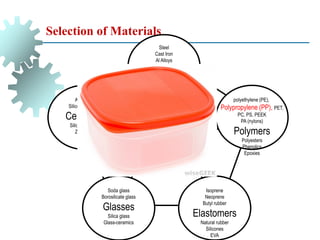
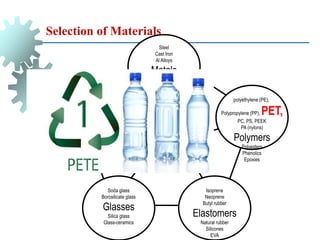
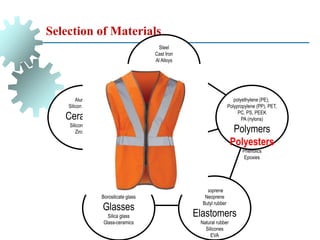
polyethylene (PE),
Polypropylene (PP), PET,
PC, PS, PEEK
PA (nylons)
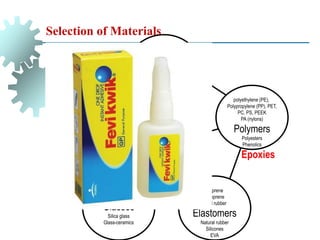
Polymers
Polyesters
Phenolics
Epoxies
Steel
Cast Iron
Al Alloys
Metals
Cu Alloys
Zn Alloys
Ti Alloys
Selection of Materials
Aluminas
Silicon carbides
Ceramics
Silicon nitrides
Zirconias
Soda glass
Borosilicate glass
Glasses
Silica glass
Glass-ceramics
Isoprene
Neoprene
Butyl rubber
Elastomers
Natural rubber
Silicones
EVA
Composites
Sandwiches
Hybrids
Segmented structures
lattices
foams
polyethylene (PE),
Polypropylene (PP), PET,
PC, PS, PEEK
PA (nylons)
Polymers
Polyesters
Phenolics
Epoxies
Steel
Cast Iron
Al Alloys
Metals
Cu Alloys
Zn Alloys
Ti Alloys
Selection of Materials
Aluminas
Silicon carbides
Ceramics
Silicon nitrides
Zirconias
Soda glass
Borosilicate glass
Glasses
Silica glass
Glass-ceramics
Isoprene
Neoprene
Butyl rubber
Elastomers
Natural rubber
Silicones
EVA
Composites
Sandwiches
Hybrids
Segmented structures
lattices
foams
polyethylene (PE),
Polypropylene (PP), PET,
PC, PS, PEEK
PA (nylons)
Polymers
Polyesters
Phenolics
Epoxies
Steel
Cast Iron
Al Alloys
Metals
Cu Alloys
Zn Alloys
Ti Alloys
Selection of Materials
Aluminas
Silicon carbides
Ceramics
Silicon nitrides
Zirconias
Soda glass
Borosilicate glass
Glasses
Silica glass
Glass-ceramics
Isoprene
Neoprene
Butyl rubber
Elastomers
Natural rubber
Silicones
EVA
Composites
Sandwiches
Hybrids
Segmented structures
lattices
foams
polyethylene (PE),
Polypropylene (PP), PET,
PC, PS, PEEK
PA (nylons)
Polymers
Polyesters
Phenolics
Epoxies
Steel
Cast Iron
Al Alloys
Metals
Cu Alloys
Zn Alloys
Ti Alloys
Selection of Materials
Aluminas
Silicon carbides
Ceramics
Silicon nitrides
Zirconias
Soda glass
Borosilicate glass
Glasses
Silica glass
Glass-ceramics
Isoprene
Neoprene
Butyl rubber
Elastomers
Natural rubber
Silicones
EVA
Composites
Sandwiches
Hybrids
Segmented structures
lattices
foams
polyethylene (PE),
Polypropylene (PP), PET,
PC, PS, PEEK
PA (nylons)
Polymers
Polyesters
Phenolics
Epoxies
Steel
Cast Iron
Al Alloys
Metals
Cu Alloys
Zn Alloys
Ti Alloys
Selection of Materials
Aluminas
Silicon carbides
Ceramics
Silicon nitrides
Zirconias
Soda glass
Borosilicate glass
Glasses
Silica glass
Glass-ceramics
Isoprene
Neoprene
Butyl rubber
Elastomers
Natural rubber
Silicones
EVA
Composites
Sandwiches
Hybrids
Segmented structures
lattices
foams
polyethylene (PE),
Polypropylene (PP), PET,
PC, PS, PEEK
PA (nylons)
Polymers
Polyesters
Phenolics
Epoxies
Steel
Cast Iron
Al Alloys
Metals
Cu Alloys
Zn Alloys
Ti Alloys
Selection of Materials
Aluminas
Silicon carbides
Ceramics
Silicon nitrides
Zirconias
Soda glass
Borosilicate glass
Glasses
Silica glass
Glass-ceramics
Isoprene
Neoprene
Butyl rubber
Elastomers
Natural rubber
Silicones
EVA
Composites
Sandwiches
Hybrids
Segmented structures
lattices
foams
polyethylene (PE),
Polypropylene (PP), PET,
PC, PS, PEEK
PA (nylons)
Polymers
Polyesters
Phenolics
Epoxies
Steel
Cast Iron
Al Alloys
Metals
Cu Alloys
Zn Alloys
Ti Alloys
Selection of Materials
Aluminas
Silicon carbides
Ceramics
Silicon nitrides
Zirconias
Soda glass
Borosilicate glass
Glasses
Silica glass
Glass-ceramics
Isoprene
Neoprene
Butyl rubber
Elastomers
Natural rubber
Silicones
EVA
Composites
Sandwiches
Hybrids
Segmented structures
lattices
foams
polyethylene (PE),
Polypropylene (PP), PET,
PC, PS, PEEK
PA (nylons)
Polymers
Polyesters
Phenolics
Epoxies
Steel
Cast Iron
Al Alloys
Metals
Cu Alloys
Zn Alloys
Ti Alloys
Selection of Materials
Aluminas
Silicon carbides
Ceramics
Silicon nitrides
Zirconias
Soda glass
Borosilicate glass
Glasses
Silica glass
Glass-ceramics
Isoprene
Neoprene
Butyl rubber
Elastomers
Natural rubber
Silicones
EVA
Composites
Sandwiches
Hybrids
Segmented structures
lattices
foams
polyethylene (PE),
Polypropylene (PP), PET,
PC, PS, PEEK
PA (nylons)
Polymers
Polyesters
Phenolics
Epoxies
Steel
Cast Iron
Al Alloys
Metals
Cu Alloys
Zn Alloys
Ti Alloys
Selection of Materials
Aluminas
Silicon carbides
Ceramics
Silicon nitrides
Zirconias
Soda glass
Borosilicate glass
Glasses
Silica glass
Glass-ceramics
Isoprene
Neoprene
Butyl rubber
Elastomers
Natural rubber
Silicones
EVA
Composites
Sandwiches
Hybrids
Segmented structures
lattices
foams
polyethylene (PE),
Polypropylene (PP), PET,
PC, PS, PEEK
PA (nylons)
Polymers
Polyesters
Phenolics
Epoxies
Steel
Cast Iron
Al Alloys
Metals
Cu Alloys
Zn Alloys
Ti Alloys
Selection of Materials
Aluminas
Silicon carbides
Ceramics
Silicon nitrides
Zirconias
Soda glass
Borosilicate glass
Glasses
Silica glass
Glass-ceramics
Isoprene
Neoprene
Butyl rubber
Elastomers
Natural rubber
Silicones
EVA
Composites
Sandwiches
Hybrids
Segmented structures
lattices
foams
polyethylene (PE),
Polypropylene (PP), PET,
PC, PS, PEEK
PA (nylons)
Polymers
Polyesters
Phenolics
Epoxies
Steel
Cast Iron
Al Alloys
Metals
Cu Alloys
Zn Alloys
Ti Alloys
Selection of Materials
Aluminas
Silicon carbides
Ceramics
Silicon nitrides
Zirconias
Soda glass
Borosilicate glass
Glasses
Silica glass
Glass-ceramics
Isoprene
Neoprene
Butyl rubber
Elastomers
Natural rubber
Silicones
EVA
Composites
Sandwiches
Hybrids
Segmented structures
lattices
foams
polyethylene (PE),
Polypropylene (PP), PET,
PC, PS, PEEK
PA (nylons)
Polymers
Polyesters
Phenolics
Epoxies
Steel
Cast Iron
Al Alloys
Metals
Cu Alloys
Zn Alloys
Ti Alloys
Selection of Materials
Aluminas
Silicon carbides
Ceramics
Silicon nitrides
Zirconias
Soda glass
Borosilicate glass
Glasses
Silica glass
Glass-ceramics
Isoprene
Neoprene
Butyl rubber
Elastomers
Natural rubber
Silicones
EVA
Composites
Sandwiches
Hybrids
Segmented structures
lattices
foams
polyethylene (PE),
Polypropylene (PP), PET,
PC, PS, PEEK
PA (nylons)
Polymers
Polyesters
Phenolics
Epoxies
Steel
Cast Iron
Al Alloys
Metals
Cu Alloys
Zn Alloys
Ti Alloys
Selection of Materials
Aluminas
Silicon carbides
Ceramics
Silicon nitrides
Zirconias
Soda glass
Borosilicate glass
Glasses
Silica glass
Glass-ceramics
Isoprene
Neoprene
Butyl rubber
Elastomers
Natural rubber
Silicones
EVA
Composites
Sandwiches
Hybrids
Segmented structures
lattices
foams
polyethylene (PE),
Polypropylene (PP), PET,
PC, PS, PEEK
PA (nylons)
Polymers
Polyesters
Phenolics
Epoxies
Steel
Cast Iron
Al Alloys
Metals
Cu Alloys
Zn Alloys
Ti Alloys
Selection of Materials
Aluminas
Silicon carbides
Ceramics
Silicon nitrides
Zirconias
Soda glass
Borosilicate glass
Glasses
Silica glass
Glass-ceramics
Isoprene
Neoprene
Butyl rubber
Elastomers
Natural rubber
Silicones
EVA
Composites
Sandwiches
Hybrids
Segmented structures
lattices
foams
polyethylene (PE),
Polypropylene (PP), PET,
PC, PS, PEEK
PA (nylons)
Polymers
Polyesters
Phenolics
Epoxies
Steel
Cast Iron
Al Alloys
Metals
Cu Alloys
Zn Alloys
Ti Alloys
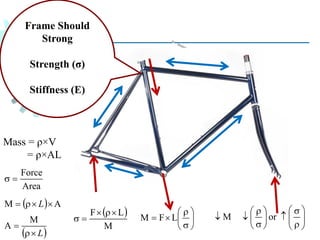
Frame Should
Strong
Strength (σ)
Stiffness (E)
Mass = ρ×V
= ρ×AL
Area
Force
=
( ) AM = L
( )L
=
M
A
( )
M
LF 
= 







= LFM orM 
















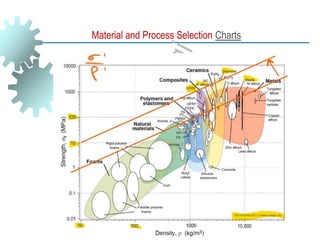
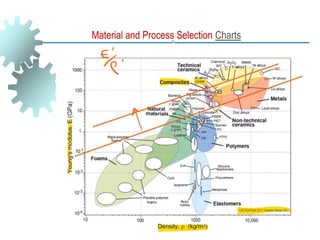
Material and Process Selection Charts
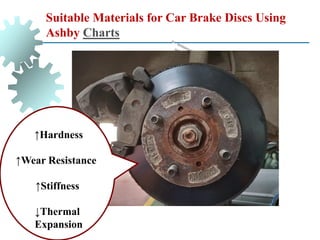
Suitable Materials for Car Brake Discs Using
Ashby Charts
↑Hardness
↑Wear Resistance
↑Stiffness
↓Thermal
Expansion
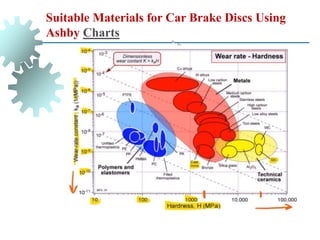
Suitable Materials for Car Brake Discs Using
Ashby Charts
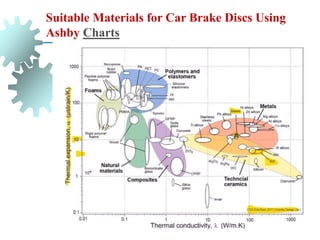
Suitable Materials for Car Brake Discs Using
Ashby Charts
Ashby - Materials Selection in Mechanical Design

General introduction to manufacturing processes

  • 1.
    MEC323:PRIMARY MANUFACTURING Unit I Generalintroduction to manufacturing processes Dr. L K Bhagi, Associate Professor, Mechanical Engineering Department, LPU
  • 2.
    Need 1. To creategoods for human being to support living and improve standard of life. 2. Producing more goods using less resource is the target to cater needs of public in general 3. So productivity is of prime importance and is achieved by reducing wastage in the form of scrap and defective products
  • 3.
  • 4.
    The first incandescentlamp was made by TA. Edison (1847-1931) in New Jersey and was first lit in 1879. A typical bulb then had a life of only about 13.5 hours. main purpose increasing their life and reducing production costs. materials and production methods Incandescent Light Bulbs “glowing with heat”
  • 5.
    The light-emitting componentis the filament, which, by the passage of current and due to its electrical resistance, is heated to incandescence to a temperature of 2200°-3000°C. Edison’s first successful lamp had a carbon filament, although he and others also had experimented with carbonized paper and metals such as osmium, itidium, and tantalum. Incandescent Light Bulbs “glowing with heat”
  • 6.
    However, none ofthese materials has the strength, resistance to high temperature, and long life as has tungsten, which is now the most commonly used filament material. Incandescent Light Bulbs “glowing with heat”
  • 7.
    The first stepis making the glass stem that supports the lead-in wires and the filament connects them to the base of the bulb. Step in Manufacturing a Light Bulb
  • 8.
    All these componentsare positioned, assembled, and sealed while the glass is heated by gas flames. Step in Manufacturing a Light Bulb
  • 9.
    The filament isthen attached to the lead-in wires. Step in Manufacturing a Light Bulb
  • 10.
    The filament ismade by powder metallurgy techniques. which involves first pressing tungsten powder into ingots and sintering it. Step in Manufacturing a Light Bulb
  • 11.
    Next, the ingotis shaped into round rods by rotary swaging and then drawing it through a set of dies into thin wire. The wire diameter for a 60-W, 120-V bulb is 0.045 mm. Step in Manufacturing a Light Bulb
  • 12.
    The diameter mustbe controlled precisely, because if it is only 1% less than the diameter specified, the life of the bulb would be reduced by as much as 25%. R = p (L / A) Step in Manufacturing a Light Bulb
  • 13.
    The diameter mustbe controlled precisely, because if it is only 1% less than the diameter specified, the life of the bulb would be reduced by as much as 25%. R = p (L / A) Step in Manufacturing a Light Bulb
  • 14.
    filament wire iscoiled this is done in order to increase the light producing capacity of the filament. Step in Manufacturing a Light Bulb
  • 15.
    The completed stemassembly (called the mount) is transferred to a machine that lowers a glass bulb over the mount. Gas flames are used to seal the rim of the mount to the neck of the bulb. Step in Manufacturing a Light Bulb
  • 16.
    The air inthe bulb is then exhausted and filled with inert gas. The filling gas must be pure. Step in Manufacturing a Light Bulb
  • 17.
    The next stepinvolves attaching the metal base to the glass bulb with a special cement. The machine that performs this operation also solders or welds the lead-in wires to the base, to provide the electrical connection. Step in Manufacturing a Light Bulb
  • 18.
    The lead-in wiresare usually made of nickel, copper, or molybdenum, and the support wires are made of molybdenum Step in Manufacturing a Light Bulb
  • 19.
    The bulb baseis generally made from aluminum, replacing the more expensive brass base. Bulb Industry Step in Manufacturing a Light Bulb
  • 21.
    Resources for manufacturing Inmanufacturing for producing goods used are the resources in the form of – Natural resources (air, water, animal, wheat, minerals etc.) – Machine tool: plants, machines, tool, robots, automation Creation of goods for human being: (Natural Resources) × (Man power)machine tool
  • 22.
    Manufacturing Today, production methodshave advanced to such an extent that (a) aluminum beverage cans are made at rates of more than 500 per minute, with each can costing about Rs 1.2 to make, (b) holes in sheet metal are punched at rates of 800 holes per minute, and (c) incandescent light bulbs are made at rates of more than 2000 bulbs per minute.
  • 23.
    Manufacturing The word manufacturefirst appeared in English in 1567 and is derived from the Latin manu factus, meaning “made by hand”. The word manufacturing first appeared in 1683, and the word production, which is often used interchangeably with the word manufacturing, first appeared sometime during the 15th century.
  • 24.
    Manufacturing – Technologically: Physicaland chemical processes to alter size, shape and properties of material suitable for service use. – Economically: (value addition) A step to convert raw material into useful product of high value.
  • 25.
    Manufacturing- Technologically Application ofphysical and chemical processes used for changing shape, size, properties, and appearance of raw material for required function. ▪ Always carried out as a sequence of operations.
  • 26.
    Manufacturing – Economically (value Addition) Transformation of materials into items of greater value by means of one or more processing and/or assembly operations ▪ Raw material processed by manufacturing processes usable goods are obtained (high value)
  • 27.
  • 28.
  • 29.
  • 30.
    Casting Investment casting Lost foamcasting Expanded Polystyrene foam Shell molding casting Permanent Mold Gravity Casting
  • 31.
  • 32.
  • 33.
  • 34.
  • 35.
  • 36.
  • 37.
  • 38.
  • 39.
  • 40.
  • 41.
  • 42.
    Classification of ManufacturingProcesses Manufacturing Processes Processesing Operations Assembly Operations Shaping Processes Surface Processing Operations Property Enhancing Processes Permanent Joining Processes Mechanical Fastening Solidification Processes Deformation Processes Particulate Processesing Material Removal Process Welding Soldering and Brazing Adhesive Bonding Heat Treatment Cleaning & Surface treatments Adhesive Bonding Thread Fasteners Permanent Fastening Methods
  • 43.
    Materials in Manufacturing Mostengineering materials can be classified into one of three basic categories: 1. Metals 2. Ceramics 3. Polymers ▪ Their chemistries are different. ▪ Their mechanical and physical properties are dissimilar. ▪ These differences affect the manufacturing processes that can be used to produce products from them.
  • 44.
    Metals Two basic groups: 1.Ferrous metals - based on iron: ▪ Steel = Fe - C alloy (0.08 to 2.1%C) ▪ Cast iron = Fe - C alloy (2.1% to 6.76%C) 2. Non-ferrous metals - all other metallic elements and their alloys: aluminum, copper, magnesium, nickel, silver, tin, zinc, brass, gold, titanium, etc.
  • 45.
    Ceramics Ceramic materials areinorganic, non-metallic materials made from compounds of a metal and a non metal. ▪ Typical non-metallic elements are oxygen, nitrogen, and carbon ▪ For processing, ceramics divide into: 1. Crystalline ceramics – includes: ▪ Traditional ceramics, such as clay (hydrous aluminum silicates) ▪ Modern ceramics, such as alumina (Al2O3), silicon carbide (SiC), etc. 2. Glasses – mostly based on silica (SiO2)
  • 46.
    Ceramics>Characteristics of Ceramics ▪Low density compared to metals ▪ High melting point or decomposition temperature ▪ High hardness and very brittle ▪ High elastic modulus and moderate strength ▪ Low toughness ▪ High electrical resistivity ▪ Low thermal conductivity ▪ High temperature wear resistance ▪ Thermal Shock resistance ▪ High corrosion resistance Main drawback is brittleness and low toughness
  • 47.
    Ceramics>Silicon nitride bearings(Si3N4) havegood shock resistance compared to other ceramics. SNB bearings are harder than metal, results in ✓80% less friction, ✓3 to 10 times longer lifetime, 80% higher speed, ✓60% less weight, ✓higher corrosion resistance and ✓higher operation temp., as compared to traditional metal bearings. Silicon nitride bearings are especially useful in applications where corrosion, electric or magnetic fields prohibit the use of metals. Si3N4 was used as abrasive and cutting tools.
  • 48.
    Polymers (Greek poly-, "many"+ mer, "part") The word POLYMER means many ‘mers’ ▪ A ‘mer’ is a unit ▪ Polyethylene means many ‘ethylenes’ ▪ The molecular weight of a polymer (length of the chain – number of ‘mers’) will effect the properties. • 10-20 ethylenes – greases or oils • 200-300 waxes • 20,000 + polyethylene
  • 49.
    Polymers (Greek poly-, "many"+ mer, "part") Compound formed of repeating structural units called monomers, who share atoms with neighboring monomers to form a long chain. Three categories: 1. Thermoplastic polymers - can be subjected to multiple heating and cooling cycles without altering molecular structure. 2. Thermosetting polymers - molecules chemically transform (cure) into a rigid structure – cannot be reheated. 3. Elastomers - shows significant elastic behavior
  • 50.
    Polymers (Greek poly-, "many"+ mer, "part") Compound formed of repeating structural units called monomers, who share atoms with neighboring monomers to form a long chain. Three categories: 1. Thermoplastic polymers - can be subjected to multiple heating and cooling cycles without altering molecular structure. 2. Thermosetting polymers - molecules chemically transform (cure) into a rigid structure – cannot be reheated. 3. Elastomers - shows significant elastic behavior A monomer (one part) is a molecule that can undergo polymerization. Large numbers of monomers combine to form polymers in a process called polymerization.
  • 51.
    Polymers (Greek poly-, "many"+ mer, "part") Compound formed of repeating structural units called monomers, who share atoms with neighboring monomers to form a long chain. Three categories: 1. Thermoplastic polymers - can be subjected to multiple heating and cooling cycles without altering molecular structure. 2. Thermosetting polymers - molecules chemically transform (cure) into a rigid structure – cannot be reheated. 3. Elastomers - shows significant elastic behavior A monomer (one part) is a molecule that can undergo polymerization. Large numbers of monomers combine to form polymers in a process called polymerization. polymerization is a process of reacting monomer molecules together in a chemical reaction to form polymer chains.
  • 52.
    Polymers (Greek poly-, "many"+ mer, "part") Compound formed of repeating structural units called monomers, who share atoms with neighboring monomers to form a long chain. Three categories: 1. Thermoplastic polymers - can be subjected to multiple heating and cooling cycles without altering molecular structure. 2. Thermosetting polymers - molecules chemically transform (cure) into a rigid structure – cannot be reheated. 3. Elastomers - shows significant elastic behavior A monomer (one part) is a molecule that can undergo polymerization. Large numbers of monomers combine to form polymers in a process called polymerization. polymerization is a process of reacting monomer molecules together in a chemical reaction to form polymer chains. Polymers referred to as "homopolymers," repeated long chains or structures of the same monomer unit, whereas polymers that consist of more than one monomer unit are referred to as “copolymers”
  • 53.
    Polymers (Greek poly-, "many"+ mer, "part") Compound formed of repeating structural units called monomers, who share atoms with neighboring monomers to form a long chain. Three categories: 1. Thermoplastic polymers - can be subjected to multiple heating and cooling cycles without altering molecular structure. 2. Thermosetting polymers - molecules chemically transform (cure) into a rigid structure – cannot be reheated. 3. Elastomers - shows significant elastic behavior A monomer (one part) is a molecule that can undergo polymerization. Large numbers of monomers combine to form polymers in a process called polymerization. polymerization is a process of reacting monomer molecules together in a chemical reaction to form polymer chains. Polymers referred to as "homopolymers," repeated long chains or structures of the same monomer unit, whereas polymers that consist of more than one monomer unit are referred to as “copolymers”
  • 54.
    Polymers (Greek poly-, "many"+ mer, "part") Compound formed of repeating structural units called monomers, who share atoms with neighboring monomers to form a long chain. Three categories: 1. Thermoplastic polymers - can be subjected to multiple heating and cooling cycles without altering molecular structure. 2. Thermosetting polymers - molecules chemically transform (cure) into a rigid structure – cannot be reheated. 3. Elastomers - shows significant elastic behavior
  • 55.
    In Addition: Composites Non-homogeneousor heterogeneous mixtures of below mentioned three basic types rather than a unique category.
  • 56.
    Composites Material consisting oftwo or more phases that are processed separately and then bonded together to achieve properties superior to its constituents: ▪ Matrix - homogeneous mass of material, such as grains of identical unit cell structure in a solid metal or polymer. ▪ Reinforcements – particles, fibers, whiskers of as a foreign element. ▪ Properties of composites depend on physical shapes of components, method of processing, content of foreign element as well as their shapes.
  • 57.
    Post-Manufacturing Processes Alters amaterial’s shape, physical properties, or appearance in order to add value. Four categories of processing operations: 1. Shaping operations – to alter the geometry of the starting work material 2. Property enhancer operations – to improve physical properties without changing shape 3. Surface processing operations - to clean, coat, or deposit material on exterior surface of the work 4. Assembly
  • 58.
    Solidification Processes Starting materialis heated sufficiently to transform it into a liquid or highly plastic state. ▪ Examples: metal casting, plastic molding, etc.
  • 59.
    Particulate Processing Starting materialsare powders of metals or ceramics or even thermoset plastics. ▪ Usually involves pressing and sintering, in which powders are first compressed and then heated to bond the individual particles.
  • 60.
    Deformation Processes 1. Startingmaterial is shaped by application of forces that exceed the yield strength of the material. 2. Starting material can be heated to reduce the amount of input force. Examples: (a) forging, (b) rolling and (b) extrusion.
  • 61.
    Material Removal Processes Excessmaterial removed from the starting piece so what remains is the desired geometry. ▪ Examples……
  • 62.
    Waste Problem WhileManufacturing Desirable to minimize waste in part shaping. ▪ Material removal processes are wasteful in unit operations, simply by the way they work. ▪ Most casting, molding and particulate processing operations waste little material. ▪ Almost zero waste in metal forming processes. Terminology for minimum waste processes: ▪ Net-shape processes - when most of the starting material is used and no subsequent machining is required (3D printing and powder metallurgy. ▪ Near-net shape processes - when minimum amount of machining is required (forging, rolling, sheet metal operations).
  • 63.
    Surface Processing Operations ▪Cleaning - chemical and mechanical processes to remove dirt, oil, and other contaminants from the surface ▪ Surface roughness treatments - mechanical working such as sand blasting, barrel finishing and simply rubbing with files or emery papers.
  • 64.
    Assembly Operations Two ormore separate parts are joined to form a new entity ▪ Types of assembly operations: ▪ Permanent joints. Examples: welding, soldering, brazing and use of adhesives. ▪ Temporary joints. Examples: screws, bolts, nuts, press fitting, and expansion fits. ▪ Semi-permanent joints. Examples: rivets, and clamps
  • 65.
  • 66.
    Low/Job Production Job shopis the term used for this type of production facility. ▪ A job shop makes low quantities of specialized and customized products. ▪ Products are typically complex, e.g., space capsules, prototype aircraft and special machinery . ▪ Equipment in a job shop are flexible. ▪ Designed for maximum flexibility.
  • 67.
    Medium Production 1. Dependsupon demand and can vary time to time: 2. Also called Batch production 3. Further extensions: Cellular manufacturing
  • 68.
    High Production ▪ Oftenreferred to as mass production. ▪ High demand for product. ▪ Manufacturing system dedicated to the production of that product.
  • 69.
    Manufacturing capability Capabilities Capacity of production Servicelife of the part produced Quality of part produced Economical aspect Environmental aspects Compatibility with materials
  • 70.
    How to selecta particular type of suitable process? ✓ On basis of experience. ✓ Facility available. ✓ Material characters. ✓ Processing time and processing cost. ✓ Capital cost of the facility ✓ Overhead and operational cost ✓ Features of manufacturing process ✓ Geometrical features of the products
  • 71.
    Examples of CastingProcesses ▪ Sand Casting (Almost all materials)
  • 72.
    Examples.. ▪ Shell moulding(ferrous and non ferous)
  • 73.
    Examples.. ▪ Vacuum moulding(low melting allow materials)
  • 74.
    Examples.. ▪ Expanded polystyrenecasting (Cast iron and mild steel)
  • 75.
  • 76.
    Examples.. ▪ Plaster andCeramic mould casting (Non ferrous)
  • 77.
    Examples.. ▪ Die casting(Al, Mg and Cu alloys)
  • 78.
  • 79.
    Selecting Ideal Materialsfor Bicycle Frames
  • 80.
    Selection of Materials Aluminas Siliconcarbides Ceramics Silicon nitrides Zirconias Soda glass Borosilicate glass Glasses Silica glass Glass-ceramics Isoprene Neoprene Butyl rubber Elastomers Natural rubber Silicones EVA Composites Sandwiches Hybrids Segmented structures lattices foams polyethylene (PE), Polypropylene (PP), PET, PC, PS, PEEK PA (nylons) Polymers Polyesters Phenolics Epoxies Steel Cast Iron Al Alloys Metals Cu Alloys Zn Alloys Ti Alloys
  • 81.
    Selection of Materials Aluminas Siliconcarbides Ceramics Silicon nitrides Zirconias Soda glass Borosilicate glass Glasses Silica glass Glass-ceramics Isoprene Neoprene Butyl rubber Elastomers Natural rubber Silicones EVA Composites Sandwiches Hybrids Segmented structures lattices foams polyethylene (PE), Polypropylene (PP), PET, PC, PS, PEEK PA (nylons) Polymers Polyesters Phenolics Epoxies Steel Cast Iron Al Alloys Metals Cu Alloys Zn Alloys Ti Alloys
  • 82.
    Selection of Materials Aluminas Siliconcarbides Ceramics Silicon nitrides Zirconias Soda glass Borosilicate glass Glasses Silica glass Glass-ceramics Isoprene Neoprene Butyl rubber Elastomers Natural rubber Silicones EVA Composites Sandwiches Hybrids Segmented structures lattices foams polyethylene (PE), Polypropylene (PP), PET, PC, PS, PEEK PA (nylons) Polymers Polyesters Phenolics Epoxies Steel Cast Iron Al Alloys Metals Cu Alloys Zn Alloys Ti Alloys
  • 83.
    Selection of Materials Aluminas Siliconcarbides Ceramics Silicon nitrides Zirconias Soda glass Borosilicate glass Glasses Silica glass Glass-ceramics Isoprene Neoprene Butyl rubber Elastomers Natural rubber Silicones EVA Composites Sandwiches Hybrids Segmented structures lattices foams polyethylene (PE), Polypropylene (PP), PET, PC, PS, PEEK PA (nylons) Polymers Polyesters Phenolics Epoxies Steel Cast Iron Al Alloys Metals Cu Alloys Zn Alloys Ti Alloys
  • 84.
    Selection of Materials Aluminas Siliconcarbides Ceramics Silicon nitrides Zirconias Soda glass Borosilicate glass Glasses Silica glass Glass-ceramics Isoprene Neoprene Butyl rubber Elastomers Natural rubber Silicones EVA Composites Sandwiches Hybrids Segmented structures lattices foams polyethylene (PE), Polypropylene (PP), PET, PC, PS, PEEK PA (nylons) Polymers Polyesters Phenolics Epoxies Steel Cast Iron Al Alloys Metals Cu Alloys Zn Alloys Ti Alloys
  • 85.
    Selection of Materials Aluminas Siliconcarbides Ceramics Silicon nitrides Zirconias Soda glass Borosilicate glass Glasses Silica glass Glass-ceramics Isoprene Neoprene Butyl rubber Elastomers Natural rubber Silicones EVA Composites Sandwiches Hybrids Segmented structures lattices foams polyethylene (PE), Polypropylene (PP), PET, PC, PS, PEEK PA (nylons) Polymers Polyesters Phenolics Epoxies Steel Cast Iron Al Alloys Metals Cu Alloys Zn Alloys Ti Alloys
  • 86.
    Selection of Materials Aluminas Siliconcarbides Ceramics Silicon nitrides Zirconias Soda glass Borosilicate glass Glasses Silica glass Glass-ceramics Isoprene Neoprene Butyl rubber Elastomers Natural rubber Silicones EVA Composites Sandwiches Hybrids Segmented structures lattices foams polyethylene (PE), Polypropylene (PP), PET, PC, PS, PEEK PA (nylons) Polymers Polyesters Phenolics Epoxies Steel Cast Iron Al Alloys Metals Cu Alloys Zn Alloys Ti Alloys
  • 87.
    Selection of Materials Aluminas Siliconcarbides Ceramics Silicon nitrides Zirconias Soda glass Borosilicate glass Glasses Silica glass Glass-ceramics Isoprene Neoprene Butyl rubber Elastomers Natural rubber Silicones EVA Composites Sandwiches Hybrids Segmented structures lattices foams polyethylene (PE), Polypropylene (PP), PET, PC, PS, PEEK PA (nylons) Polymers Polyesters Phenolics Epoxies Steel Cast Iron Al Alloys Metals Cu Alloys Zn Alloys Ti Alloys
  • 88.
    Selection of Materials Aluminas Siliconcarbides Ceramics Silicon nitrides Zirconias Soda glass Borosilicate glass Glasses Silica glass Glass-ceramics Isoprene Neoprene Butyl rubber Elastomers Natural rubber Silicones EVA Composites Sandwiches Hybrids Segmented structures lattices foams polyethylene (PE), Polypropylene (PP), PET, PC, PS, PEEK PA (nylons) Polymers Polyesters Phenolics Epoxies Steel Cast Iron Al Alloys Metals Cu Alloys Zn Alloys Ti Alloys
  • 89.
    Selection of Materials Aluminas Siliconcarbides Ceramics Silicon nitrides Zirconias Soda glass Borosilicate glass Glasses Silica glass Glass-ceramics Isoprene Neoprene Butyl rubber Elastomers Natural rubber Silicones EVA Composites Sandwiches Hybrids Segmented structures lattices foams polyethylene (PE), Polypropylene (PP), PET, PC, PS, PEEK PA (nylons) Polymers Polyesters Phenolics Epoxies Steel Cast Iron Al Alloys Metals Cu Alloys Zn Alloys Ti Alloys
  • 90.
    Selection of Materials Aluminas Siliconcarbides Ceramics Silicon nitrides Zirconias Soda glass Borosilicate glass Glasses Silica glass Glass-ceramics Isoprene Neoprene Butyl rubber Elastomers Natural rubber Silicones EVA Composites Sandwiches Hybrids Segmented structures lattices foams polyethylene (PE), Polypropylene (PP), PET, PC, PS, PEEK PA (nylons) Polymers Polyesters Phenolics Epoxies Steel Cast Iron Al Alloys Metals Cu Alloys Zn Alloys Ti Alloys
  • 91.
    Selection of Materials Aluminas Siliconcarbides Ceramics Silicon nitrides Zirconias Soda glass Borosilicate glass Glasses Silica glass Glass-ceramics Isoprene Neoprene Butyl rubber Elastomers Natural rubber Silicones EVA Composites Sandwiches Hybrids Segmented structures lattices foams polyethylene (PE), Polypropylene (PP), PET, PC, PS, PEEK PA (nylons) Polymers Polyesters Phenolics Epoxies Steel Cast Iron Al Alloys Metals Cu Alloys Zn Alloys Ti Alloys
  • 92.
    Selection of Materials Aluminas Siliconcarbides Ceramics Silicon nitrides Zirconias Soda glass Borosilicate glass Glasses Silica glass Glass-ceramics Isoprene Neoprene Butyl rubber Elastomers Natural rubber Silicones EVA Composites Sandwiches Hybrids Segmented structures lattices foams polyethylene (PE), Polypropylene (PP), PET, PC, PS, PEEK PA (nylons) Polymers Polyesters Phenolics Epoxies Steel Cast Iron Al Alloys Metals Cu Alloys Zn Alloys Ti Alloys
  • 93.
    Selection of Materials Aluminas Siliconcarbides Ceramics Silicon nitrides Zirconias Soda glass Borosilicate glass Glasses Silica glass Glass-ceramics Isoprene Neoprene Butyl rubber Elastomers Natural rubber Silicones EVA Composites Sandwiches Hybrids Segmented structures lattices foams polyethylene (PE), Polypropylene (PP), PET, PC, PS, PEEK PA (nylons) Polymers Polyesters Phenolics Epoxies Steel Cast Iron Al Alloys Metals Cu Alloys Zn Alloys Ti Alloys
  • 94.
    Selection of Materials Aluminas Siliconcarbides Ceramics Silicon nitrides Zirconias Soda glass Borosilicate glass Glasses Silica glass Glass-ceramics Isoprene Neoprene Butyl rubber Elastomers Natural rubber Silicones EVA Composites Sandwiches Hybrids Segmented structures lattices foams polyethylene (PE), Polypropylene (PP), PET, PC, PS, PEEK PA (nylons) Polymers Polyesters Phenolics Epoxies Steel Cast Iron Al Alloys Metals Cu Alloys Zn Alloys Ti Alloys
  • 95.
    Frame Should Strong Strength (σ) Stiffness(E) Mass = ρ×V = ρ×AL Area Force = ( ) AM = L ( )L = M A ( ) M LF  =         = LFM orM                 
  • 96.
    Material and ProcessSelection Charts
  • 97.
    Material and ProcessSelection Charts
  • 98.
    Suitable Materials forCar Brake Discs Using Ashby Charts ↑Hardness ↑Wear Resistance ↑Stiffness ↓Thermal Expansion
  • 99.
    Suitable Materials forCar Brake Discs Using Ashby Charts
  • 100.
    Suitable Materials forCar Brake Discs Using Ashby Charts
  • 101.
    Ashby - MaterialsSelection in Mechanical Design