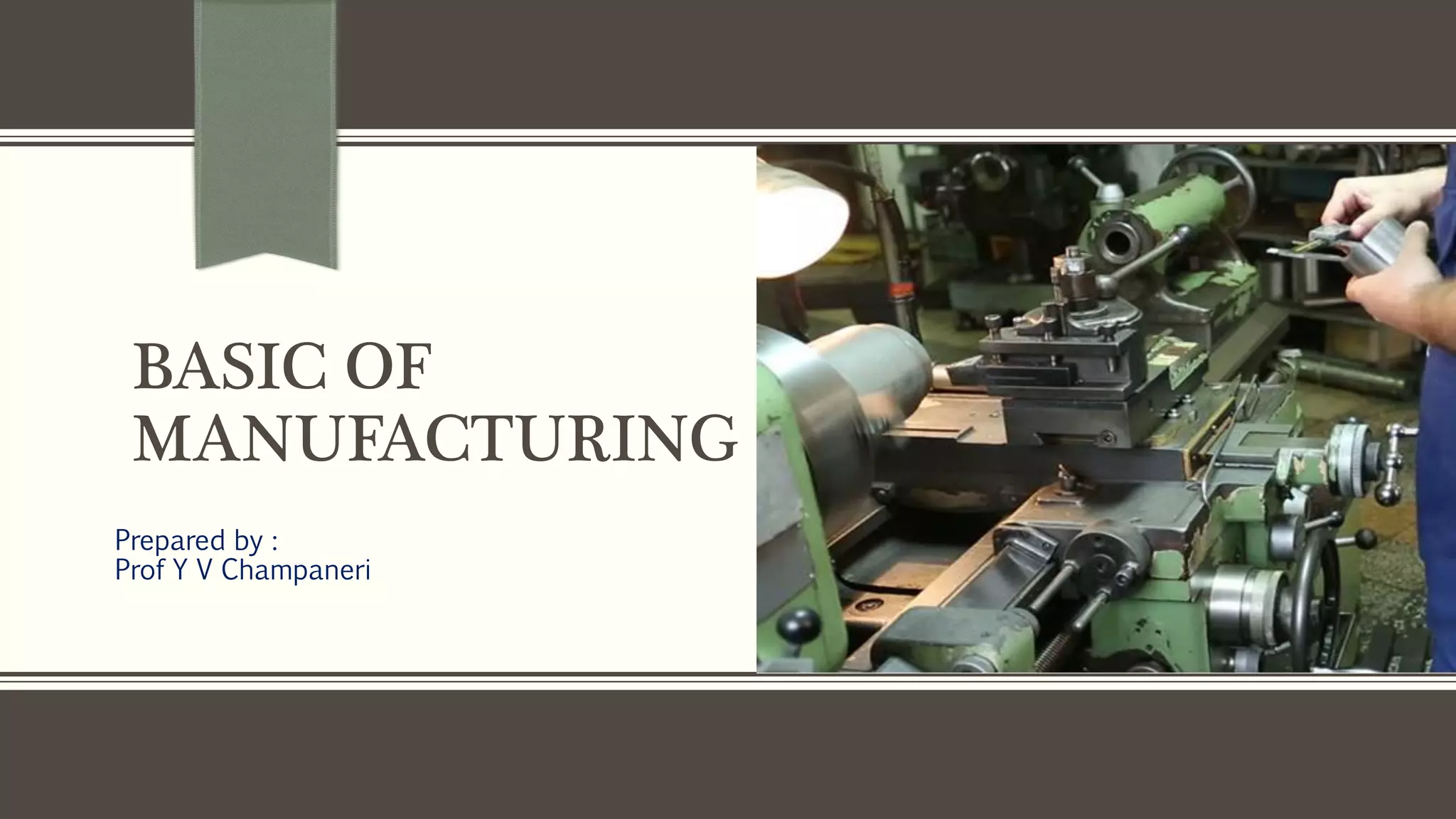
BASIC OF
MANUFACTURING
Prepared by :
Prof Y V Champaneri
What is Manufacturing Process?
 Manufacturing Process define as process of conversely raw material in to products
encompass the design and manufacturing of good using various method ,
techniques like man, Machine and Money.
 Manufacturing processes are the steps through which raw materials are transformed
into a final product. The manufacturing process begins with the creation of the
materials from which the design is made.
Importance Of Manufacturing
 The term may refer to range of human activity, from handicraft to high tech, but is
most commonly applied to industrial production in which raw material are
transformed into finished goods on large scale.
 Such finished goods may be used for manufacturing. Product such as aircraft,
household appliances, or sold to wholesalers, who in turn sell them to retailers.
 Manufacturing takes turns under all types of economic systems.
 In free market economy, manufacturing is usually directed toward the mass
production of product for sale to consumers at a profit
 In mixed market economics, manufacturing occurs under some degree of
government regulation.
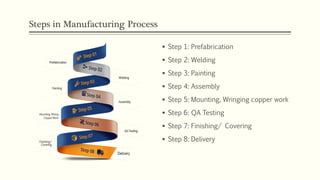
Steps in Manufacturing Process
 Step 1: Prefabrication
 Step 2: Welding
 Step 3: Painting
 Step 4: Assembly
 Step 5: Mounting, Wringing copper work
 Step 6: QA Testing
 Step 7: Finishing/ Covering
 Step 8: Delivery
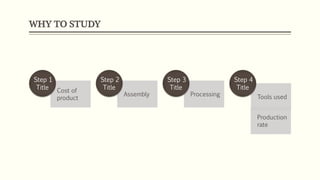
WHY TO STUDY
Cost of
product
Step 1
Title
Assembly
Step 2
Title
Processing
Step 3
Title
Tools used
Production
rate
Step 4
Title
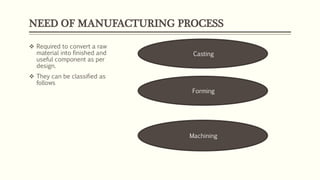
NEED OF MANUFACTURING PROCESS
 Required to convert a raw
material into finished and
useful component as per
design.
 They can be classified as
follows
Casting
Forming
Machining
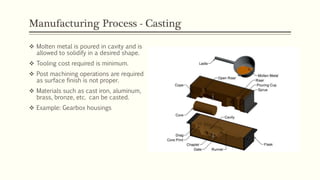
Manufacturing Process - Casting
 Molten metal is poured in cavity and is
allowed to solidify in a desired shape.
 Tooling cost required is minimum.
 Post machining operations are required
as surface finish is not proper.
 Materials such as cast iron, aluminum,
brass, bronze, etc. can be casted.
 Example: Gearbox housings
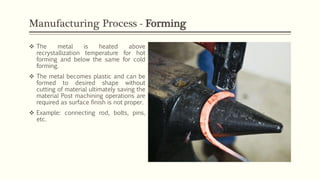
Manufacturing Process - Forming
 The metal is heated above
recrystallization temperature for hot
forming and below the same for cold
forming.
 The metal becomes plastic and can be
formed to desired shape without
cutting of material ultimately saving the
material Post machining operations are
required as surface finish is not proper.
 Example: connecting rod, bolts, pins,
etc.
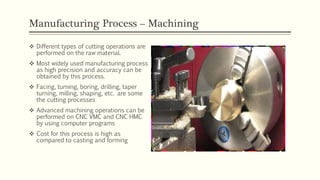
Manufacturing Process – Machining
 Different types of cutting operations are
performed on the raw material.
 Most widely used manufacturing process
as high precision and accuracy can be
obtained by this process.
 Facing, turning, boring, drilling, taper
turning, milling, shaping, etc. are some
the cutting processes
 Advanced machining operations can be
performed on CNC VMC and CNC HMC
by using computer programs
 Cost for this process is high as
compared to casting and forming
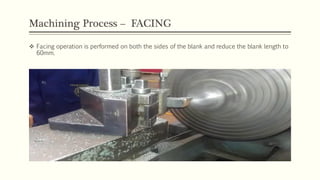
Machining Process – FACING
 Facing operation is performed on both the sides of the blank and reduce the blank length to
60mm.
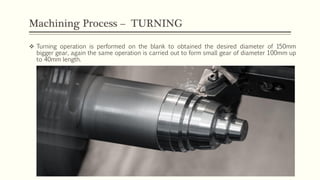
Machining Process – TURNING
 Turning operation is performed on the blank to obtained the desired diameter of 150mm
bigger gear, again the same operation is carried out to form small gear of diameter 100mm up
to 40mm length.
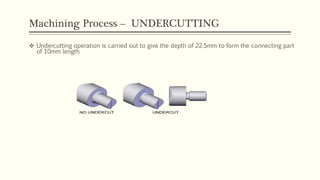
Machining Process – UNDERCUTTING
 Undercutting operation is carried out to give the depth of 22.5mm to form the connecting part
of 10mm length
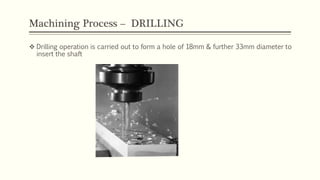
Machining Process – DRILLING
 Drilling operation is carried out to form a hole of 18mm & further 33mm diameter to
insert the shaft
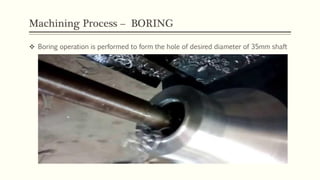
Machining Process – BORING
 Boring operation is performed to form the hole of desired diameter of 35mm shaft
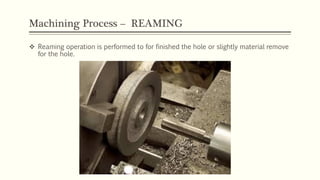
Machining Process – REAMING
 Reaming operation is performed to for finished the hole or slightly material remove
for the hole.
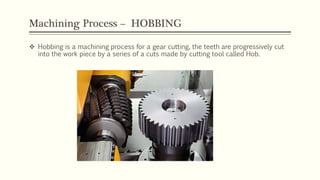
Machining Process – HOBBING
 Hobbing is a machining process for a gear cutting, the teeth are progressively cut
into the work piece by a series of a cuts made by cutting tool called Hob.
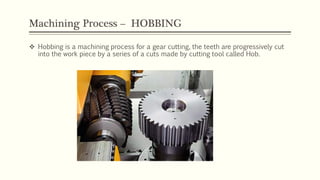
Machining Process – HOBBING
 Hobbing is a machining process for a gear cutting, the teeth are progressively cut
into the work piece by a series of a cuts made by cutting tool called Hob.
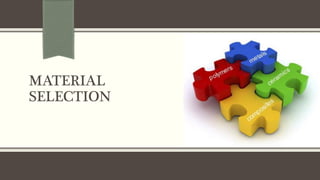
MATERIAL
SELECTION
Material Selection
• Material Selection is not as difficult as it might appear but it does require an
awareness of the general behavior of plastics as a group , as well as a
familiarity with the special characteristics of individual plastics
• Material selection is a step in the process of designing any physical object. In
the context of product design, the main goal of material selection is to minimize
cost while meeting product performance goals
• Materials science and engineering plays a vital role in this modern age of science
and technology. Various kinds of materials are used in industry, housing,
agriculture, transportation etc. to meet the plant and individual requirements.
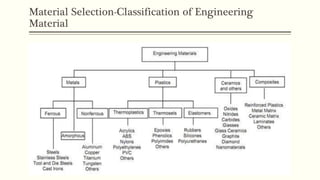
Material Selection-Classification of Engineering
Material
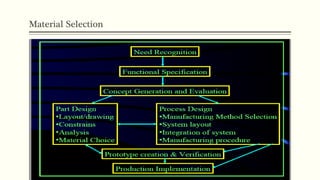
Material Selection
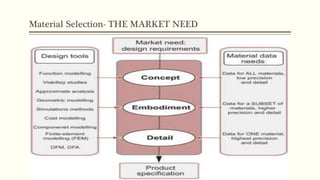
Material Selection- THE MARKET NEED
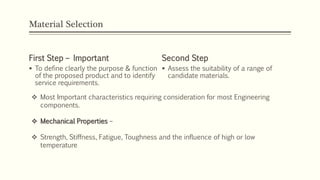
Material Selection
First Step – Important
 To define clearly the purpose & function
of the proposed product and to identify
service requirements.
Second Step
 Assess the suitability of a range of
candidate materials.
 Most Important characteristics requiring consideration for most Engineering
components.
 Mechanical Properties –
 Strength, Stiffness, Fatigue, Toughness and the influence of high or low
temperature.
Material Selection – Mechanical Properties
Fatigue
 Plastics are susceptible to brittle crack growth fractures as a result of cyclic
stresses. Plastics are also prone to thermal softening if the cyclic stress or rate is
high. The best plastics are Polypropylene (PP), Ethylene-Propylene copolymer and
PVDF. (Self Hinge application).
Material Selection – Mechanical Properties
Toughness
 By toughness we mean the resistance to fracture. At room temperature the
unreinforced plastics include Nylon 66, LDPE, LLDPE, EVA and Polyurethane
structural foam. At sub-zero temperatures it is necessary to consider plastics sucas
ABS, Polycarbonate and EVA.
Material Selection – Mechanical Properties
Degradation- Physical or Chemical attack:
 Plastics are best corrosion resistance material. Plastics are susceptible to chemical
attack and degradation. Degradation of plastics is also caused by heat, stress and
radiation. Generally Crystalline plastics offer better environmental resistance than
Amorphous. Nylon 66, PEEK & PPS. Noknown solvent at room temperature for PP,
PE, PPS & PEEK.
Material Selection – Mechanical Properties
Degradation- Weathering
 This is caused by contact with oxidizing acids, exposure to UV
Degradation- Oxidation
 This generally occurs as a result of the combine effect of water absorption and
exposure to Ultra- Violate radiation..
Material Selection – Mechanical Properties
Wear Resistance and Frictional Properties:
 The use of plastics in bearing application and in situation where there is sliding
contact e. g. gears, piston rings, seals cams etc. The advantage of plastics are low
rates of wear in the absence of conventional lubricants, low cost. The ability to
absorb shock and vibration with the ability to operate with low noise and power
consumption. The plastics with the best resistance to wear are Ultra High Molecular
Weight Polyethylene (used in Hip joint replacement) and PTFE lubricated Polyamide
(Nylon), Acetal & PBT
Material Selection – Special Properties
Thermal Properties:
 Properties of Plastics are Temperature dependent. Glass Transition Temp. below
which the material behaves like Glass. For example Polystyrene and Acrylic are
below their Tg at room temp. The material is in Glassy state. Same PE is above its
Tg and hence very Flexible.
Electrical Properties:
 PTFE & PE are among the best insulating materials available. Insulators should have
Resistivity 104W..
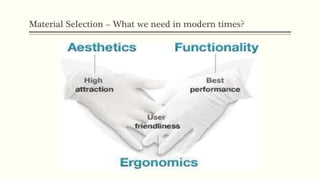
Material Selection – What we need in modern times?
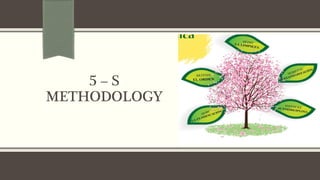
5 – S
METHODOLOGY
5 – S Methodology
What is it?
 5S is a workplace organization technique
 It is a way to involve associates in the ownership of their workspace
 It helps create and maintain the efficiency and effectiveness of a work area
5S is a common starting point for Lean activities in a company
“Quality starts with yourself "”is the motto
5 – S Methodology
What’s it for??
It is a way to create:
 Cleaner work areas
 More organization
 Safer working conditions
 Less wasted time
 Efficient work processes and practices
 More available space
5 – S Methodology
How does it work???
5S is most effective when applied in a systematic
way
The following video illustrates the 5S methodology
5 – S Methodology
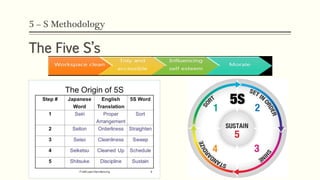
The Five S’s
5 – S Methodology
5 - S
Sorting – Separating the needed from the not-needed
Simplifying – A place for everything and everything in its
place, clean and ready to use
Systematic Cleaning or Sweeping – Cleaning for
inspection
Standardizing – Developing common methods for
consistency
Sustaining – Holding the gains and improving
5 – S Methodology
The First S - Sorting
Separating the Needed from the Not-Needed
 Eliminate not-needed items and perform an initial cleaning
 Establish criteria/handling of items
 Identify not-needed items
 Move not-needed items to holding area
 Conduct a white-elephant sale
 Conduct an initial cleaning
5 – S Methodology
The Second S - Simplifying
A place for everything and everything in its place, clean and
ready to use
 Arrange workplace for safety and efficiency
 Identify key equipment and supplies
 Determine location for each item
 Outline locations and zones
 Develop shadow boards, label items
 Document layout, equipment, supplies
5 – S Methodology
The Third S – Systematic Cleaning
Cleaning for Inspection
 Perform daily cleaning and inspection to understand work conditions
 Identify points to check for performance
 Determine acceptable performance
 Determine visual indicators/controls
 Mark equipment/controls
 Conduct daily cleaning/inspections
5 – S Methodology
The Fourth S - Standardizing
Developing Common Methods for Consistency
 Make abnormal conditions noticeable and document agreements
 Document agreements and checks
 Establish/document standard methods across similar work areas
 Document new standard methods
5 – S Methodology
The Fifth S - Sustaining
Holding the Gains and Improving
 Maintain the gains from other 5S activities and improve
 Determine 5S Level of Achievement
 Perform routine checks
 Analyze results of routine checks
 Measure progress and plan for continuous improvement
5 – S Methodology
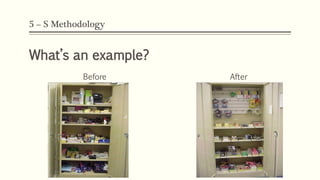
What’s an example?
Before After
5 – S Methodology
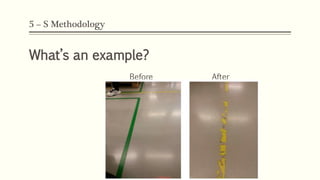
What’s an example?
Before After
SIX - 𝜎
Six 𝜎 Approach
What is Six Sigma ??
 Six sigma is a business statistical Strategy.
 Is to identifying defects and removing them from the process of products to improve
quality.
 A defect is defined as any process output that does not meet customer
specifications.
 Statistical measure to objectively evaluate processes.
Six 𝜎 Approach
History of Six Sigma??
 The Six sigma was founded by Motorola in the 1970s.
 Out of senior executive Art Sundry's criticism of Motorola’s bad quality.
 They founded a connection between increases in quality and decreases in costs of
production.
 Bill Smith, “Father of six sigma” introduce this quality improvement Methodology to
Motorola.
Six 𝜎 Approach
Definition of Six Sigma??
 Quality management program developed by Motorola in the 1980s.
 Management philosophy focused on business process improvements to:
 Eliminate waste, rework, and mistakes
 Increase customer satisfaction
 Increase profitability and competitiveness
Six 𝜎 Approach
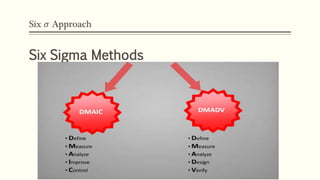
Six Sigma Methods
Six 𝜎 Approach
DMAIC Explanations
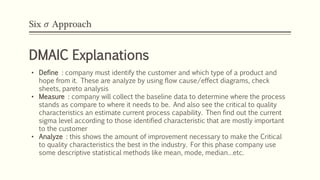
• Define : company must identify the customer and which type of a product and
hope from it. These are analyze by using flow cause/effect diagrams, check
sheets, pareto analysis
• Measure : company will collect the baseline data to determine where the process
stands as compare to where it needs to be. And also see the critical to quality
characteristics an estimate current process capability. Then find out the current
sigma level according to those identified characteristic that are mostly important
to the customer
• Analyze : this shows the amount of improvement necessary to make the Critical
to quality characteristics the best in the industry. For this phase company use
some descriptive statistical methods like mean, mode, median…etc.
Six 𝜎 Approach
DMAIC Explanations
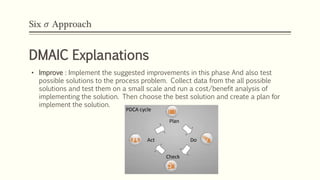
• Improve : Implement the suggested improvements in this phase And also test
possible solutions to the process problem. Collect data from the all possible
solutions and test them on a small scale and run a cost/benefit analysis of
implementing the solution. Then choose the best solution and create a plan for
implement the solution.
• Improvement Cycle
Six 𝜎 Approach
DMAIC Explanations
• Control : measures are implemented to ensure improvements are maintained. To
monitor the process improvements, basically use tools like statistically process
control charts. These charts have three limits, the center line for the average.
Monitor the process to ensure that the process is in the control limits.
Six 𝜎 Approach
DMADV Explanations
• This method is also called DFSS (Design For Six Sigma) And have five phases
• Define design goals that are consistent with customer demands and the
enterprise strategy.
• Measure and identify CTQs (characteristics that are Critical To Quality), product
capabilities, production process capability, and risks.
• Analyze to develop and design alternatives, create a high-level design and
evaluate design capability to select the best design.
• Design details, optimize the design, and plan for design verification. This phase
may require simulations. •
• Verify the design, set up pilot runs, implement the production process and hand it
over to the process owner(s).
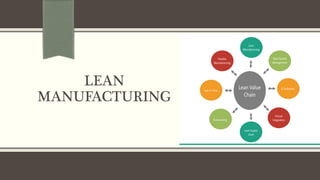
LEAN
MANUFACTURING
LEAN Manufacturing
Lean Manufacturing
 The concept of Lean Manufacturing was developed by Henry Ford in 1920’s.
 Toyota was the first company to introduce ‘lean manufacturing’ concept in its
production system.
 Lean manufacturing focuses on reducing waste.
LEAN Manufacturing
Types of Waste
 OVERPRODUCTION
 INVENTORY
 WAITING
 MOTION
 TRANSPORTATION
 RE-WORK
 OVER-PROCESSING
LEAN Manufacturing
Principles of Lean Manufacturing
 To create continuous flow .
 To use pull-systems to manage the workflow
 To reduce batch sizes and inventories
 To eliminate waste
 To cross-train workers in order to deal with inherent variability
 Selective use of automation
 To instill a Continuous Improvement competence
LEAN Manufacturing
Benefits of Lean Manufacturing
 Productivity Improvement
 Total manufacturing time saved
 Less scrap
 Low inventory
 Quality improvement
 Plant space saved
 Better labor utilization
 Safety of operations
LEAN Manufacturing
Implementation Stages of Lean Manufacturing
 Three stages in the implementation of ‘Lean Manufacturing’---
 Data collection stage
 Data analysis and development of solution Stage
 Implementation Stage
LEAN Manufacturing
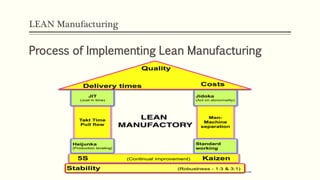
Process of Implementing Lean Manufacturing
Basic of manufacturing

Basic of manufacturing

  • 1.
  • 2.
    What is ManufacturingProcess?  Manufacturing Process define as process of conversely raw material in to products encompass the design and manufacturing of good using various method , techniques like man, Machine and Money.  Manufacturing processes are the steps through which raw materials are transformed into a final product. The manufacturing process begins with the creation of the materials from which the design is made.
  • 3.
    Importance Of Manufacturing The term may refer to range of human activity, from handicraft to high tech, but is most commonly applied to industrial production in which raw material are transformed into finished goods on large scale.  Such finished goods may be used for manufacturing. Product such as aircraft, household appliances, or sold to wholesalers, who in turn sell them to retailers.  Manufacturing takes turns under all types of economic systems.  In free market economy, manufacturing is usually directed toward the mass production of product for sale to consumers at a profit  In mixed market economics, manufacturing occurs under some degree of government regulation.
  • 4.
    Steps in ManufacturingProcess  Step 1: Prefabrication  Step 2: Welding  Step 3: Painting  Step 4: Assembly  Step 5: Mounting, Wringing copper work  Step 6: QA Testing  Step 7: Finishing/ Covering  Step 8: Delivery
  • 5.
    WHY TO STUDY Costof product Step 1 Title Assembly Step 2 Title Processing Step 3 Title Tools used Production rate Step 4 Title
  • 6.
    NEED OF MANUFACTURINGPROCESS  Required to convert a raw material into finished and useful component as per design.  They can be classified as follows Casting Forming Machining
  • 7.
    Manufacturing Process -Casting  Molten metal is poured in cavity and is allowed to solidify in a desired shape.  Tooling cost required is minimum.  Post machining operations are required as surface finish is not proper.  Materials such as cast iron, aluminum, brass, bronze, etc. can be casted.  Example: Gearbox housings
  • 8.
    Manufacturing Process -Forming  The metal is heated above recrystallization temperature for hot forming and below the same for cold forming.  The metal becomes plastic and can be formed to desired shape without cutting of material ultimately saving the material Post machining operations are required as surface finish is not proper.  Example: connecting rod, bolts, pins, etc.
  • 9.
    Manufacturing Process –Machining  Different types of cutting operations are performed on the raw material.  Most widely used manufacturing process as high precision and accuracy can be obtained by this process.  Facing, turning, boring, drilling, taper turning, milling, shaping, etc. are some the cutting processes  Advanced machining operations can be performed on CNC VMC and CNC HMC by using computer programs  Cost for this process is high as compared to casting and forming
  • 10.
    Machining Process –FACING  Facing operation is performed on both the sides of the blank and reduce the blank length to 60mm.
  • 11.
    Machining Process –TURNING  Turning operation is performed on the blank to obtained the desired diameter of 150mm bigger gear, again the same operation is carried out to form small gear of diameter 100mm up to 40mm length.
  • 12.
    Machining Process –UNDERCUTTING  Undercutting operation is carried out to give the depth of 22.5mm to form the connecting part of 10mm length
  • 13.
    Machining Process –DRILLING  Drilling operation is carried out to form a hole of 18mm & further 33mm diameter to insert the shaft
  • 14.
    Machining Process –BORING  Boring operation is performed to form the hole of desired diameter of 35mm shaft
  • 15.
    Machining Process –REAMING  Reaming operation is performed to for finished the hole or slightly material remove for the hole.
  • 16.
    Machining Process –HOBBING  Hobbing is a machining process for a gear cutting, the teeth are progressively cut into the work piece by a series of a cuts made by cutting tool called Hob.
  • 17.
    Machining Process –HOBBING  Hobbing is a machining process for a gear cutting, the teeth are progressively cut into the work piece by a series of a cuts made by cutting tool called Hob.
  • 18.
  • 19.
    Material Selection • MaterialSelection is not as difficult as it might appear but it does require an awareness of the general behavior of plastics as a group , as well as a familiarity with the special characteristics of individual plastics • Material selection is a step in the process of designing any physical object. In the context of product design, the main goal of material selection is to minimize cost while meeting product performance goals • Materials science and engineering plays a vital role in this modern age of science and technology. Various kinds of materials are used in industry, housing, agriculture, transportation etc. to meet the plant and individual requirements.
  • 20.
  • 21.
  • 22.
  • 23.
    Material Selection First Step– Important  To define clearly the purpose & function of the proposed product and to identify service requirements. Second Step  Assess the suitability of a range of candidate materials.  Most Important characteristics requiring consideration for most Engineering components.  Mechanical Properties –  Strength, Stiffness, Fatigue, Toughness and the influence of high or low temperature.
  • 24.
    Material Selection –Mechanical Properties Fatigue  Plastics are susceptible to brittle crack growth fractures as a result of cyclic stresses. Plastics are also prone to thermal softening if the cyclic stress or rate is high. The best plastics are Polypropylene (PP), Ethylene-Propylene copolymer and PVDF. (Self Hinge application).
  • 25.
    Material Selection –Mechanical Properties Toughness  By toughness we mean the resistance to fracture. At room temperature the unreinforced plastics include Nylon 66, LDPE, LLDPE, EVA and Polyurethane structural foam. At sub-zero temperatures it is necessary to consider plastics sucas ABS, Polycarbonate and EVA.
  • 26.
    Material Selection –Mechanical Properties Degradation- Physical or Chemical attack:  Plastics are best corrosion resistance material. Plastics are susceptible to chemical attack and degradation. Degradation of plastics is also caused by heat, stress and radiation. Generally Crystalline plastics offer better environmental resistance than Amorphous. Nylon 66, PEEK & PPS. Noknown solvent at room temperature for PP, PE, PPS & PEEK.
  • 27.
    Material Selection –Mechanical Properties Degradation- Weathering  This is caused by contact with oxidizing acids, exposure to UV Degradation- Oxidation  This generally occurs as a result of the combine effect of water absorption and exposure to Ultra- Violate radiation..
  • 28.
    Material Selection –Mechanical Properties Wear Resistance and Frictional Properties:  The use of plastics in bearing application and in situation where there is sliding contact e. g. gears, piston rings, seals cams etc. The advantage of plastics are low rates of wear in the absence of conventional lubricants, low cost. The ability to absorb shock and vibration with the ability to operate with low noise and power consumption. The plastics with the best resistance to wear are Ultra High Molecular Weight Polyethylene (used in Hip joint replacement) and PTFE lubricated Polyamide (Nylon), Acetal & PBT
  • 29.
    Material Selection –Special Properties Thermal Properties:  Properties of Plastics are Temperature dependent. Glass Transition Temp. below which the material behaves like Glass. For example Polystyrene and Acrylic are below their Tg at room temp. The material is in Glassy state. Same PE is above its Tg and hence very Flexible. Electrical Properties:  PTFE & PE are among the best insulating materials available. Insulators should have Resistivity 104W..
  • 30.
    Material Selection –What we need in modern times?
  • 31.
  • 32.
    5 – SMethodology What is it?  5S is a workplace organization technique  It is a way to involve associates in the ownership of their workspace  It helps create and maintain the efficiency and effectiveness of a work area 5S is a common starting point for Lean activities in a company “Quality starts with yourself "”is the motto
  • 33.
    5 – SMethodology What’s it for?? It is a way to create:  Cleaner work areas  More organization  Safer working conditions  Less wasted time  Efficient work processes and practices  More available space
  • 34.
    5 – SMethodology How does it work??? 5S is most effective when applied in a systematic way The following video illustrates the 5S methodology
  • 35.
    5 – SMethodology The Five S’s
  • 36.
    5 – SMethodology 5 - S Sorting – Separating the needed from the not-needed Simplifying – A place for everything and everything in its place, clean and ready to use Systematic Cleaning or Sweeping – Cleaning for inspection Standardizing – Developing common methods for consistency Sustaining – Holding the gains and improving
  • 37.
    5 – SMethodology The First S - Sorting Separating the Needed from the Not-Needed  Eliminate not-needed items and perform an initial cleaning  Establish criteria/handling of items  Identify not-needed items  Move not-needed items to holding area  Conduct a white-elephant sale  Conduct an initial cleaning
  • 38.
    5 – SMethodology The Second S - Simplifying A place for everything and everything in its place, clean and ready to use  Arrange workplace for safety and efficiency  Identify key equipment and supplies  Determine location for each item  Outline locations and zones  Develop shadow boards, label items  Document layout, equipment, supplies
  • 39.
    5 – SMethodology The Third S – Systematic Cleaning Cleaning for Inspection  Perform daily cleaning and inspection to understand work conditions  Identify points to check for performance  Determine acceptable performance  Determine visual indicators/controls  Mark equipment/controls  Conduct daily cleaning/inspections
  • 40.
    5 – SMethodology The Fourth S - Standardizing Developing Common Methods for Consistency  Make abnormal conditions noticeable and document agreements  Document agreements and checks  Establish/document standard methods across similar work areas  Document new standard methods
  • 41.
    5 – SMethodology The Fifth S - Sustaining Holding the Gains and Improving  Maintain the gains from other 5S activities and improve  Determine 5S Level of Achievement  Perform routine checks  Analyze results of routine checks  Measure progress and plan for continuous improvement
  • 42.
    5 – SMethodology What’s an example? Before After
  • 43.
    5 – SMethodology What’s an example? Before After
  • 44.
  • 45.
    Six 𝜎 Approach Whatis Six Sigma ??  Six sigma is a business statistical Strategy.  Is to identifying defects and removing them from the process of products to improve quality.  A defect is defined as any process output that does not meet customer specifications.  Statistical measure to objectively evaluate processes.
  • 46.
    Six 𝜎 Approach Historyof Six Sigma??  The Six sigma was founded by Motorola in the 1970s.  Out of senior executive Art Sundry's criticism of Motorola’s bad quality.  They founded a connection between increases in quality and decreases in costs of production.  Bill Smith, “Father of six sigma” introduce this quality improvement Methodology to Motorola.
  • 47.
    Six 𝜎 Approach Definitionof Six Sigma??  Quality management program developed by Motorola in the 1980s.  Management philosophy focused on business process improvements to:  Eliminate waste, rework, and mistakes  Increase customer satisfaction  Increase profitability and competitiveness
  • 48.
    Six 𝜎 Approach SixSigma Methods
  • 49.
    Six 𝜎 Approach DMAICExplanations • Define : company must identify the customer and which type of a product and hope from it. These are analyze by using flow cause/effect diagrams, check sheets, pareto analysis • Measure : company will collect the baseline data to determine where the process stands as compare to where it needs to be. And also see the critical to quality characteristics an estimate current process capability. Then find out the current sigma level according to those identified characteristic that are mostly important to the customer • Analyze : this shows the amount of improvement necessary to make the Critical to quality characteristics the best in the industry. For this phase company use some descriptive statistical methods like mean, mode, median…etc.
  • 50.
    Six 𝜎 Approach DMAICExplanations • Improve : Implement the suggested improvements in this phase And also test possible solutions to the process problem. Collect data from the all possible solutions and test them on a small scale and run a cost/benefit analysis of implementing the solution. Then choose the best solution and create a plan for implement the solution. • Improvement Cycle
  • 51.
    Six 𝜎 Approach DMAICExplanations • Control : measures are implemented to ensure improvements are maintained. To monitor the process improvements, basically use tools like statistically process control charts. These charts have three limits, the center line for the average. Monitor the process to ensure that the process is in the control limits.
  • 52.
    Six 𝜎 Approach DMADVExplanations • This method is also called DFSS (Design For Six Sigma) And have five phases • Define design goals that are consistent with customer demands and the enterprise strategy. • Measure and identify CTQs (characteristics that are Critical To Quality), product capabilities, production process capability, and risks. • Analyze to develop and design alternatives, create a high-level design and evaluate design capability to select the best design. • Design details, optimize the design, and plan for design verification. This phase may require simulations. • • Verify the design, set up pilot runs, implement the production process and hand it over to the process owner(s).
  • 53.
  • 54.
    LEAN Manufacturing Lean Manufacturing The concept of Lean Manufacturing was developed by Henry Ford in 1920’s.  Toyota was the first company to introduce ‘lean manufacturing’ concept in its production system.  Lean manufacturing focuses on reducing waste.
  • 55.
    LEAN Manufacturing Types ofWaste  OVERPRODUCTION  INVENTORY  WAITING  MOTION  TRANSPORTATION  RE-WORK  OVER-PROCESSING
  • 56.
    LEAN Manufacturing Principles ofLean Manufacturing  To create continuous flow .  To use pull-systems to manage the workflow  To reduce batch sizes and inventories  To eliminate waste  To cross-train workers in order to deal with inherent variability  Selective use of automation  To instill a Continuous Improvement competence
  • 57.
    LEAN Manufacturing Benefits ofLean Manufacturing  Productivity Improvement  Total manufacturing time saved  Less scrap  Low inventory  Quality improvement  Plant space saved  Better labor utilization  Safety of operations
  • 58.
    LEAN Manufacturing Implementation Stagesof Lean Manufacturing  Three stages in the implementation of ‘Lean Manufacturing’---  Data collection stage  Data analysis and development of solution Stage  Implementation Stage
  • 59.
    LEAN Manufacturing Process ofImplementing Lean Manufacturing