Foundry-Basics
By
Mr.B.Ramesh, M.E., (Ph.D.),
Research Scholar, CEG, Anna University, Chennai.
Associate Professor,
Department of Mechanical Engineering,,
St. Joseph’s College of Engineering,
Jeppiaar Trust, Chennai-119
What is a Foundry?
• Casting is one of the oldest industrial processes
• There are different casting processes.
The focus here is: “GREEN SAND” CASTING
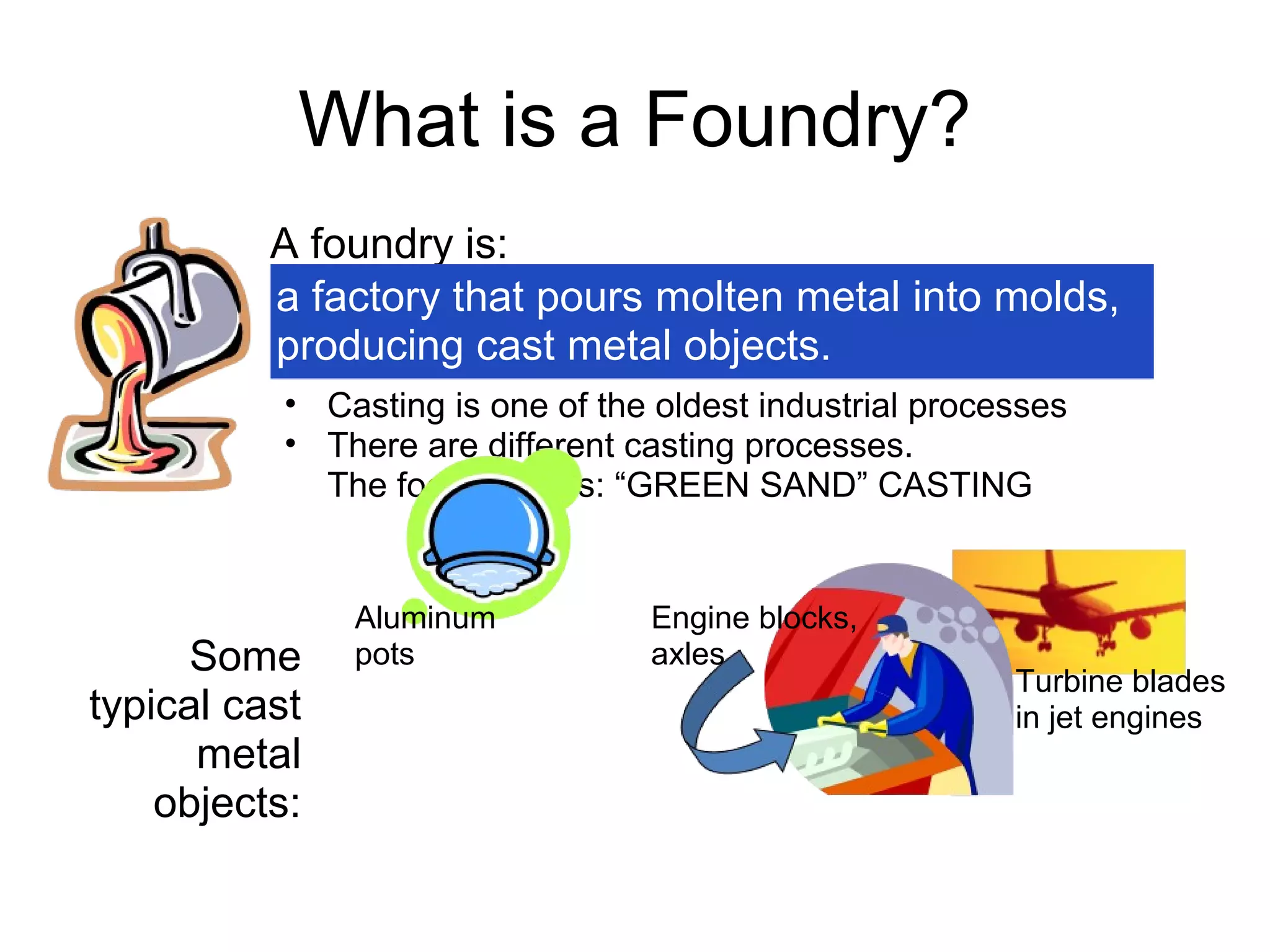
A foundry is:
a factory that pours molten metal into molds,
producing cast metal objects.
Some
typical cast
metal
objects:
Turbine blades
in jet engines
Engine blocks,
axles
Aluminum
pots
SAND-CASTING
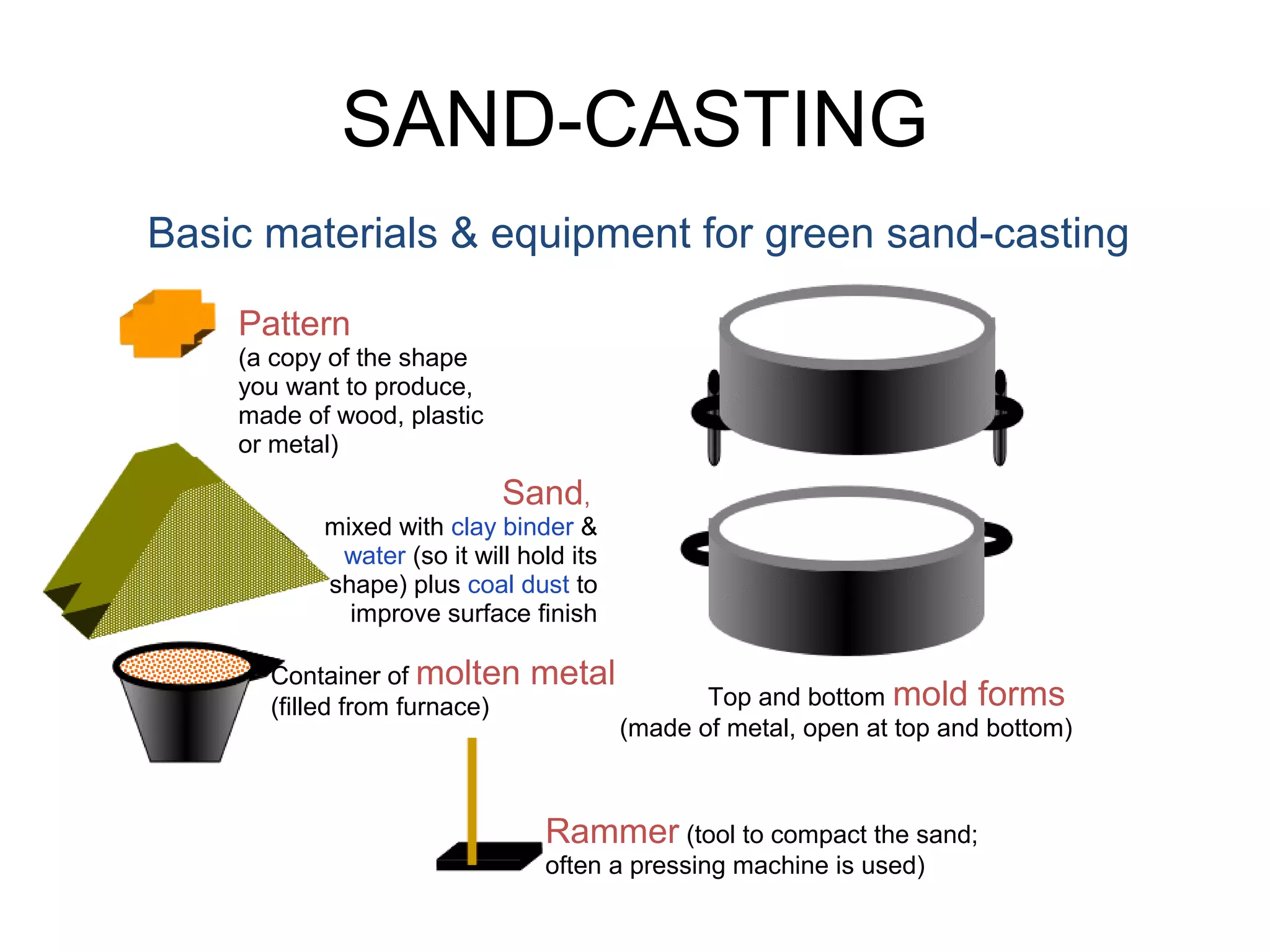
Sand,
mixed with clay binder &
water (so it will hold its
shape) plus coal dust to
improve surface finish
Pattern
(a copy of the shape
you want to produce,
made of wood, plastic
or metal)
Basic materials & equipment for green sand-casting
Container of molten metal
(filled from furnace) Top and bottom mold forms
(made of metal, open at top and bottom)
Rammer (tool to compact the sand;
often a pressing machine is used)
SAND-CASTING
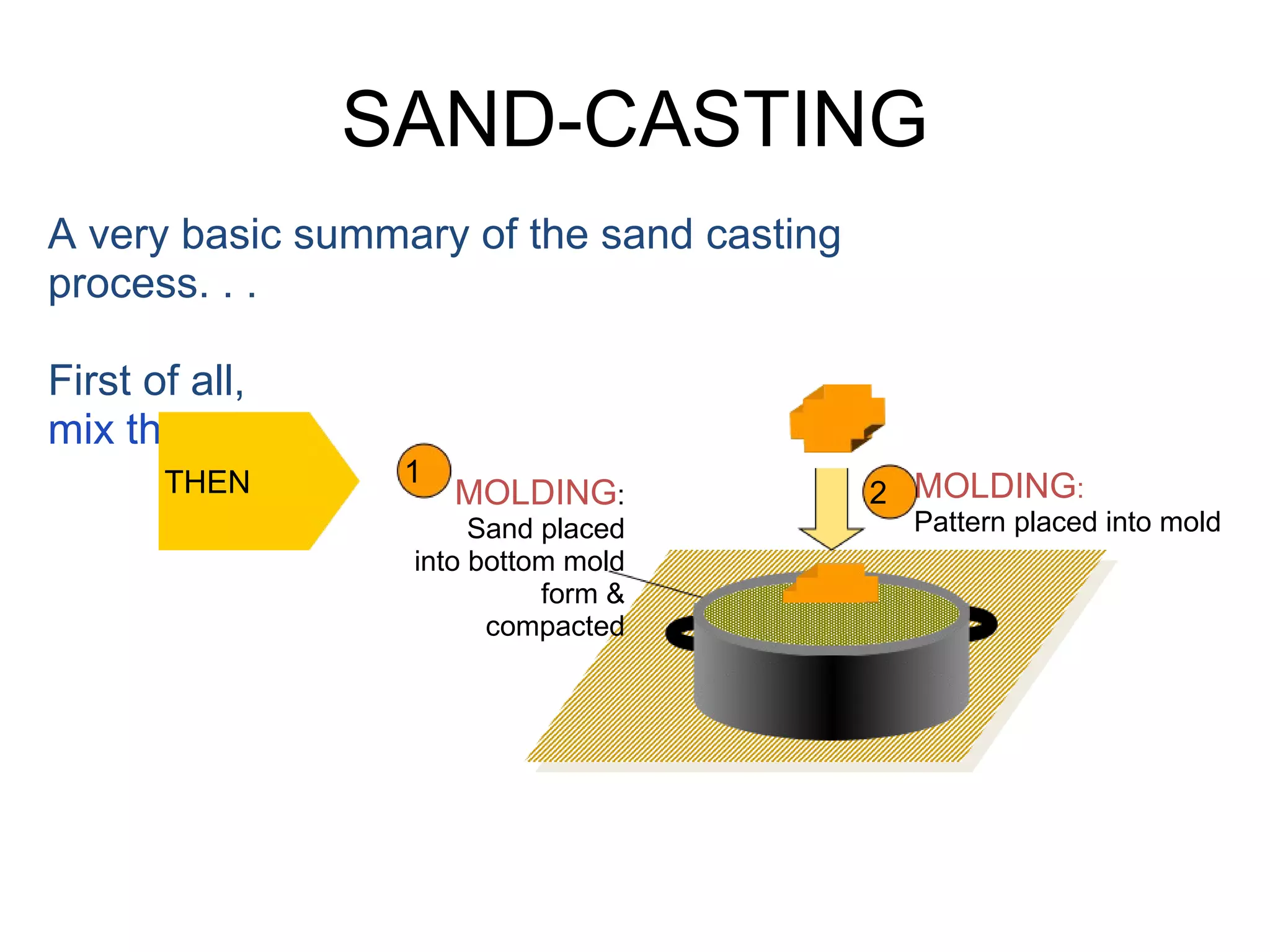
MOLDING:
Sand placed
into bottom mold
form &
compacted
MOLDING:
Pattern placed into mold
A very basic summary of the sand casting
process. . .
First of all,
mix the sand.
2
1THEN
SAND-CASTING
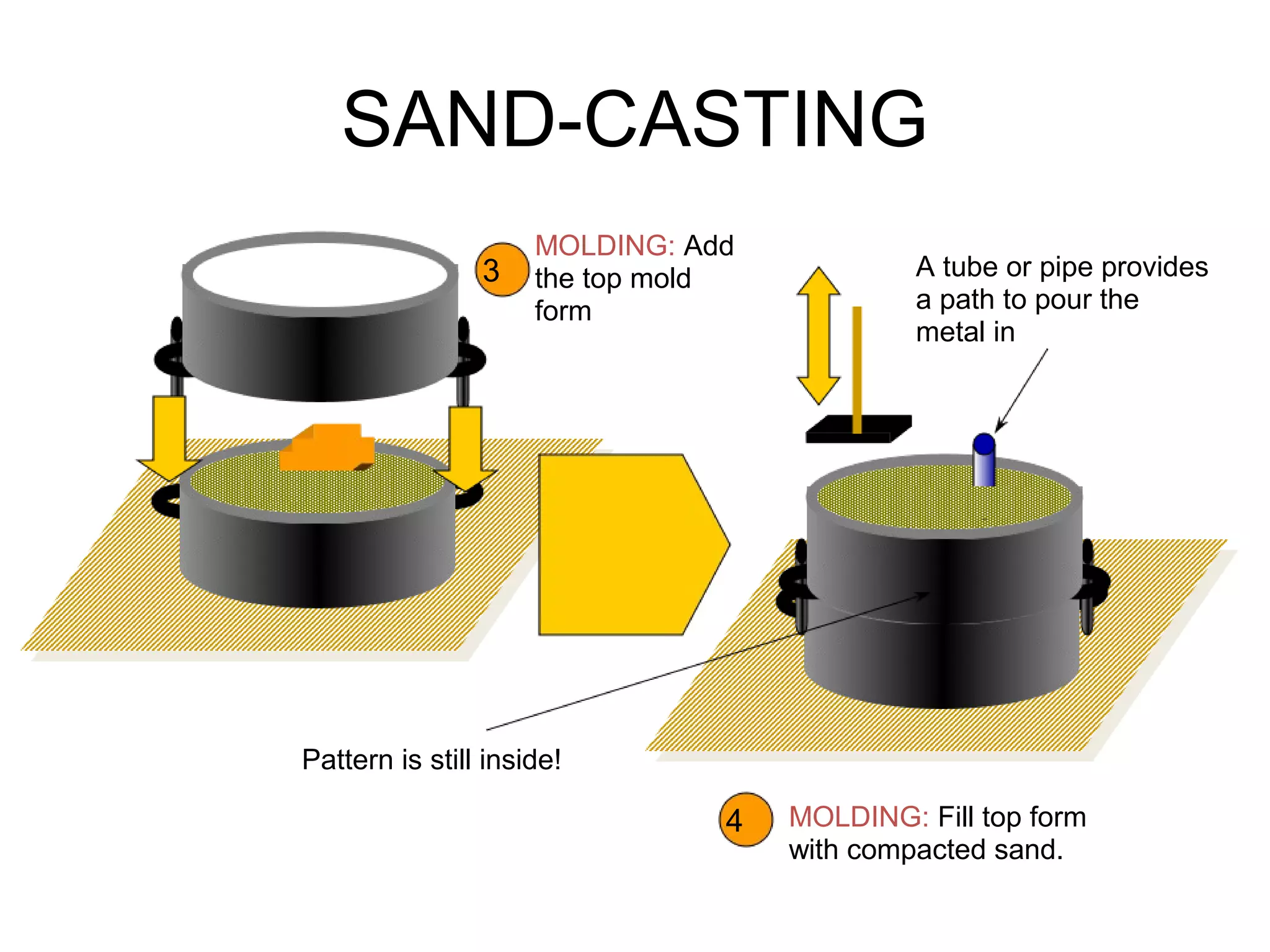
MOLDING: Add
the top mold
form
3
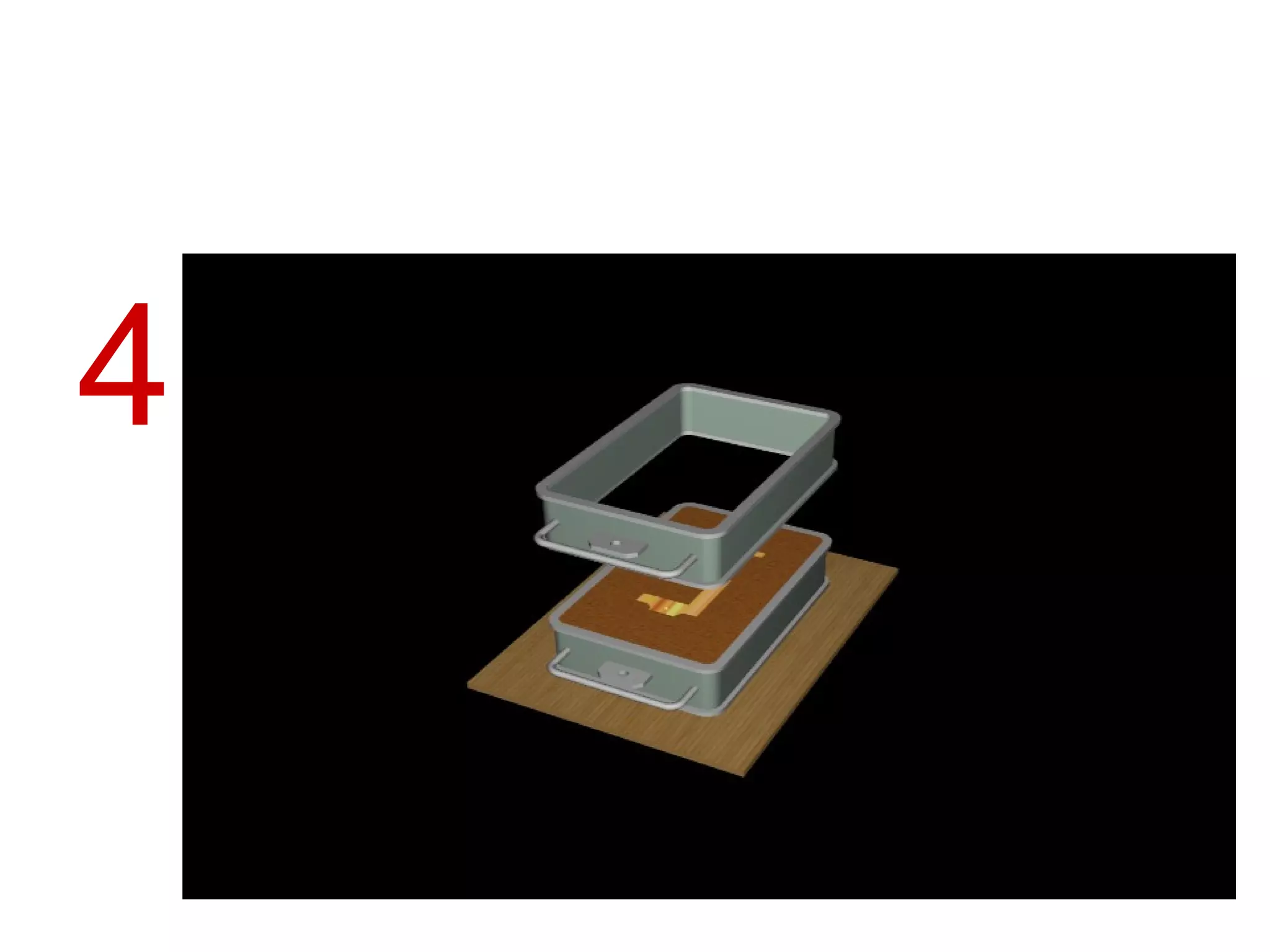
4 MOLDING: Fill top form
with compacted sand.
A tube or pipe provides
a path to pour the
metal in
Pattern is still inside!
SAND-CASTING
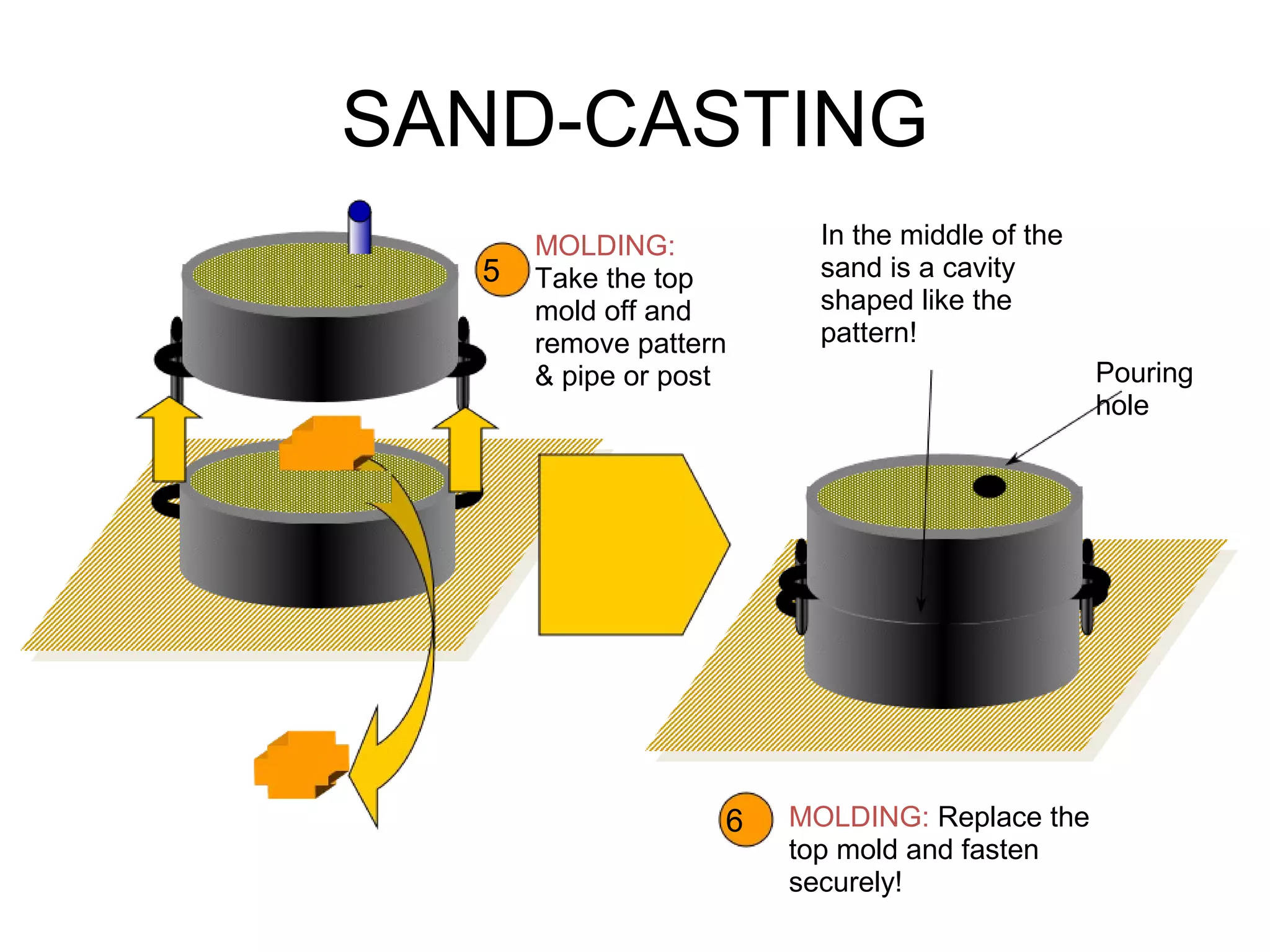
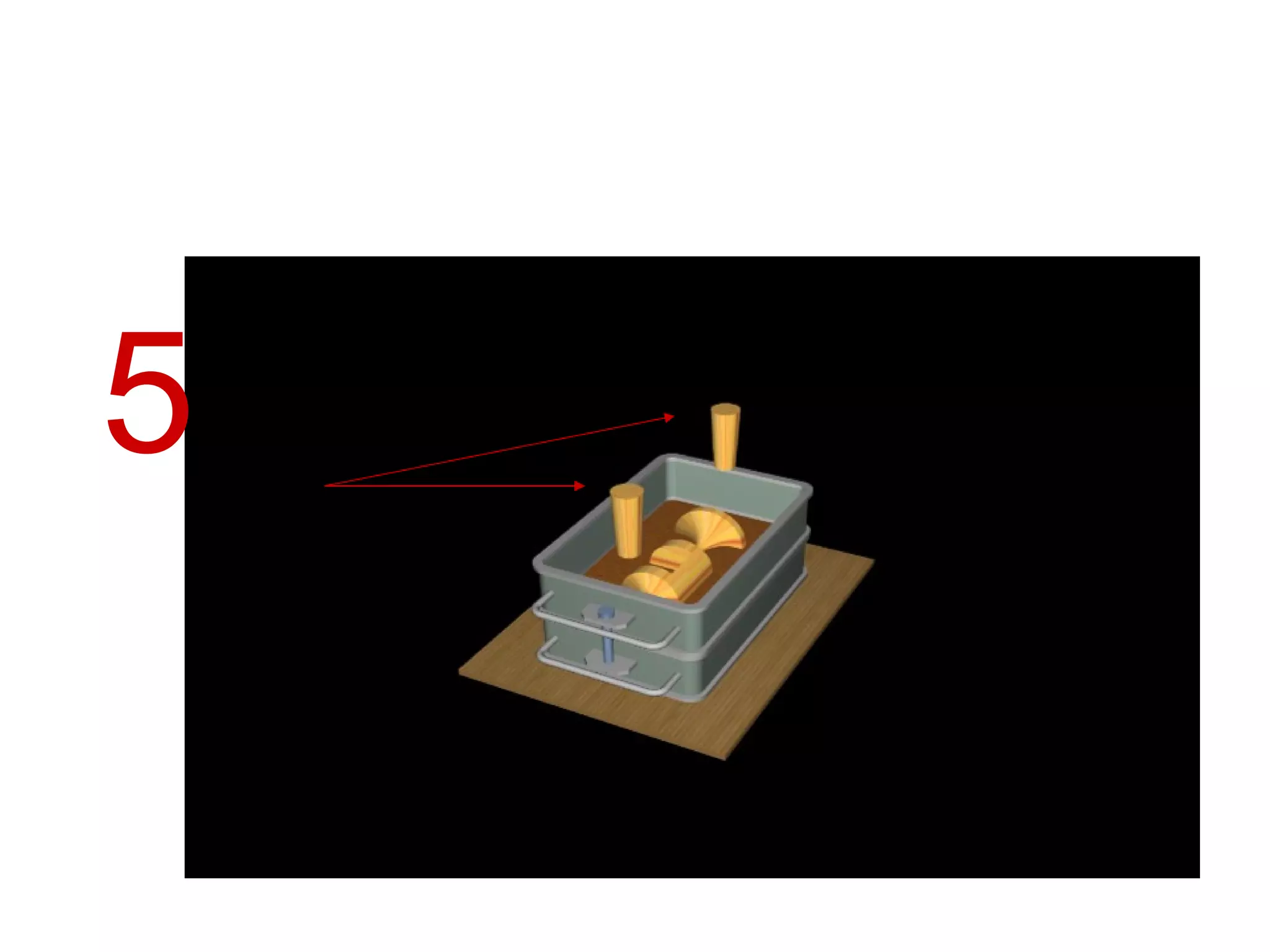
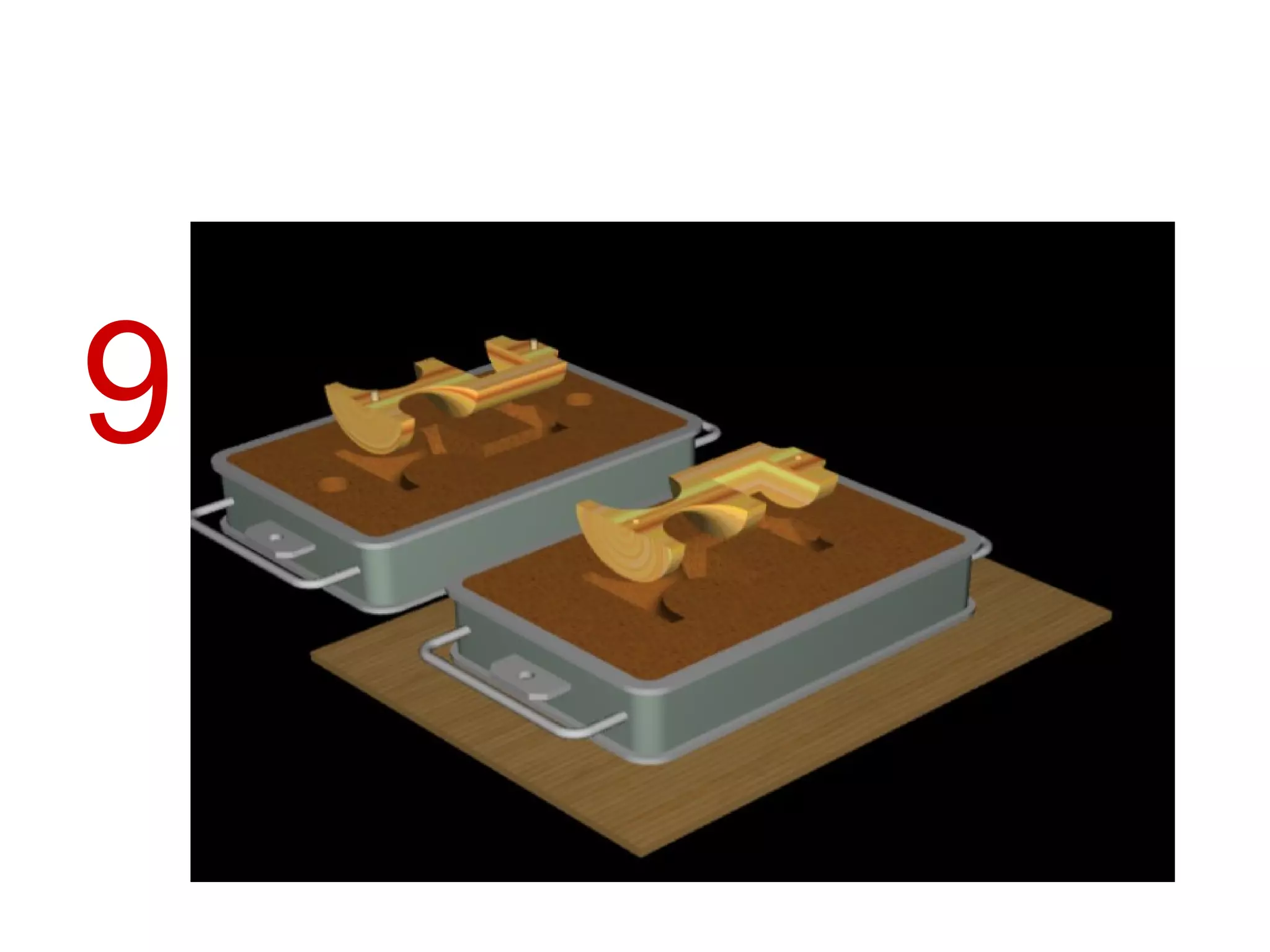
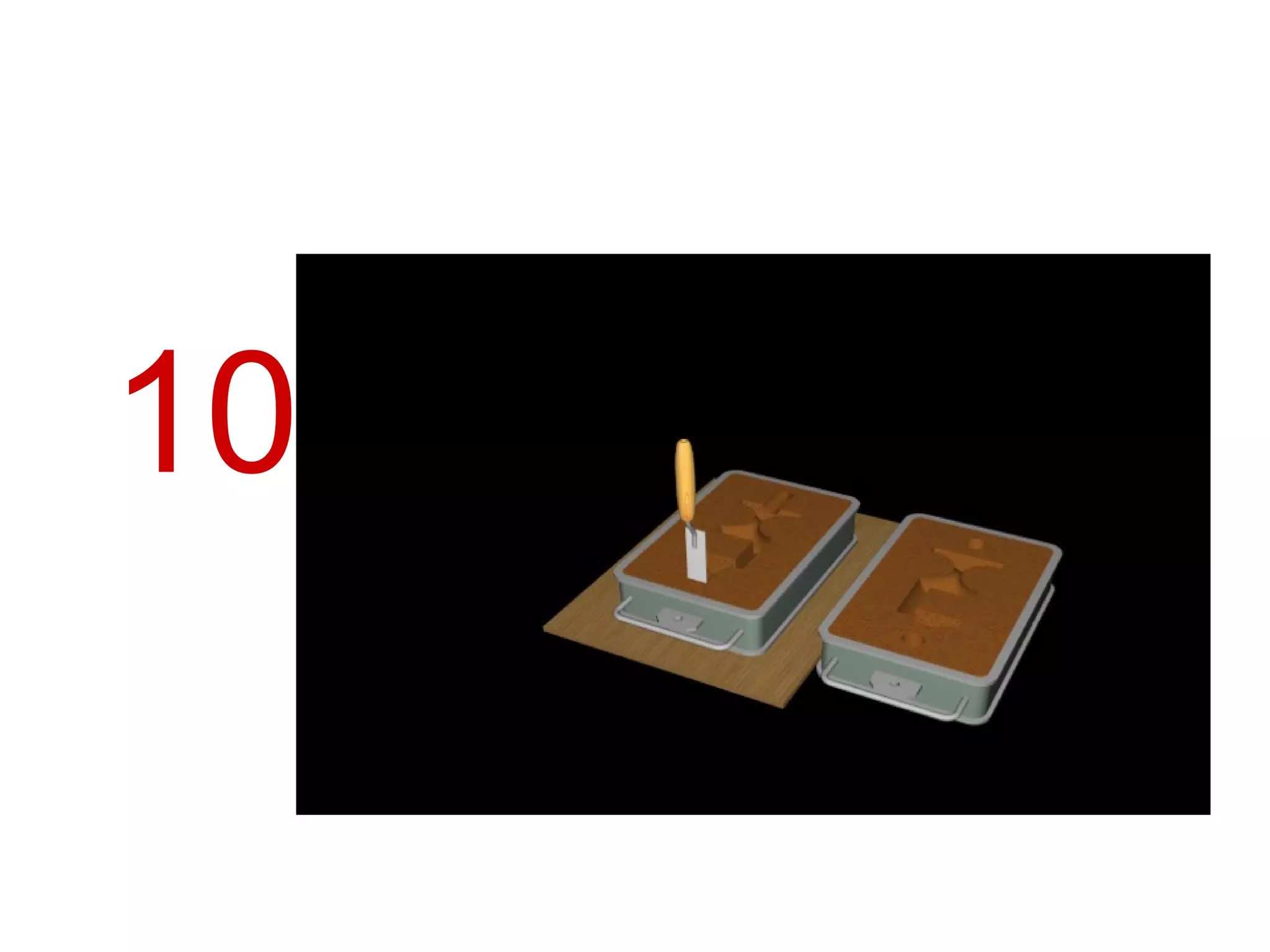
MOLDING:
Take the top
mold off and
remove pattern
& pipe or post
5
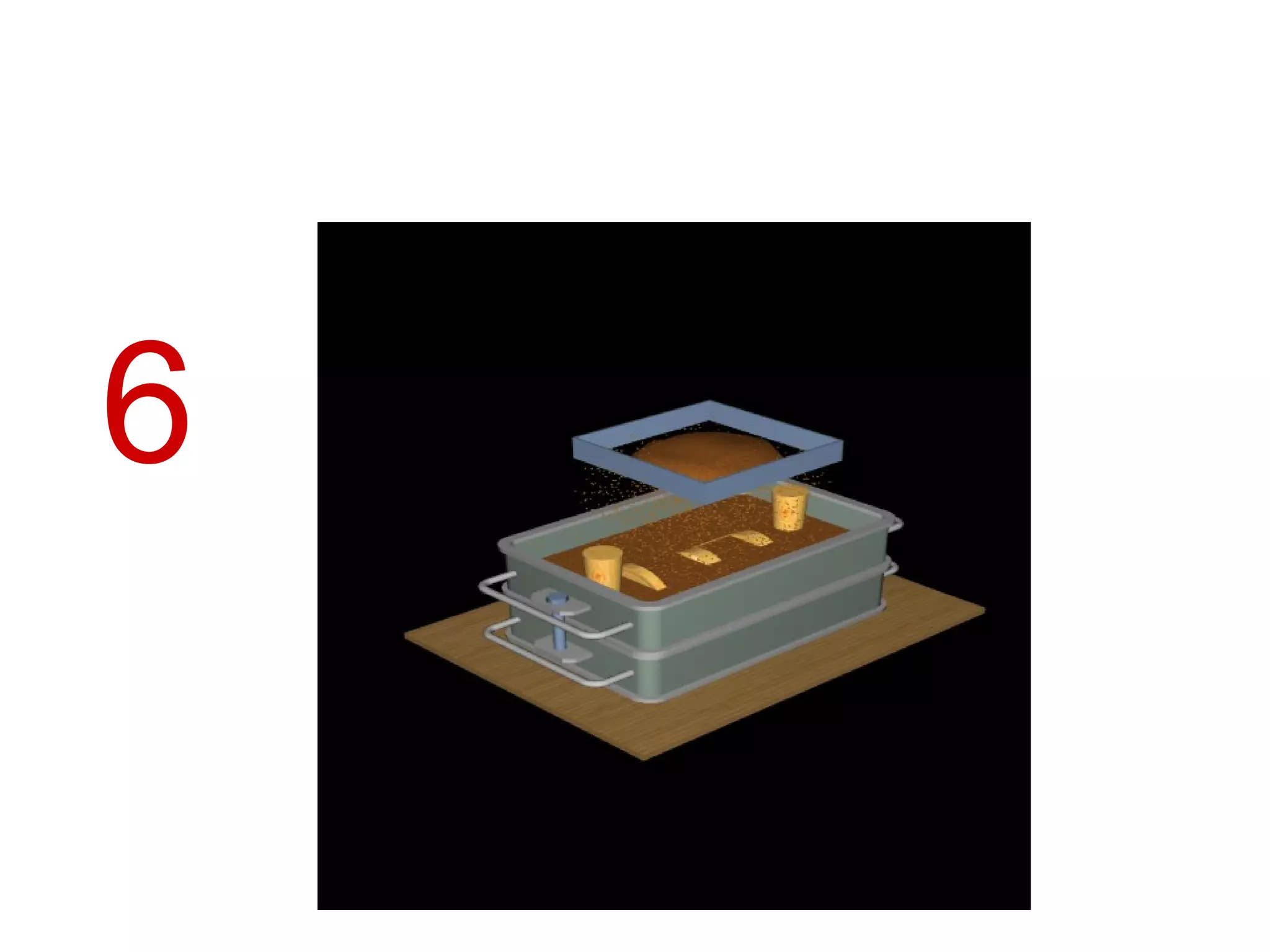
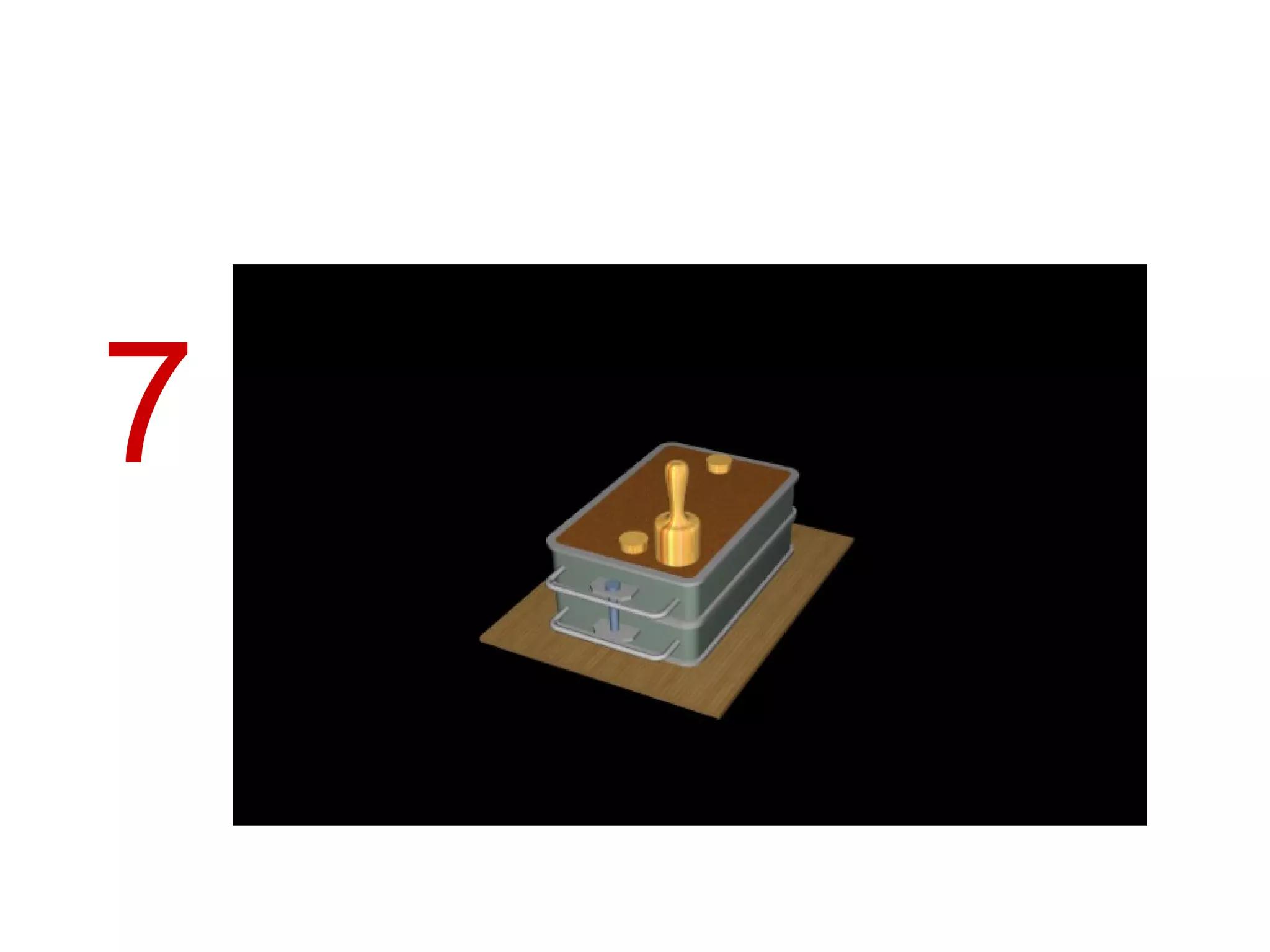
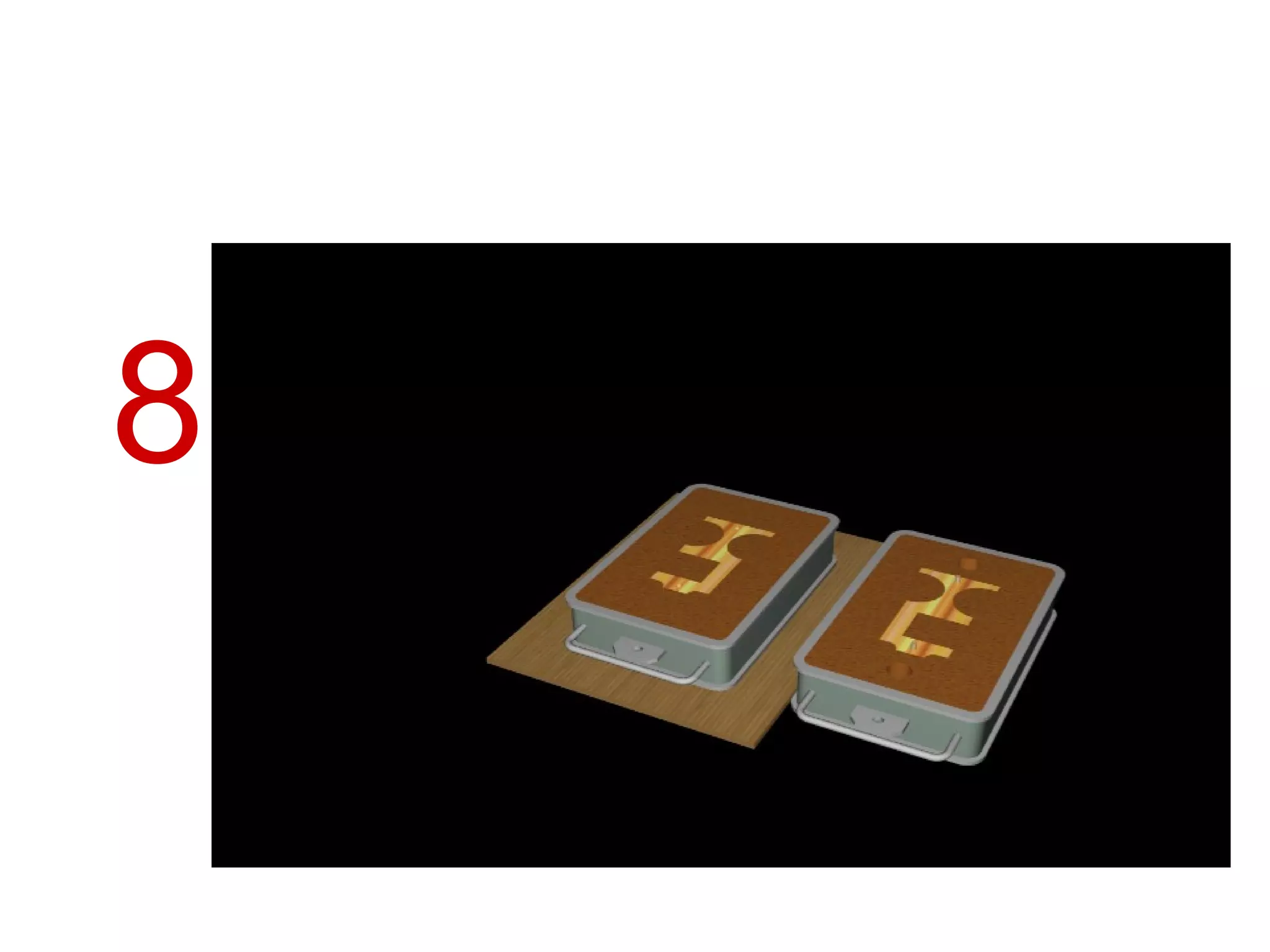
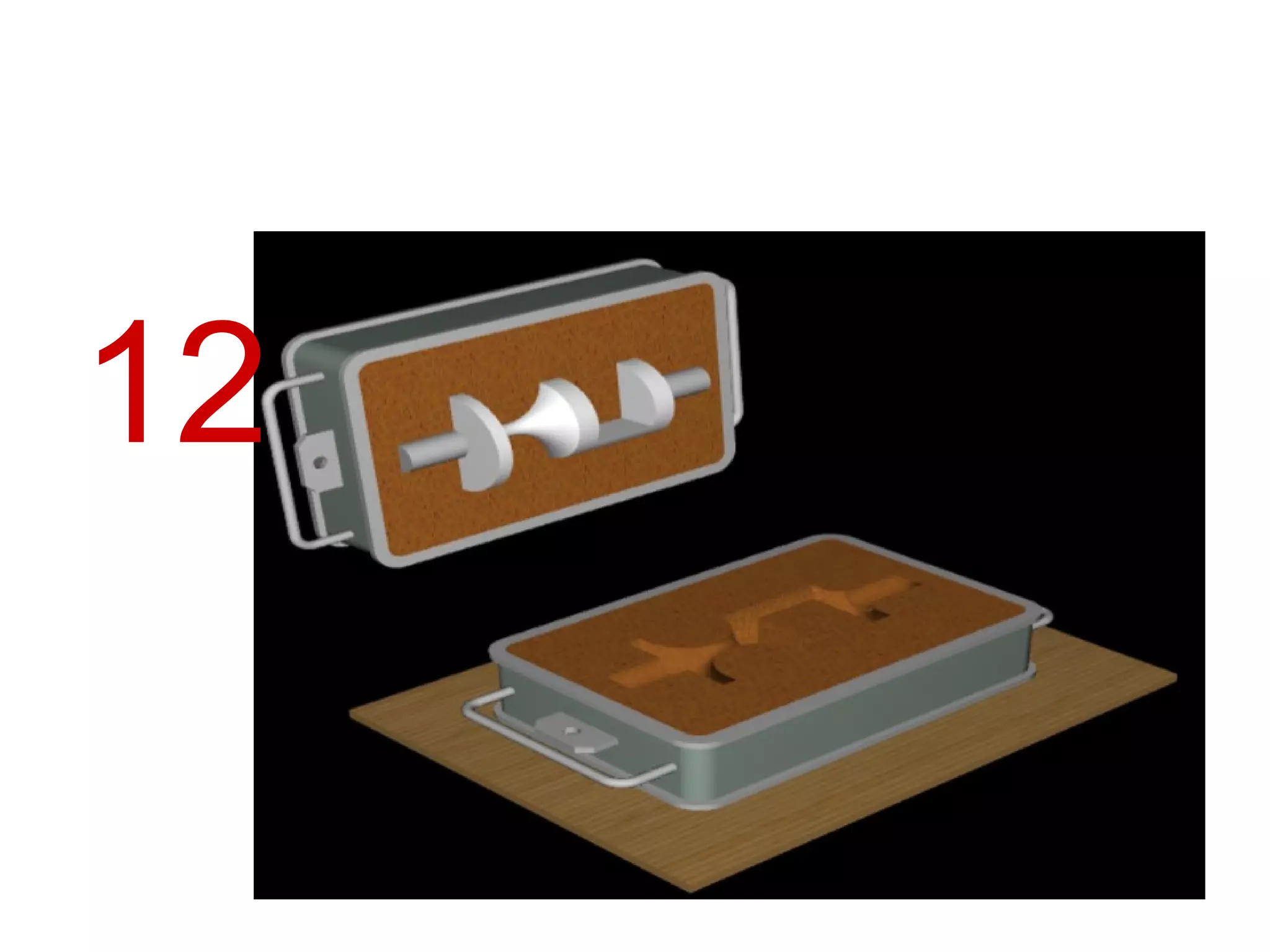
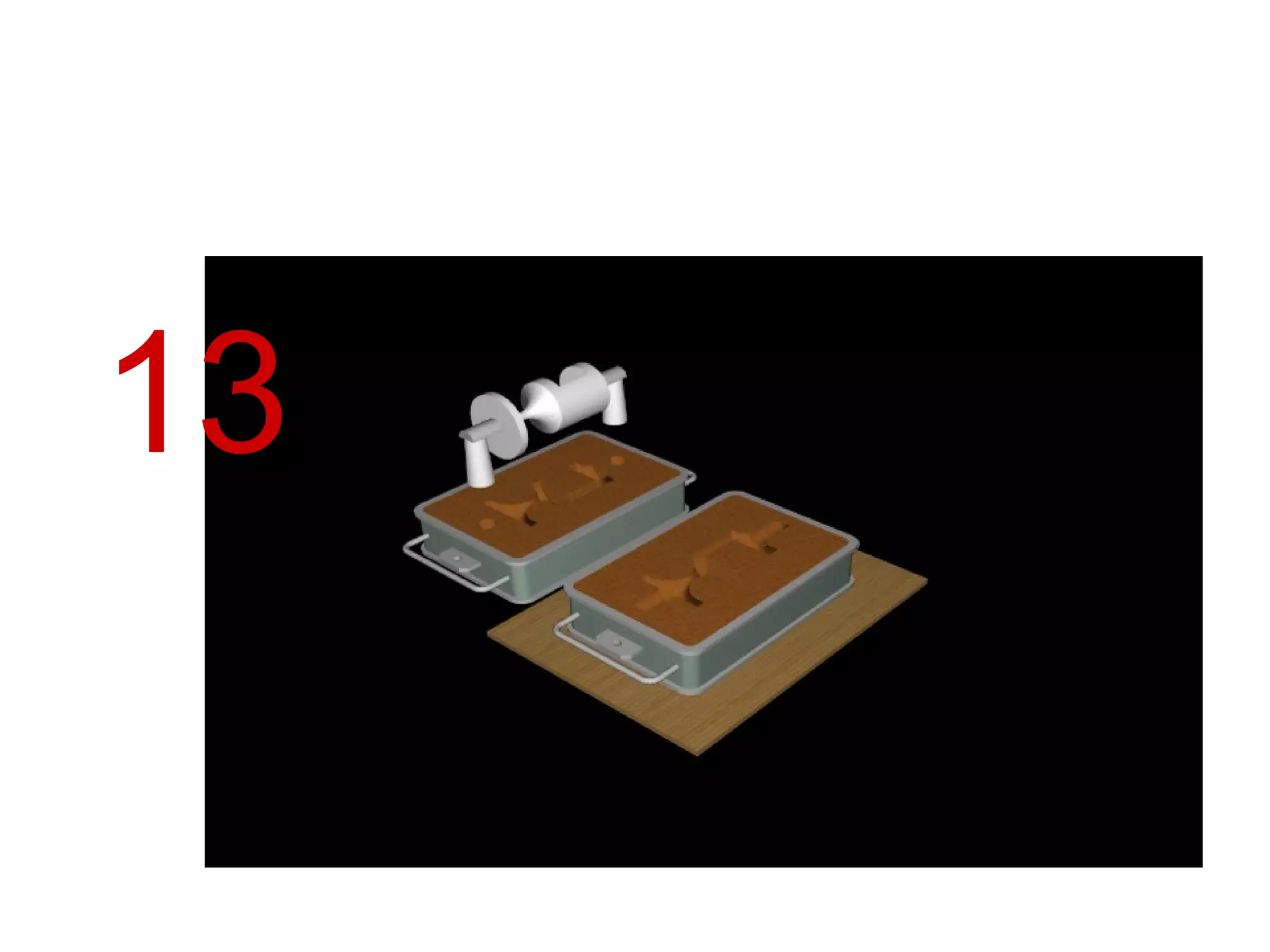
6 MOLDING: Replace the
top mold and fasten
securely!
Pouring
hole
In the middle of the
sand is a cavity
shaped like the
pattern!
SAND-CASTING
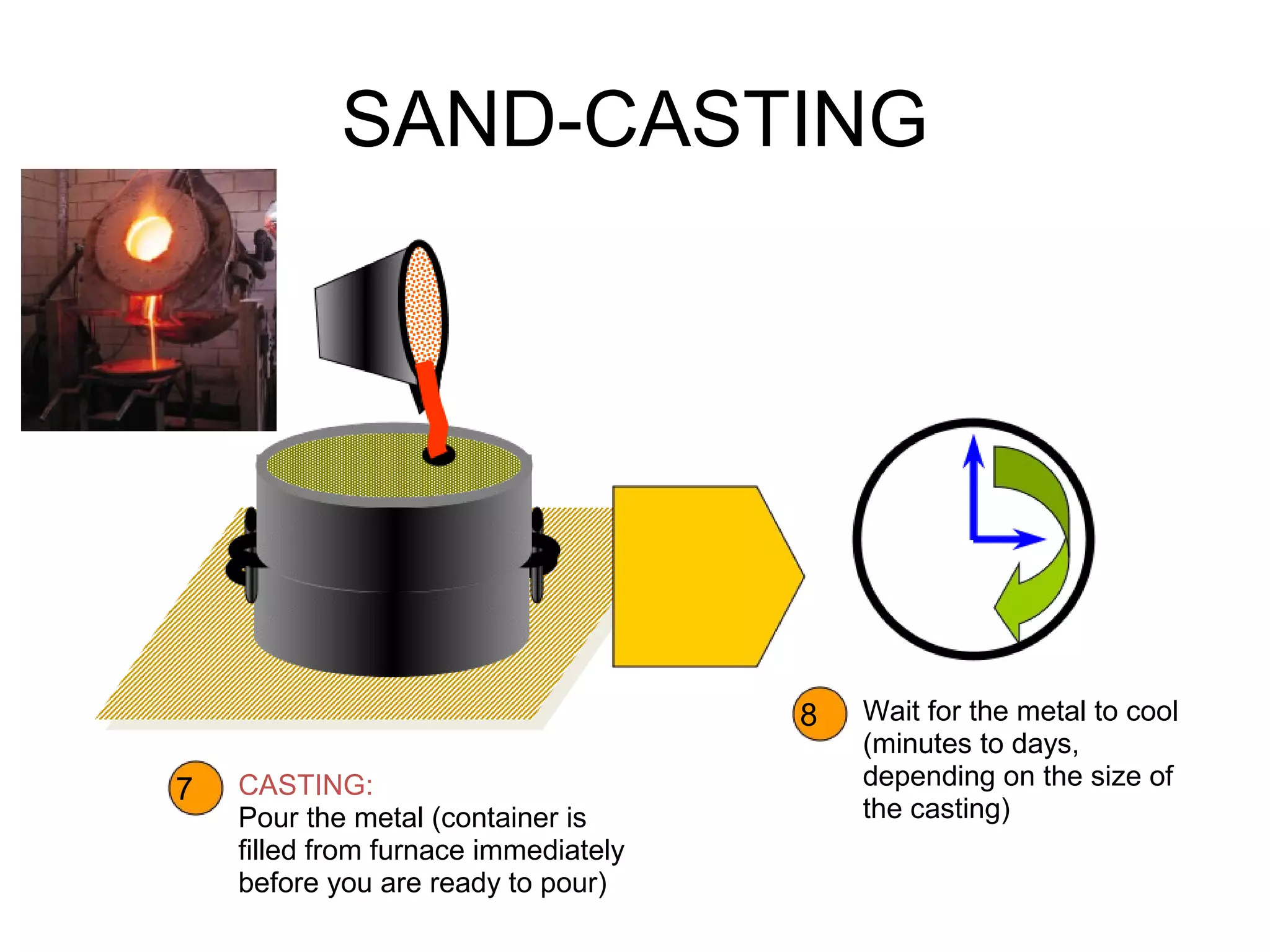
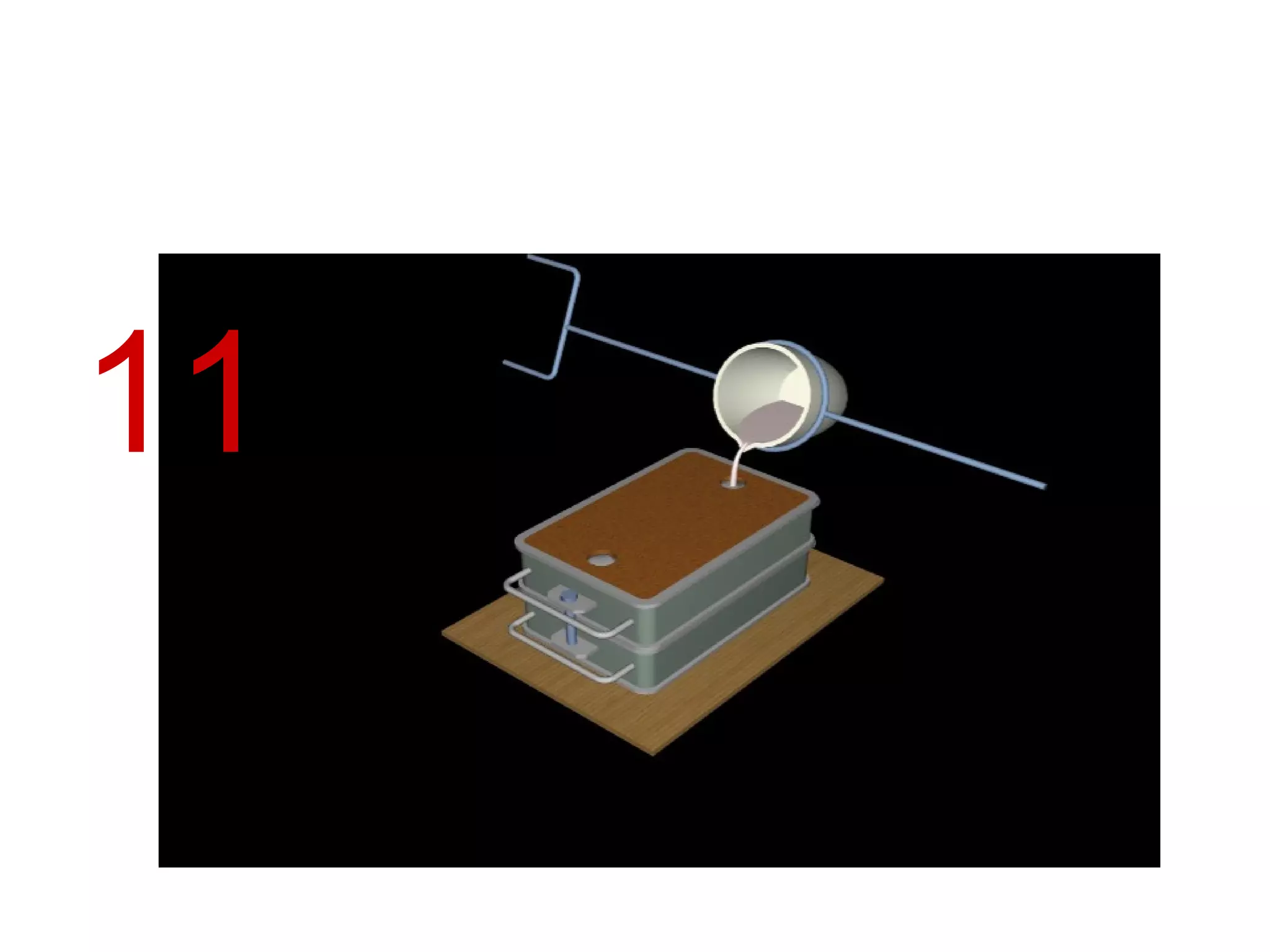
7 CASTING:
Pour the metal (container is
filled from furnace immediately
before you are ready to pour)
8 Wait for the metal to cool
(minutes to days,
depending on the size of
the casting)
SAND-CASTING
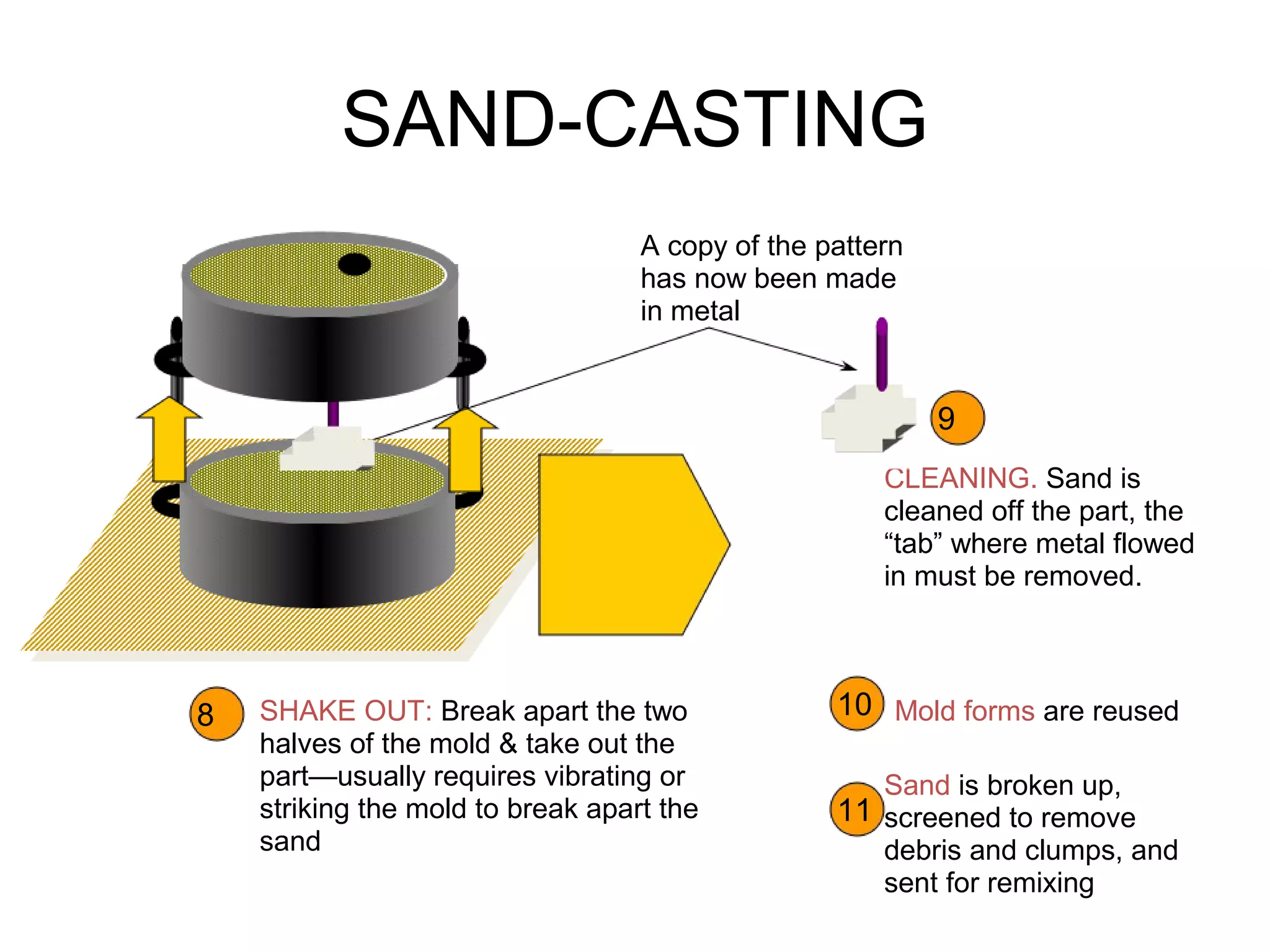
8 SHAKE OUT: Break apart the two
halves of the mold & take out the
part—usually requires vibrating or
striking the mold to break apart the
sand
CLEANING. Sand is
cleaned off the part, the
“tab” where metal flowed
in must be removed.
9
A copy of the pattern
has now been made
in metal
10 Mold forms are reused
11
Sand is broken up,
screened to remove
debris and clumps, and
sent for remixing
SAND-CASTING
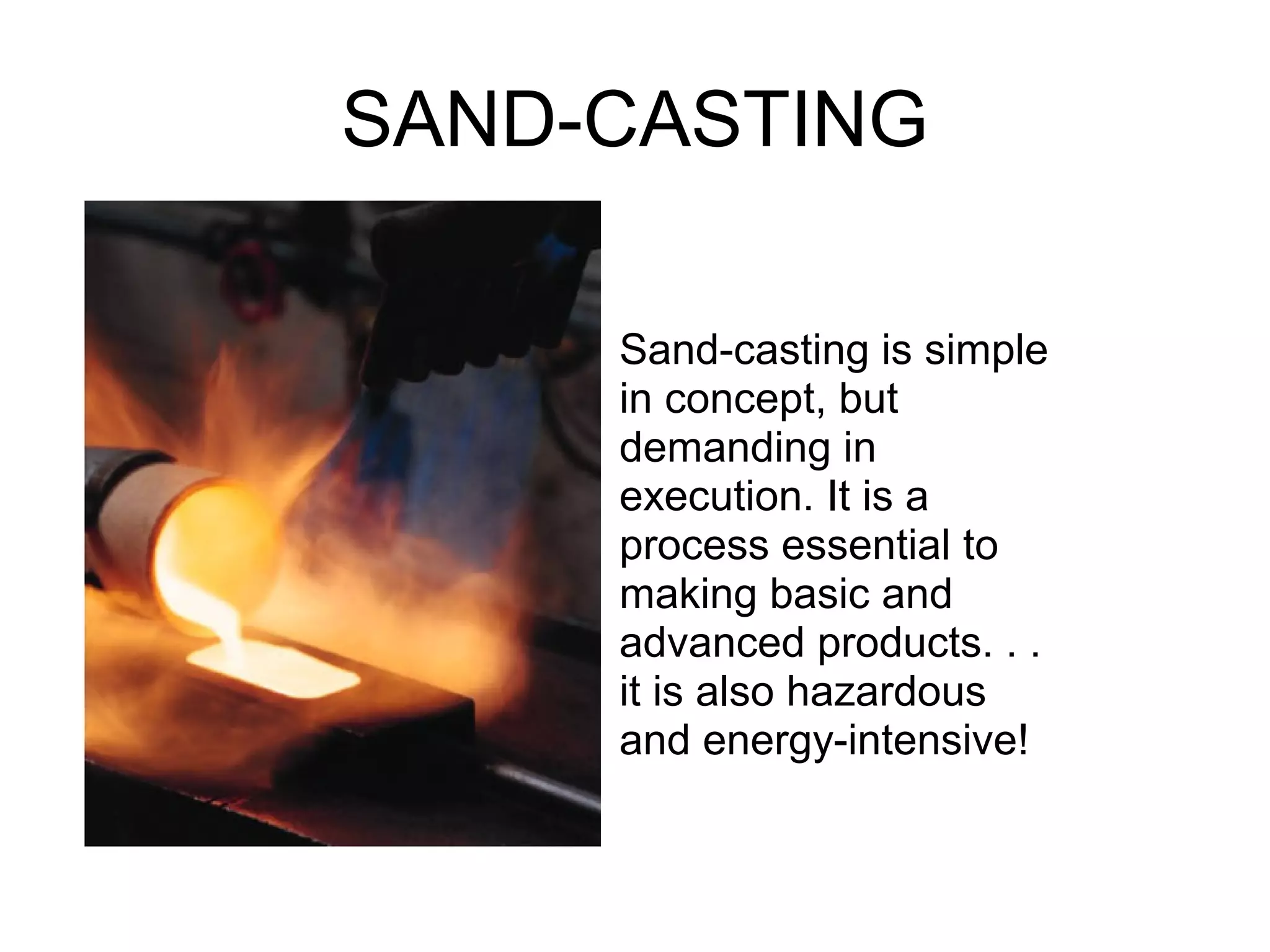
Sand-casting is simple
in concept, but
demanding in
execution. It is a
process essential to
making basic and
advanced products. . .
it is also hazardous
and energy-intensive!
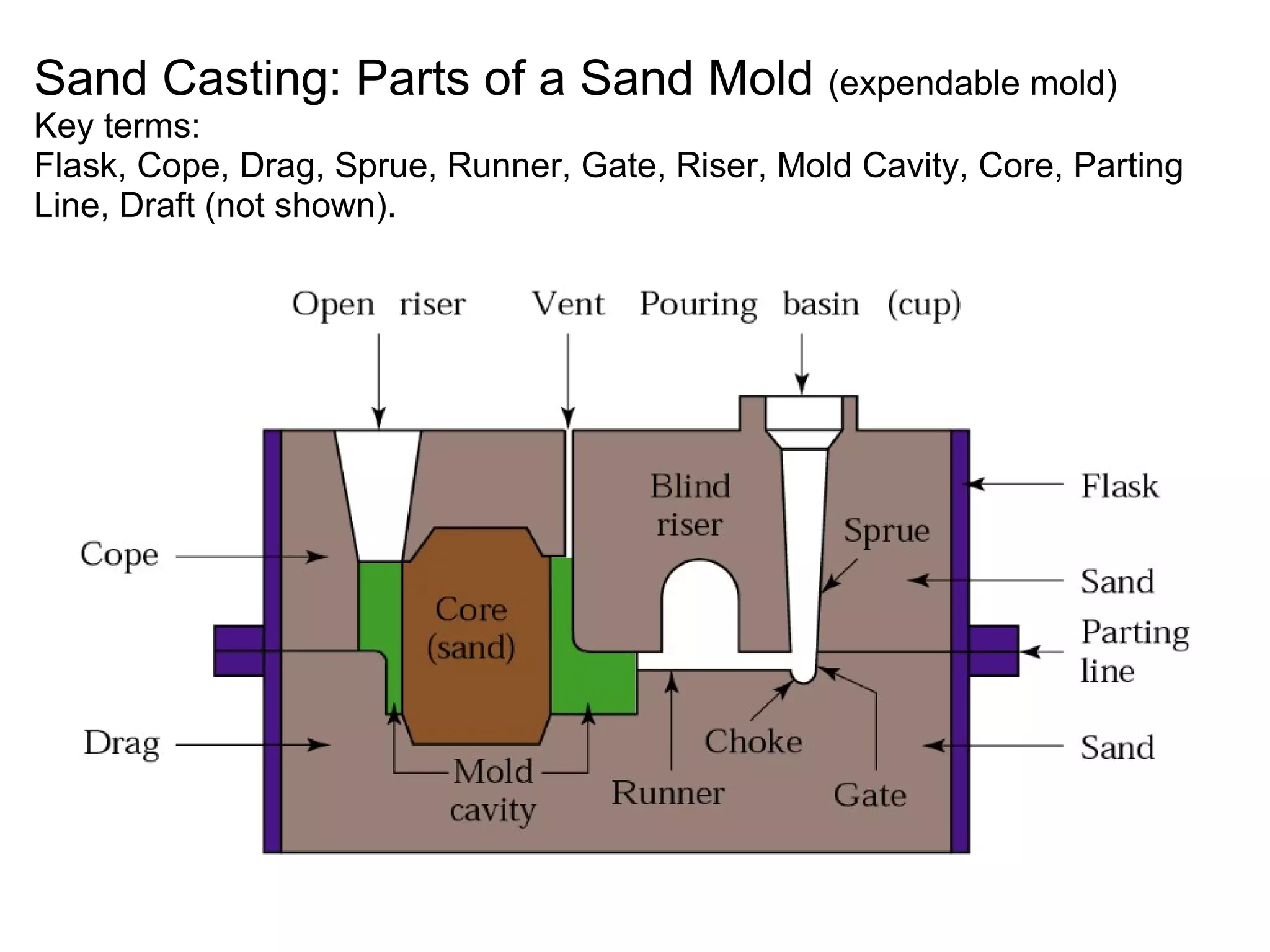
Sand Casting: Parts of a Sand Mold (expendable mold)
Key terms:
Flask, Cope, Drag, Sprue, Runner, Gate, Riser, Mold Cavity, Core, Parting
Line, Draft (not shown).
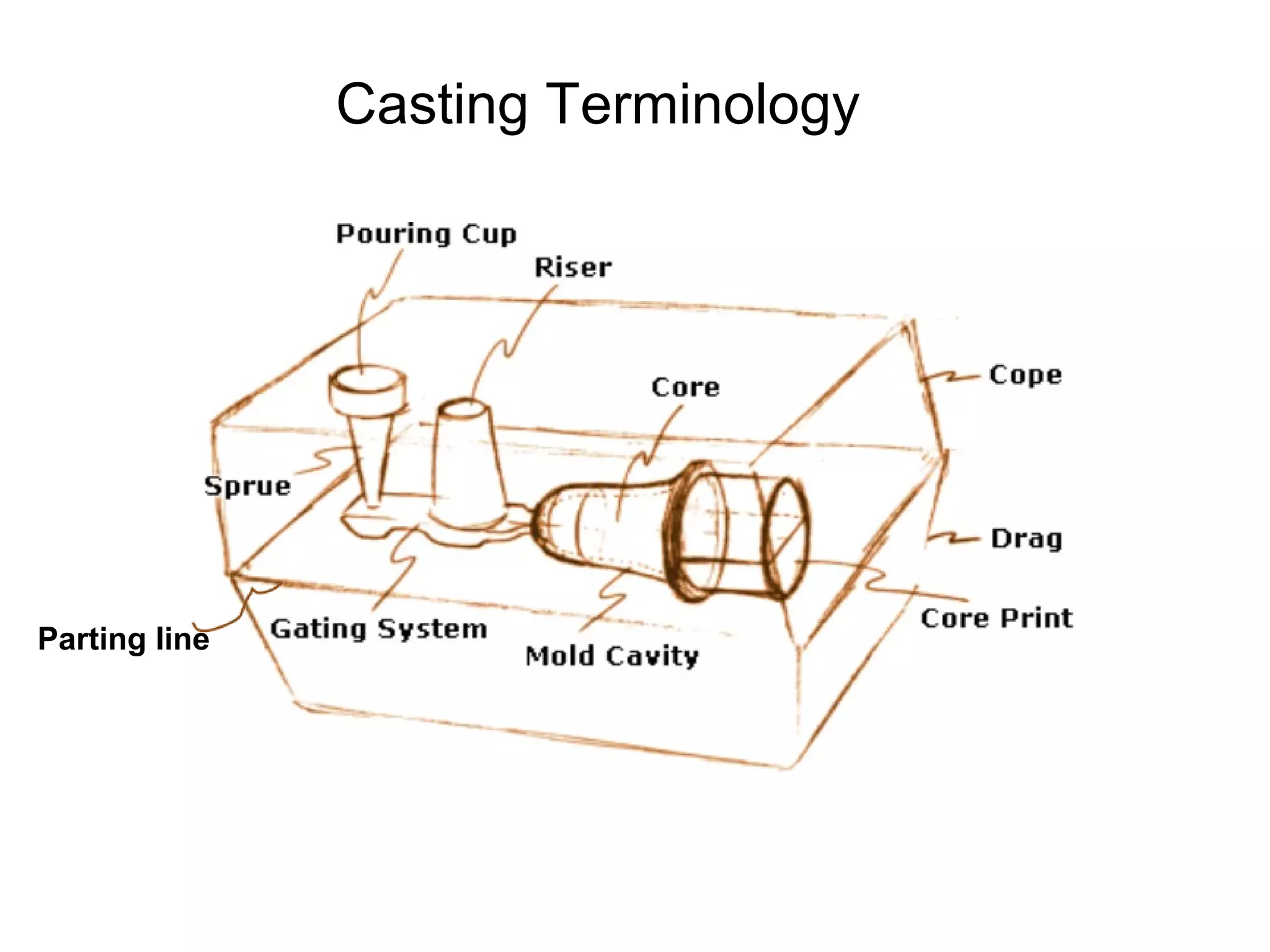
Casting Terminology
Parting line
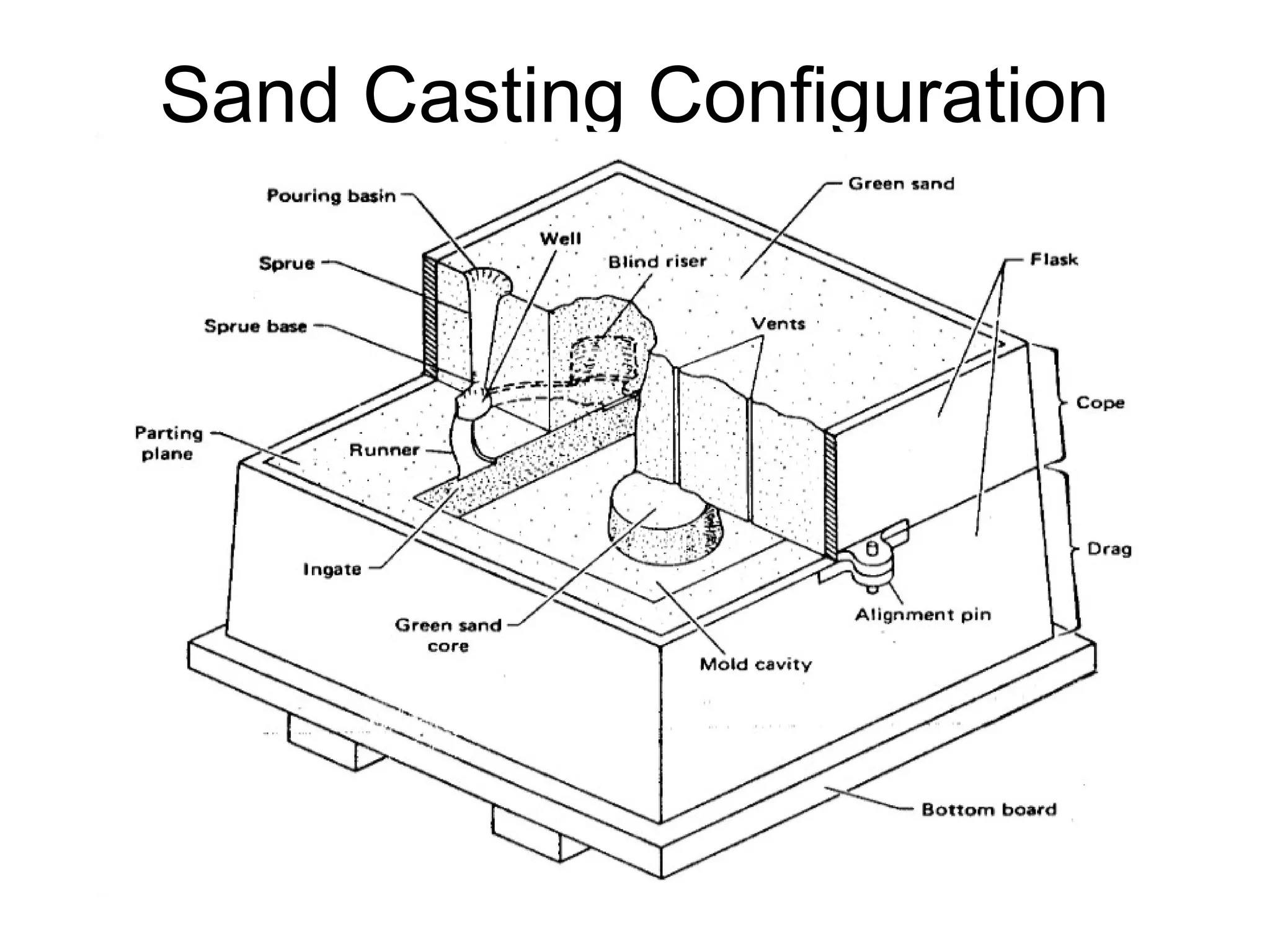
Sand Casting Configuration
Patterns
What is pattern?
• Approximate duplicate of product
• Patterns are made in the shape of the casting
• Pattern Materials: Wood, Plastic or metal.
• One piece or multiple piece pattern
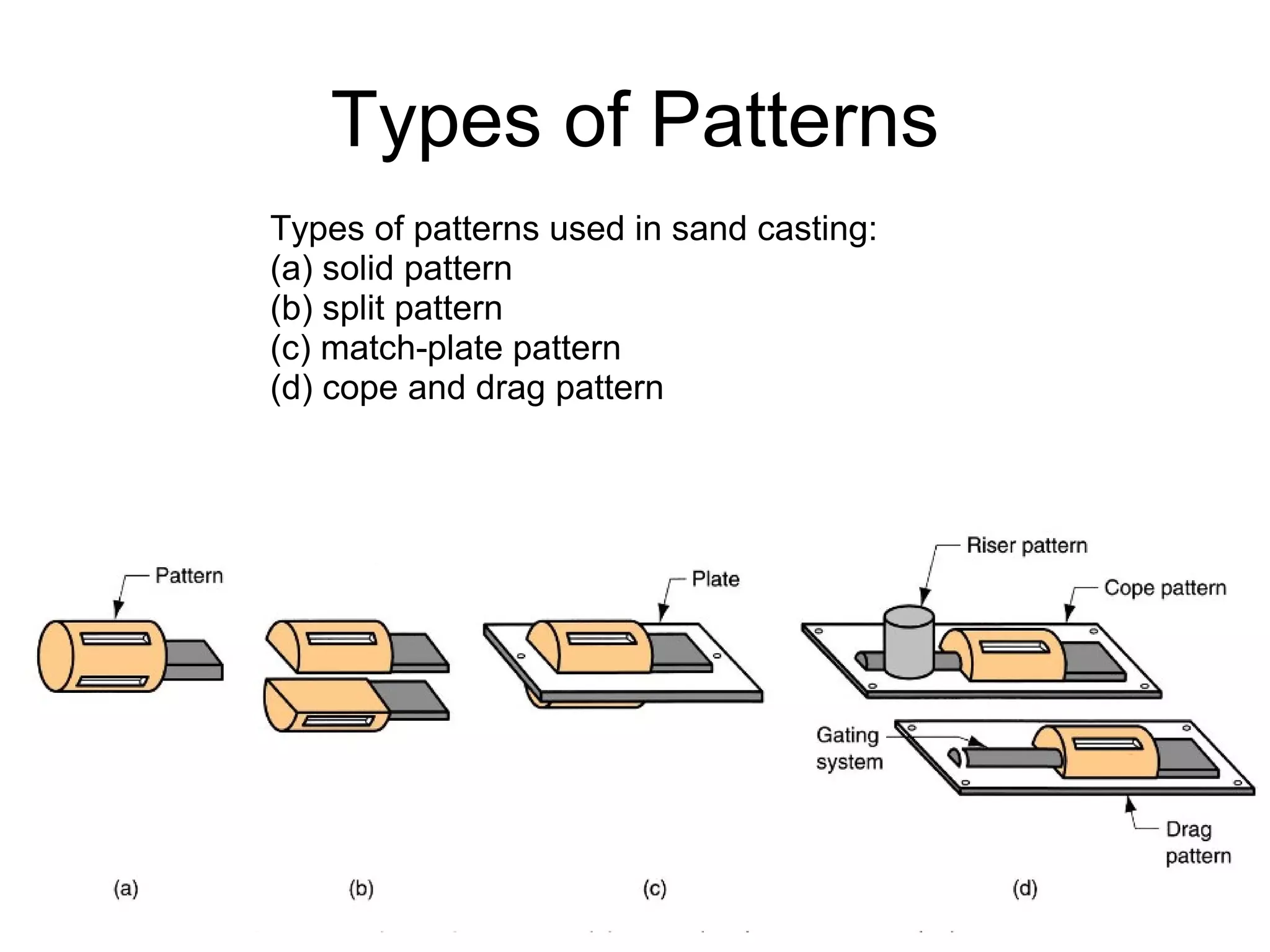
Types of Patterns
Types of patterns used in sand casting:
(a) solid pattern
(b) split pattern
(c) match plate pattern‑
(d) cope and drag pattern
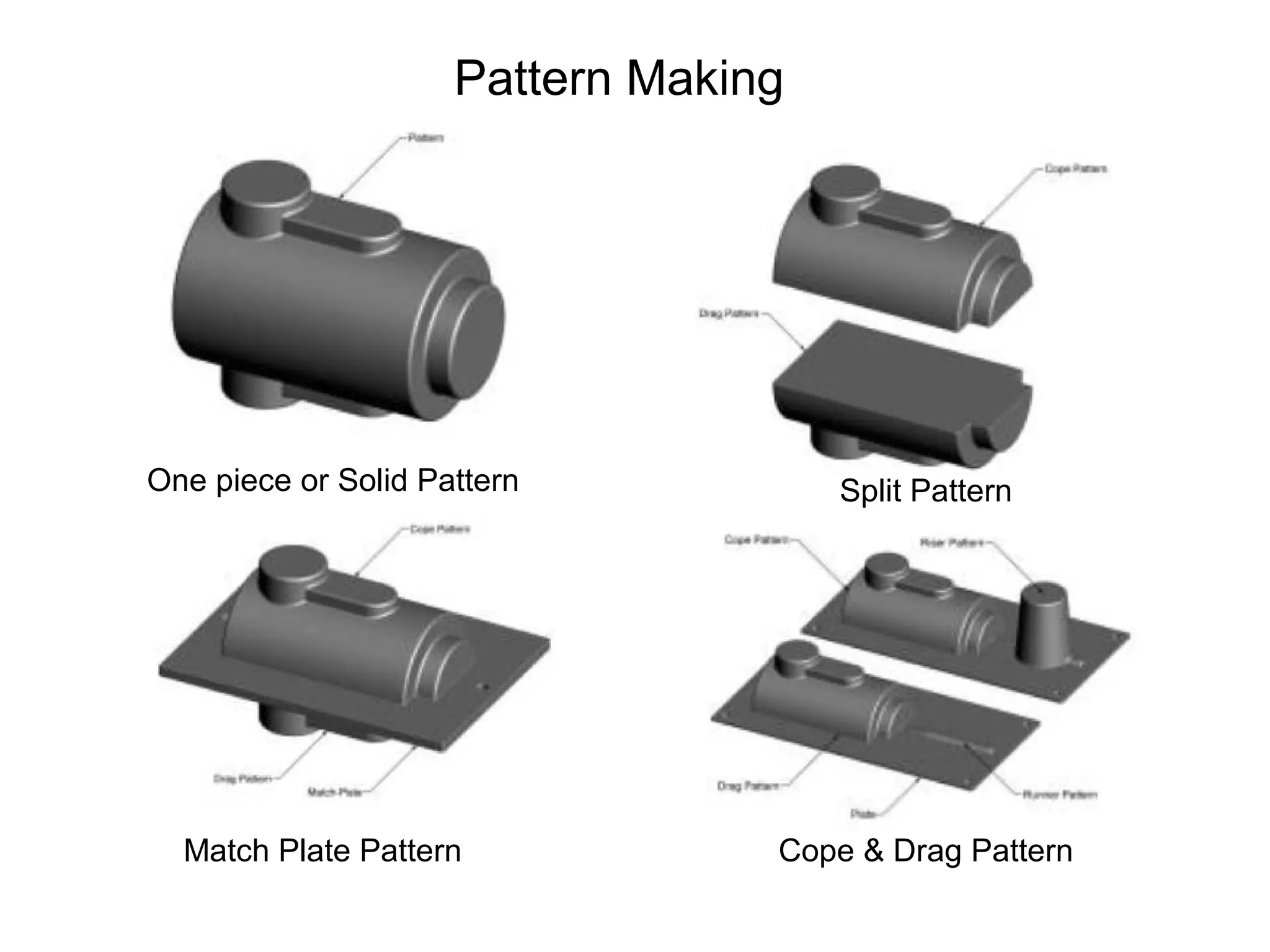
Pattern Making
One piece or Solid Pattern
Cope & Drag PatternMatch Plate Pattern
Split Pattern
Pattern Allowances
Shrinkage Allowance
Patterns are made larger than the casting to compensate
contraction of the liquid while freezing.
For internal cavities the allowances should be negative.
Machining Allowance
Allowance required to remove the rough cast surface. 2 to 25 mm
(0.1 to 1’)
Draft Allowance
To facilitate ease of removal, usually ½ to 2 deg.
Shrinkage allowance
Normal shrinkage: Cast iron 0.83 to 1.3%
Aluminum - 1.3%
Cores
Cores
• Cores are used to create internal cavities.
• Should have similar properties as the mold.
• Shaken out after casting is produced.
Process
1
Mould
2
3
Dolly
4
5Sprue
Pins
6
7
8
9
10
11
12
13

Foundry-Basics

  • 1.
    Foundry-Basics By Mr.B.Ramesh, M.E., (Ph.D.), ResearchScholar, CEG, Anna University, Chennai. Associate Professor, Department of Mechanical Engineering,, St. Joseph’s College of Engineering, Jeppiaar Trust, Chennai-119
  • 2.
    What is aFoundry? • Casting is one of the oldest industrial processes • There are different casting processes. The focus here is: “GREEN SAND” CASTING A foundry is: a factory that pours molten metal into molds, producing cast metal objects. Some typical cast metal objects: Turbine blades in jet engines Engine blocks, axles Aluminum pots
  • 3.
    SAND-CASTING Sand, mixed with claybinder & water (so it will hold its shape) plus coal dust to improve surface finish Pattern (a copy of the shape you want to produce, made of wood, plastic or metal) Basic materials & equipment for green sand-casting Container of molten metal (filled from furnace) Top and bottom mold forms (made of metal, open at top and bottom) Rammer (tool to compact the sand; often a pressing machine is used)
  • 4.
    SAND-CASTING MOLDING: Sand placed into bottommold form & compacted MOLDING: Pattern placed into mold A very basic summary of the sand casting process. . . First of all, mix the sand. 2 1THEN
  • 5.
    SAND-CASTING MOLDING: Add the topmold form 3 4 MOLDING: Fill top form with compacted sand. A tube or pipe provides a path to pour the metal in Pattern is still inside!
  • 6.
    SAND-CASTING MOLDING: Take the top moldoff and remove pattern & pipe or post 5 6 MOLDING: Replace the top mold and fasten securely! Pouring hole In the middle of the sand is a cavity shaped like the pattern!
  • 7.
    SAND-CASTING 7 CASTING: Pour themetal (container is filled from furnace immediately before you are ready to pour) 8 Wait for the metal to cool (minutes to days, depending on the size of the casting)
  • 8.
    SAND-CASTING 8 SHAKE OUT:Break apart the two halves of the mold & take out the part—usually requires vibrating or striking the mold to break apart the sand CLEANING. Sand is cleaned off the part, the “tab” where metal flowed in must be removed. 9 A copy of the pattern has now been made in metal 10 Mold forms are reused 11 Sand is broken up, screened to remove debris and clumps, and sent for remixing
  • 9.
    SAND-CASTING Sand-casting is simple inconcept, but demanding in execution. It is a process essential to making basic and advanced products. . . it is also hazardous and energy-intensive!
  • 10.
    Sand Casting: Partsof a Sand Mold (expendable mold) Key terms: Flask, Cope, Drag, Sprue, Runner, Gate, Riser, Mold Cavity, Core, Parting Line, Draft (not shown).
  • 11.
  • 12.
  • 13.
    Patterns What is pattern? •Approximate duplicate of product • Patterns are made in the shape of the casting • Pattern Materials: Wood, Plastic or metal. • One piece or multiple piece pattern
  • 14.
    Types of Patterns Typesof patterns used in sand casting: (a) solid pattern (b) split pattern (c) match plate pattern‑ (d) cope and drag pattern
  • 15.
    Pattern Making One pieceor Solid Pattern Cope & Drag PatternMatch Plate Pattern Split Pattern
  • 16.
    Pattern Allowances Shrinkage Allowance Patternsare made larger than the casting to compensate contraction of the liquid while freezing. For internal cavities the allowances should be negative. Machining Allowance Allowance required to remove the rough cast surface. 2 to 25 mm (0.1 to 1’) Draft Allowance To facilitate ease of removal, usually ½ to 2 deg. Shrinkage allowance Normal shrinkage: Cast iron 0.83 to 1.3% Aluminum - 1.3%
  • 17.
    Cores Cores • Cores areused to create internal cavities. • Should have similar properties as the mold. • Shaken out after casting is produced.
  • 18.
  • 19.
  • 20.
  • 21.
  • 22.
  • 23.
  • 24.
  • 25.
  • 26.
  • 27.
  • 28.
  • 29.
  • 30.

Editor's Notes

  • #4 The pattern must be slightly larger than the finished part you want to produce, as metal shrinks when it cools (about 10mm/meter, depending on the lengh)
  • #5 STRONGLY SUGGEST that presenter be prepared with props:
  • #6 Note that the top form and bottom form lock together; they always fit together the same way!
  • #7 In “dry sand casting,” the molds filled with sand are baked to increase the strength of the sand. In green sand casting, the water with which the clay is mixed is not evaporated.
  • #8 Sometimes the molds filled with sand are baked to increase the strength of the sand
  • #9 For very large parts, sand set on the shop floor forms the bottom half of the mold. This is “floor molding”
  • #10 Key hazards: burns, silicosis (from inhalation of dust), toxic fumes when organic binders are volatilized by molten metal.