Pteridophytes as First Vascular Plants
BY
DR. RASIKA N. PATIL
ASSISTANT PROFESSOR
SHRI SHIVAJI COLLEGE OF ARTS COMMERCE
AND SCIENCE
Meaning of Pteridophytes
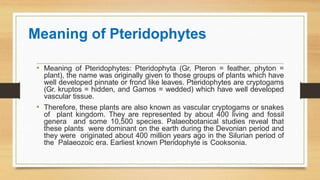
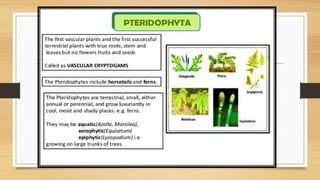
• Meaning of Pteridophytes: Pteridophyta (Gr, Pteron = feather, phyton =
plant), the name was originally given to those groups of plants which have
well developed pinnate or frond like leaves. Pteridophytes are cryptogams
(Gr. kruptos = hidden, and Gamos = wedded) which have well developed
vascular tissue.
• Therefore, these plants are also known as vascular cryptogams or snakes
of plant kingdom. They are represented by about 400 living and fossil
genera and some 10,500 species. Palaeobotanical studies reveal that
these plants were dominant on the earth during the Devonian period and
they were originated about 400 million years ago in the Silurian period of
the Palaeozoic era. Earliest known Pteridophyte is Cooksonia.
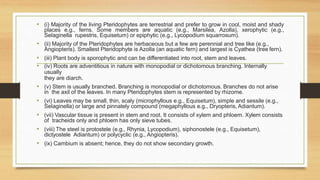
• (i) Majority of the living Pteridophytes are terrestrial and prefer to grow in cool, moist and shady
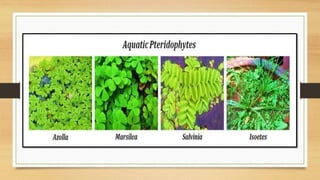
places e.g., ferns. Some members are aquatic (e.g., Marsilea, Azolla), xerophytic (e.g.,
Selaginella rupestris, Equisetum) or epiphytic (e.g., Lycopodium squarrosum).
• (ii) Majority of the Pteridophytes are herbaceous but a few are perennial and tree like (e.g.,
Angiopteris). Smallest Pteridophyte is Azolla (an aquatic fern) and largest is Cyathea (tree fern).
• (iii) Plant body is sporophytic and can be differentiated into root, stem and leaves.
• (iv) Roots are adventitious in nature with monopodial or dichotomous branching. Internally
usually
they are diarch.
• (v) Stem is usually branched. Branching is monopodial or dichotomous. Branches do not arise
in the axil of the leaves. In many Pteridophytes stem is represented by rhizome.
• (vi) Leaves may be small, thin, scaly (microphyllous e.g., Equisetum), simple and sessile (e.g.,
Selaginella) or large and pinnately compound (megaphyllous e.g., Dryopteris, Adiantum).
• (vii) Vascular tissue is present in stem and root. It consists of xylem and phloem. Xylem consists
of tracheids only and phloem has only sieve tubes.
• (viii) The steel is protostele (e.g., Rhynia, Lycopodium), siphonostele (e.g., Equisetum),
dictyostele Adiantum) or polycyclic (e.g., Angiopteris).
• (ix) Cambium is absent; hence, they do not show secondary growth.
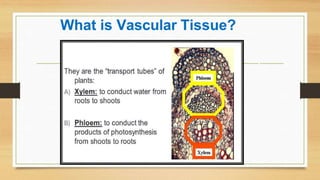
What is Vascular Tissue?
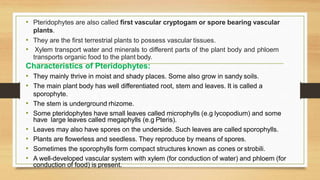
• Pteridophytes are also called first vascular cryptogam or spore bearing vascular
plants.
• They are the first terrestrial plants to possess vascular tissues.
• Xylem transport water and minerals to different parts of the plant body and phloem
transports organic food to the plant body.
Characteristics of Pteridophytes:
• They mainly thrive in moist and shady places. Some also grow in sandy soils.
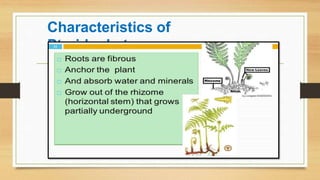
• The main plant body has well differentiated root, stem and leaves. It is called a
sporophyte.
• The stem is underground rhizome.
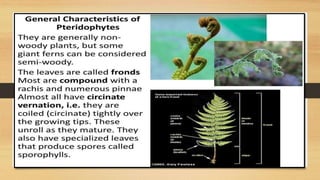
• Some pteridophytes have small leaves called microphylls (e.g lycopodium) and some
have large leaves called megaphylls (e.g Pteris).
• Leaves may also have spores on the underside. Such leaves are called sporophylls.
• Plants are flowerless and seedless. They reproduce by means of spores.
• Sometimes the sporophylls form compact structures known as cones or strobili.
• A well-developed vascular system with xylem (for conduction of water) and phloem (for
conduction of food) is present.
Pteridophytes
Basics
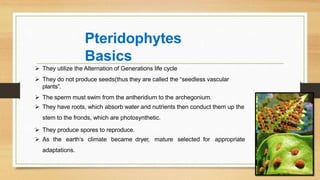
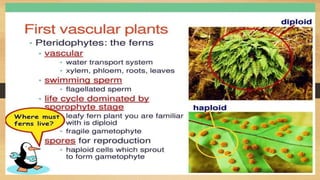
 They utilize the Alternation of Generations life cycle
 They do not produce seeds(thus they are called the “seedless vascular
plants”.
 The sperm must swim from the antheridium to the archegonium.
 They have roots, which absorb water and nutrients then conduct them up the
stem to the fronds, which are photosynthetic.
 They produce spores to reproduce.
 As the earth’s climate became dryer, mature selected for appropriate
adaptations.
Characteristics of
Pteridophytes
THANK YOU