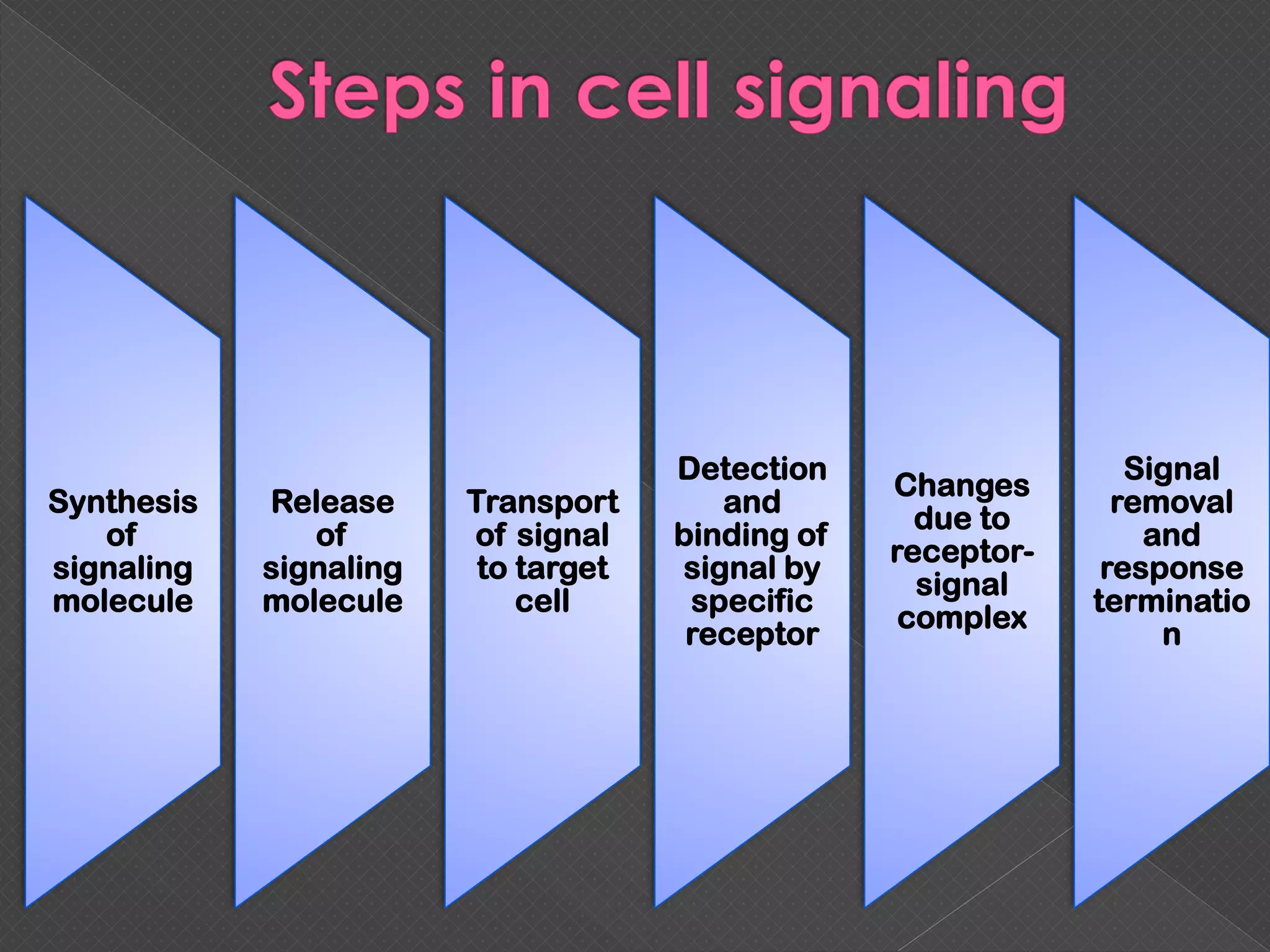
Synthesis
of
signaling
molecule
Release
of
signaling
molecule
Transport
of signal
to target
cell
Detection
and
binding of
signal by
specific
receptor
Changes
due to
receptor-
signal
complex
Signal
removal
and
response
terminatio
n
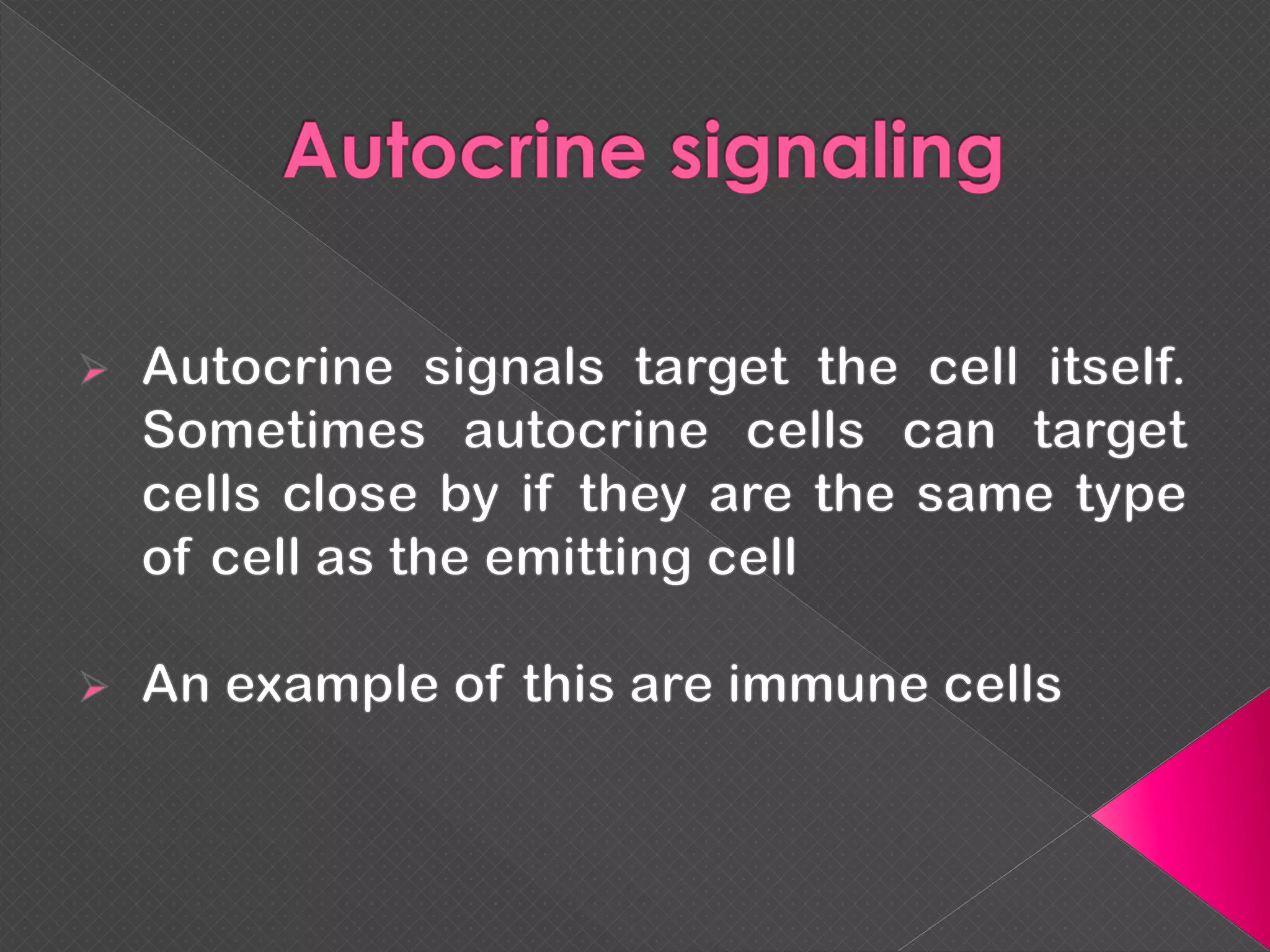
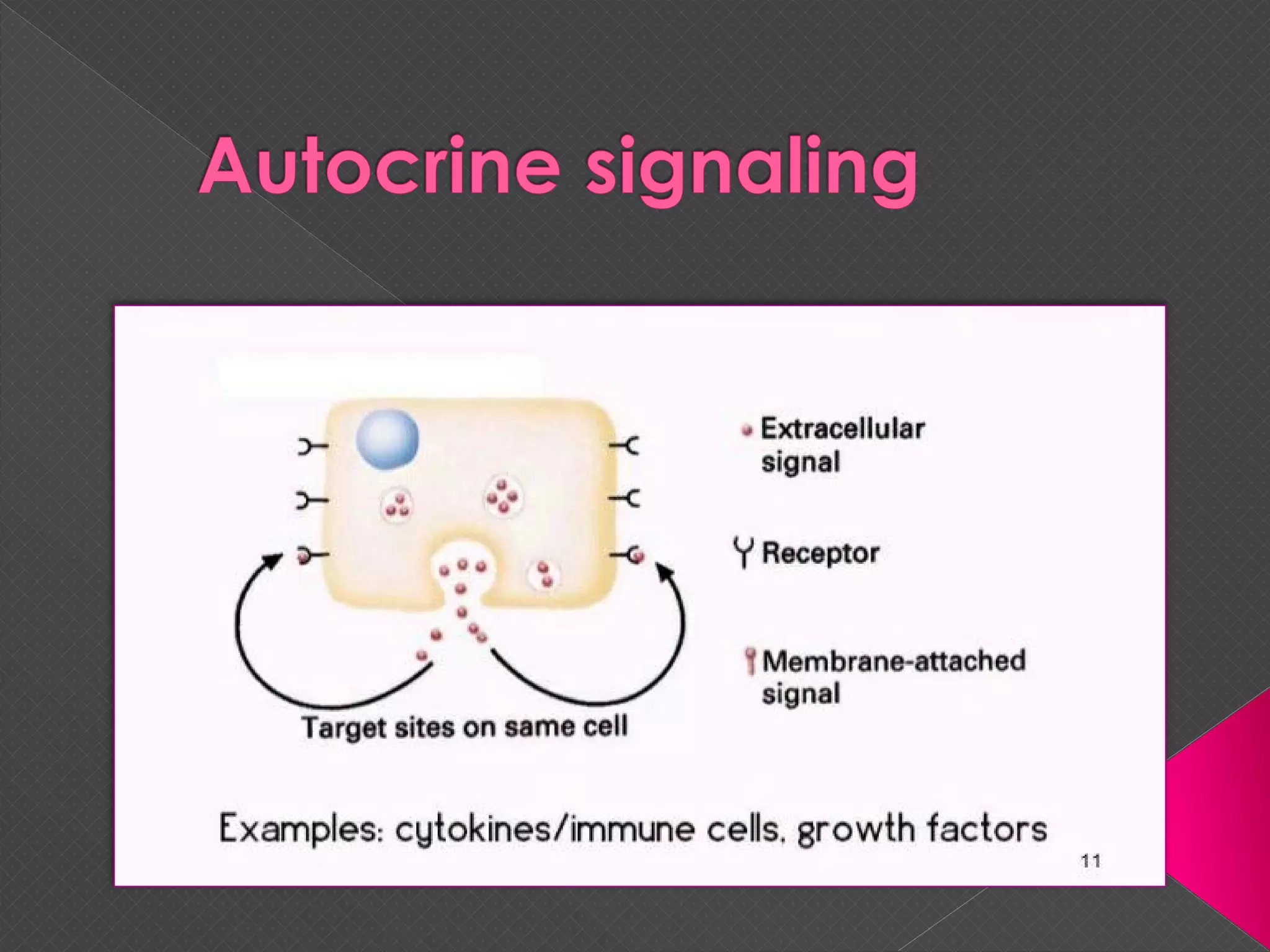
 Autocrine signaling
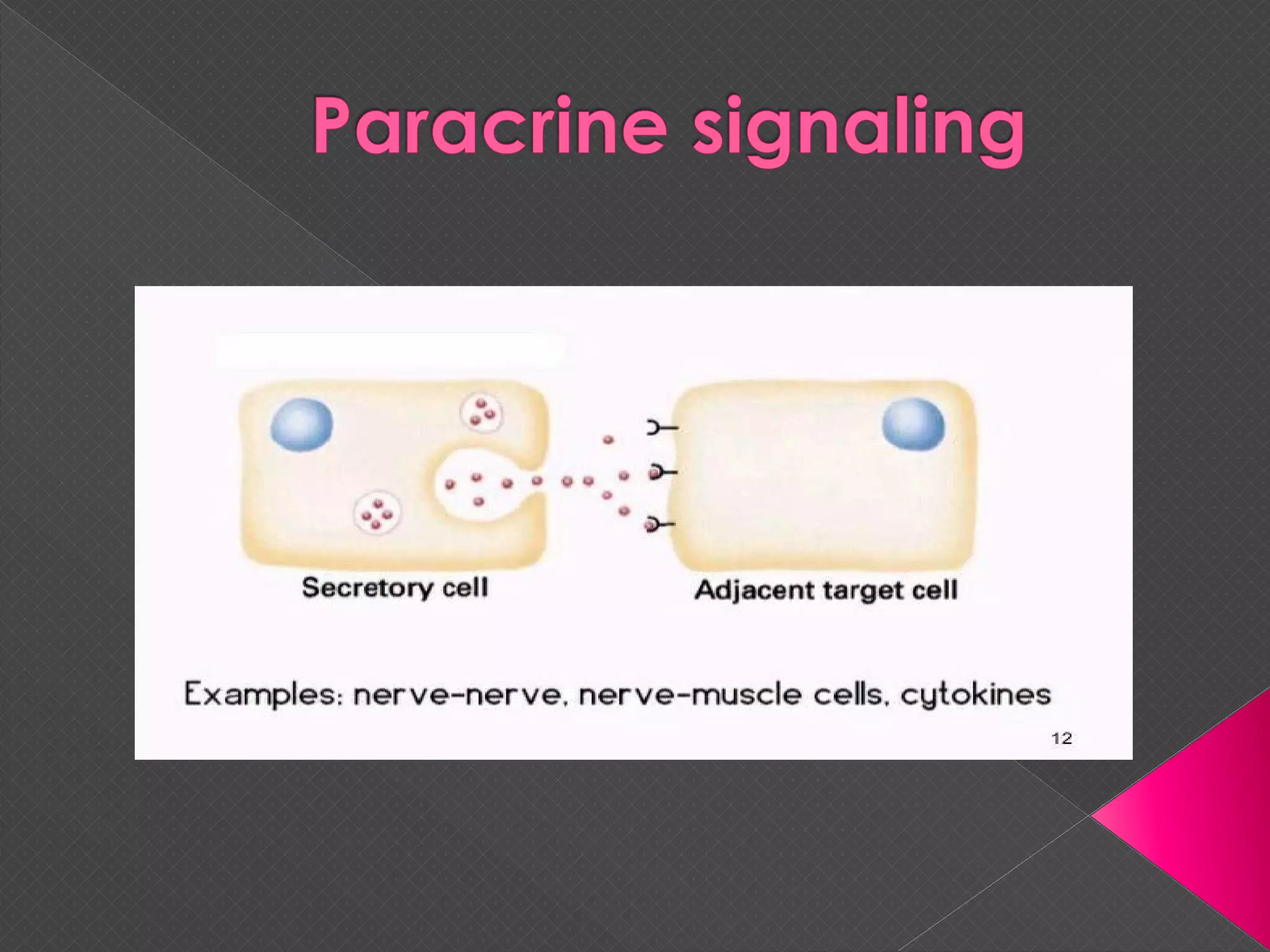
 Paracrine signaling
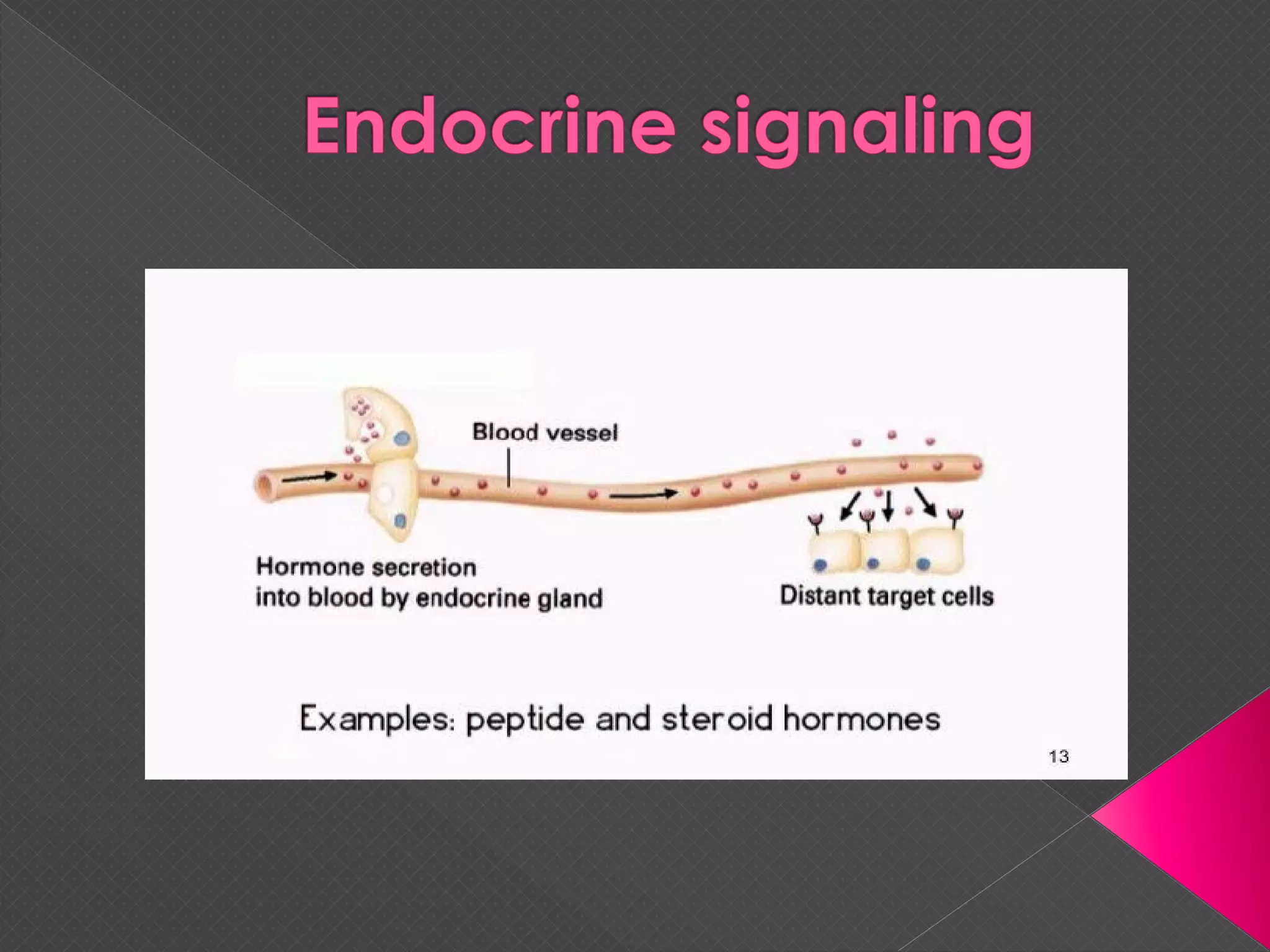
 Endocrine signaling
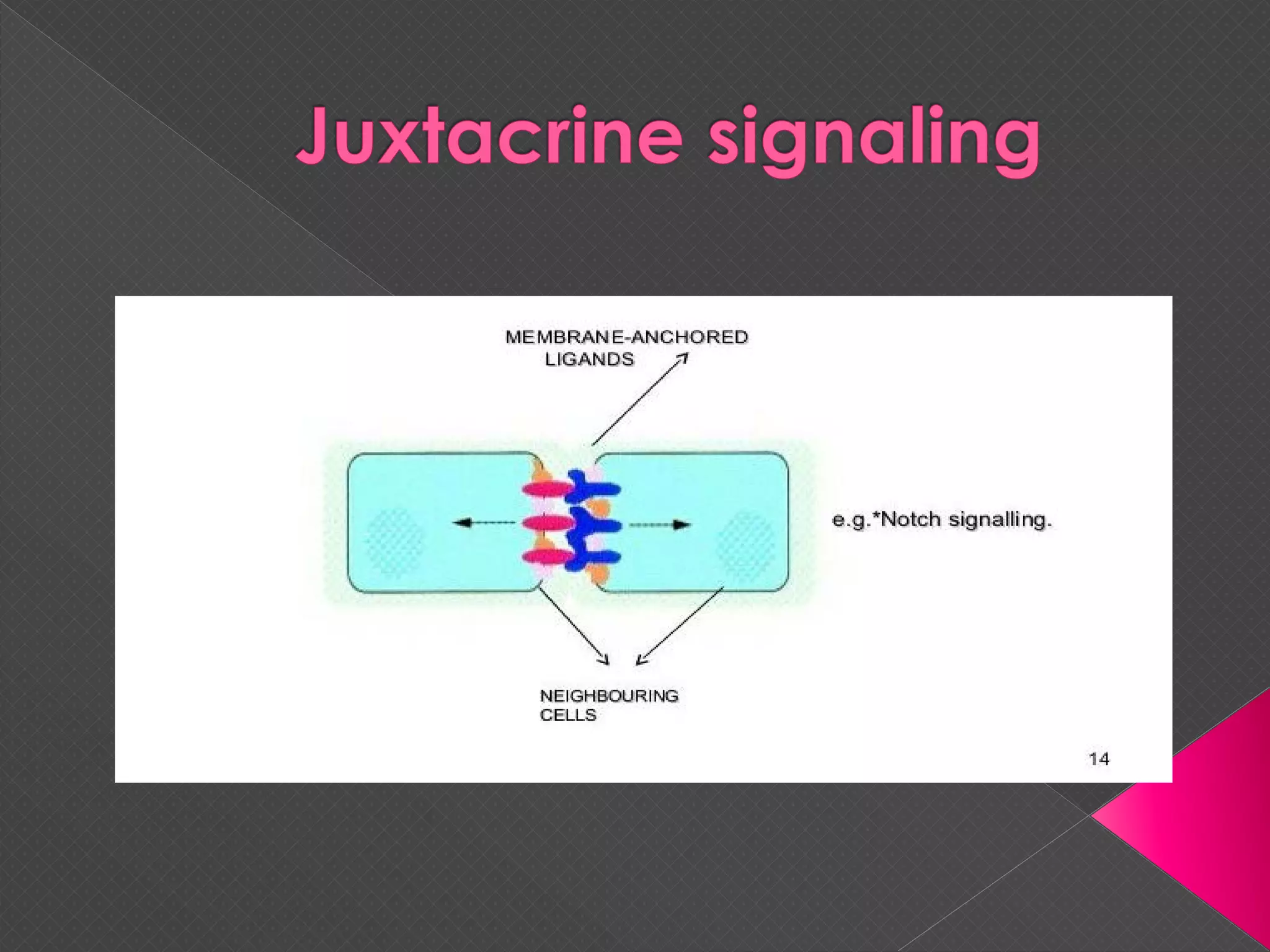
 Juxtacrine signaling
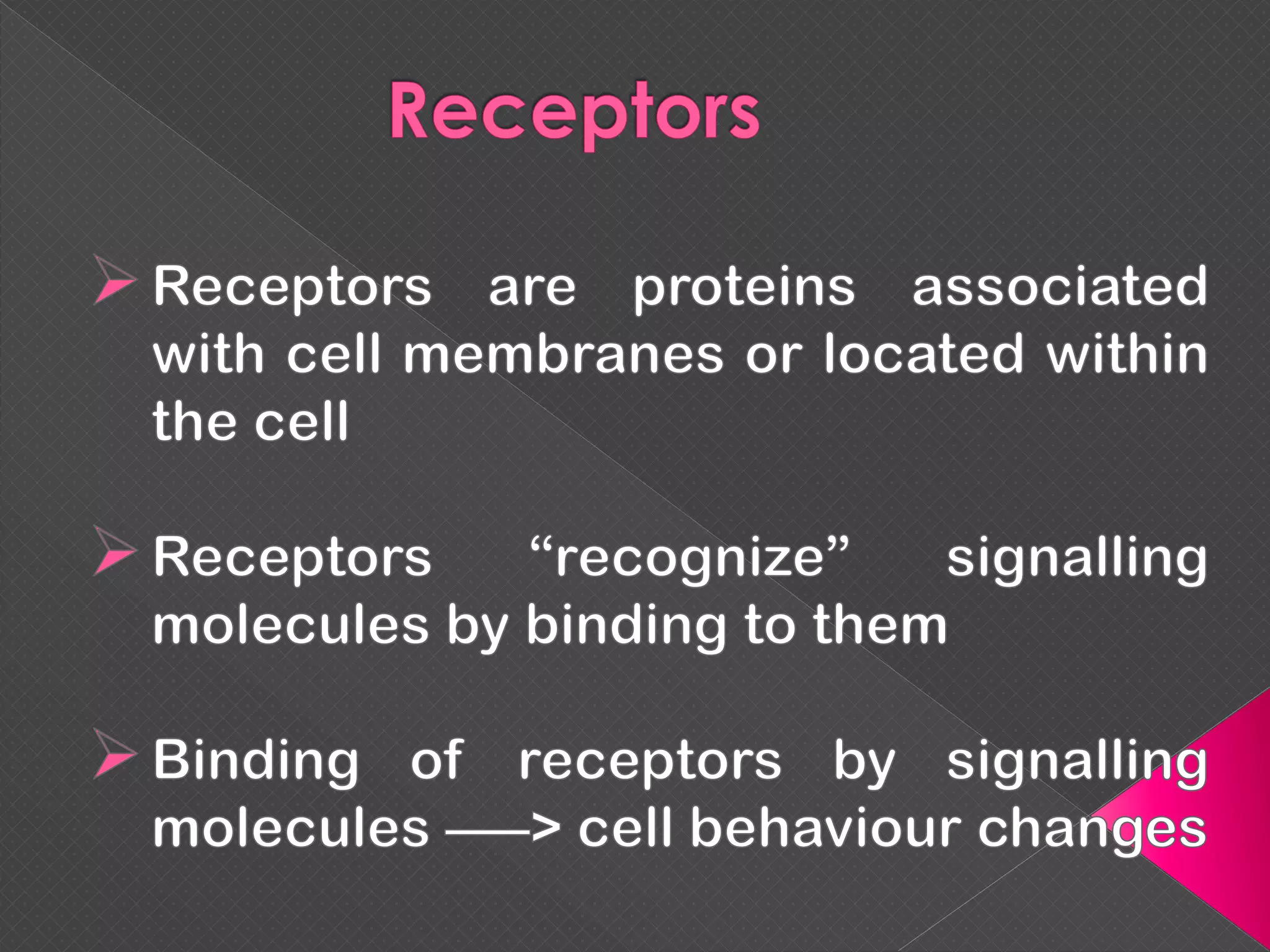
 An agent which activates a receptor to
produce an effect similar to that of the
physiological signal molecule
 An agent which activates a receptor to
produce an effect in the opposite
direction to that of the agonist
 An agent which prevents the action of
an agonist on a receptor or the
subsequent response, but does not
have any effect of its own
 An agent which activates a receptor to
produce submaximal effect but
antagonizes the action of a full agonist
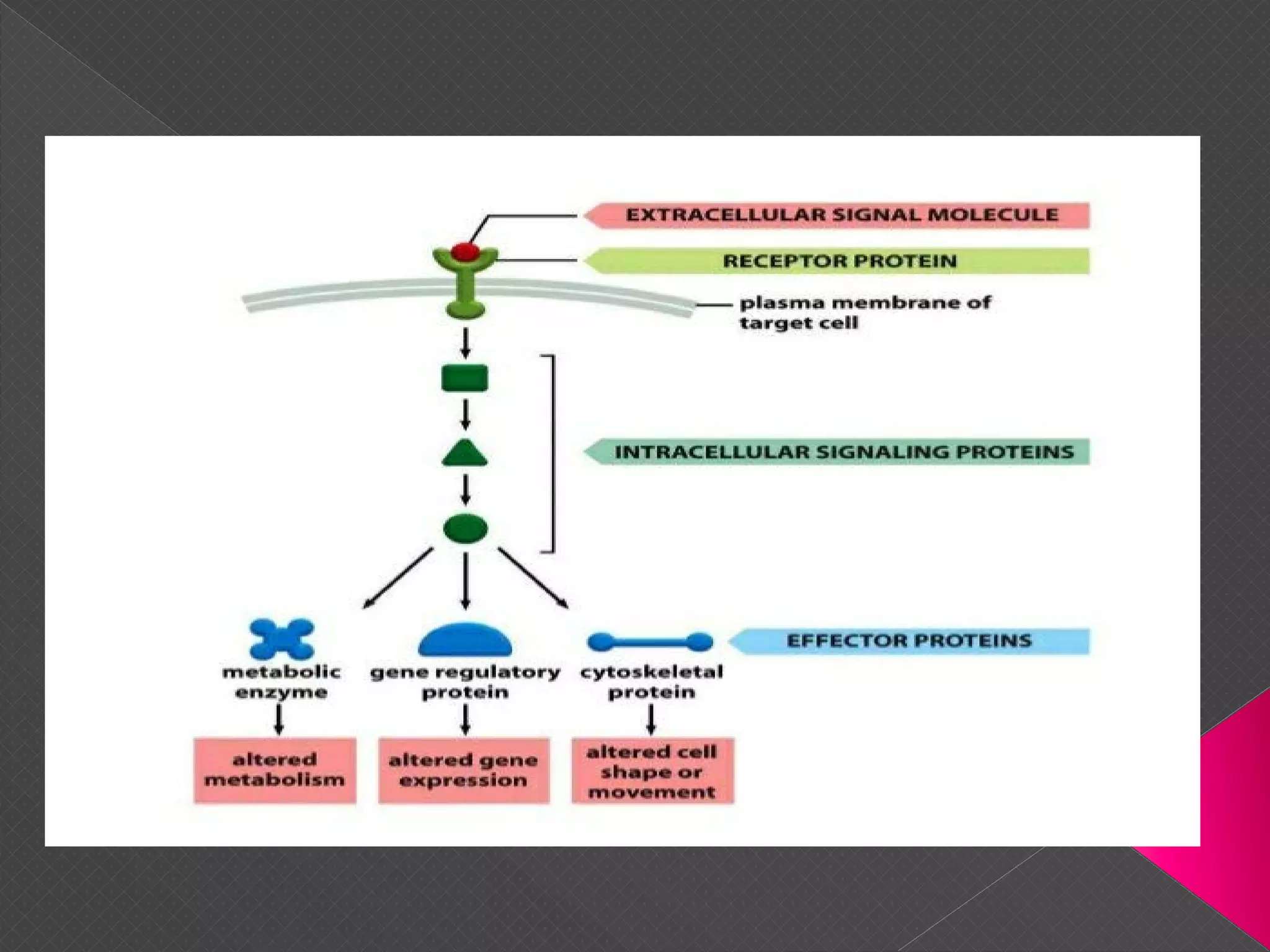
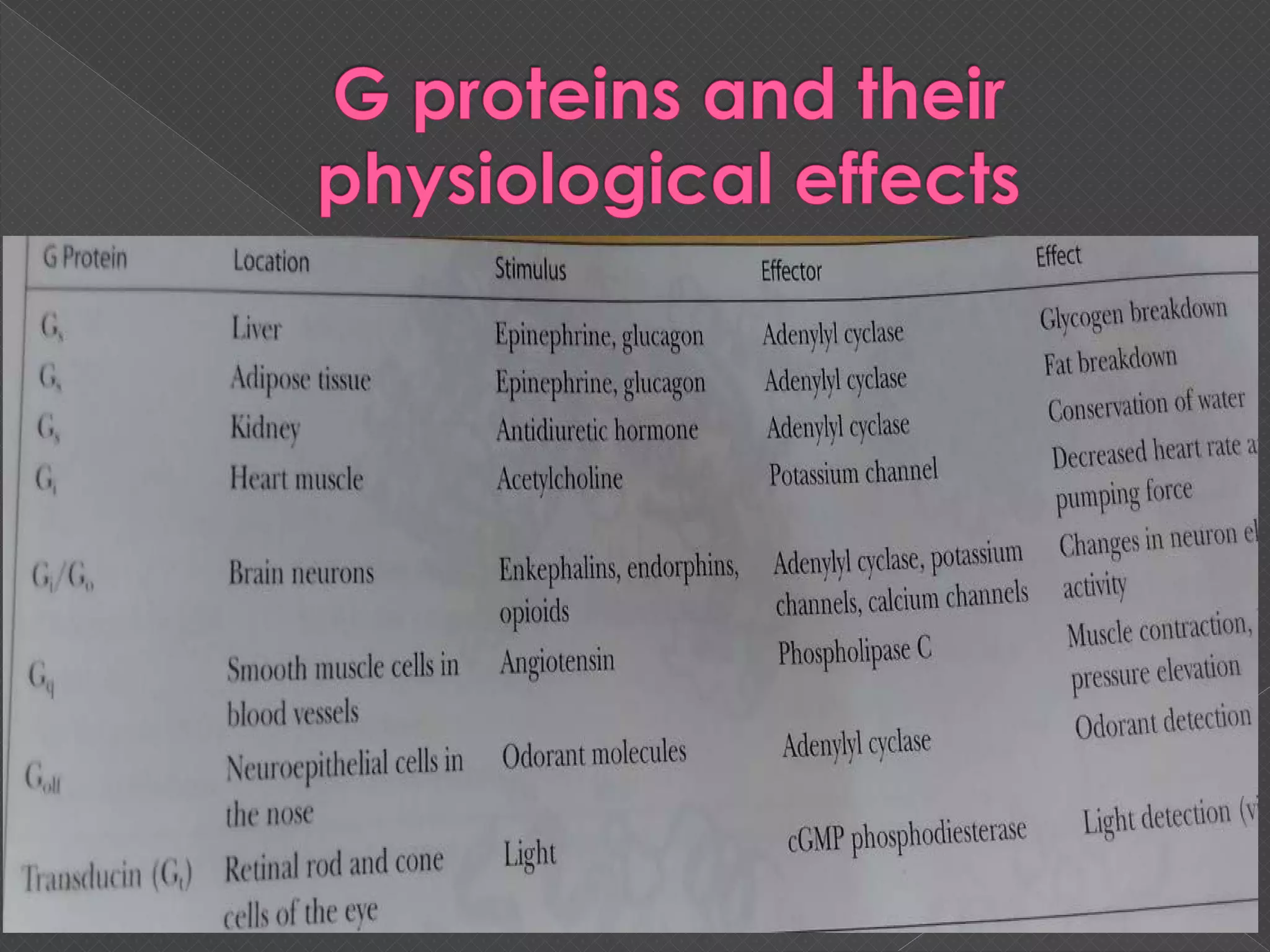
 To propagate regulatory signals from
outside to within the effector cell when
the molecular species carrying the
signal cannot itself penetrate the cell
membrane
 To amplify the signal
 To integrate various extracellular and
intracellular regulatory signal
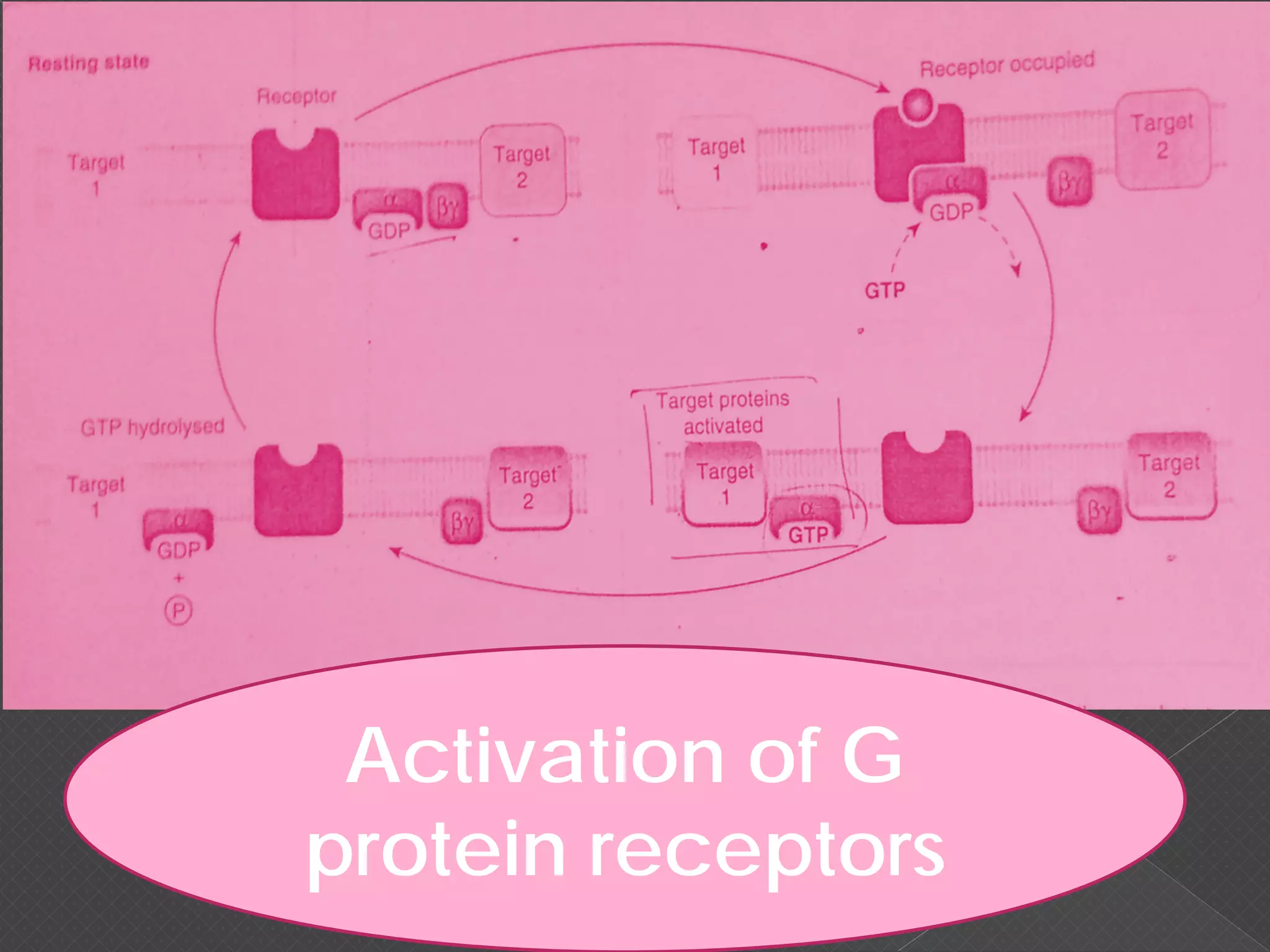
 Their signaling protein partners are
called G proteins because they bind to
the nucleotide GTP to regulate their
shape and activity
 When activated, they can trigger the
activation of several copies of the same
G protein. Because activated G proteins
dissociate from the GPCR, leaving the
binding site available to bind and
activate, thereby amplifying the effect of
a single signal molecule
 Gs subgroup which stimulate
adenylyl cyclase
 It includes Golf coupled to olfactory
receptors
 Gi subgroup which inhibit adenylyl
cyclase and activate some Ca²+ and
K+ channels
 Gq subgroup which couple receptors
to calcium mobilisation through
phospholipase Cβ that in turn generates
the two second messengers inositol
triphosphate (IP3) and diacylglycerol
(DAG)
 Gt subgroup which stimulate
phosphodiesterase following light
stimulation of the retina involving
transducin
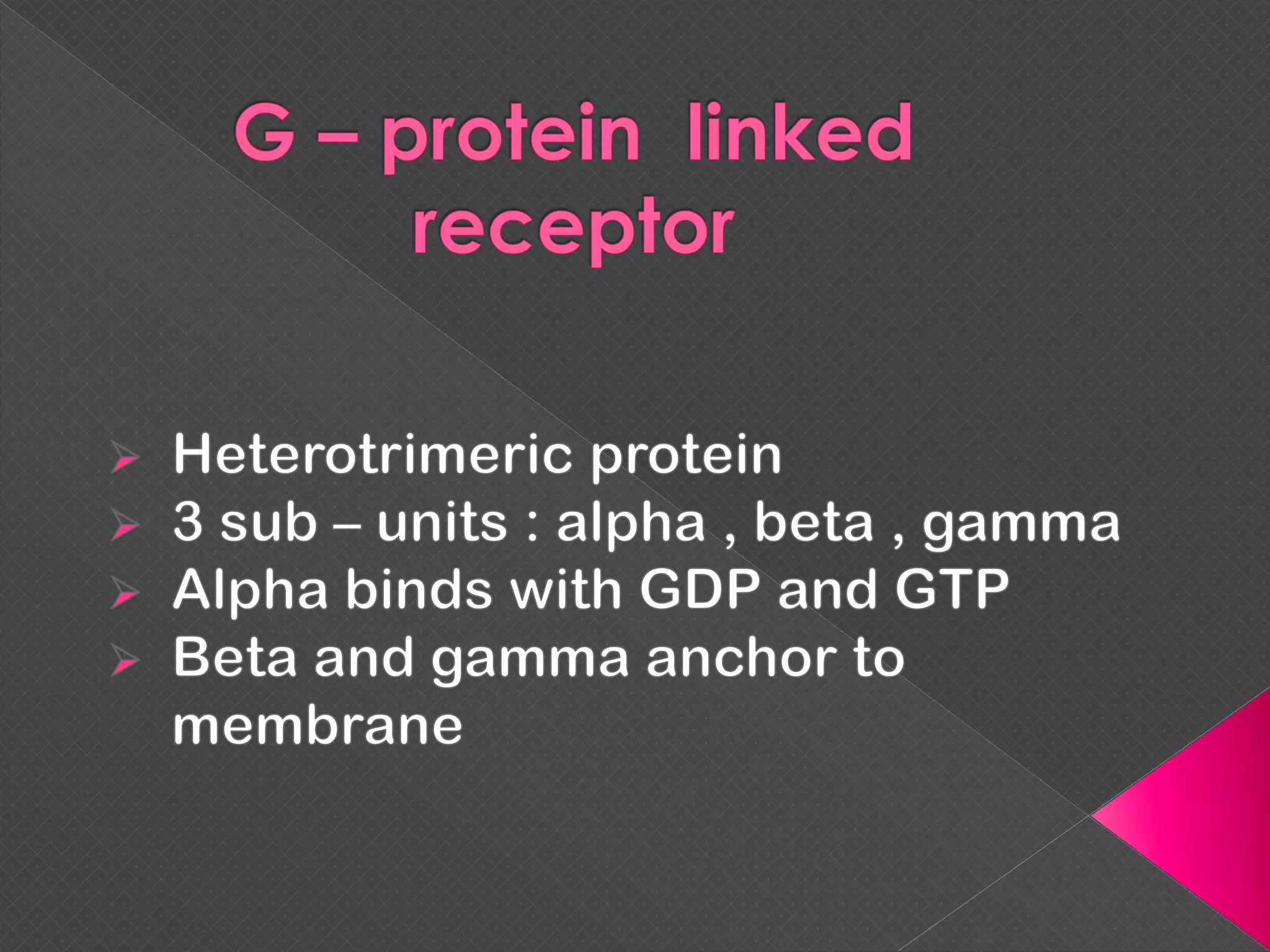
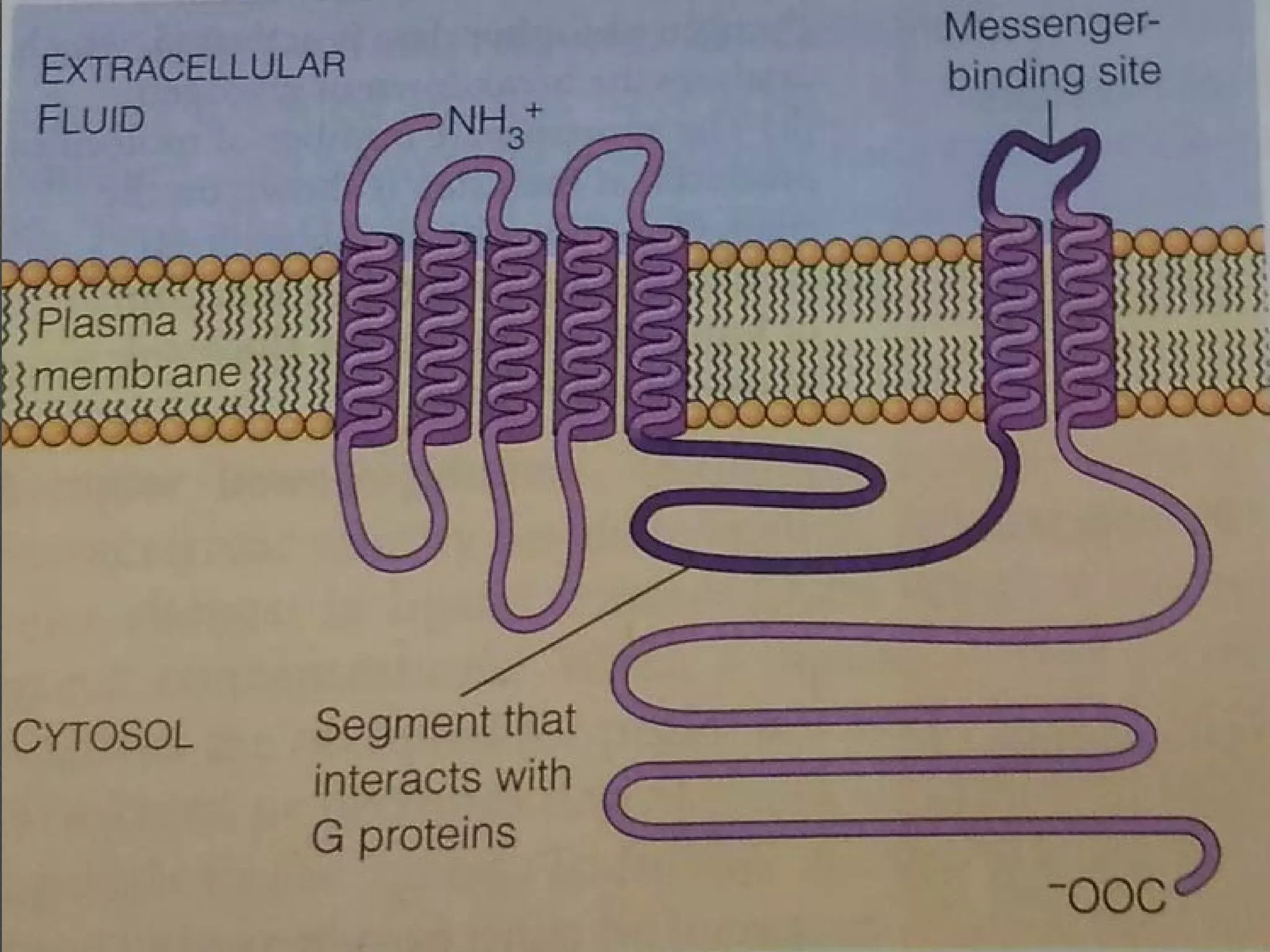
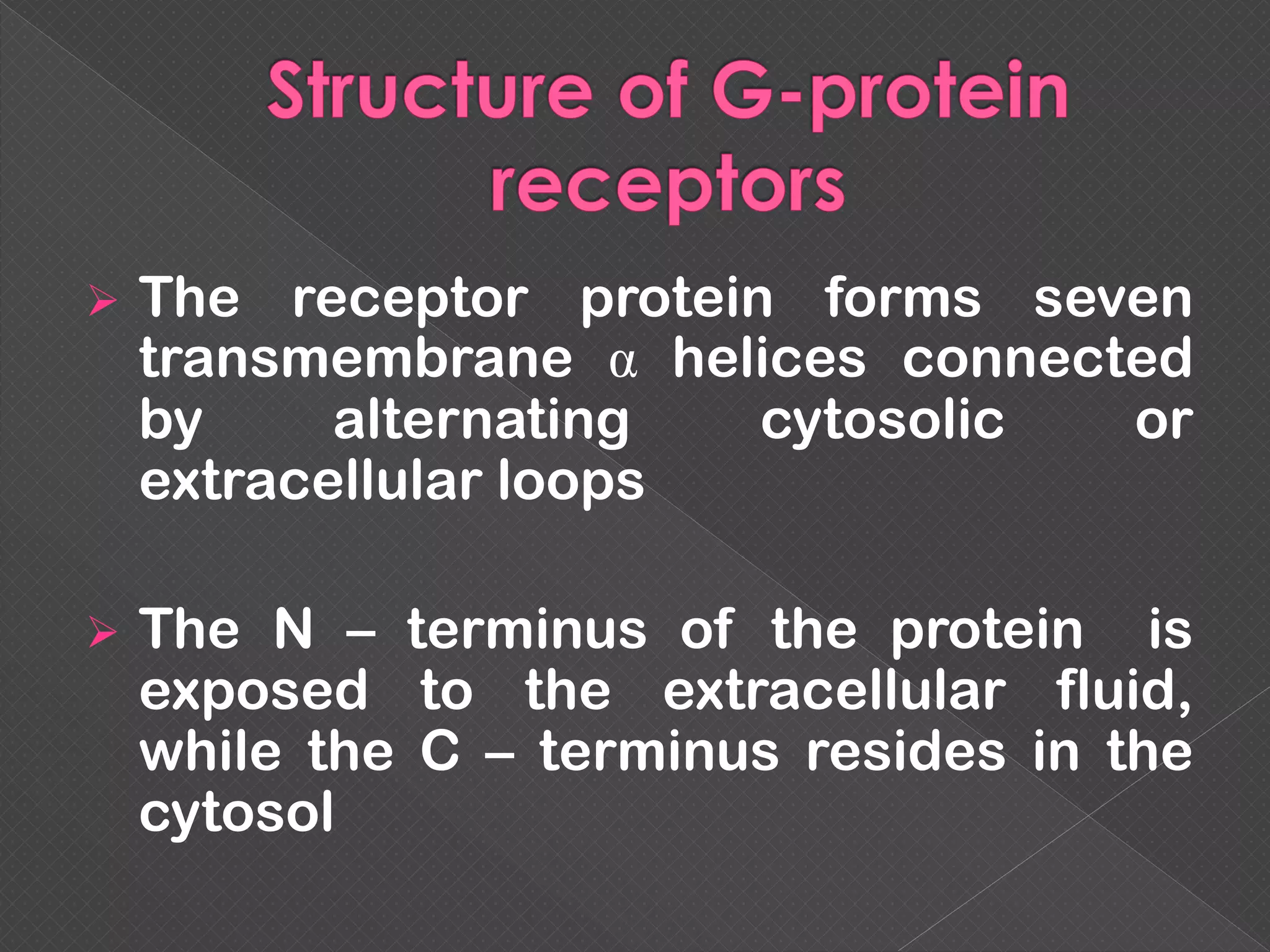
 The receptor protein forms seven
transmembrane α helices connected
by alternating cytosolic or
extracellular loops
 The N – terminus of the protein is
exposed to the extracellular fluid,
while the C – terminus resides in the
cytosol
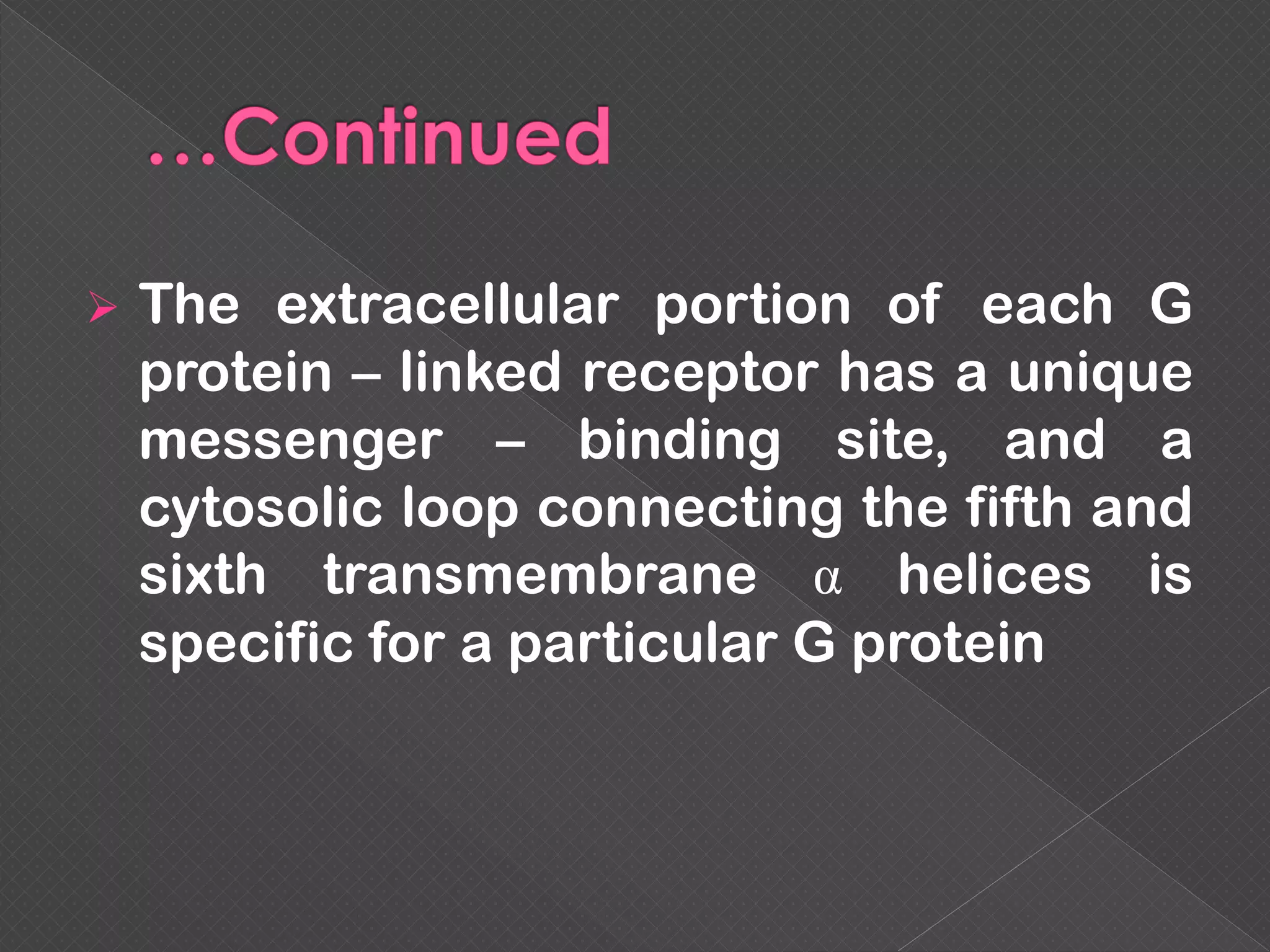
 The extracellular portion of each G
protein – linked receptor has a unique
messenger – binding site, and a
cytosolic loop connecting the fifth and
sixth transmembrane α helices is
specific for a particular G protein
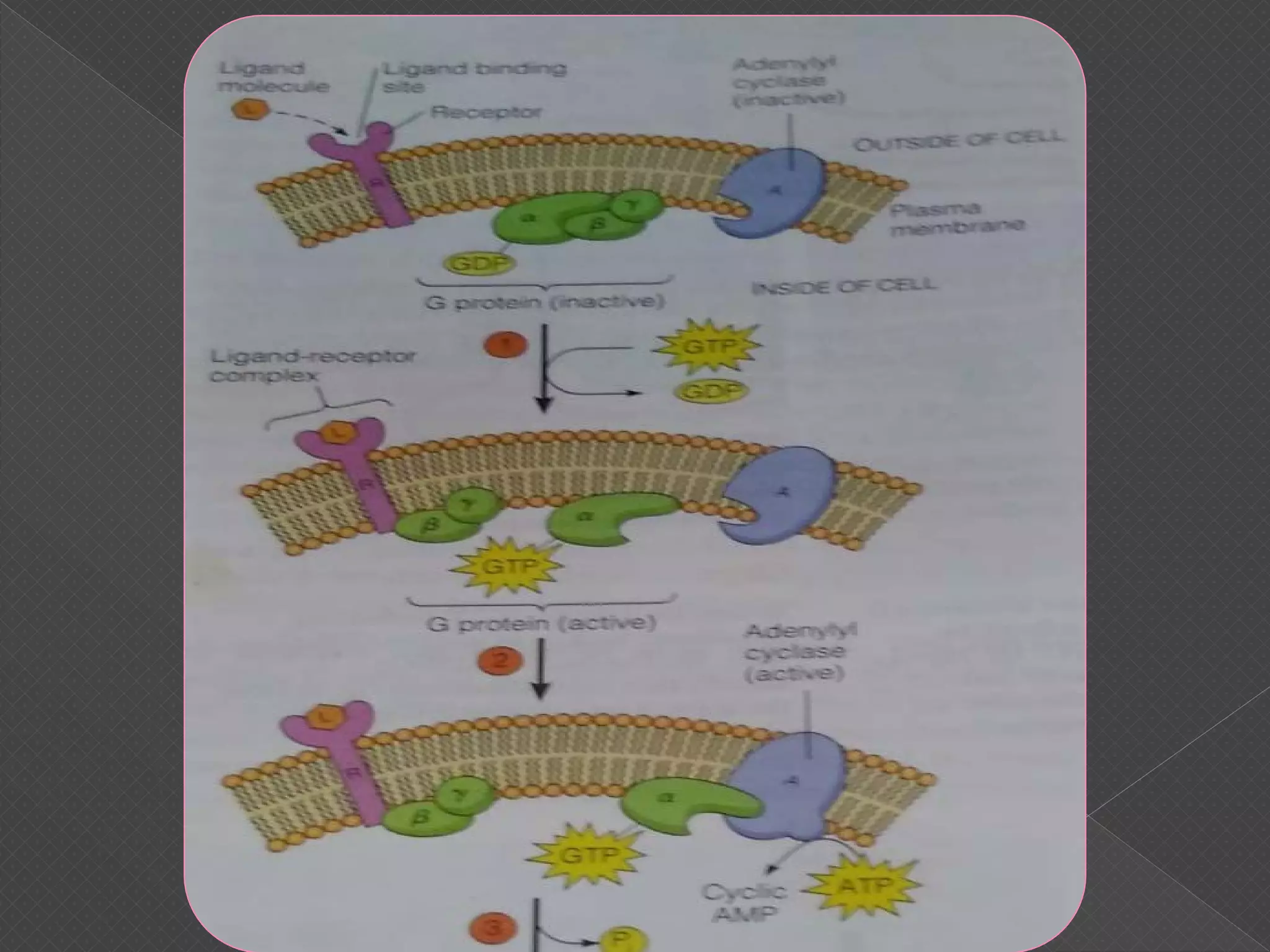
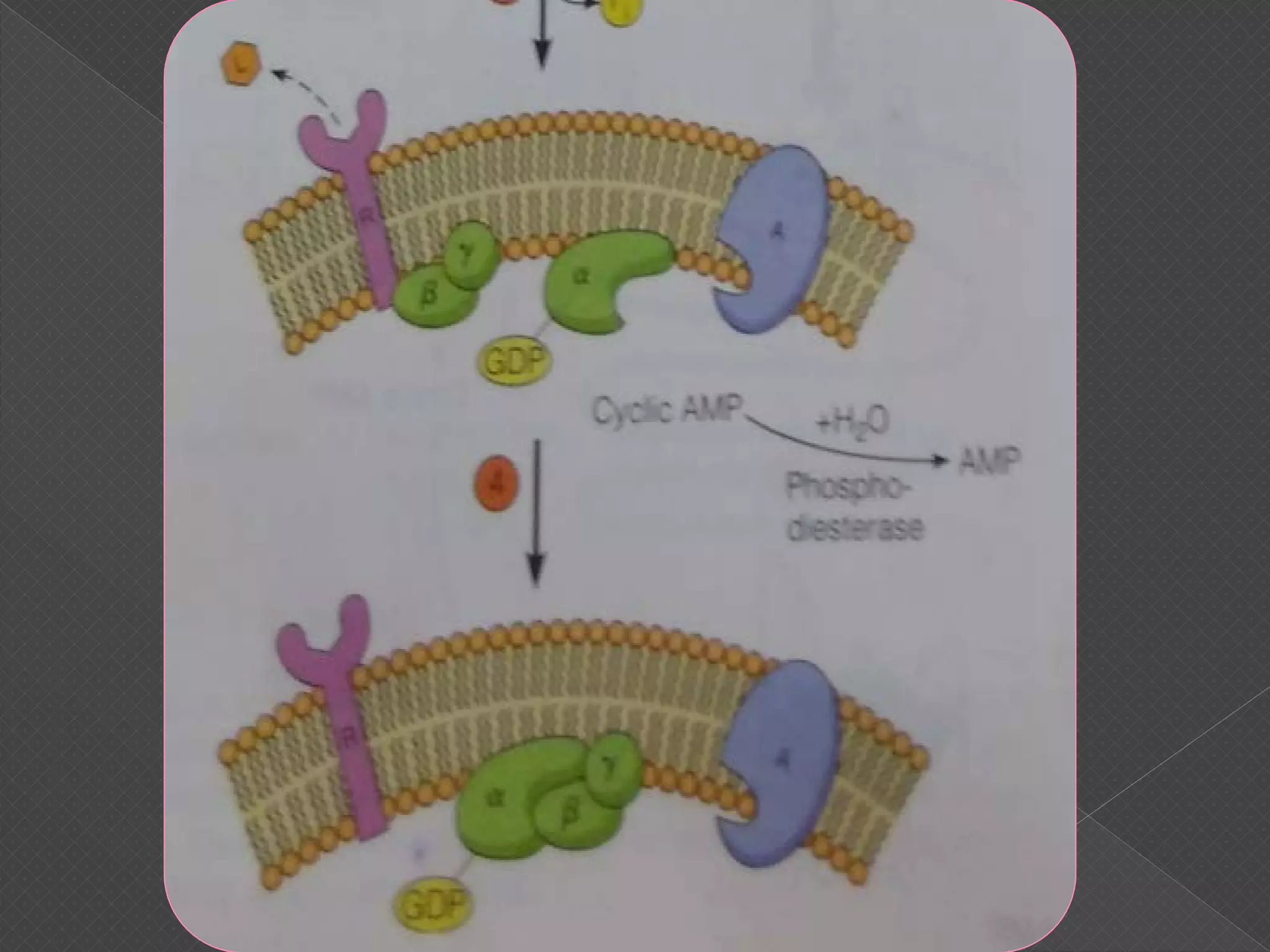
Activation of G
protein receptors
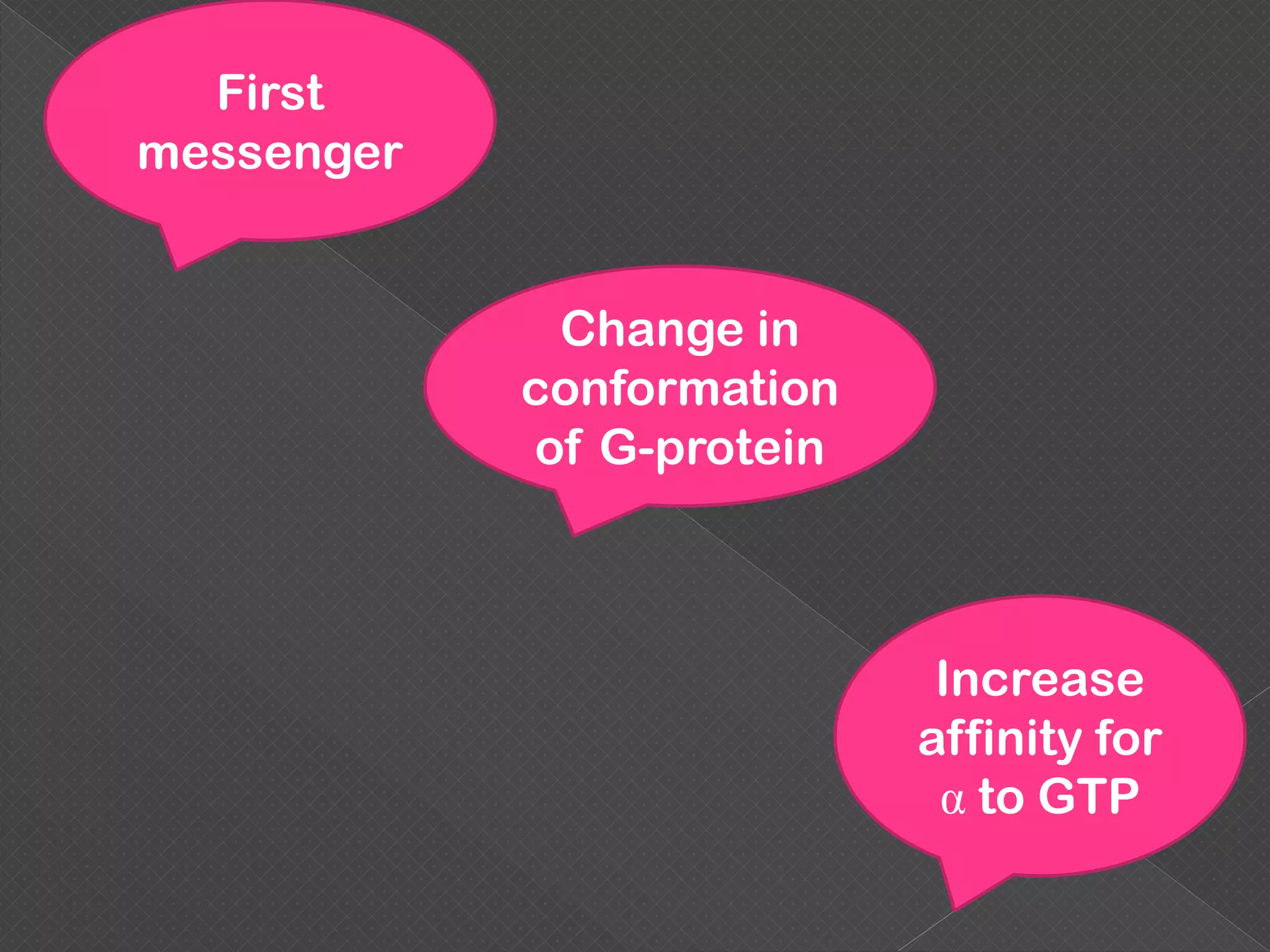
First
messenger
Change in
conformation
of G-protein
Increase
affinity for
α to GTP
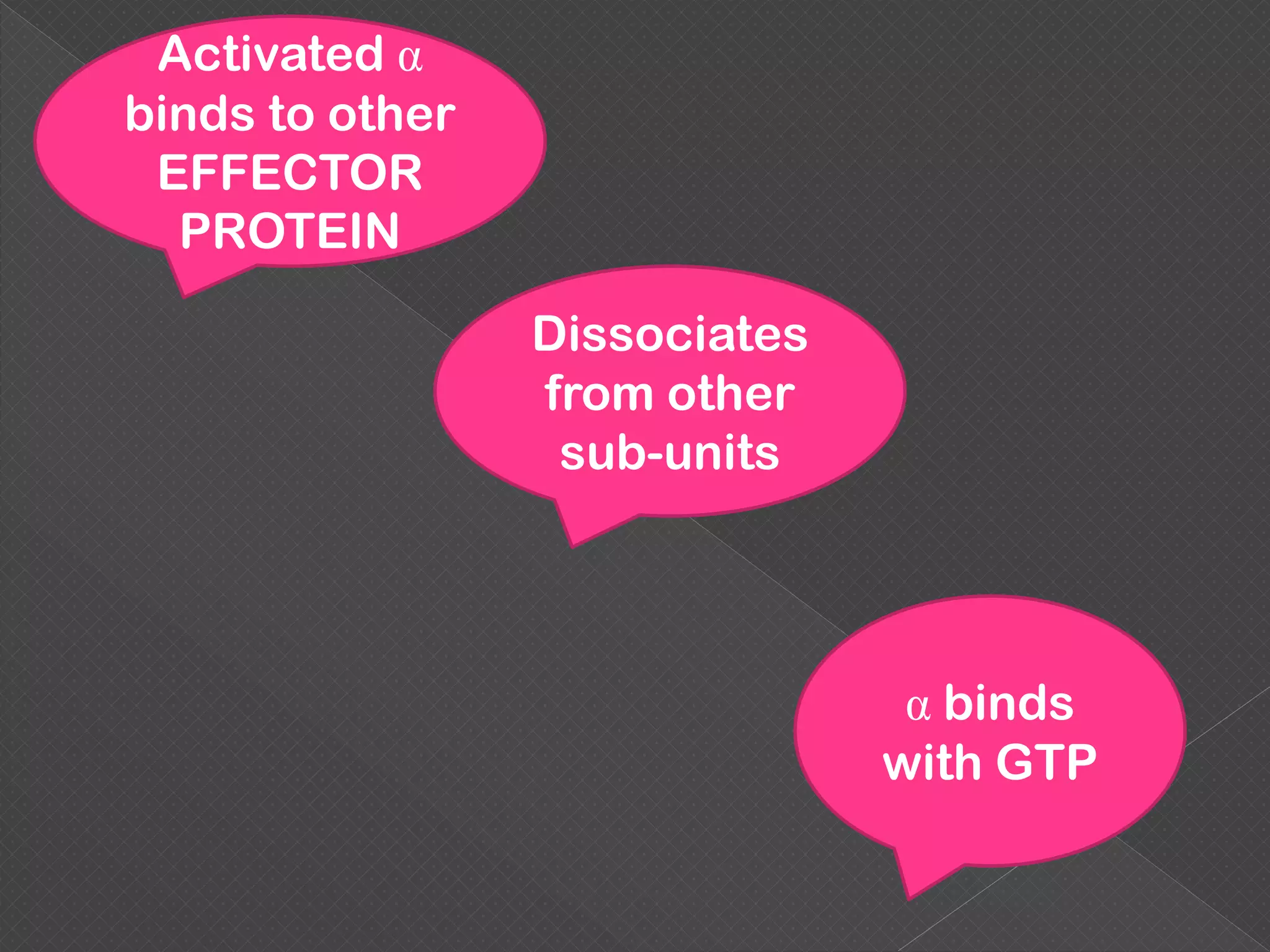
Activated α
binds to other
EFFECTOR
PROTEIN
Dissociates
from other
sub-units
α binds
with GTP
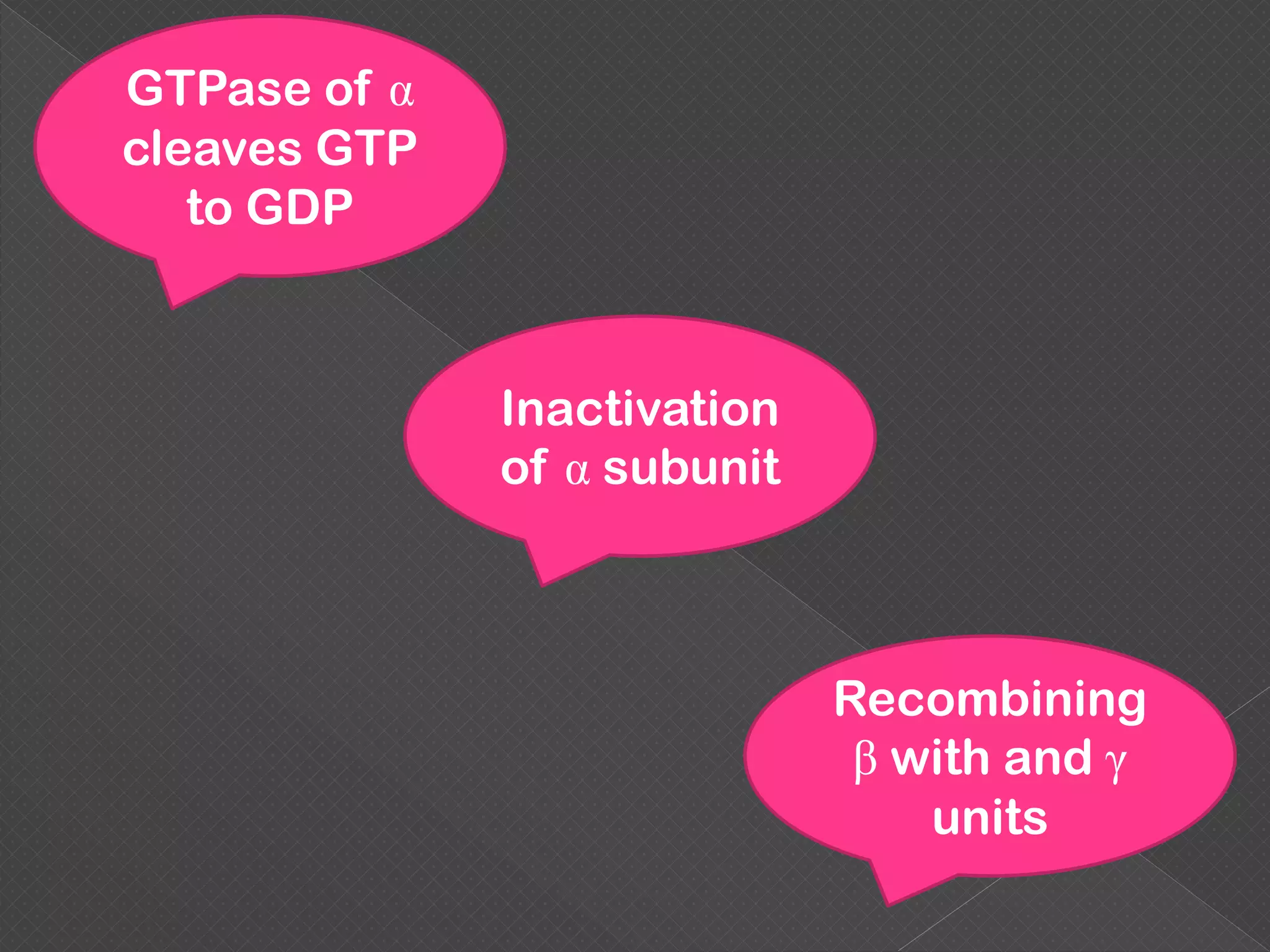
GTPase of α
cleaves GTP
to GDP
Inactivation
of α subunit
Recombining
β with and γ
units
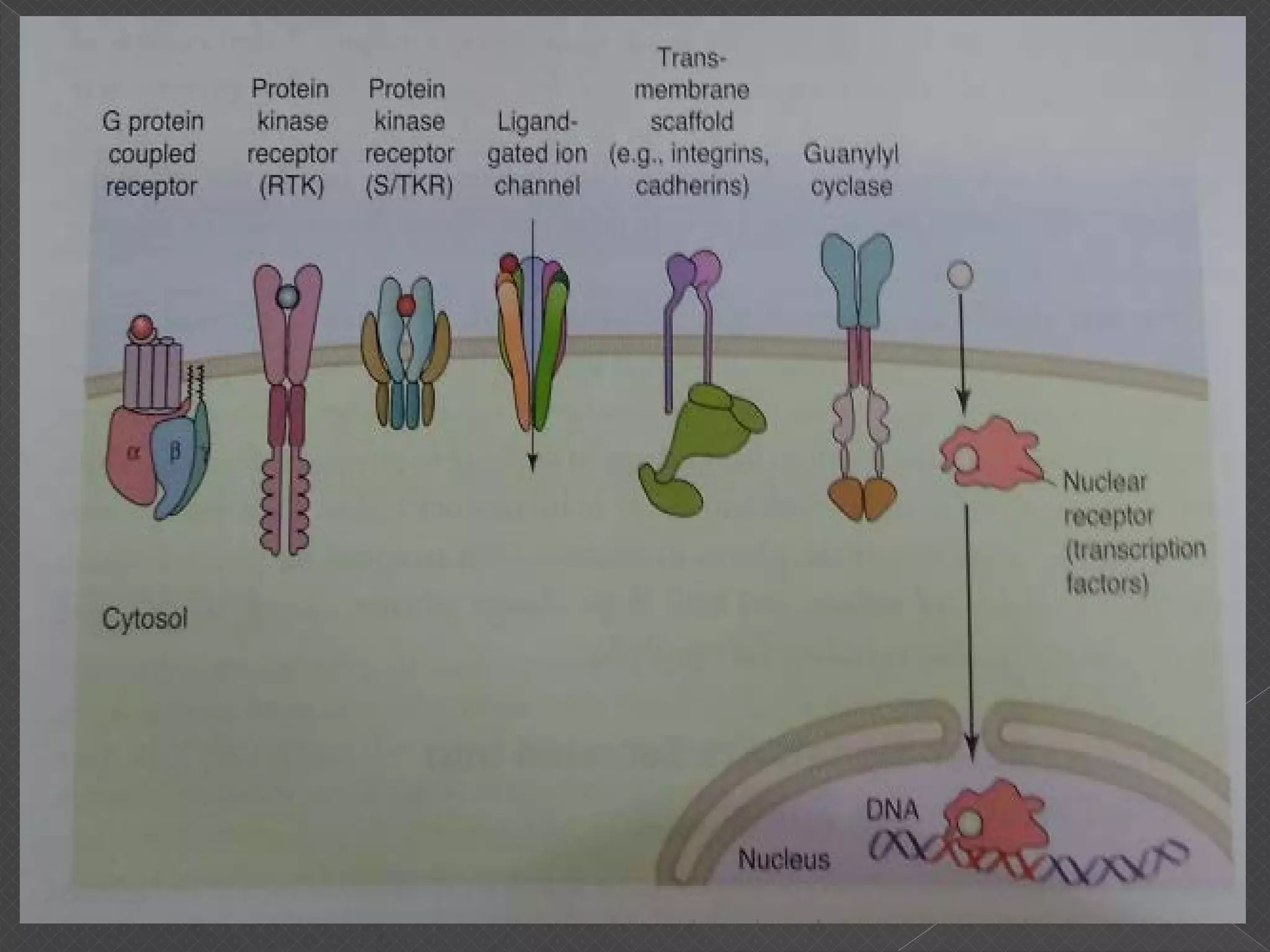
 These are transmembrane proteins
that are composed of at least two
subunits and therefore have a
quaternary structure
 Each of the subunits contains a single
α-helical transmembrane domain, so
they can diffuse relatively easily in the
membrane
 The subunits of inactive receptors
dissociate from one another, and only
bind to one another when they come into
contact with the proper ligand
 Their cytoplasmic tails contain protein
kinase domains
 A protein kinase is an enzyme that
attaches phosphate groups to the side
chains of specific amino acids
 Serine/threonine kinase receptor are
more heterogeneous in structure than
tyrosine kinases, and most do not
undergo transautophosphorylation;
instead, they phosphorylate a
separate signaling protein
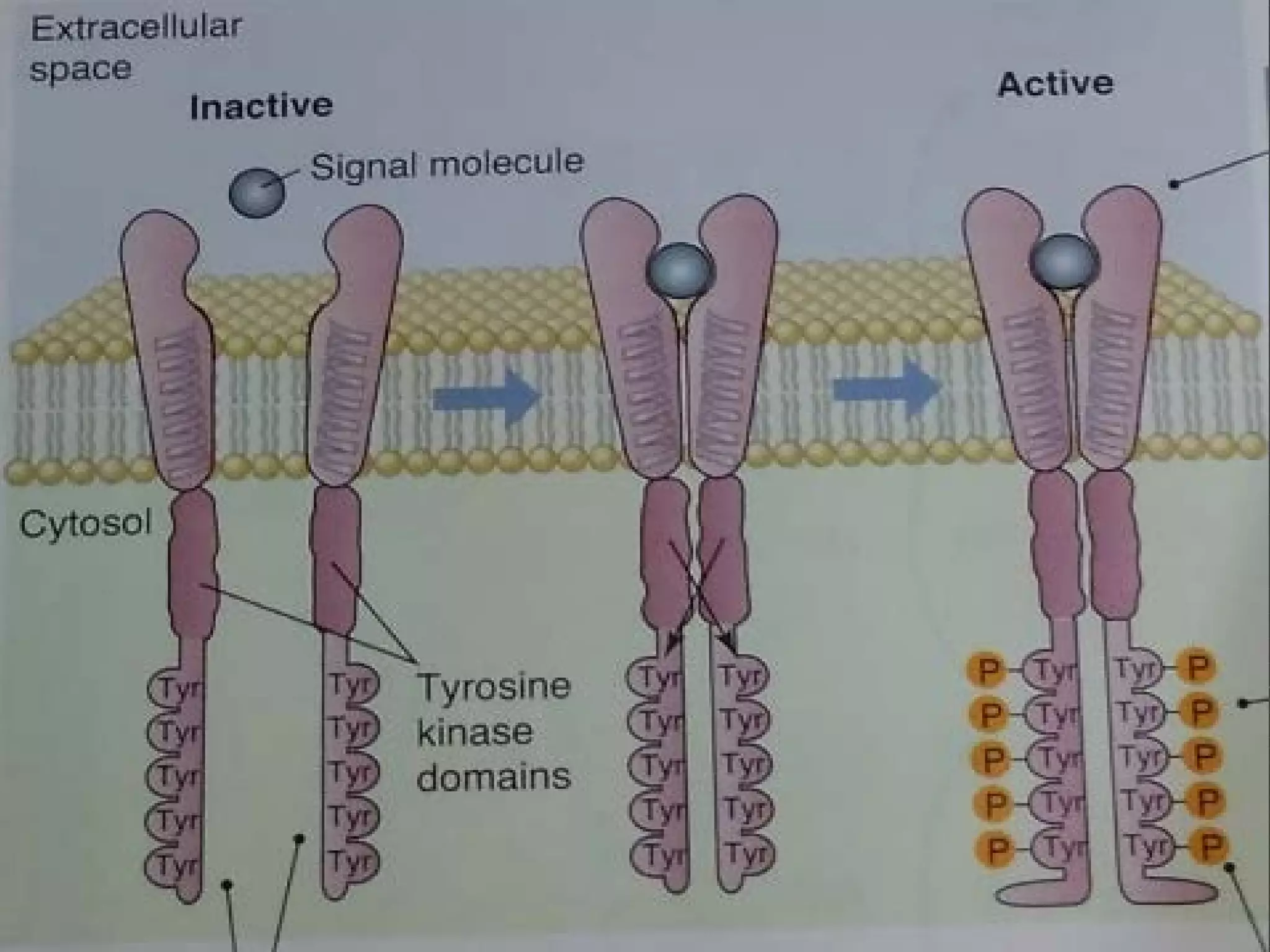
 Tyrosine kinase receptor, which
contain two subunits. Each of the two
subunits contains a tyrosine kinase,
and in many cases, each
phosphorylates tyrosines on the
opposite subunit, a behavior called
transautophosphorylation
 Many receptor tyrosine kinases (RTKs)
trigger a chain of signal transduction
events inside the cell that ultimately
leads to cell growth, proliferation, or the
specialization of cells in a process
known as differentiation
 These processes are tightly controlled ,
so that only specific cells respond when
the appropriate ligand is available
 Examples of RTKs include the insulin
receptor, the nerve growth factor
receptor and the epidermal growth
factor (EGF)
 These receptors often consist of a single
polypeptide chain with only one
transmembrane segment
 The extracellular portion of the receptor
contains the ligand – binding domain
 Inactive receptors are separate
polypeptides with inactive tyrosine
kinase domains
 Binding to a signaling molecule
causes the two subunits of the
receptor to join together, also called
dimerize
 The resulting phosphotyrosine amino
acids are binding sites for additional
signaling proteins that pass the signal
along the pathway
 When the cytoplasmic tail of one
subunit is brought close to the
tyrosine kinase domain of the other
subunit, it is phosphorylated on
specific tyrosine amino acids
 They are actually located in the
cytoplasm and migrate to the nucleus
after binding with their ligands
 They are composed of a C – terminal
ligand – binding region, a core DNA –
binding domain (DBD) and an N-
terminal domain that contains the AF1
(activation function 1) region
 The core region has two zinc fingers that
are responsible for recognizing the DNA
sequences specific to this receptor
 The N – terminus interacts with other
cellular transcription factors in a ligand –
independent manner
 Depending on these interactions , it can
modify the binding / activity of the
receptor
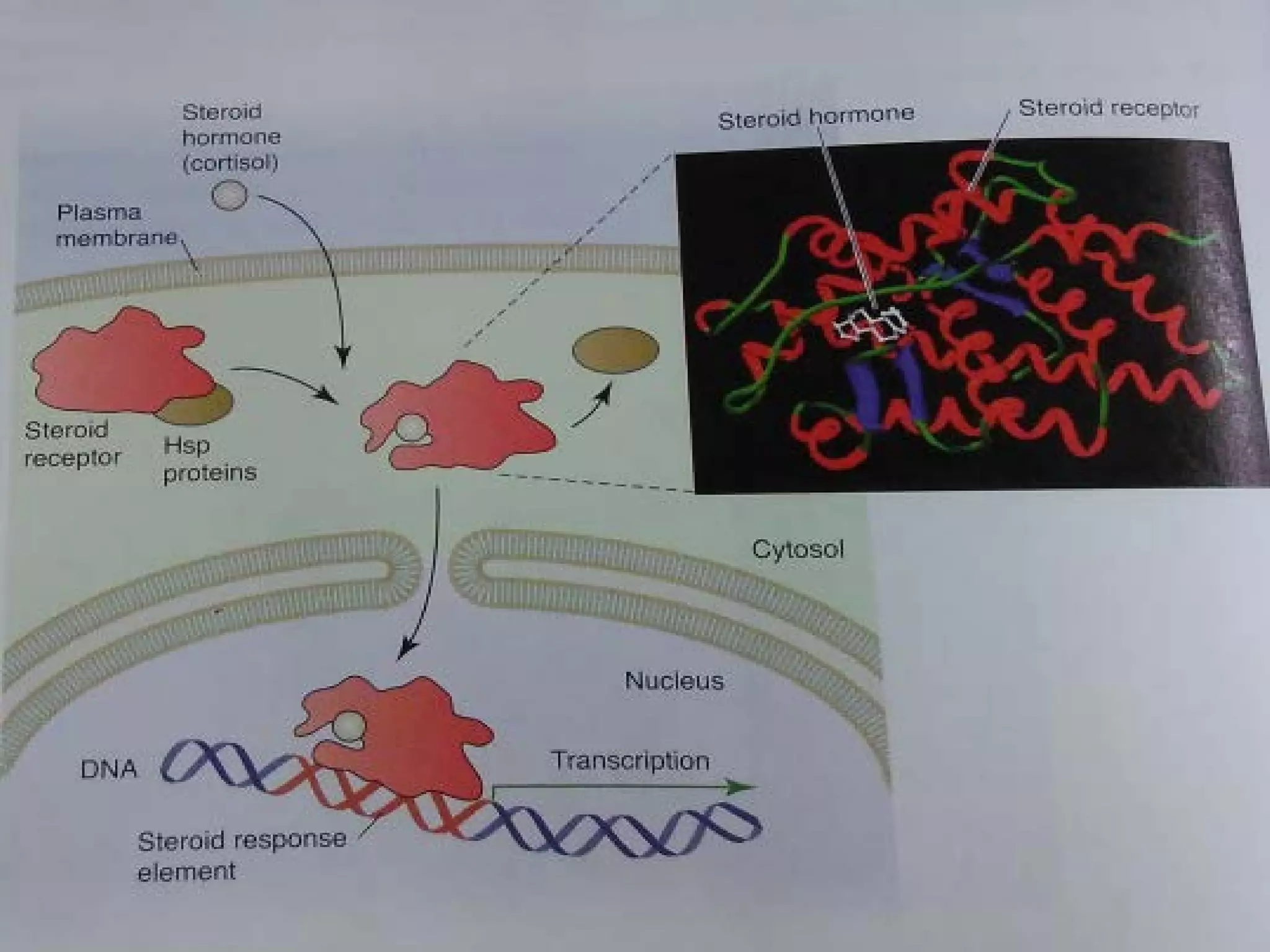
 Membrane – permeable signals adhere to
receptor proteins in the cytosol
 These receptors typically have very
short signal transduction pathways they
move directly into the nucleus once they
are bound and activated . These are
called nuclear receptors for this reason
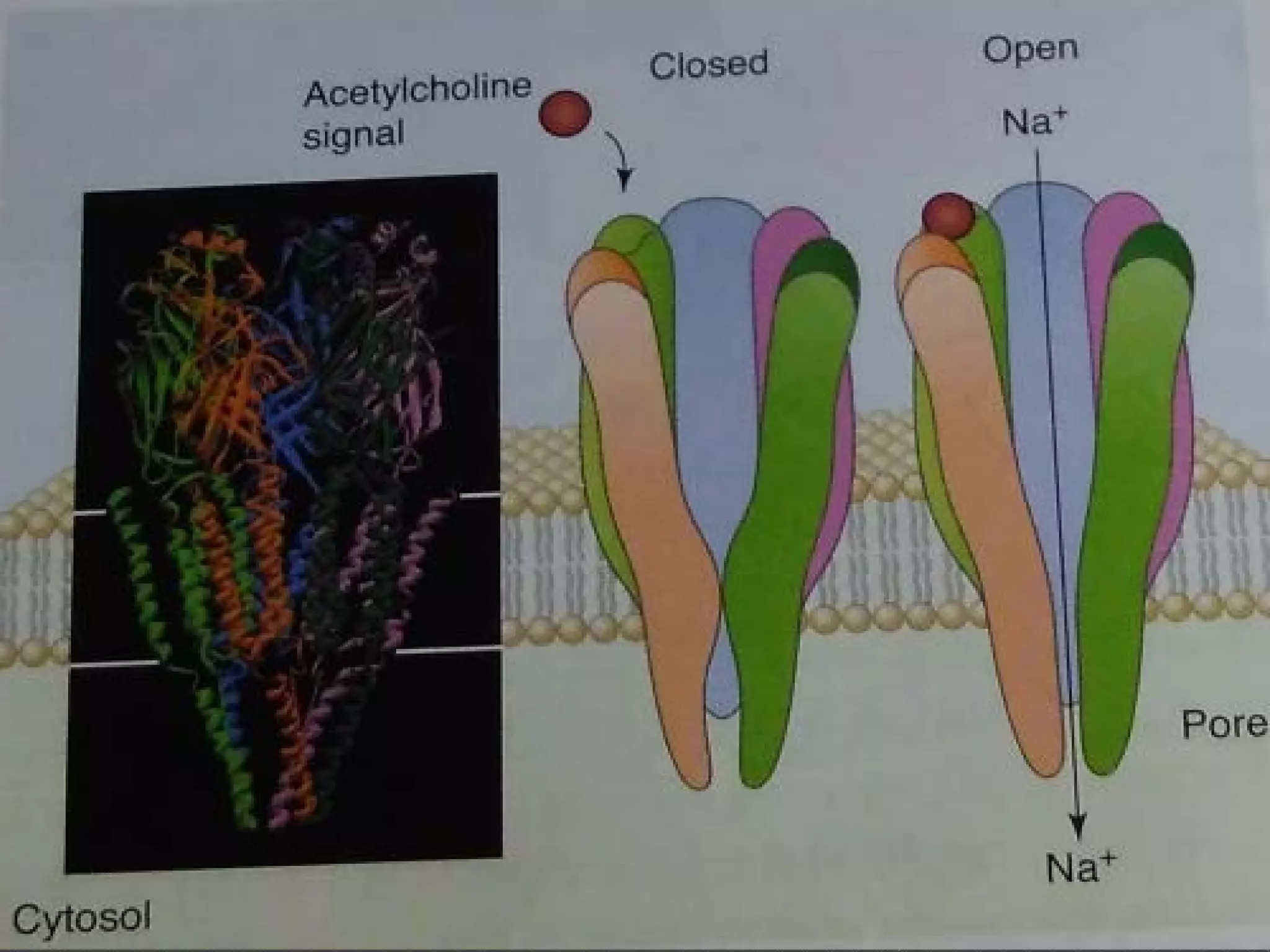
 It is commonly known as ionotropic
receptors, are a group of
transmembrane ion channel proteins
which open to allow ions such as Na+,
k+, Ca²+ and Cl¯ to pass through
membrane in response to the binding
of a chemical messenger such as a
neurotransmitter
 When a presynaptic neuron is excited, it
releases neurotransmitter from vesicles
into the synaptic cleft
 The neurotransmitter then binds to
receptors located on the postsynaptic
neuron. If these receptors are ligand -
gated ion channels, a resulting
conformational change opens the ion
channels, which leads to a flow of ions
across the cell membrane
 This, in turn, results in either a
depolarization, for an excitatory
receptor response, or a
hyperpolarization, for an inhibitory
response
 These proteins are typically composed
of at least two different domains: a
transmembrane domain which
includes the ion pore, and an
extracellular domain which includes
the ligand binding location
 Ionotropic glutamate receptors
 NMDA receptors
 GABA receptors
 5-HT receptors
 Verma S. P. , Agarwal K.V. , cell biology,
published by S. Chand & company Pvt. Ltd. NEW
DELHI, first edition, 2016, page no. 530 – 532
 Rastogi Bala Veer, Aneja R. K. , principles of
biochemistry, published by Scientific
International Pvt. Ltd. NEW DELHI, fifth edition,
page no. 211 - 219
 Plopper George, cell biology, published by jones
& bartlett learning, second edition, 2016, page
no. 372 – 380
 https://www.cancer.gov/publications/dictionaries/
cancer-terms?cdrid=633297
 http://encyclopedia2.thefreedictionary.com/intra
cellular +signaling+ pathway

Assignment on Cell signaling

  • 3.
    Synthesis of signaling molecule Release of signaling molecule Transport of signal to target cell Detection and bindingof signal by specific receptor Changes due to receptor- signal complex Signal removal and response terminatio n
  • 5.
     Autocrine signaling Paracrine signaling  Endocrine signaling  Juxtacrine signaling
  • 18.
     An agentwhich activates a receptor to produce an effect similar to that of the physiological signal molecule
  • 19.
     An agentwhich activates a receptor to produce an effect in the opposite direction to that of the agonist
  • 20.
     An agentwhich prevents the action of an agonist on a receptor or the subsequent response, but does not have any effect of its own
  • 21.
     An agentwhich activates a receptor to produce submaximal effect but antagonizes the action of a full agonist
  • 22.
     To propagateregulatory signals from outside to within the effector cell when the molecular species carrying the signal cannot itself penetrate the cell membrane  To amplify the signal  To integrate various extracellular and intracellular regulatory signal
  • 26.
     Their signalingprotein partners are called G proteins because they bind to the nucleotide GTP to regulate their shape and activity  When activated, they can trigger the activation of several copies of the same G protein. Because activated G proteins dissociate from the GPCR, leaving the binding site available to bind and activate, thereby amplifying the effect of a single signal molecule
  • 27.
     Gs subgroupwhich stimulate adenylyl cyclase  It includes Golf coupled to olfactory receptors  Gi subgroup which inhibit adenylyl cyclase and activate some Ca²+ and K+ channels
  • 28.
     Gq subgroupwhich couple receptors to calcium mobilisation through phospholipase Cβ that in turn generates the two second messengers inositol triphosphate (IP3) and diacylglycerol (DAG)  Gt subgroup which stimulate phosphodiesterase following light stimulation of the retina involving transducin
  • 31.
     The receptorprotein forms seven transmembrane α helices connected by alternating cytosolic or extracellular loops  The N – terminus of the protein is exposed to the extracellular fluid, while the C – terminus resides in the cytosol
  • 32.
     The extracellularportion of each G protein – linked receptor has a unique messenger – binding site, and a cytosolic loop connecting the fifth and sixth transmembrane α helices is specific for a particular G protein
  • 33.
  • 34.
  • 35.
    Activated α binds toother EFFECTOR PROTEIN Dissociates from other sub-units α binds with GTP
  • 36.
    GTPase of α cleavesGTP to GDP Inactivation of α subunit Recombining β with and γ units
  • 39.
     These aretransmembrane proteins that are composed of at least two subunits and therefore have a quaternary structure  Each of the subunits contains a single α-helical transmembrane domain, so they can diffuse relatively easily in the membrane
  • 40.
     The subunitsof inactive receptors dissociate from one another, and only bind to one another when they come into contact with the proper ligand  Their cytoplasmic tails contain protein kinase domains  A protein kinase is an enzyme that attaches phosphate groups to the side chains of specific amino acids
  • 41.
     Serine/threonine kinasereceptor are more heterogeneous in structure than tyrosine kinases, and most do not undergo transautophosphorylation; instead, they phosphorylate a separate signaling protein
  • 42.
     Tyrosine kinasereceptor, which contain two subunits. Each of the two subunits contains a tyrosine kinase, and in many cases, each phosphorylates tyrosines on the opposite subunit, a behavior called transautophosphorylation
  • 44.
     Many receptortyrosine kinases (RTKs) trigger a chain of signal transduction events inside the cell that ultimately leads to cell growth, proliferation, or the specialization of cells in a process known as differentiation  These processes are tightly controlled , so that only specific cells respond when the appropriate ligand is available
  • 45.
     Examples ofRTKs include the insulin receptor, the nerve growth factor receptor and the epidermal growth factor (EGF)
  • 46.
     These receptorsoften consist of a single polypeptide chain with only one transmembrane segment  The extracellular portion of the receptor contains the ligand – binding domain  Inactive receptors are separate polypeptides with inactive tyrosine kinase domains
  • 47.
     Binding toa signaling molecule causes the two subunits of the receptor to join together, also called dimerize  The resulting phosphotyrosine amino acids are binding sites for additional signaling proteins that pass the signal along the pathway
  • 48.
     When thecytoplasmic tail of one subunit is brought close to the tyrosine kinase domain of the other subunit, it is phosphorylated on specific tyrosine amino acids
  • 49.
     They areactually located in the cytoplasm and migrate to the nucleus after binding with their ligands  They are composed of a C – terminal ligand – binding region, a core DNA – binding domain (DBD) and an N- terminal domain that contains the AF1 (activation function 1) region
  • 50.
     The coreregion has two zinc fingers that are responsible for recognizing the DNA sequences specific to this receptor  The N – terminus interacts with other cellular transcription factors in a ligand – independent manner  Depending on these interactions , it can modify the binding / activity of the receptor
  • 51.
     Membrane –permeable signals adhere to receptor proteins in the cytosol  These receptors typically have very short signal transduction pathways they move directly into the nucleus once they are bound and activated . These are called nuclear receptors for this reason
  • 53.
     It iscommonly known as ionotropic receptors, are a group of transmembrane ion channel proteins which open to allow ions such as Na+, k+, Ca²+ and Cl¯ to pass through membrane in response to the binding of a chemical messenger such as a neurotransmitter
  • 54.
     When apresynaptic neuron is excited, it releases neurotransmitter from vesicles into the synaptic cleft  The neurotransmitter then binds to receptors located on the postsynaptic neuron. If these receptors are ligand - gated ion channels, a resulting conformational change opens the ion channels, which leads to a flow of ions across the cell membrane
  • 55.
     This, inturn, results in either a depolarization, for an excitatory receptor response, or a hyperpolarization, for an inhibitory response
  • 56.
     These proteinsare typically composed of at least two different domains: a transmembrane domain which includes the ion pore, and an extracellular domain which includes the ligand binding location
  • 58.
     Ionotropic glutamatereceptors  NMDA receptors  GABA receptors  5-HT receptors
  • 59.
     Verma S.P. , Agarwal K.V. , cell biology, published by S. Chand & company Pvt. Ltd. NEW DELHI, first edition, 2016, page no. 530 – 532  Rastogi Bala Veer, Aneja R. K. , principles of biochemistry, published by Scientific International Pvt. Ltd. NEW DELHI, fifth edition, page no. 211 - 219  Plopper George, cell biology, published by jones & bartlett learning, second edition, 2016, page no. 372 – 380  https://www.cancer.gov/publications/dictionaries/ cancer-terms?cdrid=633297  http://encyclopedia2.thefreedictionary.com/intra cellular +signaling+ pathway