
KNOCKOUT
MOUSE
TRANSGENIC ANIMALS
bea
TRANSGENIC ANIMAL
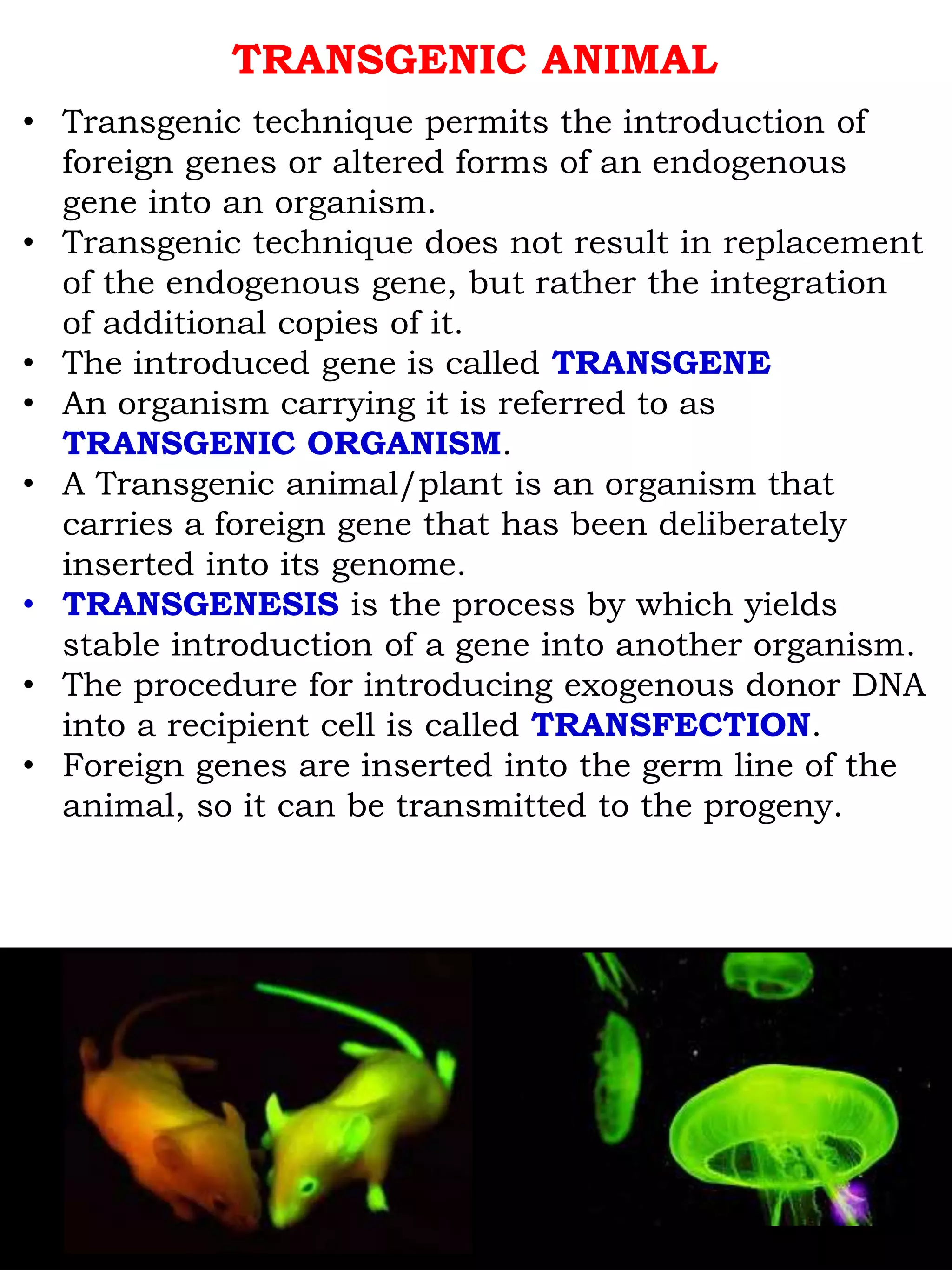
• Transgenic technique permits the introduction of
foreign genes or altered forms of an endogenous
gene into an organism.
• Transgenic technique does not result in replacement
of the endogenous gene, but rather the integration
of additional copies of it.
• The introduced gene is called TRANSGENE
• An organism carrying it is referred to as
TRANSGENIC ORGANISM.
• A Transgenic animal/plant is an organism that
carries a foreign gene that has been deliberately
inserted into its genome.
• TRANSGENESIS is the process by which yields
stable introduction of a gene into another organism.
• The procedure for introducing exogenous donor DNA
into a recipient cell is called TRANSFECTION.
• Foreign genes are inserted into the germ line of the
animal, so it can be transmitted to the progeny.
KNOCKOUT MOUSE
• A knockout mouse is a mouse in which a specific
gene has been inactivated or “knocked out” by
replacing it or disrupting it with an artificial piece of
DNA.
• The loss of gene activity often causes changes in
a mouse's phenotype and thus provides valuable
information on the function of the gene.
• The first knockout mouse was created by Mario R.
Capecchi, Sir Martin J. Evans and Oliver
Smithies in 1989.
PROCEDURE
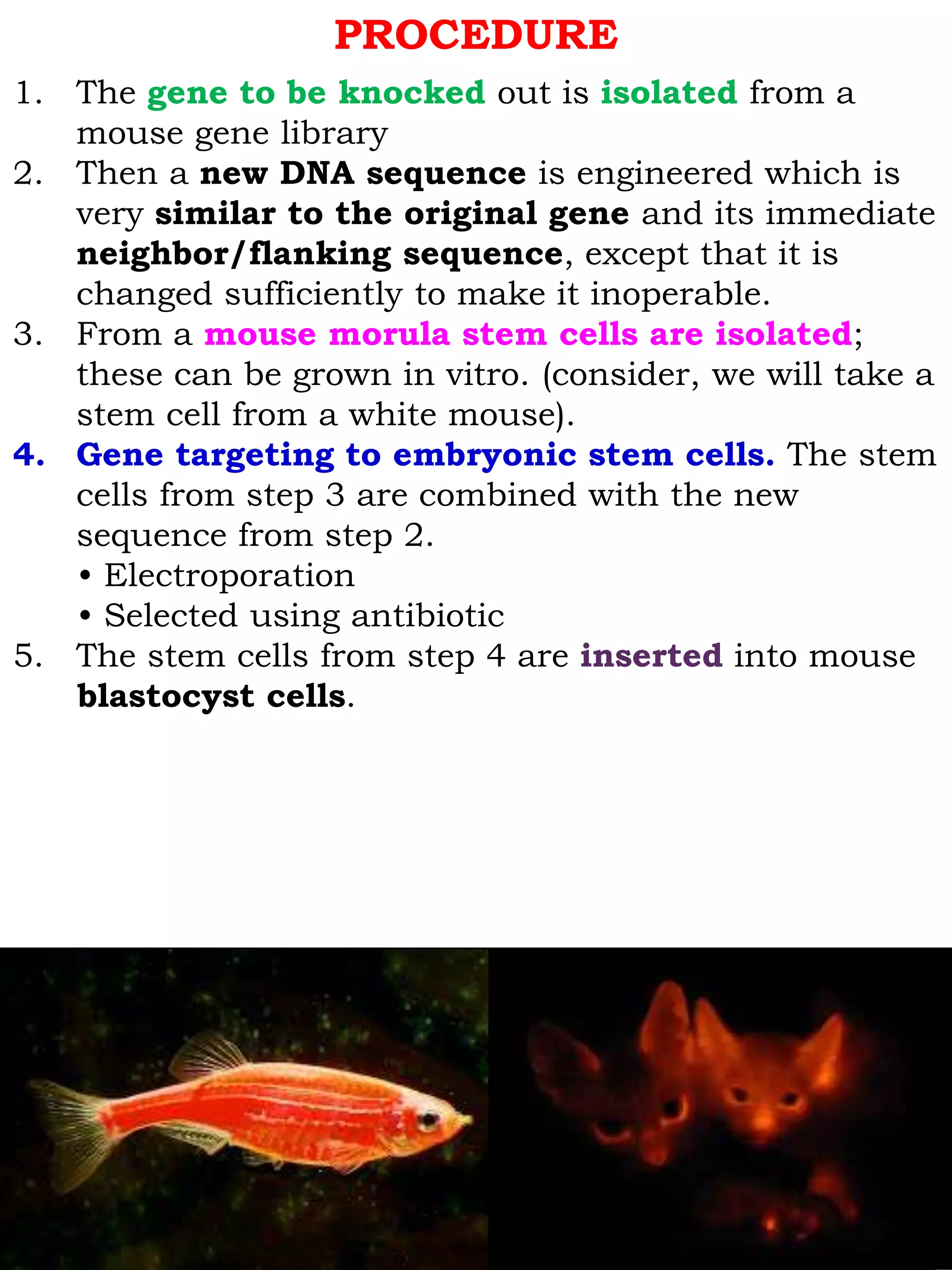
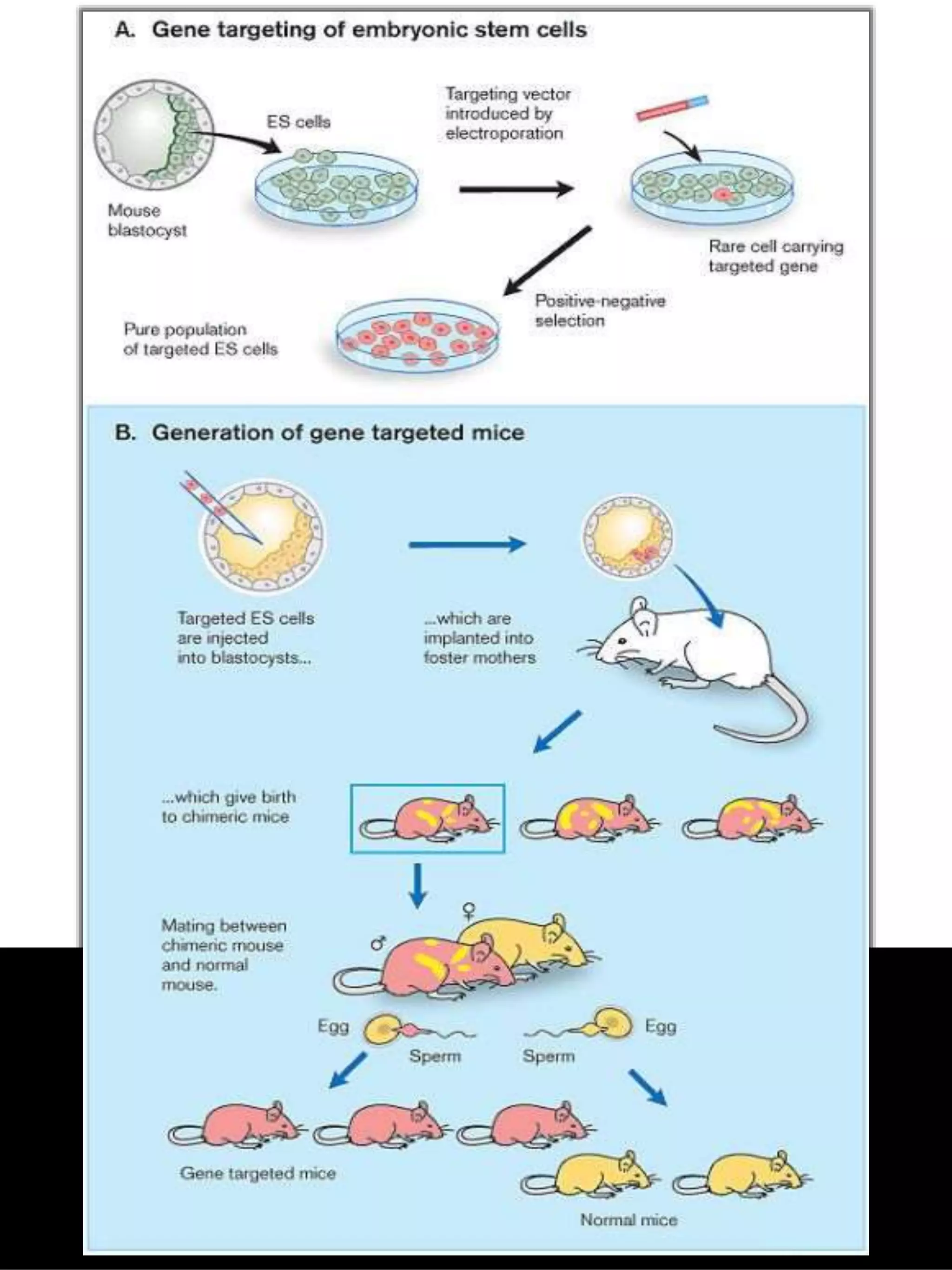
1. The gene to be knocked out is isolated from a
mouse gene library
2. Then a new DNA sequence is engineered which is
very similar to the original gene and its immediate
neighbor/flanking sequence, except that it is
changed sufficiently to make it inoperable.
3. From a mouse morula stem cells are isolated;
these can be grown in vitro. (consider, we will take a
stem cell from a white mouse).
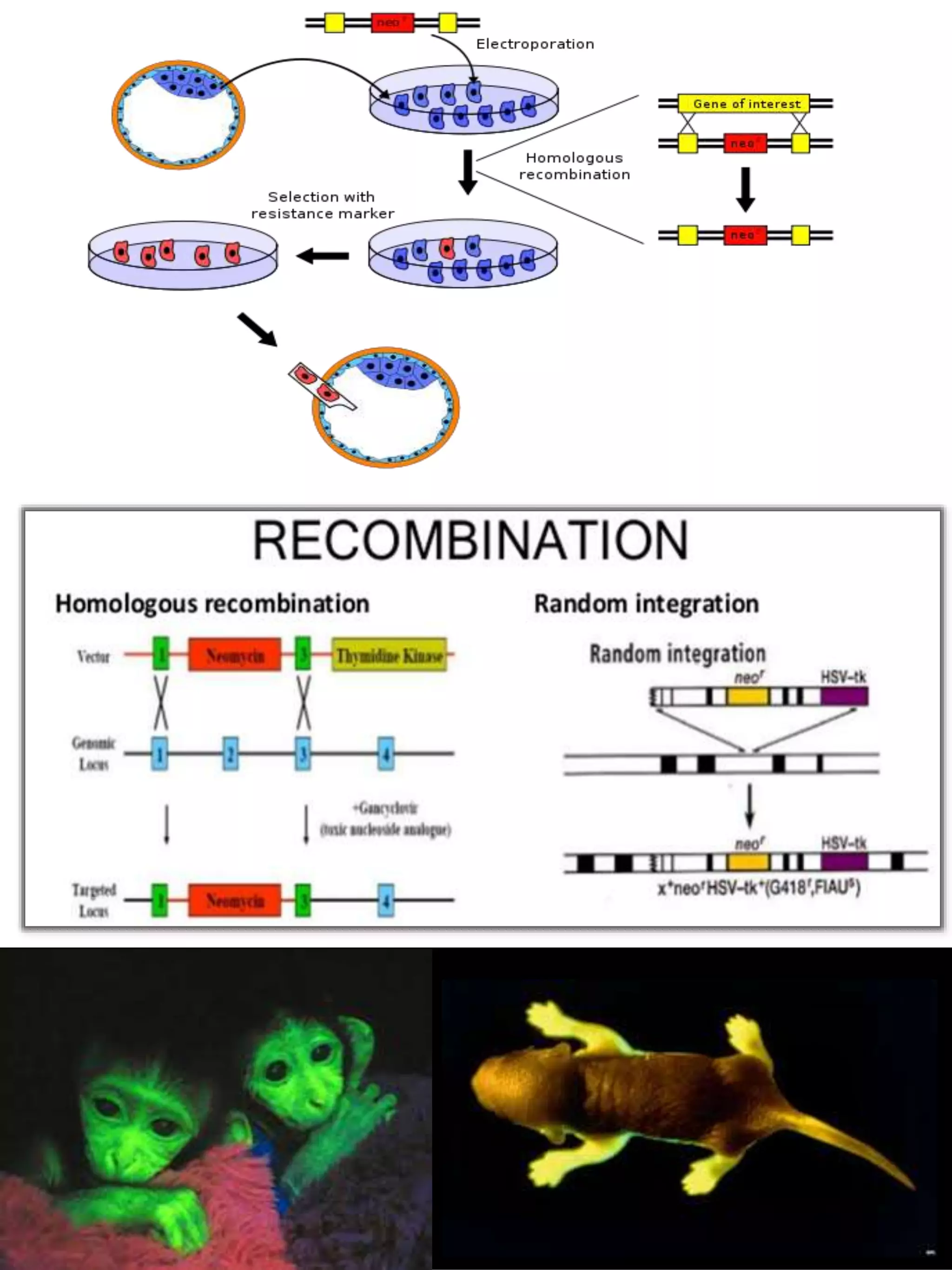
4. Gene targeting to embryonic stem cells. The stem
cells from step 3 are combined with the new
sequence from step 2.
• Electroporation
• Selected using antibiotic
5. The stem cells from step 4 are inserted into mouse
blastocyst cells.
PROCEDURE…
6. Blastocysts are then implanted into the uterus of
female mice, to complete the pregnancy.
7. The blastocysts contain two types of stem cells:
• The original ones
• The newly engineered ones
8. The newborn mice will therefore be chimeras: parts
of their bodies result from the original stem cells,
other parts result from the engineered stem cells.
9. Newborn mice are useful only, if the newly
engineered sequence was incorporated into the
germ cells (egg or sperm cells).
10. Cross these new mice with others and watch for
offspring that are all white. These are then further
inbred to produce mice that carry no functional
copy of the original gene.
MEDICAL IMPORTANCE
Disease model
Bioreactors for
pharmaceuticals
Xenotransplantation
AGRICULTURAL
IMPORTANCE
Disease resistant animals
For improving quality and
quantity of milk, meat, eggs
and wool production.
INDUSTRIAL IMPORTANCE
Toxicity sensitive
transgenic animals to test
chemicals.
Spider silk in milk of goat
THANK YOU

Transgenic Animal (KNOCKOUT MOUSE) production and Application

  • 1.
  • 3.
    TRANSGENIC ANIMAL • Transgenictechnique permits the introduction of foreign genes or altered forms of an endogenous gene into an organism. • Transgenic technique does not result in replacement of the endogenous gene, but rather the integration of additional copies of it. • The introduced gene is called TRANSGENE • An organism carrying it is referred to as TRANSGENIC ORGANISM. • A Transgenic animal/plant is an organism that carries a foreign gene that has been deliberately inserted into its genome. • TRANSGENESIS is the process by which yields stable introduction of a gene into another organism. • The procedure for introducing exogenous donor DNA into a recipient cell is called TRANSFECTION. • Foreign genes are inserted into the germ line of the animal, so it can be transmitted to the progeny.
  • 4.
    KNOCKOUT MOUSE • Aknockout mouse is a mouse in which a specific gene has been inactivated or “knocked out” by replacing it or disrupting it with an artificial piece of DNA. • The loss of gene activity often causes changes in a mouse's phenotype and thus provides valuable information on the function of the gene. • The first knockout mouse was created by Mario R. Capecchi, Sir Martin J. Evans and Oliver Smithies in 1989.
  • 5.
    PROCEDURE 1. The geneto be knocked out is isolated from a mouse gene library 2. Then a new DNA sequence is engineered which is very similar to the original gene and its immediate neighbor/flanking sequence, except that it is changed sufficiently to make it inoperable. 3. From a mouse morula stem cells are isolated; these can be grown in vitro. (consider, we will take a stem cell from a white mouse). 4. Gene targeting to embryonic stem cells. The stem cells from step 3 are combined with the new sequence from step 2. • Electroporation • Selected using antibiotic 5. The stem cells from step 4 are inserted into mouse blastocyst cells.
  • 7.
    PROCEDURE… 6. Blastocysts arethen implanted into the uterus of female mice, to complete the pregnancy. 7. The blastocysts contain two types of stem cells: • The original ones • The newly engineered ones 8. The newborn mice will therefore be chimeras: parts of their bodies result from the original stem cells, other parts result from the engineered stem cells. 9. Newborn mice are useful only, if the newly engineered sequence was incorporated into the germ cells (egg or sperm cells). 10. Cross these new mice with others and watch for offspring that are all white. These are then further inbred to produce mice that carry no functional copy of the original gene.
  • 10.
    MEDICAL IMPORTANCE Disease model Bioreactorsfor pharmaceuticals Xenotransplantation AGRICULTURAL IMPORTANCE Disease resistant animals For improving quality and quantity of milk, meat, eggs and wool production. INDUSTRIAL IMPORTANCE Toxicity sensitive transgenic animals to test chemicals. Spider silk in milk of goat
  • 12.