Developments of Animal Model [Knockout Mice].
Presented by
Anil Behera
Subject – Animal Biotechnology
What is an animal Model ?
• Scientist Weggler in 1983 defined- “an animal model as a living organism with an inherited,
naturally acquired, or induced pathological process that in one or more respects closely
resembles the same phenomenon in men”.
• The Institute of Laboratory Animal Resources(ILAR) of the National Academy of Sciences
adopted and modified weggler’s definition as follows: an animal model is a living organism
in which normative biology or behaviour can be studied, or in which a spontaneous or
induced pathological process can be investigated, and in which the phenomenon in one or
more respects resembles the same phenomenon in humans or other species of animal.
INTRODUCTION:
NEED FOR THE ANIMAL MODELS !
• For ethical reasons, initiation and progression of certain type of diseases cannot be studied in
humans. Animal data can provide with models of biologic trends before proceeding to human
application.
• Inability to examine initiation and progression of different diseases has led to a great interest
in the use of animal models in animal disease research. Animal models help us determination
of disease activity, individuals at risk, and susceptibility of disease progression etc.
• An animal model in which selected microbiological and immunological parameters can be
studied prospectively is desirable.
• It is important to be able to test how a new drug or procedure will affect a whole biological
system before using it on humans. This is critical for scientific as well as ethical reasons.
1. Induced / experimental models.
2. Spontaneous / natural models.
3. Negative / non reactive models.
4. Orphan models.
(Davidson et al 1987)
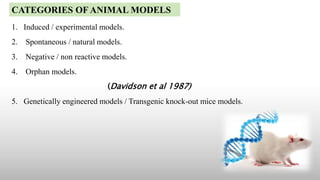
5. Genetically engineered models / Transgenic knock-out mice models.
CATEGORIES OF ANIMAL MODELS
1. Small rodents [ ex-mice, rats, hamsters, minks.]
2. Larger animals [ex- dogs and sheep.]
3. Non-human primates [ex-baboon, macaque, chimpanzee and gorilla.]
4. Others [ex-apes, cats, horses, guinea pigs, mongooses, wolves, foxes, rabbits, ferret etc.]
CLASSIFICATION OF ANIMAL MODELS
CHOICE OF ANIMALS [CRITERIA FOR SPECIES SELECTION]
• Availability of laboratory facilities
• Presence of a breeding colony
• Cost
• Ease of handling
• Ease of housing
• Relatedness to humans
• Limitations imposed by the size of body structures
• Availability of appropriately sized research instrument
• Transferability of information
• Ethical implications.
etc.
APPLICATIONS OF ANIMAL MODELS
• Analysis of disease pathogenesis , route of infection & transmission of disease.
• Characterization of host immune responses to natural infection & vaccination.
• Development of novel strategies for vaccine delivery & formulation.
• Induction of immunity.
• Reduction of clinical symptoms & disease transmission .
• Development of novel vaccination concepts such as in vitro or maternal immunization.
• Animal models are used in antiserum production ,steroid production , mAB production etc.
• Animal models are used in toxicological research , biochemical research , drug discovery ,
virology research ,cardiac surgery , cancer research , leprosy research, otology,
xenodiagnosis field etc. ..etc.…
• Animals are not human , so results must be extrapolated.
• Research animals are expensive to purchase , house, feed and provide with veterinary care.
• Use of animals are governed by ethical opposition.
• Different bone structure and composition than humans and higher metabolic rates than
humans.
• Transgenic rescue of knock-out mice is time consuming ,expensive & labour intensive.
• Diseases that develop in people can differ significantly from the artificial ways that they are
imposed on animal models in a laboratory setting. And some drug shows toxic effects only
within certain genetic backgrounds.
LIMITATIONS OF ANIMAL MODELS
KNOCK-OUT MICE
• What are knockout mice? -A knockout mouse is a mouse in which a specific gene has
been inactivated or “knocked out” by replacing it or disrupting it with an artificial piece of
DNA.
• The loss of gene activity often causes changes in a mouse's phenotype and thus provides
valuable information on the function of the gene.
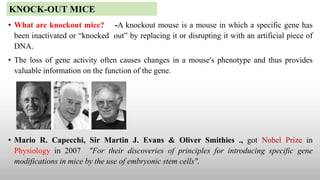
• Mario R. Capecchi, Sir Martin J. Evans & Oliver Smithies ., got Nobel Prize in
Physiology in 2007 "For their discoveries of principles for introducing specific gene
modifications in mice by the use of embryonic stem cells".
PROCEDURE FOR KNOCK-OUT MICE
Procedure –
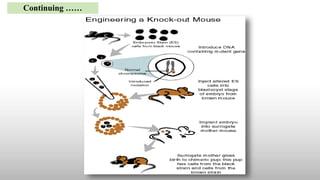
1.The gene to be knocked out is isolated from a mouse gene library.
2. Then a new DNA sequence is engineered which is very similar to the original gene and its
immediate neighbor sequence, except that it is changed sufficiently to make it inoperable.
3. From a mouse morula stem cells are isolated; these can be grown in vitro. For this
example, we will take a stem cell from a white mouse.
4. The stem cells from step 3 are combined with the new sequence from step 2 via
electroporation & selected using antibiotics.
5. The stem cells from step 4 are inserted into mouse blastocyst cells.
6. Blastocysts are then implanted into the uterus of female mice, to complete the pregnancy.
7. The blastocysts contain two types of stem cells: the original ones & the newly engineered
ones
8. The newborn mice will therefore be chimeras: parts of their bodies result from the original
stem cells, other parts result from the engineered stem cells.
9. Newborn mice are only useful if the newly engineered sequence was incorporated into the
germ cells (egg or sperm cells).
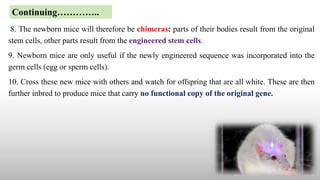
10. Cross these new mice with others and watch for offspring that are all white. These are then
further inbred to produce mice that carry no functional copy of the original gene.
Continuing…………..
Continuing ……
TRANSGENIC VS. KNOCKOUT MICE
.
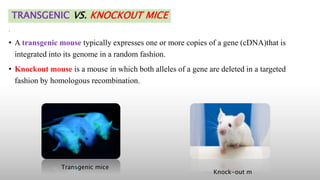
• A transgenic mouse typically expresses one or more copies of a gene (cDNA)that is
integrated into its genome in a random fashion.
• Knockout mouse is a mouse in which both alleles of a gene are deleted in a targeted
fashion by homologous recombination.
Transgenic mice
Knock-out m
1. Provides valuable information about the function(s) of that gene.
2. Genes are common between humans and mice, knockout mice gives researcher information
about the function of that gene in humans.
3. Useful in studying and modeling different kinds of cancer, obesity, heart disease, diabetes,
arthritis, anxiety, aging and Parkinson disease.
4. Knockout mice also offer a biological context in which drugs and other therapies can be
developed and tested.
IMPORTANCE OF KNOCKOUT MICE IN BIOLOGY & MEDICINE
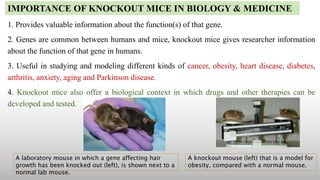
A laboratory mouse in which a gene affecting hair
growth has been knocked out (left), is shown next to a
normal lab mouse.
A knockout mouse (left) that is a model for
obesity, compared with a normal mouse.
• 15 percent of gene knockouts are developmentally lethal, which means that the
genetically altered embryos cannot grow into adult mice.
• Lack of adult mice- more difficult to determine a gene's function in relation to human
health.
• In some instances, the gene may serve a different function in adults than in developing
embryos.
• Knocking out a gene also may fail to produce an observable change in a mouse
• There is variability in the whole procedure depending largely on the strain from which
the stem cells have been derived.
LIMITATIONS
THANK YOU……

Development of animal model (Knockout Mice)

  • 1.
    Developments of AnimalModel [Knockout Mice]. Presented by Anil Behera Subject – Animal Biotechnology
  • 2.
    What is ananimal Model ? • Scientist Weggler in 1983 defined- “an animal model as a living organism with an inherited, naturally acquired, or induced pathological process that in one or more respects closely resembles the same phenomenon in men”. • The Institute of Laboratory Animal Resources(ILAR) of the National Academy of Sciences adopted and modified weggler’s definition as follows: an animal model is a living organism in which normative biology or behaviour can be studied, or in which a spontaneous or induced pathological process can be investigated, and in which the phenomenon in one or more respects resembles the same phenomenon in humans or other species of animal. INTRODUCTION:
  • 3.
    NEED FOR THEANIMAL MODELS ! • For ethical reasons, initiation and progression of certain type of diseases cannot be studied in humans. Animal data can provide with models of biologic trends before proceeding to human application. • Inability to examine initiation and progression of different diseases has led to a great interest in the use of animal models in animal disease research. Animal models help us determination of disease activity, individuals at risk, and susceptibility of disease progression etc. • An animal model in which selected microbiological and immunological parameters can be studied prospectively is desirable. • It is important to be able to test how a new drug or procedure will affect a whole biological system before using it on humans. This is critical for scientific as well as ethical reasons.
  • 4.
    1. Induced /experimental models. 2. Spontaneous / natural models. 3. Negative / non reactive models. 4. Orphan models. (Davidson et al 1987) 5. Genetically engineered models / Transgenic knock-out mice models. CATEGORIES OF ANIMAL MODELS
  • 5.
    1. Small rodents[ ex-mice, rats, hamsters, minks.] 2. Larger animals [ex- dogs and sheep.] 3. Non-human primates [ex-baboon, macaque, chimpanzee and gorilla.] 4. Others [ex-apes, cats, horses, guinea pigs, mongooses, wolves, foxes, rabbits, ferret etc.] CLASSIFICATION OF ANIMAL MODELS
  • 6.
    CHOICE OF ANIMALS[CRITERIA FOR SPECIES SELECTION] • Availability of laboratory facilities • Presence of a breeding colony • Cost • Ease of handling • Ease of housing • Relatedness to humans • Limitations imposed by the size of body structures • Availability of appropriately sized research instrument • Transferability of information • Ethical implications. etc.
  • 7.
    APPLICATIONS OF ANIMALMODELS • Analysis of disease pathogenesis , route of infection & transmission of disease. • Characterization of host immune responses to natural infection & vaccination. • Development of novel strategies for vaccine delivery & formulation. • Induction of immunity. • Reduction of clinical symptoms & disease transmission . • Development of novel vaccination concepts such as in vitro or maternal immunization. • Animal models are used in antiserum production ,steroid production , mAB production etc. • Animal models are used in toxicological research , biochemical research , drug discovery , virology research ,cardiac surgery , cancer research , leprosy research, otology, xenodiagnosis field etc. ..etc.…
  • 8.
    • Animals arenot human , so results must be extrapolated. • Research animals are expensive to purchase , house, feed and provide with veterinary care. • Use of animals are governed by ethical opposition. • Different bone structure and composition than humans and higher metabolic rates than humans. • Transgenic rescue of knock-out mice is time consuming ,expensive & labour intensive. • Diseases that develop in people can differ significantly from the artificial ways that they are imposed on animal models in a laboratory setting. And some drug shows toxic effects only within certain genetic backgrounds. LIMITATIONS OF ANIMAL MODELS
  • 9.
    KNOCK-OUT MICE • Whatare knockout mice? -A knockout mouse is a mouse in which a specific gene has been inactivated or “knocked out” by replacing it or disrupting it with an artificial piece of DNA. • The loss of gene activity often causes changes in a mouse's phenotype and thus provides valuable information on the function of the gene. • Mario R. Capecchi, Sir Martin J. Evans & Oliver Smithies ., got Nobel Prize in Physiology in 2007 "For their discoveries of principles for introducing specific gene modifications in mice by the use of embryonic stem cells".
  • 10.
    PROCEDURE FOR KNOCK-OUTMICE Procedure – 1.The gene to be knocked out is isolated from a mouse gene library. 2. Then a new DNA sequence is engineered which is very similar to the original gene and its immediate neighbor sequence, except that it is changed sufficiently to make it inoperable. 3. From a mouse morula stem cells are isolated; these can be grown in vitro. For this example, we will take a stem cell from a white mouse. 4. The stem cells from step 3 are combined with the new sequence from step 2 via electroporation & selected using antibiotics. 5. The stem cells from step 4 are inserted into mouse blastocyst cells. 6. Blastocysts are then implanted into the uterus of female mice, to complete the pregnancy. 7. The blastocysts contain two types of stem cells: the original ones & the newly engineered ones
  • 11.
    8. The newbornmice will therefore be chimeras: parts of their bodies result from the original stem cells, other parts result from the engineered stem cells. 9. Newborn mice are only useful if the newly engineered sequence was incorporated into the germ cells (egg or sperm cells). 10. Cross these new mice with others and watch for offspring that are all white. These are then further inbred to produce mice that carry no functional copy of the original gene. Continuing…………..
  • 12.
  • 13.
    TRANSGENIC VS. KNOCKOUTMICE . • A transgenic mouse typically expresses one or more copies of a gene (cDNA)that is integrated into its genome in a random fashion. • Knockout mouse is a mouse in which both alleles of a gene are deleted in a targeted fashion by homologous recombination. Transgenic mice Knock-out m
  • 14.
    1. Provides valuableinformation about the function(s) of that gene. 2. Genes are common between humans and mice, knockout mice gives researcher information about the function of that gene in humans. 3. Useful in studying and modeling different kinds of cancer, obesity, heart disease, diabetes, arthritis, anxiety, aging and Parkinson disease. 4. Knockout mice also offer a biological context in which drugs and other therapies can be developed and tested. IMPORTANCE OF KNOCKOUT MICE IN BIOLOGY & MEDICINE A laboratory mouse in which a gene affecting hair growth has been knocked out (left), is shown next to a normal lab mouse. A knockout mouse (left) that is a model for obesity, compared with a normal mouse.
  • 15.
    • 15 percentof gene knockouts are developmentally lethal, which means that the genetically altered embryos cannot grow into adult mice. • Lack of adult mice- more difficult to determine a gene's function in relation to human health. • In some instances, the gene may serve a different function in adults than in developing embryos. • Knocking out a gene also may fail to produce an observable change in a mouse • There is variability in the whole procedure depending largely on the strain from which the stem cells have been derived. LIMITATIONS
  • 16.