Kirchoff’s Rules
Purpose: solve
complex circuits
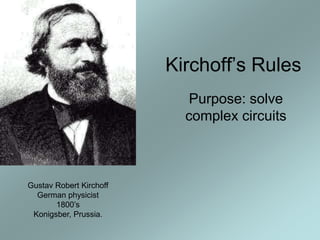
Gustav Robert Kirchoff
German physicist
1800’s
Konigsber, Prussia.
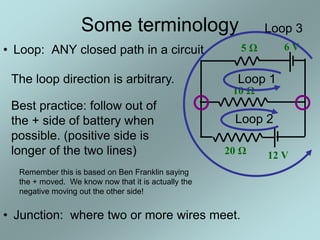
Some terminology
• Loop: ANY closed path in a circuit. 5 Ω 6 V
10 Ω
12 V20 Ω
• Junction: where two or more wires meet.
Best practice: follow out of
the + side of battery when
possible. (positive side is
longer of the two lines)
The loop direction is arbitrary. Loop 1
Loop 2
Loop 3
Remember this is based on Ben Franklin saying
the + moved. We know now that it is actually the
negative moving out the other side!
5 Ω 6 V
10 Ω
12 V20 Ω
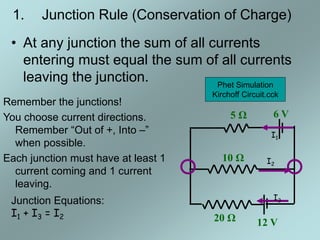
1. Junction Rule (Conservation of Charge)
• At any junction the sum of all currents
entering must equal the sum of all currents
leaving the junction.
Remember the junctions!
You choose current directions.
Remember “Out of +, Into –”
when possible.
Each junction must have at least 1
current coming and 1 current
leaving.
I1
I3
I2
Phet Simulation
Kirchoff Circuit.cck
Junction Equations:
I1 + I3 = I2
5 Ω 6 V
10 Ω
12 V20 Ω
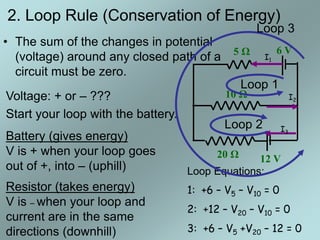
2. Loop Rule (Conservation of Energy)
• The sum of the changes in potential
(voltage) around any closed path of a
circuit must be zero.
Loop 1
Voltage: + or – ???
Start your loop with the battery.
Battery (gives energy)
V is + when your loop goes
out of +, into – (uphill)
Resistor (takes energy)
V is – when your loop and
current are in the same
directions (downhill)
Loop Equations:
1: +6 – V5 – V10 = 0
2: +12 – V20 – V10 = 0
3: +6 – V5 +V20 – 12 = 0
I1
I3
I2
Loop 2
Loop 3
5 Ω 6 V
10 Ω
12 V20 Ω
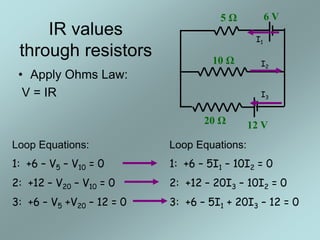
IR values
through resistors
• Apply Ohms Law:
V = IR
Loop Equations:
1: +6 – V5 – V10 = 0
2: +12 – V20 – V10 = 0
3: +6 – V5 +V20 – 12 = 0
Loop Equations:
1: +6 – 5I1 – 10I2 = 0
2: +12 – 20I3 – 10I2 = 0
3: +6 – 5I1 + 20I3 – 12 = 0
I1
I3
I2
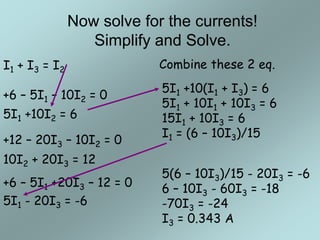
Now solve for the currents!
Simplify and Solve.
I1 + I3 = I2
+6 – 5I1 +20I3 – 12 = 0
+12 – 20I3 – 10I2 = 0
+6 – 5I1 – 10I2 = 0
5I1 - 20I3 = -6
10I2 + 20I3 = 12
5I1 +10I2 = 6
Combine these 2 eq.
5I1 +10(I1 + I3) = 6
5I1 + 10I1 + 10I3 = 6
15I1 + 10I3 = 6
I1 = (6 – 10I3)/15
5(6 – 10I3)/15 - 20I3 = -6
6 – 10I3 - 60I3 = -18
-70I3 = -24
I3 = 0.343 A
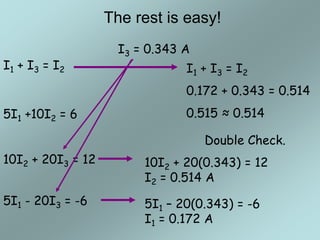
The rest is easy!
I1 + I3 = I2
5I1 - 20I3 = -6
10I2 + 20I3 = 12
5I1 +10I2 = 6
I3 = 0.343 A
5I1 – 20(0.343) = -6
I1 = 0.172 A
10I2 + 20(0.343) = 12
I2 = 0.514 A
Double Check.
I1 + I3 = I2
0.172 + 0.343 = 0.514
0.515 ≈ 0.514

11 kirchoffs laws bh

  • 1.
    Kirchoff’s Rules Purpose: solve complexcircuits Gustav Robert Kirchoff German physicist 1800’s Konigsber, Prussia.
  • 2.
    Some terminology • Loop:ANY closed path in a circuit. 5 Ω 6 V 10 Ω 12 V20 Ω • Junction: where two or more wires meet. Best practice: follow out of the + side of battery when possible. (positive side is longer of the two lines) The loop direction is arbitrary. Loop 1 Loop 2 Loop 3 Remember this is based on Ben Franklin saying the + moved. We know now that it is actually the negative moving out the other side!
  • 3.
    5 Ω 6V 10 Ω 12 V20 Ω 1. Junction Rule (Conservation of Charge) • At any junction the sum of all currents entering must equal the sum of all currents leaving the junction. Remember the junctions! You choose current directions. Remember “Out of +, Into –” when possible. Each junction must have at least 1 current coming and 1 current leaving. I1 I3 I2 Phet Simulation Kirchoff Circuit.cck Junction Equations: I1 + I3 = I2
  • 4.
    5 Ω 6V 10 Ω 12 V20 Ω 2. Loop Rule (Conservation of Energy) • The sum of the changes in potential (voltage) around any closed path of a circuit must be zero. Loop 1 Voltage: + or – ??? Start your loop with the battery. Battery (gives energy) V is + when your loop goes out of +, into – (uphill) Resistor (takes energy) V is – when your loop and current are in the same directions (downhill) Loop Equations: 1: +6 – V5 – V10 = 0 2: +12 – V20 – V10 = 0 3: +6 – V5 +V20 – 12 = 0 I1 I3 I2 Loop 2 Loop 3
  • 5.
    5 Ω 6V 10 Ω 12 V20 Ω IR values through resistors • Apply Ohms Law: V = IR Loop Equations: 1: +6 – V5 – V10 = 0 2: +12 – V20 – V10 = 0 3: +6 – V5 +V20 – 12 = 0 Loop Equations: 1: +6 – 5I1 – 10I2 = 0 2: +12 – 20I3 – 10I2 = 0 3: +6 – 5I1 + 20I3 – 12 = 0 I1 I3 I2
  • 6.
    Now solve forthe currents! Simplify and Solve. I1 + I3 = I2 +6 – 5I1 +20I3 – 12 = 0 +12 – 20I3 – 10I2 = 0 +6 – 5I1 – 10I2 = 0 5I1 - 20I3 = -6 10I2 + 20I3 = 12 5I1 +10I2 = 6 Combine these 2 eq. 5I1 +10(I1 + I3) = 6 5I1 + 10I1 + 10I3 = 6 15I1 + 10I3 = 6 I1 = (6 – 10I3)/15 5(6 – 10I3)/15 - 20I3 = -6 6 – 10I3 - 60I3 = -18 -70I3 = -24 I3 = 0.343 A
  • 7.
    The rest iseasy! I1 + I3 = I2 5I1 - 20I3 = -6 10I2 + 20I3 = 12 5I1 +10I2 = 6 I3 = 0.343 A 5I1 – 20(0.343) = -6 I1 = 0.172 A 10I2 + 20(0.343) = 12 I2 = 0.514 A Double Check. I1 + I3 = I2 0.172 + 0.343 = 0.514 0.515 ≈ 0.514