Capacitors with Dielectrics
Department of Electrical Engineering
Neotech Institute of Technology 1
By:- D’Costa Benedict
Dodiya Hiral P.
Messy Wilson
Shukla Gaurav
Khoiwal Yashwant
Guided by:-Prof. (Dr.) A. R. Chudasama
Mrs. Nidhi Gohil
Dielectric
•A dielectric is a nonconducting material inserted between
the plates of a capacitor.
•A dielectric increases the ability of a capacitor to store
energy.
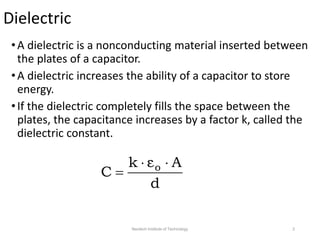
•If the dielectric completely fills the space between the
plates, the capacitance increases by a factor k, called the
dielectric constant.
d
A
ε
k
C o 


Neotech Institute of Technology 2
Dielectric
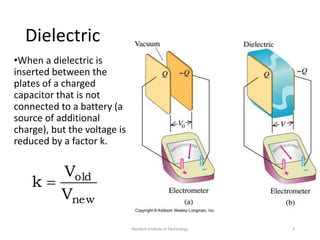
•When a dielectric is
inserted between the
plates of a charged
capacitor that is not
connected to a battery (a
source of additional
charge), but the voltage is
reduced by a factor k.
new
old
V
V
k 
Neotech Institute of Technology 3
Dielectric
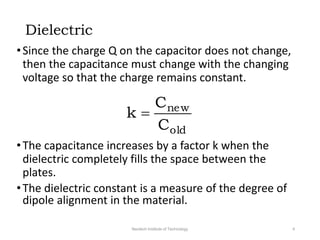
•Since the charge Q on the capacitor does not change,
then the capacitance must change with the changing
voltage so that the charge remains constant.
•The capacitance increases by a factor k when the
dielectric completely fills the space between the
plates.
•The dielectric constant is a measure of the degree of
dipole alignment in the material.
old
new
C
C
k 
Neotech Institute of Technology 4
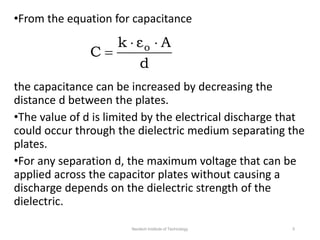
•From the equation for capacitance
the capacitance can be increased by decreasing the
distance d between the plates.
•The value of d is limited by the electrical discharge that
could occur through the dielectric medium separating the
plates.
•For any separation d, the maximum voltage that can be
applied across the capacitor plates without causing a
discharge depends on the dielectric strength of the
dielectric.
d
A
ε
k
C o 


Neotech Institute of Technology 5
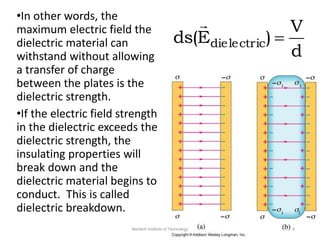
•In other words, the
maximum electric field the
dielectric material can
withstand without allowing
a transfer of charge
between the plates is the
dielectric strength.
•If the electric field strength
in the dielectric exceeds the
dielectric strength, the
insulating properties will
break down and the
dielectric material begins to
conduct. This is called
dielectric breakdown.
d
V
)
E
(
ds dielectric 

Neotech Institute of Technology 6
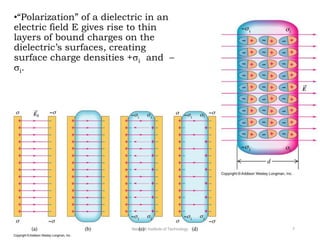
•“Polarization” of a dielectric in an
electric field E gives rise to thin
layers of bound charges on the
dielectric’s surfaces, creating
surface charge densities +si and –
si.
Neotech Institute of Technology 7
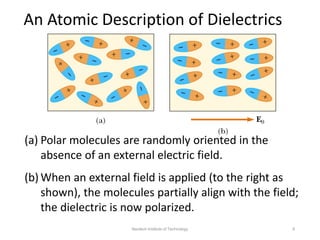
An Atomic Description of Dielectrics
(a) Polar molecules are randomly oriented in the
absence of an external electric field.
(b) When an external field is applied (to the right as
shown), the molecules partially align with the field;
the dielectric is now polarized.
Neotech Institute of Technology 8
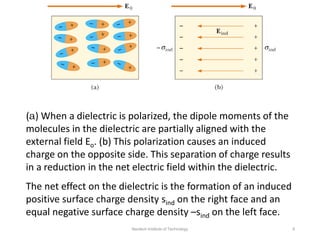
(a) When a dielectric is polarized, the dipole moments of the
molecules in the dielectric are partially aligned with the
external field Eo. (b) This polarization causes an induced
charge on the opposite side. This separation of charge results
in a reduction in the net electric field within the dielectric.
The net effect on the dielectric is the formation of an induced
positive surface charge density sind on the right face and an
equal negative surface charge density –sind on the left face.
Neotech Institute of Technology 9
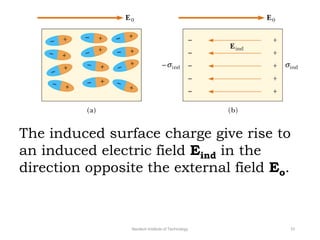
The induced surface charge give rise to
an induced electric field Eind in the
direction opposite the external field Eo.
Neotech Institute of Technology 10
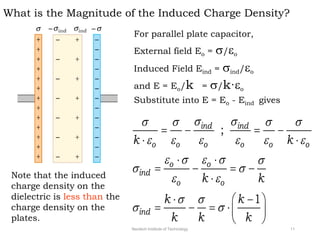
What is the Magnitude of the Induced Charge Density?
Note that the induced
charge density on the
dielectric is less than the
charge density on the
plates.
For parallel plate capacitor,
External field Eo = s/eo
Induced Field Eind = sind/eo
and E = Eo/k = s/k·eo
Substitute into E = Eo - Eind gives
;
1
ind ind
o o o o o o
o o
ind
o o
ind
k k
k k
k k
k k k
s s
s s s s
e e e e e e
e s e s s
s s
e e
s s
s s
   
 
 
   

 
 
    
 
Neotech Institute of Technology 11
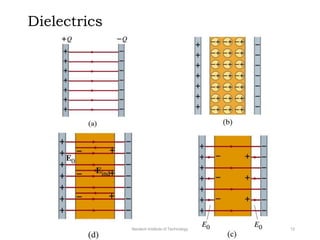
Dielectrics
Neotech Institute of Technology 12
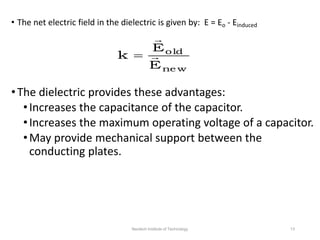
• The net electric field in the dielectric is given by: E = Eo - Einduced
•The dielectric provides these advantages:
•Increases the capacitance of the capacitor.
•Increases the maximum operating voltage of a capacitor.
•May provide mechanical support between the
conducting plates.
ne w
old
E
E
k 


Neotech Institute of Technology 13
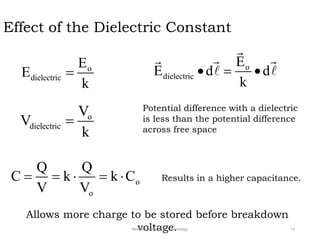
Effect of the Dielectric Constant
o
dielectric
E
E
k
 o
dielectric
E
E d d
k
  
o
dielectric
V
V
k

Potential difference with a dielectric
is less than the potential difference
across free space
o
o
Q Q
C k k C
V V
     Results in a higher capacitance.
Allows more charge to be stored before breakdown
voltage.
Neotech Institute of Technology 14
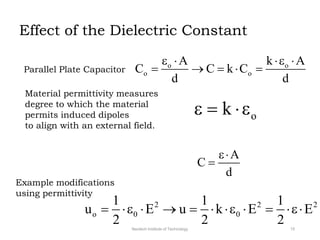
Effect of the Dielectric Constant
Parallel Plate Capacitor
o o
o o
A k A
C C k C
d d
e  e 
    
o
k
e  e
A
C
d
e

Material permittivity measures
degree to which the material
permits induced dipoles
to align with an external field.
2 2 2
o 0 0
1 1 1
u E u k E E
2 2 2
 e     e   e
Example modifications
using permittivity
Neotech Institute of Technology 15
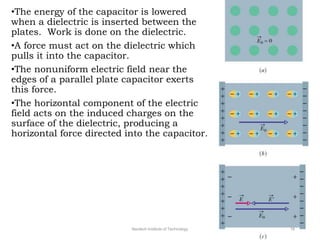
•The energy of the capacitor is lowered
when a dielectric is inserted between the
plates. Work is done on the dielectric.
•A force must act on the dielectric which
pulls it into the capacitor.
•The nonuniform electric field near the
edges of a parallel plate capacitor exerts
this force.
•The horizontal component of the electric
field acts on the induced charges on the
surface of the dielectric, producing a
horizontal force directed into the capacitor.
Neotech Institute of Technology 16
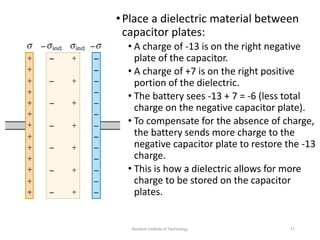
•Place a dielectric material between
capacitor plates:
• A charge of -13 is on the right negative
plate of the capacitor.
• A charge of +7 is on the right positive
portion of the dielectric.
• The battery sees -13 + 7 = -6 (less total
charge on the negative capacitor plate).
• To compensate for the absence of charge,
the battery sends more charge to the
negative capacitor plate to restore the -13
charge.
• This is how a dielectric allows for more
charge to be stored on the capacitor
plates.
Neotech Institute of Technology 17
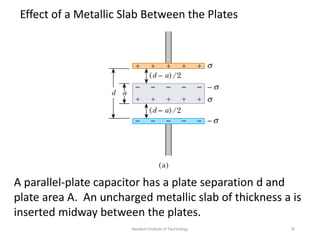
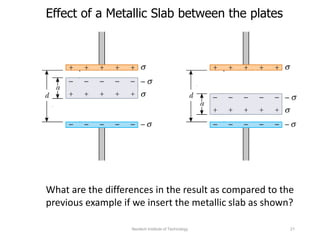
Effect of a Metallic Slab Between the Plates
A parallel-plate capacitor has a plate separation d and
plate area A. An uncharged metallic slab of thickness a is
inserted midway between the plates.
Neotech Institute of Technology 18
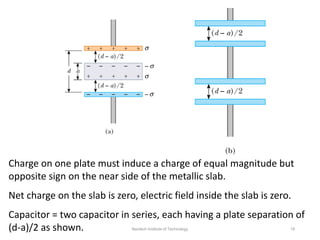
Charge on one plate must induce a charge of equal magnitude but
opposite sign on the near side of the metallic slab.
Net charge on the slab is zero, electric field inside the slab is zero.
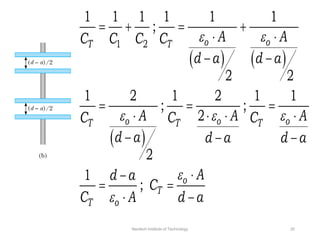
Capacitor = two capacitor in series, each having a plate separation of
(d-a)/2 as shown. Neotech Institute of Technology 19
   
 
1 2
1 1 1 1 1 1
;
2 2
1 2 1 2 1 1
; ;
2
2
1
;
o o
T T
o o o
T T T
o
T
T o
A A
C C C C
d a d a
A A A
C C C
d a d a d a
A
d a
C
C A d a
e e
e e e
e
e
   
 
 
  
   
  


 
 
Neotech Institute of Technology 20
Effect of a Metallic Slab between the plates
What are the differences in the result as compared to the
previous example if we insert the metallic slab as shown?
Neotech Institute of Technology 21
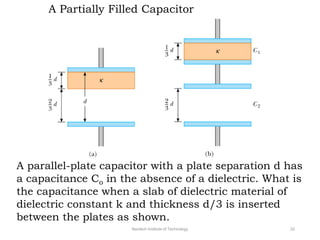
A Partially Filled Capacitor
A parallel-plate capacitor with a plate separation d has
a capacitance Co in the absence of a dielectric. What is
the capacitance when a slab of dielectric material of
dielectric constant k and thickness d/3 is inserted
between the plates as shown.
Neotech Institute of Technology 22
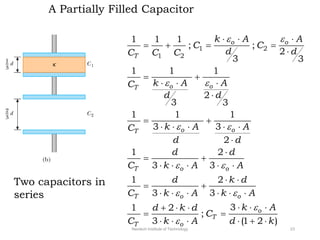
A Partially Filled Capacitor
Two capacitors in
series
1 2
1 2
1 1 1
; ;
2
3 3
1 1 1
2
3 3
1 1 1
3 3
2
1 2
3 3
1 2
3 3
3
1 2
;
3 (1 2 )
o o
T
o o
T
o o
T
T o o
T o o
o
T
T o
k A A
C C
d d
C C C
k A A
C
d d
k A A
C
d d
d d
C k A A
d k d
C k A k A
k A
d k d
C
C k A d k
e e
e e
e e
e e
e e
e
e
  
   

 
  

 
    


 
    
 
 
     
  
  
 
     
Neotech Institute of Technology 23
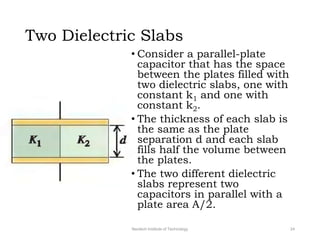
Two Dielectric Slabs
• Consider a parallel-plate
capacitor that has the space
between the plates filled with
two dielectric slabs, one with
constant k1 and one with
constant k2.
• The thickness of each slab is
the same as the plate
separation d and each slab
fills half the volume between
the plates.
• The two different dielectric
slabs represent two
capacitors in parallel with a
plate area A/2.
Neotech Institute of Technology 24
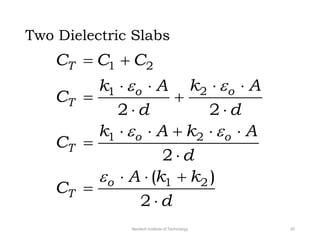
Two Dielectric Slabs
1 2
2
1
1 2
1 2
2 2
2
( )
2
T
o
o
T
o o
T
o
T
C C C
k A
k A
C
d d
k A k A
C
d
A k k
C
d
e
e
e e
e
 
 
 
 
 
    


  


Neotech Institute of Technology 25

Capacitors with Dielectrics final.ppt

  • 1.
    Capacitors with Dielectrics Departmentof Electrical Engineering Neotech Institute of Technology 1 By:- D’Costa Benedict Dodiya Hiral P. Messy Wilson Shukla Gaurav Khoiwal Yashwant Guided by:-Prof. (Dr.) A. R. Chudasama Mrs. Nidhi Gohil
  • 2.
    Dielectric •A dielectric isa nonconducting material inserted between the plates of a capacitor. •A dielectric increases the ability of a capacitor to store energy. •If the dielectric completely fills the space between the plates, the capacitance increases by a factor k, called the dielectric constant. d A ε k C o    Neotech Institute of Technology 2
  • 3.
    Dielectric •When a dielectricis inserted between the plates of a charged capacitor that is not connected to a battery (a source of additional charge), but the voltage is reduced by a factor k. new old V V k  Neotech Institute of Technology 3
  • 4.
    Dielectric •Since the chargeQ on the capacitor does not change, then the capacitance must change with the changing voltage so that the charge remains constant. •The capacitance increases by a factor k when the dielectric completely fills the space between the plates. •The dielectric constant is a measure of the degree of dipole alignment in the material. old new C C k  Neotech Institute of Technology 4
  • 5.
    •From the equationfor capacitance the capacitance can be increased by decreasing the distance d between the plates. •The value of d is limited by the electrical discharge that could occur through the dielectric medium separating the plates. •For any separation d, the maximum voltage that can be applied across the capacitor plates without causing a discharge depends on the dielectric strength of the dielectric. d A ε k C o    Neotech Institute of Technology 5
  • 6.
    •In other words,the maximum electric field the dielectric material can withstand without allowing a transfer of charge between the plates is the dielectric strength. •If the electric field strength in the dielectric exceeds the dielectric strength, the insulating properties will break down and the dielectric material begins to conduct. This is called dielectric breakdown. d V ) E ( ds dielectric   Neotech Institute of Technology 6
  • 7.
    •“Polarization” of adielectric in an electric field E gives rise to thin layers of bound charges on the dielectric’s surfaces, creating surface charge densities +si and – si. Neotech Institute of Technology 7
  • 8.
    An Atomic Descriptionof Dielectrics (a) Polar molecules are randomly oriented in the absence of an external electric field. (b) When an external field is applied (to the right as shown), the molecules partially align with the field; the dielectric is now polarized. Neotech Institute of Technology 8
  • 9.
    (a) When adielectric is polarized, the dipole moments of the molecules in the dielectric are partially aligned with the external field Eo. (b) This polarization causes an induced charge on the opposite side. This separation of charge results in a reduction in the net electric field within the dielectric. The net effect on the dielectric is the formation of an induced positive surface charge density sind on the right face and an equal negative surface charge density –sind on the left face. Neotech Institute of Technology 9
  • 10.
    The induced surfacecharge give rise to an induced electric field Eind in the direction opposite the external field Eo. Neotech Institute of Technology 10
  • 11.
    What is theMagnitude of the Induced Charge Density? Note that the induced charge density on the dielectric is less than the charge density on the plates. For parallel plate capacitor, External field Eo = s/eo Induced Field Eind = sind/eo and E = Eo/k = s/k·eo Substitute into E = Eo - Eind gives ; 1 ind ind o o o o o o o o ind o o ind k k k k k k k k k s s s s s s e e e e e e e s e s s s s e e s s s s                         Neotech Institute of Technology 11
  • 12.
  • 13.
    • The netelectric field in the dielectric is given by: E = Eo - Einduced •The dielectric provides these advantages: •Increases the capacitance of the capacitor. •Increases the maximum operating voltage of a capacitor. •May provide mechanical support between the conducting plates. ne w old E E k    Neotech Institute of Technology 13
  • 14.
    Effect of theDielectric Constant o dielectric E E k  o dielectric E E d d k    o dielectric V V k  Potential difference with a dielectric is less than the potential difference across free space o o Q Q C k k C V V      Results in a higher capacitance. Allows more charge to be stored before breakdown voltage. Neotech Institute of Technology 14
  • 15.
    Effect of theDielectric Constant Parallel Plate Capacitor o o o o A k A C C k C d d e  e       o k e  e A C d e  Material permittivity measures degree to which the material permits induced dipoles to align with an external field. 2 2 2 o 0 0 1 1 1 u E u k E E 2 2 2  e     e   e Example modifications using permittivity Neotech Institute of Technology 15
  • 16.
    •The energy ofthe capacitor is lowered when a dielectric is inserted between the plates. Work is done on the dielectric. •A force must act on the dielectric which pulls it into the capacitor. •The nonuniform electric field near the edges of a parallel plate capacitor exerts this force. •The horizontal component of the electric field acts on the induced charges on the surface of the dielectric, producing a horizontal force directed into the capacitor. Neotech Institute of Technology 16
  • 17.
    •Place a dielectricmaterial between capacitor plates: • A charge of -13 is on the right negative plate of the capacitor. • A charge of +7 is on the right positive portion of the dielectric. • The battery sees -13 + 7 = -6 (less total charge on the negative capacitor plate). • To compensate for the absence of charge, the battery sends more charge to the negative capacitor plate to restore the -13 charge. • This is how a dielectric allows for more charge to be stored on the capacitor plates. Neotech Institute of Technology 17
  • 18.
    Effect of aMetallic Slab Between the Plates A parallel-plate capacitor has a plate separation d and plate area A. An uncharged metallic slab of thickness a is inserted midway between the plates. Neotech Institute of Technology 18
  • 19.
    Charge on oneplate must induce a charge of equal magnitude but opposite sign on the near side of the metallic slab. Net charge on the slab is zero, electric field inside the slab is zero. Capacitor = two capacitor in series, each having a plate separation of (d-a)/2 as shown. Neotech Institute of Technology 19
  • 20.
         1 2 1 1 1 1 1 1 ; 2 2 1 2 1 2 1 1 ; ; 2 2 1 ; o o T T o o o T T T o T T o A A C C C C d a d a A A A C C C d a d a d a A d a C C A d a e e e e e e e                         Neotech Institute of Technology 20
  • 21.
    Effect of aMetallic Slab between the plates What are the differences in the result as compared to the previous example if we insert the metallic slab as shown? Neotech Institute of Technology 21
  • 22.
    A Partially FilledCapacitor A parallel-plate capacitor with a plate separation d has a capacitance Co in the absence of a dielectric. What is the capacitance when a slab of dielectric material of dielectric constant k and thickness d/3 is inserted between the plates as shown. Neotech Institute of Technology 22
  • 23.
    A Partially FilledCapacitor Two capacitors in series 1 2 1 2 1 1 1 ; ; 2 3 3 1 1 1 2 3 3 1 1 1 3 3 2 1 2 3 3 1 2 3 3 3 1 2 ; 3 (1 2 ) o o T o o T o o T T o o T o o o T T o k A A C C d d C C C k A A C d d k A A C d d d d C k A A d k d C k A k A k A d k d C C k A d k e e e e e e e e e e e e                                                       Neotech Institute of Technology 23
  • 24.
    Two Dielectric Slabs •Consider a parallel-plate capacitor that has the space between the plates filled with two dielectric slabs, one with constant k1 and one with constant k2. • The thickness of each slab is the same as the plate separation d and each slab fills half the volume between the plates. • The two different dielectric slabs represent two capacitors in parallel with a plate area A/2. Neotech Institute of Technology 24
  • 25.
    Two Dielectric Slabs 12 2 1 1 2 1 2 2 2 2 ( ) 2 T o o T o o T o T C C C k A k A C d d k A k A C d A k k C d e e e e e                       Neotech Institute of Technology 25