Electricity and Magnetism
 Electric forces hold atoms and
     molecules together.
 Electricity controls our thinking, feeling,
     muscles and metabolic processes.
 Electricity and magnetism underpin
much of our current technology (e.g.
computers).
 Electricity and magnetism are linked
on a fundamental level.
Electric Charges
• Evidence for electric charges is everywhere, e.g.
   – static electricity.
   – lightning.
• Objects may become charged by contact and
  frictional forces.
• Benjamin Franklin (1700’s) discovered that there are
  two types of charges:
   – positive charge.
   – negative charge.
• Franklin also discovered that like charges repel and
  unlike charges attract one another.
• Electric charge is
   – quantized (Millikan)
   – conserved (Franklin)
Electric Charges in Atoms
• Atoms consist of a nucleus
  containing positively
  charged protons.
• The nucleus of an atom is
  surrounded by an equal
  number of negatively
  charged electrons.
• The net charge on an atom
  is zero.
• An atom may gain or lose
  electrons, becoming an ion
  with a net negative or
  positive charge.               Nuclear diameter ~ 10-15 m
                                      (femtometer)
• Polar molecules have zero
  net charge but their charges   Atomic diameter ~ 10-9 m
  are unevenly distributed in
  space (e.g. water).                  (nanometer)
Classes of Materials
• CONDUCTORS are materials in which
  charges may move freely (e.g. copper).

• INSULATORS are materials in which charges
  cannot move freely (e.g. glass).

• SEMICONDUCTORS are materials in which
  charges may move under some conditions
  (e.g. silicon).
Charges and the Earth
• The earth acts as a near-infinite source
  or sink of charges, and therefore its net
  charge cannot easily be changed.

• Any conductor in contact with the earth
  is said to be GROUNDED and cannot
  receive a net charge. (principle of
  lightning rod)
Induced Charge
• Charged objects brought close to a conductor may
  cause charge to redistribute (polarize the conductor).

• If a polarized conductor is momentarily grounded,
  charge will be transferred to/from the earth, and it
  may be left with a net charge (by INDUCTION).

• Objects may be charged by
  – conduction (requires contact with another
    charged object.
  – induction (requires no contact with another
    charged object).
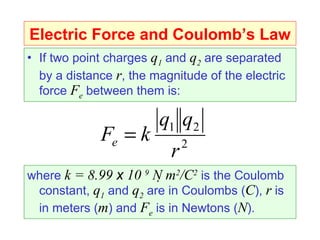
Electric Force and Coulomb’s Law
• If two point charges q1 and q2 are separated
  by a distance r, the magnitude of the electric
  force Fe between them is:

                        q1 q2
             Fe = k           2
                          r
where k = 8.99 x 10 9 N m2/C2 is the Coulomb
 constant, q1 and q2 are in Coulombs (C), r is
 in meters (m) and Fe is in Newtons (N).
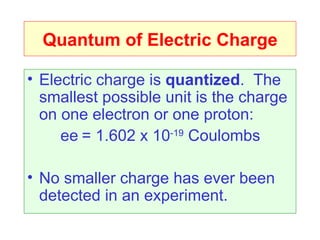
Quantum of Electric Charge

• Electric charge is quantized. The
  smallest possible unit is the charge
  on one electron or one proton:
     ee = 1.602 x 10⁻¹⁹ Coulombs

• No smaller charge has ever been
  detected in an experiment.
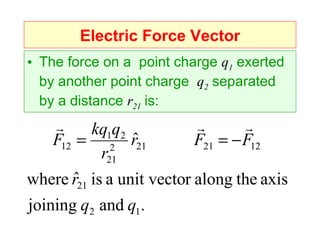
Electric Force Vector
• The force on a point charge q1 exerted
  by another point charge q2 separated
  by a distance r21 is:
         kq1q2                   
   F12 = 2 r21   ˆ         F21 = − F12
            r21
      ˆ
where r21 is a unit vector along the axis
joining q2 and q1.
Principle of Superposition
• For a system of N charges q1, q2, q3, …, qN,
  the resultant force F1 on q1 exerted by
  charges q2, q3, …, qN is:
                     
   F1 = F12 + F13 +  + F1N
• Each charge may be considered to exert a
  force on q1 that is independent of the other
  charges present.
Field Forces and Electric Field
• Field forces act through space even if there is
  no contact (e.g. gravitational force).
• The ELECTRIC FIELD E is defined in terms
  of the electric force that would act on a
  positive test charge q0 :
   
 Fe
E=    in N/C
   q0
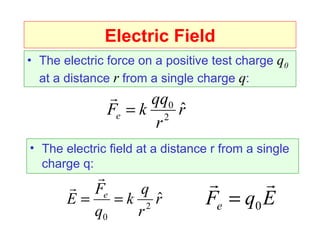
Electric Field
• The electric force on a positive test charge q0
  at a distance r from a single charge q:
                    qq0
               Fe = k 2 rˆ
                      r
• The electric field at a distance r from a single
  charge q:
                                       
        Fe     q
       E=    =k 2 r
                  ˆ              Fe = q0 E
          q0   r
Electric Field due to
  a Group of Charges:

          qi
   E = k ∑ 2 ri
              ˆ
         i ri
ˆ
ri is a unit vector from qi to q0
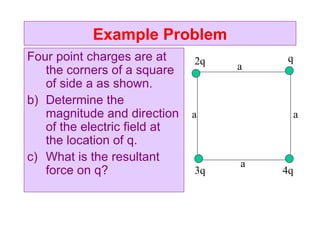
Example Problem
Four point charges are at     2q        q
   the corners of a square         a
   of side a as shown.
b) Determine the
   magnitude and direction    a          a
   of the electric field at
   the location of q.
c) What is the resultant           a
   force on q?                3q       4q
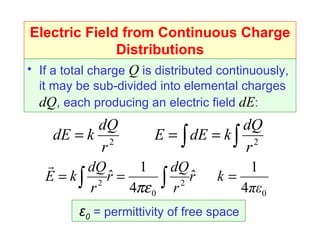
Electric Field from Continuous Charge
                  Distributions
• If a total charge Q is distributed continuously,
  it may be sub-divided into elemental charges
  dQ, each producing an electric field dE:
          dQ                          dQ
    dE = k 2            E = ∫ dE = k ∫ 2
          r                           r
        dQ      1      dQ              1
   E = k∫ 2 r =
            ˆ         ∫ r 2 rˆ      k=
         r      4πε 0                  4πε0
         ε0 = permittivity of free space
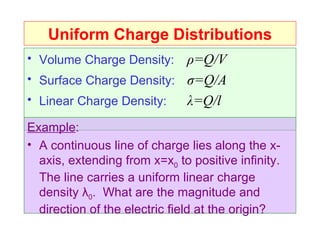
Uniform Charge Distributions
• Volume Charge Density:  ρ=Q/V
• Surface Charge Density: σ=Q/A
• Linear Charge Density:  λ=Q/l
Example:
• A continuous line of charge lies along the x-
  axis, extending from x=x0 to positive infinity.
  The line carries a uniform linear charge
  density λ0. What are the magnitude and
  direction of the electric field at the origin?
Example Problem:
Electric Field due to a Power Line
• A power line is suspended a constant
  distance yo above the ground, and carries a
  uniform linear charge density λo. Assume that
  the wire is infinitely long and that the ground
  is a flat plane. What are the magnitude and
  direction of the electric field on the ground
  immediately below the power line?
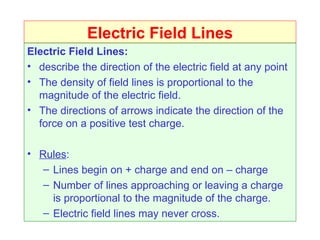
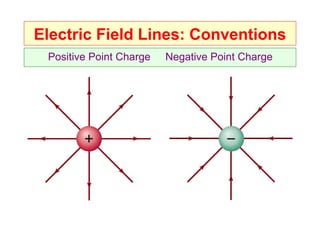
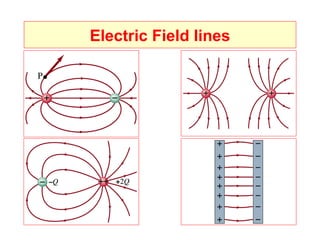
Electric Field Lines
Electric Field Lines:
• describe the direction of the electric field at any point
• The density of field lines is proportional to the
  magnitude of the electric field.
• The directions of arrows indicate the direction of the
  force on a positive test charge.

• Rules:
   – Lines begin on + charge and end on – charge
   – Number of lines approaching or leaving a charge
     is proportional to the magnitude of the charge.
   – Electric field lines may never cross.
Electric Field Lines: Conventions
 Positive Point Charge   Negative Point Charge
Electric Field lines

Elec mag2

  • 1.
    Electricity and Magnetism Electric forces hold atoms and molecules together.  Electricity controls our thinking, feeling, muscles and metabolic processes.  Electricity and magnetism underpin much of our current technology (e.g. computers).  Electricity and magnetism are linked on a fundamental level.
  • 2.
    Electric Charges • Evidencefor electric charges is everywhere, e.g. – static electricity. – lightning. • Objects may become charged by contact and frictional forces. • Benjamin Franklin (1700’s) discovered that there are two types of charges: – positive charge. – negative charge. • Franklin also discovered that like charges repel and unlike charges attract one another. • Electric charge is – quantized (Millikan) – conserved (Franklin)
  • 3.
    Electric Charges inAtoms • Atoms consist of a nucleus containing positively charged protons. • The nucleus of an atom is surrounded by an equal number of negatively charged electrons. • The net charge on an atom is zero. • An atom may gain or lose electrons, becoming an ion with a net negative or positive charge. Nuclear diameter ~ 10-15 m (femtometer) • Polar molecules have zero net charge but their charges Atomic diameter ~ 10-9 m are unevenly distributed in space (e.g. water). (nanometer)
  • 4.
    Classes of Materials •CONDUCTORS are materials in which charges may move freely (e.g. copper). • INSULATORS are materials in which charges cannot move freely (e.g. glass). • SEMICONDUCTORS are materials in which charges may move under some conditions (e.g. silicon).
  • 5.
    Charges and theEarth • The earth acts as a near-infinite source or sink of charges, and therefore its net charge cannot easily be changed. • Any conductor in contact with the earth is said to be GROUNDED and cannot receive a net charge. (principle of lightning rod)
  • 6.
    Induced Charge • Chargedobjects brought close to a conductor may cause charge to redistribute (polarize the conductor). • If a polarized conductor is momentarily grounded, charge will be transferred to/from the earth, and it may be left with a net charge (by INDUCTION). • Objects may be charged by – conduction (requires contact with another charged object. – induction (requires no contact with another charged object).
  • 7.
    Electric Force andCoulomb’s Law • If two point charges q1 and q2 are separated by a distance r, the magnitude of the electric force Fe between them is: q1 q2 Fe = k 2 r where k = 8.99 x 10 9 N m2/C2 is the Coulomb constant, q1 and q2 are in Coulombs (C), r is in meters (m) and Fe is in Newtons (N).
  • 8.
    Quantum of ElectricCharge • Electric charge is quantized. The smallest possible unit is the charge on one electron or one proton: ee = 1.602 x 10⁻¹⁹ Coulombs • No smaller charge has ever been detected in an experiment.
  • 9.
    Electric Force Vector •The force on a point charge q1 exerted by another point charge q2 separated by a distance r21 is:  kq1q2   F12 = 2 r21 ˆ F21 = − F12 r21 ˆ where r21 is a unit vector along the axis joining q2 and q1.
  • 10.
    Principle of Superposition •For a system of N charges q1, q2, q3, …, qN, the resultant force F1 on q1 exerted by charges q2, q3, …, qN is:     F1 = F12 + F13 +  + F1N • Each charge may be considered to exert a force on q1 that is independent of the other charges present.
  • 11.
    Field Forces andElectric Field • Field forces act through space even if there is no contact (e.g. gravitational force). • The ELECTRIC FIELD E is defined in terms of the electric force that would act on a positive test charge q0 :   Fe E= in N/C q0
  • 12.
    Electric Field • Theelectric force on a positive test charge q0 at a distance r from a single charge q:  qq0 Fe = k 2 rˆ r • The electric field at a distance r from a single charge q:     Fe q E= =k 2 r ˆ Fe = q0 E q0 r
  • 13.
    Electric Field dueto a Group of Charges:  qi E = k ∑ 2 ri ˆ i ri ˆ ri is a unit vector from qi to q0
  • 14.
    Example Problem Four pointcharges are at 2q q the corners of a square a of side a as shown. b) Determine the magnitude and direction a a of the electric field at the location of q. c) What is the resultant a force on q? 3q 4q
  • 15.
    Electric Field fromContinuous Charge Distributions • If a total charge Q is distributed continuously, it may be sub-divided into elemental charges dQ, each producing an electric field dE: dQ dQ dE = k 2 E = ∫ dE = k ∫ 2 r r  dQ 1 dQ 1 E = k∫ 2 r = ˆ ∫ r 2 rˆ k= r 4πε 0 4πε0 ε0 = permittivity of free space
  • 16.
    Uniform Charge Distributions •Volume Charge Density: ρ=Q/V • Surface Charge Density: σ=Q/A • Linear Charge Density: λ=Q/l Example: • A continuous line of charge lies along the x- axis, extending from x=x0 to positive infinity. The line carries a uniform linear charge density λ0. What are the magnitude and direction of the electric field at the origin?
  • 17.
    Example Problem: Electric Fielddue to a Power Line • A power line is suspended a constant distance yo above the ground, and carries a uniform linear charge density λo. Assume that the wire is infinitely long and that the ground is a flat plane. What are the magnitude and direction of the electric field on the ground immediately below the power line?
  • 18.
    Electric Field Lines ElectricField Lines: • describe the direction of the electric field at any point • The density of field lines is proportional to the magnitude of the electric field. • The directions of arrows indicate the direction of the force on a positive test charge. • Rules: – Lines begin on + charge and end on – charge – Number of lines approaching or leaving a charge is proportional to the magnitude of the charge. – Electric field lines may never cross.
  • 19.
    Electric Field Lines:Conventions Positive Point Charge Negative Point Charge
  • 20.