Gravitational            Electric
                                                 E
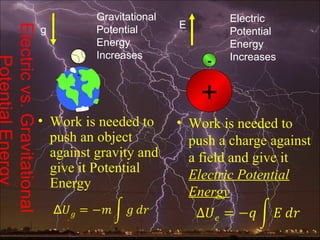
Electric vs. Gravitational
                             g   Potential                Potential
                                 Energy                   Energy
                                 Increases                Increases
                                                      -


                                                     +
                       • Work is needed to       • Work is needed to
                         push an object            push a charge against
                         against gravity and       a field and give it
                         give it Potential         Electric Potential
                         Energy
                                                   Energy
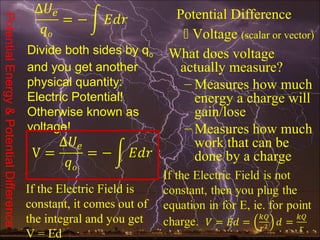
Potential Difference
Potential Energy & Potential Difference

                                                                         Voltage (scalar or vector)
                                          Divide both sides by qo     What does voltage
                                          and you get another          actually measure?
                                          physical quantity:            – Measures how much
                                          Electric Potential!             energy a charge will
                                          Otherwise known as              gain/lose
                                          voltage!                      – Measures how much
                                                                          work that can be
                                                                          done by a charge

                                          If the Electric Field is
                                          constant, it comes out of
                                          the integral and you get
                                          V = Ed
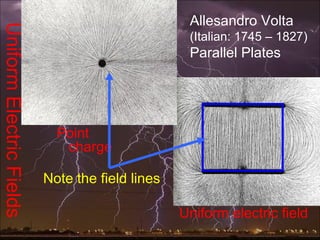
Allesandro Volta
Uniform Electric Fields
                                                  (Italian: 1745 – 1827)
                                                  Parallel Plates


                            Point
                             charge

                          Note the field lines

                                                 Uniform electric field
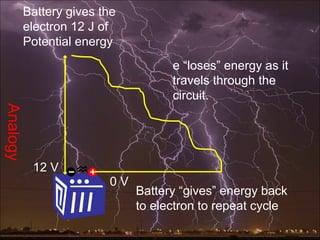
Battery gives the
      electron 12 J of
      Potential energy
                                e “loses” energy as it
                                travels through the
                                circuit.
Analogy


          12 V
                     0V
                          Battery “gives” energy back
                          to electron to repeat cycle
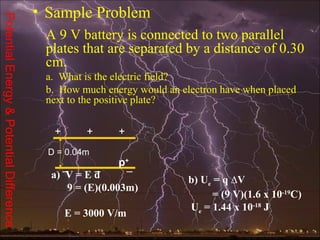
• Sample Problem
Potential Energy & Potential Difference

                                           A 9 V battery is connected to two parallel
                                           plates that are separated by a distance of 0.30
                                           cm.
                                           a. What is the electric field?
                                           b. How much energy would an electron have when placed
                                           next to the positive plate?

                                             +       +       +
                                            D = 0.04m
                                                 –       –   p+  –
                                            a) V = E d                   b) Ue = q ∆V
                                               9 = (E)(0.003m)
                                                                               = (9 V)(1.6 x 10⁻¹⁹C)
                                                                         Ue = 1.44 x 10⁻¹⁸ J
                                                 E = 3000 V/m
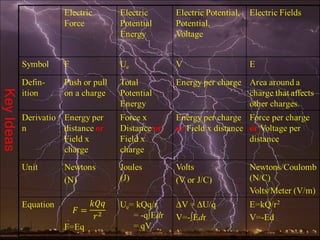
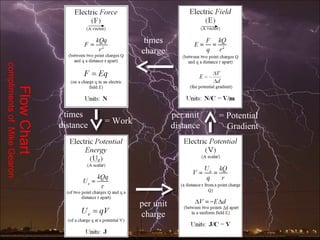
Key Ideas
times
                                                       charge
compliments of Mike Gearon
                      Flow Chart


                                    times                         per unit   = Potential
                                   distance   = Work
                                                                  distance     Gradient


                                                       per unit
                                                       charge
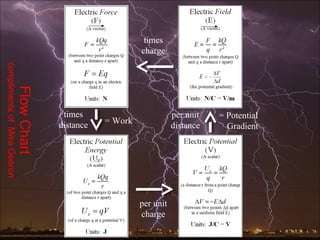
times
                                                       charge
compliments of Mike Gearon
                      Flow Chart


                                    times                         per unit   = Potential
                                   distance   = Work
                                                                  distance     Gradient


                                                       per unit
                                                       charge

1 electric energy & potential AP

  • 2.
    Gravitational Electric E Electric vs. Gravitational g Potential Potential Energy Energy Increases Increases - + • Work is needed to • Work is needed to push an object push a charge against against gravity and a field and give it give it Potential Electric Potential Energy Energy
  • 3.
    Potential Difference Potential Energy& Potential Difference  Voltage (scalar or vector) Divide both sides by qo What does voltage and you get another actually measure? physical quantity: – Measures how much Electric Potential! energy a charge will Otherwise known as gain/lose voltage! – Measures how much work that can be done by a charge If the Electric Field is constant, it comes out of the integral and you get V = Ed
  • 4.
    Allesandro Volta Uniform ElectricFields (Italian: 1745 – 1827) Parallel Plates Point charge Note the field lines Uniform electric field
  • 5.
    Battery gives the electron 12 J of Potential energy e “loses” energy as it travels through the circuit. Analogy 12 V 0V Battery “gives” energy back to electron to repeat cycle
  • 7.
    • Sample Problem PotentialEnergy & Potential Difference A 9 V battery is connected to two parallel plates that are separated by a distance of 0.30 cm. a. What is the electric field? b. How much energy would an electron have when placed next to the positive plate? + + + D = 0.04m – – p+ – a) V = E d b) Ue = q ∆V 9 = (E)(0.003m) = (9 V)(1.6 x 10⁻¹⁹C) Ue = 1.44 x 10⁻¹⁸ J E = 3000 V/m
  • 8.
  • 9.
    times charge compliments of Mike Gearon Flow Chart times per unit = Potential distance = Work distance Gradient per unit charge
  • 10.
    times charge compliments of Mike Gearon Flow Chart times per unit = Potential distance = Work distance Gradient per unit charge