Work & Energy
In the past…
v, a, x, t  How things move, Kinematics
F, a, m  What makes them move, Dynamics
Now we will look at WHY they move!!! Energy!
Energy  The ability to do work.
Work =

Force x Displacement

1 Joule = 1 Newton x 1 Meter
1.
2.
3.

Object must move.
Force & Displacement must be on the
same plane
Don’t forget air friction is negligible.
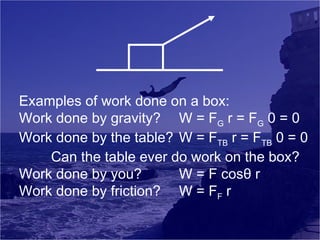
Examples of work done on a box:
Work done by gravity? W = FG r = FG 0 = 0
Work done by the table? W = FTB r = FTB 0 = 0
Can the table ever do work on the box?
Work done by you?
W = F cosθ r
Work done by friction? W = FF r
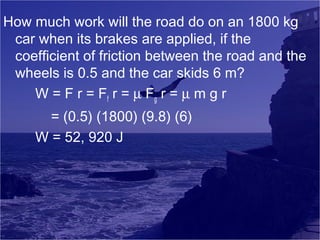
How much work will the road do on an 1800 kg
car when its brakes are applied, if the
coefficient of friction between the road and the
wheels is 0.5 and the car skids 6 m?
W = F r = F f r = µ Fg r = µ m g r
= (0.5) (1800) (9.8) (6)
W = 52, 920 J
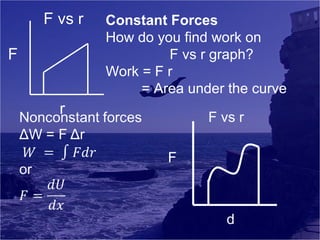
F vs r
F

Constant Forces
How do you find work on
F vs r graph?
Work = F r
= Area under the curve

r

F vs r
F

d
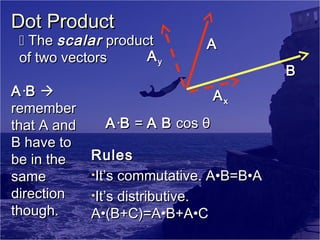
Dot Product

 The scalar product
Ay
of two vectors

A B 
remember
that A and
B have to
be in the
same
direction
though.

A
B
Ax

A B = A B cos θ
Rules
•It’s commutative. A•B=B•A
•It’s distributive.
A•(B+C)=A•B+A•C
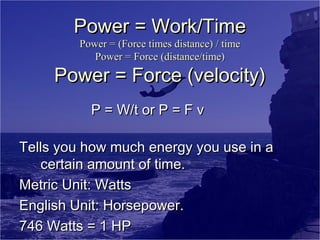
Power = Work/Time
Power = (Force times distance) / time
Power = Force (distance/time)

Power = Force (velocity)
P = W/t or P = F v
Tells you how much energy you use in a
certain amount of time.
Metric Unit: Watts
English Unit: Horsepower.
746 Watts = 1 HP
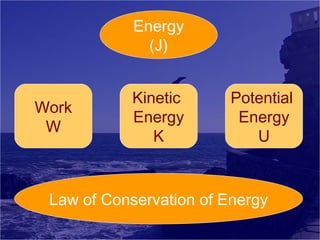
Energy
(J)

Work
W

Kinetic
Energy
K

Potential
Energy
U

Law of Conservation of Energy
Energy
ability to do work
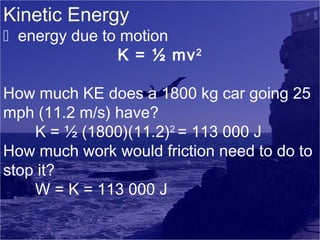
Kinetic Energy

 energy due to motion
K = ½ mv 2
How much KE does a 1800 kg car going 25
mph (11.2 m/s) have?
K = ½ (1800)(11.2)2 = 113 000 J
How much work would friction need to do to
stop it?
W = K = 113 000 J
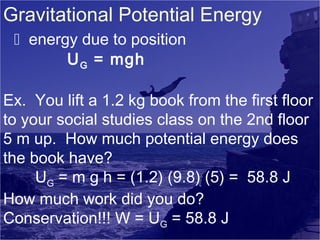
Gravitational Potential Energy
 energy due to position
U G = mgh
Ex. You lift a 1.2 kg book from the first floor
to your social studies class on the 2nd floor
5 m up. How much potential energy does
the book have?
UG = m g h = (1.2) (9.8) (5) = 58.8 J
How much work did you do?
Conservation!!! W = UG = 58.8 J
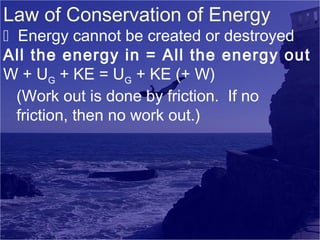
Law of Conservation of Energy

 Energy cannot be created or destroyed
All the energy in = All the energy out
W + UG + KE = UG + KE (+ W)
(Work out is done by friction. If no
friction, then no work out.)
A 600 kg roller coaster car is lifted to the top of the first
hill, 55 m above the ground.
a. How much potential energy does it have?
UG = m g h
b. How much work was done to get the cart to the top
of the first hill?
W = UG
c. How fast is it going at the bottom of the first hill?
UG = K = ½ mv2
d. If the second hill is 40 m high, then how fast will the
cart be going when it crests the hill?
UG = UG + K
In the first car example, was there any
potential energy?
No W + 0 + K1 = 0 + K2 (+0)
W = K 2 – K1
W = ΔK
In the second example, was there any
kinetic energy at the beginning or the
end?
No W + UG1 + 0 = UG2 + 0 (+0)
W = UG2 – UG1
W = ΔUG
Work Energy Theorem
W = ΔK

W = Δ UG

In order to change any type of energy,
work must be done.
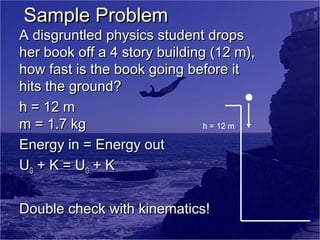
Sample Problem

A disgruntled physics student drops
her book off a 4 story building (12 m),
how fast is the book going before it
hits the ground?
h = 12 m
m = 1.7 kg
h = 12 m
Energy in = Energy out
UG + K = UG + K
Double check with kinematics!
A school bus pulls into an intersection. A car
traveling 35 km/h approaches and hits a patch
of ice. The driver locks the brakes causing the
car to slide toward the intersection. If the car
is originally 26 m away and the coefficient of
friction between the car’s tires and the icy road
is 0.25, does the car hit the bus and poor
innocent school children lose their lives … or
does the car stop just in the nick of time letting
the little children grow up to do physics
problems involving school buses and icy
roads?
Which of the following is an expression
for mechanical power?
a. Ft/m
b. F2m/a
c. Fm2/t
d. Fm/t
e. F2t/m
A pendulum consisting of a mass m attached to a
light string of length l is displaced from its rest
position, making an angle θ with the vertical. It is
then released and allowed to swing freely. Which
of the following expressions represents the
velocity of the mass when it reaches its lowest
position?
a. √(2gl(1-cos θ))

d. √(2gl (1-sin θ))

b. √(2gl tan θ)

e. √(2gl(cos θ-1))

c. √(2gl cos θ)
A mass m is moving horizontally along a nearly
frictionless floor with velocity v. the mass now
encounters a part of the floor that has a
coefficient of friction given by µ. The total
distance traveled by the mass before it is slowed
by friction to a stop is given by
a. 2v2/µg
b. v2/2µg
c. 2µgv2
d. µv2/2g
e. µvg
A 0.75 kg sphere is dropped through a tall
column of liquid. When the sphere has fallen
a distance of 2.0 m, it is observed to have a
velocity of 2.5 m/s.
a. How much work was done by the frictional
“viscosity” of the liquid?
b. What is the average force of friction during
the placement of 2.0 m?
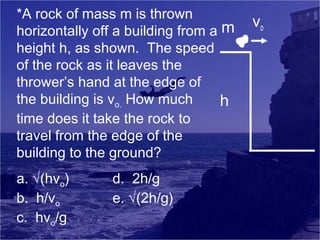
*A rock of mass m is thrown
horizontally off a building from a m
height h, as shown. The speed
of the rock as it leaves the
thrower’s hand at the edge of
the building is vo. How much
h
time does it take the rock to
travel from the edge of the
building to the ground?
a. √(hvo)
b. h/vo
c. hvo/g

d. 2h/g
e. √(2h/g)

vo
*What is the kinetic energy of the rock
just before it hits the ground?
a. mgh
b. ½ mvo2
c. ½ mvo2 – mgh
d. ½ mvo2 + mgh
e. mgh – ½ mvo2
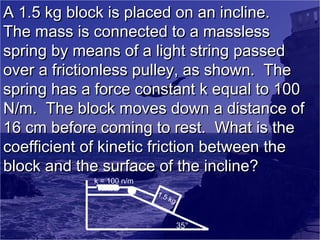
A 1.5 kg block is placed on an incline.
The mass is connected to a massless
spring by means of a light string passed
over a frictionless pulley, as shown. The
spring has a force constant k equal to 100
N/m. The block moves down a distance of
16 cm before coming to rest. What is the
coefficient of kinetic friction between the
block and the surface of the incline?
k = 100 n/m

1.5
kg

35°

1 work & energy notes

  • 1.
    Work & Energy Inthe past… v, a, x, t  How things move, Kinematics F, a, m  What makes them move, Dynamics Now we will look at WHY they move!!! Energy! Energy  The ability to do work.
  • 2.
    Work = Force xDisplacement 1 Joule = 1 Newton x 1 Meter 1. 2. 3. Object must move. Force & Displacement must be on the same plane Don’t forget air friction is negligible.
  • 3.
    Examples of workdone on a box: Work done by gravity? W = FG r = FG 0 = 0 Work done by the table? W = FTB r = FTB 0 = 0 Can the table ever do work on the box? Work done by you? W = F cosθ r Work done by friction? W = FF r
  • 4.
    How much workwill the road do on an 1800 kg car when its brakes are applied, if the coefficient of friction between the road and the wheels is 0.5 and the car skids 6 m? W = F r = F f r = µ Fg r = µ m g r = (0.5) (1800) (9.8) (6) W = 52, 920 J
  • 5.
    F vs r F ConstantForces How do you find work on F vs r graph? Work = F r = Area under the curve r F vs r F d
  • 6.
    Dot Product  Thescalar product Ay of two vectors A B  remember that A and B have to be in the same direction though. A B Ax A B = A B cos θ Rules •It’s commutative. A•B=B•A •It’s distributive. A•(B+C)=A•B+A•C
  • 7.
    Power = Work/Time Power= (Force times distance) / time Power = Force (distance/time) Power = Force (velocity) P = W/t or P = F v Tells you how much energy you use in a certain amount of time. Metric Unit: Watts English Unit: Horsepower. 746 Watts = 1 HP
  • 8.
  • 9.
  • 10.
    Kinetic Energy  energydue to motion K = ½ mv 2 How much KE does a 1800 kg car going 25 mph (11.2 m/s) have? K = ½ (1800)(11.2)2 = 113 000 J How much work would friction need to do to stop it? W = K = 113 000 J
  • 11.
    Gravitational Potential Energy energy due to position U G = mgh Ex. You lift a 1.2 kg book from the first floor to your social studies class on the 2nd floor 5 m up. How much potential energy does the book have? UG = m g h = (1.2) (9.8) (5) = 58.8 J How much work did you do? Conservation!!! W = UG = 58.8 J
  • 12.
    Law of Conservationof Energy  Energy cannot be created or destroyed All the energy in = All the energy out W + UG + KE = UG + KE (+ W) (Work out is done by friction. If no friction, then no work out.)
  • 13.
    A 600 kgroller coaster car is lifted to the top of the first hill, 55 m above the ground. a. How much potential energy does it have? UG = m g h b. How much work was done to get the cart to the top of the first hill? W = UG c. How fast is it going at the bottom of the first hill? UG = K = ½ mv2 d. If the second hill is 40 m high, then how fast will the cart be going when it crests the hill? UG = UG + K
  • 14.
    In the firstcar example, was there any potential energy? No W + 0 + K1 = 0 + K2 (+0) W = K 2 – K1 W = ΔK In the second example, was there any kinetic energy at the beginning or the end? No W + UG1 + 0 = UG2 + 0 (+0) W = UG2 – UG1 W = ΔUG
  • 15.
    Work Energy Theorem W= ΔK W = Δ UG In order to change any type of energy, work must be done.
  • 16.
    Sample Problem A disgruntledphysics student drops her book off a 4 story building (12 m), how fast is the book going before it hits the ground? h = 12 m m = 1.7 kg h = 12 m Energy in = Energy out UG + K = UG + K Double check with kinematics!
  • 18.
    A school buspulls into an intersection. A car traveling 35 km/h approaches and hits a patch of ice. The driver locks the brakes causing the car to slide toward the intersection. If the car is originally 26 m away and the coefficient of friction between the car’s tires and the icy road is 0.25, does the car hit the bus and poor innocent school children lose their lives … or does the car stop just in the nick of time letting the little children grow up to do physics problems involving school buses and icy roads?
  • 19.
    Which of thefollowing is an expression for mechanical power? a. Ft/m b. F2m/a c. Fm2/t d. Fm/t e. F2t/m
  • 20.
    A pendulum consistingof a mass m attached to a light string of length l is displaced from its rest position, making an angle θ with the vertical. It is then released and allowed to swing freely. Which of the following expressions represents the velocity of the mass when it reaches its lowest position? a. √(2gl(1-cos θ)) d. √(2gl (1-sin θ)) b. √(2gl tan θ) e. √(2gl(cos θ-1)) c. √(2gl cos θ)
  • 21.
    A mass mis moving horizontally along a nearly frictionless floor with velocity v. the mass now encounters a part of the floor that has a coefficient of friction given by µ. The total distance traveled by the mass before it is slowed by friction to a stop is given by a. 2v2/µg b. v2/2µg c. 2µgv2 d. µv2/2g e. µvg
  • 22.
    A 0.75 kgsphere is dropped through a tall column of liquid. When the sphere has fallen a distance of 2.0 m, it is observed to have a velocity of 2.5 m/s. a. How much work was done by the frictional “viscosity” of the liquid? b. What is the average force of friction during the placement of 2.0 m?
  • 23.
    *A rock ofmass m is thrown horizontally off a building from a m height h, as shown. The speed of the rock as it leaves the thrower’s hand at the edge of the building is vo. How much h time does it take the rock to travel from the edge of the building to the ground? a. √(hvo) b. h/vo c. hvo/g d. 2h/g e. √(2h/g) vo
  • 24.
    *What is thekinetic energy of the rock just before it hits the ground? a. mgh b. ½ mvo2 c. ½ mvo2 – mgh d. ½ mvo2 + mgh e. mgh – ½ mvo2
  • 25.
    A 1.5 kgblock is placed on an incline. The mass is connected to a massless spring by means of a light string passed over a frictionless pulley, as shown. The spring has a force constant k equal to 100 N/m. The block moves down a distance of 16 cm before coming to rest. What is the coefficient of kinetic friction between the block and the surface of the incline? k = 100 n/m 1.5 kg 35°

Editor's Notes

  • #14 a. 3.23 x 10⁵ b. 3.23 x 10⁵ c. 30 something d. v = 17.6 m/s
  • #17 v = 15.3 m/s
  • #20 E
  • #21 A
  • #22 B
  • #23 UG=14.7 KE = ½ (0.75)(2.52)=2.34J Ef – Ei = 2.34 – 14.7 = -12.4 J = W F = W/d = -12.4/2 = -6.2 N
  • #24 E
  • #25 D
  • #26 Wg = 1.35 Wf = 1.93mu Ws = 1.28 coefficient = 0.036