• First Capacitors
                   – Ewald Georg von Kleist (German)
A Little History

                     • 1745
                   – Pieter van Musschenbroek (Dutch)
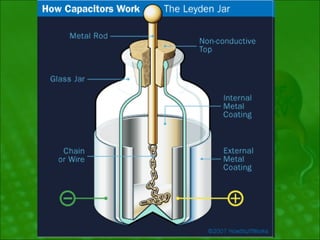
                     • Leyden Jar
                   – Benjamin Franklin (American)
                     • Franklin Square
                   – Michael Faraday (English)
                     • Wanted to store unused electrons from
                       experiments
                     • Oil drums
                     • Unit of capacitance named after him
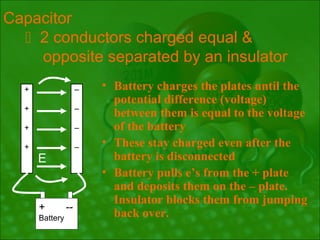
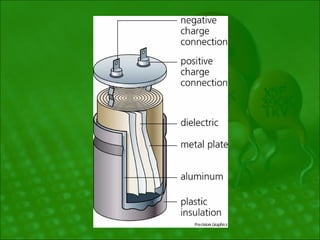
Capacitor
   2 conductors charged equal &
    opposite separated by an insulator
  +                  –   • Battery charges the plates until the
                           potential difference (voltage)
  +                  –
                           between them is equal to the voltage
  +                  –     of the battery
  +                  –   • These stay charged even after the
      E                    battery is disconnected
                         • Battery pulls e’s from the + plate
                           and deposits them on the – plate.
                           Insulator blocks them from jumping
      +         --
      Battery              back over.
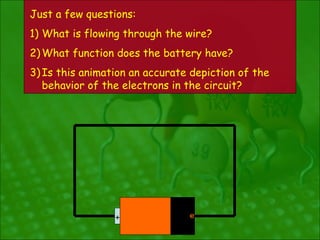
Just a few questions:
1) What is flowing through the wire?
2) What function does the battery have?
3) Is this animation an accurate depiction of the
   behavior of the electrons in the circuit?


                 +              e
                                --
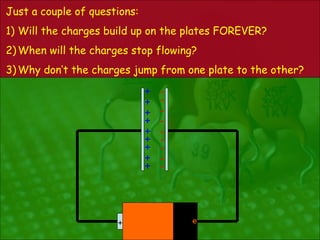
Just a couple of questions:
1) Will the charges build up on the plates FOREVER?
2) When will the charges stop flowing?
3) Why don’t the charges jump from one plate to the other?

                              +   -
                              +   -
                              +   -
                              +   -
                              +   -
                              +   -
                              +   -
                              +   -
                              +   -


                      +               e-
                                      -
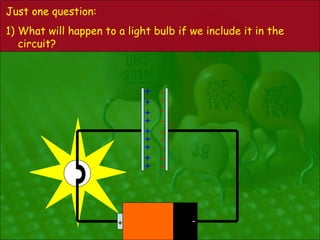
Just one question:
1) What will happen to a light bulb if we include it in the
   circuit?


                             +   -
                             +   -
                             +   -
                             +   -
                             +   -
                             +   -
                             +   -
                             +   -
                             +   -


                       +               -
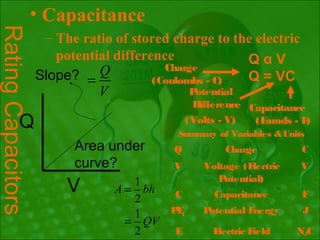
• Capacitance
Rating Capacitors
                     – The ratio of stored charge to the electric
                       potential difference              QαV
                              Q           Charge
                    Slope? =            (Coulombs - C)   Q = VC
                              V                Potential
                                                Difference Capacitance
          Q                                    (Volts - V)  (Farads - F)
                                            Summary of Variables & Units
                          Area under       Q           Charge          C
                          curve?           V      Voltage (Electric    V
                                                     Potential)
                         V          1
                                 A = bh C           Capacitance        F
                                    2
                                    1   PC
                                         E        Potential Energy     J
                                   = QV
                                    2   E           Electric Field    N/
                                                                       C
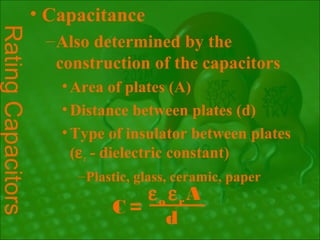
• Capacitance
Rating Capacitors
                    – Also determined by the
                      construction of the capacitors
                      • Area of plates (A)
                      • Distance between plates (d)
                      • Type of insulator between plates
                        (ε r - dielectric constant)
                        – Plastic, glass, ceramic, paper
                                 εo εrA
                              C=
                                   d
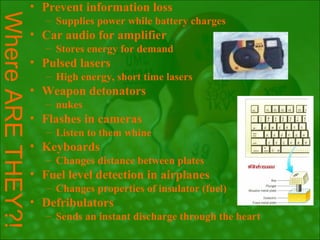
• Prevent information loss
Where ARE THEY?!
                   – Supplies power while battery charges
               • Car audio for amplifier
                   – Stores energy for demand
               • Pulsed lasers
                   – High energy, short time lasers
               • Weapon detonators
                   – nukes
               • Flashes in cameras
                   – Listen to them whine
               • Keyboards
                   – Changes distance between plates
               • Fuel level detection in airplanes
                   – Changes properties of insulator (fuel)
               • Defribulators
                   – Sends an instant discharge through the heart

4 capacitors

  • 2.
    • First Capacitors – Ewald Georg von Kleist (German) A Little History • 1745 – Pieter van Musschenbroek (Dutch) • Leyden Jar – Benjamin Franklin (American) • Franklin Square – Michael Faraday (English) • Wanted to store unused electrons from experiments • Oil drums • Unit of capacitance named after him
  • 4.
    Capacitor 2 conductors charged equal & opposite separated by an insulator + – • Battery charges the plates until the potential difference (voltage) + – between them is equal to the voltage + – of the battery + – • These stay charged even after the E battery is disconnected • Battery pulls e’s from the + plate and deposits them on the – plate. Insulator blocks them from jumping + -- Battery back over.
  • 5.
    Just a fewquestions: 1) What is flowing through the wire? 2) What function does the battery have? 3) Is this animation an accurate depiction of the behavior of the electrons in the circuit? + e --
  • 6.
    Just a coupleof questions: 1) Will the charges build up on the plates FOREVER? 2) When will the charges stop flowing? 3) Why don’t the charges jump from one plate to the other? + - + - + - + - + - + - + - + - + - + e- -
  • 7.
    Just one question: 1)What will happen to a light bulb if we include it in the circuit? + - + - + - + - + - + - + - + - + - + -
  • 9.
    • Capacitance Rating Capacitors – The ratio of stored charge to the electric potential difference QαV Q Charge Slope? = (Coulombs - C) Q = VC V Potential Difference Capacitance Q (Volts - V) (Farads - F) Summary of Variables & Units Area under Q Charge C curve? V Voltage (Electric V Potential) V 1 A = bh C Capacitance F 2 1 PC E Potential Energy J = QV 2 E Electric Field N/ C
  • 10.
    • Capacitance Rating Capacitors – Also determined by the construction of the capacitors • Area of plates (A) • Distance between plates (d) • Type of insulator between plates (ε r - dielectric constant) – Plastic, glass, ceramic, paper εo εrA C= d
  • 11.
    • Prevent informationloss Where ARE THEY?! – Supplies power while battery charges • Car audio for amplifier – Stores energy for demand • Pulsed lasers – High energy, short time lasers • Weapon detonators – nukes • Flashes in cameras – Listen to them whine • Keyboards – Changes distance between plates • Fuel level detection in airplanes – Changes properties of insulator (fuel) • Defribulators – Sends an instant discharge through the heart

Editor's Notes

  • #6 electrons Pushes electrons giving them energy No, electrons actually have drift velocity and bump into the next electron
  • #7 Pretty much yes. When it reaches the potential the battery has Too great of a distance. Too much resistance between the plates.