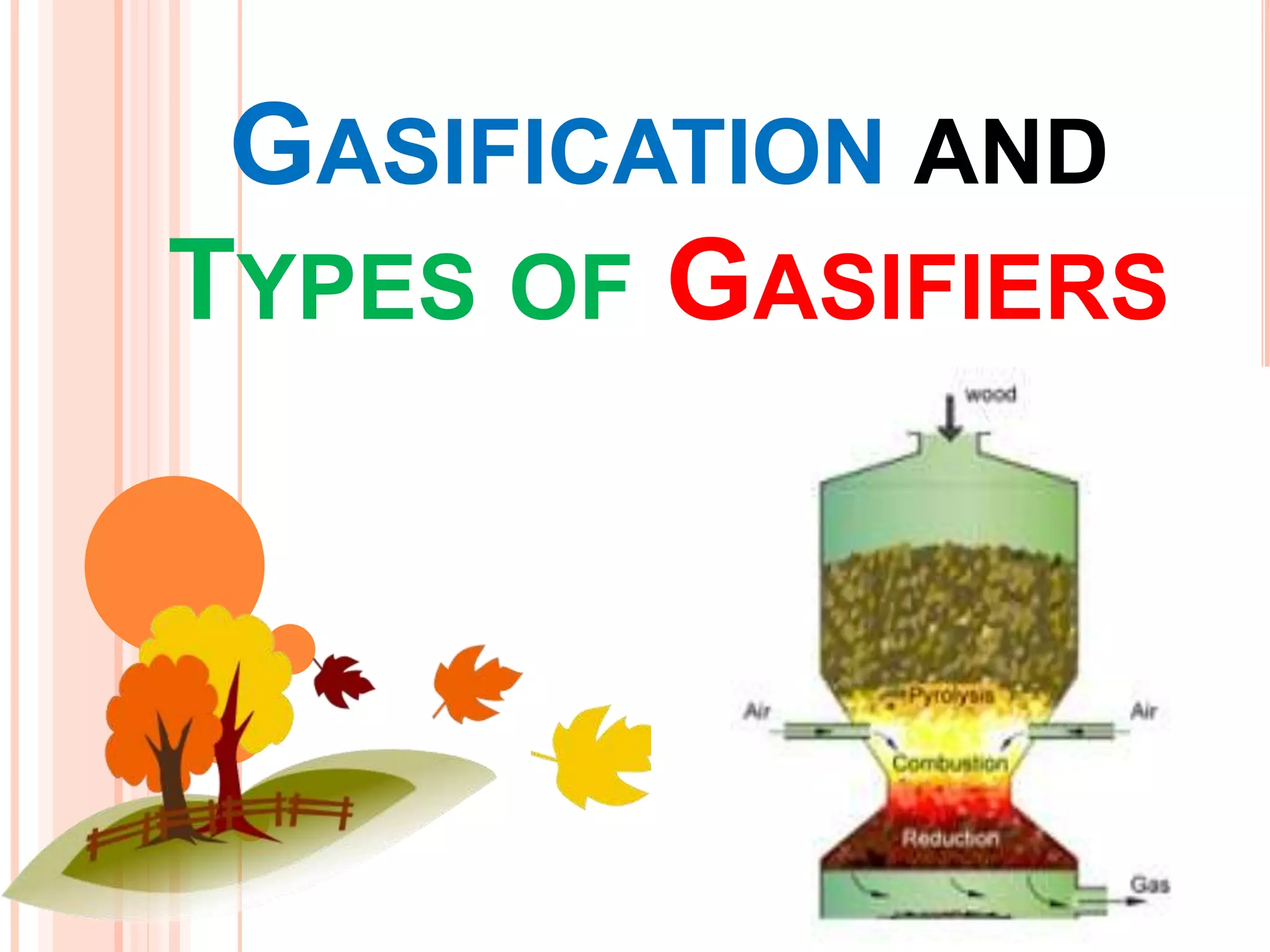
GASIFICATION AND
TYPES OF GASIFIERS
BIOMASS GASIFICATION
 The gasification is a thermo-chemical process that
converts any carbon-containing material into a
combustible gas by supplying a restricted amount of
oxygen.
 In case of biomass feedstock, this gas is known as wood
gas, producer gas or syngas, which composed primarily of
carbon monoxide and hydrogen as fuels, together with
small amount of methane.
 It will also contain other compounds, such as sulfur and
nitrogen oxides, depending on the chemical composition
of the fuel.
 Producer gas is a mixture of gases: 18%–22% carbon
monoxide (CO), 8%–12% hydrogen (H2), 8%–12% carbon
dioxide (CO2), 2%–4% methane (CH4) and 45%–50%
nitrogen (N2) making up the rest.
 Under typical gasification conditions, oxygen levels are
restricted to less than 30% of that required for complete
combustion.
 Raw producer is not an end product, but requires further
processing.
 Gasification adds value to low- or negative-value
feedstocks by converting them to marketable fuels and
products.
 In utilization of gases from biomass gasification, it is
important to understand that gas specifications are
different for the various applications.
 Furthermore, the composition of the gasification gas is
very dependent on the type of gasification process,
gasification agent and the gasification temperature.
 Based on the general composition and the typical
applications, two main types of gasification gas can be
distinguished as producer gas and syngas.
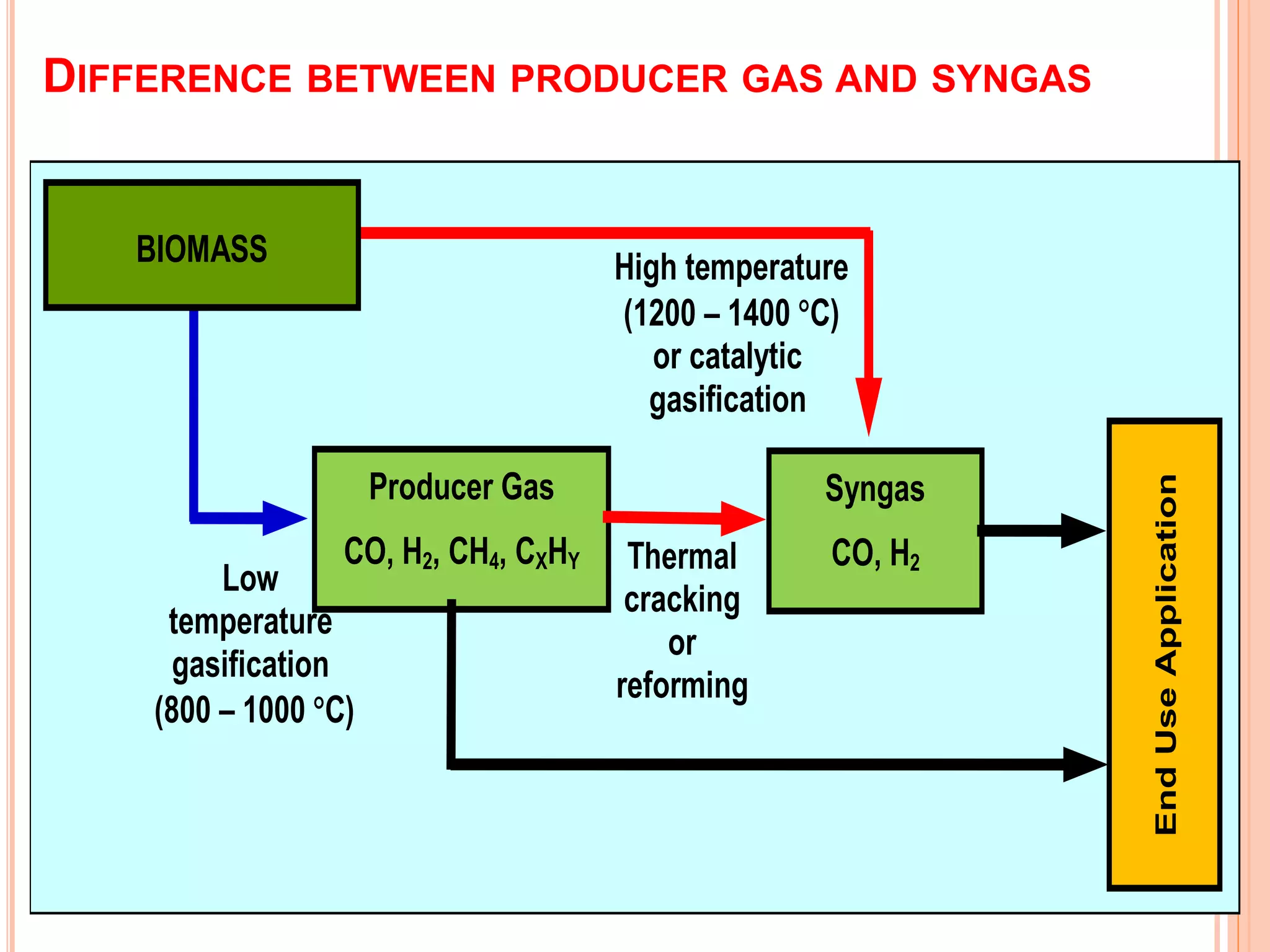
DIFFERENCE BETWEEN PRODUCER GAS AND SYNGAS
Low
temperature
gasification
(800 – 1000 C)
Producer Gas
CO, H2, CH4, CXHY
Syngas
CO, H2
High temperature
(1200 – 1400 C)
or catalytic
gasification
BIOMASS
Thermal
cracking
or
reforming
End
Use
Application
Difference between producer gas and syngas
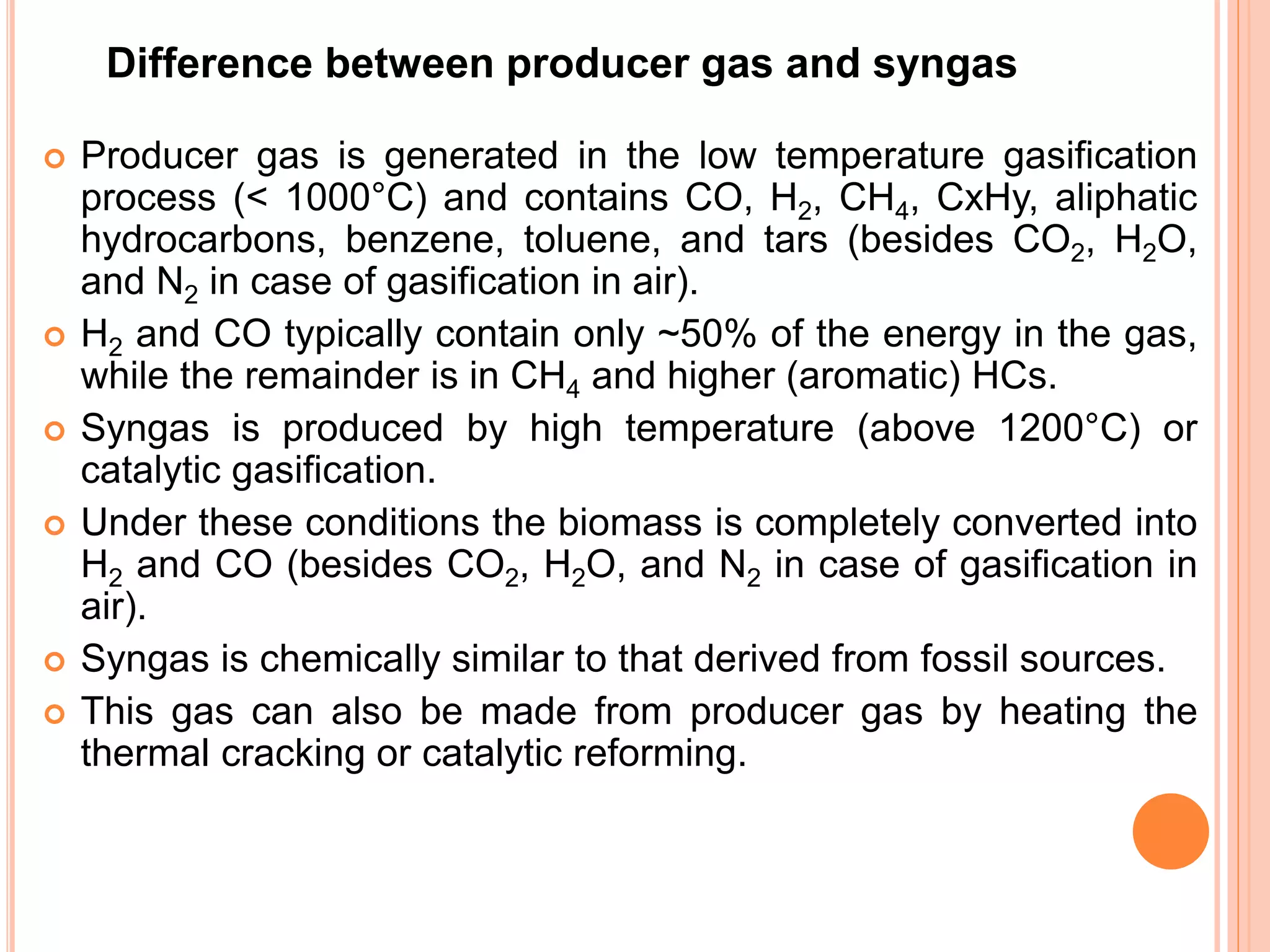
 Producer gas is generated in the low temperature gasification
process (< 1000°C) and contains CO, H2, CH4, CxHy, aliphatic
hydrocarbons, benzene, toluene, and tars (besides CO2, H2O,
and N2 in case of gasification in air).
 H2 and CO typically contain only ~50% of the energy in the gas,
while the remainder is in CH4 and higher (aromatic) HCs.
 Syngas is produced by high temperature (above 1200°C) or
catalytic gasification.
 Under these conditions the biomass is completely converted into
H2 and CO (besides CO2, H2O, and N2 in case of gasification in
air).
 Syngas is chemically similar to that derived from fossil sources.
 This gas can also be made from producer gas by heating the
thermal cracking or catalytic reforming.
GASIFICATION AGENTS
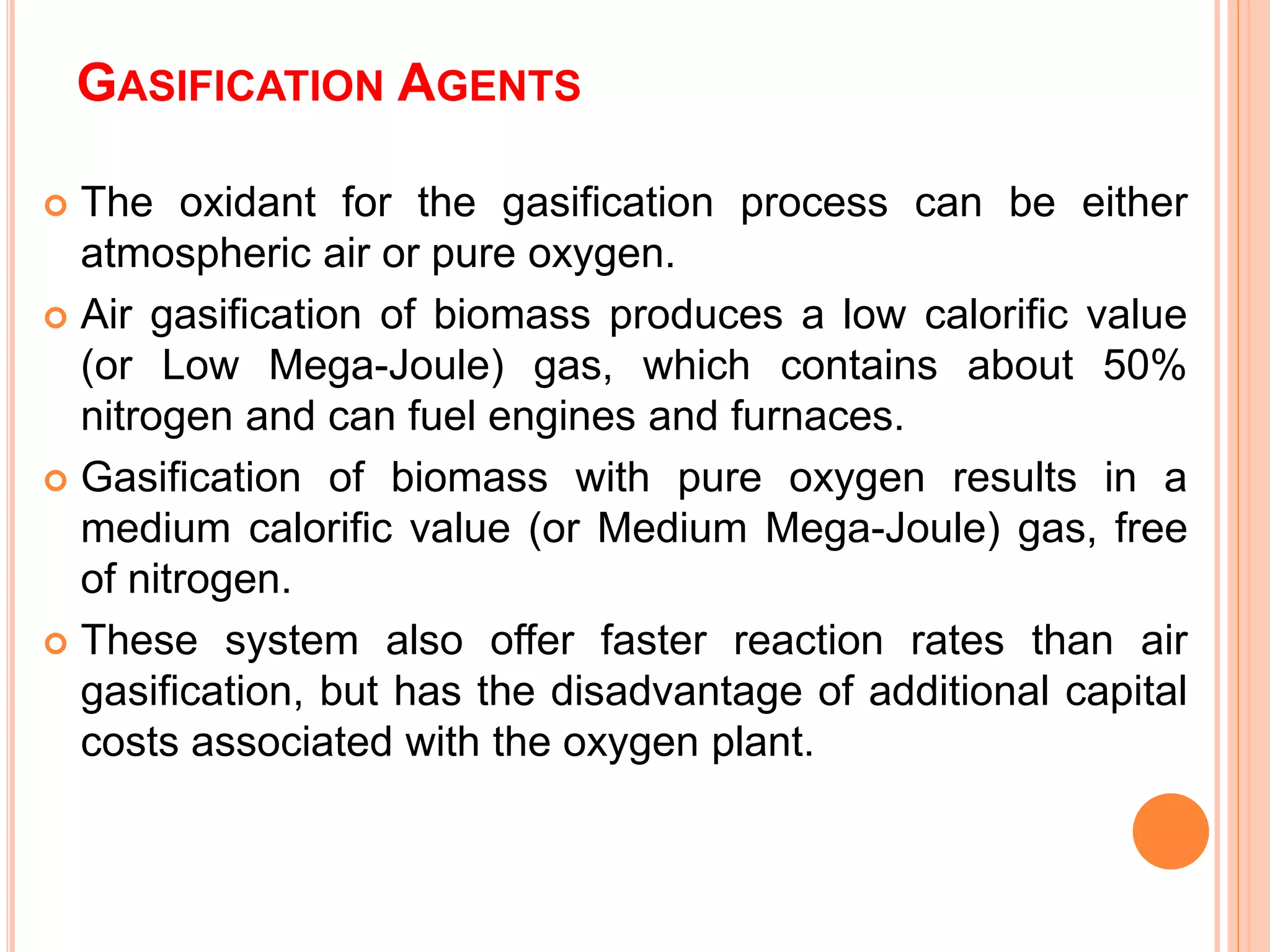
 The oxidant for the gasification process can be either
atmospheric air or pure oxygen.
 Air gasification of biomass produces a low calorific value
(or Low Mega-Joule) gas, which contains about 50%
nitrogen and can fuel engines and furnaces.
 Gasification of biomass with pure oxygen results in a
medium calorific value (or Medium Mega-Joule) gas, free
of nitrogen.
 These system also offer faster reaction rates than air
gasification, but has the disadvantage of additional capital
costs associated with the oxygen plant.
GASIFIER END-USES
 Syngas or producer gas can be burned to create heat,
steam, or electricity.
 It can be converted to methane and fed into a natural gas
distribution system.
 Syngas can also be converted to methanol, ethanol, and
other chemicals or liquid fuels.
 Methanol produced through gasification can be further
refined into biodiesel with addition of vegetable oils or
animal fats.
 Use of gasification for generation of fuels, chemicals and
power.
ADVANTAGES OF BIOMASS GASIFICATION
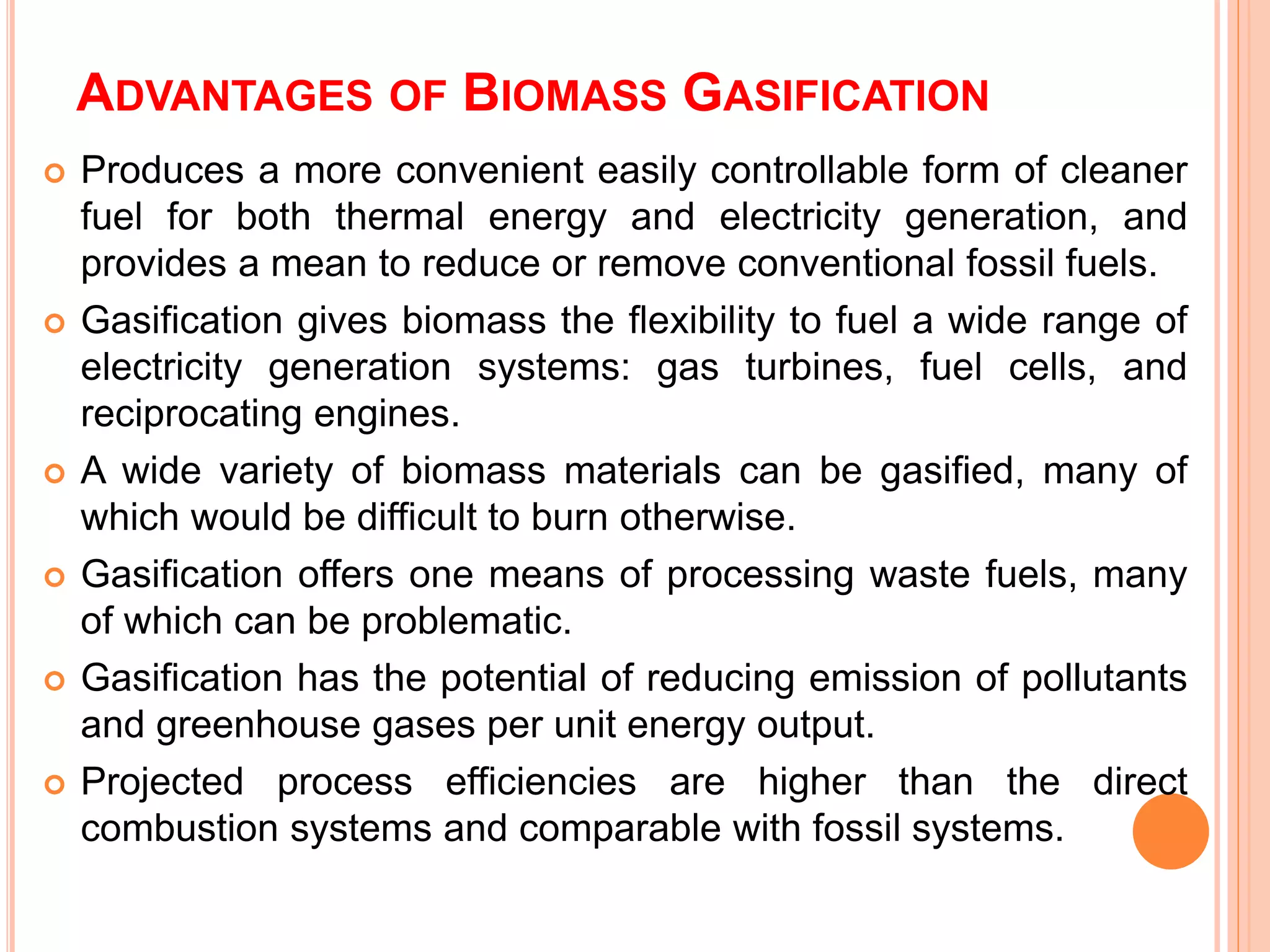
 Produces a more convenient easily controllable form of cleaner
fuel for both thermal energy and electricity generation, and
provides a mean to reduce or remove conventional fossil fuels.
 Gasification gives biomass the flexibility to fuel a wide range of
electricity generation systems: gas turbines, fuel cells, and
reciprocating engines.
 A wide variety of biomass materials can be gasified, many of
which would be difficult to burn otherwise.
 Gasification offers one means of processing waste fuels, many
of which can be problematic.
 Gasification has the potential of reducing emission of pollutants
and greenhouse gases per unit energy output.
 Projected process efficiencies are higher than the direct
combustion systems and comparable with fossil systems.
BIOMASS GASIFIERS
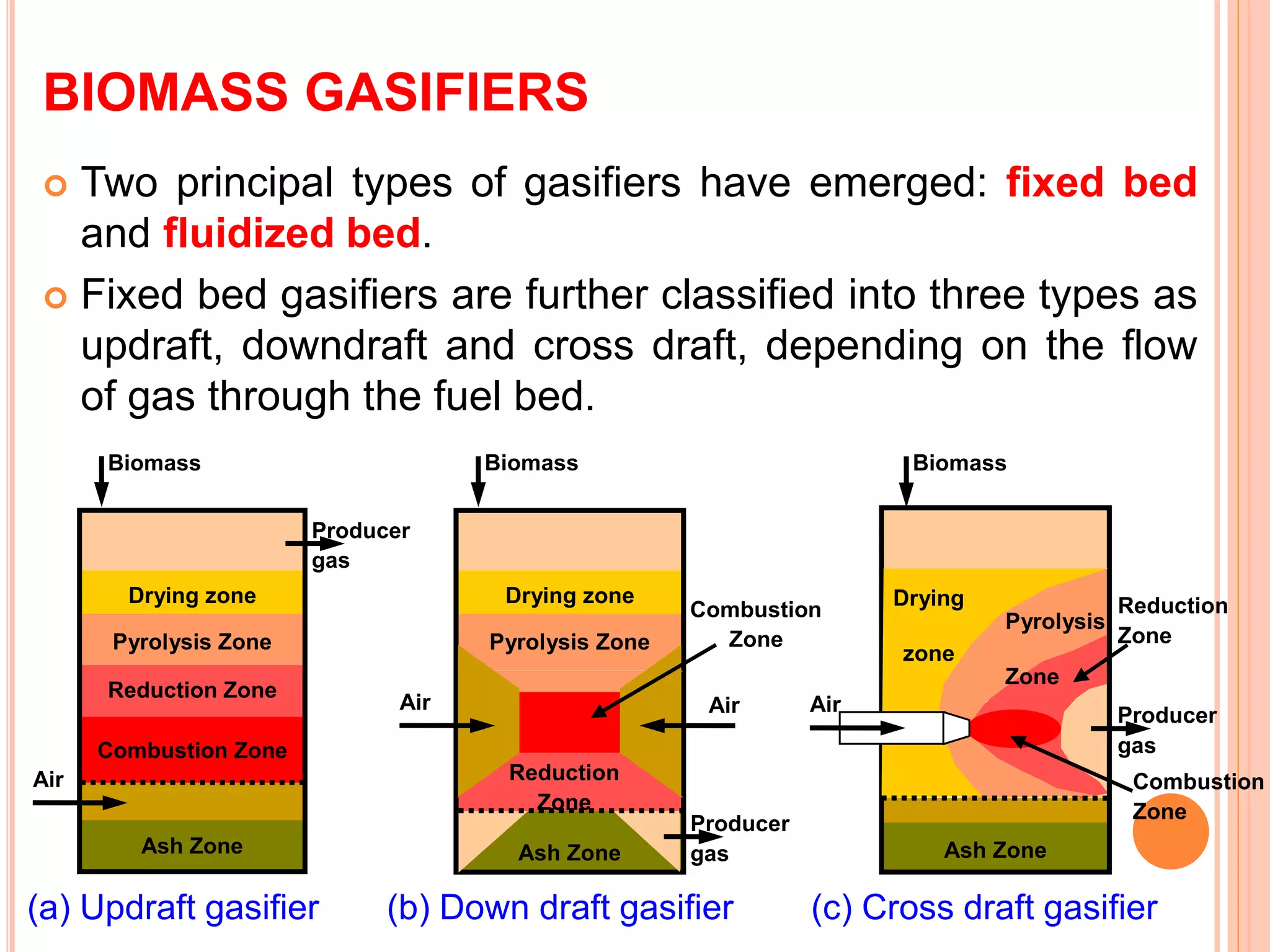
 Two principal types of gasifiers have emerged: fixed bed
and fluidized bed.
 Fixed bed gasifiers are further classified into three types as
updraft, downdraft and cross draft, depending on the flow
of gas through the fuel bed.
Drying zone
Pyrolysis Zone
Reduction Zone
Combustion Zone
Ash Zone
Biomass
Air
Producer
gas
Biomass
Drying zone
Pyrolysis Zone
Combustion
Zone
Ash Zone
Air
Reduction
Zone
Producer
gas
Air
Reduction
Zone
Combustion
Zone
Ash Zone
Air
Drying
zone
Pyrolysis
Zone
Producer
gas
Biomass
(a) Updraft gasifier (b) Down draft gasifier (c) Cross draft gasifier
 The processes taking place in the drying, pyrolysis and
reduction zones are driven by heat transferred from the
combustion zone (which is also called as the oxidation or
hearth zone).
 In the drying zone, moisture in biomass evaporates.
 In case of updraft gasifier this moisture leaves along with gas at
the top.
 In case of downdraft gasifier the moisture passes thorough the
reduction and combustion zones and participates in certain
chemical reactions.
 Essentially dry biomass enters the pyrolysis zone from the
drying zone.
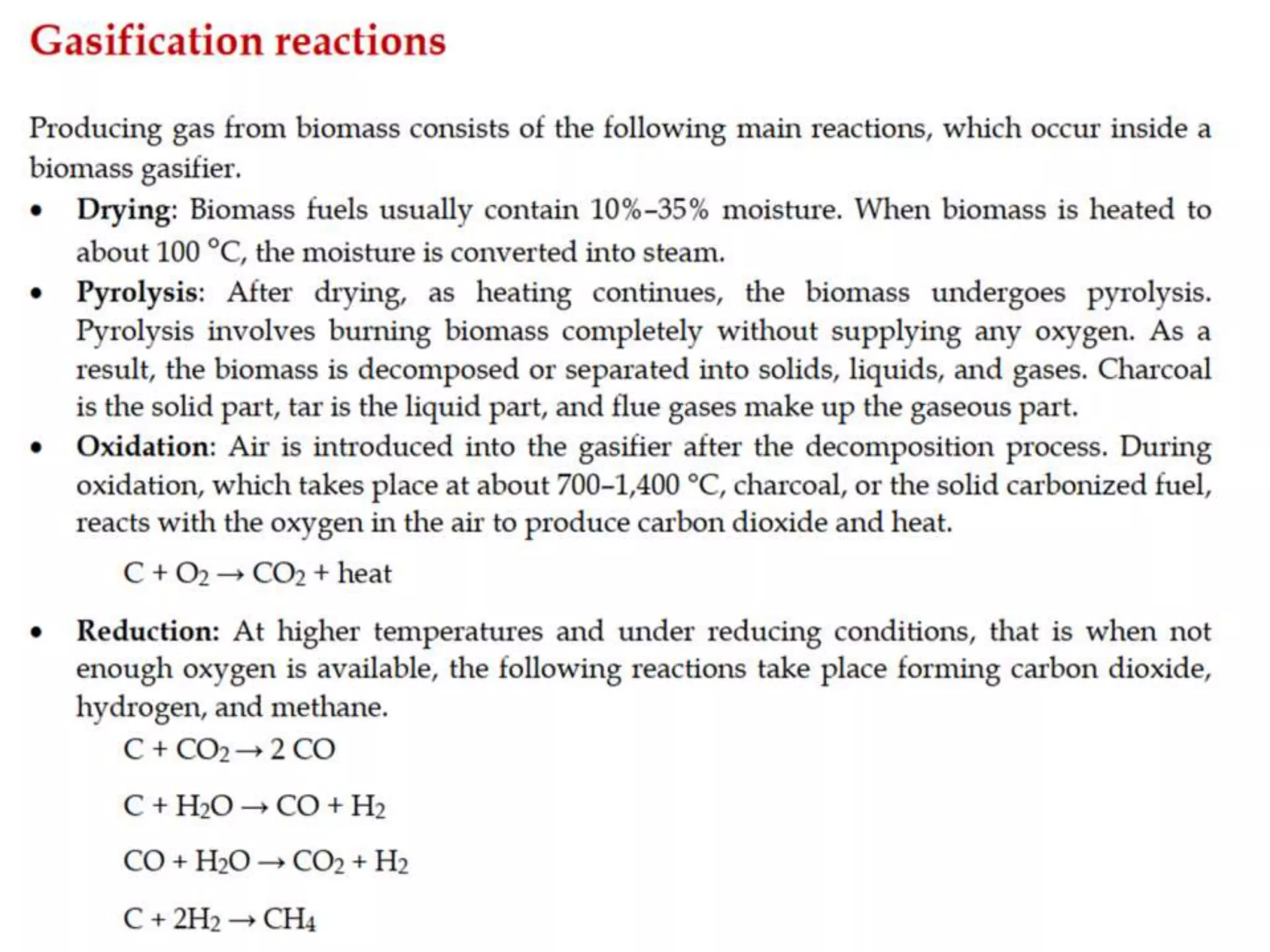
 Pyrolysis converts the dried biomass into char, tar vapour,
water vapour and non-condensable gases.
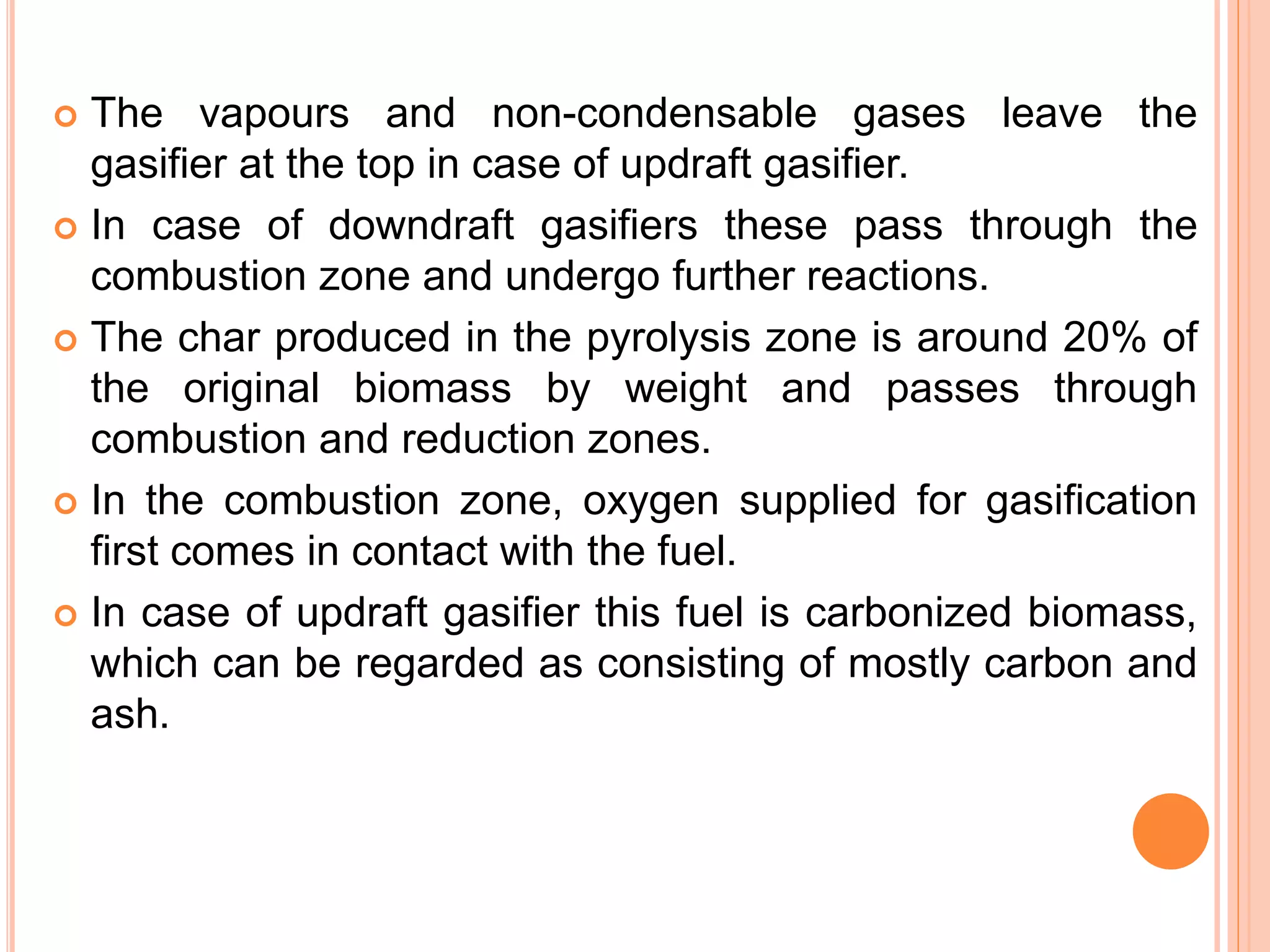
 The vapours and non-condensable gases leave the
gasifier at the top in case of updraft gasifier.
 In case of downdraft gasifiers these pass through the
combustion zone and undergo further reactions.
 The char produced in the pyrolysis zone is around 20% of
the original biomass by weight and passes through
combustion and reduction zones.
 In the combustion zone, oxygen supplied for gasification
first comes in contact with the fuel.
 In case of updraft gasifier this fuel is carbonized biomass,
which can be regarded as consisting of mostly carbon and
ash.
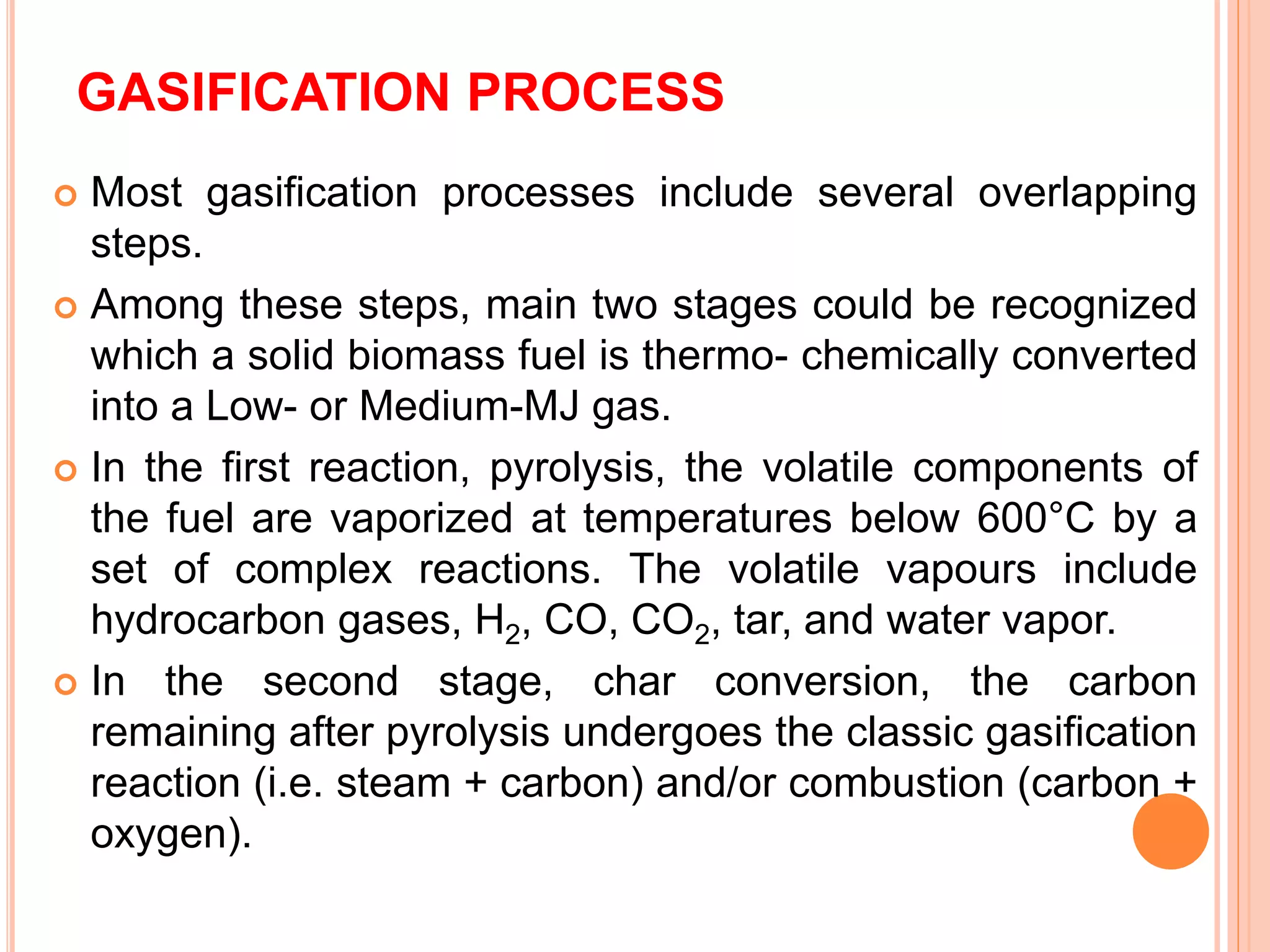
GASIFICATION PROCESS
 Most gasification processes include several overlapping
steps.
 Among these steps, main two stages could be recognized
which a solid biomass fuel is thermo- chemically converted
into a Low- or Medium-MJ gas.
 In the first reaction, pyrolysis, the volatile components of
the fuel are vaporized at temperatures below 600°C by a
set of complex reactions. The volatile vapours include
hydrocarbon gases, H2, CO, CO2, tar, and water vapor.
 In the second stage, char conversion, the carbon
remaining after pyrolysis undergoes the classic gasification
reaction (i.e. steam + carbon) and/or combustion (carbon +
oxygen).
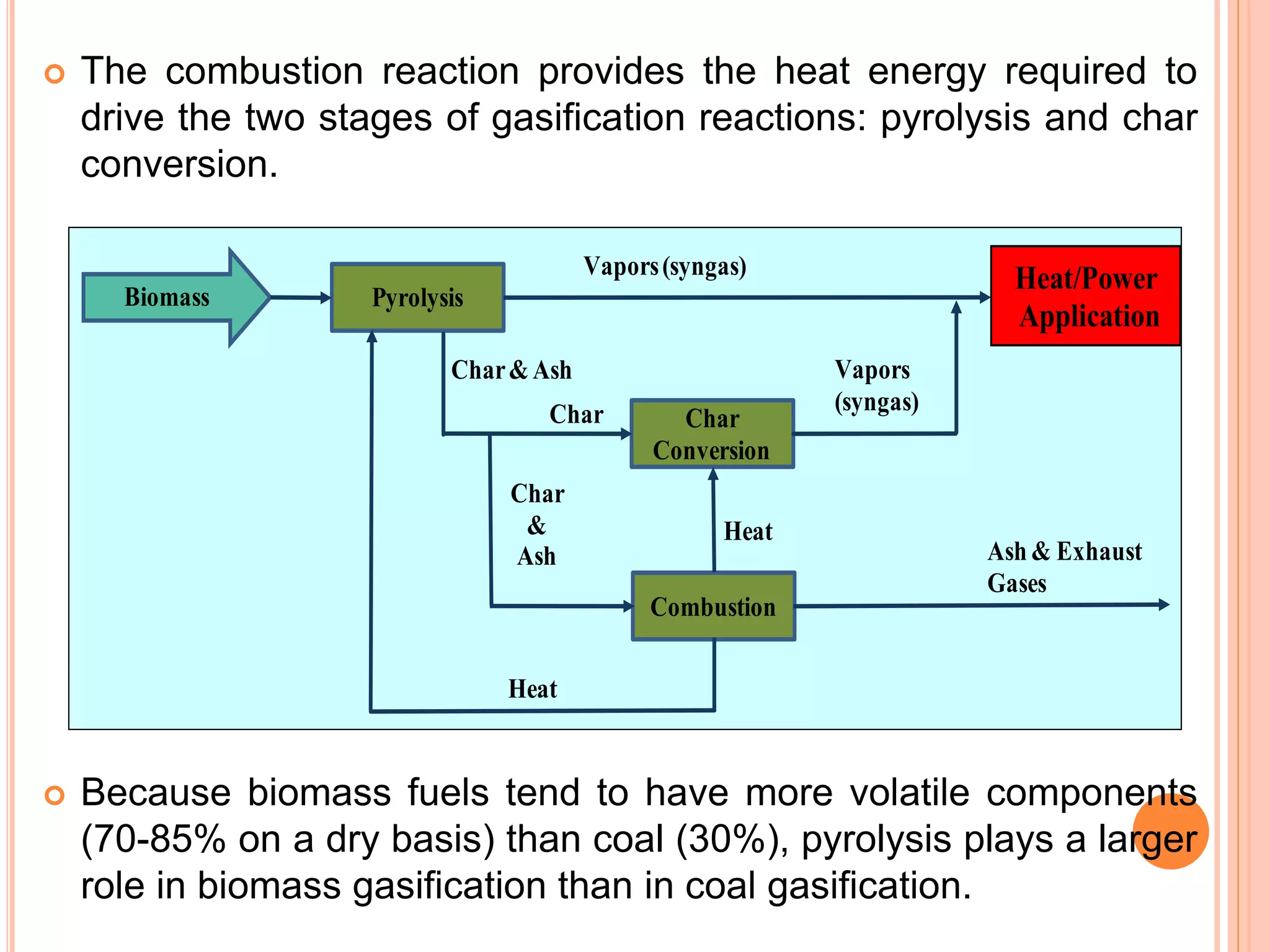
 The combustion reaction provides the heat energy required to
drive the two stages of gasification reactions: pyrolysis and char
conversion.
 Because biomass fuels tend to have more volatile components
(70-85% on a dry basis) than coal (30%), pyrolysis plays a larger
role in biomass gasification than in coal gasification.
Heat
Biomass Pyrolysis
Char
Conversion
Combustion
Vapors(syngas)
GasTurbine
PowerCycles
Char
Vapors
(syngas)
Char
&
Ash Ash & Exhaust
Gases
Heat
Char&Ash
Heat/Power
Application
GASIFICATION PROCESS: REACTOR ZONES
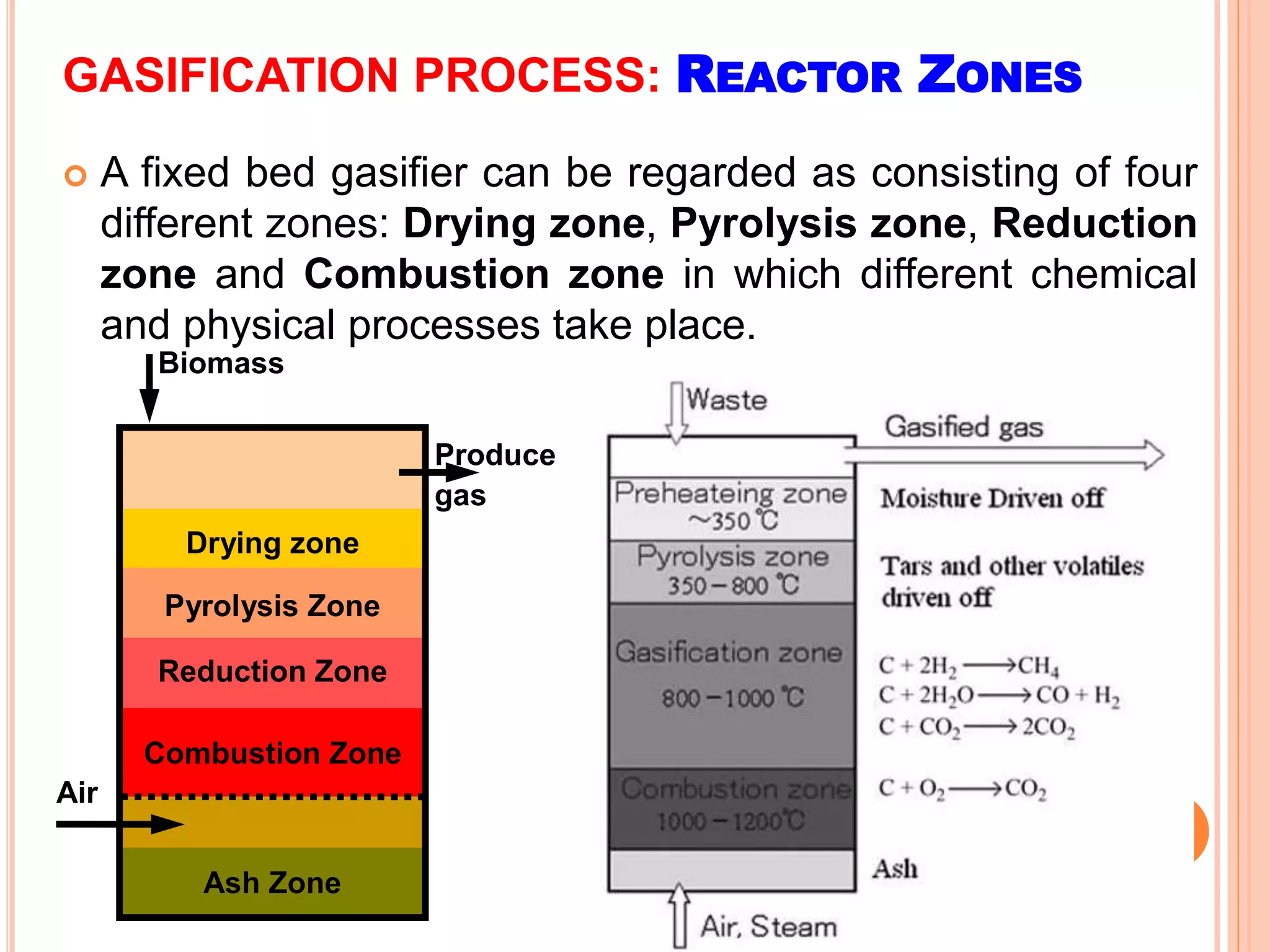
 A fixed bed gasifier can be regarded as consisting of four
different zones: Drying zone, Pyrolysis zone, Reduction
zone and Combustion zone in which different chemical
and physical processes take place.
Drying zone
Pyrolysis Zone
Reduction Zone
Combustion Zone
Ash Zone
Biomass
Air
Producer
gas
UPWARD DRAFT OR COUNTER-CURRENT GASIFIER
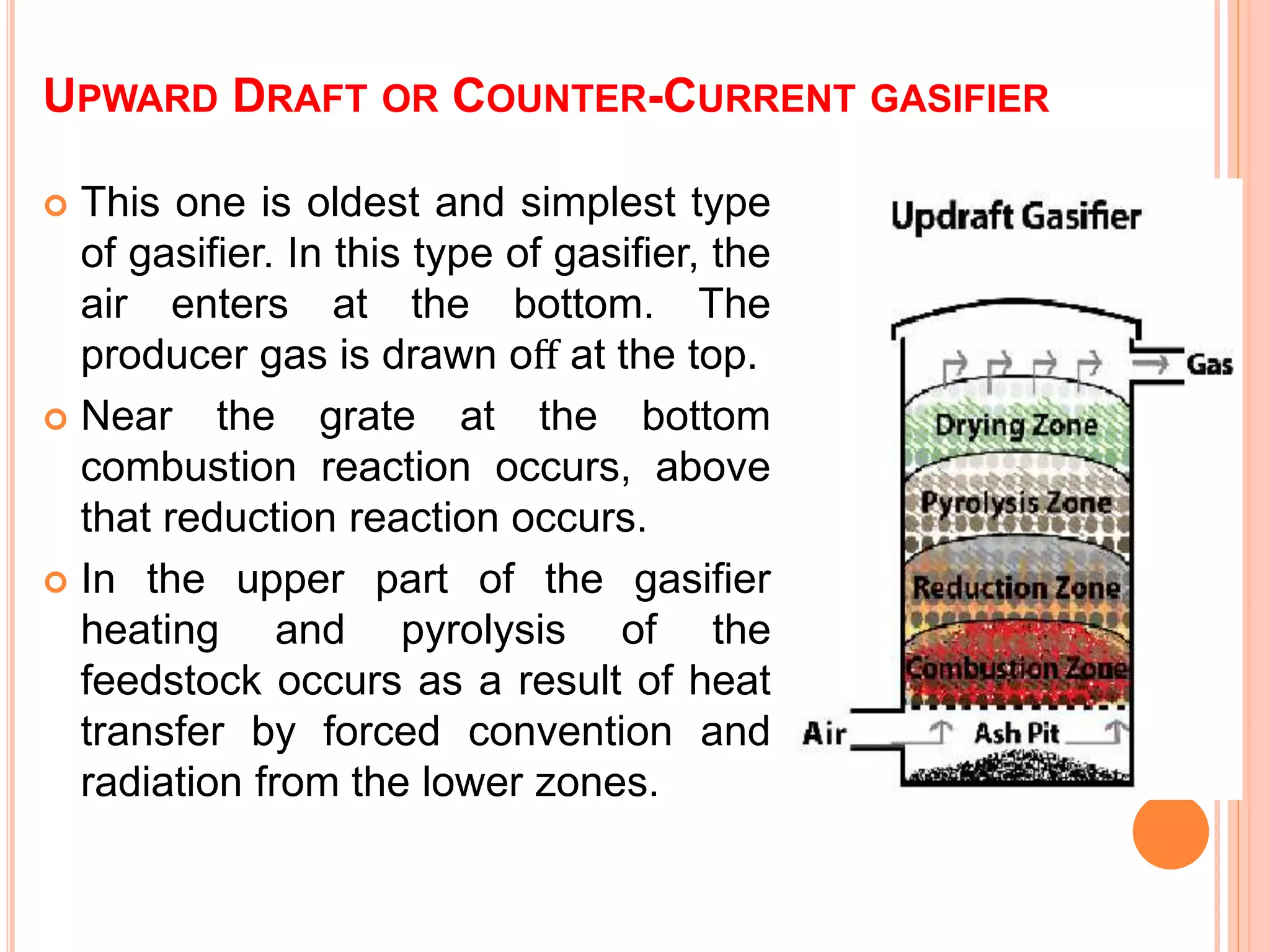
 This one is oldest and simplest type
of gasifier. In this type of gasifier, the
air enters at the bottom. The
producer gas is drawn off at the top.
 Near the grate at the bottom
combustion reaction occurs, above
that reduction reaction occurs.
 In the upper part of the gasifier
heating and pyrolysis of the
feedstock occurs as a result of heat
transfer by forced convention and
radiation from the lower zones.
 Tars and volatile produce produced during the reaction will
leave along with the syn gas at the top of the gasifier.
Which will be later separated by use of cyclone and candle
filter. The resulting gas is rich in hydrocarbons (tars) and is
suitable only for direct heating purposes in industrial
furnaces. If it is to be used for electricity generation by I.C.
engines, it has to be cleaned thoroughly.
 The major advantages of this type of gasifier are its
simplicity, high charcoal burn out and internal heat
exchange leading to low temperature of exit gas and high
equipment efficiency. This gasifier can work with several
kind of feedstock ranging from Coal to Biomass.
 Inlet of coal can be decided based on the type of
gasification process selected to be used in this gasifier.
DOWNDRAFT OR CO-CURRENT GASIFIER
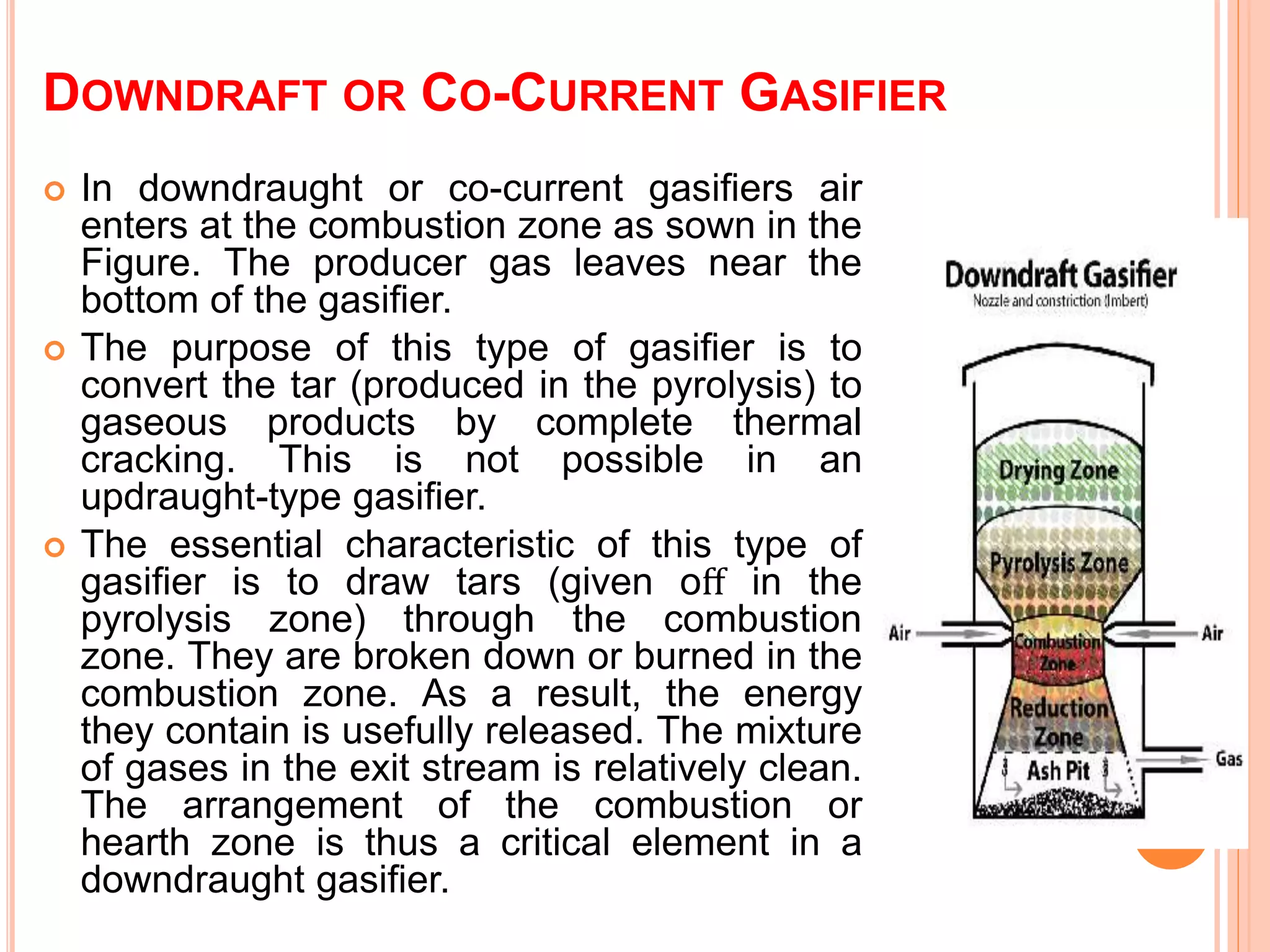
 In downdraught or co-current gasifiers air
enters at the combustion zone as sown in the
Figure. The producer gas leaves near the
bottom of the gasifier.
 The purpose of this type of gasifier is to
convert the tar (produced in the pyrolysis) to
gaseous products by complete thermal
cracking. This is not possible in an
updraught-type gasifier.
 The essential characteristic of this type of
gasifier is to draw tars (given off in the
pyrolysis zone) through the combustion
zone. They are broken down or burned in the
combustion zone. As a result, the energy
they contain is usefully released. The mixture
of gases in the exit stream is relatively clean.
The arrangement of the combustion or
hearth zone is thus a critical element in a
downdraught gasifier.
 In most downdraught gasifiers, the internal diameter is
reduced in the combustion zone to create a throat. This is
frequently made of replaceable ceramic material. Air inlet
nozzles are commonly set in a lining round the throat to
distribute air as uniformly as possible.
 This type of gasifier is most commonly used for engine
applications due to its ability to produce a relatively clean
gas. A disadvantage of this type of gasifier is that
slagging or sintering of ash may occur due to the
concentrated oxidation (combustion) zone. Rotating ash
grates or similar mechanisms can solve this problem.
The gasifier efficiency is less than in an up- draught
gasifier due to the higher temperature.
 Main disadvantage is that downdraft gasifier cannot be
operated with range of different feed-stocks. Low density
feedstock gives rise to flow problems and excessive
pressure drop. High ash content coal also gives more
problem with this kind of gasifier than updraft gasifier.
 Other disadvantage is it gives lower efficiency, since there
is no provision internal exchange compare to updraft
gasifier. The product stream also has low calorific value.
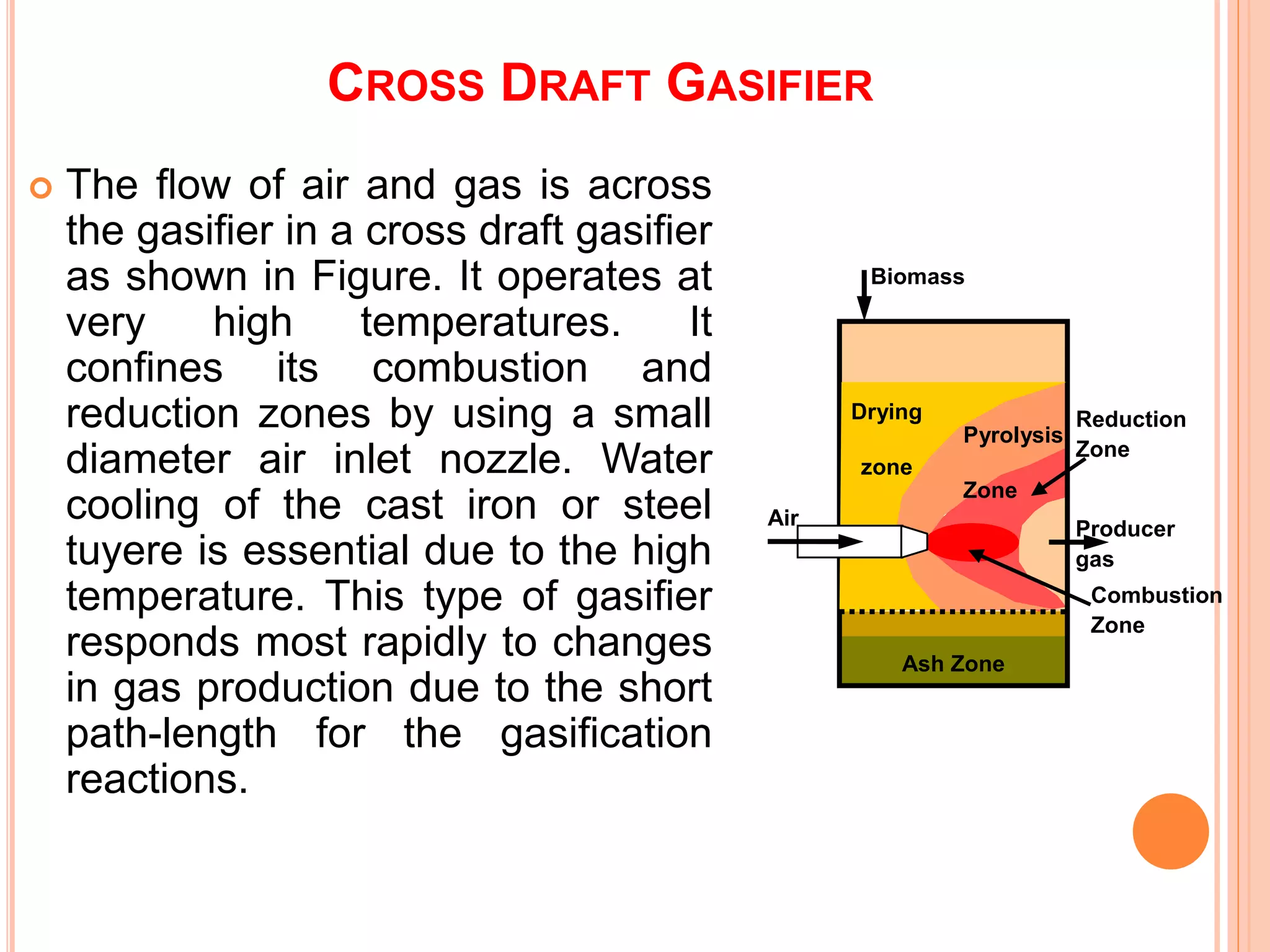
 The flow of air and gas is across
the gasifier in a cross draft gasifier
as shown in Figure. It operates at
very high temperatures. It
confines its combustion and
reduction zones by using a small
diameter air inlet nozzle. Water
cooling of the cast iron or steel
tuyere is essential due to the high
temperature. This type of gasifier
responds most rapidly to changes
in gas production due to the short
path-length for the gasification
reactions.
CROSS DRAFT GASIFIER
Reduction
Zone
Combustion
Zone
Ash Zone
Air
Drying
zone
Pyrolysis
Zone
Producer
gas
Biomass
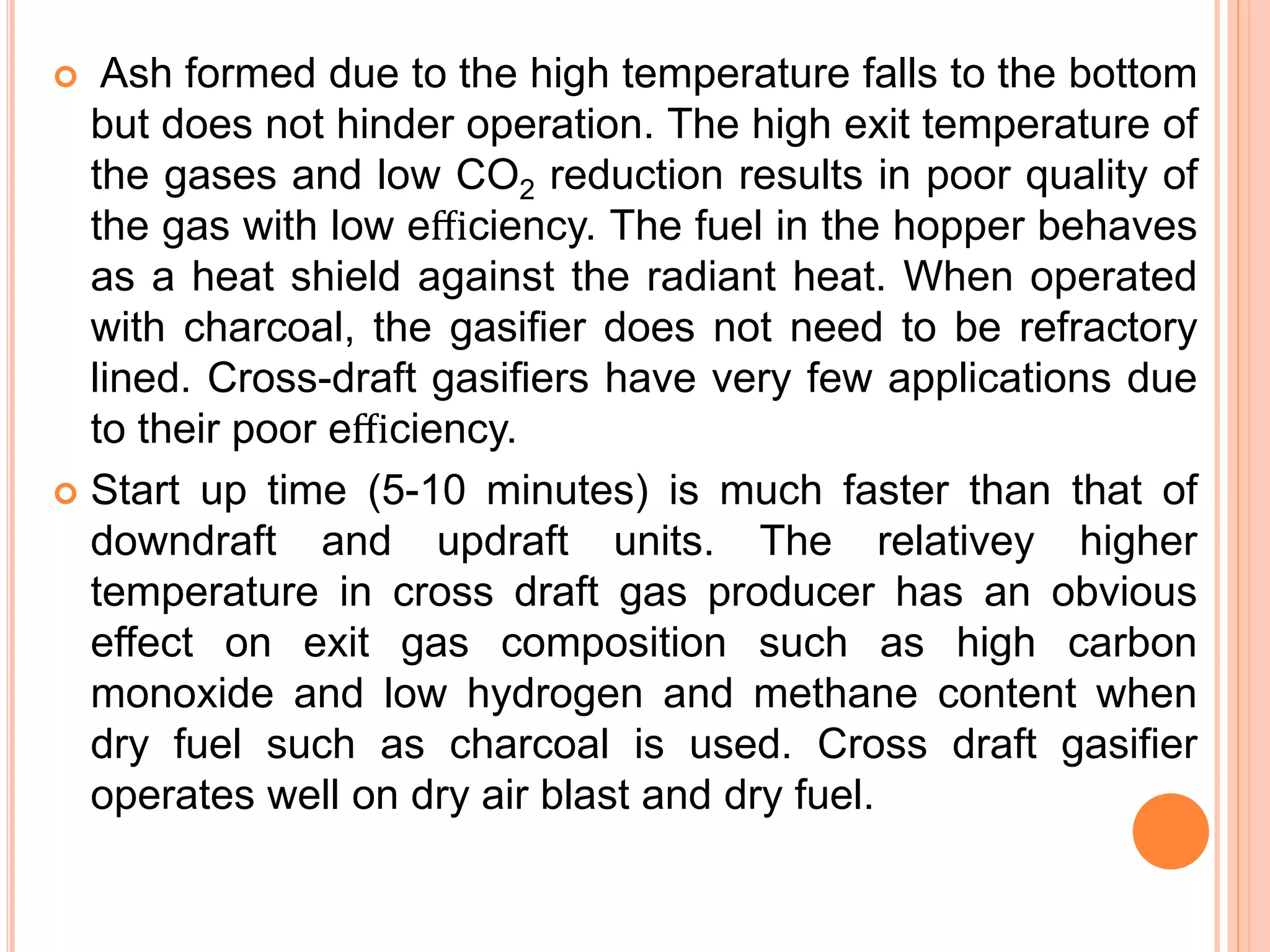
 Ash formed due to the high temperature falls to the bottom
but does not hinder operation. The high exit temperature of
the gases and low CO2 reduction results in poor quality of
the gas with low efficiency. The fuel in the hopper behaves
as a heat shield against the radiant heat. When operated
with charcoal, the gasifier does not need to be refractory
lined. Cross-draft gasifiers have very few applications due
to their poor efficiency.
 Start up time (5-10 minutes) is much faster than that of
downdraft and updraft units. The relativey higher
temperature in cross draft gas producer has an obvious
effect on exit gas composition such as high carbon
monoxide and low hydrogen and methane content when
dry fuel such as charcoal is used. Cross draft gasifier
operates well on dry air blast and dry fuel.
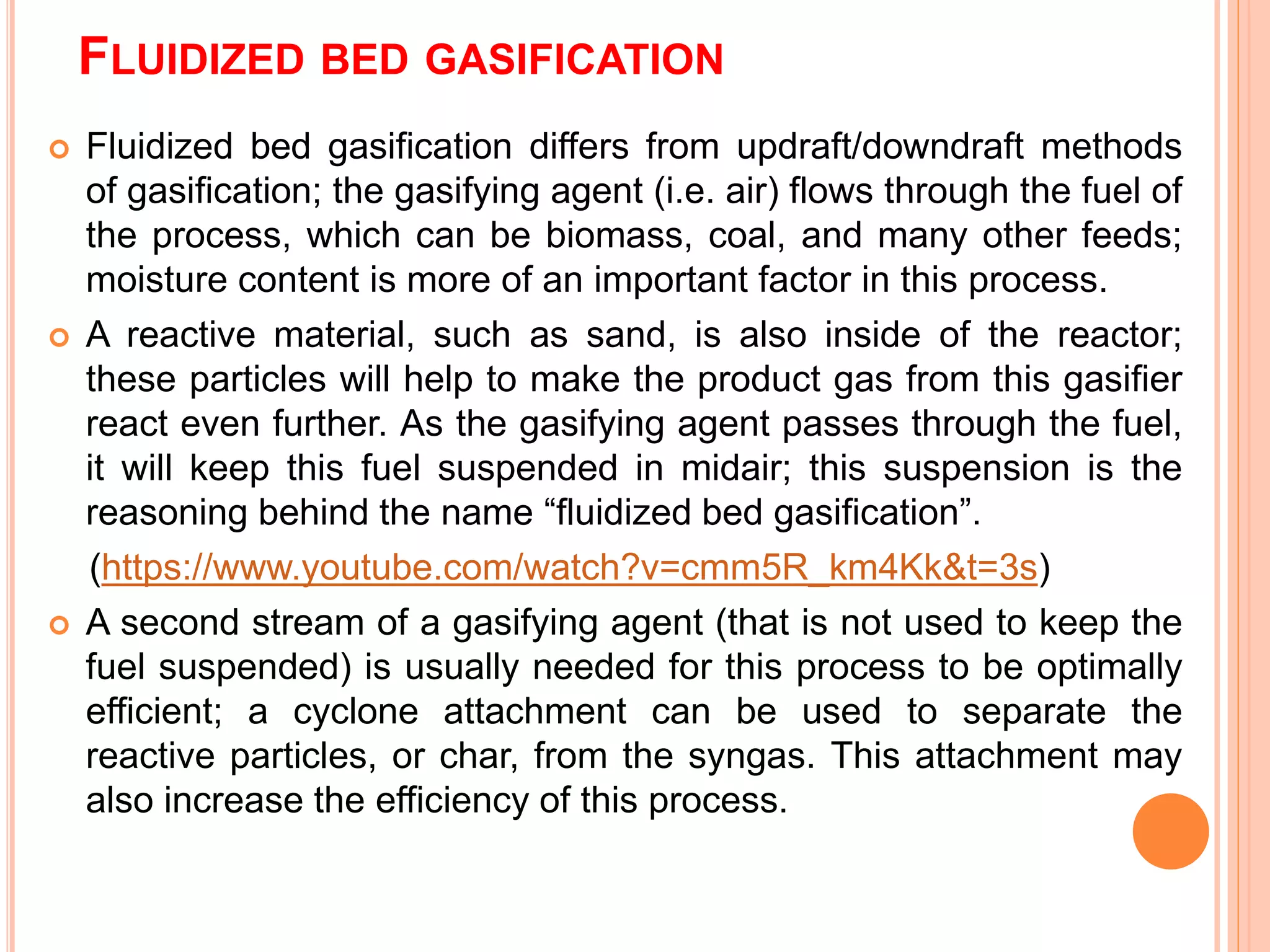
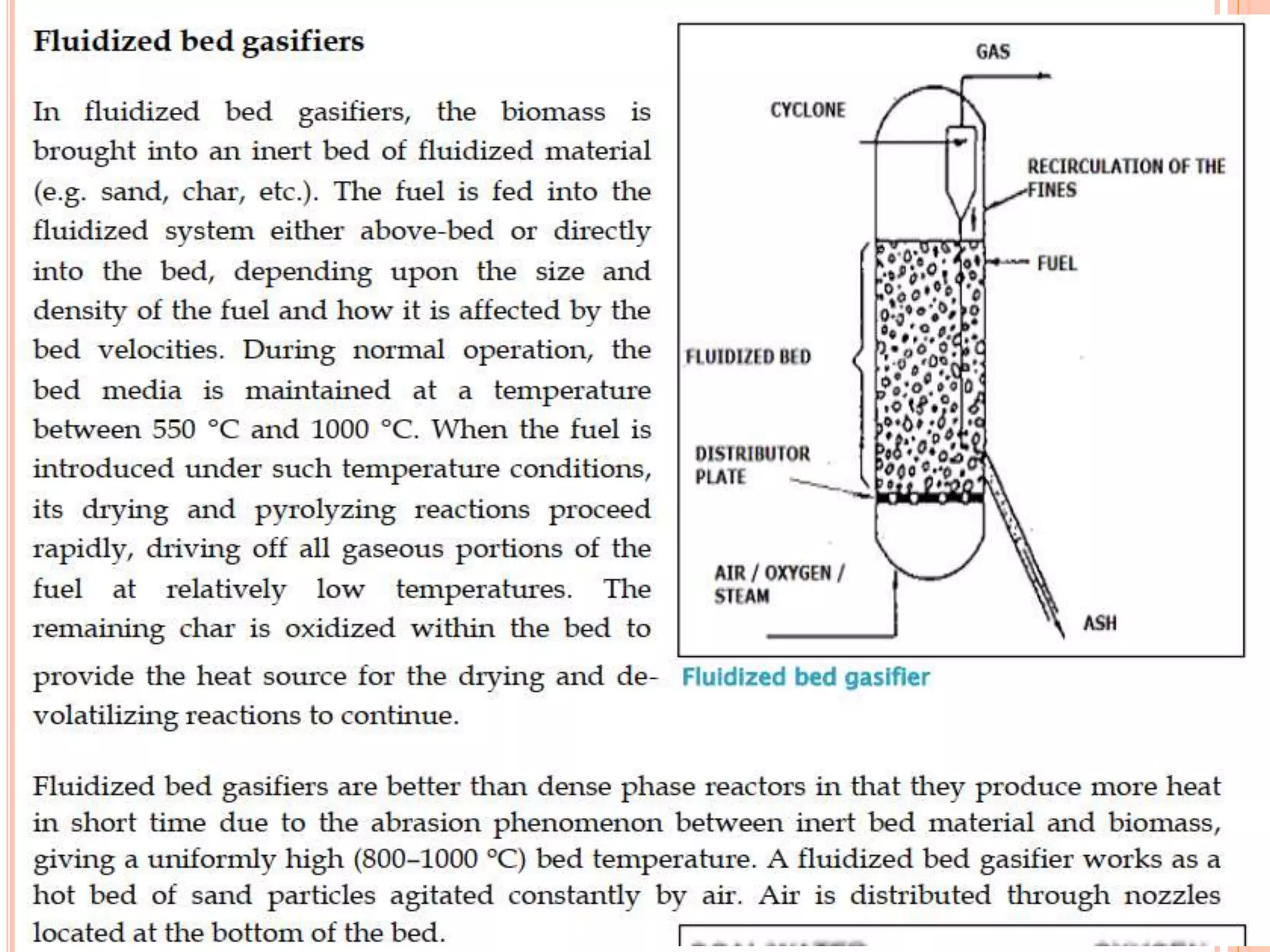
FLUIDIZED BED GASIFICATION
 Fluidized bed gasification differs from updraft/downdraft methods
of gasification; the gasifying agent (i.e. air) flows through the fuel of
the process, which can be biomass, coal, and many other feeds;
moisture content is more of an important factor in this process.
 A reactive material, such as sand, is also inside of the reactor;
these particles will help to make the product gas from this gasifier
react even further. As the gasifying agent passes through the fuel,
it will keep this fuel suspended in midair; this suspension is the
reasoning behind the name “fluidized bed gasification”.
(https://www.youtube.com/watch?v=cmm5R_km4Kk&t=3s)
 A second stream of a gasifying agent (that is not used to keep the
fuel suspended) is usually needed for this process to be optimally
efficient; a cyclone attachment can be used to separate the
reactive particles, or char, from the syngas. This attachment may
also increase the efficiency of this process.
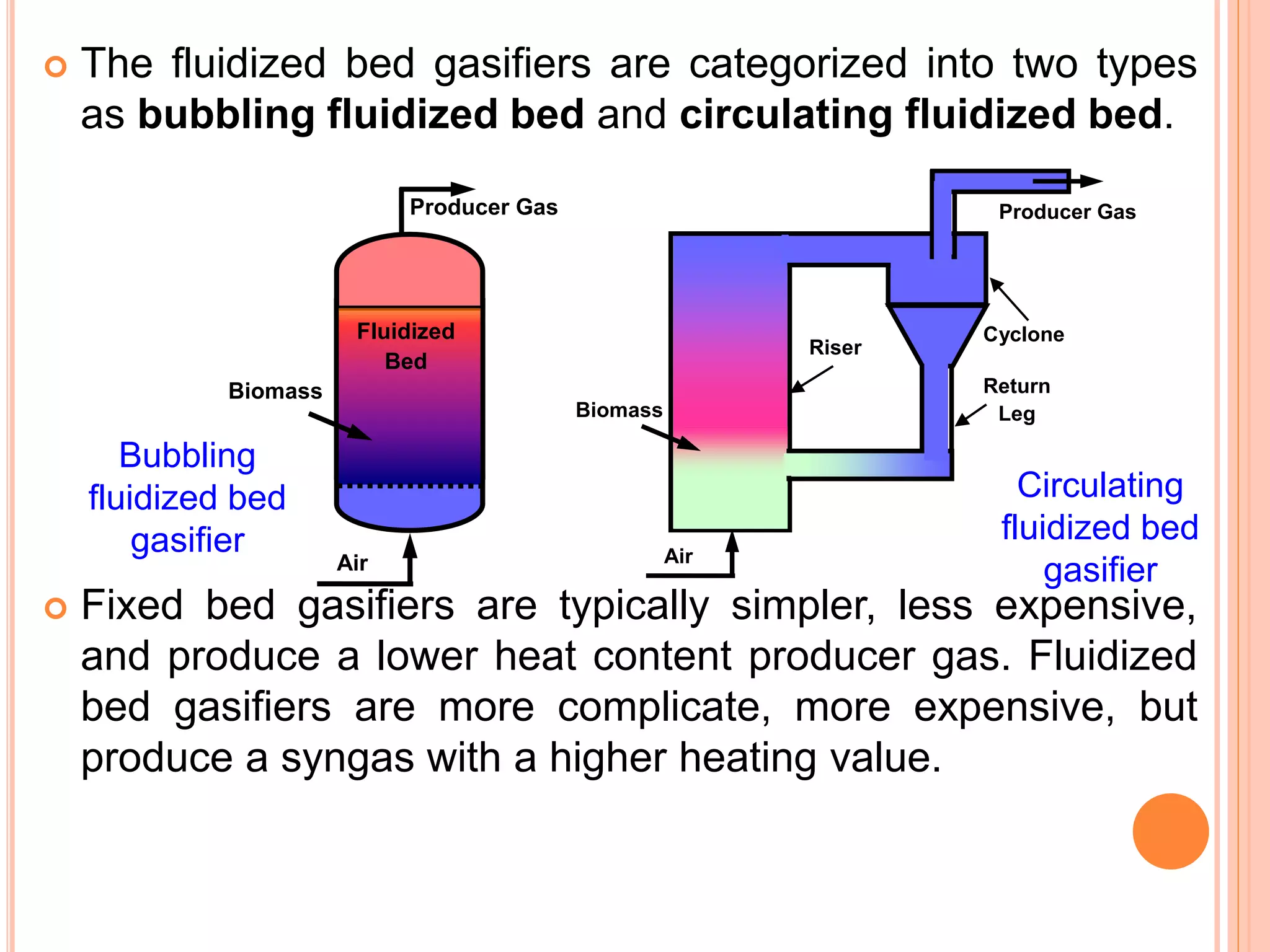
 The fluidized bed gasifiers are categorized into two types
as bubbling fluidized bed and circulating fluidized bed.
 Fixed bed gasifiers are typically simpler, less expensive,
and produce a lower heat content producer gas. Fluidized
bed gasifiers are more complicate, more expensive, but
produce a syngas with a higher heating value.
Biomass
Air
Producer Gas
Fluidized
Bed
Air
Riser
Biomass
Cyclone
Return
Leg
Producer Gas
Bubbling
fluidized bed
gasifier
Circulating
fluidized bed
gasifier
Thank You

Gasification and types of gasifiers

  • 1.
  • 2.
    BIOMASS GASIFICATION  Thegasification is a thermo-chemical process that converts any carbon-containing material into a combustible gas by supplying a restricted amount of oxygen.  In case of biomass feedstock, this gas is known as wood gas, producer gas or syngas, which composed primarily of carbon monoxide and hydrogen as fuels, together with small amount of methane.  It will also contain other compounds, such as sulfur and nitrogen oxides, depending on the chemical composition of the fuel.  Producer gas is a mixture of gases: 18%–22% carbon monoxide (CO), 8%–12% hydrogen (H2), 8%–12% carbon dioxide (CO2), 2%–4% methane (CH4) and 45%–50% nitrogen (N2) making up the rest.
  • 3.
     Under typicalgasification conditions, oxygen levels are restricted to less than 30% of that required for complete combustion.  Raw producer is not an end product, but requires further processing.  Gasification adds value to low- or negative-value feedstocks by converting them to marketable fuels and products.  In utilization of gases from biomass gasification, it is important to understand that gas specifications are different for the various applications.  Furthermore, the composition of the gasification gas is very dependent on the type of gasification process, gasification agent and the gasification temperature.  Based on the general composition and the typical applications, two main types of gasification gas can be distinguished as producer gas and syngas.
  • 4.
    DIFFERENCE BETWEEN PRODUCERGAS AND SYNGAS Low temperature gasification (800 – 1000 C) Producer Gas CO, H2, CH4, CXHY Syngas CO, H2 High temperature (1200 – 1400 C) or catalytic gasification BIOMASS Thermal cracking or reforming End Use Application
  • 5.
    Difference between producergas and syngas  Producer gas is generated in the low temperature gasification process (< 1000°C) and contains CO, H2, CH4, CxHy, aliphatic hydrocarbons, benzene, toluene, and tars (besides CO2, H2O, and N2 in case of gasification in air).  H2 and CO typically contain only ~50% of the energy in the gas, while the remainder is in CH4 and higher (aromatic) HCs.  Syngas is produced by high temperature (above 1200°C) or catalytic gasification.  Under these conditions the biomass is completely converted into H2 and CO (besides CO2, H2O, and N2 in case of gasification in air).  Syngas is chemically similar to that derived from fossil sources.  This gas can also be made from producer gas by heating the thermal cracking or catalytic reforming.
  • 6.
    GASIFICATION AGENTS  Theoxidant for the gasification process can be either atmospheric air or pure oxygen.  Air gasification of biomass produces a low calorific value (or Low Mega-Joule) gas, which contains about 50% nitrogen and can fuel engines and furnaces.  Gasification of biomass with pure oxygen results in a medium calorific value (or Medium Mega-Joule) gas, free of nitrogen.  These system also offer faster reaction rates than air gasification, but has the disadvantage of additional capital costs associated with the oxygen plant.
  • 8.
    GASIFIER END-USES  Syngasor producer gas can be burned to create heat, steam, or electricity.  It can be converted to methane and fed into a natural gas distribution system.  Syngas can also be converted to methanol, ethanol, and other chemicals or liquid fuels.  Methanol produced through gasification can be further refined into biodiesel with addition of vegetable oils or animal fats.  Use of gasification for generation of fuels, chemicals and power.
  • 9.
    ADVANTAGES OF BIOMASSGASIFICATION  Produces a more convenient easily controllable form of cleaner fuel for both thermal energy and electricity generation, and provides a mean to reduce or remove conventional fossil fuels.  Gasification gives biomass the flexibility to fuel a wide range of electricity generation systems: gas turbines, fuel cells, and reciprocating engines.  A wide variety of biomass materials can be gasified, many of which would be difficult to burn otherwise.  Gasification offers one means of processing waste fuels, many of which can be problematic.  Gasification has the potential of reducing emission of pollutants and greenhouse gases per unit energy output.  Projected process efficiencies are higher than the direct combustion systems and comparable with fossil systems.
  • 10.
    BIOMASS GASIFIERS  Twoprincipal types of gasifiers have emerged: fixed bed and fluidized bed.  Fixed bed gasifiers are further classified into three types as updraft, downdraft and cross draft, depending on the flow of gas through the fuel bed. Drying zone Pyrolysis Zone Reduction Zone Combustion Zone Ash Zone Biomass Air Producer gas Biomass Drying zone Pyrolysis Zone Combustion Zone Ash Zone Air Reduction Zone Producer gas Air Reduction Zone Combustion Zone Ash Zone Air Drying zone Pyrolysis Zone Producer gas Biomass (a) Updraft gasifier (b) Down draft gasifier (c) Cross draft gasifier
  • 11.
     The processestaking place in the drying, pyrolysis and reduction zones are driven by heat transferred from the combustion zone (which is also called as the oxidation or hearth zone).  In the drying zone, moisture in biomass evaporates.  In case of updraft gasifier this moisture leaves along with gas at the top.  In case of downdraft gasifier the moisture passes thorough the reduction and combustion zones and participates in certain chemical reactions.  Essentially dry biomass enters the pyrolysis zone from the drying zone.  Pyrolysis converts the dried biomass into char, tar vapour, water vapour and non-condensable gases.
  • 12.
     The vapoursand non-condensable gases leave the gasifier at the top in case of updraft gasifier.  In case of downdraft gasifiers these pass through the combustion zone and undergo further reactions.  The char produced in the pyrolysis zone is around 20% of the original biomass by weight and passes through combustion and reduction zones.  In the combustion zone, oxygen supplied for gasification first comes in contact with the fuel.  In case of updraft gasifier this fuel is carbonized biomass, which can be regarded as consisting of mostly carbon and ash.
  • 13.
    GASIFICATION PROCESS  Mostgasification processes include several overlapping steps.  Among these steps, main two stages could be recognized which a solid biomass fuel is thermo- chemically converted into a Low- or Medium-MJ gas.  In the first reaction, pyrolysis, the volatile components of the fuel are vaporized at temperatures below 600°C by a set of complex reactions. The volatile vapours include hydrocarbon gases, H2, CO, CO2, tar, and water vapor.  In the second stage, char conversion, the carbon remaining after pyrolysis undergoes the classic gasification reaction (i.e. steam + carbon) and/or combustion (carbon + oxygen).
  • 14.
     The combustionreaction provides the heat energy required to drive the two stages of gasification reactions: pyrolysis and char conversion.  Because biomass fuels tend to have more volatile components (70-85% on a dry basis) than coal (30%), pyrolysis plays a larger role in biomass gasification than in coal gasification. Heat Biomass Pyrolysis Char Conversion Combustion Vapors(syngas) GasTurbine PowerCycles Char Vapors (syngas) Char & Ash Ash & Exhaust Gases Heat Char&Ash Heat/Power Application
  • 15.
    GASIFICATION PROCESS: REACTORZONES  A fixed bed gasifier can be regarded as consisting of four different zones: Drying zone, Pyrolysis zone, Reduction zone and Combustion zone in which different chemical and physical processes take place. Drying zone Pyrolysis Zone Reduction Zone Combustion Zone Ash Zone Biomass Air Producer gas
  • 16.
    UPWARD DRAFT ORCOUNTER-CURRENT GASIFIER  This one is oldest and simplest type of gasifier. In this type of gasifier, the air enters at the bottom. The producer gas is drawn off at the top.  Near the grate at the bottom combustion reaction occurs, above that reduction reaction occurs.  In the upper part of the gasifier heating and pyrolysis of the feedstock occurs as a result of heat transfer by forced convention and radiation from the lower zones.
  • 17.
     Tars andvolatile produce produced during the reaction will leave along with the syn gas at the top of the gasifier. Which will be later separated by use of cyclone and candle filter. The resulting gas is rich in hydrocarbons (tars) and is suitable only for direct heating purposes in industrial furnaces. If it is to be used for electricity generation by I.C. engines, it has to be cleaned thoroughly.  The major advantages of this type of gasifier are its simplicity, high charcoal burn out and internal heat exchange leading to low temperature of exit gas and high equipment efficiency. This gasifier can work with several kind of feedstock ranging from Coal to Biomass.  Inlet of coal can be decided based on the type of gasification process selected to be used in this gasifier.
  • 18.
    DOWNDRAFT OR CO-CURRENTGASIFIER  In downdraught or co-current gasifiers air enters at the combustion zone as sown in the Figure. The producer gas leaves near the bottom of the gasifier.  The purpose of this type of gasifier is to convert the tar (produced in the pyrolysis) to gaseous products by complete thermal cracking. This is not possible in an updraught-type gasifier.  The essential characteristic of this type of gasifier is to draw tars (given off in the pyrolysis zone) through the combustion zone. They are broken down or burned in the combustion zone. As a result, the energy they contain is usefully released. The mixture of gases in the exit stream is relatively clean. The arrangement of the combustion or hearth zone is thus a critical element in a downdraught gasifier.
  • 19.
     In mostdowndraught gasifiers, the internal diameter is reduced in the combustion zone to create a throat. This is frequently made of replaceable ceramic material. Air inlet nozzles are commonly set in a lining round the throat to distribute air as uniformly as possible.  This type of gasifier is most commonly used for engine applications due to its ability to produce a relatively clean gas. A disadvantage of this type of gasifier is that slagging or sintering of ash may occur due to the concentrated oxidation (combustion) zone. Rotating ash grates or similar mechanisms can solve this problem. The gasifier efficiency is less than in an up- draught gasifier due to the higher temperature.
  • 20.
     Main disadvantageis that downdraft gasifier cannot be operated with range of different feed-stocks. Low density feedstock gives rise to flow problems and excessive pressure drop. High ash content coal also gives more problem with this kind of gasifier than updraft gasifier.  Other disadvantage is it gives lower efficiency, since there is no provision internal exchange compare to updraft gasifier. The product stream also has low calorific value.
  • 21.
     The flowof air and gas is across the gasifier in a cross draft gasifier as shown in Figure. It operates at very high temperatures. It confines its combustion and reduction zones by using a small diameter air inlet nozzle. Water cooling of the cast iron or steel tuyere is essential due to the high temperature. This type of gasifier responds most rapidly to changes in gas production due to the short path-length for the gasification reactions. CROSS DRAFT GASIFIER Reduction Zone Combustion Zone Ash Zone Air Drying zone Pyrolysis Zone Producer gas Biomass
  • 22.
     Ash formeddue to the high temperature falls to the bottom but does not hinder operation. The high exit temperature of the gases and low CO2 reduction results in poor quality of the gas with low efficiency. The fuel in the hopper behaves as a heat shield against the radiant heat. When operated with charcoal, the gasifier does not need to be refractory lined. Cross-draft gasifiers have very few applications due to their poor efficiency.  Start up time (5-10 minutes) is much faster than that of downdraft and updraft units. The relativey higher temperature in cross draft gas producer has an obvious effect on exit gas composition such as high carbon monoxide and low hydrogen and methane content when dry fuel such as charcoal is used. Cross draft gasifier operates well on dry air blast and dry fuel.
  • 23.
    FLUIDIZED BED GASIFICATION Fluidized bed gasification differs from updraft/downdraft methods of gasification; the gasifying agent (i.e. air) flows through the fuel of the process, which can be biomass, coal, and many other feeds; moisture content is more of an important factor in this process.  A reactive material, such as sand, is also inside of the reactor; these particles will help to make the product gas from this gasifier react even further. As the gasifying agent passes through the fuel, it will keep this fuel suspended in midair; this suspension is the reasoning behind the name “fluidized bed gasification”. (https://www.youtube.com/watch?v=cmm5R_km4Kk&t=3s)  A second stream of a gasifying agent (that is not used to keep the fuel suspended) is usually needed for this process to be optimally efficient; a cyclone attachment can be used to separate the reactive particles, or char, from the syngas. This attachment may also increase the efficiency of this process.
  • 24.
     The fluidizedbed gasifiers are categorized into two types as bubbling fluidized bed and circulating fluidized bed.  Fixed bed gasifiers are typically simpler, less expensive, and produce a lower heat content producer gas. Fluidized bed gasifiers are more complicate, more expensive, but produce a syngas with a higher heating value. Biomass Air Producer Gas Fluidized Bed Air Riser Biomass Cyclone Return Leg Producer Gas Bubbling fluidized bed gasifier Circulating fluidized bed gasifier
  • 27.