TYPES OF GASIFIER
GASIFICATION
 Gasification is a partial oxidation process whereby a carbon source such as
coal, natural gas or biomass is broken down into carbon monoxide (CO)
and Hydrogen (H2) plus carbon dioxide (CO2) and possibly hydrocarbon
molecules such as methane (CH4)
 This mix of gas is known as producer gas and the precise characteristics of
the gas will depend on the gasification parameters such as temperature and
also the oxidizer used
 The oxidizer may be air, in which case the producer gas will also contain
Nitrogen (N2) or steam or oxygen
GASIFIER
• Gasifier is an equipment which can gasify a variety of biomass such as
wood waste, agricultural wastes like stalks and roots of various crops,
maize cobs, etc.
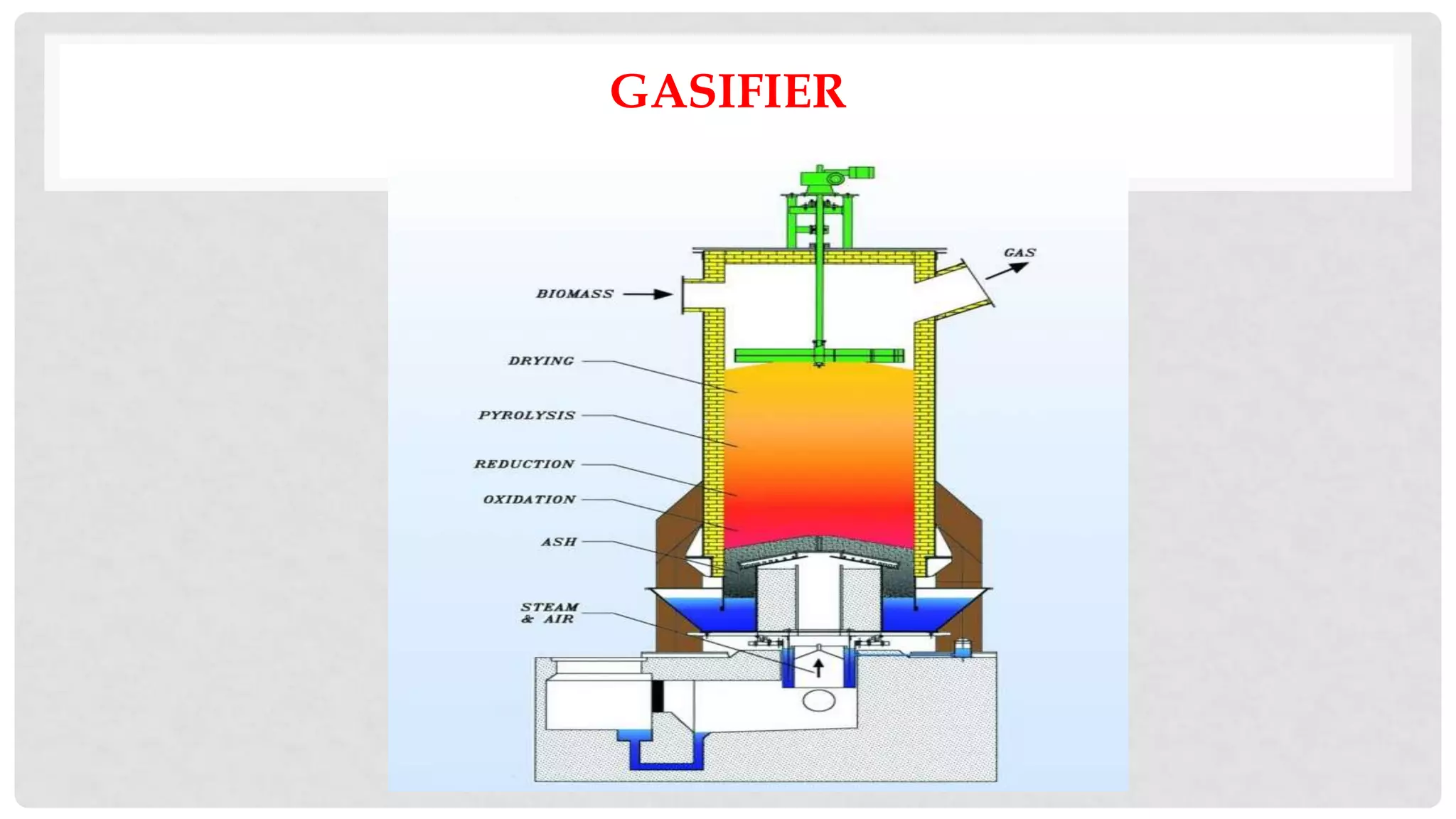
• The gasifier is essentially a chemical processes take place. Biomass gets
dried, heated, pyrolyzed, partially oxidized and reduced, as it flows
through it.
• The gas produced in the gasifier is a clean burning fuel having calorific
value of about 950 to 1200 Kcal/m3.
• Hydrogen(18 - 20 %)and carbon - monoxide (18 - 24%) are the main
constituents of the gas.
• The advantages of a gasifier are very easy to operate, maintain, sturdy in
construction and reliable in operation
GASIFIER
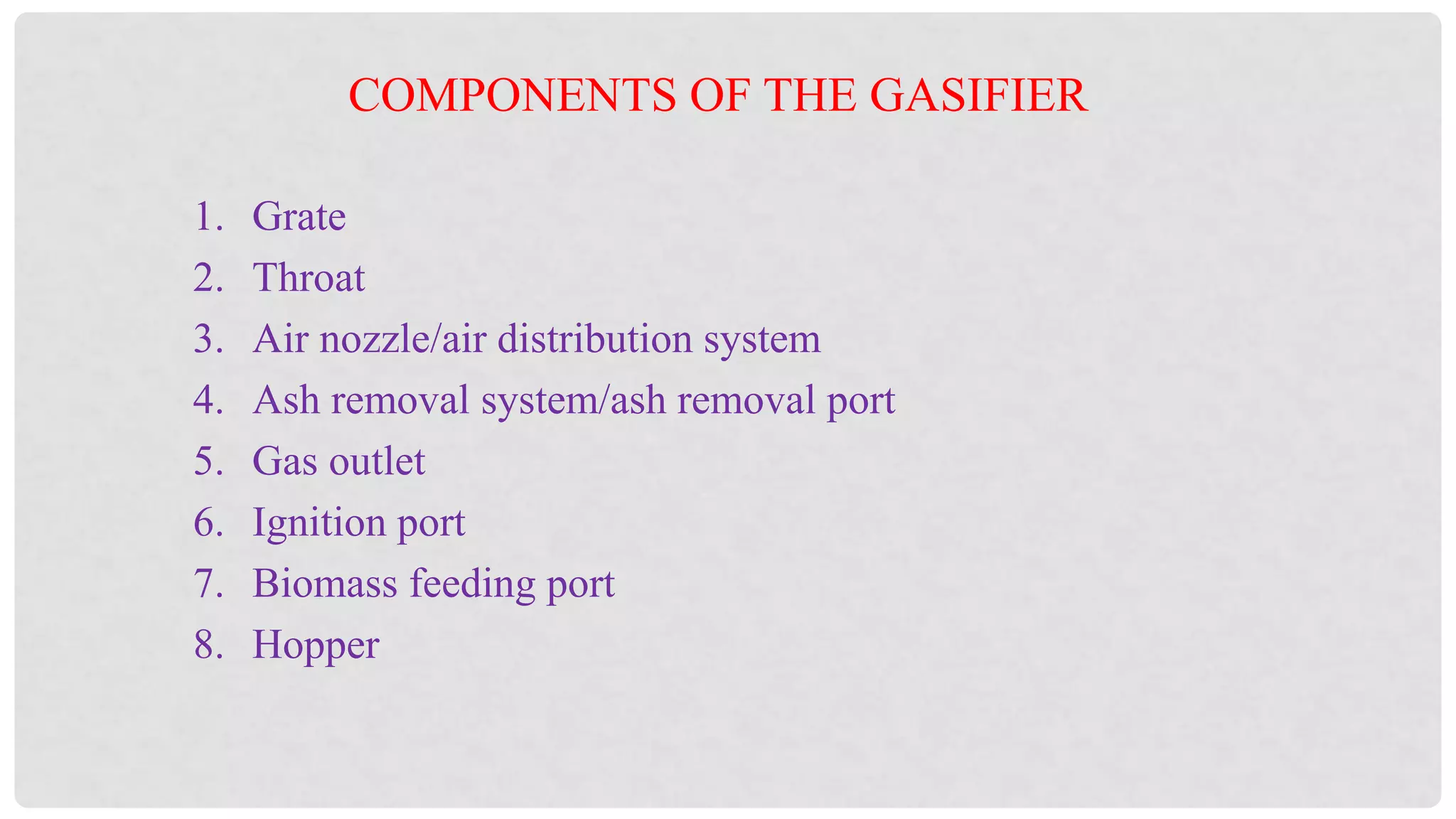
1. Grate
2. Throat
3. Air nozzle/air distribution system
4. Ash removal system/ash removal port
5. Gas outlet
6. Ignition port
7. Biomass feeding port
8. Hopper
COMPONENTS OF THE GASIFIER
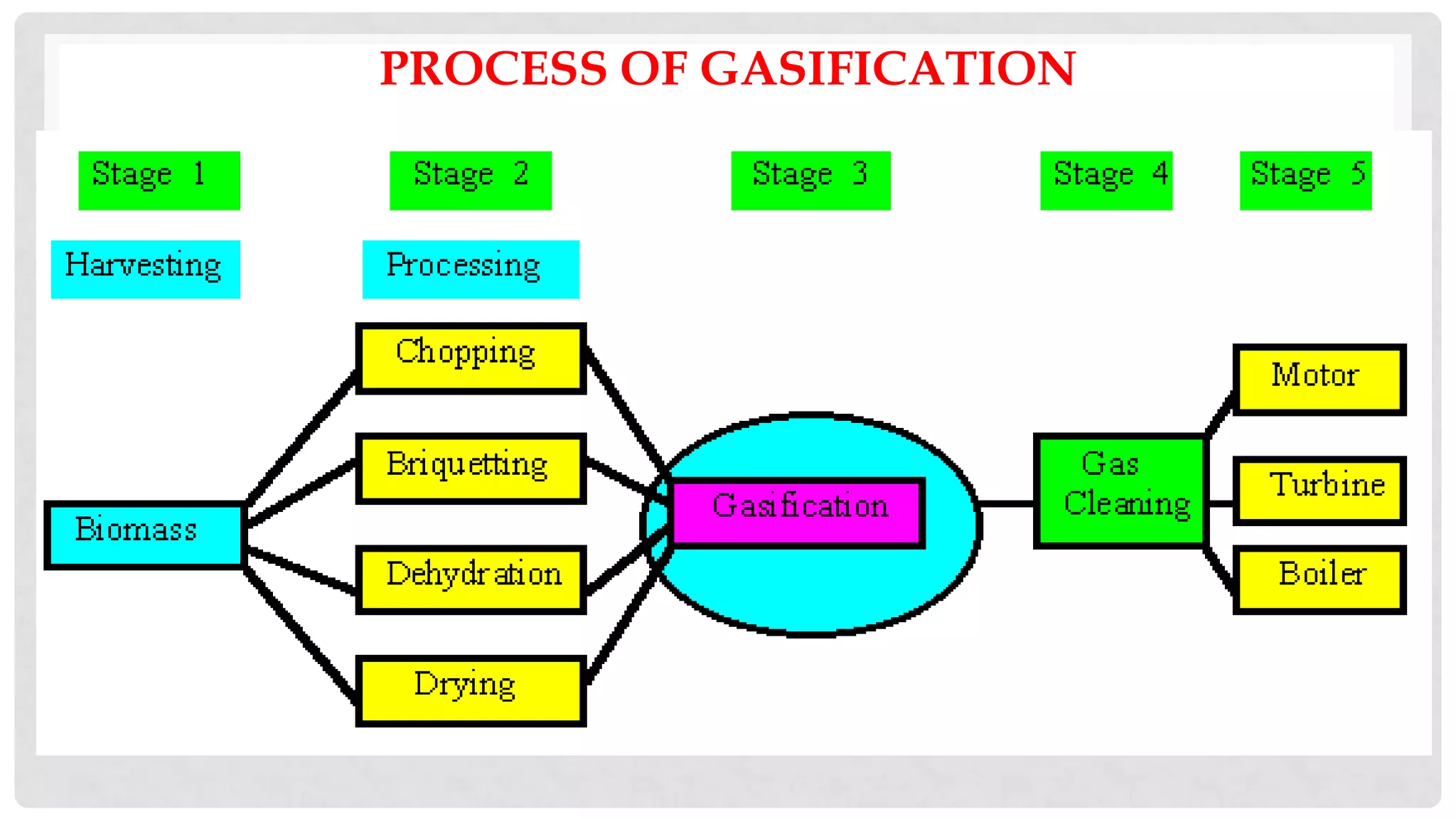
PROCESS OF GASIFICATION
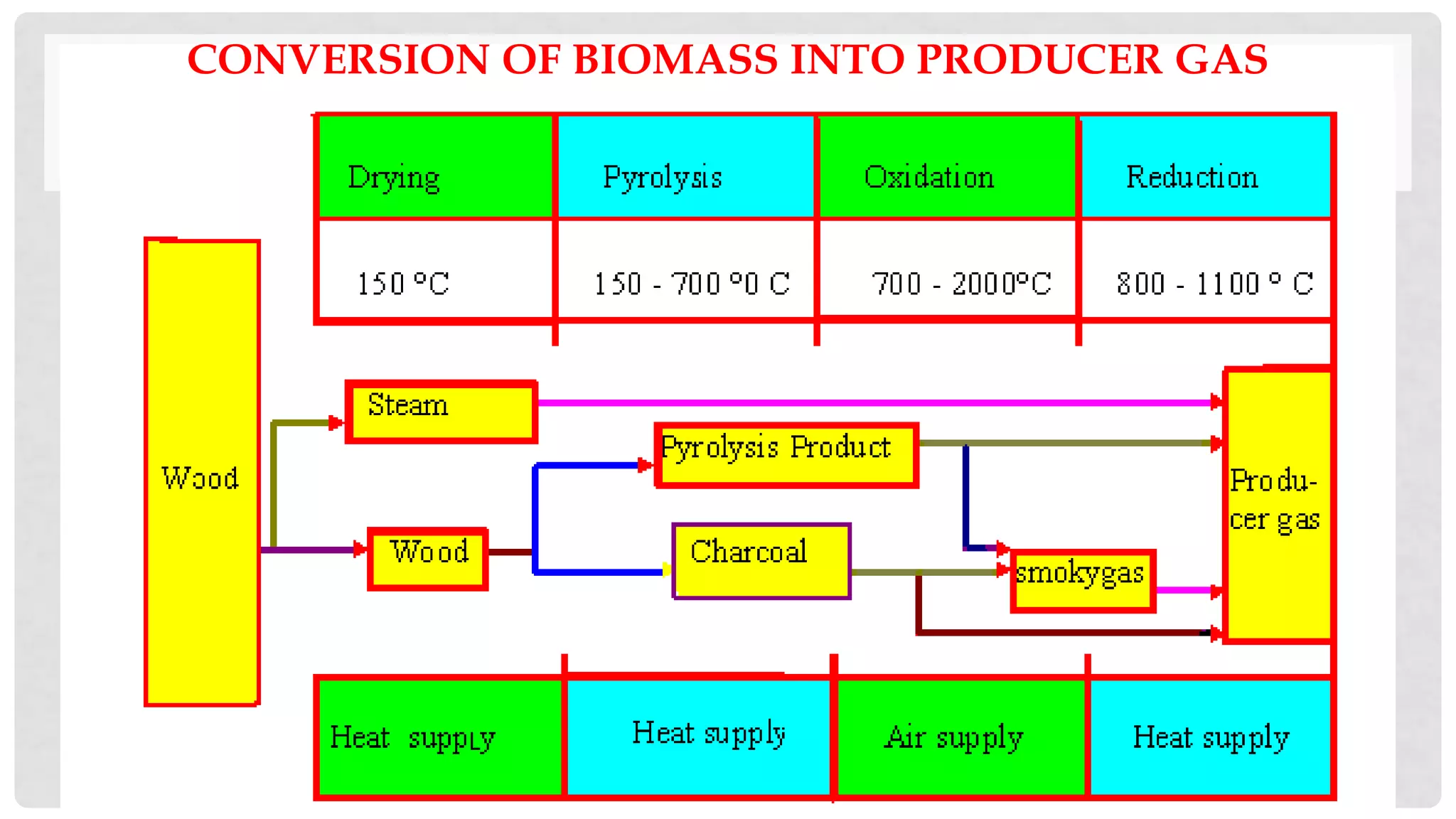
CONVERSION OF BIOMASS INTO PRODUCER GAS
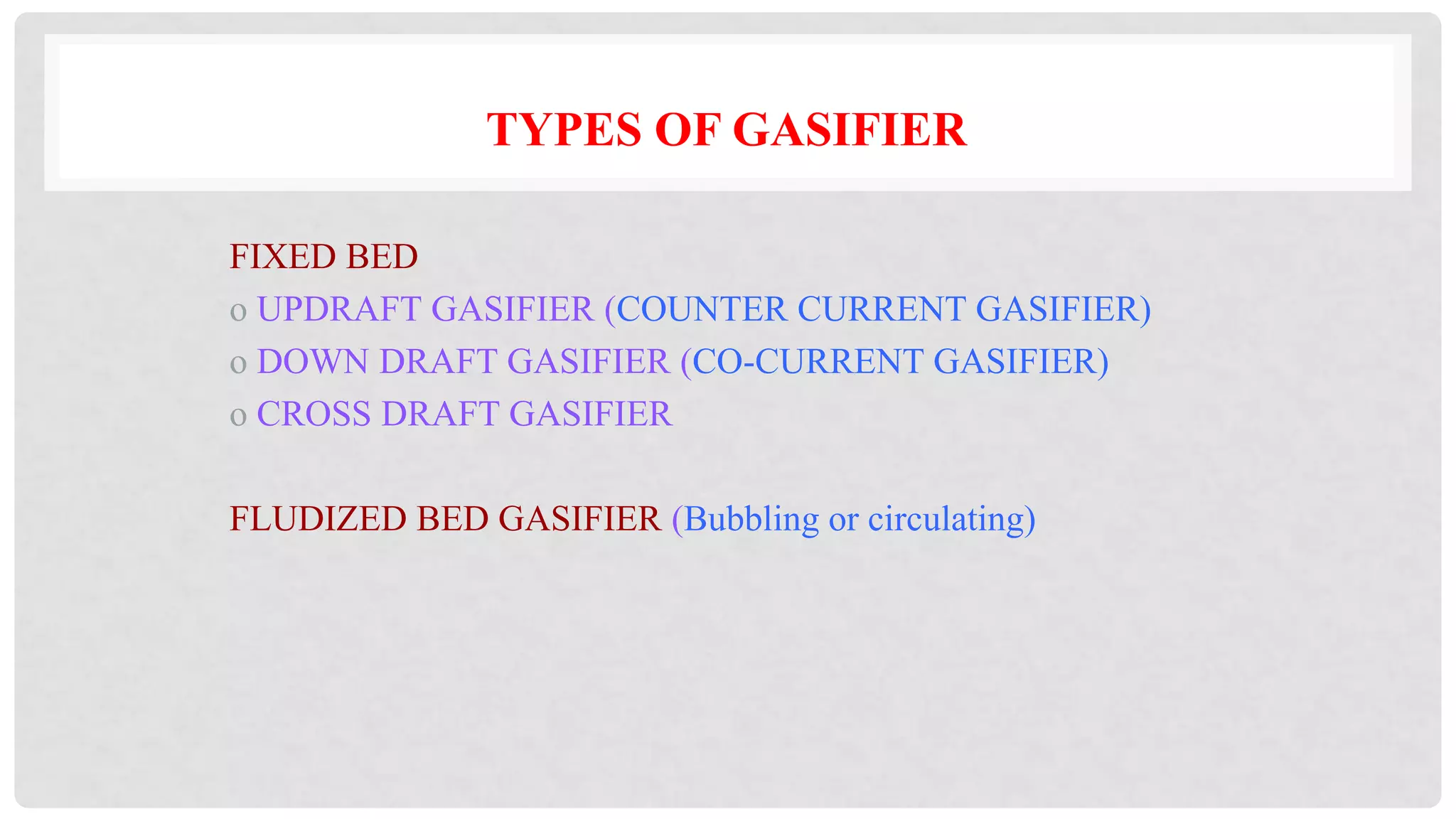
TYPES OF GASIFIER
FIXED BED
o UPDRAFT GASIFIER (COUNTER CURRENT GASIFIER)
o DOWN DRAFT GASIFIER (CO-CURRENT GASIFIER)
o CROSS DRAFT GASIFIER
FLUDIZED BED GASIFIER (Bubbling or circulating)
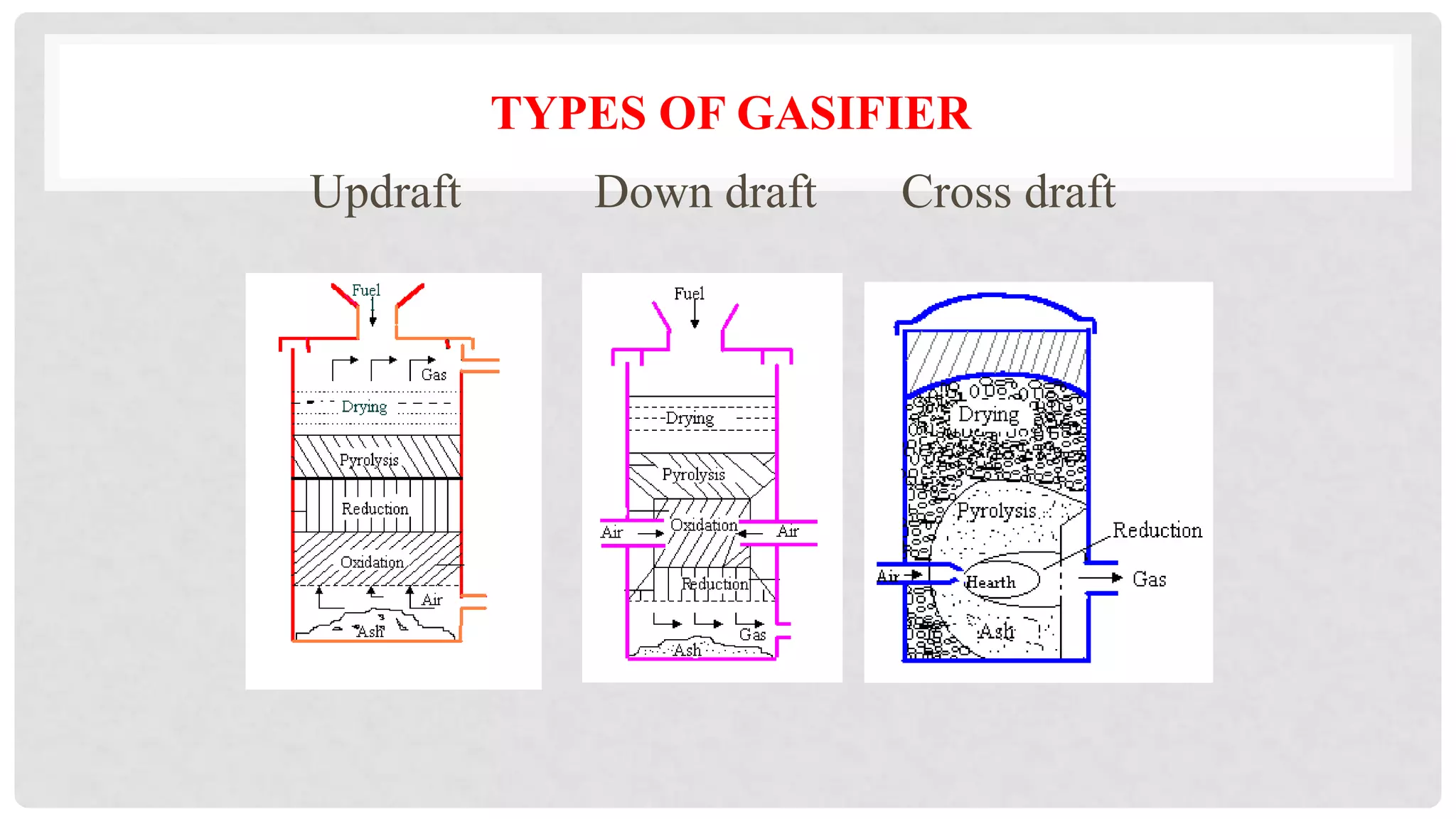
Updraft Down draft Cross draft
TYPES OF GASIFIER
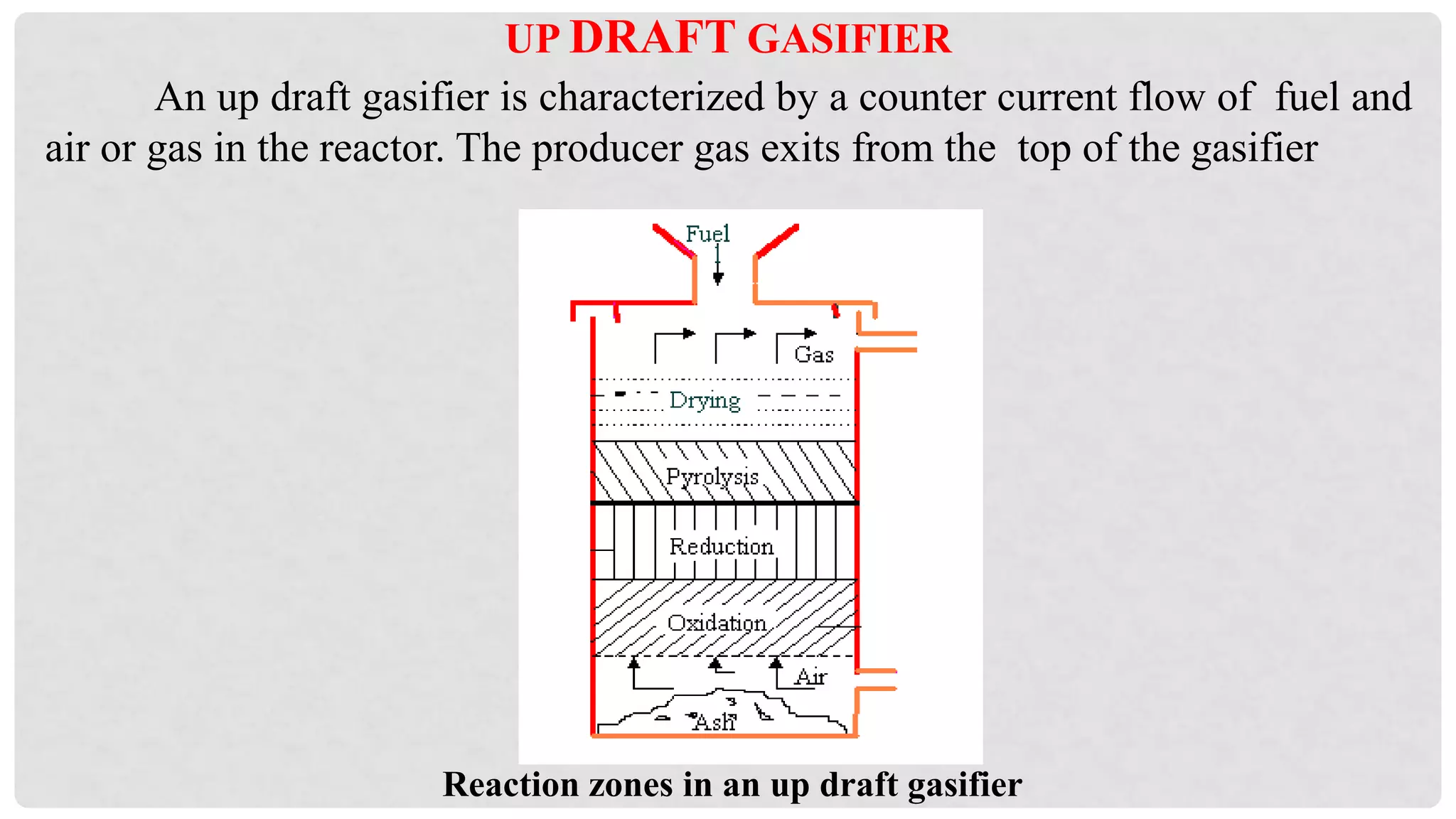
UP DRAFT GASIFIER
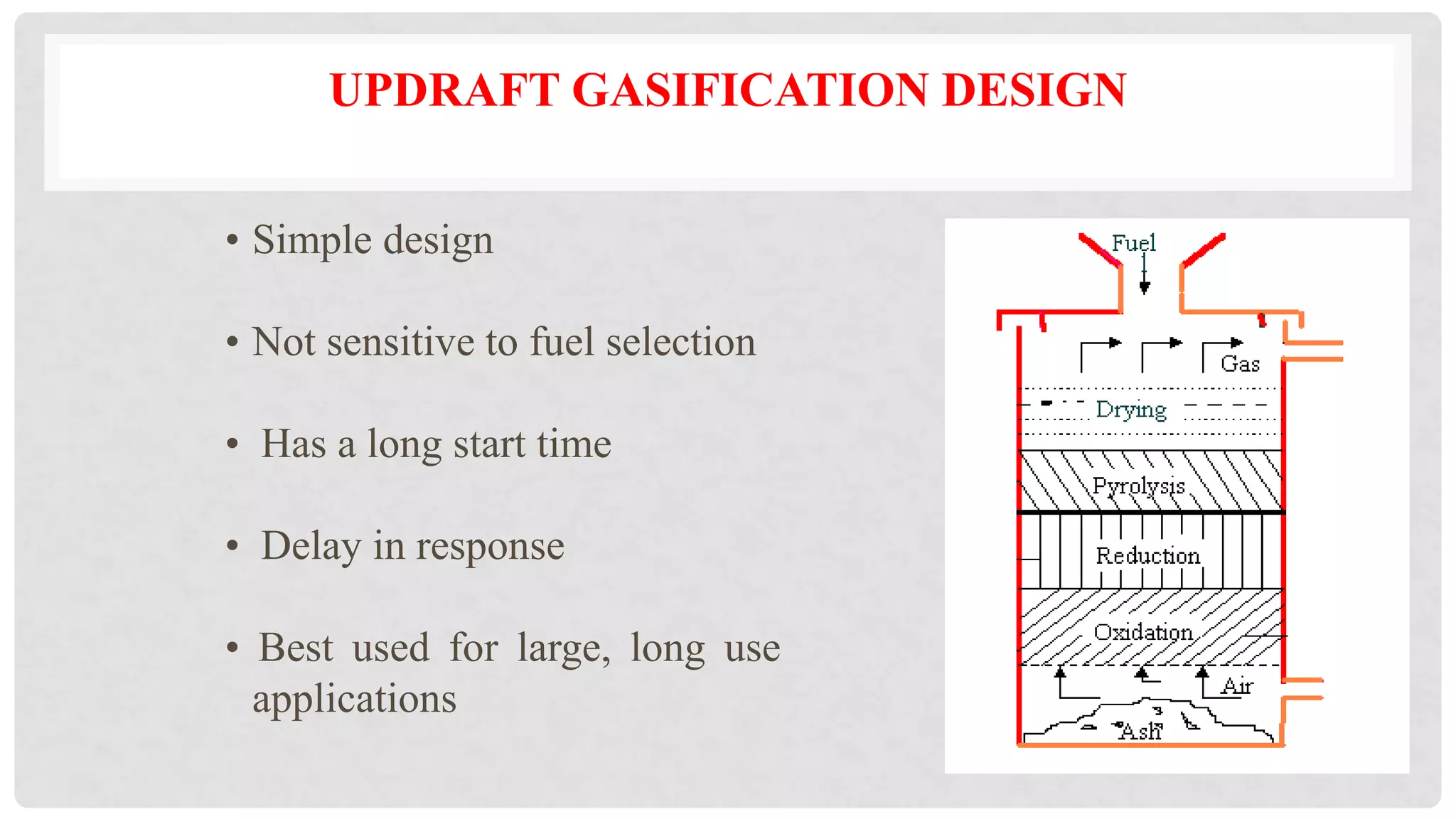
Reaction zones in an up draft gasifier
An up draft gasifier is characterized by a counter current flow of fuel and
air or gas in the reactor. The producer gas exits from the top of the gasifier
FEATURES OF UPDRAFT GASIFIER
• The biomass enters the top of the reaction chamber while steam and air or
oxygen enter from bottom through grate
• The fuel flows downward and up-flowing hot gases pyrolyze it. some of the
resulting charcoal residue falls to the grate, where it burns, producing heat
and giving off carbon dioxide and water vapor
• The CO2 and H2O react with other charcoal particles, producing carbon
monoxide and hydrogen gases
• The gases exit from the top and ashes fall through the grate
• The updraft design is relatively simple and can handle biomass fuels with
high ash and moisture content
• The gas contains 10-20 percent volatile oils making the gas unsuitable for
use in engines or gas turbines
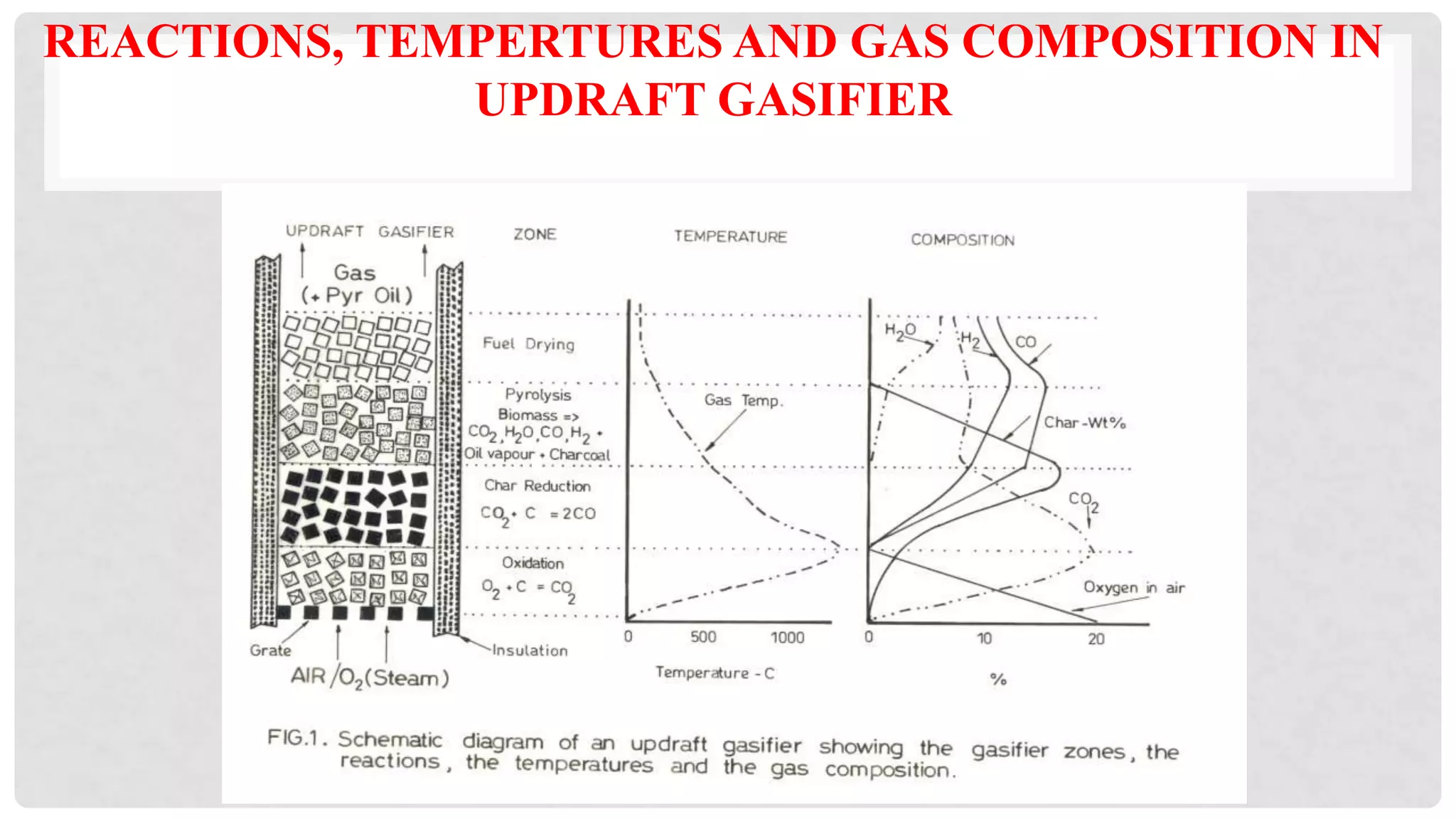
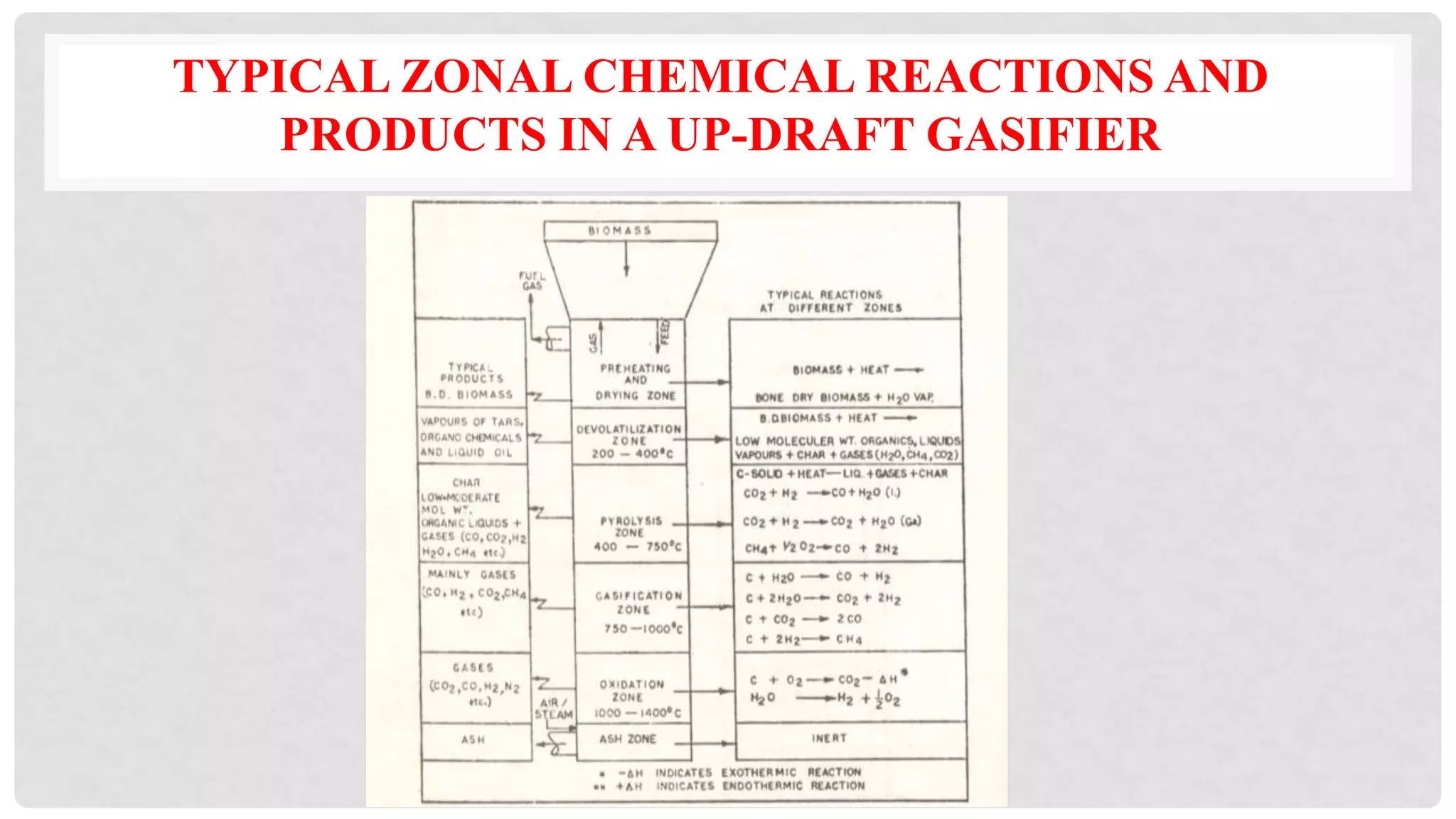
TYPICAL ZONAL CHEMICAL REACTIONS AND
PRODUCTS IN A UP-DRAFT GASIFIER
THERMO-CHEMICAL REACTIONS OCCURRING
IN GASIFICATION
REDUCTION ZONE
Products of partial combustion – H2O, CO2 and uncombusted and partially cracked
pyrolytic products undergo the following chemical reactions in the red-hot charcoal
bed
C + CO2 = 2CO (- 164.9 MJ/kg mole) [Boudouard reaction]
C +H2O = CO + H2 (- 122.6 MJ/kg mole) [water gas ]
CO + H2O = CO + H2 (+ 42 MJ/kg mole) [water shift reaction]
C + 2H2 = CH4 (+ 75 MJ/kg mole) [Methane reaction]
CO2 + H2 = CO + H2O (- 42.3 MJ/kg mole)
 Low reduction zone temperature yields low calorific value of gas
 Average temp is 850 0C
UPDRAFT GASIFICATION DESIGN
• Simple design
• Not sensitive to fuel selection
• Has a long start time
• Delay in response
• Best used for large, long use
applications
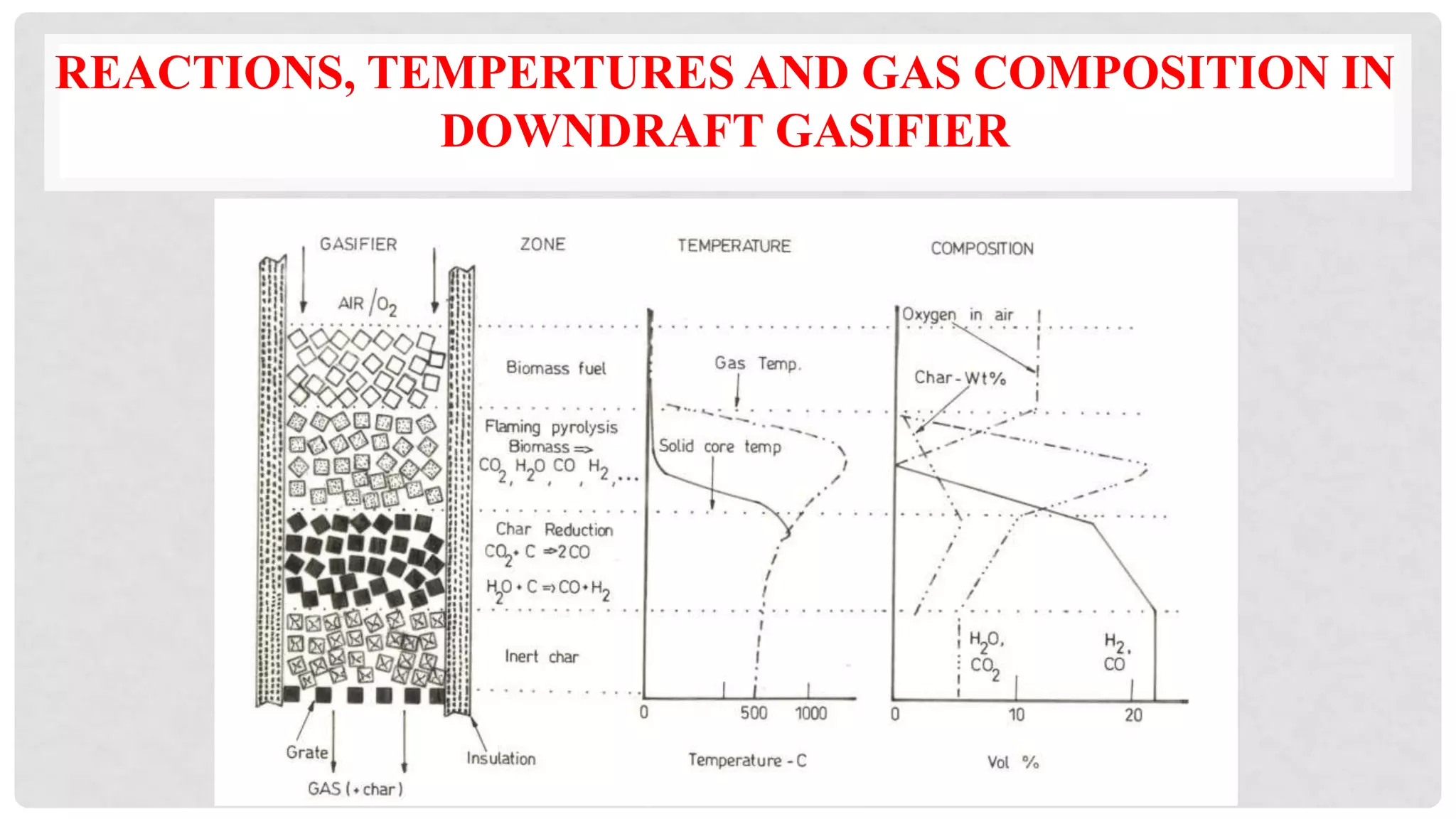
REACTIONS, TEMPERTURES AND GAS COMPOSITION IN
UPDRAFT GASIFIER
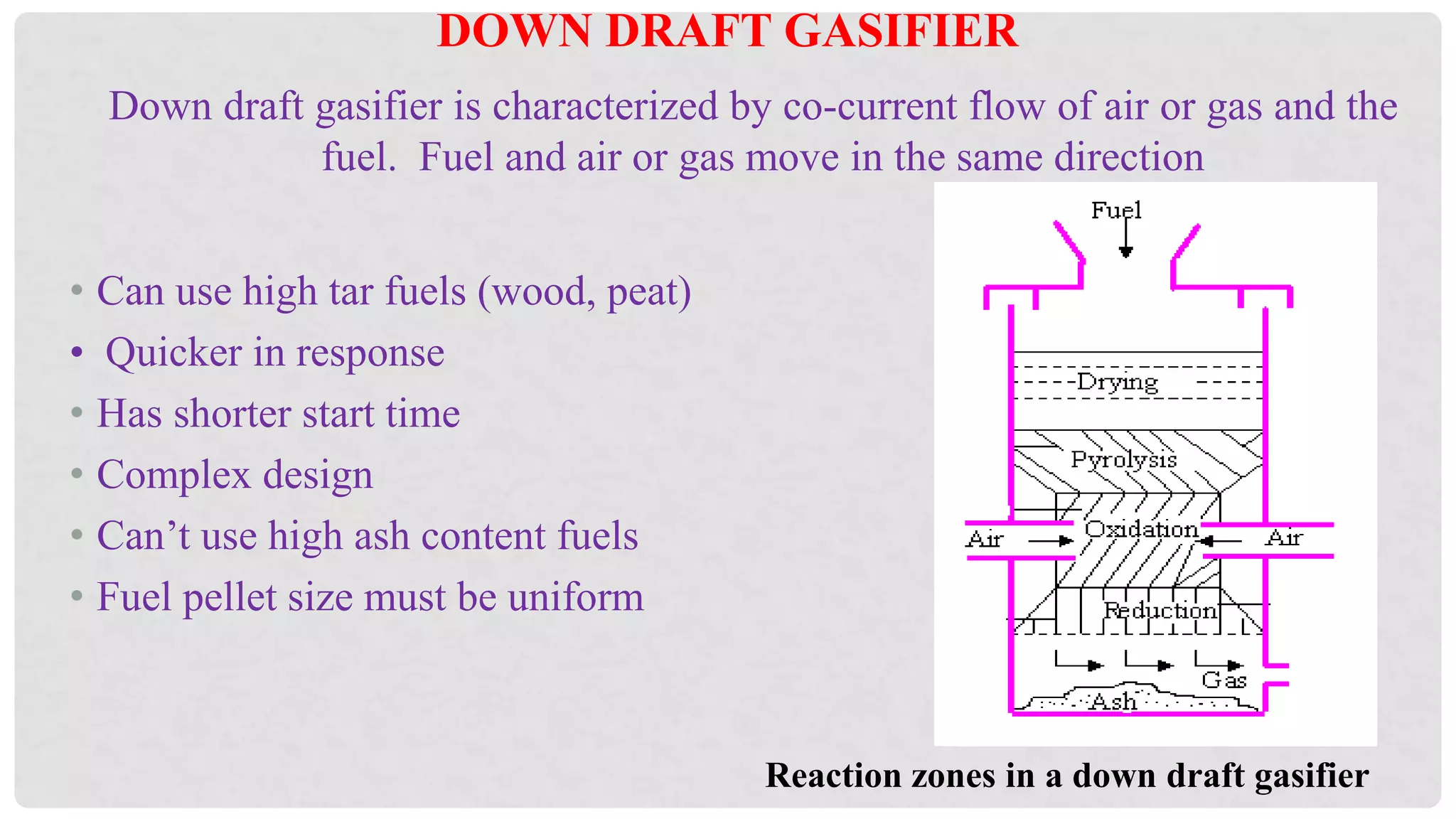
Down draft gasifier is characterized by co-current flow of air or gas and the
fuel. Fuel and air or gas move in the same direction
Reaction zones in a down draft gasifier
DOWN DRAFT GASIFIER
• Can use high tar fuels (wood, peat)
• Quicker in response
• Has shorter start time
• Complex design
• Can’t use high ash content fuels
• Fuel pellet size must be uniform
FEATURES OF DOWN DRAFT GASIFIER
• Gasifier requires drying of biomass fuel to a moisture content of less than 20
percent
• Fuel and air or oxygen enter the top of the reaction chamber
• Down-flowing fuel particles ignite, burning intensely and leaving a
charcoal residue
• The charcoal which is about 5 to 15 percent of the mass of original fuel,
then reacts with the combustion gases, producing CO and H2 gases
• These gases flow down and exit from the chamber below a grate
• The producer gas leaving the gasifier is at a high temperature
• Combustion ash falls through the grate
• The advantage of the downdraft design is the very low tar content of the
producer gas
REACTIONS, TEMPERTURES AND GAS COMPOSITION IN
DOWNDRAFT GASIFIER
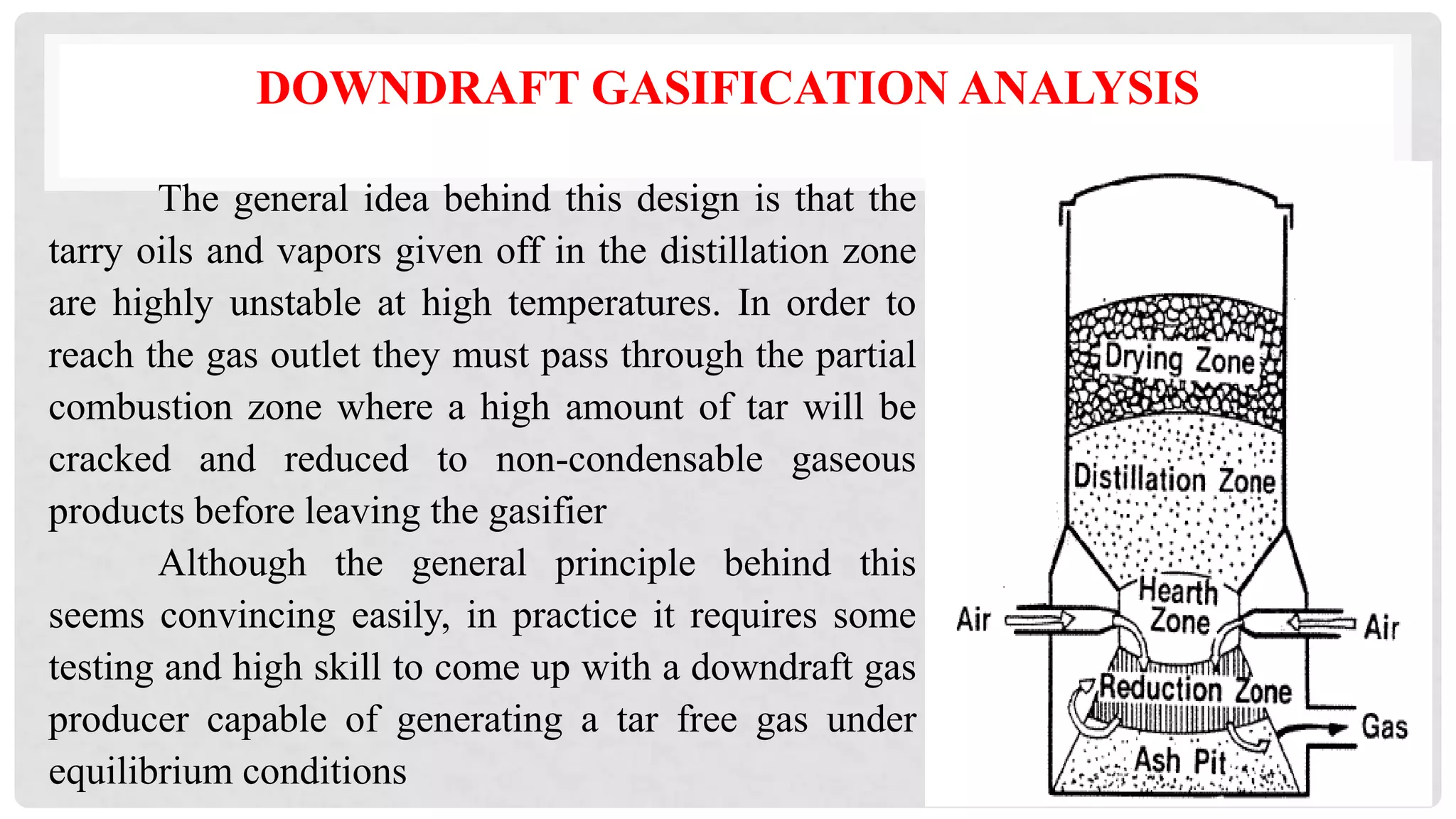
DOWNDRAFT GASIFICATION ANALYSIS
The general idea behind this design is that the
tarry oils and vapors given off in the distillation zone
are highly unstable at high temperatures. In order to
reach the gas outlet they must pass through the partial
combustion zone where a high amount of tar will be
cracked and reduced to non-condensable gaseous
products before leaving the gasifier
Although the general principle behind this
seems convincing easily, in practice it requires some
testing and high skill to come up with a downdraft gas
producer capable of generating a tar free gas under
equilibrium conditions
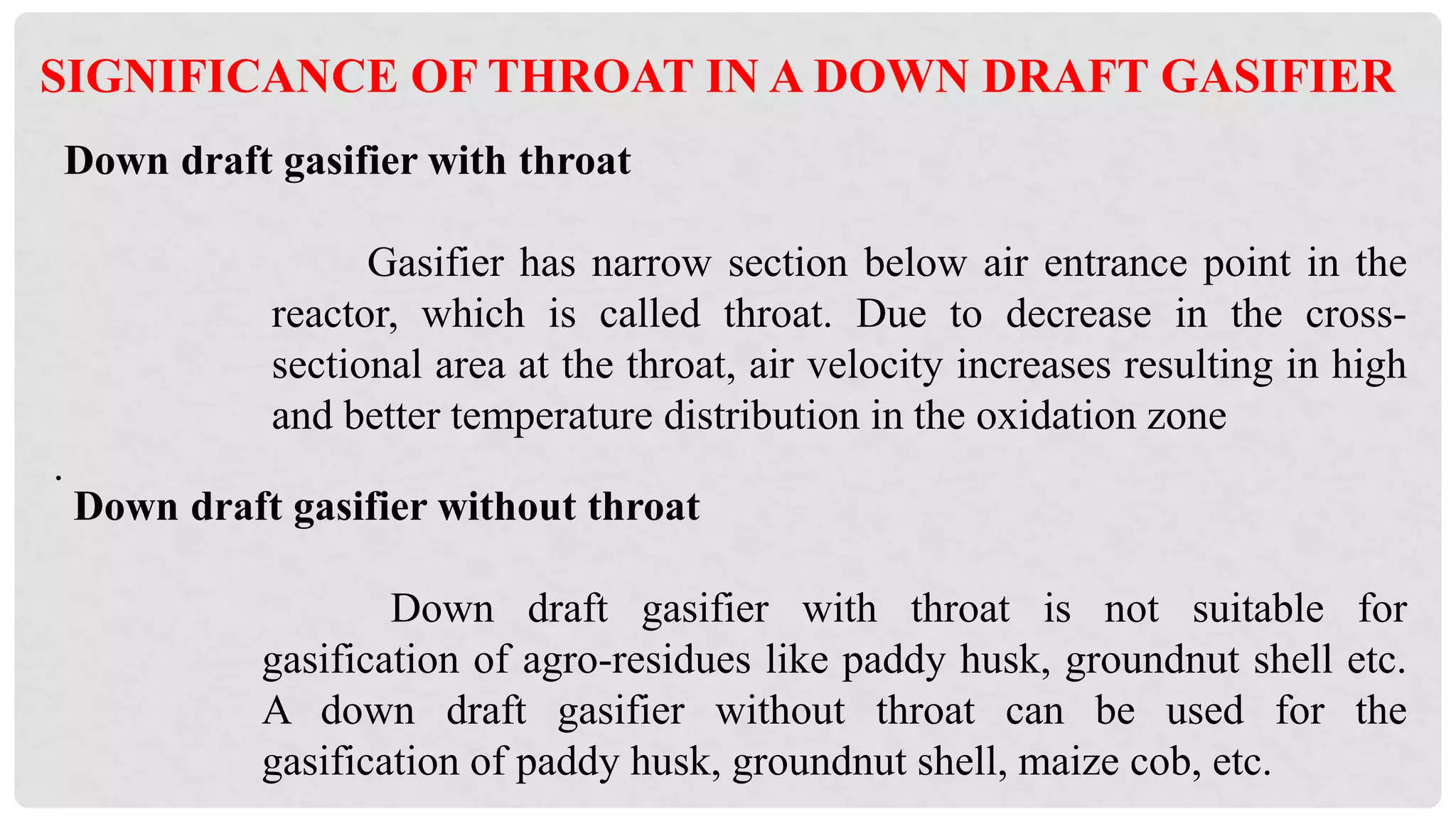
Down draft gasifier without throat
Down draft gasifier with throat is not suitable for
gasification of agro-residues like paddy husk, groundnut shell etc.
A down draft gasifier without throat can be used for the
gasification of paddy husk, groundnut shell, maize cob, etc.
Down draft gasifier with throat
Gasifier has narrow section below air entrance point in the
reactor, which is called throat. Due to decrease in the cross-
sectional area at the throat, air velocity increases resulting in high
and better temperature distribution in the oxidation zone
.
SIGNIFICANCE OF THROAT IN A DOWN DRAFT GASIFIER
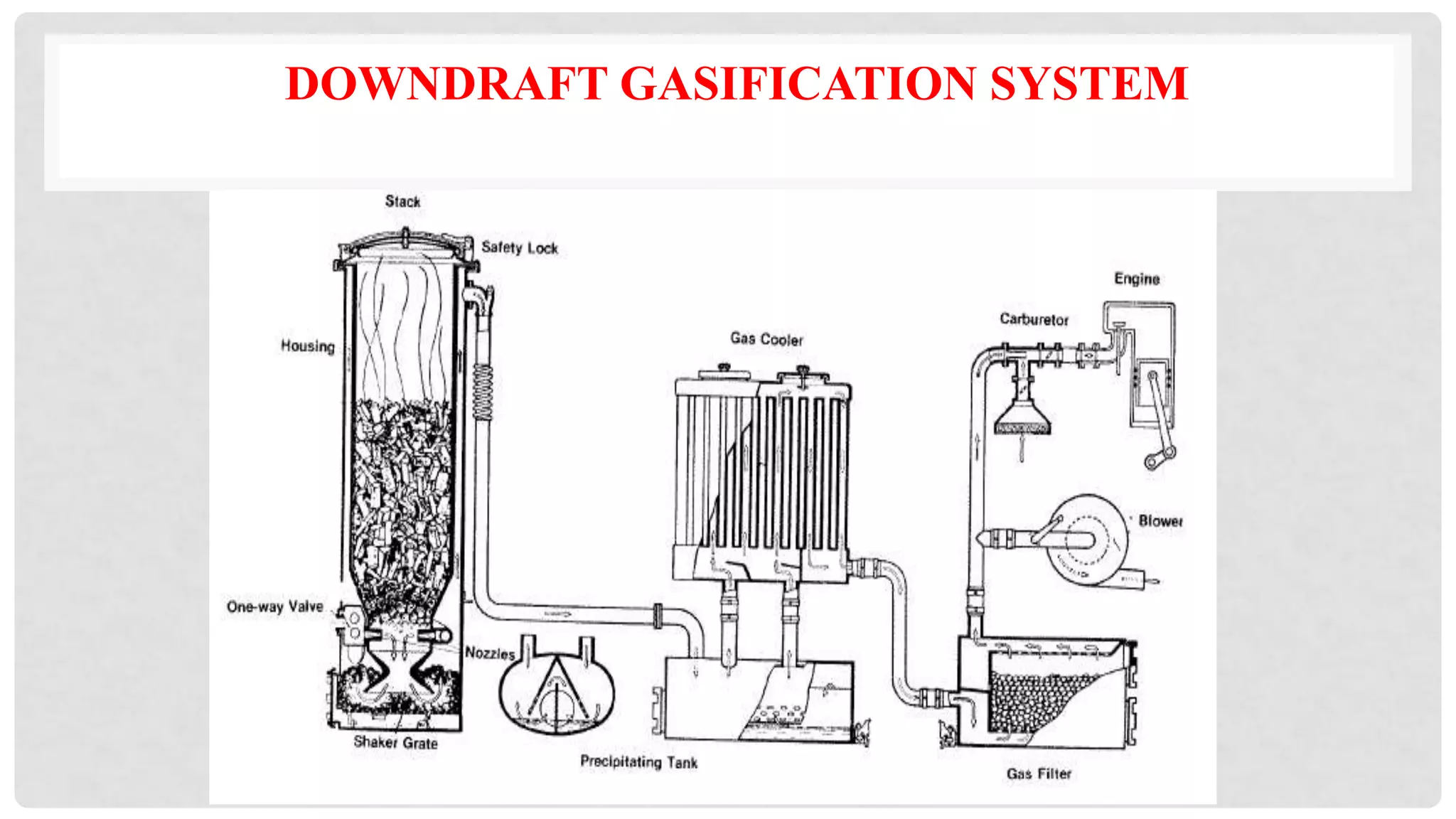
DOWNDRAFT GASIFICATION SYSTEM
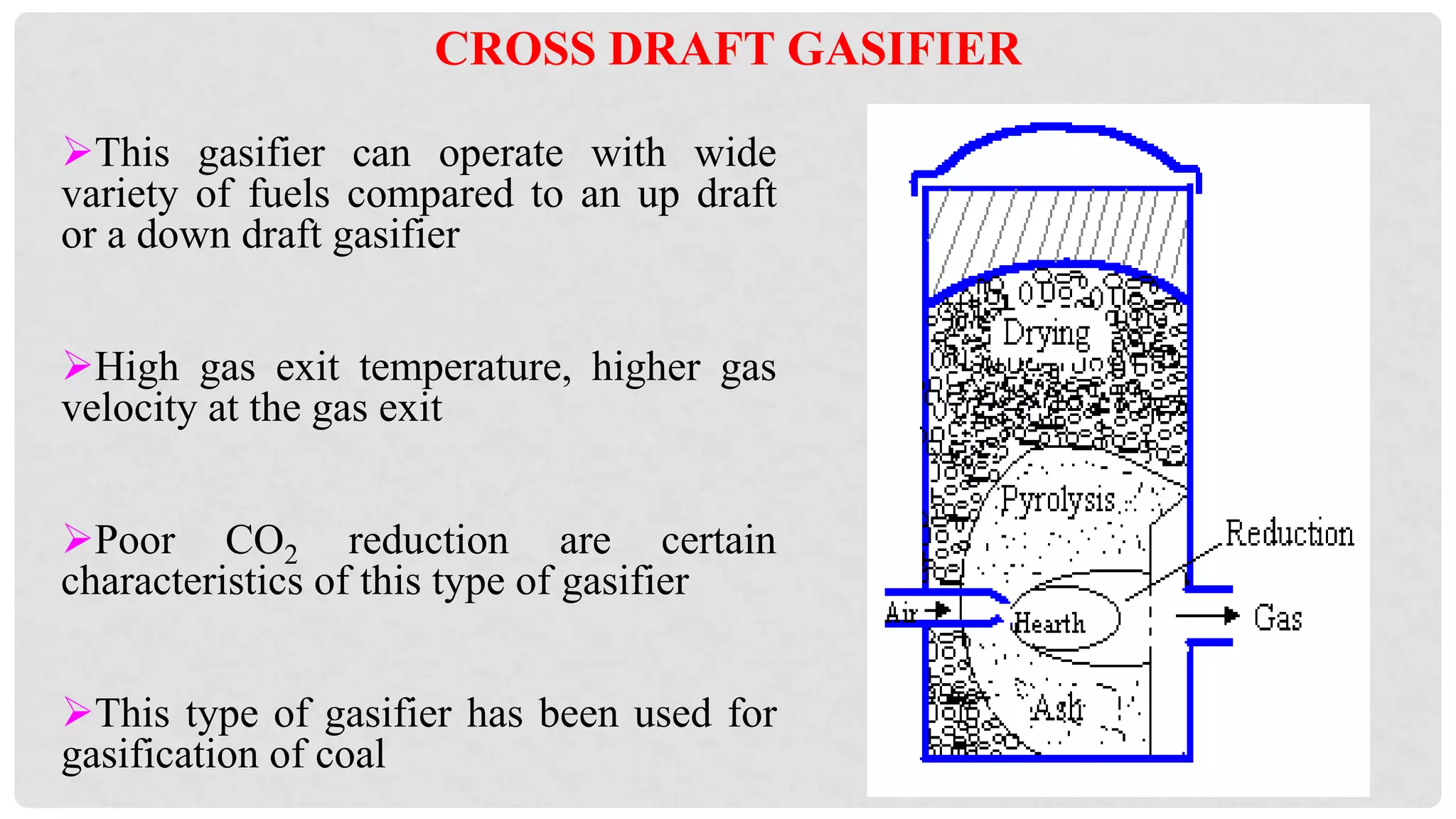
This gasifier can operate with wide
variety of fuels compared to an up draft
or a down draft gasifier
High gas exit temperature, higher gas
velocity at the gas exit
Poor CO2 reduction are certain
characteristics of this type of gasifier
This type of gasifier has been used for
gasification of coal
CROSS DRAFT GASIFIER
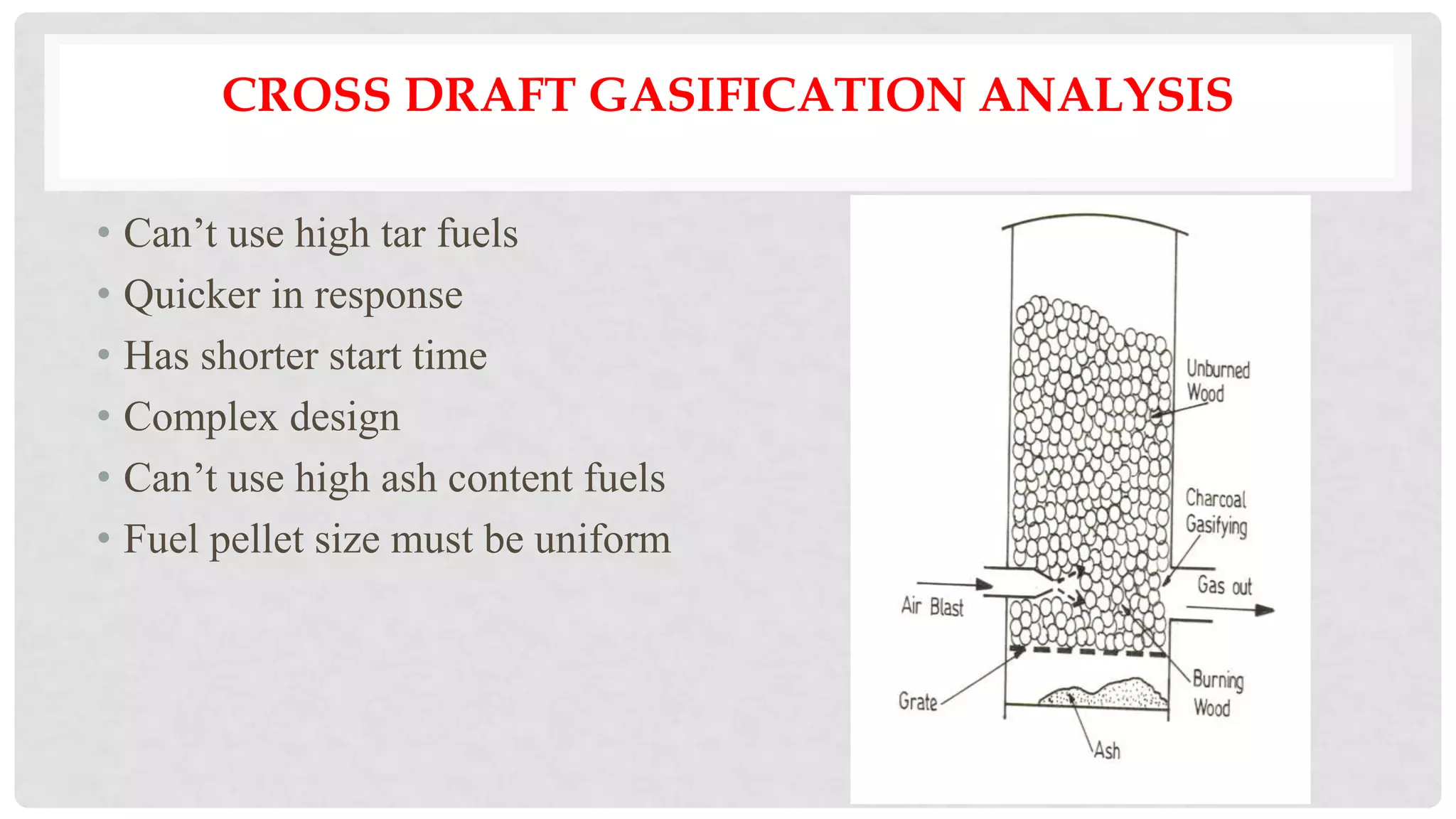
CROSS DRAFT GASIFICATION ANALYSIS
• Can’t use high tar fuels
• Quicker in response
• Has shorter start time
• Complex design
• Can’t use high ash content fuels
• Fuel pellet size must be uniform
FLUIDIZED BED GASIFICATION
A fluidization bed is a chamber with a perforated floor
having pressurized air flowing vertically where a particle
medium usually sand, is contained. The pressurized and flowing
air helps the medium allowing it to act as a fluid
• Can use most fuels (wood, peat and coal)
including agriculture waste such as straw, corn
stover and manure
• Has potential to use municipal waste such as
garbage
• Quicker in response
• Has shorter start time
• Complex design
• Lends itself to complete combustion applications
which would allow it to use liquid wastes such as
used engine oil, non-recyclable plastics & old
shoes, garbage for generation of heat
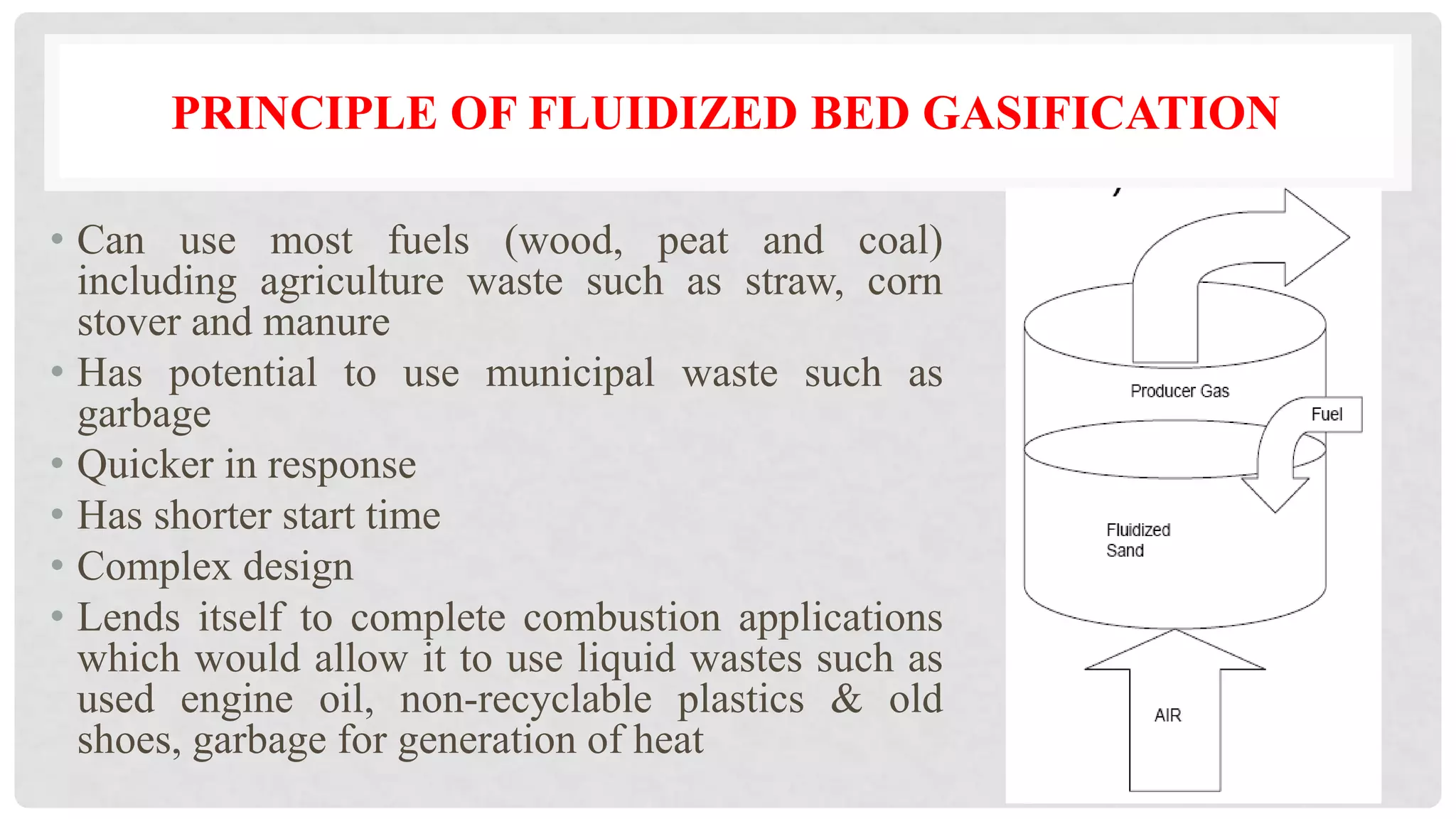
PRINCIPLE OF FLUIDIZED BED GASIFICATION
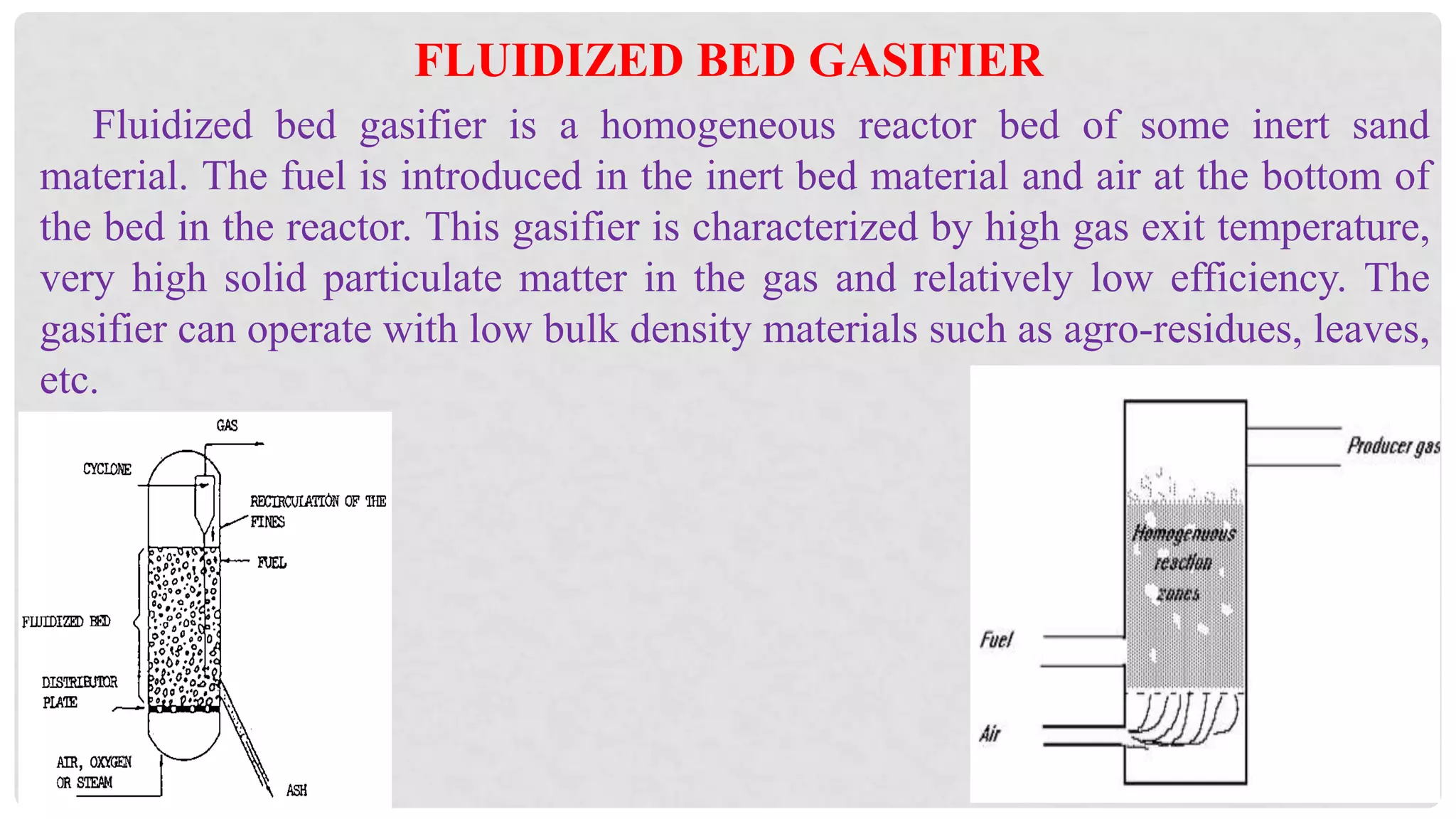
Fluidized bed gasifier is a homogeneous reactor bed of some inert sand
material. The fuel is introduced in the inert bed material and air at the bottom of
the bed in the reactor. This gasifier is characterized by high gas exit temperature,
very high solid particulate matter in the gas and relatively low efficiency. The
gasifier can operate with low bulk density materials such as agro-residues, leaves,
etc.
FLUIDIZED BED GASIFIER
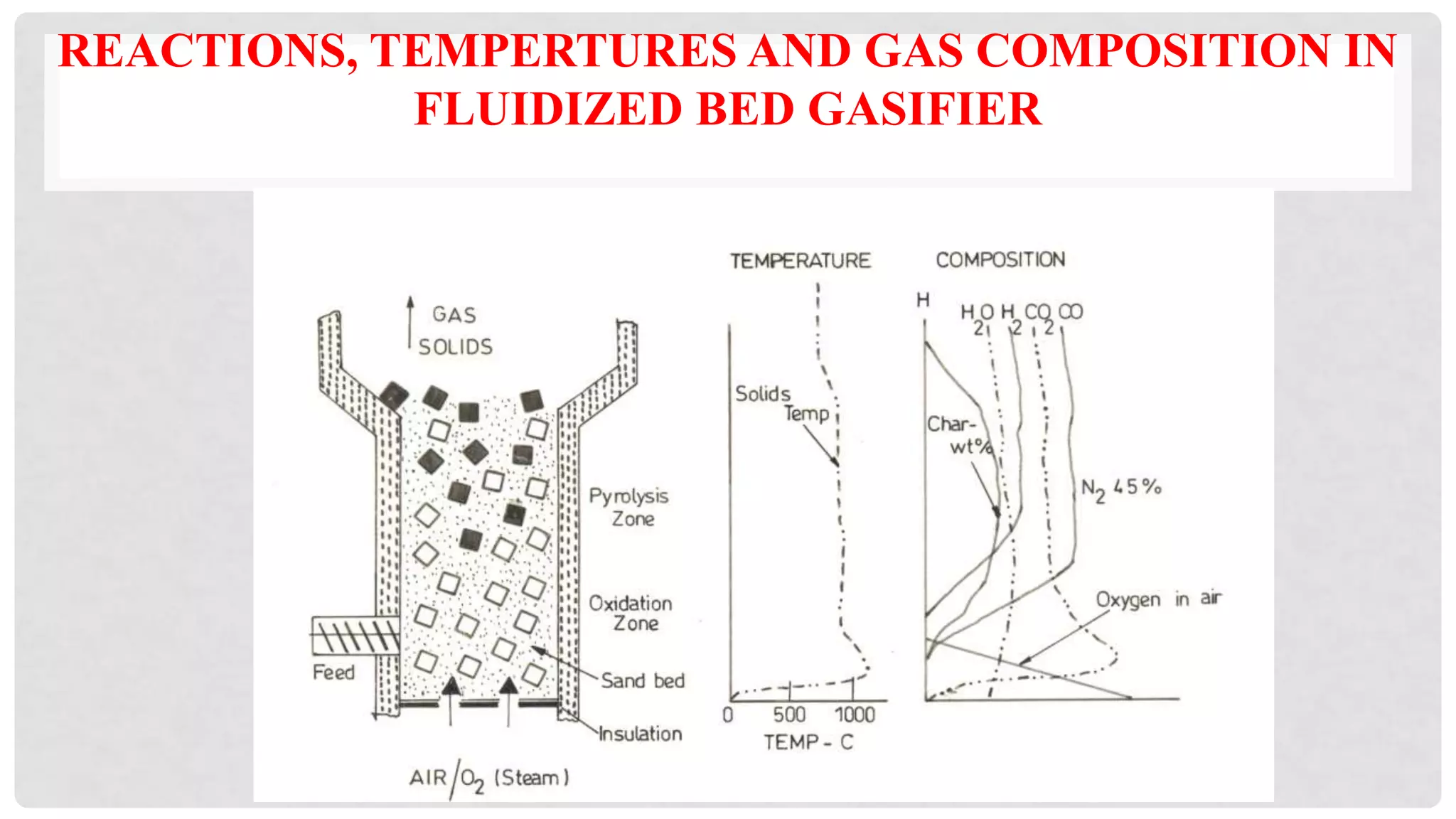
REACTIONS, TEMPERTURES AND GAS COMPOSITION IN
FLUIDIZED BED GASIFIER
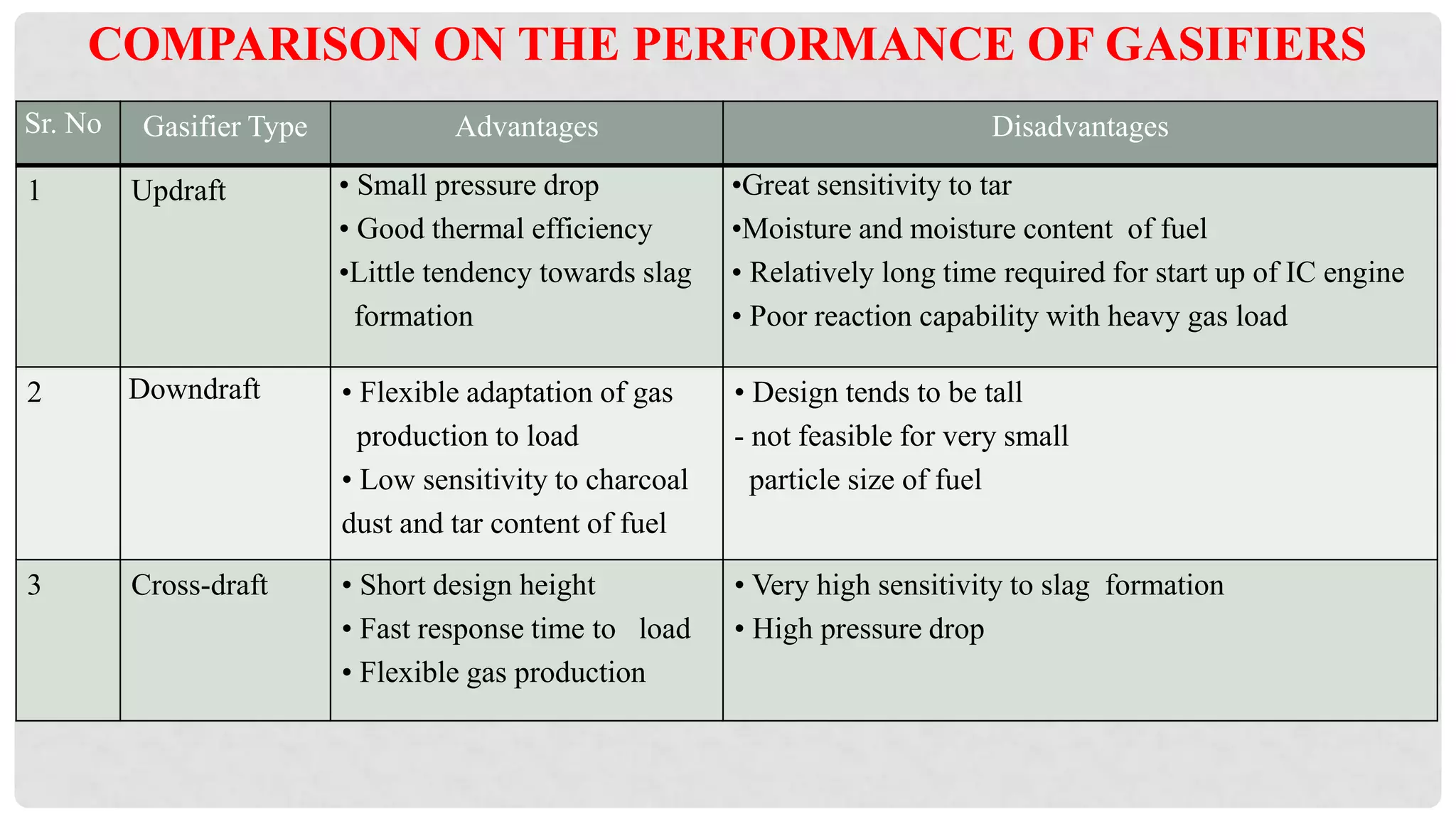
Sr. No Gasifier Type Advantages Disadvantages
1 Updraft • Small pressure drop
• Good thermal efficiency
•Little tendency towards slag
formation
•Great sensitivity to tar
•Moisture and moisture content of fuel
• Relatively long time required for start up of IC engine
• Poor reaction capability with heavy gas load
2 Downdraft • Flexible adaptation of gas
production to load
• Low sensitivity to charcoal
dust and tar content of fuel
• Design tends to be tall
- not feasible for very small
particle size of fuel
3 Cross-draft • Short design height
• Fast response time to load
• Flexible gas production
• Very high sensitivity to slag formation
• High pressure drop
COMPARISON ON THE PERFORMANCE OF GASIFIERS
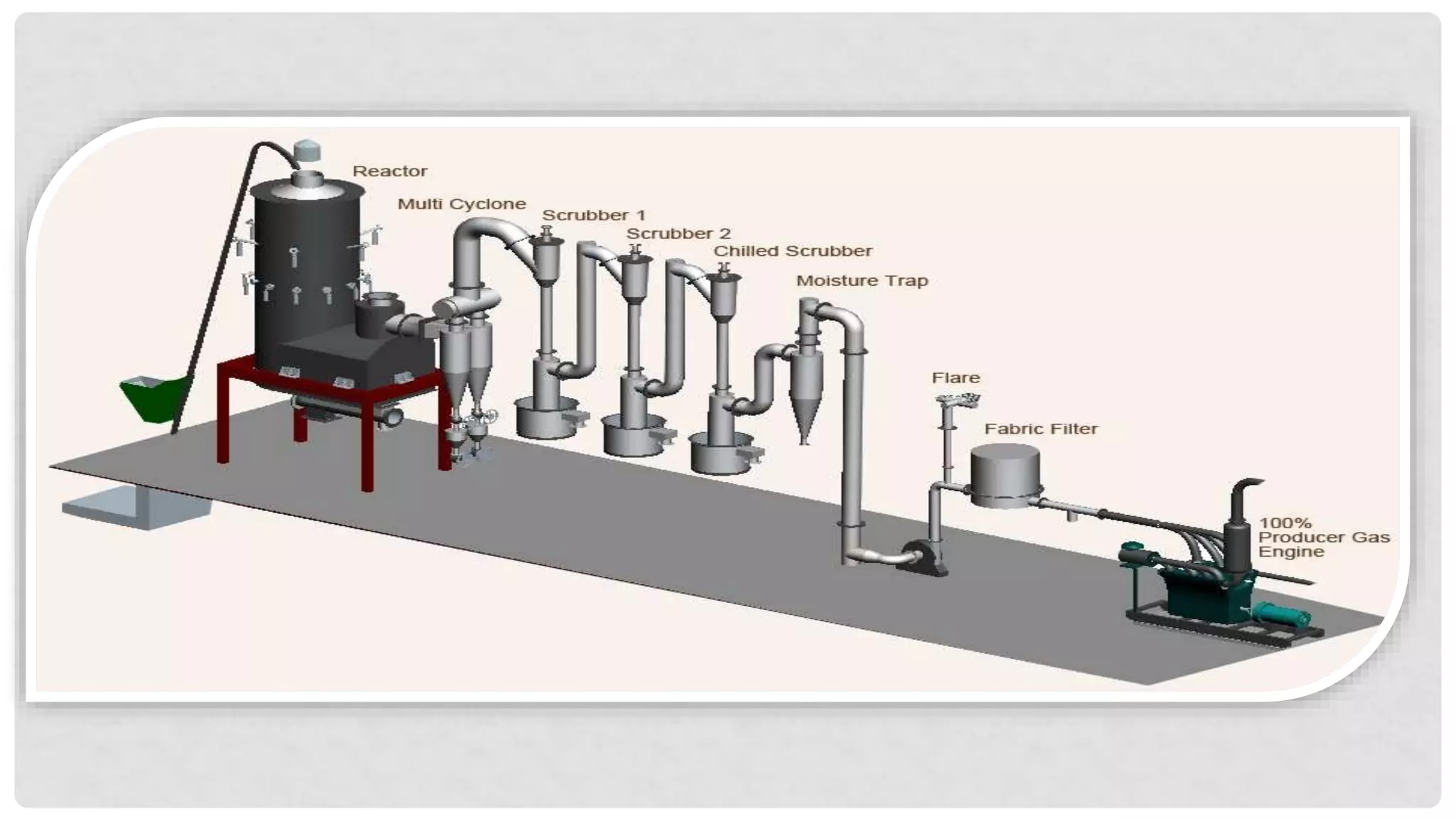
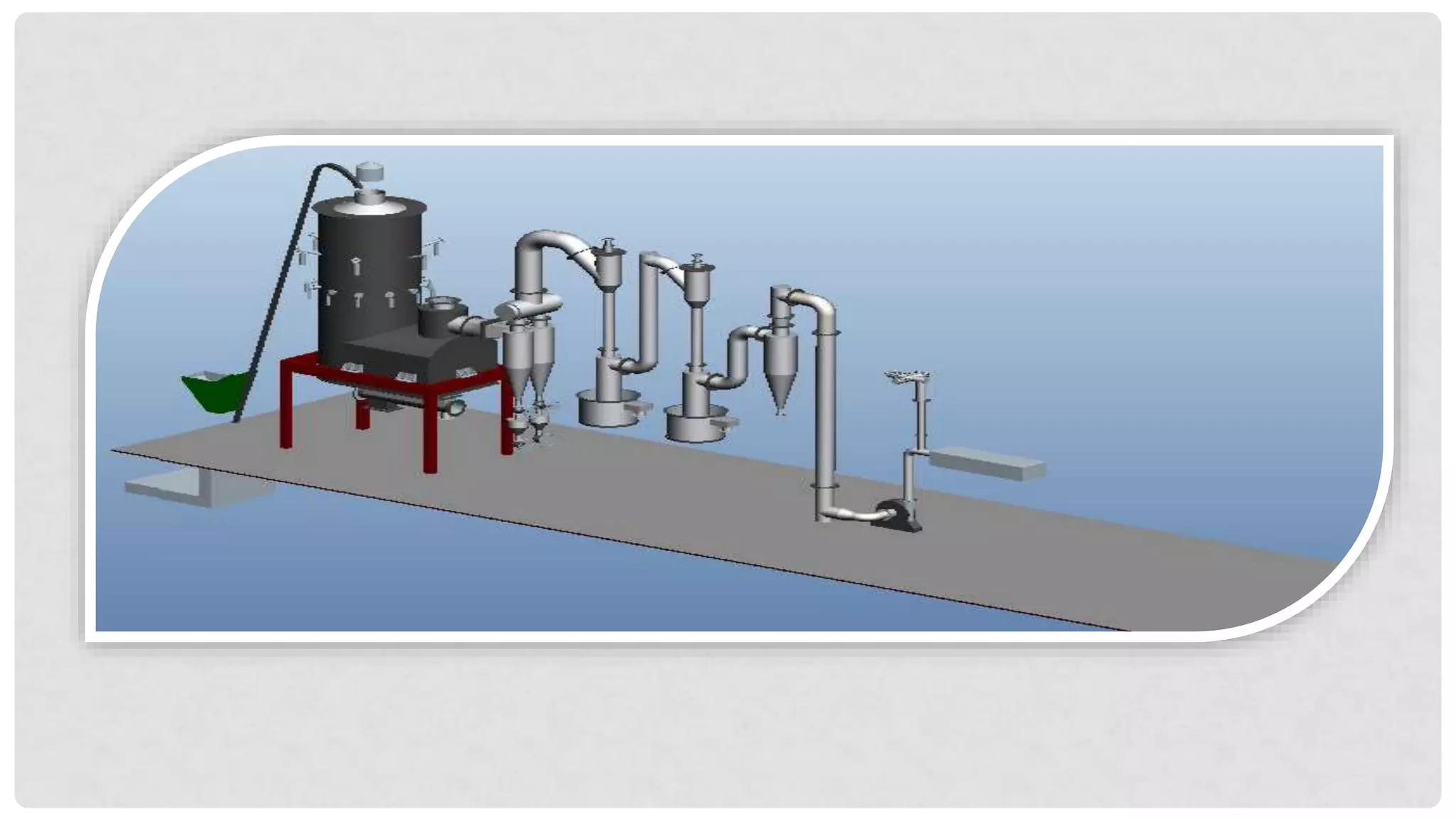
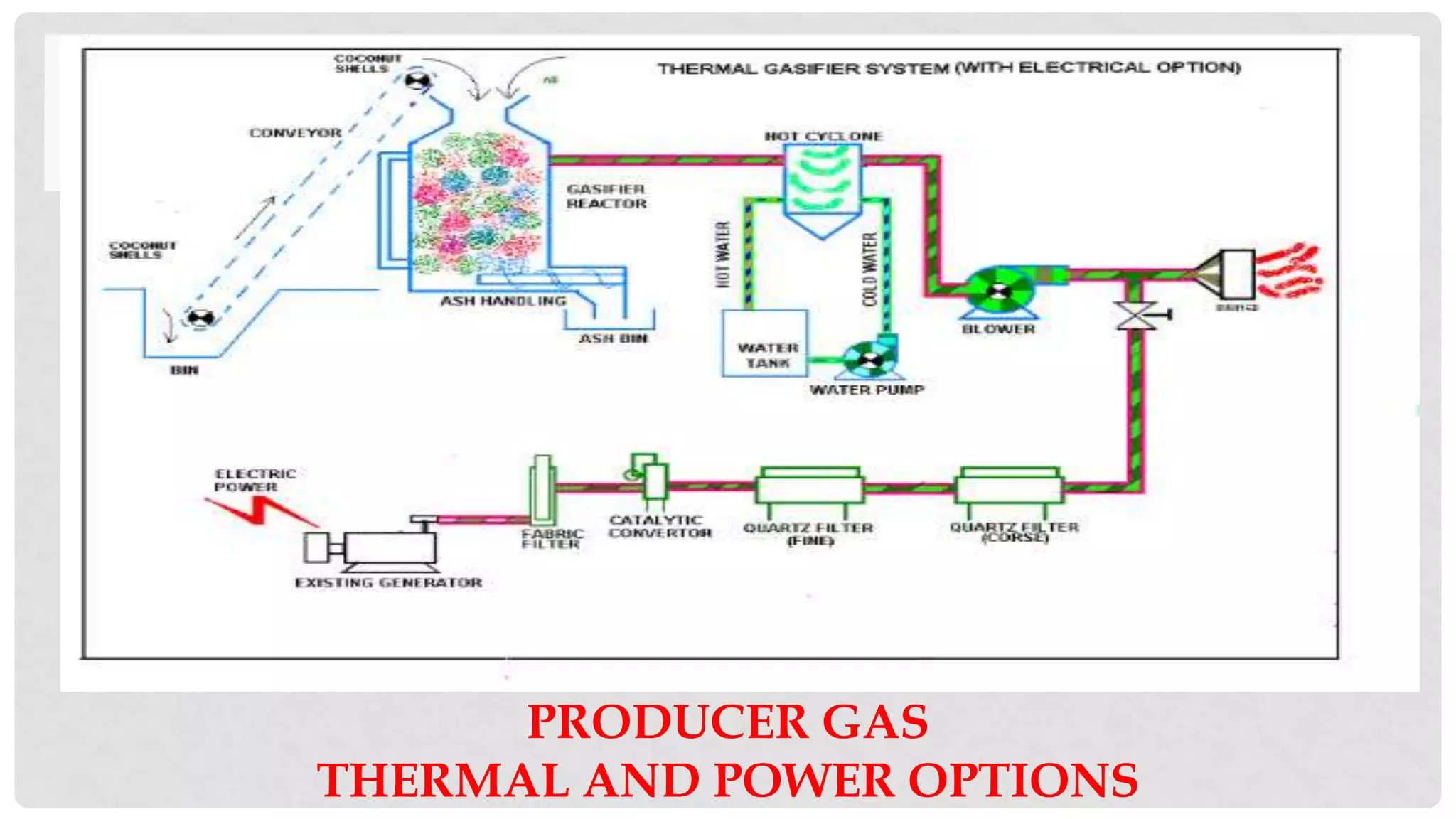
PRODUCER GAS
THERMAL AND POWER OPTIONS
THANK YOU

23. TYPES OF GASIFIER.ppt

  • 1.
  • 2.
    GASIFICATION  Gasification isa partial oxidation process whereby a carbon source such as coal, natural gas or biomass is broken down into carbon monoxide (CO) and Hydrogen (H2) plus carbon dioxide (CO2) and possibly hydrocarbon molecules such as methane (CH4)  This mix of gas is known as producer gas and the precise characteristics of the gas will depend on the gasification parameters such as temperature and also the oxidizer used  The oxidizer may be air, in which case the producer gas will also contain Nitrogen (N2) or steam or oxygen
  • 3.
    GASIFIER • Gasifier isan equipment which can gasify a variety of biomass such as wood waste, agricultural wastes like stalks and roots of various crops, maize cobs, etc. • The gasifier is essentially a chemical processes take place. Biomass gets dried, heated, pyrolyzed, partially oxidized and reduced, as it flows through it. • The gas produced in the gasifier is a clean burning fuel having calorific value of about 950 to 1200 Kcal/m3. • Hydrogen(18 - 20 %)and carbon - monoxide (18 - 24%) are the main constituents of the gas. • The advantages of a gasifier are very easy to operate, maintain, sturdy in construction and reliable in operation
  • 4.
  • 5.
    1. Grate 2. Throat 3.Air nozzle/air distribution system 4. Ash removal system/ash removal port 5. Gas outlet 6. Ignition port 7. Biomass feeding port 8. Hopper COMPONENTS OF THE GASIFIER
  • 6.
  • 7.
    CONVERSION OF BIOMASSINTO PRODUCER GAS
  • 8.
    TYPES OF GASIFIER FIXEDBED o UPDRAFT GASIFIER (COUNTER CURRENT GASIFIER) o DOWN DRAFT GASIFIER (CO-CURRENT GASIFIER) o CROSS DRAFT GASIFIER FLUDIZED BED GASIFIER (Bubbling or circulating)
  • 9.
    Updraft Down draftCross draft TYPES OF GASIFIER
  • 10.
    UP DRAFT GASIFIER Reactionzones in an up draft gasifier An up draft gasifier is characterized by a counter current flow of fuel and air or gas in the reactor. The producer gas exits from the top of the gasifier
  • 11.
    FEATURES OF UPDRAFTGASIFIER • The biomass enters the top of the reaction chamber while steam and air or oxygen enter from bottom through grate • The fuel flows downward and up-flowing hot gases pyrolyze it. some of the resulting charcoal residue falls to the grate, where it burns, producing heat and giving off carbon dioxide and water vapor • The CO2 and H2O react with other charcoal particles, producing carbon monoxide and hydrogen gases • The gases exit from the top and ashes fall through the grate • The updraft design is relatively simple and can handle biomass fuels with high ash and moisture content • The gas contains 10-20 percent volatile oils making the gas unsuitable for use in engines or gas turbines
  • 12.
    TYPICAL ZONAL CHEMICALREACTIONS AND PRODUCTS IN A UP-DRAFT GASIFIER
  • 13.
    THERMO-CHEMICAL REACTIONS OCCURRING INGASIFICATION REDUCTION ZONE Products of partial combustion – H2O, CO2 and uncombusted and partially cracked pyrolytic products undergo the following chemical reactions in the red-hot charcoal bed C + CO2 = 2CO (- 164.9 MJ/kg mole) [Boudouard reaction] C +H2O = CO + H2 (- 122.6 MJ/kg mole) [water gas ] CO + H2O = CO + H2 (+ 42 MJ/kg mole) [water shift reaction] C + 2H2 = CH4 (+ 75 MJ/kg mole) [Methane reaction] CO2 + H2 = CO + H2O (- 42.3 MJ/kg mole)  Low reduction zone temperature yields low calorific value of gas  Average temp is 850 0C
  • 14.
    UPDRAFT GASIFICATION DESIGN •Simple design • Not sensitive to fuel selection • Has a long start time • Delay in response • Best used for large, long use applications
  • 15.
    REACTIONS, TEMPERTURES ANDGAS COMPOSITION IN UPDRAFT GASIFIER
  • 16.
    Down draft gasifieris characterized by co-current flow of air or gas and the fuel. Fuel and air or gas move in the same direction Reaction zones in a down draft gasifier DOWN DRAFT GASIFIER • Can use high tar fuels (wood, peat) • Quicker in response • Has shorter start time • Complex design • Can’t use high ash content fuels • Fuel pellet size must be uniform
  • 17.
    FEATURES OF DOWNDRAFT GASIFIER • Gasifier requires drying of biomass fuel to a moisture content of less than 20 percent • Fuel and air or oxygen enter the top of the reaction chamber • Down-flowing fuel particles ignite, burning intensely and leaving a charcoal residue • The charcoal which is about 5 to 15 percent of the mass of original fuel, then reacts with the combustion gases, producing CO and H2 gases • These gases flow down and exit from the chamber below a grate • The producer gas leaving the gasifier is at a high temperature • Combustion ash falls through the grate • The advantage of the downdraft design is the very low tar content of the producer gas
  • 18.
    REACTIONS, TEMPERTURES ANDGAS COMPOSITION IN DOWNDRAFT GASIFIER
  • 19.
    DOWNDRAFT GASIFICATION ANALYSIS Thegeneral idea behind this design is that the tarry oils and vapors given off in the distillation zone are highly unstable at high temperatures. In order to reach the gas outlet they must pass through the partial combustion zone where a high amount of tar will be cracked and reduced to non-condensable gaseous products before leaving the gasifier Although the general principle behind this seems convincing easily, in practice it requires some testing and high skill to come up with a downdraft gas producer capable of generating a tar free gas under equilibrium conditions
  • 20.
    Down draft gasifierwithout throat Down draft gasifier with throat is not suitable for gasification of agro-residues like paddy husk, groundnut shell etc. A down draft gasifier without throat can be used for the gasification of paddy husk, groundnut shell, maize cob, etc. Down draft gasifier with throat Gasifier has narrow section below air entrance point in the reactor, which is called throat. Due to decrease in the cross- sectional area at the throat, air velocity increases resulting in high and better temperature distribution in the oxidation zone . SIGNIFICANCE OF THROAT IN A DOWN DRAFT GASIFIER
  • 21.
  • 22.
    This gasifier canoperate with wide variety of fuels compared to an up draft or a down draft gasifier High gas exit temperature, higher gas velocity at the gas exit Poor CO2 reduction are certain characteristics of this type of gasifier This type of gasifier has been used for gasification of coal CROSS DRAFT GASIFIER
  • 23.
    CROSS DRAFT GASIFICATIONANALYSIS • Can’t use high tar fuels • Quicker in response • Has shorter start time • Complex design • Can’t use high ash content fuels • Fuel pellet size must be uniform
  • 24.
    FLUIDIZED BED GASIFICATION Afluidization bed is a chamber with a perforated floor having pressurized air flowing vertically where a particle medium usually sand, is contained. The pressurized and flowing air helps the medium allowing it to act as a fluid
  • 25.
    • Can usemost fuels (wood, peat and coal) including agriculture waste such as straw, corn stover and manure • Has potential to use municipal waste such as garbage • Quicker in response • Has shorter start time • Complex design • Lends itself to complete combustion applications which would allow it to use liquid wastes such as used engine oil, non-recyclable plastics & old shoes, garbage for generation of heat PRINCIPLE OF FLUIDIZED BED GASIFICATION
  • 26.
    Fluidized bed gasifieris a homogeneous reactor bed of some inert sand material. The fuel is introduced in the inert bed material and air at the bottom of the bed in the reactor. This gasifier is characterized by high gas exit temperature, very high solid particulate matter in the gas and relatively low efficiency. The gasifier can operate with low bulk density materials such as agro-residues, leaves, etc. FLUIDIZED BED GASIFIER
  • 27.
    REACTIONS, TEMPERTURES ANDGAS COMPOSITION IN FLUIDIZED BED GASIFIER
  • 28.
    Sr. No GasifierType Advantages Disadvantages 1 Updraft • Small pressure drop • Good thermal efficiency •Little tendency towards slag formation •Great sensitivity to tar •Moisture and moisture content of fuel • Relatively long time required for start up of IC engine • Poor reaction capability with heavy gas load 2 Downdraft • Flexible adaptation of gas production to load • Low sensitivity to charcoal dust and tar content of fuel • Design tends to be tall - not feasible for very small particle size of fuel 3 Cross-draft • Short design height • Fast response time to load • Flexible gas production • Very high sensitivity to slag formation • High pressure drop COMPARISON ON THE PERFORMANCE OF GASIFIERS
  • 32.
  • 33.