WATER EROSION
Lecture-3
Dr. Ajay Singh Lodhi
Assistant Professor
College of Agriculture, Balaghat (M.P.)
Jawahar Lal Krishi Vishwa Vidyalaya, Jabalpur (M.P.)
WATER EROSION
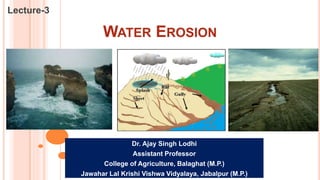
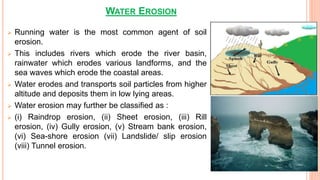
 Running water is the most common agent of soil
erosion.
 This includes rivers which erode the river basin,
rainwater which erodes various landforms, and the
sea waves which erode the coastal areas.
 Water erodes and transports soil particles from higher
altitude and deposits them in low lying areas.
 Water erosion may further be classified as :
 (i) Raindrop erosion, (ii) Sheet erosion, (iii) Rill
erosion, (iv) Gully erosion, (v) Stream bank erosion,
(vi) Sea-shore erosion (vii) Landslide/ slip erosion
(viii) Tunnel erosion.
TYPES OF WATER EROSION
Splash Erosion:
 It is also known as raindrop erosion because it is
caused by the impact of raindrops on exposed soil
surface.
 The process of raindrop erosion can be described as:
when raindrop strikes on open soil surface it forms a
crater. This is accomplished by forming a blast which
bounces the water and soil up and returns back around
the crater.
 The soil may be splashed into the air up to a height of
50 to 75 cm depending upon the size of rain drops. At
the same time the soil particles also move horizontally
as much as 1.50 m on level land surface.
 On sloping land, more than half of the splashed
particles move down with the runoff.
TYPES OF WATER EROSION
Sheet Erosion:
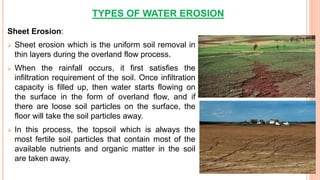
 Sheet erosion which is the uniform soil removal in
thin layers during the overland flow process.
 When the rainfall occurs, it first satisfies the
infiltration requirement of the soil. Once infiltration
capacity is filled up, then water starts flowing on
the surface in the form of overland flow, and if
there are loose soil particles on the surface, the
floor will take the soil particles away.
 In this process, the topsoil which is always the
most fertile soil particles that contain most of the
available nutrients and organic matter in the soil
are taken away.
TYPES OF WATER EROSION
Rill Erosion:
 If the overland flow process continues, its erosive
action results in the formation of shallow channels
known as rills.
 Rill erosion occurs when runoff water forms small
channels as it concentrates down a slope. These rills
can be up to 0.3m deep.
 It is very common in bare agricultural land, overgrazed
land, freshly cultivated land wherever the soil surface is
exposed and almost irregular.
 These rills can be removed with primary tillage
implements.
 Rill erosion is an intermediate stage between sheet and
gully erosion
TYPES OF WATER EROSION
Gully Erosion:
 If rills are not destroyed, and the detachment
continues, then these rills become wider and deeper.
Then they result in the deformation of gullies. They are
much larger than the rills, so normal cultivation cannot
smooth and out.
 It is the advanced stage of rill erosion.
 Some of the major causes of gully erosion are:
steepness of land slope, soil texture, rainfall intensity,
land mismanagement, biotic interference with natural
vegetation, incorrect agricultural practices, etc.
 Gully erosion gets initiated where the longitudinal
profile of an alluvial land becomes too steep due to
sediment deposition.
TYPES OF WATER EROSION
Stream Bank Erosion:
 Stream bank erosion is defined as the removal of
stream bank soil by water either flowing over the sides
of the stream or scouring from there.
 The stream bank erosion due to stream flow in the form
of scouring and undercutting of the soil below the water
surface caused by wave action is a continuous process
in perennial streams.
 Stream bank erosion is mainly aggravated due to
removal of vegetation, over grazing or cultivation on the
area close to stream banks.
TYPES OF WATER EROSION
Sea-shore Erosion:
 It is also called coastal erosion. Sea shore erosion is
the wearing away of land and the removal of beach or
dune sediments by wave action, tidal currents, wave
currents, or drainage.
 Waves, generated by storms, wind or fast moving
motor craft, cause coastal erosion which may take the
form of long-term losses of sediment and rocks, or
merely the temporary redistribution of coastal
sediments.
TYPES OF WATER EROSION
Landslide Erosion:
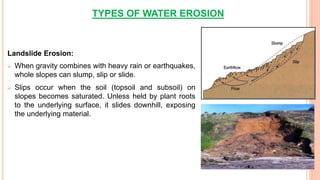
 When gravity combines with heavy rain or earthquakes,
whole slopes can slump, slip or slide.
 Slips occur when the soil (topsoil and subsoil) on
slopes becomes saturated. Unless held by plant roots
to the underlying surface, it slides downhill, exposing
the underlying material.
TYPES OF WATER EROSION
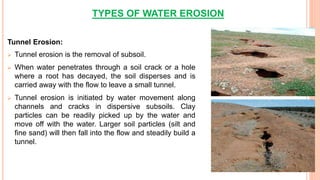
Tunnel Erosion:
 Tunnel erosion is the removal of subsoil.
 When water penetrates through a soil crack or a hole
where a root has decayed, the soil disperses and is
carried away with the flow to leave a small tunnel.
 Tunnel erosion is initiated by water movement along
channels and cracks in dispersive subsoils. Clay
particles can be readily picked up by the water and
move off with the water. Larger soil particles (silt and
fine sand) will then fall into the flow and steadily build a
tunnel.
Thank You

Water Erosion.pptx

  • 1.
    WATER EROSION Lecture-3 Dr. AjaySingh Lodhi Assistant Professor College of Agriculture, Balaghat (M.P.) Jawahar Lal Krishi Vishwa Vidyalaya, Jabalpur (M.P.)
  • 2.
    WATER EROSION  Runningwater is the most common agent of soil erosion.  This includes rivers which erode the river basin, rainwater which erodes various landforms, and the sea waves which erode the coastal areas.  Water erodes and transports soil particles from higher altitude and deposits them in low lying areas.  Water erosion may further be classified as :  (i) Raindrop erosion, (ii) Sheet erosion, (iii) Rill erosion, (iv) Gully erosion, (v) Stream bank erosion, (vi) Sea-shore erosion (vii) Landslide/ slip erosion (viii) Tunnel erosion.
  • 3.
    TYPES OF WATEREROSION Splash Erosion:  It is also known as raindrop erosion because it is caused by the impact of raindrops on exposed soil surface.  The process of raindrop erosion can be described as: when raindrop strikes on open soil surface it forms a crater. This is accomplished by forming a blast which bounces the water and soil up and returns back around the crater.  The soil may be splashed into the air up to a height of 50 to 75 cm depending upon the size of rain drops. At the same time the soil particles also move horizontally as much as 1.50 m on level land surface.  On sloping land, more than half of the splashed particles move down with the runoff.
  • 4.
    TYPES OF WATEREROSION Sheet Erosion:  Sheet erosion which is the uniform soil removal in thin layers during the overland flow process.  When the rainfall occurs, it first satisfies the infiltration requirement of the soil. Once infiltration capacity is filled up, then water starts flowing on the surface in the form of overland flow, and if there are loose soil particles on the surface, the floor will take the soil particles away.  In this process, the topsoil which is always the most fertile soil particles that contain most of the available nutrients and organic matter in the soil are taken away.
  • 5.
    TYPES OF WATEREROSION Rill Erosion:  If the overland flow process continues, its erosive action results in the formation of shallow channels known as rills.  Rill erosion occurs when runoff water forms small channels as it concentrates down a slope. These rills can be up to 0.3m deep.  It is very common in bare agricultural land, overgrazed land, freshly cultivated land wherever the soil surface is exposed and almost irregular.  These rills can be removed with primary tillage implements.  Rill erosion is an intermediate stage between sheet and gully erosion
  • 6.
    TYPES OF WATEREROSION Gully Erosion:  If rills are not destroyed, and the detachment continues, then these rills become wider and deeper. Then they result in the deformation of gullies. They are much larger than the rills, so normal cultivation cannot smooth and out.  It is the advanced stage of rill erosion.  Some of the major causes of gully erosion are: steepness of land slope, soil texture, rainfall intensity, land mismanagement, biotic interference with natural vegetation, incorrect agricultural practices, etc.  Gully erosion gets initiated where the longitudinal profile of an alluvial land becomes too steep due to sediment deposition.
  • 7.
    TYPES OF WATEREROSION Stream Bank Erosion:  Stream bank erosion is defined as the removal of stream bank soil by water either flowing over the sides of the stream or scouring from there.  The stream bank erosion due to stream flow in the form of scouring and undercutting of the soil below the water surface caused by wave action is a continuous process in perennial streams.  Stream bank erosion is mainly aggravated due to removal of vegetation, over grazing or cultivation on the area close to stream banks.
  • 8.
    TYPES OF WATEREROSION Sea-shore Erosion:  It is also called coastal erosion. Sea shore erosion is the wearing away of land and the removal of beach or dune sediments by wave action, tidal currents, wave currents, or drainage.  Waves, generated by storms, wind or fast moving motor craft, cause coastal erosion which may take the form of long-term losses of sediment and rocks, or merely the temporary redistribution of coastal sediments.
  • 9.
    TYPES OF WATEREROSION Landslide Erosion:  When gravity combines with heavy rain or earthquakes, whole slopes can slump, slip or slide.  Slips occur when the soil (topsoil and subsoil) on slopes becomes saturated. Unless held by plant roots to the underlying surface, it slides downhill, exposing the underlying material.
  • 10.
    TYPES OF WATEREROSION Tunnel Erosion:  Tunnel erosion is the removal of subsoil.  When water penetrates through a soil crack or a hole where a root has decayed, the soil disperses and is carried away with the flow to leave a small tunnel.  Tunnel erosion is initiated by water movement along channels and cracks in dispersive subsoils. Clay particles can be readily picked up by the water and move off with the water. Larger soil particles (silt and fine sand) will then fall into the flow and steadily build a tunnel.
  • 11.