INTERCULTURE EQUIPMENTS
Dr. Ajay Singh Lodhi
Assistant Professor
College of Agriculture, Balaghat
Jawahar Lal Krishi Vishwa Vidyalaya, Jabalpur (M.P.)
INTERCULTURAL EQUIPMENTS
Intercultural Operations: All the lighter and finer operations carried out on the soil,
between sowing had harvesting are termed as intercultural operations. They include
weeding, fertilizer application, mulching, etc. The machineries and implements used for this
purpose are called as inter cultural equipments.
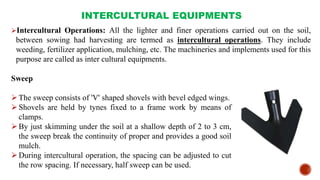
Sweep
The sweep consists of 'V' shaped shovels with bevel edged wings.
Shovels are held by tynes fixed to a frame work by means of
clamps.
By just skimming under the soil at a shallow depth of 2 to 3 cm,
the sweep break the continuity of proper and provides a good soil
mulch.
During intercultural operation, the spacing can be adjusted to cut
the row spacing. If necessary, half sweep can be used.
INTERCULTURAL EQUIPMENTS
Junior hoe
 It is an interculture equipment used primarily for
weeding in between the rows of standing crops.
It consists of reversible shovels with curved tynes
attached to framework with hinge arrangement.
A handle and beam are fixed to the framework for
guiding and attaching the unit to the yoke.
The spacing between the shovel can be adjusted
according to the row spacing of the crop.
The coverage is 1.5 ha per day.
INTERCULTURAL EQUIPMENTS- WEEDERS
Hand Hoe
This is the weeding tool used widely in most of the
farms to carry out the weeding operation and also as
harvesting tool to bring the produce from inside the
root zone.
This tool has a short handle made of country wood and
a small shovel attached at its end.
The width of cut is not a standard one and depends on
the village artisan who makes it and the demand of the
farmer who uses it.
INTERCULTURAL EQUIPMENTS- WEEDERS
Long Handled Weeders
The drudgery to the human is more and the working efficiency is low with the hand
held hoes, which makes the operator to bend / sit down work on the soil.
To reduce this problem, long handled weeders were developed.
Some of the long handled weeders are
Long handled hoe
Paddy weeder
Dry land weeders (Star type and peg type ).
INTERCULTURAL EQUIPMENTS- WEEDERS
Long handled hoe
This tool has a long bamboo / wooden
stick of about 1.2 m length.
At the end a double end shovel is fixed
rigidly, with different cutting widths.
Weeding can be done easily by using this
tool.
INTERCULTURAL EQUIPMENTS- WEEDERS
Paddy weeder
Paddy weeder does the weeding operation when
the seedlings are transplanted in rows.
The implement has an inclined long handle.
At the fool of it two conical cylinders with
serrated lugs on its periphery are fixed.
These two conical serrated cylinders can rotate
freely about it axis and placed in opposite sides.
A steel plate has been into the loose soil and
assists in easy operations.
In operation, the see rated lugs cut and burry the
weeds and some of the weeds are wound on the
surface of the cylinders, which can be removed
manually.
INTERCULTURAL EQUIPMENTS- WEEDERS
Dry land/garden land weeder
This can be classified into star type and peg type
depending upon the shape of the roller attached at the
foot of the long handle, to facilitate easy movement of
the weeder and to have sufficient grip on the soil.
The star type is suitable for clay loam and black cotton
soils.
The cutting blade is fixed on vertical and positioned
appropriately depending upon the height of the operator.
The weeding operation is done by smooth and short
reciprocating motion.
The peg tooth of the peg type permits the movement of
roller without clogging due to reduced contact area.
INTERCULTURAL EQUIPMENTS- WEEDERS
Cono weeder for paddy
It is useful for uprooting and burying weeds in between standing rows of rice crop in
wetlands. It disturbs the topsoil and increases the aeration.
The unit consists of a long handle made of mild steel tube.
Two truncated rollers one behind other are fitted at the bottom of the long handle.
The conical rollers have serrated projections on the periphery.
A float provided in the front portion prevents the unit from sinking into, the puddled soil.
The cono weeder can also be used for trampling the green manure crop in addition to
weeding operation. They are more efficient than manual pulling of weeds.
Thank You

Interculture Equipments.pptx

  • 1.
    INTERCULTURE EQUIPMENTS Dr. AjaySingh Lodhi Assistant Professor College of Agriculture, Balaghat Jawahar Lal Krishi Vishwa Vidyalaya, Jabalpur (M.P.)
  • 2.
    INTERCULTURAL EQUIPMENTS Intercultural Operations:All the lighter and finer operations carried out on the soil, between sowing had harvesting are termed as intercultural operations. They include weeding, fertilizer application, mulching, etc. The machineries and implements used for this purpose are called as inter cultural equipments. Sweep The sweep consists of 'V' shaped shovels with bevel edged wings. Shovels are held by tynes fixed to a frame work by means of clamps. By just skimming under the soil at a shallow depth of 2 to 3 cm, the sweep break the continuity of proper and provides a good soil mulch. During intercultural operation, the spacing can be adjusted to cut the row spacing. If necessary, half sweep can be used.
  • 3.
    INTERCULTURAL EQUIPMENTS Junior hoe It is an interculture equipment used primarily for weeding in between the rows of standing crops. It consists of reversible shovels with curved tynes attached to framework with hinge arrangement. A handle and beam are fixed to the framework for guiding and attaching the unit to the yoke. The spacing between the shovel can be adjusted according to the row spacing of the crop. The coverage is 1.5 ha per day.
  • 4.
    INTERCULTURAL EQUIPMENTS- WEEDERS HandHoe This is the weeding tool used widely in most of the farms to carry out the weeding operation and also as harvesting tool to bring the produce from inside the root zone. This tool has a short handle made of country wood and a small shovel attached at its end. The width of cut is not a standard one and depends on the village artisan who makes it and the demand of the farmer who uses it.
  • 5.
    INTERCULTURAL EQUIPMENTS- WEEDERS LongHandled Weeders The drudgery to the human is more and the working efficiency is low with the hand held hoes, which makes the operator to bend / sit down work on the soil. To reduce this problem, long handled weeders were developed. Some of the long handled weeders are Long handled hoe Paddy weeder Dry land weeders (Star type and peg type ).
  • 6.
    INTERCULTURAL EQUIPMENTS- WEEDERS Longhandled hoe This tool has a long bamboo / wooden stick of about 1.2 m length. At the end a double end shovel is fixed rigidly, with different cutting widths. Weeding can be done easily by using this tool.
  • 7.
    INTERCULTURAL EQUIPMENTS- WEEDERS Paddyweeder Paddy weeder does the weeding operation when the seedlings are transplanted in rows. The implement has an inclined long handle. At the fool of it two conical cylinders with serrated lugs on its periphery are fixed. These two conical serrated cylinders can rotate freely about it axis and placed in opposite sides. A steel plate has been into the loose soil and assists in easy operations. In operation, the see rated lugs cut and burry the weeds and some of the weeds are wound on the surface of the cylinders, which can be removed manually.
  • 8.
    INTERCULTURAL EQUIPMENTS- WEEDERS Dryland/garden land weeder This can be classified into star type and peg type depending upon the shape of the roller attached at the foot of the long handle, to facilitate easy movement of the weeder and to have sufficient grip on the soil. The star type is suitable for clay loam and black cotton soils. The cutting blade is fixed on vertical and positioned appropriately depending upon the height of the operator. The weeding operation is done by smooth and short reciprocating motion. The peg tooth of the peg type permits the movement of roller without clogging due to reduced contact area.
  • 9.
    INTERCULTURAL EQUIPMENTS- WEEDERS Conoweeder for paddy It is useful for uprooting and burying weeds in between standing rows of rice crop in wetlands. It disturbs the topsoil and increases the aeration. The unit consists of a long handle made of mild steel tube. Two truncated rollers one behind other are fitted at the bottom of the long handle. The conical rollers have serrated projections on the periphery. A float provided in the front portion prevents the unit from sinking into, the puddled soil. The cono weeder can also be used for trampling the green manure crop in addition to weeding operation. They are more efficient than manual pulling of weeds.
  • 10.