Subject: Renewable Energy
and Green Technology
Topic: Gasification &
Gasifier
by
Dr. Sanjay Singh Chouhan
Assistant Professor
College of Agriculture, JNKVV,
Powarkheda, Hoshangabad
Principles of Gasification
• Gasification is defined as the conversion of biomass into a
gaseous-energy carrier by means of partial oxidation at the
elevated temperature.
• This process involves a sequence of chemical and thermal
reactions like the oxidation and reduction.
• Gasification process convert solid biomass with a limited quantity
of air into Producer gas.
Producer Gas
• Producer gas, the gas generated when wood, charcoal or coal is
gasified with air, consists of some 40 % combustible gases, mainly
carbon monoxide, hydrogen and some methane. The rest are non-
combustible and consists mainly of nitrogen, carbon dioxide and water
vapor.
• Producer gas is a mixture of combustible {Hydrogen (13-19%), Methane
(1-5%) and Carbon Monoxide (18-22%)} and non-combustible {Nitrogen
(45-55%), Carbon dioxide (9-12%)} gases.
• The producer gas has a calorific value ranging from 1000 to 1200
kcal/Nm3.
• The gas also contains condensable tar, acids and dust as impurities.
These impurities may lead to operational problems and abnormal engine
wear.
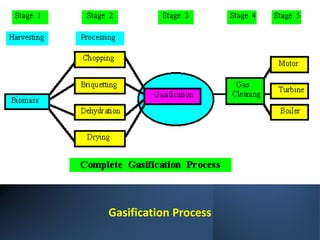
Gasification Process
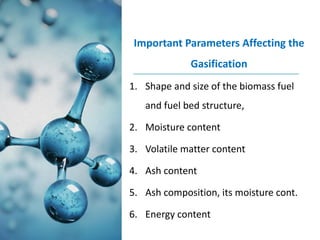
Important Parameters Affecting the
Gasification
1. Shape and size of the biomass fuel
and fuel bed structure,
2. Moisture content
3. Volatile matter content
4. Ash content
5. Ash composition, its moisture cont.
6. Energy content
Disadvantage
1. The gasification system has to be
designed specifically to suit
thermo-chemical characteristics
of biomass,
2. The technology is more
complicated than direct
combustion process.
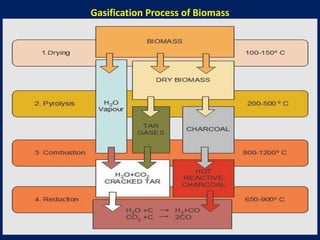
Gasification Process of Biomass
Gasification Reactions
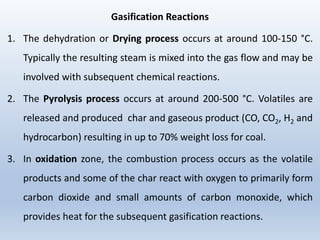
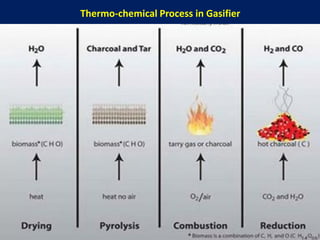
1. The dehydration or Drying process occurs at around 100-150 °C.
Typically the resulting steam is mixed into the gas flow and may be
involved with subsequent chemical reactions.
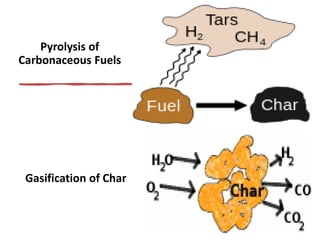
2. The Pyrolysis process occurs at around 200-500 °C. Volatiles are
released and produced char and gaseous product (CO, CO2, H2 and
hydrocarbon) resulting in up to 70% weight loss for coal.
3. In oxidation zone, the combustion process occurs as the volatile
products and some of the char react with oxygen to primarily form
carbon dioxide and small amounts of carbon monoxide, which
provides heat for the subsequent gasification reactions.
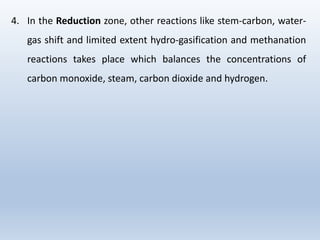
4. In the Reduction zone, other reactions like stem-carbon, water-
gas shift and limited extent hydro-gasification and methanation
reactions takes place which balances the concentrations of
carbon monoxide, steam, carbon dioxide and hydrogen.
Pyrolysis of
Carbonaceous Fuels
Gasification of Char
Thermo-chemical Process in Gasifier
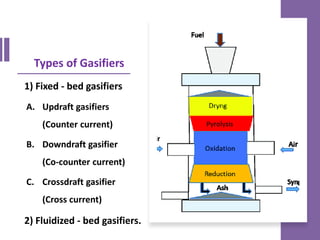
Types of Gasifiers
1) Fixed - bed gasifiers
A. Updraft gasifiers
(Counter current)
B. Downdraft gasifier
(Co-counter current)
C. Crossdraft gasifier
(Cross current)
2) Fluidized - bed gasifiers.
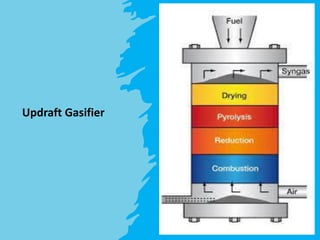
Updraft Gasifier
Updraft gasifier
• Air flow is upward and the gas leaves at the top.
• Near the grate at the bottom the combustion reactions occur,
which are followed by reduction reactions.
• In the upper part of the gasifier, heating and pyrolysis of the
feedstock occur as a result of heat transfer by forced convection
and radiation from the lower zones.
• The tars and volatiles produced during this process will be
carried in the gas stream.
• Ashes are removed from the bottom of the gasifier.
Advantage of updraft
1. It is simple in design.
2. It has clearly defined zones for various reactions
3. Its efficiency is very high because hot gases pass through entire
fuel bed.
4. High charcoal burn-out and internal heat exchange leading to
low gas exit temperatures.
5. The possibility of operation with many types of feedstock
(sawdust, cereal hulls, etc.) .
6. The gas is used for direct heat applications, in which tars can
simply burnt.
Disadvantage
1. Unsuitable for high volatile fuels.
2. possibility of clogging in the equipment, which can lead to
oxygen break-through and dangerous, explosive situations.
3. Necessity to install automatic moving grates.
4. the problems associated with disposal of the tar containing
condensates that result from the gas cleaning operations.
Downdraft
Gasifier
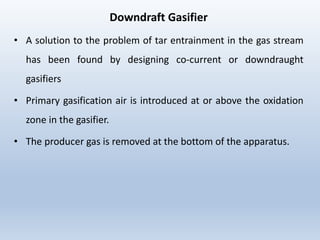
Downdraft Gasifier
• A solution to the problem of tar entrainment in the gas stream
has been found by designing co-current or downdraught
gasifiers
• Primary gasification air is introduced at or above the oxidation
zone in the gasifier.
• The producer gas is removed at the bottom of the apparatus.
Advantage
1. The main advantage of downdraught gasifiers lies in the
possibility of producing a tar-free gas suitable for engine
applications.
2. Downdraught gasifiers suffer less from environmental objections
than updraught gasifiers.
Disadvantage
1. The gas leaves at relative high temperature, hence gasifier
efficiency is less.
2. Not suitable for high ash fuels, high moisture and low ash fusion
temperature.
Cross-draft
Gasifier
Cross-draft gasifier
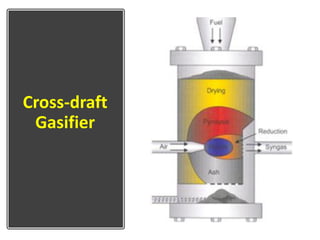
• Cross-draught gasifiers are an adaptation for the use of charcoal.
• Charcoal gasification results in very high temperatures (1500 °C
and higher) in the oxidation zone.
• In cross draught gasifiers insulation against these high
temperatures is provided by the fuel (charcoal) itself.
• In a cross-draft gasifier, air is fed into the gasifier through a
horizontal nozzle
• The resulting fuel gas is discharged through a vertical grate on the
opposite side of the air injection location.
• The biomass can be fed to the gasifier either from the top or
from the side.
• The reactions in the cross-draft gasifier are similar to the
downdraft gasifier.
Advantage of crossdraft
1. Gate not required.
2. Single air blower
3. Ash formed due to high temprature fall to the bottom and does
not require cleaning operation.
Disadvantage
1. The gas leaves at relative high temperature, hence gasifier
efficiency is less.
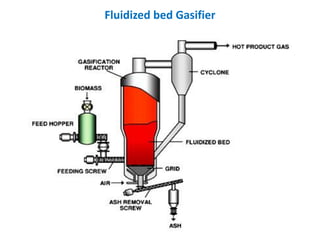
Fluidized bed gasifier
• The operation of both up and downdraught gasifiers is
influenced by the morphological, physical and chemical
properties of the fuel.
• Problems commonly encountered are: lack of bunkerflow,
slagging and extreme pressure drop over the gasifier.
• A design approach aiming at the removal of the above
difficulties is the fluidized bed gasifier.
Fluidized bed Gasifier
• In general, the fluidized bed gasifier is a tall refractory lined unit.
• The height to diameter ratio of a fluidized bed reactor is 10:1.
• The inert materials like sand or ash may be used as a fluidizing
medium.
• Air is blown through a bed of solid particles at a sufficient velocity
to keep these in a state of suspension.
• The bed is originally externally heated and the feedstock is
introduced as soon as a sufficiently high temperature is reached.
• This fuel particles quickly mixed with the bed material and almost
instantaneously heated up to the bed temperature.
• As a result of this treatment the fuel is pyrolysed very fast,
• Most systems are equipped with an internal cyclone in order to
minimize char blow-out as much as possible.
• Ash particles are also carried over the top of the reactor and
have to be removed from the gas stream if the gas is used in
engine applications
• The output of a biomass gasifier can be used for a variety of
direct thermal applications such as cooking, drying, heating
water, and generating steam.
• It can also be used as a fuel after cleaning for I.C. Engines to
obtain mechanical shaft power or electrical power.
• The conversion efficiency of a gasifier is usually around 75%.
Thanks for listening…..
JNKVV- College of Agriculture, Powarkheda 27

Gasification and gasifier

  • 1.
    Subject: Renewable Energy andGreen Technology Topic: Gasification & Gasifier by Dr. Sanjay Singh Chouhan Assistant Professor College of Agriculture, JNKVV, Powarkheda, Hoshangabad
  • 2.
    Principles of Gasification •Gasification is defined as the conversion of biomass into a gaseous-energy carrier by means of partial oxidation at the elevated temperature. • This process involves a sequence of chemical and thermal reactions like the oxidation and reduction. • Gasification process convert solid biomass with a limited quantity of air into Producer gas.
  • 3.
    Producer Gas • Producergas, the gas generated when wood, charcoal or coal is gasified with air, consists of some 40 % combustible gases, mainly carbon monoxide, hydrogen and some methane. The rest are non- combustible and consists mainly of nitrogen, carbon dioxide and water vapor. • Producer gas is a mixture of combustible {Hydrogen (13-19%), Methane (1-5%) and Carbon Monoxide (18-22%)} and non-combustible {Nitrogen (45-55%), Carbon dioxide (9-12%)} gases. • The producer gas has a calorific value ranging from 1000 to 1200 kcal/Nm3. • The gas also contains condensable tar, acids and dust as impurities. These impurities may lead to operational problems and abnormal engine wear.
  • 4.
  • 5.
    Important Parameters Affectingthe Gasification 1. Shape and size of the biomass fuel and fuel bed structure, 2. Moisture content 3. Volatile matter content 4. Ash content 5. Ash composition, its moisture cont. 6. Energy content
  • 6.
    Disadvantage 1. The gasificationsystem has to be designed specifically to suit thermo-chemical characteristics of biomass, 2. The technology is more complicated than direct combustion process.
  • 7.
  • 8.
    Gasification Reactions 1. Thedehydration or Drying process occurs at around 100-150 °C. Typically the resulting steam is mixed into the gas flow and may be involved with subsequent chemical reactions. 2. The Pyrolysis process occurs at around 200-500 °C. Volatiles are released and produced char and gaseous product (CO, CO2, H2 and hydrocarbon) resulting in up to 70% weight loss for coal. 3. In oxidation zone, the combustion process occurs as the volatile products and some of the char react with oxygen to primarily form carbon dioxide and small amounts of carbon monoxide, which provides heat for the subsequent gasification reactions.
  • 9.
    4. In theReduction zone, other reactions like stem-carbon, water- gas shift and limited extent hydro-gasification and methanation reactions takes place which balances the concentrations of carbon monoxide, steam, carbon dioxide and hydrogen.
  • 10.
  • 11.
  • 12.
    Types of Gasifiers 1)Fixed - bed gasifiers A. Updraft gasifiers (Counter current) B. Downdraft gasifier (Co-counter current) C. Crossdraft gasifier (Cross current) 2) Fluidized - bed gasifiers.
  • 13.
  • 14.
    Updraft gasifier • Airflow is upward and the gas leaves at the top. • Near the grate at the bottom the combustion reactions occur, which are followed by reduction reactions. • In the upper part of the gasifier, heating and pyrolysis of the feedstock occur as a result of heat transfer by forced convection and radiation from the lower zones. • The tars and volatiles produced during this process will be carried in the gas stream. • Ashes are removed from the bottom of the gasifier.
  • 15.
    Advantage of updraft 1.It is simple in design. 2. It has clearly defined zones for various reactions 3. Its efficiency is very high because hot gases pass through entire fuel bed. 4. High charcoal burn-out and internal heat exchange leading to low gas exit temperatures. 5. The possibility of operation with many types of feedstock (sawdust, cereal hulls, etc.) . 6. The gas is used for direct heat applications, in which tars can simply burnt.
  • 16.
    Disadvantage 1. Unsuitable forhigh volatile fuels. 2. possibility of clogging in the equipment, which can lead to oxygen break-through and dangerous, explosive situations. 3. Necessity to install automatic moving grates. 4. the problems associated with disposal of the tar containing condensates that result from the gas cleaning operations.
  • 17.
  • 18.
    Downdraft Gasifier • Asolution to the problem of tar entrainment in the gas stream has been found by designing co-current or downdraught gasifiers • Primary gasification air is introduced at or above the oxidation zone in the gasifier. • The producer gas is removed at the bottom of the apparatus.
  • 19.
    Advantage 1. The mainadvantage of downdraught gasifiers lies in the possibility of producing a tar-free gas suitable for engine applications. 2. Downdraught gasifiers suffer less from environmental objections than updraught gasifiers. Disadvantage 1. The gas leaves at relative high temperature, hence gasifier efficiency is less. 2. Not suitable for high ash fuels, high moisture and low ash fusion temperature.
  • 20.
  • 21.
    Cross-draft gasifier • Cross-draughtgasifiers are an adaptation for the use of charcoal. • Charcoal gasification results in very high temperatures (1500 °C and higher) in the oxidation zone. • In cross draught gasifiers insulation against these high temperatures is provided by the fuel (charcoal) itself. • In a cross-draft gasifier, air is fed into the gasifier through a horizontal nozzle • The resulting fuel gas is discharged through a vertical grate on the opposite side of the air injection location.
  • 22.
    • The biomasscan be fed to the gasifier either from the top or from the side. • The reactions in the cross-draft gasifier are similar to the downdraft gasifier. Advantage of crossdraft 1. Gate not required. 2. Single air blower 3. Ash formed due to high temprature fall to the bottom and does not require cleaning operation. Disadvantage 1. The gas leaves at relative high temperature, hence gasifier efficiency is less.
  • 23.
    Fluidized bed gasifier •The operation of both up and downdraught gasifiers is influenced by the morphological, physical and chemical properties of the fuel. • Problems commonly encountered are: lack of bunkerflow, slagging and extreme pressure drop over the gasifier. • A design approach aiming at the removal of the above difficulties is the fluidized bed gasifier.
  • 24.
  • 25.
    • In general,the fluidized bed gasifier is a tall refractory lined unit. • The height to diameter ratio of a fluidized bed reactor is 10:1. • The inert materials like sand or ash may be used as a fluidizing medium. • Air is blown through a bed of solid particles at a sufficient velocity to keep these in a state of suspension. • The bed is originally externally heated and the feedstock is introduced as soon as a sufficiently high temperature is reached. • This fuel particles quickly mixed with the bed material and almost instantaneously heated up to the bed temperature. • As a result of this treatment the fuel is pyrolysed very fast,
  • 26.
    • Most systemsare equipped with an internal cyclone in order to minimize char blow-out as much as possible. • Ash particles are also carried over the top of the reactor and have to be removed from the gas stream if the gas is used in engine applications • The output of a biomass gasifier can be used for a variety of direct thermal applications such as cooking, drying, heating water, and generating steam. • It can also be used as a fuel after cleaning for I.C. Engines to obtain mechanical shaft power or electrical power. • The conversion efficiency of a gasifier is usually around 75%.
  • 27.
    Thanks for listening….. JNKVV-College of Agriculture, Powarkheda 27