Pyrolysis
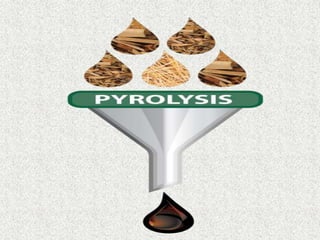
 Pyrolysis is a thermo chemical decomposition
of organic material in to liquid, gases and
char(solid residue)at elevated temperature in
the absence of oxygen(or any halogen).
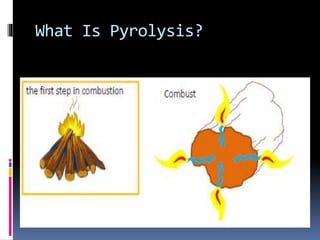
WHAT IS PYROLYSIS?
 Pyrolysis does not involve reactions with oxygen,
water, or any other reagents.
 In practice, it is not possible to achieve a completely
oxygen-free atmosphere.
 Because some oxygen is present in any pyrolysis
system, a small amount of oxidation occurs.
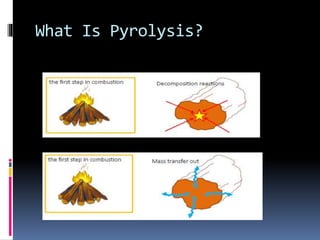
What Is Pyrolysis?
What Is Pyrolysis?
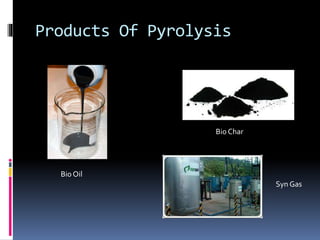
Products Of Pyrolysis
Bio Oil
Bio Char
Syn Gas
Materials used??
 Biomass ;- is an organic material produced
directly from plants & animals or indirectly
from industrial,commercial,domestic or
agricultural products.

 Agricultural waste :- crop & vegetabl residuals(rice
husk, straw)
 livestock :- butchery waste, bone material, dead
animals.
 forestry :- forest residue, processing waste,sawdust.
 Fishery :- processing waste, fishbone meal,dead fish.
 Industrial & house hold organic residuals :- sewage
sludge, waste food etc.
Types of pyrolysis
1. Slow pyrolysis
2. Fast pyrolysis
 Dry Pyrolysis
 Oxydizing Pyrolysis
Slow pyrolysis
 Slow biomass heating rates→low
temperatures→lengthy gas and solids
residence times.
 Temperature :- around 500˚C.
 Main product :- bio-char.
Fast pyrolysis
 Yield 60% bio-oil.
 Takes only seconds to complete the pyrolyses.
 Very high heating and heat transfer rates,which
require a finely ground feed.
 Residence time of pyrolysis vapours in the
reactor less than 1 sec.
 Quenching (rapid cooling) of the pyrolysis
vapours to give the bio-oil product.
 Calorific value :- 3500kcal.
Dry Pyrolysis
 Process of thermal decomposition without
access of oxygen (O₂)
 Product of dry pyrolysis are gas with high
heat of combustion, liquid and solid carbon
residue.
 Type of dry pyrolysis depend on the
temperature of the process
Oxidizing Pyrolysis
 It’s impossible to achieve a completely
oxygen-free atmosphere.
 Thus, a small amount of oxidation occurs.
If volatile or semi-volatile materials are
present in the waste, thermal desorption
will also occur.
 Thermal decomposition of industrial waste
by its partial burning or direct contact with
end product of fuel combustion
 This method is used for neutralization of
most wastes including “inconvenient” ones
for burning
Rice Husk
 The outermost layer of the paddy grain is the
rice husk, also called rice hull.
 Still often considered as a waste product in
the rice mill & therefore often either burned
in the open or dumped on wasteland.
 Rice husk has high calorific value and often
can be used as a renewable fuel.
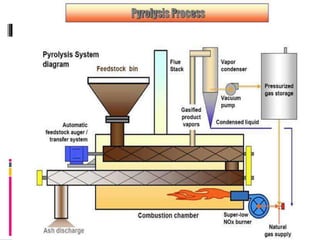
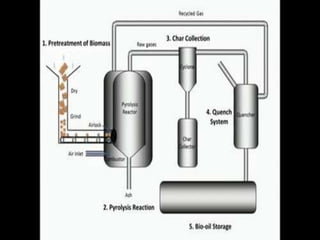
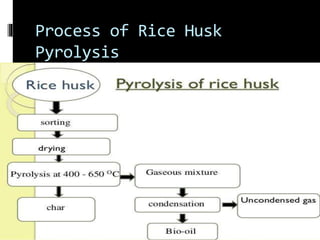
Process of Rice Husk
Pyrolysis
Process
 moisture free rice husk sample was taken in
to a perforated holder and was introduced in
to the tube furnace.
 The furnace was made air tight & heated
electrically.
 Reactor temperature was recorded using a
digital thermometer.
 Pyrolyses were performed under
vaccum.(710-720mm Hg).
 A centrifugal pump was set to create & maintain
the vaccum inside the pyrolyser.
 Temperature of pyrolyser was varied within 400-
650°C.
 The mixture of liquid & gas was allowed to come
out through vaccum line & set at one side of the
pyrolyser.
 The fluid from the pyrolyser was condensed in a
series of ice cooled condenser & bio-oil was
obtained.
 Uncondensed gas was blown off.
 The solid bio-char was collected from the
pyrolyser as residue at the end of each batch
of pyrolysis.
Advantages of pyrolysis
 Simple.
 Low cost technology.
 Capable of processing a wide variety of
feedstock's producing gases,biooil,
biochemical & charcoal.
 Reduces greenhouse gas emissions and
waste going to landfill .
 Produces a marketable product
(electricity).
 Low risk of water pollution .
 Low risk of odours .
 High recovery rate of resources .
 Minimal risk of health consequences .
 Commercially proven technology.
Disadvantages
 Technology is still evolving.
 Market are yet to be developed for char
product and pyrolysis liquid.
Bio-oil (Pyrolysis Oil)
 dark brown liquid
 has a similar composition to biomass.
 much higher density than woody materials
which reduces storage and transport costs.
 Boilers
 Furnaces
 Hot Water Generators
 Hot Air Generators
 Thermic Fluid Heater
 Electric Generators (mixed with 50% diesel)
 Diesel Pumps(mixed with 50% diesel)
 Biochar
 The growing concerns about climate change have
brought biochar into limelight. Combustion and
decomposition of woody biomass and agricultural
residues results in the emission of a large amount of
carbon dioxide.Biochar can store this CO2 in the soil
leading to reduction in GHGs emission and
enhancement of soil fertility.
 can increase the available nutrients for plant growth,
water retention and reduce the amount of fertilizer by
preventing the leaching of nutrients out of the soil.
 reduces methane and nitrous oxide emissions from
soil, thus further reducing GHGs emissions.
 can be utilized in many applications as a replacement
for other biomass energy systems.
 can be used as a soil amendment to increase plant
growth yield.
 Syngas
 made up of carbon monoxide, and
hydrogen (85%) with smaller amounts of
carbon dioxide and methane.
 has a high calorific value so it can be used
as a fuel to generate electricity or steam.
 may also be used as a basic chemical in the
petrochemical industry.
 has less than half the energy density of
natural gas.
conclusion
 pyrolysis has been attracting much attention
due to its high efficiency and good
environmental performance characteristics.
 It also provides an opportunity for the processing
of agricultural residues,wood wastes and
municipal solid waste into clean energy.
 In addition,biochar sequestration could make a
big difference in the fossil fuel emissions
worldwide and act as a major player in the global
carbonmarket with its robust, clean and simple
production technology.
Pyrolysis .

Pyrolysis .

  • 3.
    Pyrolysis  Pyrolysis isa thermo chemical decomposition of organic material in to liquid, gases and char(solid residue)at elevated temperature in the absence of oxygen(or any halogen).
  • 4.
    WHAT IS PYROLYSIS? Pyrolysis does not involve reactions with oxygen, water, or any other reagents.  In practice, it is not possible to achieve a completely oxygen-free atmosphere.  Because some oxygen is present in any pyrolysis system, a small amount of oxidation occurs.
  • 5.
  • 6.
  • 7.
    Products Of Pyrolysis BioOil Bio Char Syn Gas
  • 8.
    Materials used??  Biomass;- is an organic material produced directly from plants & animals or indirectly from industrial,commercial,domestic or agricultural products.  Agricultural waste :- crop & vegetabl residuals(rice husk, straw)  livestock :- butchery waste, bone material, dead animals.  forestry :- forest residue, processing waste,sawdust.  Fishery :- processing waste, fishbone meal,dead fish.  Industrial & house hold organic residuals :- sewage sludge, waste food etc.
  • 9.
    Types of pyrolysis 1.Slow pyrolysis 2. Fast pyrolysis  Dry Pyrolysis  Oxydizing Pyrolysis
  • 10.
    Slow pyrolysis  Slowbiomass heating rates→low temperatures→lengthy gas and solids residence times.  Temperature :- around 500˚C.  Main product :- bio-char.
  • 11.
    Fast pyrolysis  Yield60% bio-oil.  Takes only seconds to complete the pyrolyses.  Very high heating and heat transfer rates,which require a finely ground feed.  Residence time of pyrolysis vapours in the reactor less than 1 sec.  Quenching (rapid cooling) of the pyrolysis vapours to give the bio-oil product.  Calorific value :- 3500kcal.
  • 13.
    Dry Pyrolysis  Processof thermal decomposition without access of oxygen (O₂)  Product of dry pyrolysis are gas with high heat of combustion, liquid and solid carbon residue.  Type of dry pyrolysis depend on the temperature of the process
  • 14.
    Oxidizing Pyrolysis  It’simpossible to achieve a completely oxygen-free atmosphere.  Thus, a small amount of oxidation occurs. If volatile or semi-volatile materials are present in the waste, thermal desorption will also occur.
  • 15.
     Thermal decompositionof industrial waste by its partial burning or direct contact with end product of fuel combustion  This method is used for neutralization of most wastes including “inconvenient” ones for burning
  • 17.
    Rice Husk  Theoutermost layer of the paddy grain is the rice husk, also called rice hull.  Still often considered as a waste product in the rice mill & therefore often either burned in the open or dumped on wasteland.  Rice husk has high calorific value and often can be used as a renewable fuel.
  • 18.
    Process of RiceHusk Pyrolysis
  • 19.
    Process  moisture freerice husk sample was taken in to a perforated holder and was introduced in to the tube furnace.  The furnace was made air tight & heated electrically.  Reactor temperature was recorded using a digital thermometer.  Pyrolyses were performed under vaccum.(710-720mm Hg).
  • 20.
     A centrifugalpump was set to create & maintain the vaccum inside the pyrolyser.  Temperature of pyrolyser was varied within 400- 650°C.  The mixture of liquid & gas was allowed to come out through vaccum line & set at one side of the pyrolyser.  The fluid from the pyrolyser was condensed in a series of ice cooled condenser & bio-oil was obtained.
  • 21.
     Uncondensed gaswas blown off.  The solid bio-char was collected from the pyrolyser as residue at the end of each batch of pyrolysis.
  • 22.
    Advantages of pyrolysis Simple.  Low cost technology.  Capable of processing a wide variety of feedstock's producing gases,biooil, biochemical & charcoal.  Reduces greenhouse gas emissions and waste going to landfill .
  • 23.
     Produces amarketable product (electricity).  Low risk of water pollution .  Low risk of odours .  High recovery rate of resources .  Minimal risk of health consequences .  Commercially proven technology.
  • 24.
    Disadvantages  Technology isstill evolving.  Market are yet to be developed for char product and pyrolysis liquid.
  • 25.
    Bio-oil (Pyrolysis Oil) dark brown liquid  has a similar composition to biomass.  much higher density than woody materials which reduces storage and transport costs.  Boilers  Furnaces  Hot Water Generators  Hot Air Generators  Thermic Fluid Heater  Electric Generators (mixed with 50% diesel)  Diesel Pumps(mixed with 50% diesel)
  • 26.
     Biochar  Thegrowing concerns about climate change have brought biochar into limelight. Combustion and decomposition of woody biomass and agricultural residues results in the emission of a large amount of carbon dioxide.Biochar can store this CO2 in the soil leading to reduction in GHGs emission and enhancement of soil fertility.  can increase the available nutrients for plant growth, water retention and reduce the amount of fertilizer by preventing the leaching of nutrients out of the soil.  reduces methane and nitrous oxide emissions from soil, thus further reducing GHGs emissions.  can be utilized in many applications as a replacement for other biomass energy systems.  can be used as a soil amendment to increase plant growth yield.
  • 27.
     Syngas  madeup of carbon monoxide, and hydrogen (85%) with smaller amounts of carbon dioxide and methane.  has a high calorific value so it can be used as a fuel to generate electricity or steam.  may also be used as a basic chemical in the petrochemical industry.  has less than half the energy density of natural gas.
  • 28.
    conclusion  pyrolysis hasbeen attracting much attention due to its high efficiency and good environmental performance characteristics.  It also provides an opportunity for the processing of agricultural residues,wood wastes and municipal solid waste into clean energy.  In addition,biochar sequestration could make a big difference in the fossil fuel emissions worldwide and act as a major player in the global carbonmarket with its robust, clean and simple production technology.