
GRAFTING, PRUNING AND
TRAINING TOOLS
Dr. Ajay Singh Lodhi
Assistant Professor
College of Agriculture, Balaghat
Jawahar Lal Krishi Vishwa Vidyalaya, Jabalpur (M.P.)
GRAFTING AND BUDDING
Grafting is a method of asexual plant propagation widely used in agriculture and
horticulture where the tissues of one plant are encouraged to fuse with those of another. It is
most commonly used for the propagation of trees and shrubs grown commercially.
In most cases, one plant is selected for its roots, and this is called the stock or rootstock.
The other plant is selected for its stems, leaves, flowers, or fruits and is called the scion.
The scion contains the desired genes to duplicated in future production by the stock/scion
plant.
In stem grafting, a common grafting method, a shoot of a selected, desired plant cultivar
is grafting onto the stock of another type. In another common from called budding, a
dormant side bud is grafting on the stem of another stock plant, and when it has fused
successfully, it is encouraged to grow by cutting out the stem above the new bud.
BUDDING is a grafting technique in which a single bud from the desired scion is used
rather than an entire scion containing many buds. Most budding is done just before or
during the growing season. However some species may be budded during the winter
while they are dormant. Budding requires the same precautions as grafting.
GRAFTING AND BUDDING
Reasons for Grafting and Budding
Change varieties or cultivars
Optimize cross-pollination and pollination.
Take advantage of particular rootstocks
Benefit from inter stocks
Perpetuate clones
Produce certain plant forms
Repair damaged plants
Increase the growth rate of seedlings
GRAFTING AND BUDDING
TOOLS USED FOR BUDDING AND GRAFTING
Dibber
Budding and grafting knives
Grafting Tools
Grafting Tape.
Pruning and Lopping Shears
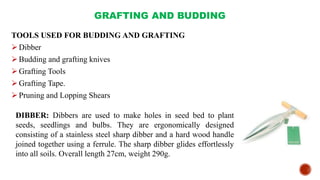
DIBBER: Dibbers are used to make holes in seed bed to plant
seeds, seedlings and bulbs. They are ergonomically designed
consisting of a stainless steel sharp dibber and a hard wood handle
joined together using a ferrule. The sharp dibber glides effortlessly
into all soils. Overall length 27cm, weight 290g.
GRAFTING AND BUDDING
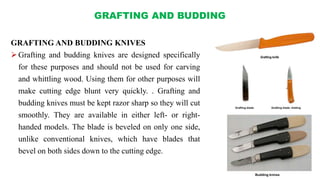
GRAFTING AND BUDDING KNIVES
Grafting and budding knives are designed specifically
for these purposes and should not be used for carving
and whittling wood. Using them for other purposes will
make cutting edge blunt very quickly. . Grafting and
budding knives must be kept razor sharp so they will cut
smoothly. They are available in either left- or right-
handed models. The blade is beveled on only one side,
unlike conventional knives, which have blades that
bevel on both sides down to the cutting edge.
GRAFTING AND BUDDING
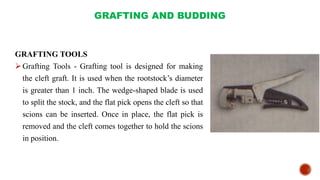
GRAFTING TOOLS
Grafting Tools - Grafting tool is designed for making
the cleft graft. It is used when the rootstock’s diameter
is greater than 1 inch. The wedge-shaped blade is used
to split the stock, and the flat pick opens the cleft so that
scions can be inserted. Once in place, the flat pick is
removed and the cleft comes together to hold the scions
in position.
PRUNING
Pruning is a horticultural and silvicultural practice involving the
selective removal of certain parts of a plant, such as branches, buds,
or roots.
It is a process of carefully removing the parts of the plant - even
healthy parts - to make it healthier still or more attractive, or to
improve other qualities, such as its fruit-bearing ability. It's important
to point out that the emphasis here is on improvement, not removal.
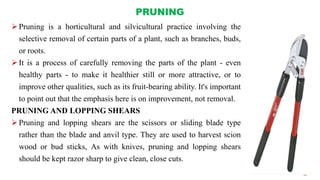
PRUNING AND LOPPING SHEARS
Pruning and lopping shears are the scissors or sliding blade type
rather than the blade and anvil type. They are used to harvest scion
wood or bud sticks, As with knives, pruning and lopping shears
should be kept razor sharp to give clean, close cuts.
PRUNING EQUIPMENTS
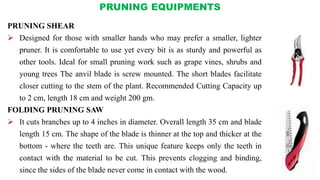
PRUNING SHEAR
 Designed for those with smaller hands who may prefer a smaller, lighter
pruner. It is comfortable to use yet every bit is as sturdy and powerful as
other tools. Ideal for small pruning work such as grape vines, shrubs and
young trees The anvil blade is screw mounted. The short blades facilitate
closer cutting to the stem of the plant. Recommended Cutting Capacity up
to 2 cm, length 18 cm and weight 200 gm.
FOLDING PRUNING SAW
 It cuts branches up to 4 inches in diameter. Overall length 35 cm and blade
length 15 cm. The shape of the blade is thinner at the top and thicker at the
bottom - where the teeth are. This unique feature keeps only the teeth in
contact with the material to be cut. This prevents clogging and binding,
since the sides of the blade never come in contact with the wood.
PRUNING EQUIPMENTS
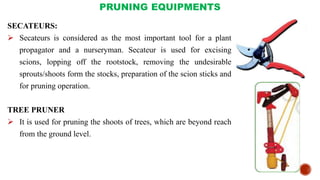
SECATEURS:
 Secateurs is considered as the most important tool for a plant
propagator and a nurseryman. Secateur is used for excising
scions, lopping off the rootstock, removing the undesirable
sprouts/shoots form the stocks, preparation of the scion sticks and
for pruning operation.
TREE PRUNER
 It is used for pruning the shoots of trees, which are beyond reach
from the ground level.
Thank You

Grafting, pruning and training tools.pptx

  • 1.
    GRAFTING, PRUNING AND TRAININGTOOLS Dr. Ajay Singh Lodhi Assistant Professor College of Agriculture, Balaghat Jawahar Lal Krishi Vishwa Vidyalaya, Jabalpur (M.P.)
  • 2.
    GRAFTING AND BUDDING Graftingis a method of asexual plant propagation widely used in agriculture and horticulture where the tissues of one plant are encouraged to fuse with those of another. It is most commonly used for the propagation of trees and shrubs grown commercially. In most cases, one plant is selected for its roots, and this is called the stock or rootstock. The other plant is selected for its stems, leaves, flowers, or fruits and is called the scion. The scion contains the desired genes to duplicated in future production by the stock/scion plant. In stem grafting, a common grafting method, a shoot of a selected, desired plant cultivar is grafting onto the stock of another type. In another common from called budding, a dormant side bud is grafting on the stem of another stock plant, and when it has fused successfully, it is encouraged to grow by cutting out the stem above the new bud. BUDDING is a grafting technique in which a single bud from the desired scion is used rather than an entire scion containing many buds. Most budding is done just before or during the growing season. However some species may be budded during the winter while they are dormant. Budding requires the same precautions as grafting.
  • 3.
    GRAFTING AND BUDDING Reasonsfor Grafting and Budding Change varieties or cultivars Optimize cross-pollination and pollination. Take advantage of particular rootstocks Benefit from inter stocks Perpetuate clones Produce certain plant forms Repair damaged plants Increase the growth rate of seedlings
  • 4.
    GRAFTING AND BUDDING TOOLSUSED FOR BUDDING AND GRAFTING Dibber Budding and grafting knives Grafting Tools Grafting Tape. Pruning and Lopping Shears DIBBER: Dibbers are used to make holes in seed bed to plant seeds, seedlings and bulbs. They are ergonomically designed consisting of a stainless steel sharp dibber and a hard wood handle joined together using a ferrule. The sharp dibber glides effortlessly into all soils. Overall length 27cm, weight 290g.
  • 5.
    GRAFTING AND BUDDING GRAFTINGAND BUDDING KNIVES Grafting and budding knives are designed specifically for these purposes and should not be used for carving and whittling wood. Using them for other purposes will make cutting edge blunt very quickly. . Grafting and budding knives must be kept razor sharp so they will cut smoothly. They are available in either left- or right- handed models. The blade is beveled on only one side, unlike conventional knives, which have blades that bevel on both sides down to the cutting edge.
  • 6.
    GRAFTING AND BUDDING GRAFTINGTOOLS Grafting Tools - Grafting tool is designed for making the cleft graft. It is used when the rootstock’s diameter is greater than 1 inch. The wedge-shaped blade is used to split the stock, and the flat pick opens the cleft so that scions can be inserted. Once in place, the flat pick is removed and the cleft comes together to hold the scions in position.
  • 7.
    PRUNING Pruning is ahorticultural and silvicultural practice involving the selective removal of certain parts of a plant, such as branches, buds, or roots. It is a process of carefully removing the parts of the plant - even healthy parts - to make it healthier still or more attractive, or to improve other qualities, such as its fruit-bearing ability. It's important to point out that the emphasis here is on improvement, not removal. PRUNING AND LOPPING SHEARS Pruning and lopping shears are the scissors or sliding blade type rather than the blade and anvil type. They are used to harvest scion wood or bud sticks, As with knives, pruning and lopping shears should be kept razor sharp to give clean, close cuts.
  • 8.
    PRUNING EQUIPMENTS PRUNING SHEAR Designed for those with smaller hands who may prefer a smaller, lighter pruner. It is comfortable to use yet every bit is as sturdy and powerful as other tools. Ideal for small pruning work such as grape vines, shrubs and young trees The anvil blade is screw mounted. The short blades facilitate closer cutting to the stem of the plant. Recommended Cutting Capacity up to 2 cm, length 18 cm and weight 200 gm. FOLDING PRUNING SAW  It cuts branches up to 4 inches in diameter. Overall length 35 cm and blade length 15 cm. The shape of the blade is thinner at the top and thicker at the bottom - where the teeth are. This unique feature keeps only the teeth in contact with the material to be cut. This prevents clogging and binding, since the sides of the blade never come in contact with the wood.
  • 9.
    PRUNING EQUIPMENTS SECATEURS:  Secateursis considered as the most important tool for a plant propagator and a nurseryman. Secateur is used for excising scions, lopping off the rootstock, removing the undesirable sprouts/shoots form the stocks, preparation of the scion sticks and for pruning operation. TREE PRUNER  It is used for pruning the shoots of trees, which are beyond reach from the ground level.
  • 10.