
SOIL LOSS MEASUREMENT
TECHNIQUES
Lecture-5
Dr. Ajay Singh Lodhi
Assistant Professor
College of Agriculture, Balaghat (M.P.)
Jawahar Lal Krishi Vishwa Vidyalaya, Jabalpur (M.P.)
NEED OF SOIL LOSS MEASUREMENT
 Measurement of soil losses from agricultural watersheds is necessary to know
 The influence of soil and water conservation practices in the area and
 Take appropriate measures to prevent serious consequences.
 Information generated by the studies on soil loss is used to develop relationships which
could be used to predict the soil loss under different soil and crop management practices.
 It is helpful for
 Design of soil conservation measures
 Design of Dam and Reservoirs
 Design of Stable Channels
SOIL LOSS MEASUREMENT
Soil loss measurements could be done through
 Runoff Plots
 Sediment Samplers
When we use Runoff Plots
 For demonstration of farmers
 For comparative studies
 To obtain data for validation of models to
predict
 Runoff
 Sediment
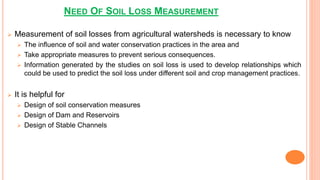
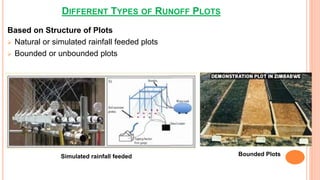
Runoff Plots
DIFFERENT TYPES OF RUNOFF PLOTS
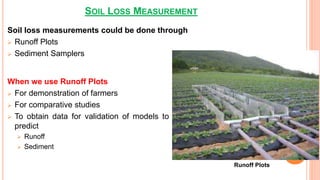
Based on Structure of Plots
 Natural or simulated rainfall feeded plots
 Bounded or unbounded plots
Simulated rainfall feeded Bounded Plots
DIFFERENT TYPES OF RUNOFF PLOTS
Based on Size of the Plots
 Micro Plots
 Medium or USLE Plots
 Large Plots or Watersheds
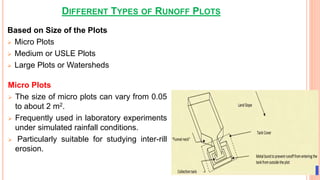
Micro Plots
 The size of micro plots can vary from 0.05
to about 2 m2.
 Frequently used in laboratory experiments
under simulated rainfall conditions.
 Particularly suitable for studying inter-rill
erosion.
DIFFERENT TYPES OF RUNOFF PLOTS
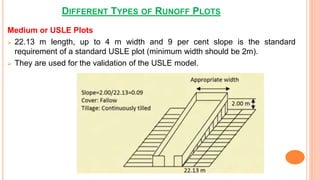
Medium or USLE Plots
 22.13 m length, up to 4 m width and 9 per cent slope is the standard
requirement of a standard USLE plot (minimum width should be 2m).
 They are used for the validation of the USLE model.
DIFFERENT TYPES OF RUNOFF PLOTS
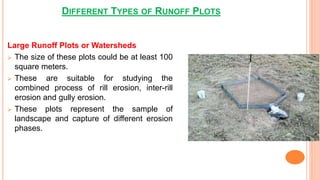
Large Runoff Plots or Watersheds
 The size of these plots could be at least 100
square meters.
 These are suitable for studying the
combined process of rill erosion, inter-rill
erosion and gully erosion.
 These plots represent the sample of
landscape and capture of different erosion
phases.
MERITS AND DEMERITS OF RUNOFF PLOTS
Merits
 Useful in assessing the magnitude or severity of erosion and its effect on soil
productivity.
 Useful in designing and establishing erosion control practices.
Demerits
 These are expensive for both initial construction and maintenance.
 Huge number of labour is required.
 Problems of collecting samples and recording the soil, and water data.
SEDIMENT SAMPLER
 Sediment samplers are basically used to collect sediment-laden water samples
from a flowing water body (river, tributary, canal etc.).
 These sample is subjected to laboratory analysis to determining the chemical,
physical, toxicological or biological composition of the sediment.
 Samples are also used to collect scoops or cores of soil from a known silt
deposition site, for example, reservoir bottom flood plain, to gather historical
information.
SEDIMENT SAMPLING METHODS
 Slot Sampling
 Grab Sampling
SLOT SAMPLING
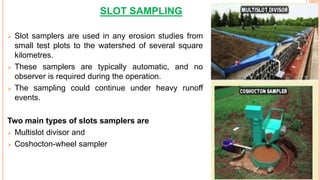
 Slot samplers are used in any erosion studies from
small test plots to the watershed of several square
kilometres.
 These samplers are typically automatic, and no
observer is required during the operation.
 The sampling could continue under heavy runoff
events.
Two main types of slots samplers are
 Multislot divisor and
 Coshocton-wheel sampler
MULTISLOT DIVISOR
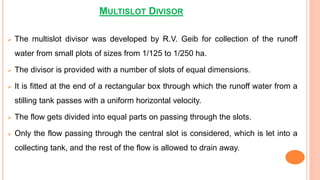
 The multislot divisor was developed by R.V. Geib for collection of the runoff
water from small plots of sizes from 1/125 to 1/250 ha.
 The divisor is provided with a number of slots of equal dimensions.
 It is fitted at the end of a rectangular box through which the runoff water from a
stilling tank passes with a uniform horizontal velocity.
 The flow gets divided into equal parts on passing through the slots.
 Only the flow passing through the central slot is considered, which is let into a
collecting tank, and the rest of the flow is allowed to drain away.
MULTISLOT DIVISOR
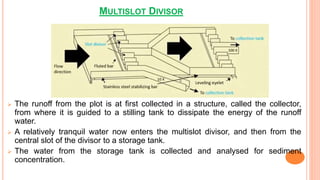
 The runoff from the plot is at first collected in a structure, called the collector,
from where it is guided to a stilling tank to dissipate the energy of the runoff
water.
 A relatively tranquil water now enters the multislot divisor, and then from the
central slot of the divisor to a storage tank.
 The water from the storage tank is collected and analysed for sediment
concentration.
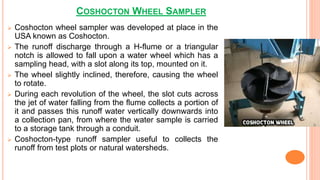
COSHOCTON WHEEL SAMPLER
 Coshocton wheel sampler was developed at place in the
USA known as Coshocton.
 The runoff discharge through a H-flume or a triangular
notch is allowed to fall upon a water wheel which has a
sampling head, with a slot along its top, mounted on it.
 The wheel slightly inclined, therefore, causing the wheel
to rotate.
 During each revolution of the wheel, the slot cuts across
the jet of water falling from the flume collects a portion of
it and passes this runoff water vertically downwards into
a collection pan, from where the water sample is carried
to a storage tank through a conduit.
 Coshocton-type runoff sampler useful to collects the
runoff from test plots or natural watersheds.
Thank You

Soil Loss Measurement Techniques.pptx

  • 1.
    SOIL LOSS MEASUREMENT TECHNIQUES Lecture-5 Dr.Ajay Singh Lodhi Assistant Professor College of Agriculture, Balaghat (M.P.) Jawahar Lal Krishi Vishwa Vidyalaya, Jabalpur (M.P.)
  • 2.
    NEED OF SOILLOSS MEASUREMENT  Measurement of soil losses from agricultural watersheds is necessary to know  The influence of soil and water conservation practices in the area and  Take appropriate measures to prevent serious consequences.  Information generated by the studies on soil loss is used to develop relationships which could be used to predict the soil loss under different soil and crop management practices.  It is helpful for  Design of soil conservation measures  Design of Dam and Reservoirs  Design of Stable Channels
  • 3.
    SOIL LOSS MEASUREMENT Soilloss measurements could be done through  Runoff Plots  Sediment Samplers When we use Runoff Plots  For demonstration of farmers  For comparative studies  To obtain data for validation of models to predict  Runoff  Sediment Runoff Plots
  • 4.
    DIFFERENT TYPES OFRUNOFF PLOTS Based on Structure of Plots  Natural or simulated rainfall feeded plots  Bounded or unbounded plots Simulated rainfall feeded Bounded Plots
  • 5.
    DIFFERENT TYPES OFRUNOFF PLOTS Based on Size of the Plots  Micro Plots  Medium or USLE Plots  Large Plots or Watersheds Micro Plots  The size of micro plots can vary from 0.05 to about 2 m2.  Frequently used in laboratory experiments under simulated rainfall conditions.  Particularly suitable for studying inter-rill erosion.
  • 6.
    DIFFERENT TYPES OFRUNOFF PLOTS Medium or USLE Plots  22.13 m length, up to 4 m width and 9 per cent slope is the standard requirement of a standard USLE plot (minimum width should be 2m).  They are used for the validation of the USLE model.
  • 7.
    DIFFERENT TYPES OFRUNOFF PLOTS Large Runoff Plots or Watersheds  The size of these plots could be at least 100 square meters.  These are suitable for studying the combined process of rill erosion, inter-rill erosion and gully erosion.  These plots represent the sample of landscape and capture of different erosion phases.
  • 8.
    MERITS AND DEMERITSOF RUNOFF PLOTS Merits  Useful in assessing the magnitude or severity of erosion and its effect on soil productivity.  Useful in designing and establishing erosion control practices. Demerits  These are expensive for both initial construction and maintenance.  Huge number of labour is required.  Problems of collecting samples and recording the soil, and water data.
  • 9.
    SEDIMENT SAMPLER  Sedimentsamplers are basically used to collect sediment-laden water samples from a flowing water body (river, tributary, canal etc.).  These sample is subjected to laboratory analysis to determining the chemical, physical, toxicological or biological composition of the sediment.  Samples are also used to collect scoops or cores of soil from a known silt deposition site, for example, reservoir bottom flood plain, to gather historical information. SEDIMENT SAMPLING METHODS  Slot Sampling  Grab Sampling
  • 10.
    SLOT SAMPLING  Slotsamplers are used in any erosion studies from small test plots to the watershed of several square kilometres.  These samplers are typically automatic, and no observer is required during the operation.  The sampling could continue under heavy runoff events. Two main types of slots samplers are  Multislot divisor and  Coshocton-wheel sampler
  • 11.
    MULTISLOT DIVISOR  Themultislot divisor was developed by R.V. Geib for collection of the runoff water from small plots of sizes from 1/125 to 1/250 ha.  The divisor is provided with a number of slots of equal dimensions.  It is fitted at the end of a rectangular box through which the runoff water from a stilling tank passes with a uniform horizontal velocity.  The flow gets divided into equal parts on passing through the slots.  Only the flow passing through the central slot is considered, which is let into a collecting tank, and the rest of the flow is allowed to drain away.
  • 12.
    MULTISLOT DIVISOR  Therunoff from the plot is at first collected in a structure, called the collector, from where it is guided to a stilling tank to dissipate the energy of the runoff water.  A relatively tranquil water now enters the multislot divisor, and then from the central slot of the divisor to a storage tank.  The water from the storage tank is collected and analysed for sediment concentration.
  • 13.
    COSHOCTON WHEEL SAMPLER Coshocton wheel sampler was developed at place in the USA known as Coshocton.  The runoff discharge through a H-flume or a triangular notch is allowed to fall upon a water wheel which has a sampling head, with a slot along its top, mounted on it.  The wheel slightly inclined, therefore, causing the wheel to rotate.  During each revolution of the wheel, the slot cuts across the jet of water falling from the flume collects a portion of it and passes this runoff water vertically downwards into a collection pan, from where the water sample is carried to a storage tank through a conduit.  Coshocton-type runoff sampler useful to collects the runoff from test plots or natural watersheds.
  • 14.