Presented By:-
Machhi Dhruvi Anilkumar
1st Sem. M.Pharm.
Department of Pharmaceutical Quality Assurance
Smt. B. N. B. Swaminarayan Pharmacy College, Salvav-vapi
Topic:- CTD (Common Technical Document) &
eCTD (Electronic Common Technical Document)
Subject Name:- Quality Control & Quality Assurance
Subject Code:- MQA103T
1
Common Technical Document (CTD)
• The common technical document (CTD) is a set of specification for application
dossier for the registration of medicines & designed to be used across Europe,
Japan & United States.
• It is an internationally agreed format for the preparation of applications regarding
new drugs intended to be submitted to regional regulatory authorities in
participating countries.
• CTD is maintained by ICH of technical requirement for registration of
pharmaceutical for human use.
4/6/2022 Dhruvi Machhi Smt.BNB.SPC,Salvav-Vapi 2
Electronic common technical document (eCTD)
• Electronic version of CTD is called eCTD.
• After decades of using paper, the goal is the electronic transfer of drug
application & their review across submission formats, procedures &
reasons came in Electronic Common Technical Document (ECTD).
• The eCTD is an interface & international specification for the
pharmaceutical industry to transfer regulatory information.
• The focus of the specification is to provide the ability to transfer the
registration application electronically from industry to a regulatory
authority.
4/6/2022 Dhruvi Machhi Smt.BNB.SPC,Salvav-Vapi 3
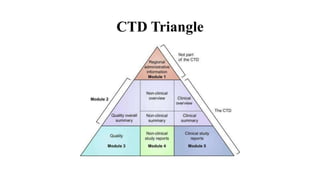
Organization of CTD and eCTD
• The Common Technical Document is organized into five modules.
• Module 1 is region specific.
• Modules 2, 3, 4, & 5 are intended to be common for all regions.
• Conformance with this guideline should ensure that these four
modules are provided in a format acceptable to the regulatory
authorities
CTD Triangle
Module 1-Administrative information and
prescribing information
• The name of the folder for module 1 should be m1.
• This module contains administrative information that is unique for
each region.
• Regional guidance will provide the specific instructions on how to
provide the administrative formats & detailed prescribing information.
Module 2-Summaries
• The name of the folder for module 2 should be m2.
• This module contains overall summaries of quality, non-clinical &
clinical. The files in this module should be provided as PDF text with
exception of a few embedded images, when needed.
• It starts with a general introduction to the drug, including its
pharmacological class, mode of action, & proposed clinical use.
Module 3-Quality
• The name of the folder for module 3 should be M3.
• This module contains Quality aspects of the intended drug or
medicinal product.
• Module 3 presents the chemistry, manufacturing,& controls reports for
the product.
• Full details of what should be included in Module 3 are provided in
the ICH M4Q guideline.
Module 4 - nonclinical study reports
• The name of the folder for module 4 should be m4.
• This module contains details of nonclinical studies.
• The structure and content of Module 4 is specified in the ICH M4S
guidelines
Module 5-Clinical study reports
• The name of the folder for module 5 should be m5.
• This module contains details of clinical studies.
• The structure and content of Module 5 is specified in the ICH M4E
guidelines,9 which provided a specific placement of clinical study
reports & related information to simplify preparation & review & to
ensure completeness.
References
• Jordan, Debbie. "An overview of the Common Technical Document
(CTD) regulatory dossier." Medical Writing 23.2 (2014): 101-105.
Thank
you

CTD & eCTD

  • 1.
    Presented By:- Machhi DhruviAnilkumar 1st Sem. M.Pharm. Department of Pharmaceutical Quality Assurance Smt. B. N. B. Swaminarayan Pharmacy College, Salvav-vapi Topic:- CTD (Common Technical Document) & eCTD (Electronic Common Technical Document) Subject Name:- Quality Control & Quality Assurance Subject Code:- MQA103T 1
  • 2.
    Common Technical Document(CTD) • The common technical document (CTD) is a set of specification for application dossier for the registration of medicines & designed to be used across Europe, Japan & United States. • It is an internationally agreed format for the preparation of applications regarding new drugs intended to be submitted to regional regulatory authorities in participating countries. • CTD is maintained by ICH of technical requirement for registration of pharmaceutical for human use. 4/6/2022 Dhruvi Machhi Smt.BNB.SPC,Salvav-Vapi 2
  • 3.
    Electronic common technicaldocument (eCTD) • Electronic version of CTD is called eCTD. • After decades of using paper, the goal is the electronic transfer of drug application & their review across submission formats, procedures & reasons came in Electronic Common Technical Document (ECTD). • The eCTD is an interface & international specification for the pharmaceutical industry to transfer regulatory information. • The focus of the specification is to provide the ability to transfer the registration application electronically from industry to a regulatory authority. 4/6/2022 Dhruvi Machhi Smt.BNB.SPC,Salvav-Vapi 3
  • 4.
    Organization of CTDand eCTD • The Common Technical Document is organized into five modules. • Module 1 is region specific. • Modules 2, 3, 4, & 5 are intended to be common for all regions. • Conformance with this guideline should ensure that these four modules are provided in a format acceptable to the regulatory authorities
  • 5.
  • 6.
    Module 1-Administrative informationand prescribing information • The name of the folder for module 1 should be m1. • This module contains administrative information that is unique for each region. • Regional guidance will provide the specific instructions on how to provide the administrative formats & detailed prescribing information.
  • 7.
    Module 2-Summaries • Thename of the folder for module 2 should be m2. • This module contains overall summaries of quality, non-clinical & clinical. The files in this module should be provided as PDF text with exception of a few embedded images, when needed. • It starts with a general introduction to the drug, including its pharmacological class, mode of action, & proposed clinical use.
  • 8.
    Module 3-Quality • Thename of the folder for module 3 should be M3. • This module contains Quality aspects of the intended drug or medicinal product. • Module 3 presents the chemistry, manufacturing,& controls reports for the product. • Full details of what should be included in Module 3 are provided in the ICH M4Q guideline.
  • 9.
    Module 4 -nonclinical study reports • The name of the folder for module 4 should be m4. • This module contains details of nonclinical studies. • The structure and content of Module 4 is specified in the ICH M4S guidelines
  • 10.
    Module 5-Clinical studyreports • The name of the folder for module 5 should be m5. • This module contains details of clinical studies. • The structure and content of Module 5 is specified in the ICH M4E guidelines,9 which provided a specific placement of clinical study reports & related information to simplify preparation & review & to ensure completeness.
  • 11.
    References • Jordan, Debbie."An overview of the Common Technical Document (CTD) regulatory dossier." Medical Writing 23.2 (2014): 101-105.
  • 12.