
GAS CHROMATOGRAPHY
Presented by:
Majid Farooq (M. Pharm 1st Sem.)
Aman Thakur (M. Pharm 1st Sem.)
GAS CHROMATOGRAPHY
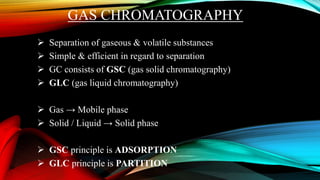
 Separation of gaseous & volatile substances
 Simple & efficient in regard to separation
 GC consists of GSC (gas solid chromatography)
 GLC (gas liquid chromatography)
 Gas → Mobile phase
 Solid / Liquid → Solid phase
 GSC principle is ADSORPTION
 GLC principle is PARTITION
PRINCIPLE
The organic compounds are separated due to
differences in their partitioning behavior
between the mobile gas phase and the
stationary phase in the column.
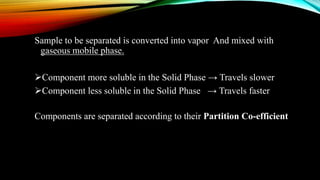
Sample to be separated is converted into vapor And mixed with
gaseous mobile phase.
Component more soluble in the Solid Phase → Travels slower
Component less soluble in the Solid Phase → Travels faster
Components are separated according to their Partition Co-efficient
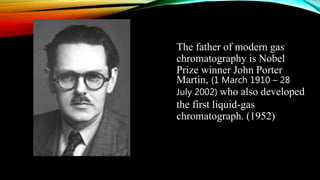
The father of modern gas
chromatography is Nobel
Prize winner John Porter
Martin, (1 March 1910 – 28
July 2002) who also developed
the first liquid-gas
chromatograph. (1952)
GAS SOLID CHROMATOGRAPHY
The stationary phase, in this case, is a solid like silica or alumina.
The mobile phase is, of course, a suitable carrier gas.
 Most useful for the separation and analysis of gases like CH4, CO2,
CO, ... etc.
The use of GSC in practice is considered marginal when compared
to gas liquid chromatography.
GAS - LIQUID CHROMATOGRAPHY (GLC)
The stationary phase is a liquid with very low volatility while the
mobile phase is a suitable carrier gas.
 GLC is the most widely used technique for separation of volatile
species.
The presence of a wide variety of stationary phases has high selectivity
and easy column preparation as compared of GSC.
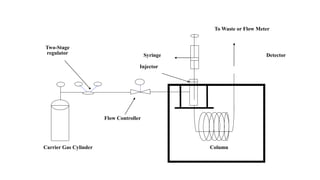
INSTRUMENTATION
Carrier gas
Flow regulators & Flow meters
Injection devices
Columns
Temperature control devices
Detectors
Recorders & Integrators
Syringe
Injector
Detector
Carrier Gas Cylinder Column
To Waste or Flow Meter
Flow Controller
Two-Stage
regulator
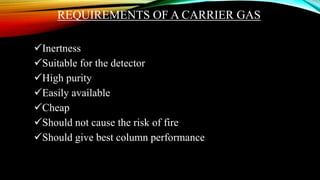
REQUIREMENTS OF A CARRIER GAS
Inertness
Suitable for the detector
High purity
Easily available
Cheap
Should not cause the risk of fire
Should give best column performance
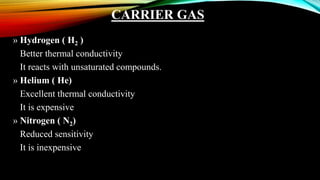
CARRIER GAS
» Hydrogen ( H2 )
Better thermal conductivity
It reacts with unsaturated compounds.
» Helium ( He)
Excellent thermal conductivity
It is expensive
» Nitrogen ( N2)
Reduced sensitivity
It is inexpensive
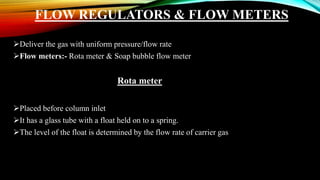
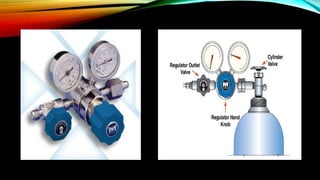
FLOW REGULATORS & FLOW METERS
Deliver the gas with uniform pressure/flow rate
Flow meters:- Rota meter & Soap bubble flow meter
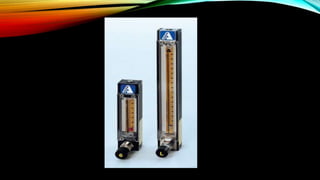
Rota meter
Placed before column inlet
It has a glass tube with a float held on to a spring.
The level of the float is determined by the flow rate of carrier gas
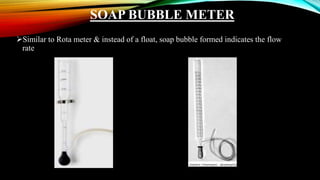
SOAP BUBBLE METER
Similar to Rota meter & instead of a float, soap bubble formed indicates the flow
rate
INJECTORS
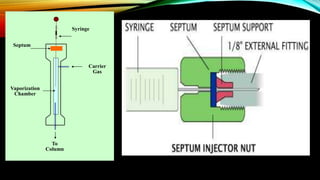
These are composed of a glass tube where vaporization of the sample takes place.
 The sample is introduced into the injector through a self-sealing silicone rubber septum.
The carrier gas flows through the injector carrying vaporized solutes.
 The temperature of the injector should be adjusted so that flash vaporization of all
solutes occurs. If the temperature of the injector is not high enough (at least 50
degrees above highest boiling component), band broadening will take place.
Carrier
Gas
Syringe
Vaporization
Chamber
To
Column
Septum
GAS CHROMATOGRAPHIC COLUMNS
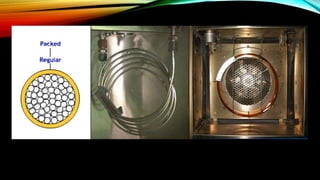
These columns are fabricated from glass, stainless steel, copper, or other suitable
tubes.
Stainless steel is the most common tubing used with internal diameters from 1-4 mm.
The column is packed with finely divided particles (100-300 mm diameter), which is
coated with stationary phase. However, glass tubes are also used for large-scale
separations.
Stainless steel is the most widely used because it is most inert and easy to work with.
 These find excellent and wide use because of easy packing and good routine separation
characteristics.
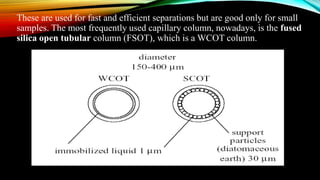
Open tubular or capillary columns are finding broad applications. These are mainly of
two types:
• Wall-coated open tubular (WCOT) <1 mm thick liquid coating on inside of silica tube
• Support-coated open tubular (SCOT) 30 mm thick coating of liquid coated support on
inside of silica tube
These are used for fast and efficient separations but are good only for small
samples. The most frequently used capillary column, nowadays, is the fused
silica open tubular column (FSOT), which is a WCOT column.
Capillary columns advantages compared to packed columns
1. higher resolution
2. shorter analysis times
3. greater sensitivity
Capillary columns disadvantage compared to packed
columns
1. smaller sample capacity
2. Need better experience
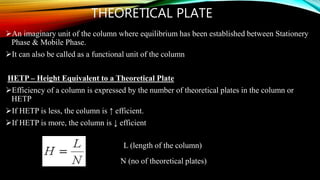
THEORETICAL PLATE
An imaginary unit of the column where equilibrium has been established between Stationery
Phase & Mobile Phase.
It can also be called as a functional unit of the column
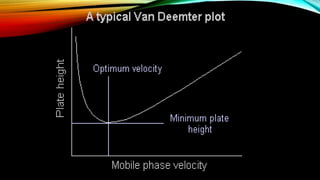
HETP – Height Equivalent to a Theoretical Plate
Efficiency of a column is expressed by the number of theoretical plates in the column or
HETP
If HETP is less, the column is ↑ efficient.
If HETP is more, the column is ↓ efficient
L (length of the column)
N (no of theoretical plates)
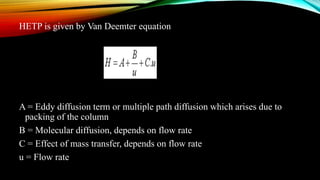
HETP is given by Van Deemter equation
A = Eddy diffusion term or multiple path diffusion which arises due to
packing of the column
B = Molecular diffusion, depends on flow rate
C = Effect of mass transfer, depends on flow rate
u = Flow rate
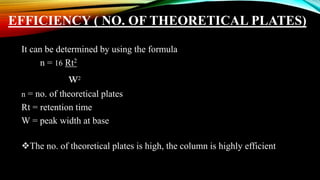
EFFICIENCY ( NO. OF THEORETICAL PLATES)
It can be determined by using the formula
n = 16 Rt2
w2
n = no. of theoretical plates
Rt = retention time
W = peak width at base
The no. of theoretical plates is high, the column is highly efficient
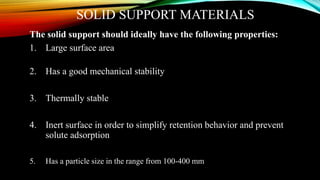
SOLID SUPPORT MATERIALS
The solid support should ideally have the following properties:
1. Large surface area
2. Has a good mechanical stability
3. Thermally stable
4. Inert surface in order to simplify retention behavior and prevent
solute adsorption
5. Has a particle size in the range from 100-400 mm
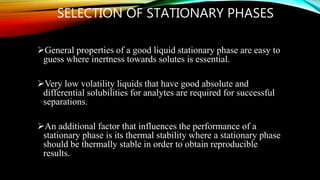
SELECTION OF STATIONARY PHASES
General properties of a good liquid stationary phase are easy to
guess where inertness towards solutes is essential.
Very low volatility liquids that have good absolute and
differential solubilities for analytes are required for successful
separations.
An additional factor that influences the performance of a
stationary phase is its thermal stability where a stationary phase
should be thermally stable in order to obtain reproducible
results.
Generally, the film thickness primarily affects the retention character and the
sample capacity of a column.
Thick films are used with highly volatile analytes, because such films retain
solutes for a longer time and thus provide a greater time for separation to take
place.
Thin films are useful for separating species of low volatility in a reasonable
time.
 A thicker film can tolerate a larger sample size.
Film thicknesses in the range from 0.1 – 5 mm are common.
LIQUID STATIONARY PHASES
In general, the polarity of the stationary phase should match that of the
sample constituents ("like" dissolves "like").
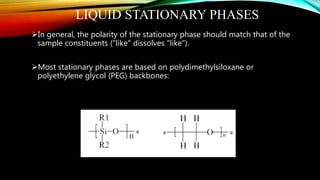
Most stationary phases are based on polydimethylsiloxane or
polyethylene glycol (PEG) backbones:
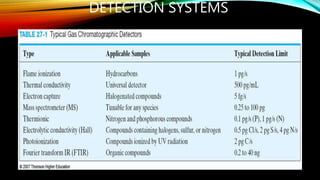
DETECTION SYSTEMS
THERMAL CONDUCTIVITY
DETECTORS(TCD)
A very early detector for gas chromatography, and one that still finds wide application, is
based upon changes in the thermal conductivity of the gas stream brought about by the
presence of analyte molecules.
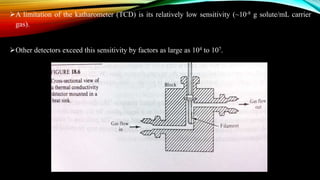
The sensing element of TCD is an electrically heated element whose temperature at
constant electrical power depends upon the thermal conductivity of the surrounding gas.
The heated element may be a fine platinum, gold, or tungsten wire or a semiconducting
thermistor.
The advantage of the thermal conductivity detector is its simplicity, its large linear dynamic
range(~105), its general response to both organic and inorganic species, and its non-
destructive character, which permits collection of solutes after detection.
A limitation of the katharometer (TCD) is its relatively low sensitivity (~10-8 g solute/mL carrier
gas).
Other detectors exceed this sensitivity by factors as large as 104 to 107.
FLAME IONIZATION DETECTORS (FID)
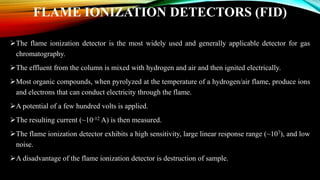
The flame ionization detector is the most widely used and generally applicable detector for gas
chromatography.
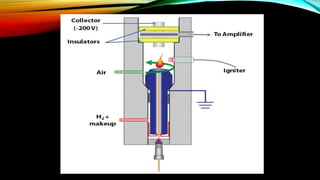
The effluent from the column is mixed with hydrogen and air and then ignited electrically.
Most organic compounds, when pyrolyzed at the temperature of a hydrogen/air flame, produce ions
and electrons that can conduct electricity through the flame.
A potential of a few hundred volts is applied.
The resulting current (~10-12 A) is then measured.
The flame ionization detector exhibits a high sensitivity, large linear response range (~107), and low
noise.
A disadvantage of the flame ionization detector is destruction of sample.
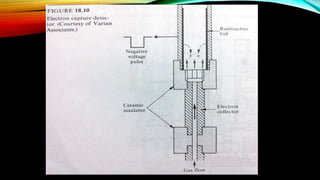
Electron-Capture Detectors(ECD)
The electron-capture detector has become one of the most widely used detectors for
environmental samples because this detector selectivity detects halogen containing
compounds, such as pesticides and polychlorinated biphenyls (PCB)
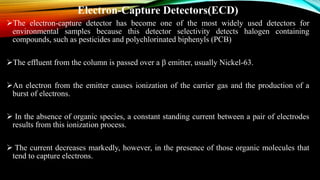
The effluent from the column is passed over a  emitter, usually Nickel-63.
An electron from the emitter causes ionization of the carrier gas and the production of a
burst of electrons.
 In the absence of organic species, a constant standing current between a pair of electrodes
results from this ionization process.
 The current decreases markedly, however, in the presence of those organic molecules that
tend to capture electrons.
The electron-capture detector is selective in its response being highly sensitive
to molecules containing electronegative functional groups such as halogens,
peroxides, quinones, and nitro groups.
It is insensitive to functional groups such as amines, alcohols, and
hydrocarbons.
An important application of the electron-capture detector has been for the
detection and determination of chlorinated insecticides.
PARAMETERS USED IN GC
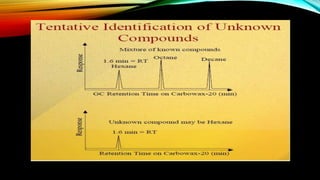
• Retention time (Rt)
It is the difference in time b/w the point of injection & appearance of peak
maxima. Rt is measured in minutes or seconds
(or) It is the time required for 50% of a component to be eluted from a
column
• Retention volume (Vr)
It is the volume of carrier gas which is required to elute 50% of the
component from the column.
Retention volume = Retention time ˣ Flow rate
ADVANTAGES OF G.C
Very high resolution power, complex mixtures can be resolved
into its components by this method.
Very high sensitivity with TCD, detect down to 100 ppm
It is a micro method, small sample size is required
Fast analysis is possible
Relatively good precision & accuracy
Qualitative & quantitative analysis is possible
DISADVANTAGES OF G.C
Limited to volatile sample.
Not suitable for thermally labile substances.
Detectors used in GC are destructive.
APPLICATIONS OF G.C
Separation and identification of lipids, carbohydrates & proteins.
Separation and identification of amino acids in urine for diagnostic purpose.
Measurement of drugs and other metabolites in biological fluids.
Used for toxicological analysis of biological fluids by using ECD detector.
Analysis of pesticides in soil, water, food.
Forensic analysis of urine and blood alcohol levels.
Used to identify nitro compounds in trace quantities.
Gas Chromatography

Gas Chromatography

  • 1.
    GAS CHROMATOGRAPHY Presented by: MajidFarooq (M. Pharm 1st Sem.) Aman Thakur (M. Pharm 1st Sem.)
  • 2.
    GAS CHROMATOGRAPHY  Separationof gaseous & volatile substances  Simple & efficient in regard to separation  GC consists of GSC (gas solid chromatography)  GLC (gas liquid chromatography)  Gas → Mobile phase  Solid / Liquid → Solid phase  GSC principle is ADSORPTION  GLC principle is PARTITION
  • 3.
    PRINCIPLE The organic compoundsare separated due to differences in their partitioning behavior between the mobile gas phase and the stationary phase in the column.
  • 4.
    Sample to beseparated is converted into vapor And mixed with gaseous mobile phase. Component more soluble in the Solid Phase → Travels slower Component less soluble in the Solid Phase → Travels faster Components are separated according to their Partition Co-efficient
  • 5.
    The father ofmodern gas chromatography is Nobel Prize winner John Porter Martin, (1 March 1910 – 28 July 2002) who also developed the first liquid-gas chromatograph. (1952)
  • 6.
    GAS SOLID CHROMATOGRAPHY Thestationary phase, in this case, is a solid like silica or alumina. The mobile phase is, of course, a suitable carrier gas.  Most useful for the separation and analysis of gases like CH4, CO2, CO, ... etc. The use of GSC in practice is considered marginal when compared to gas liquid chromatography.
  • 7.
    GAS - LIQUIDCHROMATOGRAPHY (GLC) The stationary phase is a liquid with very low volatility while the mobile phase is a suitable carrier gas.  GLC is the most widely used technique for separation of volatile species. The presence of a wide variety of stationary phases has high selectivity and easy column preparation as compared of GSC.
  • 8.
    INSTRUMENTATION Carrier gas Flow regulators& Flow meters Injection devices Columns Temperature control devices Detectors Recorders & Integrators
  • 9.
    Syringe Injector Detector Carrier Gas CylinderColumn To Waste or Flow Meter Flow Controller Two-Stage regulator
  • 10.
    REQUIREMENTS OF ACARRIER GAS Inertness Suitable for the detector High purity Easily available Cheap Should not cause the risk of fire Should give best column performance
  • 11.
    CARRIER GAS » Hydrogen( H2 ) Better thermal conductivity It reacts with unsaturated compounds. » Helium ( He) Excellent thermal conductivity It is expensive » Nitrogen ( N2) Reduced sensitivity It is inexpensive
  • 12.
    FLOW REGULATORS &FLOW METERS Deliver the gas with uniform pressure/flow rate Flow meters:- Rota meter & Soap bubble flow meter Rota meter Placed before column inlet It has a glass tube with a float held on to a spring. The level of the float is determined by the flow rate of carrier gas
  • 14.
    SOAP BUBBLE METER Similarto Rota meter & instead of a float, soap bubble formed indicates the flow rate
  • 16.
    INJECTORS These are composedof a glass tube where vaporization of the sample takes place.  The sample is introduced into the injector through a self-sealing silicone rubber septum. The carrier gas flows through the injector carrying vaporized solutes.  The temperature of the injector should be adjusted so that flash vaporization of all solutes occurs. If the temperature of the injector is not high enough (at least 50 degrees above highest boiling component), band broadening will take place.
  • 17.
  • 18.
    GAS CHROMATOGRAPHIC COLUMNS Thesecolumns are fabricated from glass, stainless steel, copper, or other suitable tubes. Stainless steel is the most common tubing used with internal diameters from 1-4 mm. The column is packed with finely divided particles (100-300 mm diameter), which is coated with stationary phase. However, glass tubes are also used for large-scale separations.
  • 20.
    Stainless steel isthe most widely used because it is most inert and easy to work with.  These find excellent and wide use because of easy packing and good routine separation characteristics. Open tubular or capillary columns are finding broad applications. These are mainly of two types: • Wall-coated open tubular (WCOT) <1 mm thick liquid coating on inside of silica tube • Support-coated open tubular (SCOT) 30 mm thick coating of liquid coated support on inside of silica tube
  • 21.
    These are usedfor fast and efficient separations but are good only for small samples. The most frequently used capillary column, nowadays, is the fused silica open tubular column (FSOT), which is a WCOT column.
  • 22.
    Capillary columns advantagescompared to packed columns 1. higher resolution 2. shorter analysis times 3. greater sensitivity Capillary columns disadvantage compared to packed columns 1. smaller sample capacity 2. Need better experience
  • 23.
    THEORETICAL PLATE An imaginaryunit of the column where equilibrium has been established between Stationery Phase & Mobile Phase. It can also be called as a functional unit of the column HETP – Height Equivalent to a Theoretical Plate Efficiency of a column is expressed by the number of theoretical plates in the column or HETP If HETP is less, the column is ↑ efficient. If HETP is more, the column is ↓ efficient L (length of the column) N (no of theoretical plates)
  • 24.
    HETP is givenby Van Deemter equation A = Eddy diffusion term or multiple path diffusion which arises due to packing of the column B = Molecular diffusion, depends on flow rate C = Effect of mass transfer, depends on flow rate u = Flow rate
  • 25.
    EFFICIENCY ( NO.OF THEORETICAL PLATES) It can be determined by using the formula n = 16 Rt2 w2 n = no. of theoretical plates Rt = retention time W = peak width at base The no. of theoretical plates is high, the column is highly efficient
  • 27.
    SOLID SUPPORT MATERIALS Thesolid support should ideally have the following properties: 1. Large surface area 2. Has a good mechanical stability 3. Thermally stable 4. Inert surface in order to simplify retention behavior and prevent solute adsorption 5. Has a particle size in the range from 100-400 mm
  • 28.
    SELECTION OF STATIONARYPHASES General properties of a good liquid stationary phase are easy to guess where inertness towards solutes is essential. Very low volatility liquids that have good absolute and differential solubilities for analytes are required for successful separations. An additional factor that influences the performance of a stationary phase is its thermal stability where a stationary phase should be thermally stable in order to obtain reproducible results.
  • 29.
    Generally, the filmthickness primarily affects the retention character and the sample capacity of a column. Thick films are used with highly volatile analytes, because such films retain solutes for a longer time and thus provide a greater time for separation to take place. Thin films are useful for separating species of low volatility in a reasonable time.  A thicker film can tolerate a larger sample size. Film thicknesses in the range from 0.1 – 5 mm are common.
  • 30.
    LIQUID STATIONARY PHASES Ingeneral, the polarity of the stationary phase should match that of the sample constituents ("like" dissolves "like"). Most stationary phases are based on polydimethylsiloxane or polyethylene glycol (PEG) backbones:
  • 31.
  • 32.
    THERMAL CONDUCTIVITY DETECTORS(TCD) A veryearly detector for gas chromatography, and one that still finds wide application, is based upon changes in the thermal conductivity of the gas stream brought about by the presence of analyte molecules. The sensing element of TCD is an electrically heated element whose temperature at constant electrical power depends upon the thermal conductivity of the surrounding gas. The heated element may be a fine platinum, gold, or tungsten wire or a semiconducting thermistor. The advantage of the thermal conductivity detector is its simplicity, its large linear dynamic range(~105), its general response to both organic and inorganic species, and its non- destructive character, which permits collection of solutes after detection.
  • 33.
    A limitation ofthe katharometer (TCD) is its relatively low sensitivity (~10-8 g solute/mL carrier gas). Other detectors exceed this sensitivity by factors as large as 104 to 107.
  • 34.
    FLAME IONIZATION DETECTORS(FID) The flame ionization detector is the most widely used and generally applicable detector for gas chromatography. The effluent from the column is mixed with hydrogen and air and then ignited electrically. Most organic compounds, when pyrolyzed at the temperature of a hydrogen/air flame, produce ions and electrons that can conduct electricity through the flame. A potential of a few hundred volts is applied. The resulting current (~10-12 A) is then measured. The flame ionization detector exhibits a high sensitivity, large linear response range (~107), and low noise. A disadvantage of the flame ionization detector is destruction of sample.
  • 36.
    Electron-Capture Detectors(ECD) The electron-capturedetector has become one of the most widely used detectors for environmental samples because this detector selectivity detects halogen containing compounds, such as pesticides and polychlorinated biphenyls (PCB) The effluent from the column is passed over a  emitter, usually Nickel-63. An electron from the emitter causes ionization of the carrier gas and the production of a burst of electrons.  In the absence of organic species, a constant standing current between a pair of electrodes results from this ionization process.  The current decreases markedly, however, in the presence of those organic molecules that tend to capture electrons.
  • 37.
    The electron-capture detectoris selective in its response being highly sensitive to molecules containing electronegative functional groups such as halogens, peroxides, quinones, and nitro groups. It is insensitive to functional groups such as amines, alcohols, and hydrocarbons. An important application of the electron-capture detector has been for the detection and determination of chlorinated insecticides.
  • 39.
    PARAMETERS USED INGC • Retention time (Rt) It is the difference in time b/w the point of injection & appearance of peak maxima. Rt is measured in minutes or seconds (or) It is the time required for 50% of a component to be eluted from a column • Retention volume (Vr) It is the volume of carrier gas which is required to elute 50% of the component from the column. Retention volume = Retention time ˣ Flow rate
  • 41.
    ADVANTAGES OF G.C Veryhigh resolution power, complex mixtures can be resolved into its components by this method. Very high sensitivity with TCD, detect down to 100 ppm It is a micro method, small sample size is required Fast analysis is possible Relatively good precision & accuracy Qualitative & quantitative analysis is possible
  • 42.
    DISADVANTAGES OF G.C Limitedto volatile sample. Not suitable for thermally labile substances. Detectors used in GC are destructive.
  • 43.
    APPLICATIONS OF G.C Separationand identification of lipids, carbohydrates & proteins. Separation and identification of amino acids in urine for diagnostic purpose. Measurement of drugs and other metabolites in biological fluids. Used for toxicological analysis of biological fluids by using ECD detector. Analysis of pesticides in soil, water, food. Forensic analysis of urine and blood alcohol levels. Used to identify nitro compounds in trace quantities.