Seminar On
HIGH PERFORMANCE LIQUID
CHROMATOGRAPHY
Presented By
MANOJ KUMAR.M
M pharmacy 1st year
H.tno.636217885001
Under Guidance Of
Prof. Dr. S.Y.Manjunath
DEPARTMENT OF PHARMACEUTICALANALYSIS
SRIKRUPA INISTITUTE OF PHARMACEUTICAL SCIENCES
(Approved by AICTE;PCI)
(Affiliated to osmania university) 1
 HPLC stands for “High Performance Liquid Chromatography”.
 High performance liquid chromatography is a powerful tool in
analysis, it yields high performance and high speed compared to
traditional column chromatography because of the forcibly
pumped mobile phase
Chromatography:
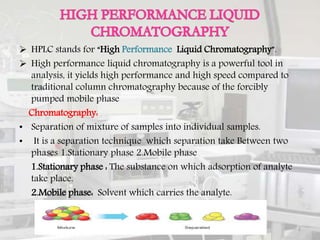
• Separation of mixture of samples into individual samples.
• It is a separation technique which separation take Between two
phases 1.Stationary phase 2.Mobile phase
1.Stationary phase : The substance on which adsorption of analyte
take place.
2.Mobile phase: Solvent which carries the analyte.
2
Liquid chromatography:
 It is a chromatographic technique in which mobile phase is a liquid.
 The main principle involved in liquid chromatography is adsorption.
PRINCIPLE
 When a mixture of samples introduced into column various chemical
and physical interactions takes place between column material and
components present in the sample travel according to their relative
affinities towards the stationary phase . the component which has more
affinity towards the stationary phase ,travels slower. The components
which having less affinity towards stationary phase travels faster.
More over it work very efficiently compare to other chromatographic
techniques. In this high pressure pump is used to transfer the sample to
stationary phase. so it is also called as high pressure liquid
chromatography.
3
 The principle of HPLC are based on Van Demeter equation
which relates the efficiency of the chromatographic column to
the particle size of the column, molecular diffusion and
thickness of stationary phase.
 The Van Deemter Equation is given as
H or HETP = A + B/u + C υ
Where,
A= Represents eddy diffusion,
B= Represents molecular diffusion,
C =Represents rate of mass transfer,
υ =Represents flow rate.
4
TYPES OF HPLC
1. Based on Mode Of Separation.
2. Based on Principle Of Separation.
3. Based on Elution Technique.
4. Based on Scale Of Operation.
5. Based on Type Of Analysis.
5
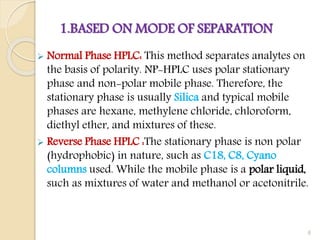
1.BASED ON MODE OF SEPARATION
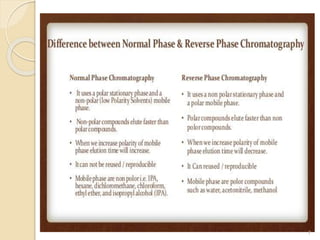
 Normal Phase HPLC: This method separates analytes on
the basis of polarity. NP-HPLC uses polar stationary
phase and non-polar mobile phase. Therefore, the
stationary phase is usually Silica and typical mobile
phases are hexane, methylene chloride, chloroform,
diethyl ether, and mixtures of these.
 Reverse Phase HPLC :The stationary phase is non polar
(hydrophobic) in nature, such as C18, C8, Cyano
columns used. While the mobile phase is a polar liquid,
such as mixtures of water and methanol or acetonitrile.
6
7
2.BASED ON PRINCIPLE OF SEPRATION
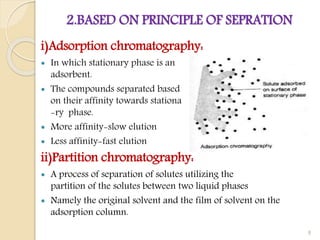
i)Adsorption chromatography:
 In which stationary phase is an
adsorbent.
 The compounds separated based
on their affinity towards stationa
-ry phase.
 More affinity-slow elution
 Less affinity-fast elution
ii)Partition chromatography:
 A process of separation of solutes utilizing the
partition of the solutes between two liquid phases
 Namely the original solvent and the film of solvent on the
adsorption column.
8
iii)Size-Exclusion HPLC:
 In which the stationary phase is a gel having a closely
controlled pore size.
 Molecules are separated based on molecular size, shape
smaller molecules being temporarily retained in the pores and
mainly Agarose , Dextran used as mobile phase.
iv)Ion-Exchange HPLC:
 Ion-exchange chromatography separates molecules based on
their respective charged groups.
 Ion-exchange chromatography retains analyte molecules on
the column based on coulombic (ionic) interactions.
 Essentially, molecules undergo electrostatic interactions with
opposite charges on the stationary phase matrix.
9
3.BASED ON ELUTION TECHNIQUE
During the chromatographic experiment, a pump can deliver a
constant mobile phase composition(isocratic) or an increasing
mobile phase composition (gradient).
i) Isocratic Elution
 Delivers constant mobile phase composition;
 Solvent must be pre-mixed;
 Lowest cost pump;
 Best for simple preparation.
ii) Gradient Elution
 Delivers variable mobile phase composition;
 In this mobile phase is programmed to change in composition
during elution time;
 Best for complex preparations.
10
4.BASED ON SCALE OF OPERATION
i)Analytical HPLC:
No recovery of individual components of substance.
ii)Preparative HPLC:
Individual components of substance can be recovered.
5.BASED ON TYPE OF ANALYSIS
i)Qualitative Analysis:
Determine the quality of sample.
ii)Quantitative Analysis:
Determine the quantity(concentration) of sample.
11
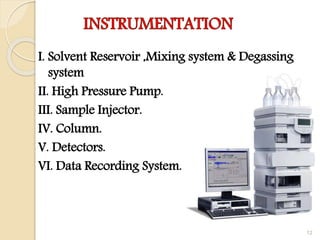
I. Solvent Reservoir ,Mixing system & Degassing
system
II. High Pressure Pump.
III. Sample Injector.
IV. Column.
V. Detectors.
VI. Data Recording System.
12
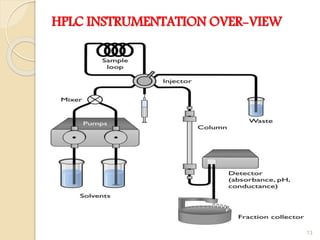
HPLC INSTRUMENTATION OVER-VIEW
13
I. Solvent reservoir & Mixing unit & degassing
system
 The appropriate solvents [mobile phase] from the reservoirs
are allowed to enter the mixing chamber where a
homogenous mixture is obtained.
 Several gases are soluble in organic solvents.
 When solvents are pumped under high pressure, gas
bubbles are formed which will interfere with the separation
process, steady base line and the shape of the peak.
 Hence degassing of solvent is important. This can be done by
-Vacuum filtration,
-Helium purging,
-Ultrasonication.
14
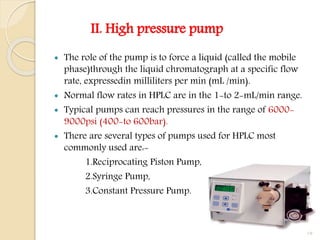
II. High pressure pump
 The role of the pump is to force a liquid (called the mobile
phase)through the liquid chromatograph at a specific flow
rate, expressedin milliliters per min (mL /min).
 Normal flow rates in HPLC are in the 1-to 2-mL/min range.
 Typical pumps can reach pressures in the range of 6000-
9000psi (400-to 600bar).
 There are several types of pumps used for HPLC most
commonly used are:-
1.Reciprocating Piston Pump,
2.Syringe Pump,
3.Constant Pressure Pump.
15
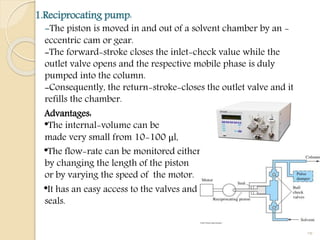
1.Reciprocating pump:
-The piston is moved in and out of a solvent chamber by an -
eccentric cam or gear.
-The forward-stroke closes the inlet-check value while the
outlet valve opens and the respective mobile phase is duly
pumped into the column.
-Consequently, the return-stroke-closes the outlet valve and it
refills the chamber.
Advantages: -
*The internal-volume can be
made very small from 10-100 μl,
*The flow-rate can be monitored either
by changing the length of the piston
or by varying the speed of the motor.
*It has an easy access to the valves and
seals.
16
2.Syringe type pump:
- These are most suitable for small columns because this pump
delivers only a fixed volume of mobile phase is forced from the
pump to column by motor.
-The rate of solvent delivery is controlled by changing the voltage
on the motor.
3.Constant Pressure Pump :
-A constant-pressure pump acts by applying a constant pressure
to the mobile-phase.
-The flow rate through the column is determined by the flow
resistance of the column.
17
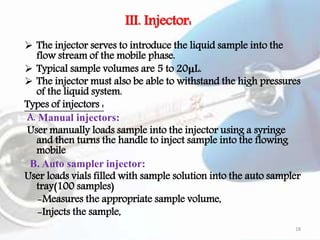
III. Injector:
 The injector serves to introduce the liquid sample into the
flow stream of the mobile phase.
 Typical sample volumes are 5 to 20μL.
 The injector must also be able to withstand the high pressures
of the liquid system.
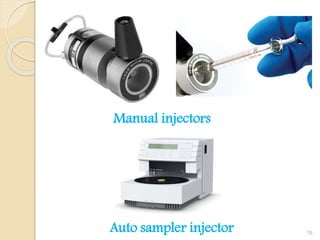
Types of injectors :
A. Manual injectors:
User manually loads sample into the injector using a syringe
and then turns the handle to inject sample into the flowing
mobile
B. Auto sampler injector:
User loads vials filled with sample solution into the auto sampler
tray(100 samples)
-Measures the appropriate sample volume,
-Injects the sample,
18
19
Manual injectors
Auto sampler injector
IV. Column
 The column [stationary phase] separates the sample components of
interest using various physical and chemical parameters.
 The columns used for HPLC are generally made up of stainless steel .
so they can withstand up to high pressure [8000psi].
 Straight columns of 20-50 cm in length & 1-4mm in diameter are
used .
 Particle size should be for porous particles 20-40μm. For porous
micro particles it should be 3-10 μm.
 porous plugs of stainless steel are used in ends of column to retain
the packing material.
Stationary phases used in column:
-Alumina
-Silica
-Polystyrene
-Polyvinyl acetate beads 20
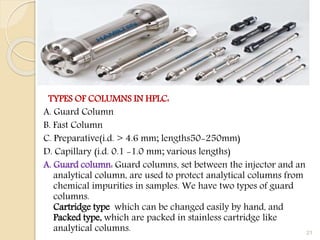
TYPES OF COLUMNS IN HPLC:
A. Guard Column
B. Fast Column
C. Preparative(i.d. > 4.6 mm; lengths50-250mm)
D. Capillary (i.d. 0.1 -1.0 mm; various lengths)
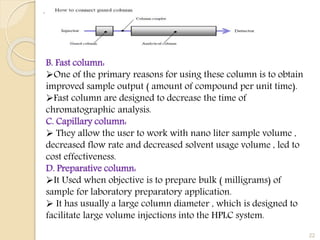
A. Guard column: Guard columns, set between the injector and an
analytical column, are used to protect analytical columns from
chemical impurities in samples. We have two types of guard
columns.
Cartridge type which can be changed easily by hand, and
Packed type, which are packed in stainless cartridge like
analytical columns. 21
22
.
B. Fast column:
One of the primary reasons for using these column is to obtain
improved sample output ( amount of compound per unit time).
Fast column are designed to decrease the time of
chromatographic analysis.
C. Capillary column:
 They allow the user to work with nano liter sample volume ,
decreased flow rate and decreased solvent usage volume , led to
cost effectiveness.
D. Preparative column:
It Used when objective is to prepare bulk ( milligrams) of
sample for laboratory preparatory application.
 It has usually a large column diameter , which is designed to
facilitate large volume injections into the HPLC system.
COLUMN EFFICIENCY IN SEPARATION PROCESS
A. Theoretical plates:
 Chromatographic column contains a large number of separate
layers, called ‘Theoretical Plates’.
 Separate equilibrations of the sample between the stationary and
mobile phase occur in these "plates".
 The analyte moves down the column by transfer of equilibrated
mobile phase from one plate to the next.
 It is important to remember that the plates do not really exist ; they
are a figment of the imagination that helps us understand the
processes at work in the column.
B. HETP [Height Equivalent to a Theoretical plate]:
 A theoretical plate is an imaginary unit of a column, where
distribution of solute between , stationary phase and mobile phase,
has attained equilibrium.
23
 It also called as functional unit of the column.
 It can be of any height , which describes the efficiency of
separation
HETP = L / N
Where
HETP = LENTH OF COLUMN / NUMBER OF THEORETICAL PLATES
 If HETP is less , the column is more efficient .
 If HETP is more , the column is les s efficient .
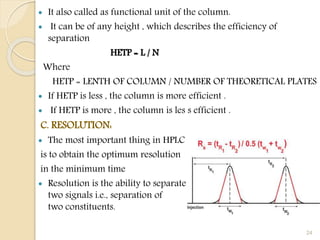
C. RESOLUTION:
 The most important thing in HPLC
is to obtain the optimum resolution
in the minimum time
 Resolution is the ability to separate
two signals i.e., separation of
two constituents.
24
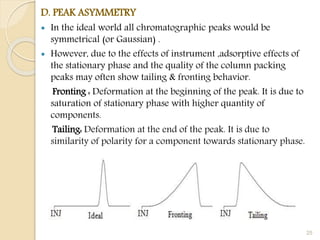
D. PEAK ASYMMETRY
 In the ideal world all chromatographic peaks would be
symmetrical (or Gaussian) .
 However, due to the effects of instrument ,adsorptive effects of
the stationary phase and the quality of the column packing
peaks may often show tailing & fronting behavior.
Fronting : Deformation at the beginning of the peak. It is due to
saturation of stationary phase with higher quantity of
components.
Tailing: Deformation at the end of the peak. It is due to
similarity of polarity for a component towards stationary phase.
25
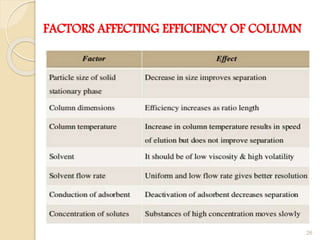
FACTORS AFFECTING EFFICIENCY OF COLUMN
26
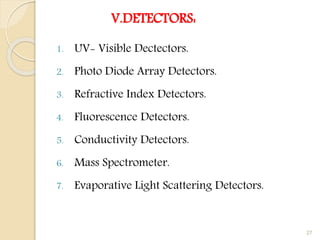
V.DETECTORS:
1. UV- Visible Dectectors.
2. Photo Diode Array Detectors.
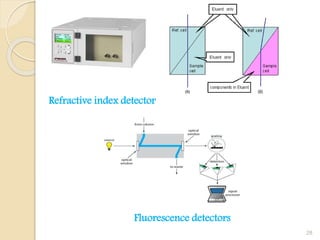
3. Refractive Index Detectors.
4. Fluorescence Detectors.
5. Conductivity Detectors.
6. Mass Spectrometer.
7. Evaporative Light Scattering Detectors.
27
28
Refractive index detector
Fluorescence detectors
HPLC ADVANTAGES:
 Speed(minutes).
 High resolution.
 Sensitivity.
 Accuracy.
 Automation.
HPLC DISADVANTAGES :
 Co-elution.
 Cost.
 Complexity.
29
SOFTWARES USED IN HPLC
 Borwin software - JASCO HPLC.
 Class-VP –SHIMADZU.
 Hitachi Primaide HPLC System Manager- HITACHI.
 HPLC/AAA Software –HITACHI.
 EZChrom Elite - Waters Corporation.
30
APPLICATIONS
 Purification Of Samples.
 Identification Of Compounds.
 Determination Of Impurities.
 Determine the Concentration Of Drug.
 Biopharmaceutical & Pharmacokinetic Studies.
 Drug Stability Studies.
 Qualitative & Quantitative Analysis.
 Environmental Applications[ analysing air & water
pollutants.
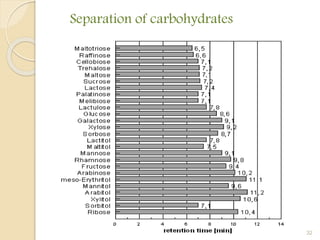
 Separation Of Mixture Of Samples.
Ex: Carbohydrates
31
Separation of carbohydrates
32
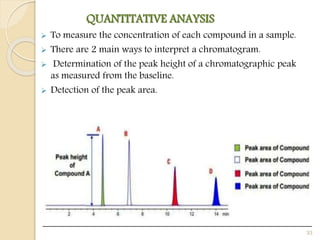
QUANTITATIVE ANAYSIS
 To measure the concentration of each compound in a sample.
 There are 2 main ways to interpret a chromatogram.
 Determination of the peak height of a chromatographic peak
as measured from the baseline.
 Detection of the peak area.
33
QUALITATIVE ANALYSIS
 The identification of individual compounds in the sample.
 The most common parameter for compound identification is its
Retention Time [Is the amount of time a compound spends on
the column after injection]
 Depending on the detector used, compound. identification is
also based on the chemical structure, molecular weight or some
other molecular parameter.
34
REFERENCES
 Principles of instrumental analysis- Doglas A
skoog
 Instrumental methods of chemical analysis-
Gurudeep R.chatwal, sham K. anand
 Textbook of chemical analysis-
Francis Rouessac and Annick Rouessac 2nd edition
john wiley & sons ltd
 Text book of modern analytical chemistry-
David harvey
35
36

HPLC BY MANOJ KUMAR.M

  • 1.
    Seminar On HIGH PERFORMANCELIQUID CHROMATOGRAPHY Presented By MANOJ KUMAR.M M pharmacy 1st year H.tno.636217885001 Under Guidance Of Prof. Dr. S.Y.Manjunath DEPARTMENT OF PHARMACEUTICALANALYSIS SRIKRUPA INISTITUTE OF PHARMACEUTICAL SCIENCES (Approved by AICTE;PCI) (Affiliated to osmania university) 1
  • 2.
     HPLC standsfor “High Performance Liquid Chromatography”.  High performance liquid chromatography is a powerful tool in analysis, it yields high performance and high speed compared to traditional column chromatography because of the forcibly pumped mobile phase Chromatography: • Separation of mixture of samples into individual samples. • It is a separation technique which separation take Between two phases 1.Stationary phase 2.Mobile phase 1.Stationary phase : The substance on which adsorption of analyte take place. 2.Mobile phase: Solvent which carries the analyte. 2
  • 3.
    Liquid chromatography:  Itis a chromatographic technique in which mobile phase is a liquid.  The main principle involved in liquid chromatography is adsorption. PRINCIPLE  When a mixture of samples introduced into column various chemical and physical interactions takes place between column material and components present in the sample travel according to their relative affinities towards the stationary phase . the component which has more affinity towards the stationary phase ,travels slower. The components which having less affinity towards stationary phase travels faster. More over it work very efficiently compare to other chromatographic techniques. In this high pressure pump is used to transfer the sample to stationary phase. so it is also called as high pressure liquid chromatography. 3
  • 4.
     The principleof HPLC are based on Van Demeter equation which relates the efficiency of the chromatographic column to the particle size of the column, molecular diffusion and thickness of stationary phase.  The Van Deemter Equation is given as H or HETP = A + B/u + C υ Where, A= Represents eddy diffusion, B= Represents molecular diffusion, C =Represents rate of mass transfer, υ =Represents flow rate. 4
  • 5.
    TYPES OF HPLC 1.Based on Mode Of Separation. 2. Based on Principle Of Separation. 3. Based on Elution Technique. 4. Based on Scale Of Operation. 5. Based on Type Of Analysis. 5
  • 6.
    1.BASED ON MODEOF SEPARATION  Normal Phase HPLC: This method separates analytes on the basis of polarity. NP-HPLC uses polar stationary phase and non-polar mobile phase. Therefore, the stationary phase is usually Silica and typical mobile phases are hexane, methylene chloride, chloroform, diethyl ether, and mixtures of these.  Reverse Phase HPLC :The stationary phase is non polar (hydrophobic) in nature, such as C18, C8, Cyano columns used. While the mobile phase is a polar liquid, such as mixtures of water and methanol or acetonitrile. 6
  • 7.
  • 8.
    2.BASED ON PRINCIPLEOF SEPRATION i)Adsorption chromatography:  In which stationary phase is an adsorbent.  The compounds separated based on their affinity towards stationa -ry phase.  More affinity-slow elution  Less affinity-fast elution ii)Partition chromatography:  A process of separation of solutes utilizing the partition of the solutes between two liquid phases  Namely the original solvent and the film of solvent on the adsorption column. 8
  • 9.
    iii)Size-Exclusion HPLC:  Inwhich the stationary phase is a gel having a closely controlled pore size.  Molecules are separated based on molecular size, shape smaller molecules being temporarily retained in the pores and mainly Agarose , Dextran used as mobile phase. iv)Ion-Exchange HPLC:  Ion-exchange chromatography separates molecules based on their respective charged groups.  Ion-exchange chromatography retains analyte molecules on the column based on coulombic (ionic) interactions.  Essentially, molecules undergo electrostatic interactions with opposite charges on the stationary phase matrix. 9
  • 10.
    3.BASED ON ELUTIONTECHNIQUE During the chromatographic experiment, a pump can deliver a constant mobile phase composition(isocratic) or an increasing mobile phase composition (gradient). i) Isocratic Elution  Delivers constant mobile phase composition;  Solvent must be pre-mixed;  Lowest cost pump;  Best for simple preparation. ii) Gradient Elution  Delivers variable mobile phase composition;  In this mobile phase is programmed to change in composition during elution time;  Best for complex preparations. 10
  • 11.
    4.BASED ON SCALEOF OPERATION i)Analytical HPLC: No recovery of individual components of substance. ii)Preparative HPLC: Individual components of substance can be recovered. 5.BASED ON TYPE OF ANALYSIS i)Qualitative Analysis: Determine the quality of sample. ii)Quantitative Analysis: Determine the quantity(concentration) of sample. 11
  • 12.
    I. Solvent Reservoir,Mixing system & Degassing system II. High Pressure Pump. III. Sample Injector. IV. Column. V. Detectors. VI. Data Recording System. 12
  • 13.
  • 14.
    I. Solvent reservoir& Mixing unit & degassing system  The appropriate solvents [mobile phase] from the reservoirs are allowed to enter the mixing chamber where a homogenous mixture is obtained.  Several gases are soluble in organic solvents.  When solvents are pumped under high pressure, gas bubbles are formed which will interfere with the separation process, steady base line and the shape of the peak.  Hence degassing of solvent is important. This can be done by -Vacuum filtration, -Helium purging, -Ultrasonication. 14
  • 15.
    II. High pressurepump  The role of the pump is to force a liquid (called the mobile phase)through the liquid chromatograph at a specific flow rate, expressedin milliliters per min (mL /min).  Normal flow rates in HPLC are in the 1-to 2-mL/min range.  Typical pumps can reach pressures in the range of 6000- 9000psi (400-to 600bar).  There are several types of pumps used for HPLC most commonly used are:- 1.Reciprocating Piston Pump, 2.Syringe Pump, 3.Constant Pressure Pump. 15
  • 16.
    1.Reciprocating pump: -The pistonis moved in and out of a solvent chamber by an - eccentric cam or gear. -The forward-stroke closes the inlet-check value while the outlet valve opens and the respective mobile phase is duly pumped into the column. -Consequently, the return-stroke-closes the outlet valve and it refills the chamber. Advantages: - *The internal-volume can be made very small from 10-100 μl, *The flow-rate can be monitored either by changing the length of the piston or by varying the speed of the motor. *It has an easy access to the valves and seals. 16
  • 17.
    2.Syringe type pump: -These are most suitable for small columns because this pump delivers only a fixed volume of mobile phase is forced from the pump to column by motor. -The rate of solvent delivery is controlled by changing the voltage on the motor. 3.Constant Pressure Pump : -A constant-pressure pump acts by applying a constant pressure to the mobile-phase. -The flow rate through the column is determined by the flow resistance of the column. 17
  • 18.
    III. Injector:  Theinjector serves to introduce the liquid sample into the flow stream of the mobile phase.  Typical sample volumes are 5 to 20μL.  The injector must also be able to withstand the high pressures of the liquid system. Types of injectors : A. Manual injectors: User manually loads sample into the injector using a syringe and then turns the handle to inject sample into the flowing mobile B. Auto sampler injector: User loads vials filled with sample solution into the auto sampler tray(100 samples) -Measures the appropriate sample volume, -Injects the sample, 18
  • 19.
  • 20.
    IV. Column  Thecolumn [stationary phase] separates the sample components of interest using various physical and chemical parameters.  The columns used for HPLC are generally made up of stainless steel . so they can withstand up to high pressure [8000psi].  Straight columns of 20-50 cm in length & 1-4mm in diameter are used .  Particle size should be for porous particles 20-40μm. For porous micro particles it should be 3-10 μm.  porous plugs of stainless steel are used in ends of column to retain the packing material. Stationary phases used in column: -Alumina -Silica -Polystyrene -Polyvinyl acetate beads 20
  • 21.
    TYPES OF COLUMNSIN HPLC: A. Guard Column B. Fast Column C. Preparative(i.d. > 4.6 mm; lengths50-250mm) D. Capillary (i.d. 0.1 -1.0 mm; various lengths) A. Guard column: Guard columns, set between the injector and an analytical column, are used to protect analytical columns from chemical impurities in samples. We have two types of guard columns. Cartridge type which can be changed easily by hand, and Packed type, which are packed in stainless cartridge like analytical columns. 21
  • 22.
    22 . B. Fast column: Oneof the primary reasons for using these column is to obtain improved sample output ( amount of compound per unit time). Fast column are designed to decrease the time of chromatographic analysis. C. Capillary column:  They allow the user to work with nano liter sample volume , decreased flow rate and decreased solvent usage volume , led to cost effectiveness. D. Preparative column: It Used when objective is to prepare bulk ( milligrams) of sample for laboratory preparatory application.  It has usually a large column diameter , which is designed to facilitate large volume injections into the HPLC system.
  • 23.
    COLUMN EFFICIENCY INSEPARATION PROCESS A. Theoretical plates:  Chromatographic column contains a large number of separate layers, called ‘Theoretical Plates’.  Separate equilibrations of the sample between the stationary and mobile phase occur in these "plates".  The analyte moves down the column by transfer of equilibrated mobile phase from one plate to the next.  It is important to remember that the plates do not really exist ; they are a figment of the imagination that helps us understand the processes at work in the column. B. HETP [Height Equivalent to a Theoretical plate]:  A theoretical plate is an imaginary unit of a column, where distribution of solute between , stationary phase and mobile phase, has attained equilibrium. 23
  • 24.
     It alsocalled as functional unit of the column.  It can be of any height , which describes the efficiency of separation HETP = L / N Where HETP = LENTH OF COLUMN / NUMBER OF THEORETICAL PLATES  If HETP is less , the column is more efficient .  If HETP is more , the column is les s efficient . C. RESOLUTION:  The most important thing in HPLC is to obtain the optimum resolution in the minimum time  Resolution is the ability to separate two signals i.e., separation of two constituents. 24
  • 25.
    D. PEAK ASYMMETRY In the ideal world all chromatographic peaks would be symmetrical (or Gaussian) .  However, due to the effects of instrument ,adsorptive effects of the stationary phase and the quality of the column packing peaks may often show tailing & fronting behavior. Fronting : Deformation at the beginning of the peak. It is due to saturation of stationary phase with higher quantity of components. Tailing: Deformation at the end of the peak. It is due to similarity of polarity for a component towards stationary phase. 25
  • 26.
  • 27.
    V.DETECTORS: 1. UV- VisibleDectectors. 2. Photo Diode Array Detectors. 3. Refractive Index Detectors. 4. Fluorescence Detectors. 5. Conductivity Detectors. 6. Mass Spectrometer. 7. Evaporative Light Scattering Detectors. 27
  • 28.
  • 29.
    HPLC ADVANTAGES:  Speed(minutes). High resolution.  Sensitivity.  Accuracy.  Automation. HPLC DISADVANTAGES :  Co-elution.  Cost.  Complexity. 29
  • 30.
    SOFTWARES USED INHPLC  Borwin software - JASCO HPLC.  Class-VP –SHIMADZU.  Hitachi Primaide HPLC System Manager- HITACHI.  HPLC/AAA Software –HITACHI.  EZChrom Elite - Waters Corporation. 30
  • 31.
    APPLICATIONS  Purification OfSamples.  Identification Of Compounds.  Determination Of Impurities.  Determine the Concentration Of Drug.  Biopharmaceutical & Pharmacokinetic Studies.  Drug Stability Studies.  Qualitative & Quantitative Analysis.  Environmental Applications[ analysing air & water pollutants.  Separation Of Mixture Of Samples. Ex: Carbohydrates 31
  • 32.
  • 33.
    QUANTITATIVE ANAYSIS  Tomeasure the concentration of each compound in a sample.  There are 2 main ways to interpret a chromatogram.  Determination of the peak height of a chromatographic peak as measured from the baseline.  Detection of the peak area. 33
  • 34.
    QUALITATIVE ANALYSIS  Theidentification of individual compounds in the sample.  The most common parameter for compound identification is its Retention Time [Is the amount of time a compound spends on the column after injection]  Depending on the detector used, compound. identification is also based on the chemical structure, molecular weight or some other molecular parameter. 34
  • 35.
    REFERENCES  Principles ofinstrumental analysis- Doglas A skoog  Instrumental methods of chemical analysis- Gurudeep R.chatwal, sham K. anand  Textbook of chemical analysis- Francis Rouessac and Annick Rouessac 2nd edition john wiley & sons ltd  Text book of modern analytical chemistry- David harvey 35
  • 36.