Grade 10 Biology
Genetics and Inheritance Patterns
Mr KremerGrade 10 Biology
Genetics and Inheritance Patterns
Mr Kremer
Genetics: Key concepts
• Mendel’s experiments with pea plants
• Dominant, recessive, + codominant traits
• Sex linkage of genetic disorders
• Biotechnology + its consequences
Mendellian Genetics
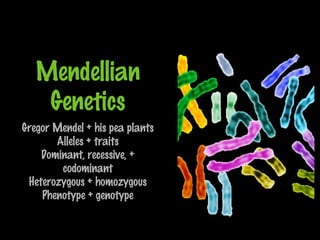
Mendellian
Genetics
Gregor Mendel + his pea plants
Alleles + traits
Dominant, recessive, +
codominant
Heterozygous + homozygous
Phenotype + genotype
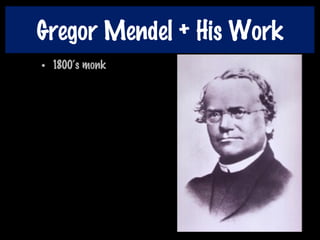
Gregor Mendel + His Work
• 1800‘s monk
Gregor Mendel + His Work
• 1800‘s monk
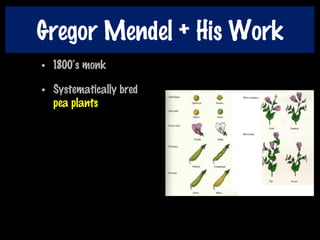
• Systematically bred
pea plants
Gregor Mendel + His Work
• 1800‘s monk
• Systematically bred
pea plants
Gregor Mendel + His Work
• 1800‘s monk
• Systematically bred
pea plants
Gregor Mendel + His Work
• 1800‘s monk
• Systematically bred
pea plants
Gregor Mendel + His Work
• 1800‘s monk
• Systematically bred
pea plants
• Identified patterns in
offspring
Gregor Mendel + His Work
• 1800‘s monk
• Systematically bred
pea plants
• Identified patterns in
offspring
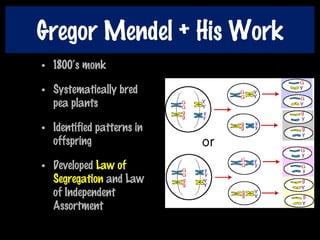
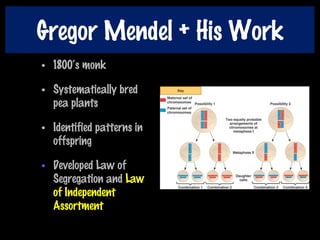
• Developed Law of
Segregation and Law
of Independent
Assortment
Gregor Mendel + His Work
• 1800‘s monk
• Systematically bred
pea plants
• Identified patterns in
offspring
• Developed Law of
Segregation and Law
of Independent
Assortment
Inheritance Patterns
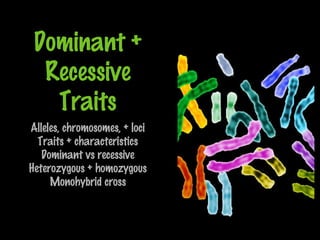
Dominant +
Recessive
Traits
Alleles, chromosomes, + loci
Traits + characteristics
Dominant vs recessive
Heterozygous + homozygous
Monohybrid cross
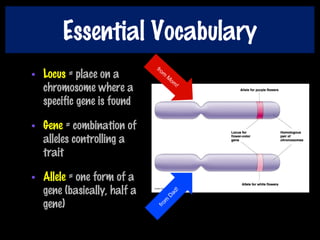
Essential Vocabulary
• Locus = place on a
chromosome where a
specific gene is found
• Gene = combination of
alleles controlling a
trait
• Allele = one form of a
gene (basically, half a
gene)
from
M
om
!
from
D
ad!
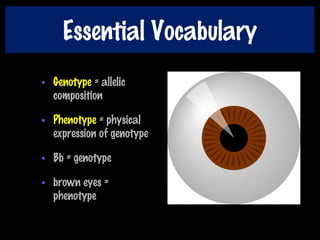
Essential Vocabulary
• Genotype = allelic
composition
• Phenotype = physical
expression of genotype
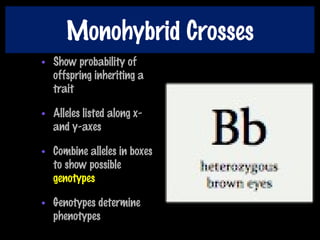
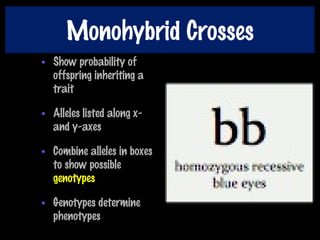
• Bb = genotype
• brown eyes =
phenotype
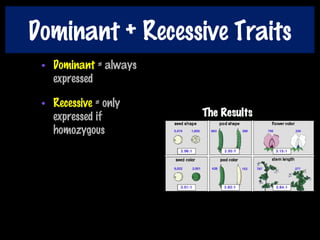
Dominant + Recessive Traits
• Dominant = always
expressed
• Recessive = only
expressed if
homozygous
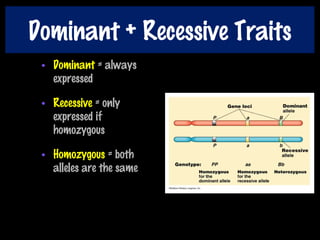
Dominant + Recessive Traits
• Dominant = always
expressed
• Recessive = only
expressed if
homozygous
• Homozygous = both
alleles are the same
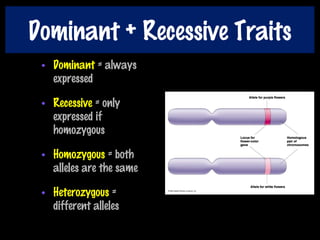
Dominant + Recessive Traits
• Dominant = always
expressed
• Recessive = only
expressed if
homozygous
• Homozygous = both
alleles are the same
• Heterozygous =
different alleles
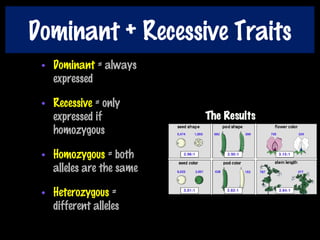
Dominant + Recessive Traits
• Dominant = always
expressed
• Recessive = only
expressed if
homozygous
• Homozygous = both
alleles are the same
• Heterozygous =
different alleles
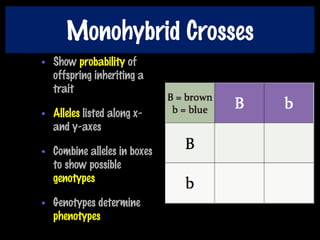
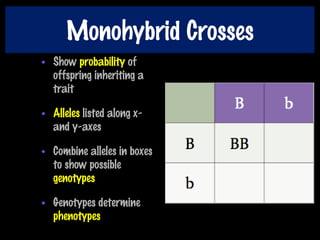
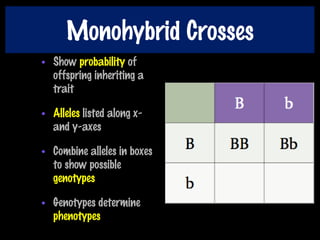
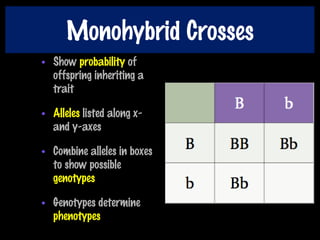
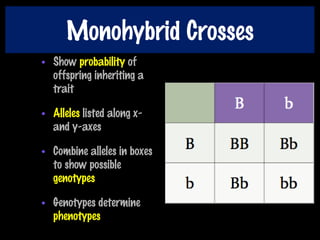
Monohybrid Crosses
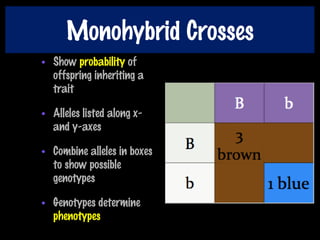
• Show probability of
offspring inheriting a
trait
• Alleles listed along x-
and y-axes
• Combine alleles in boxes
to show possible
genotypes
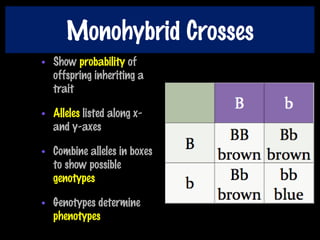
• Genotypes determine
phenotypes
Monohybrid Crosses
• Show probability of
offspring inheriting a
trait
• Alleles listed along x-
and y-axes
• Combine alleles in boxes
to show possible
genotypes
• Genotypes determine
phenotypes
Monohybrid Crosses
• Show probability of
offspring inheriting a
trait
• Alleles listed along x-
and y-axes
• Combine alleles in boxes
to show possible
genotypes
• Genotypes determine
phenotypes
Monohybrid Crosses
• Show probability of
offspring inheriting a
trait
• Alleles listed along x-
and y-axes
• Combine alleles in boxes
to show possible
genotypes
• Genotypes determine
phenotypes
Monohybrid Crosses
• Show probability of
offspring inheriting a
trait
• Alleles listed along x-
and y-axes
• Combine alleles in boxes
to show possible
genotypes
• Genotypes determine
phenotypes
Monohybrid Crosses
• Show probability of
offspring inheriting a
trait
• Alleles listed along x-
and y-axes
• Combine alleles in boxes
to show possible
genotypes
• Genotypes determine
phenotypes
Monohybrid Crosses
• Show probability of
offspring inheriting a
trait
• Alleles listed along x-
and y-axes
• Combine alleles in boxes
to show possible
genotypes
• Genotypes determine
phenotypes
Monohybrid Crosses
• Show probability of
offspring inheriting a
trait
• Alleles listed along x-
and y-axes
• Combine alleles in boxes
to show possible
genotypes
• Genotypes determine
phenotypes
Monohybrid Crosses
• Show probability of
offspring inheriting a
trait
• Alleles listed along x-
and y-axes
• Combine alleles in boxes
to show possible
genotypes
• Genotypes determine
phenotypes
Monohybrid Crosses
• Show probability of
offspring inheriting a
trait
• Alleles listed along x-
and y-axes
• Combine alleles in boxes
to show possible
genotypes
• Genotypes determine
phenotypes
Monohybrid Crosses
• Show probability of
offspring inheriting a
trait
• Alleles listed along x-
and y-axes
• Combine alleles in boxes
to show possible
genotypes
• Genotypes determine
phenotypes
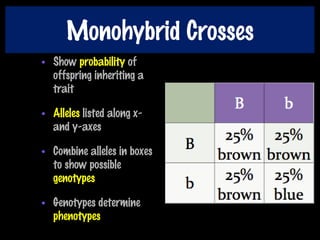
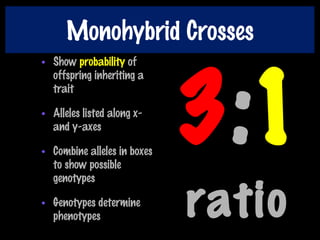
3:1
ratio
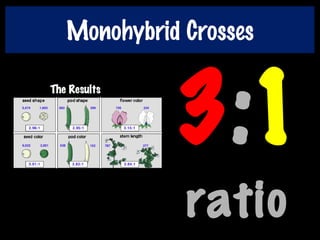
3:1
ratio
Monohybrid Crosses
Codominance + Blood Types
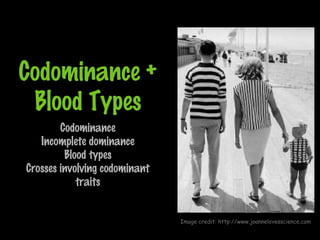
Codominance +
Blood Types
Codominance
Incomplete dominance
Blood types
Crosses involving codominant
traits
Image credit: http://www.joannelovesscience.com
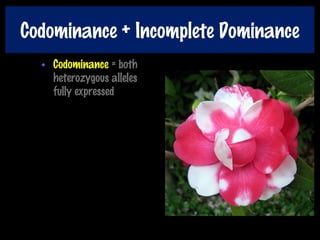
Codominance + Incomplete Dominance
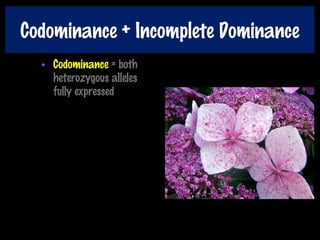
• Codominance = both
heterozygous alleles
fully expressed
Codominance + Incomplete Dominance
• Codominance = both
heterozygous alleles
fully expressed
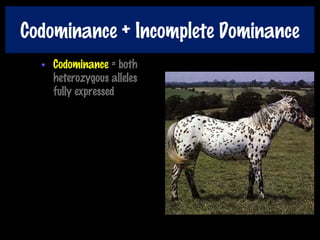
Codominance + Incomplete Dominance
• Codominance = both
heterozygous alleles
fully expressed
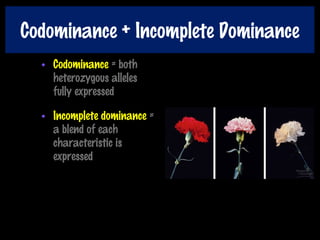
Codominance + Incomplete Dominance
• Codominance = both
heterozygous alleles
fully expressed
• Incomplete dominance =
a blend of each
characteristic is
expressed
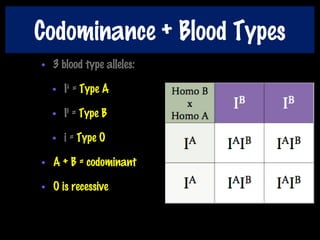
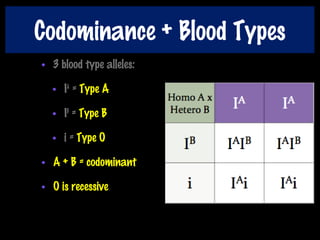
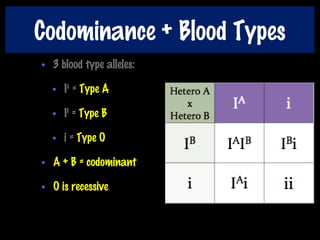
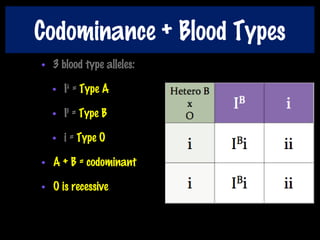
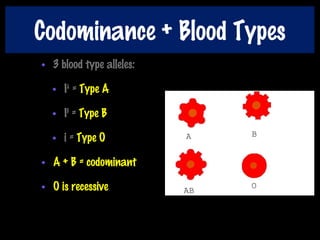
Codominance + Blood Types
• 3 blood type alleles:
• IA
= Type A
• IB
= Type B
• i = Type O
• A + B = codominant
• O is recessive
Codominance + Blood Types
• 3 blood type alleles:
• IA
= Type A
• IB
= Type B
• i = Type O
• A + B = codominant
• O is recessive
Codominance + Blood Types
• 3 blood type alleles:
• IA
= Type A
• IB
= Type B
• i = Type O
• A + B = codominant
• O is recessive
Codominance + Blood Types
• 3 blood type alleles:
• IA
= Type A
• IB
= Type B
• i = Type O
• A + B = codominant
• O is recessive
Codominance + Blood Types
• 3 blood type alleles:
• IA
= Type A
• IB
= Type B
• i = Type O
• A + B = codominant
• O is recessive
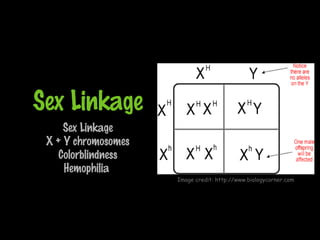
Sex Linkage
Sex Linkage
Sex Linkage
X + Y chromosomes
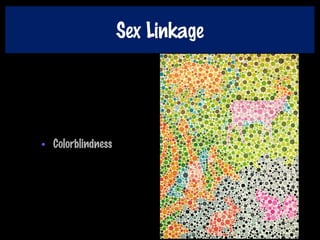
Colorblindness
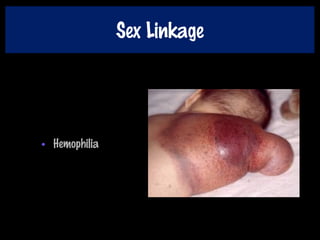
Hemophilia
Image credit: http://www.biologycorner.com
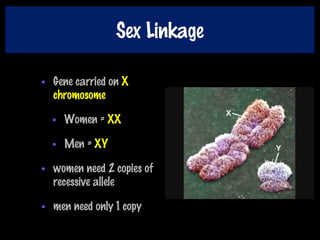
Sex Linkage
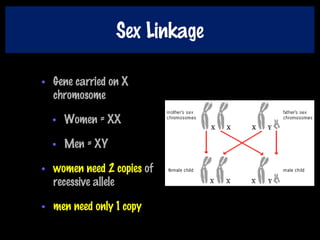
• Gene carried on X
chromosome
• Women = XX
• Men = XY
• women need 2 copies of
recessive allele
• men need only 1 copy
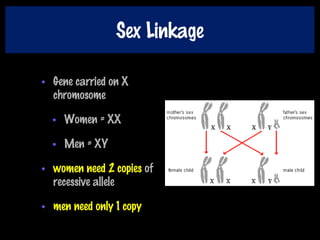
Sex Linkage
• Gene carried on X
chromosome
• Women = XX
• Men = XY
• women need 2 copies of
recessive allele
• men need only 1 copy
Sex Linkage
• Gene carried on X
chromosome
• Women = XX
• Men = XY
• women need 2 copies of
recessive allele
• men need only 1 copy
Sex Linkage
• Colorblindness
Sex Linkage
• Hemophilia
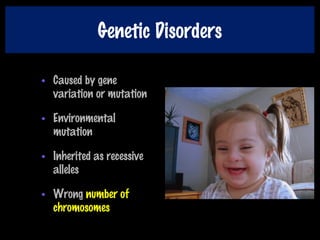
Genetic Disorders
Genetic Disorders
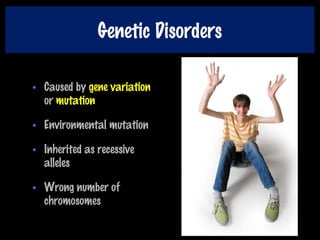
• Caused by gene variation
or mutation
• Environmental mutation
• Inherited as recessive
alleles
• Wrong number of
chromosomes
Genetic Disorders
• Caused by gene
variation or mutation
• Environmental
mutation
• Inherited as recessive
alleles
• Wrong number of
chromosomes
Genetic Disorders
• Caused by gene
variation or mutation
• Environmental
mutation
• Inherited as recessive
alleles
• Wrong number of
chromosomes
Genetic Disorders
• Caused by gene
variation or mutation
• Environmental
mutation
• Inherited as recessive
alleles
• Wrong number of
chromosomes
Genetic Disorders
• Caused by gene
variation or mutation
• Environmental
mutation
• Inherited as recessive
alleles
• Wrong number of
chromosomes
Biotechnology
Biotechnology
Genetic screening
DNA profiling
GMO’s
Stem cell research
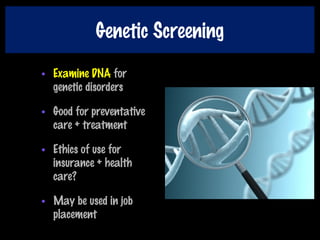
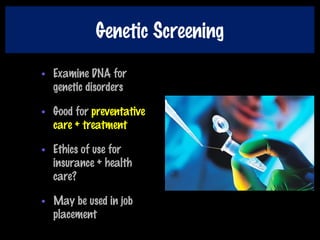
Genetic Screening
• Examine DNA for
genetic disorders
• Good for preventative
care + treatment
• Ethics of use for
insurance + health
care?
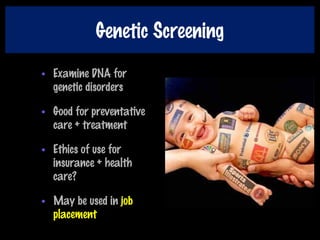
• May be used in job
placement
Genetic Screening
• Examine DNA for
genetic disorders
• Good for preventative
care + treatment
• Ethics of use for
insurance + health
care?
• May be used in job
placement
Genetic Screening
• Examine DNA for
genetic disorders
• Good for preventative
care + treatment
• Ethics of use for
insurance + health
care?
• May be used in job
placement
Genetic Screening
• Examine DNA for
genetic disorders
• Good for preventative
care + treatment
• Ethics of use for
insurance + health
care?
• May be used in job
placement
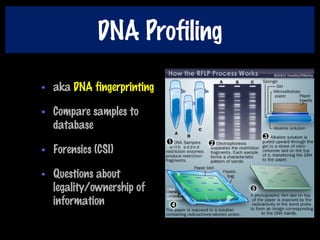
DNA Profiling
• aka DNA fingerprinting
• Compare samples to
database
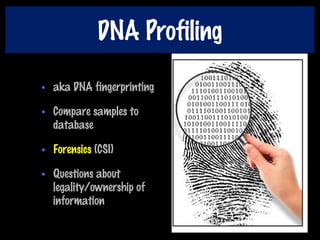
• Forensics (CSI)
• Questions about
legality/ownership of
information
DNA Profiling
• aka DNA fingerprinting
• Compare samples to
database
• Forensics (CSI)
• Questions about
legality/ownership of
information
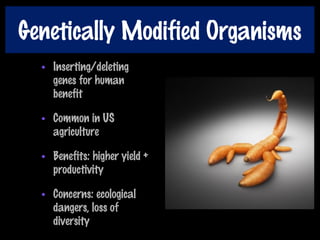
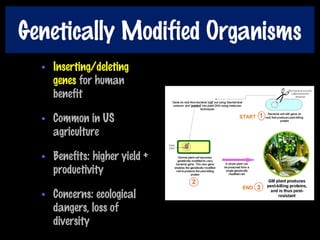
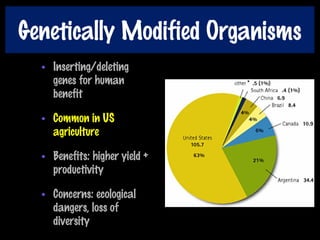
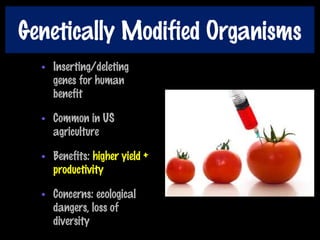
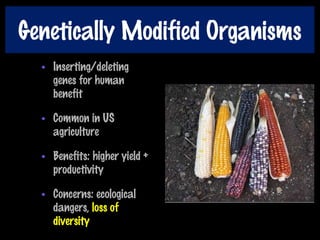
Genetically Modified Organisms
• Inserting/deleting
genes for human
benefit
• Common in US
agriculture
• Benefits: higher yield +
productivity
• Concerns: ecological
dangers, loss of
diversity
Genetically Modified Organisms
• Inserting/deleting
genes for human
benefit
• Common in US
agriculture
• Benefits: higher yield +
productivity
• Concerns: ecological
dangers, loss of
diversity
Genetically Modified Organisms
• Inserting/deleting
genes for human
benefit
• Common in US
agriculture
• Benefits: higher yield +
productivity
• Concerns: ecological
dangers, loss of
diversity
Genetically Modified Organisms
• Inserting/deleting
genes for human
benefit
• Common in US
agriculture
• Benefits: higher yield +
productivity
• Concerns: ecological
dangers, loss of
diversity
Genetically Modified Organisms
• Inserting/deleting
genes for human
benefit
• Common in US
agriculture
• Benefits: higher yield +
productivity
• Concerns: ecological
dangers, loss of
diversity

G10 genetics

  • 1.
    Grade 10 Biology Geneticsand Inheritance Patterns Mr KremerGrade 10 Biology Genetics and Inheritance Patterns Mr Kremer
  • 2.
    Genetics: Key concepts •Mendel’s experiments with pea plants • Dominant, recessive, + codominant traits • Sex linkage of genetic disorders • Biotechnology + its consequences
  • 3.
  • 4.
    Mendellian Genetics Gregor Mendel +his pea plants Alleles + traits Dominant, recessive, + codominant Heterozygous + homozygous Phenotype + genotype
  • 5.
    Gregor Mendel +His Work • 1800‘s monk
  • 6.
    Gregor Mendel +His Work • 1800‘s monk • Systematically bred pea plants
  • 7.
    Gregor Mendel +His Work • 1800‘s monk • Systematically bred pea plants
  • 8.
    Gregor Mendel +His Work • 1800‘s monk • Systematically bred pea plants
  • 9.
    Gregor Mendel +His Work • 1800‘s monk • Systematically bred pea plants
  • 10.
    Gregor Mendel +His Work • 1800‘s monk • Systematically bred pea plants • Identified patterns in offspring
  • 11.
    Gregor Mendel +His Work • 1800‘s monk • Systematically bred pea plants • Identified patterns in offspring • Developed Law of Segregation and Law of Independent Assortment
  • 12.
    Gregor Mendel +His Work • 1800‘s monk • Systematically bred pea plants • Identified patterns in offspring • Developed Law of Segregation and Law of Independent Assortment
  • 13.
  • 14.
    Dominant + Recessive Traits Alleles, chromosomes,+ loci Traits + characteristics Dominant vs recessive Heterozygous + homozygous Monohybrid cross
  • 15.
    Essential Vocabulary • Locus= place on a chromosome where a specific gene is found • Gene = combination of alleles controlling a trait • Allele = one form of a gene (basically, half a gene) from M om ! from D ad!
  • 16.
    Essential Vocabulary • Genotype= allelic composition • Phenotype = physical expression of genotype • Bb = genotype • brown eyes = phenotype
  • 17.
    Dominant + RecessiveTraits • Dominant = always expressed • Recessive = only expressed if homozygous
  • 18.
    Dominant + RecessiveTraits • Dominant = always expressed • Recessive = only expressed if homozygous • Homozygous = both alleles are the same
  • 19.
    Dominant + RecessiveTraits • Dominant = always expressed • Recessive = only expressed if homozygous • Homozygous = both alleles are the same • Heterozygous = different alleles
  • 20.
    Dominant + RecessiveTraits • Dominant = always expressed • Recessive = only expressed if homozygous • Homozygous = both alleles are the same • Heterozygous = different alleles
  • 21.
    Monohybrid Crosses • Showprobability of offspring inheriting a trait • Alleles listed along x- and y-axes • Combine alleles in boxes to show possible genotypes • Genotypes determine phenotypes
  • 22.
    Monohybrid Crosses • Showprobability of offspring inheriting a trait • Alleles listed along x- and y-axes • Combine alleles in boxes to show possible genotypes • Genotypes determine phenotypes
  • 23.
    Monohybrid Crosses • Showprobability of offspring inheriting a trait • Alleles listed along x- and y-axes • Combine alleles in boxes to show possible genotypes • Genotypes determine phenotypes
  • 24.
    Monohybrid Crosses • Showprobability of offspring inheriting a trait • Alleles listed along x- and y-axes • Combine alleles in boxes to show possible genotypes • Genotypes determine phenotypes
  • 25.
    Monohybrid Crosses • Showprobability of offspring inheriting a trait • Alleles listed along x- and y-axes • Combine alleles in boxes to show possible genotypes • Genotypes determine phenotypes
  • 26.
    Monohybrid Crosses • Showprobability of offspring inheriting a trait • Alleles listed along x- and y-axes • Combine alleles in boxes to show possible genotypes • Genotypes determine phenotypes
  • 27.
    Monohybrid Crosses • Showprobability of offspring inheriting a trait • Alleles listed along x- and y-axes • Combine alleles in boxes to show possible genotypes • Genotypes determine phenotypes
  • 28.
    Monohybrid Crosses • Showprobability of offspring inheriting a trait • Alleles listed along x- and y-axes • Combine alleles in boxes to show possible genotypes • Genotypes determine phenotypes
  • 29.
    Monohybrid Crosses • Showprobability of offspring inheriting a trait • Alleles listed along x- and y-axes • Combine alleles in boxes to show possible genotypes • Genotypes determine phenotypes
  • 30.
    Monohybrid Crosses • Showprobability of offspring inheriting a trait • Alleles listed along x- and y-axes • Combine alleles in boxes to show possible genotypes • Genotypes determine phenotypes
  • 31.
    Monohybrid Crosses • Showprobability of offspring inheriting a trait • Alleles listed along x- and y-axes • Combine alleles in boxes to show possible genotypes • Genotypes determine phenotypes 3:1 ratio
  • 32.
  • 33.
  • 34.
    Codominance + Blood Types Codominance Incompletedominance Blood types Crosses involving codominant traits Image credit: http://www.joannelovesscience.com
  • 35.
    Codominance + IncompleteDominance • Codominance = both heterozygous alleles fully expressed
  • 36.
    Codominance + IncompleteDominance • Codominance = both heterozygous alleles fully expressed
  • 37.
    Codominance + IncompleteDominance • Codominance = both heterozygous alleles fully expressed
  • 38.
    Codominance + IncompleteDominance • Codominance = both heterozygous alleles fully expressed • Incomplete dominance = a blend of each characteristic is expressed
  • 39.
    Codominance + BloodTypes • 3 blood type alleles: • IA = Type A • IB = Type B • i = Type O • A + B = codominant • O is recessive
  • 40.
    Codominance + BloodTypes • 3 blood type alleles: • IA = Type A • IB = Type B • i = Type O • A + B = codominant • O is recessive
  • 41.
    Codominance + BloodTypes • 3 blood type alleles: • IA = Type A • IB = Type B • i = Type O • A + B = codominant • O is recessive
  • 42.
    Codominance + BloodTypes • 3 blood type alleles: • IA = Type A • IB = Type B • i = Type O • A + B = codominant • O is recessive
  • 43.
    Codominance + BloodTypes • 3 blood type alleles: • IA = Type A • IB = Type B • i = Type O • A + B = codominant • O is recessive
  • 44.
  • 45.
    Sex Linkage Sex Linkage X+ Y chromosomes Colorblindness Hemophilia Image credit: http://www.biologycorner.com
  • 46.
    Sex Linkage • Genecarried on X chromosome • Women = XX • Men = XY • women need 2 copies of recessive allele • men need only 1 copy
  • 47.
    Sex Linkage • Genecarried on X chromosome • Women = XX • Men = XY • women need 2 copies of recessive allele • men need only 1 copy
  • 48.
    Sex Linkage • Genecarried on X chromosome • Women = XX • Men = XY • women need 2 copies of recessive allele • men need only 1 copy
  • 49.
  • 50.
  • 51.
  • 52.
    Genetic Disorders • Causedby gene variation or mutation • Environmental mutation • Inherited as recessive alleles • Wrong number of chromosomes
  • 53.
    Genetic Disorders • Causedby gene variation or mutation • Environmental mutation • Inherited as recessive alleles • Wrong number of chromosomes
  • 54.
    Genetic Disorders • Causedby gene variation or mutation • Environmental mutation • Inherited as recessive alleles • Wrong number of chromosomes
  • 55.
    Genetic Disorders • Causedby gene variation or mutation • Environmental mutation • Inherited as recessive alleles • Wrong number of chromosomes
  • 56.
    Genetic Disorders • Causedby gene variation or mutation • Environmental mutation • Inherited as recessive alleles • Wrong number of chromosomes
  • 57.
  • 58.
  • 59.
    Genetic Screening • ExamineDNA for genetic disorders • Good for preventative care + treatment • Ethics of use for insurance + health care? • May be used in job placement
  • 60.
    Genetic Screening • ExamineDNA for genetic disorders • Good for preventative care + treatment • Ethics of use for insurance + health care? • May be used in job placement
  • 61.
    Genetic Screening • ExamineDNA for genetic disorders • Good for preventative care + treatment • Ethics of use for insurance + health care? • May be used in job placement
  • 62.
    Genetic Screening • ExamineDNA for genetic disorders • Good for preventative care + treatment • Ethics of use for insurance + health care? • May be used in job placement
  • 63.
    DNA Profiling • akaDNA fingerprinting • Compare samples to database • Forensics (CSI) • Questions about legality/ownership of information
  • 64.
    DNA Profiling • akaDNA fingerprinting • Compare samples to database • Forensics (CSI) • Questions about legality/ownership of information
  • 65.
    Genetically Modified Organisms •Inserting/deleting genes for human benefit • Common in US agriculture • Benefits: higher yield + productivity • Concerns: ecological dangers, loss of diversity
  • 66.
    Genetically Modified Organisms •Inserting/deleting genes for human benefit • Common in US agriculture • Benefits: higher yield + productivity • Concerns: ecological dangers, loss of diversity
  • 67.
    Genetically Modified Organisms •Inserting/deleting genes for human benefit • Common in US agriculture • Benefits: higher yield + productivity • Concerns: ecological dangers, loss of diversity
  • 68.
    Genetically Modified Organisms •Inserting/deleting genes for human benefit • Common in US agriculture • Benefits: higher yield + productivity • Concerns: ecological dangers, loss of diversity
  • 69.
    Genetically Modified Organisms •Inserting/deleting genes for human benefit • Common in US agriculture • Benefits: higher yield + productivity • Concerns: ecological dangers, loss of diversity

Editor's Notes

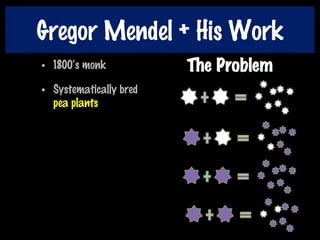
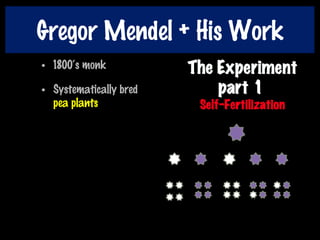
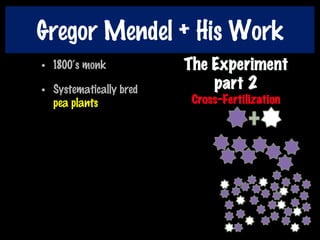
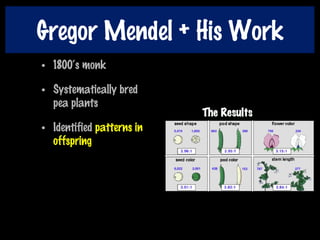
  • #6 Gregor Mendel: first person to trace the characteristics of successive generations of a living thing. saw that the traits were inherited in certain numerical ratios. Self-fertilization: Pollen from the same flower enters the egg cells of the same flower. True-breeding: All of the offspring have the same trait. Cross-Fertilization: Remove the stamens, and fertilize the carpel yourself by brushing it with the pollen from a different flower. P-Generation flowers were true-breeding, so he cross-fertilized them. The seeds produced were HYBRIDS (different ALLELES). Allowed the purple flowers from F1 to self-fertilize and had a 705:224 purple to white ratio. F3 Generation: ALL the white flowers were WHITE. About 1/3 of the purple true-breed for purple, the remaining produced a 3:1 ratio of purple to white flowers.
  • #7 Gregor Mendel: first person to trace the characteristics of successive generations of a living thing. saw that the traits were inherited in certain numerical ratios. Self-fertilization: Pollen from the same flower enters the egg cells of the same flower. True-breeding: All of the offspring have the same trait. Cross-Fertilization: Remove the stamens, and fertilize the carpel yourself by brushing it with the pollen from a different flower. P-Generation flowers were true-breeding, so he cross-fertilized them. The seeds produced were HYBRIDS (different ALLELES). Allowed the purple flowers from F1 to self-fertilize and had a 705:224 purple to white ratio. F3 Generation: ALL the white flowers were WHITE. About 1/3 of the purple true-breed for purple, the remaining produced a 3:1 ratio of purple to white flowers.
  • #8 Gregor Mendel: first person to trace the characteristics of successive generations of a living thing. saw that the traits were inherited in certain numerical ratios. Self-fertilization: Pollen from the same flower enters the egg cells of the same flower. True-breeding: All of the offspring have the same trait. Cross-Fertilization: Remove the stamens, and fertilize the carpel yourself by brushing it with the pollen from a different flower. P-Generation flowers were true-breeding, so he cross-fertilized them. The seeds produced were HYBRIDS (different ALLELES). Allowed the purple flowers from F1 to self-fertilize and had a 705:224 purple to white ratio. F3 Generation: ALL the white flowers were WHITE. About 1/3 of the purple true-breed for purple, the remaining produced a 3:1 ratio of purple to white flowers.
  • #9 Gregor Mendel: first person to trace the characteristics of successive generations of a living thing. saw that the traits were inherited in certain numerical ratios. Self-fertilization: Pollen from the same flower enters the egg cells of the same flower. True-breeding: All of the offspring have the same trait. Cross-Fertilization: Remove the stamens, and fertilize the carpel yourself by brushing it with the pollen from a different flower. P-Generation flowers were true-breeding, so he cross-fertilized them. The seeds produced were HYBRIDS (different ALLELES). Allowed the purple flowers from F1 to self-fertilize and had a 705:224 purple to white ratio. F3 Generation: ALL the white flowers were WHITE. About 1/3 of the purple true-breed for purple, the remaining produced a 3:1 ratio of purple to white flowers.
  • #10 Gregor Mendel: first person to trace the characteristics of successive generations of a living thing. saw that the traits were inherited in certain numerical ratios. Self-fertilization: Pollen from the same flower enters the egg cells of the same flower. True-breeding: All of the offspring have the same trait. Cross-Fertilization: Remove the stamens, and fertilize the carpel yourself by brushing it with the pollen from a different flower. P-Generation flowers were true-breeding, so he cross-fertilized them. The seeds produced were HYBRIDS (different ALLELES). Allowed the purple flowers from F1 to self-fertilize and had a 705:224 purple to white ratio. F3 Generation: ALL the white flowers were WHITE. About 1/3 of the purple true-breed for purple, the remaining produced a 3:1 ratio of purple to white flowers.
  • #11 Gregor Mendel: first person to trace the characteristics of successive generations of a living thing. saw that the traits were inherited in certain numerical ratios. Self-fertilization: Pollen from the same flower enters the egg cells of the same flower. True-breeding: All of the offspring have the same trait. Cross-Fertilization: Remove the stamens, and fertilize the carpel yourself by brushing it with the pollen from a different flower. P-Generation flowers were true-breeding, so he cross-fertilized them. The seeds produced were HYBRIDS (different ALLELES). Allowed the purple flowers from F1 to self-fertilize and had a 705:224 purple to white ratio. F3 Generation: ALL the white flowers were WHITE. About 1/3 of the purple true-breed for purple, the remaining produced a 3:1 ratio of purple to white flowers.
  • #12 Gregor Mendel: first person to trace the characteristics of successive generations of a living thing. saw that the traits were inherited in certain numerical ratios. Self-fertilization: Pollen from the same flower enters the egg cells of the same flower. True-breeding: All of the offspring have the same trait. Cross-Fertilization: Remove the stamens, and fertilize the carpel yourself by brushing it with the pollen from a different flower. P-Generation flowers were true-breeding, so he cross-fertilized them. The seeds produced were HYBRIDS (different ALLELES). Allowed the purple flowers from F1 to self-fertilize and had a 705:224 purple to white ratio. F3 Generation: ALL the white flowers were WHITE. About 1/3 of the purple true-breed for purple, the remaining produced a 3:1 ratio of purple to white flowers.
  • #13 Gregor Mendel: first person to trace the characteristics of successive generations of a living thing. saw that the traits were inherited in certain numerical ratios. Self-fertilization: Pollen from the same flower enters the egg cells of the same flower. True-breeding: All of the offspring have the same trait. Cross-Fertilization: Remove the stamens, and fertilize the carpel yourself by brushing it with the pollen from a different flower. P-Generation flowers were true-breeding, so he cross-fertilized them. The seeds produced were HYBRIDS (different ALLELES). Allowed the purple flowers from F1 to self-fertilize and had a 705:224 purple to white ratio. F3 Generation: ALL the white flowers were WHITE. About 1/3 of the purple true-breed for purple, the remaining produced a 3:1 ratio of purple to white flowers.
  • #47 Images, in order: X + Y chromosomes sex linkage colorblindness tests hemophilia symptoms
  • #48 Images, in order: X + Y chromosomes sex linkage colorblindness tests hemophilia symptoms
  • #49 Images, in order: X + Y chromosomes sex linkage colorblindness tests hemophilia symptoms
  • #50 Images, in order: X + Y chromosomes sex linkage colorblindness tests hemophilia symptoms
  • #51 Images, in order: X + Y chromosomes sex linkage colorblindness tests hemophilia symptoms
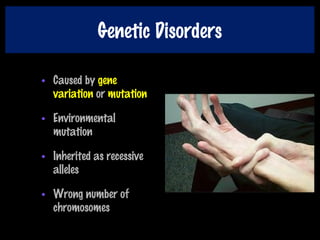
  • #53 Marfan syndrome disorder of connective tissue gene alteration or mutation causes defect in growth hormone production
  • #54 Marfan wrists
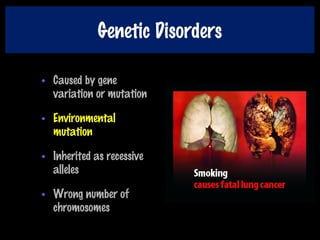
  • #55 carcinogens can interfere with DNA replication radiation may alter nucleotides in DNA
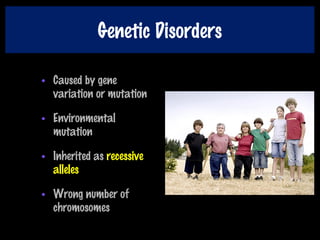
  • #56 achondroplasia (dwarfism)
  • #57 Trisomy 21 aka Down Syndrome
  • #69 drought- and disease-resistance growth patterns
  • #70 once planted in a field, pollination occurs naturally - can’t control which genes are transported to non-GMO plants