IB Environmental Systems and Societies p. 1
Topic 1: Foundations of environmental systems and societies (16 hours)
1.2 Systems & Models
Significant Ideas:
➔ A systems approach can help in the study of complex environmental issues.
➔ The use of systems and models simplifies interactions but may provide a more holistic view without
reducing issues to single processes.
Knowledge & Understanding: Use these notes to familiarize yourself with ESS terminology and concepts.
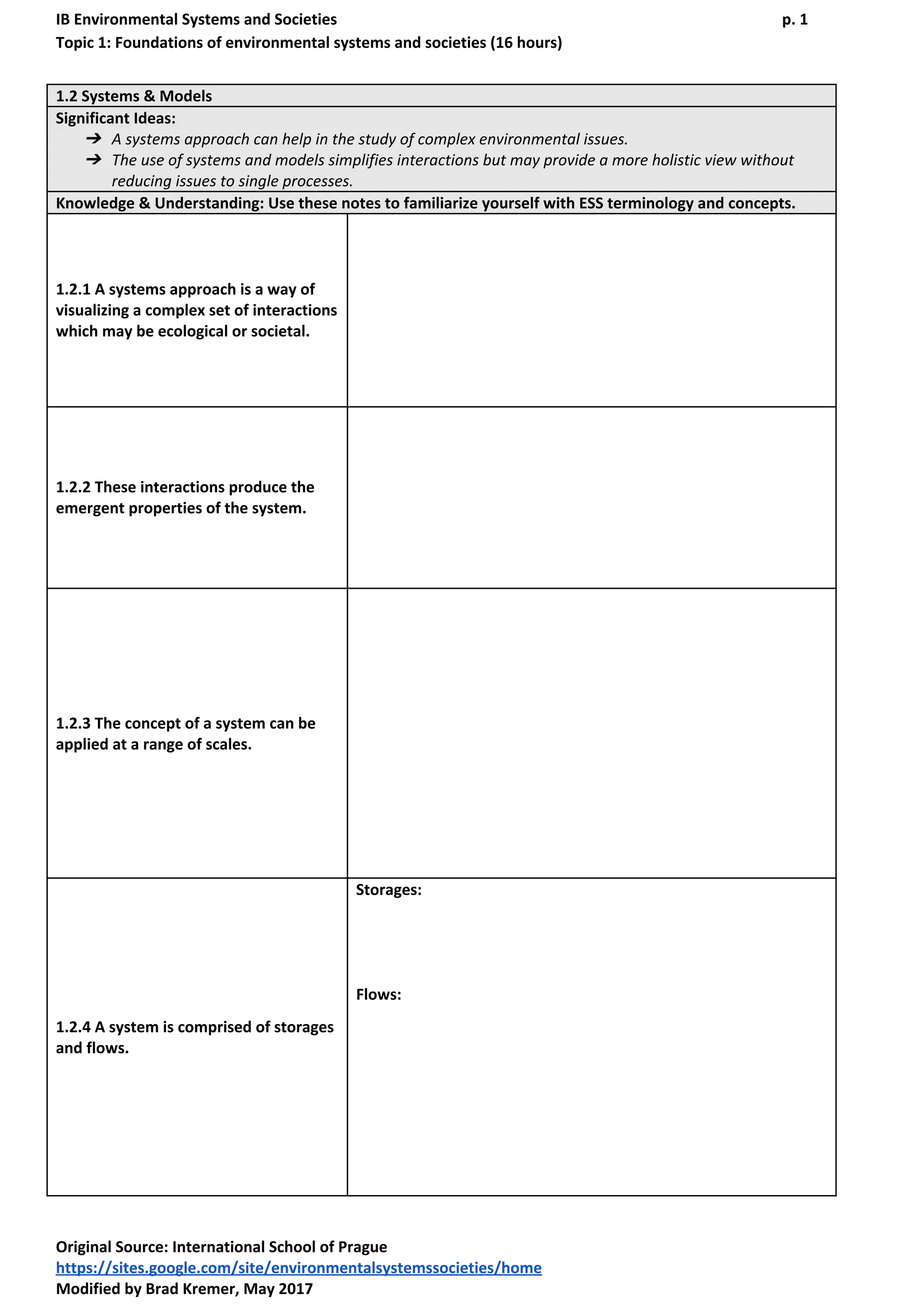
1.2.1 A ​systems approach​ is a way of
visualizing a complex set of interactions
which may be ecological or societal.
1.2.2 These interactions produce the
emergent​ properties of the system.
1.2.3 The concept of a system can be
applied at a ​range of scales​.
1.2.4 A system is comprised of ​storages
and ​flows​.
Storages:
Flows:
Original Source​: International School of Prague
https://sites.google.com/site/environmentalsystemssocieties/home
Modified by Brad Kremer, May 2017
IB Environmental Systems and Societies p. 2
Topic 1: Foundations of environmental systems and societies (16 hours)
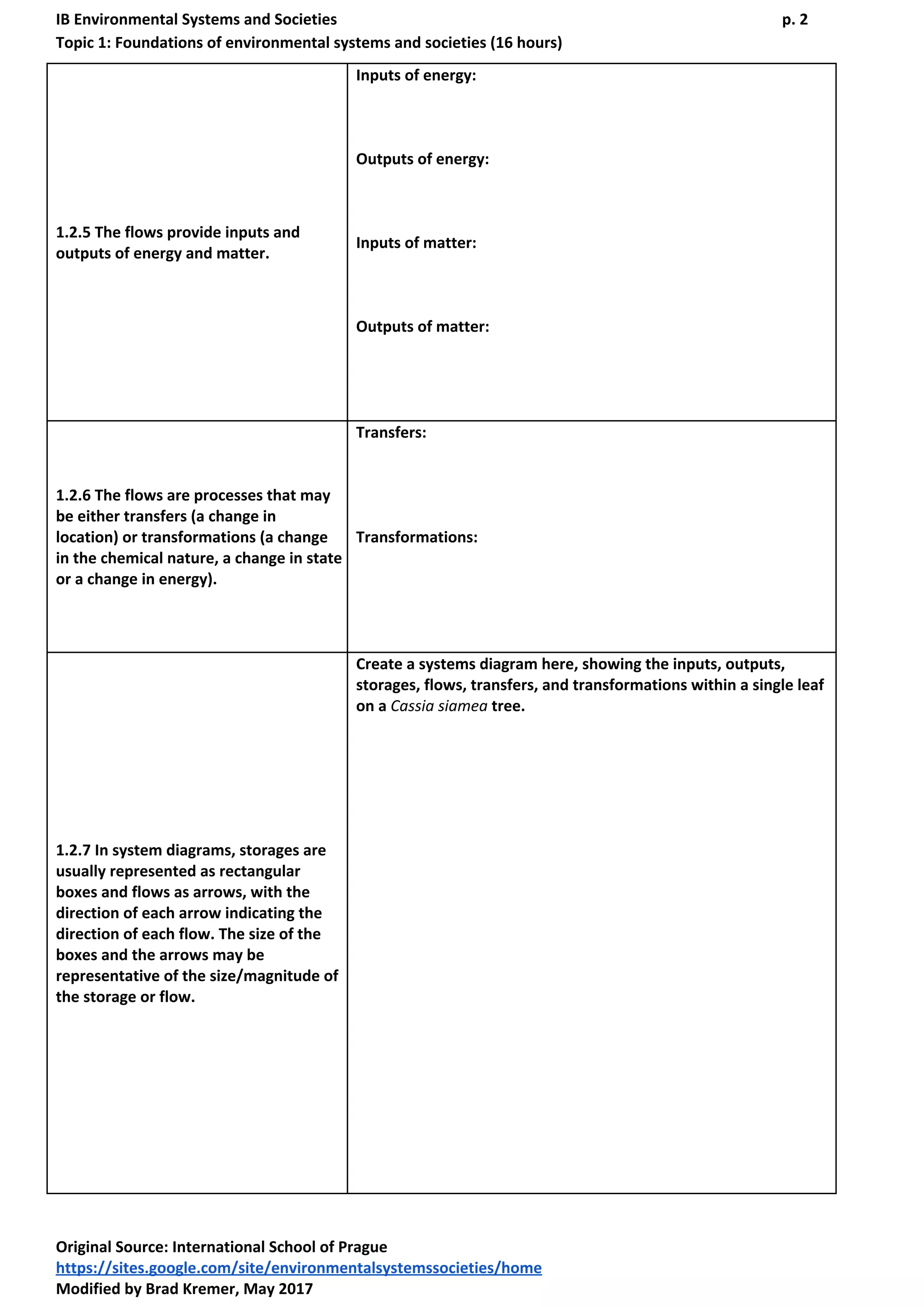
1.2.5 The flows provide ​inputs​ and
outputs​ of ​energy​ and ​matter​.
Inputs of energy:
Outputs of energy:
Inputs of matter:
Outputs of matter:
1.2.6 The ​flows​ are processes that may
be either ​transfers​ (a change in
location) or ​transformations​ (a change
in the chemical nature, a change in state
or a change in energy).
Transfers:
Transformations:
1.2.7 In ​system diagrams​, ​storages​ are
usually represented as rectangular
boxes and ​flows​ as arrows, with the
direction of each ​arrow​ indicating the
direction of each flow. The ​size​ of the
boxes and the arrows may be
representative of the size/magnitude of
the storage or flow.
Create a systems diagram here, showing the inputs, outputs,
storages, flows, transfers, and transformations within a single leaf
on a ​Cassia siamea​ tree.
Original Source​: International School of Prague
https://sites.google.com/site/environmentalsystemssocieties/home
Modified by Brad Kremer, May 2017
IB Environmental Systems and Societies p. 3
Topic 1: Foundations of environmental systems and societies (16 hours)
1.2.8 An ​open system​ exchanges both
energy and matter​ across its boundary
while a ​closed system​ exchanges only
energy​ across its boundary.
1.2.9 An ​isolated system​ is a
hypothetical concept in which neither
energy nor matter is exchanged across
the ​boundary​.
1.2.10 ​Ecosystems​ are open systems,
closed systems exist experimentally,
although the global geochemical cycles
approximate to closed systems.
1.2.11 A ​model​ is a ​simplified version​ of
reality and can be used to understand
how a system works and to ​predict​ how
it will respond to change.
1.2.12 A ​model​ inevitably involves some
approximation​ and therefore loss of
accuracy.
Original Source​: International School of Prague
https://sites.google.com/site/environmentalsystemssocieties/home
Modified by Brad Kremer, May 2017
IB Environmental Systems and Societies p. 4
Topic 1: Foundations of environmental systems and societies (16 hours)
Applications & Skills: Treat the following prompts as assessment questions on your IB ESS exam. Use the
terminology and concepts from the notes above to respond to each of these prompts
1.2.AS1 ​Construct ​a system diagram or a model from a given set of information.
1.2.AS2 ​Evaluate​ the use of models as a tool in a given situation. For example, climate change predictions.
Original Source​: International School of Prague
https://sites.google.com/site/environmentalsystemssocieties/home
Modified by Brad Kremer, May 2017

1.2 systems and models notes

  • 1.
    IB Environmental Systemsand Societies p. 1 Topic 1: Foundations of environmental systems and societies (16 hours) 1.2 Systems & Models Significant Ideas: ➔ A systems approach can help in the study of complex environmental issues. ➔ The use of systems and models simplifies interactions but may provide a more holistic view without reducing issues to single processes. Knowledge & Understanding: Use these notes to familiarize yourself with ESS terminology and concepts. 1.2.1 A ​systems approach​ is a way of visualizing a complex set of interactions which may be ecological or societal. 1.2.2 These interactions produce the emergent​ properties of the system. 1.2.3 The concept of a system can be applied at a ​range of scales​. 1.2.4 A system is comprised of ​storages and ​flows​. Storages: Flows: Original Source​: International School of Prague https://sites.google.com/site/environmentalsystemssocieties/home Modified by Brad Kremer, May 2017
  • 2.
    IB Environmental Systemsand Societies p. 2 Topic 1: Foundations of environmental systems and societies (16 hours) 1.2.5 The flows provide ​inputs​ and outputs​ of ​energy​ and ​matter​. Inputs of energy: Outputs of energy: Inputs of matter: Outputs of matter: 1.2.6 The ​flows​ are processes that may be either ​transfers​ (a change in location) or ​transformations​ (a change in the chemical nature, a change in state or a change in energy). Transfers: Transformations: 1.2.7 In ​system diagrams​, ​storages​ are usually represented as rectangular boxes and ​flows​ as arrows, with the direction of each ​arrow​ indicating the direction of each flow. The ​size​ of the boxes and the arrows may be representative of the size/magnitude of the storage or flow. Create a systems diagram here, showing the inputs, outputs, storages, flows, transfers, and transformations within a single leaf on a ​Cassia siamea​ tree. Original Source​: International School of Prague https://sites.google.com/site/environmentalsystemssocieties/home Modified by Brad Kremer, May 2017
  • 3.
    IB Environmental Systemsand Societies p. 3 Topic 1: Foundations of environmental systems and societies (16 hours) 1.2.8 An ​open system​ exchanges both energy and matter​ across its boundary while a ​closed system​ exchanges only energy​ across its boundary. 1.2.9 An ​isolated system​ is a hypothetical concept in which neither energy nor matter is exchanged across the ​boundary​. 1.2.10 ​Ecosystems​ are open systems, closed systems exist experimentally, although the global geochemical cycles approximate to closed systems. 1.2.11 A ​model​ is a ​simplified version​ of reality and can be used to understand how a system works and to ​predict​ how it will respond to change. 1.2.12 A ​model​ inevitably involves some approximation​ and therefore loss of accuracy. Original Source​: International School of Prague https://sites.google.com/site/environmentalsystemssocieties/home Modified by Brad Kremer, May 2017
  • 4.
    IB Environmental Systemsand Societies p. 4 Topic 1: Foundations of environmental systems and societies (16 hours) Applications & Skills: Treat the following prompts as assessment questions on your IB ESS exam. Use the terminology and concepts from the notes above to respond to each of these prompts 1.2.AS1 ​Construct ​a system diagram or a model from a given set of information. 1.2.AS2 ​Evaluate​ the use of models as a tool in a given situation. For example, climate change predictions. Original Source​: International School of Prague https://sites.google.com/site/environmentalsystemssocieties/home Modified by Brad Kremer, May 2017