Classical Mendelian Genetics
Presented By: Mahrukh Shehzadi
Definition of Genetics
Branch of Biology that studies the ways
in which hereditary information is
passed on from parents to offspring.
Genetics as a science was first practiced
by Gregor Mendel
Mendel was an Austrian monk who
experimented for many years with pea
plants
Mendel (cont.)
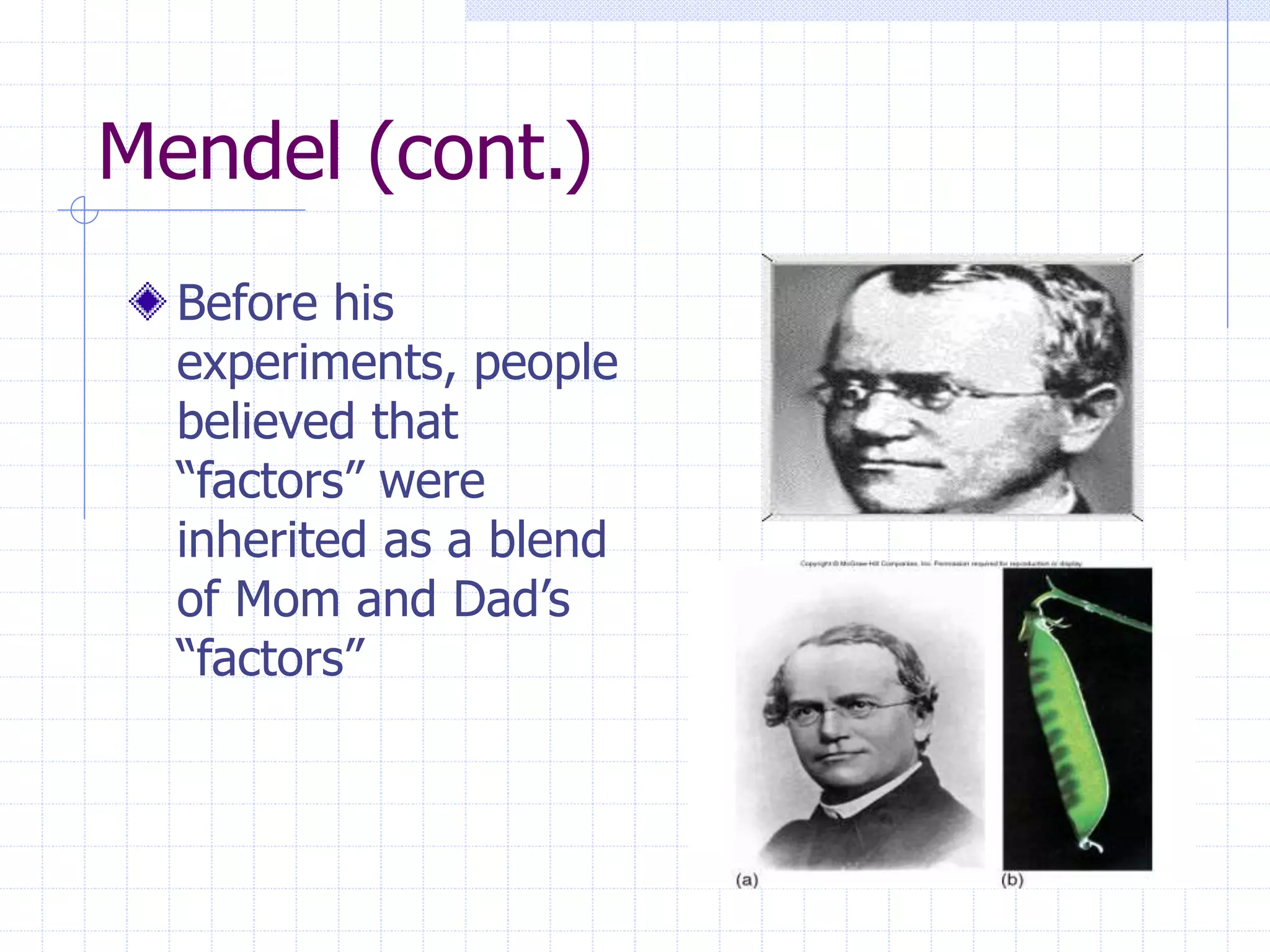
Before his
experiments, people
believed that
“factors” were
inherited as a blend
of Mom and Dad’s
“factors”
Mendel (cont.)
Why Peas?
Mendel used peas to study inheritance
because:
True breeding strains were available
Peas are easy to grow and maintain
They have a short generation time
Mendel (cont.)
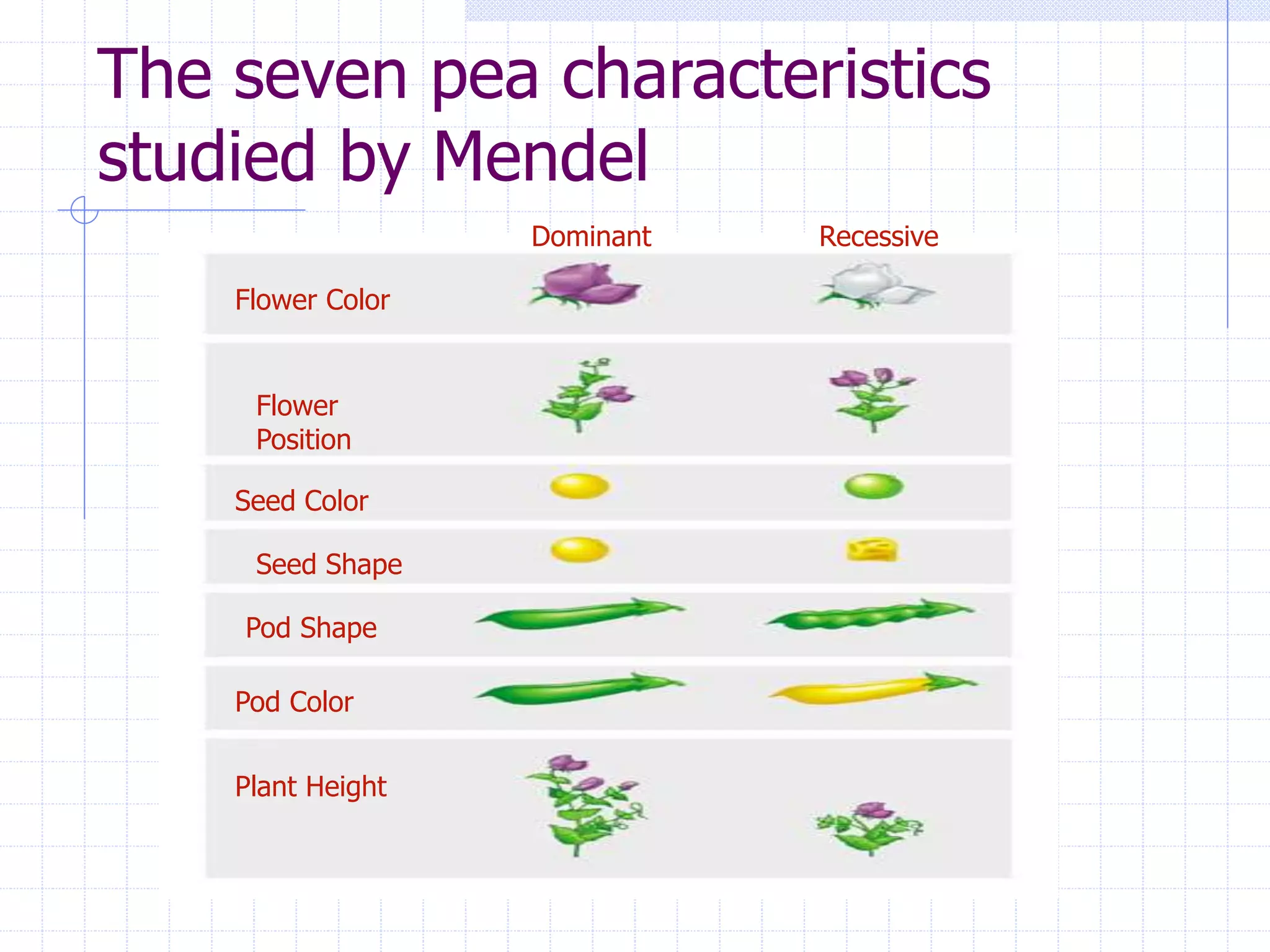
Peas have many easy to observe traits including:
 Seed color - Green or yellow
 Seed shape - Round or wrinkled
 Pod color - Green or yellow
 Pod shape - Smooth or constricted
 Flower color - White or purple
 Flower position - Axial or terminal
 Plant size - Tall or dwarf
Mendel (cont.)
Pea flowers are constructed
in such a way that they
typically self fertilize
Because of this, it is
relatively easy to control
crosses in peas
By removing the anthers of
one flower and artificially
pollinating using a brush,
crosses can be easily
controlled in peas.
The seven pea characteristics
studied by Mendel
Flower Color
Flower
Position
Seed Color
Seed Shape
Pod Shape
Pod Color
Plant Height
Dominant Recessive
Mendel’s First Experiment
•P generation –
(parental) true-
breeding
•F1- (first filial)
offspring of P
generation
•F2 – (second
filial) offspring
from F1 cross
Mendel’s First Experiment
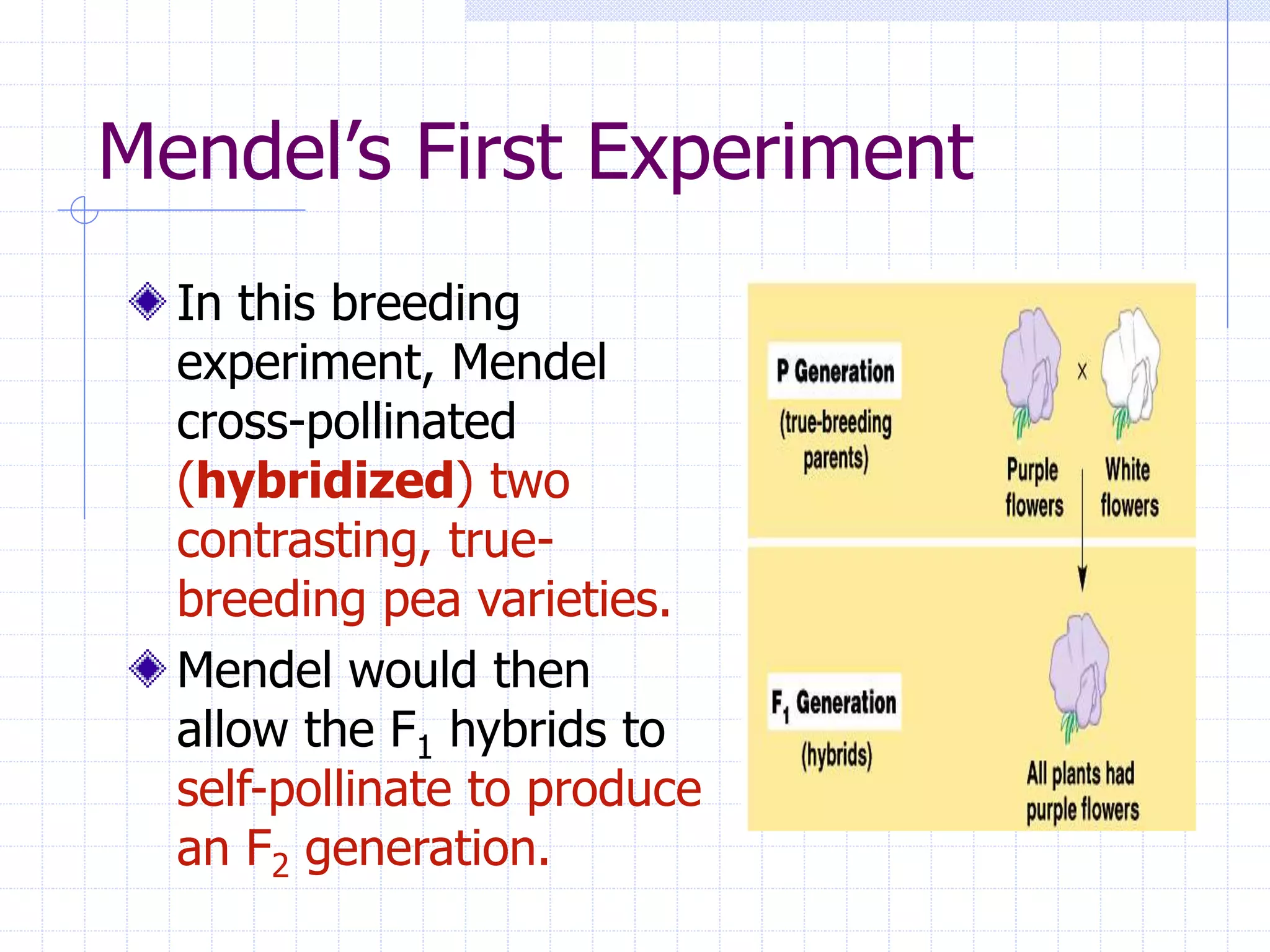
In this breeding
experiment, Mendel
cross-pollinated
(hybridized) two
contrasting, true-
breeding pea varieties.
Mendel would then
allow the F1 hybrids to
self-pollinate to produce
an F2 generation.
Mendel’s First Experiment
When Mendel allowed
the F1 plants to self-
fertilize, the F2
generation included
both purple-flowered
and white-flowered
plants.
 The white trait, absent
in the F1, reappeared
in the F2.
Mendel’s Results
When crossing purple flowered peas
with white flowered peas, Mendel got
the following results:
In the first filial (F1) generation all
offspring produced purple flowers
In the second generation (second filial
or F2) approximately a 3:1 ratio of
purple to white flowers was seen
Mendel’s Results
Because the F1 generation did not produce
light purple flowers and because white
flowers showed up in the F2 generation,
Mendel disproved blended inheritance.
Mendel said that the parents had two sets of
factors (genes), thus two copies of the flower
color gene
Each gene has two varieties-called alleles
In the case of the flower color gene, the two
alleles are white and purple
Mendel’s Results
In the F1 generation, the white allele
was hidden by the purple “dominant”
allele
In the F2 generation, 1/4 of the
offspring wound up with two copies of
the white allele, thus they were white
Mendel termed this discovery “The Law
of Dominance”
Mendel’s First Law: The Law of
Dominance
If only one of the genes in a pair is
expressed, it is called the dominant allele
The gene which is present but not expressed
is called the recessive allele
Recessive alleles may be hidden and not
shown for many generations
When two copies of a recessive allele are
present then the recessive trait will show
Mendel’s 2nd Law-The Law of
Segregation
The two alleles
for each
character
segregate
(separate)
during gamete
production
Mendel’s 2nd Law-The Law of
Segregation
Mendel’s 3rd Law-The Law of
Independent Assortment
When Mendel crossed peas and looked at two
different traits, he discovered that the traits assorted
independently
In other words, if he was looking at the height of the
plants and the color of the flowers, all four possible
combinations of height and flower color were
produced:
Tall Purple
Tall white
Dwarf Purple
Dwarf white
Mendel’s 3rd Law-The Law of
Independent Assortment
• As long as genes are on different
chromosomes, they will assort
independently
• This meant that a seed’s color did not
depend on its shape, nor did height of
the plant affect the flower color
Mendelian Genetics Vocabulary
Character –heritable feature
Trait – each variant for a character
Dominant Allele: a gene that exerts
it’s full effect no matter what effect it’s
allelic partner may have.
The dominant allele is represented by a
capitalized letter (ex. T=tall)
Mendelian Genetics Vocabulary
Recessive Allele: a gene that is
masked by the dominant allele
The recessive allele is represented by
the same letter but lower case (ex.
t=short)
Remember: Diploid organisms have 2
copies of every gene, therefore they
have 2 alleles for a specific trait
Mendelian Genetics Vocabulary
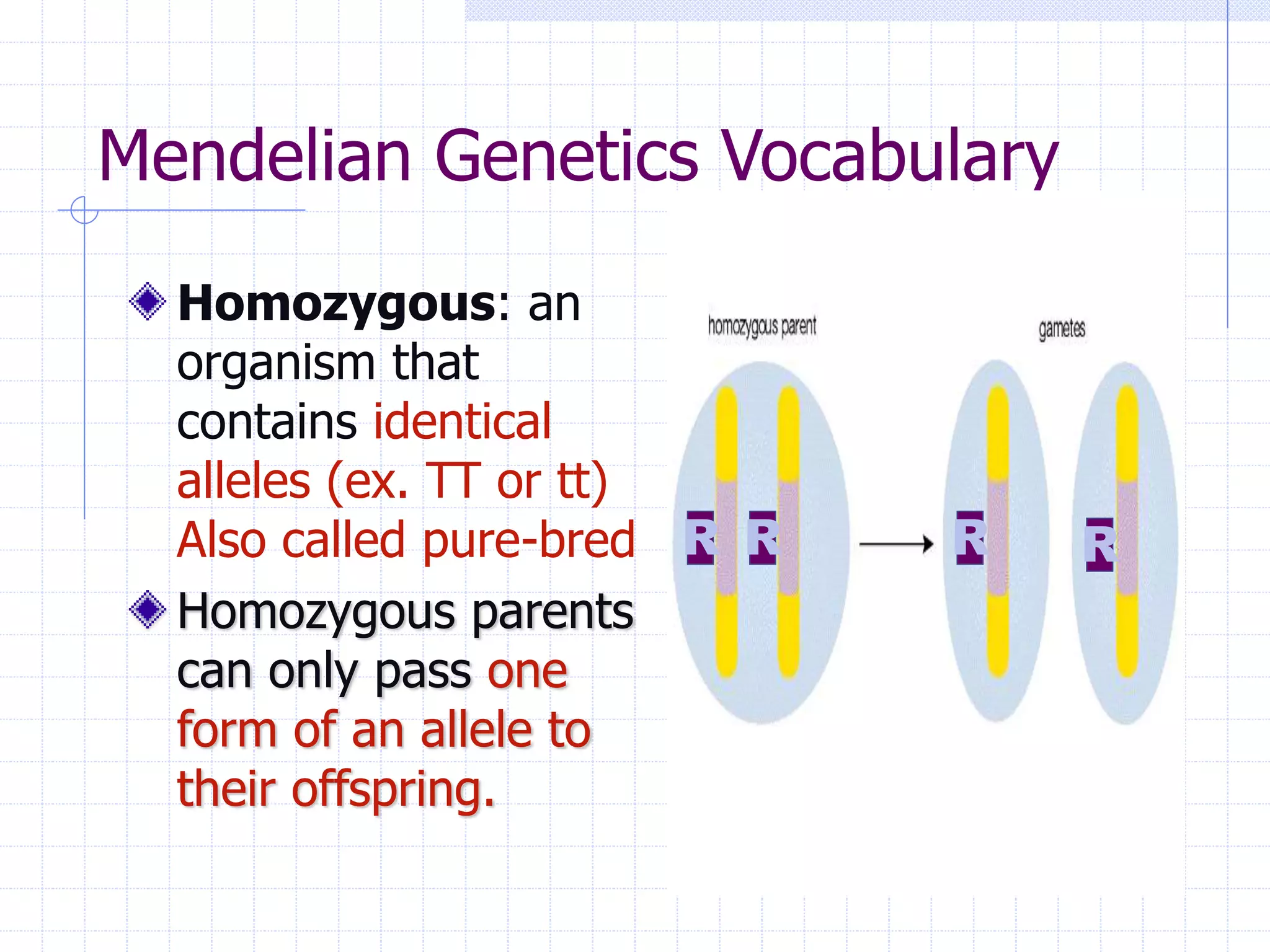
Homozygous: an
organism that
contains identical
alleles (ex. TT or tt)
Also called pure-bred
Homozygous parents
can only pass one
form of an allele to
their offspring.
R R R R
Mendelian Genetics Vocabulary
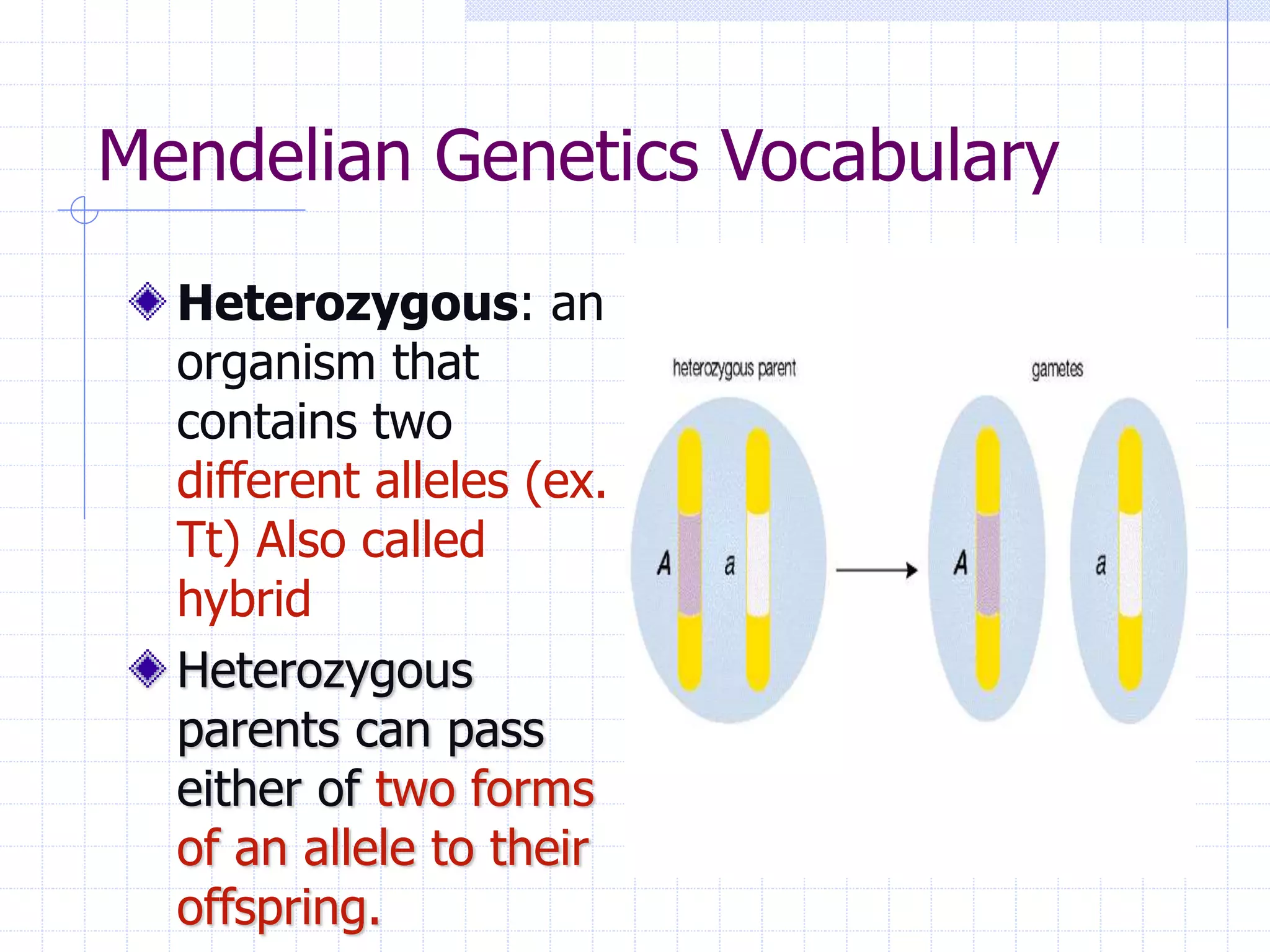
Heterozygous: an
organism that
contains two
different alleles (ex.
Tt) Also called
hybrid
Heterozygous
parents can pass
either of two forms
of an allele to their
offspring.
Mendelian Genetics Vocabulary
Genotype: genetic make-up of an organism
or the specific alleles
 represented by letters
 ex. tt, TT, Tt
Phenotype: the observable appearance of
an individual resulting from it’s genotype
 ex. Tall, short, yellow
Solving Genetic Problems Involving
Different Types of Inheritance
The Key Steps
 1.) decide the type of
inheritance involved
 2.) choose a capital letter for
the dominant trait – it’s lower
case for the recessive
counterpart
 3.) decide your mating (cross)
 4.) construct a “Punnett”
Square to describe results of
mating
 5.) be sure to answer the
question(s) posed in the
problem
Making A Punnett Square
White
Flower
Parent
(pp)
Purple
Flower
Parent
(PP)
Gametes
p p
P
P
Basic Types of Inheritance +
Genetic Crosses
A.) Simple Dominance
– One trait dominates
over a second
 1.) Test Cross – Used
to determine
whether an organism
is homozygous or
heterozygous. Test
organism is crossed
to a pure recessive.
Basic Types of Inheritance +
Genetic Crosses
Double cross-Looking at the inheritance
of two separate traits.
If both organisms are hybrid for both
traits this becomes a “dihybrid-cross”
Mendel noticed that whenever two
dihybrids are crossed, the ratio of the
genotypes is 9:3:3:1
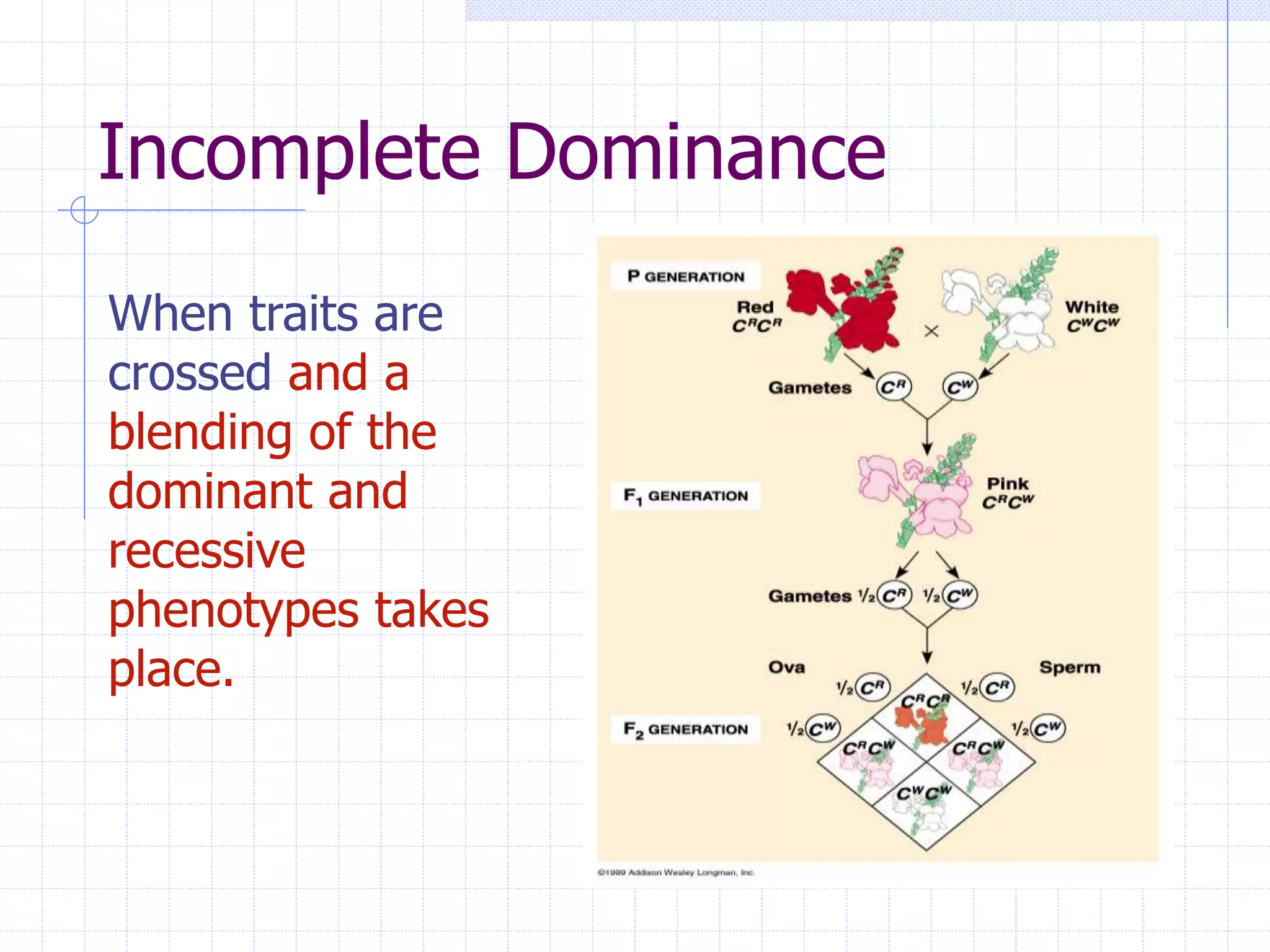
Incomplete Dominance
When traits are
crossed and a
blending of the
dominant and
recessive
phenotypes takes
place.
Basic Types of Inheritance +
Genetic Crosses
C.) Co-Dominance
(Multiple Alleles) –
Two or more alleles
both show over a
third (human blood
types)
D.) Sex-Linkage –
Traits are carried
only on the sex
chromosomes
Phenotype (Blood
Type)
Genotype
A IAIA or IA i
B IBIB or IB i
AB IAIB
O i i
Genetics and People
Genetic Diseases
1. sickle cell anemia
Production of abnormal, crescent shaped red
blood cells. It is autosomal (not in the sex
pair) and recessive (you can be normal, a
carrier, or have the disease)
caused by malformed hemoglobin
blood loses the ability to carry oxygen
red blood cells can stick to sides of blood
vessels and cause a clot
Genetics and People
2. Tay-Sachs disease:
It destroys the nervous system of
children. They usually do not live
beyond the age of four.
It is autosomal and recessive (you need
2 copies to have the disease)
common in Jews of eastern European
descent
Genetics and People
3. PKU (phenylketonuria):
It is an inherited condition of severe mental
retardation due to a failure to breakdown
phenylalanine, an amino acid.
It is autosomal and recessive.
Brain fails to develop during infancy
Can be prevented by eating a diet free of
phenylalanine
All newborns are screened for this disease
Genetics and People
4. Cystic fibrosis
A respiratory disorder caused by
excessive production of thick mucus in
the lungs and pancreas.
Autosomal and recessive.
Genetics and People
5. Thalassemia:
A severe form of anemia (loss of red
blood cells).
It is autosomal and recessive.
6. Huntington’s Disease:
An incurable form of insanity that starts
at age 40.
It is autosomal and dominant.
Genetics and People
7. Hemophilia- a sex-linked recessive
disease
Blood is missing a protein which allows
it to clot properly
Genetic engineering has led to
manufacture of this protein and better
treatment
Genetics and People
B. genetic screening
1. Amniocentesis: a
sample of amniotic
fluid is genetically
analyzed.
Genetics and People
2. Karyotype: an
enlarged
photograph of
arranged human
chromosomes.
Genetics and People
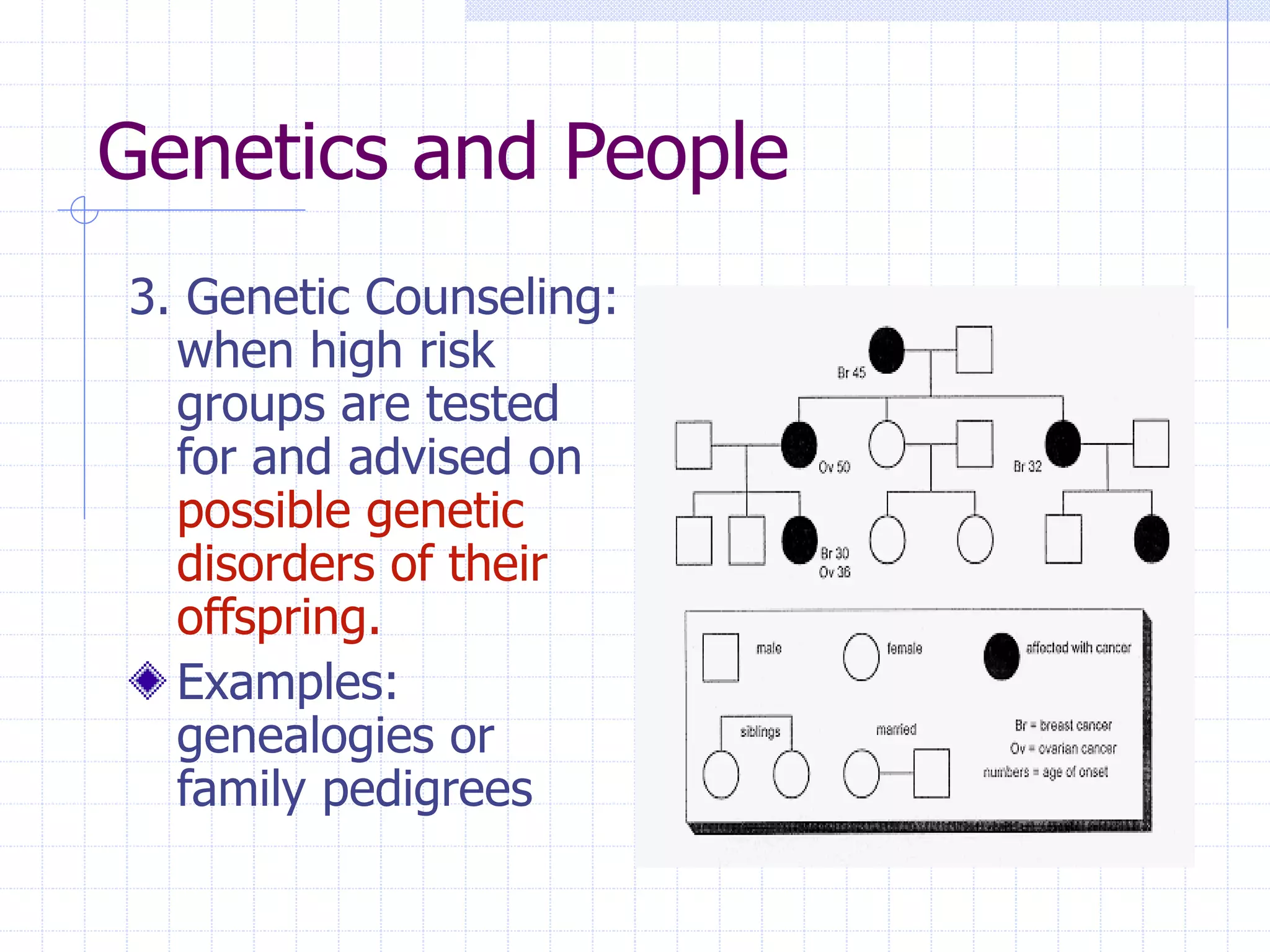
3. Genetic Counseling:
when high risk
groups are tested
for and advised on
possible genetic
disorders of their
offspring.
Examples:
genealogies or
family pedigrees
Genetic Applications
A. Plant and animal breeding: breeders
apply the principles of genetics to
improve plants and animals.
Breeding Methods:
1. Artificial Selection: plants or animals
having desired qualities are selected to
reproduce their kind.
Examples: horse and dog breeders
Genetic Applications
2. Hybridization
Crosses are made between organisms having
desirable qualities in the attempt to produce
some offspring that incorporate these
qualities.
Examples: American cattle and Brahman
cattle
Genetic Applications
3. Inbreeding
Is the mating of organisms of the same
strain or type
Example: German shepherds will only
be bred with German shepherds
Problem: offspring are more susceptible
to diseases and have shorter life spans.
Genetic Applications
4. Vegetative Propagation
Desirable traits in plants can be easily
produced by asexual means.
Example: seedless fruits
Heredity and Environment
Both the genetics and the environment
affect the phenotypes and development
of organisms.
Heredity and Environment
1. Effect of Temperature on hair color in the Himalayan rabbit
Himalayan rabbits are white
except for its black nose, ears,
tail, and feet.
In experiments, fur was removed from the
rabbits back, an ice pack was
applied while the fur grew back.
Heredity and Environment
This low temperature
produced black fur.
Conclusion: low
temperature prevents
the action of the
white fur gene and
enzyme.

Mendelian genetics

  • 1.
  • 2.
    Definition of Genetics Branchof Biology that studies the ways in which hereditary information is passed on from parents to offspring. Genetics as a science was first practiced by Gregor Mendel Mendel was an Austrian monk who experimented for many years with pea plants
  • 3.
    Mendel (cont.) Before his experiments,people believed that “factors” were inherited as a blend of Mom and Dad’s “factors”
  • 4.
    Mendel (cont.) Why Peas? Mendelused peas to study inheritance because: True breeding strains were available Peas are easy to grow and maintain They have a short generation time
  • 5.
    Mendel (cont.) Peas havemany easy to observe traits including:  Seed color - Green or yellow  Seed shape - Round or wrinkled  Pod color - Green or yellow  Pod shape - Smooth or constricted  Flower color - White or purple  Flower position - Axial or terminal  Plant size - Tall or dwarf
  • 6.
    Mendel (cont.) Pea flowersare constructed in such a way that they typically self fertilize Because of this, it is relatively easy to control crosses in peas By removing the anthers of one flower and artificially pollinating using a brush, crosses can be easily controlled in peas.
  • 7.
    The seven peacharacteristics studied by Mendel Flower Color Flower Position Seed Color Seed Shape Pod Shape Pod Color Plant Height Dominant Recessive
  • 8.
    Mendel’s First Experiment •Pgeneration – (parental) true- breeding •F1- (first filial) offspring of P generation •F2 – (second filial) offspring from F1 cross
  • 9.
    Mendel’s First Experiment Inthis breeding experiment, Mendel cross-pollinated (hybridized) two contrasting, true- breeding pea varieties. Mendel would then allow the F1 hybrids to self-pollinate to produce an F2 generation.
  • 10.
    Mendel’s First Experiment WhenMendel allowed the F1 plants to self- fertilize, the F2 generation included both purple-flowered and white-flowered plants.  The white trait, absent in the F1, reappeared in the F2.
  • 11.
    Mendel’s Results When crossingpurple flowered peas with white flowered peas, Mendel got the following results: In the first filial (F1) generation all offspring produced purple flowers In the second generation (second filial or F2) approximately a 3:1 ratio of purple to white flowers was seen
  • 12.
    Mendel’s Results Because theF1 generation did not produce light purple flowers and because white flowers showed up in the F2 generation, Mendel disproved blended inheritance. Mendel said that the parents had two sets of factors (genes), thus two copies of the flower color gene Each gene has two varieties-called alleles In the case of the flower color gene, the two alleles are white and purple
  • 13.
    Mendel’s Results In theF1 generation, the white allele was hidden by the purple “dominant” allele In the F2 generation, 1/4 of the offspring wound up with two copies of the white allele, thus they were white Mendel termed this discovery “The Law of Dominance”
  • 14.
    Mendel’s First Law:The Law of Dominance If only one of the genes in a pair is expressed, it is called the dominant allele The gene which is present but not expressed is called the recessive allele Recessive alleles may be hidden and not shown for many generations When two copies of a recessive allele are present then the recessive trait will show
  • 15.
    Mendel’s 2nd Law-TheLaw of Segregation The two alleles for each character segregate (separate) during gamete production
  • 16.
    Mendel’s 2nd Law-TheLaw of Segregation
  • 17.
    Mendel’s 3rd Law-TheLaw of Independent Assortment When Mendel crossed peas and looked at two different traits, he discovered that the traits assorted independently In other words, if he was looking at the height of the plants and the color of the flowers, all four possible combinations of height and flower color were produced: Tall Purple Tall white Dwarf Purple Dwarf white
  • 18.
    Mendel’s 3rd Law-TheLaw of Independent Assortment • As long as genes are on different chromosomes, they will assort independently • This meant that a seed’s color did not depend on its shape, nor did height of the plant affect the flower color
  • 19.
    Mendelian Genetics Vocabulary Character–heritable feature Trait – each variant for a character Dominant Allele: a gene that exerts it’s full effect no matter what effect it’s allelic partner may have. The dominant allele is represented by a capitalized letter (ex. T=tall)
  • 20.
    Mendelian Genetics Vocabulary RecessiveAllele: a gene that is masked by the dominant allele The recessive allele is represented by the same letter but lower case (ex. t=short) Remember: Diploid organisms have 2 copies of every gene, therefore they have 2 alleles for a specific trait
  • 21.
    Mendelian Genetics Vocabulary Homozygous:an organism that contains identical alleles (ex. TT or tt) Also called pure-bred Homozygous parents can only pass one form of an allele to their offspring. R R R R
  • 22.
    Mendelian Genetics Vocabulary Heterozygous:an organism that contains two different alleles (ex. Tt) Also called hybrid Heterozygous parents can pass either of two forms of an allele to their offspring.
  • 23.
    Mendelian Genetics Vocabulary Genotype:genetic make-up of an organism or the specific alleles  represented by letters  ex. tt, TT, Tt Phenotype: the observable appearance of an individual resulting from it’s genotype  ex. Tall, short, yellow
  • 24.
    Solving Genetic ProblemsInvolving Different Types of Inheritance The Key Steps  1.) decide the type of inheritance involved  2.) choose a capital letter for the dominant trait – it’s lower case for the recessive counterpart  3.) decide your mating (cross)  4.) construct a “Punnett” Square to describe results of mating  5.) be sure to answer the question(s) posed in the problem
  • 25.
    Making A PunnettSquare White Flower Parent (pp) Purple Flower Parent (PP) Gametes p p P P
  • 26.
    Basic Types ofInheritance + Genetic Crosses A.) Simple Dominance – One trait dominates over a second  1.) Test Cross – Used to determine whether an organism is homozygous or heterozygous. Test organism is crossed to a pure recessive.
  • 27.
    Basic Types ofInheritance + Genetic Crosses Double cross-Looking at the inheritance of two separate traits. If both organisms are hybrid for both traits this becomes a “dihybrid-cross” Mendel noticed that whenever two dihybrids are crossed, the ratio of the genotypes is 9:3:3:1
  • 28.
    Incomplete Dominance When traitsare crossed and a blending of the dominant and recessive phenotypes takes place.
  • 29.
    Basic Types ofInheritance + Genetic Crosses C.) Co-Dominance (Multiple Alleles) – Two or more alleles both show over a third (human blood types) D.) Sex-Linkage – Traits are carried only on the sex chromosomes Phenotype (Blood Type) Genotype A IAIA or IA i B IBIB or IB i AB IAIB O i i
  • 30.
    Genetics and People GeneticDiseases 1. sickle cell anemia Production of abnormal, crescent shaped red blood cells. It is autosomal (not in the sex pair) and recessive (you can be normal, a carrier, or have the disease) caused by malformed hemoglobin blood loses the ability to carry oxygen red blood cells can stick to sides of blood vessels and cause a clot
  • 32.
    Genetics and People 2.Tay-Sachs disease: It destroys the nervous system of children. They usually do not live beyond the age of four. It is autosomal and recessive (you need 2 copies to have the disease) common in Jews of eastern European descent
  • 33.
    Genetics and People 3.PKU (phenylketonuria): It is an inherited condition of severe mental retardation due to a failure to breakdown phenylalanine, an amino acid. It is autosomal and recessive. Brain fails to develop during infancy Can be prevented by eating a diet free of phenylalanine All newborns are screened for this disease
  • 34.
    Genetics and People 4.Cystic fibrosis A respiratory disorder caused by excessive production of thick mucus in the lungs and pancreas. Autosomal and recessive.
  • 35.
    Genetics and People 5.Thalassemia: A severe form of anemia (loss of red blood cells). It is autosomal and recessive. 6. Huntington’s Disease: An incurable form of insanity that starts at age 40. It is autosomal and dominant.
  • 36.
    Genetics and People 7.Hemophilia- a sex-linked recessive disease Blood is missing a protein which allows it to clot properly Genetic engineering has led to manufacture of this protein and better treatment
  • 37.
    Genetics and People B.genetic screening 1. Amniocentesis: a sample of amniotic fluid is genetically analyzed.
  • 38.
    Genetics and People 2.Karyotype: an enlarged photograph of arranged human chromosomes.
  • 39.
    Genetics and People 3.Genetic Counseling: when high risk groups are tested for and advised on possible genetic disorders of their offspring. Examples: genealogies or family pedigrees
  • 40.
    Genetic Applications A. Plantand animal breeding: breeders apply the principles of genetics to improve plants and animals. Breeding Methods: 1. Artificial Selection: plants or animals having desired qualities are selected to reproduce their kind. Examples: horse and dog breeders
  • 41.
    Genetic Applications 2. Hybridization Crossesare made between organisms having desirable qualities in the attempt to produce some offspring that incorporate these qualities. Examples: American cattle and Brahman cattle
  • 42.
    Genetic Applications 3. Inbreeding Isthe mating of organisms of the same strain or type Example: German shepherds will only be bred with German shepherds Problem: offspring are more susceptible to diseases and have shorter life spans.
  • 43.
    Genetic Applications 4. VegetativePropagation Desirable traits in plants can be easily produced by asexual means. Example: seedless fruits
  • 44.
    Heredity and Environment Boththe genetics and the environment affect the phenotypes and development of organisms.
  • 45.
    Heredity and Environment 1.Effect of Temperature on hair color in the Himalayan rabbit Himalayan rabbits are white except for its black nose, ears, tail, and feet. In experiments, fur was removed from the rabbits back, an ice pack was applied while the fur grew back.
  • 46.
    Heredity and Environment Thislow temperature produced black fur. Conclusion: low temperature prevents the action of the white fur gene and enzyme.