GENERAL BIOLOGY 2
 At the end of the lesson, the learners will
be able to:
1. identify the mode of inheritance of a
particular trait given the pedigree;
2. predict the genotypes of parents; and
3. compute the probability of occurrence of an
affected offspring in a given cross.
1. Pedigree
2. Proband
3. Law of Segregation
4. Law of IndependentAssortment
5. AutosomalTrait
6. Genotype
7. Phenotype
8. Phenocopy
9. IdenticalTwins
10. FraternalTwins
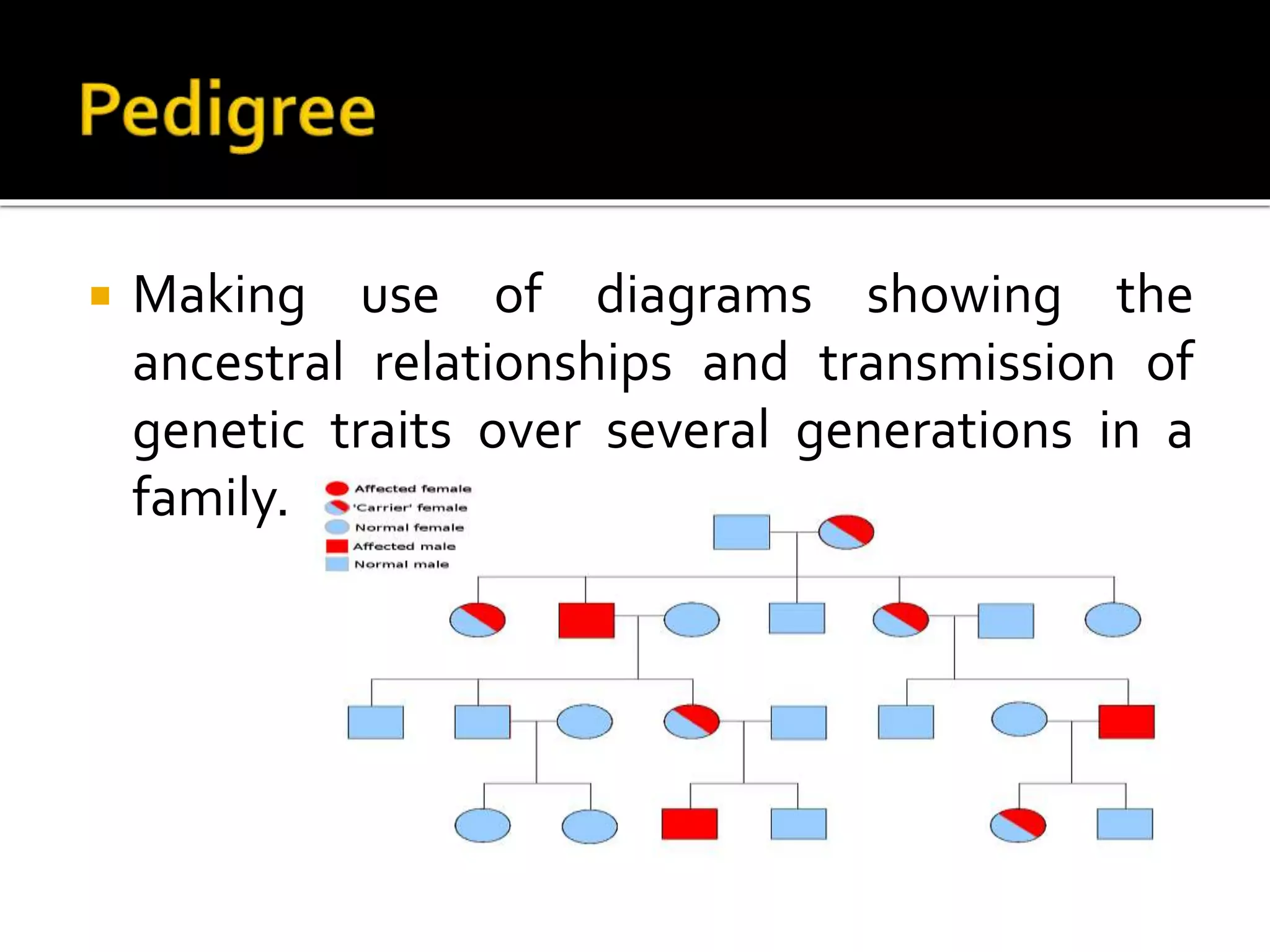
 Making use of diagrams showing the
ancestral relationships and transmission of
genetic traits over several generations in a
family.
 The individual in the pedigree that led to the
construction of the pedigree.
Example:
 A couple consults a medical geneticist
because they have an offspring who is
afflicted with a disease and they want to find
out the mode of transmission of this disease.
 When the medical geneticist constructs the
pedigree, the offspring will be labeled as the
proband. Through the pedigree, the
probability of having other affected children
may be determined.
 A trait whose alleles that control it are found
in the autosomes (body chromosomes/ non-
sex chromosomes)
 The gene pair an individual carries for a
particular trait symbolized with a pair of
letters.
 By convention, uppercase letter (eg. A) for a
dominant allele and lowercase letter (eg. a)
for the recessive allele. Any letter in the
alphabet may be used.
 For a diploid organism with two alleles in a
given gene pair, genotypes may be written
as:
 Homozygous dominant, i.e. with two
dominant alleles (DD)
 Heterozygous, i.e. with a dominant and
recessive allele (Dd).The individual will show
the dominant phenotype.
 Homozygous recessive, i.e. with two
recessive alleles (dd)
 The observable trait of an individual based on its
genotype. Examples: red flower, curly hair, blood
types ( i.e. the blood type is the phenotype)
 For a typical Mendelian trait, phenotypes may
either be:
 i. Dominant. A trait that requires at least one
dominant allele for the trait to be expressed, e.g.
Dd
 ii. Recessive. A trait that requires two recessive
alleles for the trait to be expressed
 A trait that is expressed due to specific
environmental conditions
(i.e. having hair that is dyed of a different color)
and is not due to the genotype.
 Also known as monozygotic twins, which are
derived from a single fertilization event.
 After the first cleavage or cell division of the
zygote, the cells or blastomeres separate and
become independent blastocysts implanted
in the mother’s uterus.
 Twins that are derived from
separate fertilization events
(two eggs fertilized by two
sperms) within the fallopian
tube, resulting in two separate
zygotes; also known as
dizygotic twins
 1st Mendelian Law
 For every trait governed by a pair of alleles,
these alleles segregate or separate during
gamete formation in meiosis.
 only one of the two gene copies present in an
organism is distributed to each gamete (egg or
sperm cell) that it makes, and the allocation of
the gene copies is random. When an egg and a
sperm join in fertilization, they form a new
organism, whose genotype consists of the
alleles contained in the gametes.
 In pea plants, spherical seeds (S) are dominant
to dented seeds (s). In a genetic cross of two
plants that are heterozygous for the seed shape
trait, what fraction of the offspring should have
spherical seeds?
 The gene for tall (T) is dominant over dwarf (t) in
the garden pea. A pea plant that comes from a
line of plants that are all tall (truebreeding) is
crossed with a dwarf pea plant.
 In guinea pigs, rough coat (R) is dominant
over smooth coat (r). Predict the genotypes
and phenotypes of the offspring and give the
genotypic and phenotypic ratios is a
homozygous dominant guinea pig is crossed
with a heterozygous guinea pig.
 2nd Mendelian Law
 A pair of alleles for one trait will segregate or
separate independently of another pair of
alleles for another trait during meiosis
 In a flowering plant, tall (T) is dominant to
short (t), and blue flowers (B) is dominant to
white flowers (b).
A tall plant with white flowers (Ttbb) is crossed
with a short plant with blue flowers (ttBb).
 What is the chance that the offspring will
be short with white flowers?
 In rabbits, black hair is dominant to brown
hair. Also in rabbits, long straight ears are
dominant to floppy ears.
 The letters represent the genotypes and
phenotypes of the rabbits:
 BB = black hair | Bb = black hair | bb = brown
hair
 EE = long ears | Ee = long ears | ee = floppy
ears
 A male rabbit with the genotype BBee is
crossed with a female rabbit with the
genotype bbEe.
 For Autosomal DominantTrait:Two affected
individuals can have a normal offspring.
 For Autosomal RecessiveTrait:Two affected
individuals can NEVER have a normal
offspring.
General Biology 2 - Lesson 1: Pedigree Analysis

General Biology 2 - Lesson 1: Pedigree Analysis

  • 1.
  • 2.
     At theend of the lesson, the learners will be able to: 1. identify the mode of inheritance of a particular trait given the pedigree; 2. predict the genotypes of parents; and 3. compute the probability of occurrence of an affected offspring in a given cross.
  • 3.
    1. Pedigree 2. Proband 3.Law of Segregation 4. Law of IndependentAssortment 5. AutosomalTrait 6. Genotype 7. Phenotype 8. Phenocopy 9. IdenticalTwins 10. FraternalTwins
  • 4.
     Making useof diagrams showing the ancestral relationships and transmission of genetic traits over several generations in a family.
  • 5.
     The individualin the pedigree that led to the construction of the pedigree. Example:  A couple consults a medical geneticist because they have an offspring who is afflicted with a disease and they want to find out the mode of transmission of this disease.
  • 6.
     When themedical geneticist constructs the pedigree, the offspring will be labeled as the proband. Through the pedigree, the probability of having other affected children may be determined.
  • 7.
     A traitwhose alleles that control it are found in the autosomes (body chromosomes/ non- sex chromosomes)
  • 8.
     The genepair an individual carries for a particular trait symbolized with a pair of letters.  By convention, uppercase letter (eg. A) for a dominant allele and lowercase letter (eg. a) for the recessive allele. Any letter in the alphabet may be used.
  • 9.
     For adiploid organism with two alleles in a given gene pair, genotypes may be written as:  Homozygous dominant, i.e. with two dominant alleles (DD)  Heterozygous, i.e. with a dominant and recessive allele (Dd).The individual will show the dominant phenotype.  Homozygous recessive, i.e. with two recessive alleles (dd)
  • 10.
     The observabletrait of an individual based on its genotype. Examples: red flower, curly hair, blood types ( i.e. the blood type is the phenotype)  For a typical Mendelian trait, phenotypes may either be:  i. Dominant. A trait that requires at least one dominant allele for the trait to be expressed, e.g. Dd  ii. Recessive. A trait that requires two recessive alleles for the trait to be expressed
  • 11.
     A traitthat is expressed due to specific environmental conditions (i.e. having hair that is dyed of a different color) and is not due to the genotype.
  • 12.
     Also knownas monozygotic twins, which are derived from a single fertilization event.  After the first cleavage or cell division of the zygote, the cells or blastomeres separate and become independent blastocysts implanted in the mother’s uterus.
  • 13.
     Twins thatare derived from separate fertilization events (two eggs fertilized by two sperms) within the fallopian tube, resulting in two separate zygotes; also known as dizygotic twins
  • 14.
     1st MendelianLaw  For every trait governed by a pair of alleles, these alleles segregate or separate during gamete formation in meiosis.  only one of the two gene copies present in an organism is distributed to each gamete (egg or sperm cell) that it makes, and the allocation of the gene copies is random. When an egg and a sperm join in fertilization, they form a new organism, whose genotype consists of the alleles contained in the gametes.
  • 16.
     In peaplants, spherical seeds (S) are dominant to dented seeds (s). In a genetic cross of two plants that are heterozygous for the seed shape trait, what fraction of the offspring should have spherical seeds?  The gene for tall (T) is dominant over dwarf (t) in the garden pea. A pea plant that comes from a line of plants that are all tall (truebreeding) is crossed with a dwarf pea plant.
  • 17.
     In guineapigs, rough coat (R) is dominant over smooth coat (r). Predict the genotypes and phenotypes of the offspring and give the genotypic and phenotypic ratios is a homozygous dominant guinea pig is crossed with a heterozygous guinea pig.
  • 18.
     2nd MendelianLaw  A pair of alleles for one trait will segregate or separate independently of another pair of alleles for another trait during meiosis
  • 20.
     In aflowering plant, tall (T) is dominant to short (t), and blue flowers (B) is dominant to white flowers (b). A tall plant with white flowers (Ttbb) is crossed with a short plant with blue flowers (ttBb).  What is the chance that the offspring will be short with white flowers?
  • 21.
     In rabbits,black hair is dominant to brown hair. Also in rabbits, long straight ears are dominant to floppy ears.  The letters represent the genotypes and phenotypes of the rabbits:  BB = black hair | Bb = black hair | bb = brown hair  EE = long ears | Ee = long ears | ee = floppy ears
  • 22.
     A malerabbit with the genotype BBee is crossed with a female rabbit with the genotype bbEe.
  • 24.
     For AutosomalDominantTrait:Two affected individuals can have a normal offspring.  For Autosomal RecessiveTrait:Two affected individuals can NEVER have a normal offspring.