IB Environmental Systems and Societies p. 1
Topic 2: Ecosystems and Ecology (25 hours)
2.4 Biomes, Zonation, and Succession
Significant Ideas:
➔ Climate determines the type of biome in a given area, although individual ecosystems may vary due to
many local abiotic and biotic factors.
➔ Succession leads to climax communities that may vary due to random events and interactions over
time. This leads to a pattern of alternative stable states for a given ecosystem.
➔ Ecosystem stability, succession and biodiversity are intrinsically linked.
Knowledge & Understanding: Use these notes to familiarize yourself with ESS terminology and concepts.
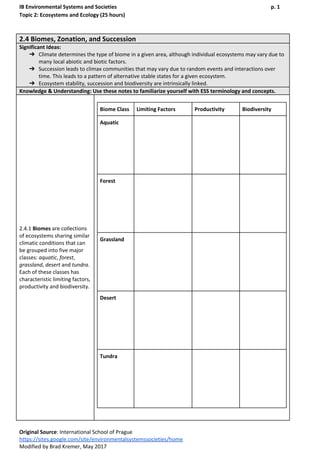
2.4.1 ​Biomes​ are collections
of ecosystems sharing similar
climatic conditions that can
be grouped into five major
classes: ​aquatic​, ​forest​,
grassland​, ​desert​ and ​tundra​.
Each of these classes has
characteristic limiting factors,
productivity and biodiversity.
Biome Class Limiting Factors Productivity Biodiversity
Aquatic
Forest
Grassland
Desert
Tundra
Original Source​: International School of Prague
https://sites.google.com/site/environmentalsystemssocieties/home
Modified by Brad Kremer, May 2017
IB Environmental Systems and Societies p. 2
Topic 2: Ecosystems and Ecology (25 hours)
2.4.2 ​Insolation,
precipitation ​and
temperature​ are the main
factors governing the
distribution of biomes.
Insolation:
Precipitation:
Temperature:
2.4.3 The ​tricellular model​ of
atmospheric circulation
explains the distribution of
precipitation and
temperature and how these
influence structure and
relative productivity of
different terrestrial biomes.
2.4.4 ​Climate change​ is
altering the distribution of
biomes and causing ​biome
shifts​.
Original Source​: International School of Prague
https://sites.google.com/site/environmentalsystemssocieties/home
Modified by Brad Kremer, May 2017
IB Environmental Systems and Societies p. 3
Topic 2: Ecosystems and Ecology (25 hours)
2.4.5 ​Zonation​ refers to
changes in community along
an environmental gradient
due to factors such as
changes in ​altitude​, ​latitude​,
tidal level​ or ​distance from
shore​ (coverage by water).
2.4.6 ​Succession​ is the
process of change over time
in an ecosystem involving
pioneer​, ​intermediate​, and
climax​ communities.
Original Source​: International School of Prague
https://sites.google.com/site/environmentalsystemssocieties/home
Modified by Brad Kremer, May 2017
IB Environmental Systems and Societies p. 4
Topic 2: Ecosystems and Ecology (25 hours)
2.4.7 During ​succession​, the
patterns of ​energy flow​,
gross and net ​productivity​,
diversity​, and ​mineral cycling
change over time.
2.4.8 Greater ​habitat
diversity​ leads to greater
species and genetic diversity.
2.4.9 ​r- and K- strategist
species have reproductive
strategies that are better
adapted to pioneer and
climax communities,
respectively.
Original Source​: International School of Prague
https://sites.google.com/site/environmentalsystemssocieties/home
Modified by Brad Kremer, May 2017
IB Environmental Systems and Societies p. 5
Topic 2: Ecosystems and Ecology (25 hours)
2.4.10 In ​early stages of
succession​, gross
productivity is low due to the
unfavorable initial conditions
and low density of produces.
The proportion of energy lost
through community
respiration is relatively low
too, so net productivity is
high—that is, the system is
growing and biomass is
accumulating.
2.4.11 In ​later stages of
succession​, with an increased
consumer community, gross
productivity may be high in a
climax community. However,
this is balanced by
respiration, so net
productivity approaches 0
and the
productivity–respiration (P :
R) ratio approaches 1.
2.4.12 In a complex
ecosystem, ​the variety of
nutrient and energy
pathways ​contributes to its
stability​.
Original Source​: International School of Prague
https://sites.google.com/site/environmentalsystemssocieties/home
Modified by Brad Kremer, May 2017
IB Environmental Systems and Societies p. 6
Topic 2: Ecosystems and Ecology (25 hours)
2.4.13 There is not one
climax community, but rather
a ​set of alternative stable
states​ for a given ecosystem.
These depend on the ​climatic
factors​, the properties of the
local soil​ and a range of
random events​ that can
occur over time.
2.4.14 ​Human activity​ is one
factor that can ​divert the
progression of succession​ to
an alternative stable state by
modifying the ecosystem; for
example, the use of fire in an
ecosystem, the use of
agriculture, grazing pressure,
or resource use (such as
deforestation). This diversion
may be more or less
permanent depending on the
resilience of the system.
2.4.15 An ​ecosystem’s
capacity to survive change
may depend on its ​diversity
and ​resilience​.
Original Source​: International School of Prague
https://sites.google.com/site/environmentalsystemssocieties/home
Modified by Brad Kremer, May 2017
IB Environmental Systems and Societies p. 7
Topic 2: Ecosystems and Ecology (25 hours)
Applications & Skills: Treat the following prompts as assessment questions on your IB ESS exam. Use the
terminology and concepts from the notes above to respond to each of these prompts.
2.4.AS1 ​Explain​ the distributions, structure, biodiversity and relative productivity of contrasting biomes.
2.4.AS2 ​Analyze​ data for a range of biomes.
Original Source​: International School of Prague
https://sites.google.com/site/environmentalsystemssocieties/home
Modified by Brad Kremer, May 2017
IB Environmental Systems and Societies p. 8
Topic 2: Ecosystems and Ecology (25 hours)
2.4.AS3 ​Discuss ​the impact of climate change on biomes.
2.4.AS4 ​Describe​ the process of succession in a given example.
2.4.AS5 ​Explain​ the general patterns of change in communities undergoing succession.
2.4.AS6 ​Discuss ​the factors which could lead to alternative stable states in an ecosystem.
Original Source​: International School of Prague
https://sites.google.com/site/environmentalsystemssocieties/home
Modified by Brad Kremer, May 2017
IB Environmental Systems and Societies p. 9
Topic 2: Ecosystems and Ecology (25 hours)
2.4.AS7 ​Discuss ​the link between ecosystem stability, succession, diversity and human activity.
2.4.AS8 ​Distinguish ​the roles of r and K selected species in succession.
2.4.AS9 ​Interpret ​models or graphs related to succession and zonation.
Original Source​: International School of Prague
https://sites.google.com/site/environmentalsystemssocieties/home
Modified by Brad Kremer, May 2017

2.4 biomes zonation and succession notes

  • 1.
    IB Environmental Systemsand Societies p. 1 Topic 2: Ecosystems and Ecology (25 hours) 2.4 Biomes, Zonation, and Succession Significant Ideas: ➔ Climate determines the type of biome in a given area, although individual ecosystems may vary due to many local abiotic and biotic factors. ➔ Succession leads to climax communities that may vary due to random events and interactions over time. This leads to a pattern of alternative stable states for a given ecosystem. ➔ Ecosystem stability, succession and biodiversity are intrinsically linked. Knowledge & Understanding: Use these notes to familiarize yourself with ESS terminology and concepts. 2.4.1 ​Biomes​ are collections of ecosystems sharing similar climatic conditions that can be grouped into five major classes: ​aquatic​, ​forest​, grassland​, ​desert​ and ​tundra​. Each of these classes has characteristic limiting factors, productivity and biodiversity. Biome Class Limiting Factors Productivity Biodiversity Aquatic Forest Grassland Desert Tundra Original Source​: International School of Prague https://sites.google.com/site/environmentalsystemssocieties/home Modified by Brad Kremer, May 2017
  • 2.
    IB Environmental Systemsand Societies p. 2 Topic 2: Ecosystems and Ecology (25 hours) 2.4.2 ​Insolation, precipitation ​and temperature​ are the main factors governing the distribution of biomes. Insolation: Precipitation: Temperature: 2.4.3 The ​tricellular model​ of atmospheric circulation explains the distribution of precipitation and temperature and how these influence structure and relative productivity of different terrestrial biomes. 2.4.4 ​Climate change​ is altering the distribution of biomes and causing ​biome shifts​. Original Source​: International School of Prague https://sites.google.com/site/environmentalsystemssocieties/home Modified by Brad Kremer, May 2017
  • 3.
    IB Environmental Systemsand Societies p. 3 Topic 2: Ecosystems and Ecology (25 hours) 2.4.5 ​Zonation​ refers to changes in community along an environmental gradient due to factors such as changes in ​altitude​, ​latitude​, tidal level​ or ​distance from shore​ (coverage by water). 2.4.6 ​Succession​ is the process of change over time in an ecosystem involving pioneer​, ​intermediate​, and climax​ communities. Original Source​: International School of Prague https://sites.google.com/site/environmentalsystemssocieties/home Modified by Brad Kremer, May 2017
  • 4.
    IB Environmental Systemsand Societies p. 4 Topic 2: Ecosystems and Ecology (25 hours) 2.4.7 During ​succession​, the patterns of ​energy flow​, gross and net ​productivity​, diversity​, and ​mineral cycling change over time. 2.4.8 Greater ​habitat diversity​ leads to greater species and genetic diversity. 2.4.9 ​r- and K- strategist species have reproductive strategies that are better adapted to pioneer and climax communities, respectively. Original Source​: International School of Prague https://sites.google.com/site/environmentalsystemssocieties/home Modified by Brad Kremer, May 2017
  • 5.
    IB Environmental Systemsand Societies p. 5 Topic 2: Ecosystems and Ecology (25 hours) 2.4.10 In ​early stages of succession​, gross productivity is low due to the unfavorable initial conditions and low density of produces. The proportion of energy lost through community respiration is relatively low too, so net productivity is high—that is, the system is growing and biomass is accumulating. 2.4.11 In ​later stages of succession​, with an increased consumer community, gross productivity may be high in a climax community. However, this is balanced by respiration, so net productivity approaches 0 and the productivity–respiration (P : R) ratio approaches 1. 2.4.12 In a complex ecosystem, ​the variety of nutrient and energy pathways ​contributes to its stability​. Original Source​: International School of Prague https://sites.google.com/site/environmentalsystemssocieties/home Modified by Brad Kremer, May 2017
  • 6.
    IB Environmental Systemsand Societies p. 6 Topic 2: Ecosystems and Ecology (25 hours) 2.4.13 There is not one climax community, but rather a ​set of alternative stable states​ for a given ecosystem. These depend on the ​climatic factors​, the properties of the local soil​ and a range of random events​ that can occur over time. 2.4.14 ​Human activity​ is one factor that can ​divert the progression of succession​ to an alternative stable state by modifying the ecosystem; for example, the use of fire in an ecosystem, the use of agriculture, grazing pressure, or resource use (such as deforestation). This diversion may be more or less permanent depending on the resilience of the system. 2.4.15 An ​ecosystem’s capacity to survive change may depend on its ​diversity and ​resilience​. Original Source​: International School of Prague https://sites.google.com/site/environmentalsystemssocieties/home Modified by Brad Kremer, May 2017
  • 7.
    IB Environmental Systemsand Societies p. 7 Topic 2: Ecosystems and Ecology (25 hours) Applications & Skills: Treat the following prompts as assessment questions on your IB ESS exam. Use the terminology and concepts from the notes above to respond to each of these prompts. 2.4.AS1 ​Explain​ the distributions, structure, biodiversity and relative productivity of contrasting biomes. 2.4.AS2 ​Analyze​ data for a range of biomes. Original Source​: International School of Prague https://sites.google.com/site/environmentalsystemssocieties/home Modified by Brad Kremer, May 2017
  • 8.
    IB Environmental Systemsand Societies p. 8 Topic 2: Ecosystems and Ecology (25 hours) 2.4.AS3 ​Discuss ​the impact of climate change on biomes. 2.4.AS4 ​Describe​ the process of succession in a given example. 2.4.AS5 ​Explain​ the general patterns of change in communities undergoing succession. 2.4.AS6 ​Discuss ​the factors which could lead to alternative stable states in an ecosystem. Original Source​: International School of Prague https://sites.google.com/site/environmentalsystemssocieties/home Modified by Brad Kremer, May 2017
  • 9.
    IB Environmental Systemsand Societies p. 9 Topic 2: Ecosystems and Ecology (25 hours) 2.4.AS7 ​Discuss ​the link between ecosystem stability, succession, diversity and human activity. 2.4.AS8 ​Distinguish ​the roles of r and K selected species in succession. 2.4.AS9 ​Interpret ​models or graphs related to succession and zonation. Original Source​: International School of Prague https://sites.google.com/site/environmentalsystemssocieties/home Modified by Brad Kremer, May 2017