Light :
MIRRORS AND LENSES
“How do you see yourself in a
mirror? How do you compare the
way you look and the way your
imagelook?
COMPETENCY AND OBJECTIVES
1. Predict the qualitative characteristics like
orientation, type, and magnification of images formed
by plane and curved mirrors and lenses
2. Compare the angle of reflection and the angle of
incidence
3. Understand the laws of reflection and relate it to
real life activities
REFLECTION
- is the bouncing of light rays when it hits a
surface like a plane mirror
PLANE MIRROR
- a polished or smooth surface (as of glass) that
forms images by reflection
- exhibits regular reflection where the angle of
incidence is equal to the angle of reflection.
Reflection Vocabulary
Real Image –
◦Image is made from “real” light rays that
converge at a real focal point so the image is
REAL
◦Can be projected onto a screen because light
actually passes through the point where the
image appears
◦Always inverted
Virtual Image–
◦“Not Real” because it cannot be projected
◦Image only seems to be there!
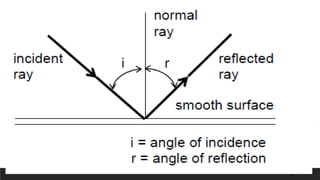
Incident Ray– the ray of light approaching the mirror
represented by an arrow approaching an optical element
element like mirrors
Reflected Ray– the ray of light which leaves the mirror
and is represented by an arrow pointing away from the
mirror
Normal Line– an imaginary line that can be drawn
perpendicular to the surface of the mirror at the point of
of incidence where the ray strikes the mirror
8
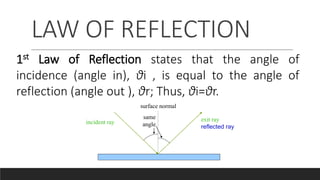
LAW OF REFLECTION
1st Law of Reflection states that the angle of
incidence (angle in), θi , is equal to the angle of
reflection (angle out ), θr; Thus, θi=θr.
surface normal
same
angle
incident ray exit ray
reflected ray
2nd Law of Reflection states the incident ray, the
reflected ray, and the normal line all lie in the
same plane. That means, what you see on the
mirror is an image which appears to be at the
back of the mirror.
10
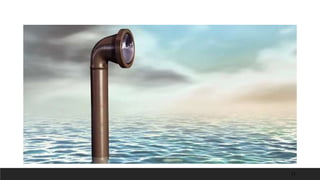
Periscope
- An optical device consisting of a tube attached to a
set of mirrors or prisms, through which an observer
(typically in a submerged submarine or behind a high
obstacle) can see things that are otherwise out of
sight
11
LEFT- RIGHT REVERSAL
Lateral inversion
It is a phenomenon wherein what is left on the
object appears as right on the image and vice
versa.
The number of images can be determined using the
formula:
N = (360/angle between the mirror) – 1
*The lower the angle, the higher the number of
images formed.
UCSD: PHYSICS 8; 2006 15
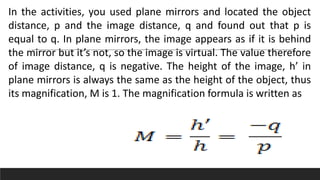
In the activities, you used plane mirrors and located the object
distance, p and the image distance, q and found out that p is
equal to q. In plane mirrors, the image appears as if it is behind
the mirror but it’s not, so the image is virtual. The value therefore
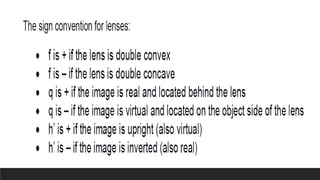
of image distance, q is negative. The height of the image, h’ in
plane mirrors is always the same as the height of the object, thus
its magnification, M is 1. The magnification formula is written as
Types of Reflection
Spring 2006 17
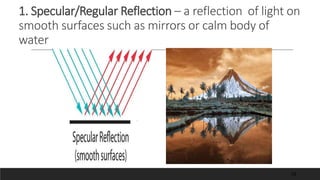
1. Specular/Regular Reflection – a reflection of light on
smooth surfaces such as mirrors or calm body of
water
18
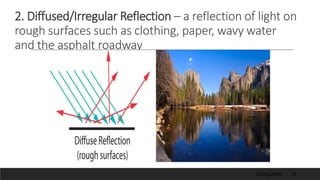
2. Diffused/Irregular Reflection – a reflection of light on
rough surfaces such as clothing, paper, wavy water
and the asphalt roadway
Spring 2006 19
20
Choose the letter only.
1. It is a polished or smooth surface that forms images by
reflection.
A. Convex Mirror C. Plane Mirror
B. Concave Mirror D. Lens
2. It is an optical device consisting of a tube attached to a set of
mirrors or prisms, through which an observer can see things
that are otherwise out of sight.
A. Microscope C. Rearview Mirror
B. Camera D. Periscope
21
3. It refers to the bending of light when passing obliquely
from one medium to another.
A. Reflection C. Dispersion
B. Refraction D. Extraction
4. What is the type of reflection on smooth surfaces?
A. Regular Reflection C. Spectacular
B. Diffused Reflection D. Irregular
22
5. How many images are formed in two plane mirrors at an
angle of 90 degrees?
A. 3 B. 4 C. 5 D. 6
6. Which of the following is not a law of reflection?
A. The incident ray, the reflected ray, and the normal line all lie
in the same plane.
B. The angle of incidence is equal to the angle of reflection.
C. The normal line, angle of incidence and angle of reflection
are equal to each other.
D. A and B
23
7. In the magnification formula, the p refers to.
A. Height of object C. Height of image
B. Distance of object D. distance of image
8. Which is true about a REAL image?
A. It cannot be projected
B. Image only seems to be there.
C. It is always inverted.
D. All of these
24
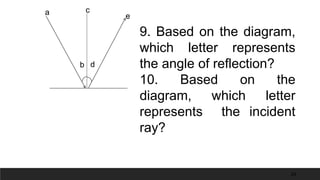
c
a
b d
e
9. Based on the diagram,
which letter represents
the angle of reflection?
10. Based on the
diagram, which letter
represents the incident
ray?
Light :
MIRRORS AND LENSES
REVIEW
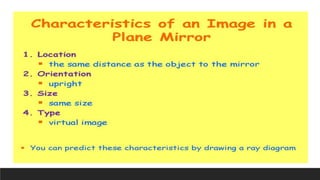
1. What is the Location, Orientation, Size,
and Type of image formed in plane mirrors?
2. What are the rays/lines found in the Plane
Mirrors?
READ ALOUD THE OBJECTIVES
1. I will be able to define the types of curved
mirrors
2. I will be able to construct ray diagrams to
describe the images formed by curved mirrors
3. I will be able to appreciate the importance of
curved mirrors
Get a spoon and
observe your image in
both sides of the spoon.
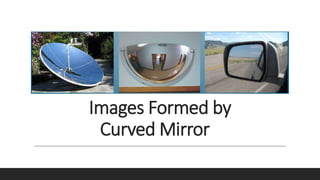
Images Formed by
Curved Mirror
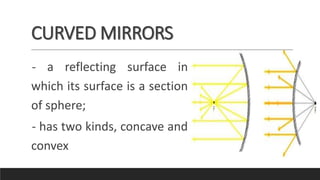
CURVED MIRRORS
- a reflecting surface in
which its surface is a section
of sphere;
- has two kinds, concave and
convex
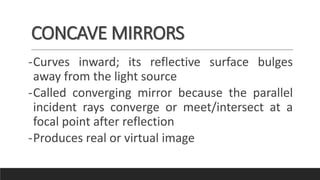
CONCAVE MIRRORS
-Curves inward; its reflective surface bulges
away from the light source
-Called converging mirror because the parallel
incident rays converge or meet/intersect at a
focal point after reflection
-Produces real or virtual image
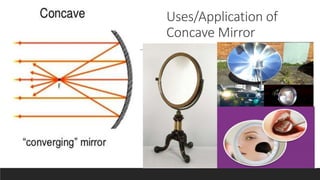
Uses/Application of
Concave Mirror
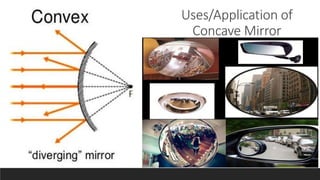
CONVEX MIRROR
-Curves outward; its reflective surface bulges
towards the light source
-Also called diverging mirrors because the
parallel incident rays diverge after reflection
-Produces Virtual images
Uses/Application of
Concave Mirror
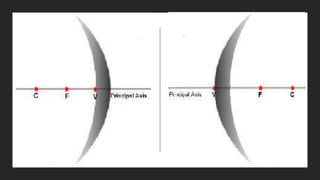
Points to Consider in Curved Mirrors
1. Center of Curvature (C) – the center of the sphere of
which the mirror is part. Its distance from the mirror is
known as the radius (R).
2. Vertex (V) – the center of the mirror
3. Focal Point/Focus (F) – the point between the center of
curvature and vertex. Its distance from the mirror is
known as the focal length (f)
35
RAY DIAGRAM
- determines the general location, size,
orientation, and type of image formed by
concave mirrors
- have been a valuable tool for determining
the path taken by light from the object to the
mirror to our eyes
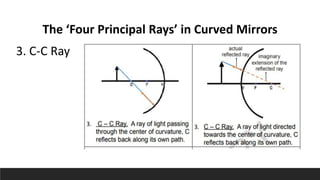
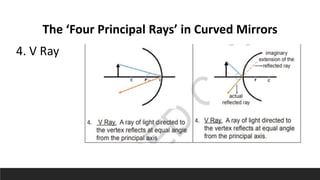
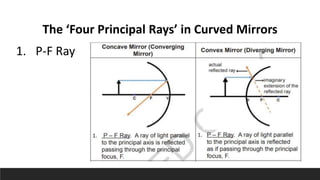
The ‘Four Principal Rays’ in Curved Mirrors
1. P-F Ray
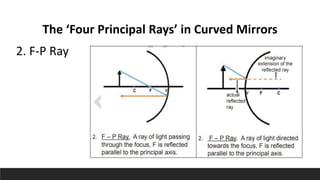
The ‘Four Principal Rays’ in Curved Mirrors
2. F-P Ray
The ‘Four Principal Rays’ in Curved Mirrors
3. C-C Ray
The ‘Four Principal Rays’ in Curved Mirrors
4. V Ray
ACTIVITY
L-O-S-T
AFTER REFLECTION
Think about this…
Means of Transportation like bus, jeepney,
taxi, private cars has designed mirrors.
These installed mirrors are what we know
as rear view and side mirrors. What do you
think are the uses of these mirrors in
relation to traffic at the same time to prevent
road accidents?
EVALUATION
Write the letter only.
1. What type of curved mirror is a diverging
mirror?
A. Concave C. Plane
B. Convex D. Lens
2. It is a curved mirror used by dentists
because it gives a magnified reflection of the
mouth?
A. Concave C. Plane
B. Convex D. Lens
3. What type of image is an inverted image?
A. Virtual C. Real
B. Fake D. Illusion
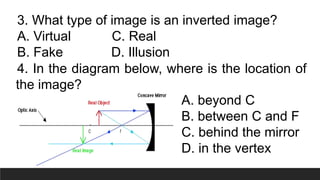
4. In the diagram below, where is the location of
the image?
A. beyond C
B. between C and F
C. behind the mirror
D. in the vertex
5. Why do most of the department stores use convex
mirrors?
A. Convex mirror magnifies the image.
B. Convex mirror makes enlarged reflection.
C. Convex mirror has converging light rays.
D. Convex mirror gives a wider range of view.
Refraction
The bending of light when it travels from one
medium to another of different optical
densities.
Light also goes through some things like glass,
water, eyeball, air
LENS
- a transparent material made of glass or plastic that refracts light rays
and focuses them at a point Some devices which use lenses are cameras,
binoculars, telescopes and microscopes. It has two kinds:
a. Converging lens (convex) which is thicker at the middle than at the
edge
b. Diverging lens (concave) which is thicker at the edge than at the
middle
50
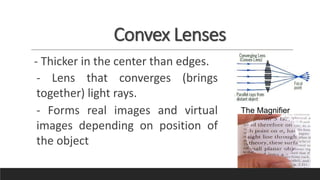
Convex Lenses
- Thicker in the center than edges.
- Lens that converges (brings
together) light rays.
- Forms real images and virtual
images depending on position of
the object
The Magnifier
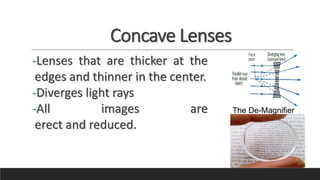
Concave Lenses
-Lenses that are thicker at the
edges and thinner in the center.
-Diverges light rays
-All images are
erect and reduced.
The De-Magnifier
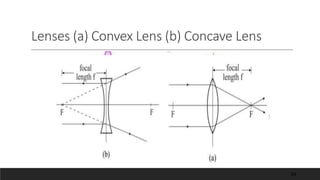
Points to Consider in Lenses
1. Vertex (V) – the geometric center of the lens
2. Focal Point/Focus (F) – a point where light rays pass
though a lens
Focal Length - the distance from the principal focus to
the center of the
53
Lenses (a) Convex Lens (b) Concave Lens
54
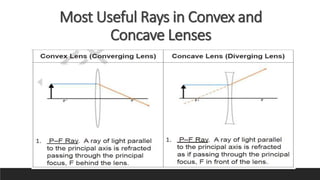
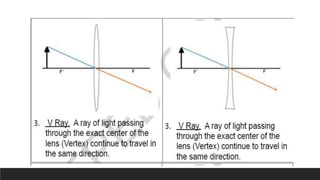
Most Useful Rays in Convex and
Concave Lenses
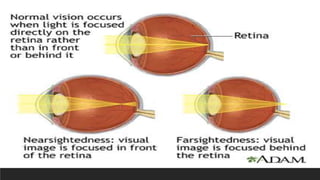
The lens of your eye is a convex lens.
In certain cases, the image falls in front of the retina
because the eyeball is too long. This is called near
sightedness. The lens of a near sighted person is too
convex. A concave lens is used to correct near
sightedness.
If the eyeball is too short, the image is focused behind the
retina. This condition is called farsightedness. The lens of
a farsighted person is not convex enough. The rays of
light converge at a point behind the retina. A convex lens
is used to correct farsightedness.
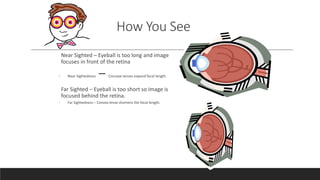
How You See
Near Sighted – Eyeball is too long and image
focuses in front of the retina
◦ Near Sightedness – Concave lenses expand focal length
Far Sighted – Eyeball is too short so image is
focused behind the retina.
◦ Far Sightedness – Convex lense shortens the focal length.
..Quarter 2 Modules
Write the letter only.
1. Lens is a transparent material made of glass or plastic that
_______ light rays and focuses them at a point.
a. Reflect c. Refracts
b. Diffracts d. Distracts
2. It refers to the distance between the Principal focus and
vertex.
a. Axis c. Focal Point
b. Focal length d. Center of curvature
UCSD: PHYSICS 8; 2006 61
3. What type of lens is a converging lens?
a. Concave lens c. Convex lens
b. Plane lens d. Glass lens
4. It is a ray of light passing through the exact center of the lens and continues to travel
in the same direction.
a. P-F Ray c. F-P Ray
b. C-C Ray d. V Ray
5. What kind of lens will always form a virtual, erect and smaller image?
a. Concave lens c. Convex lens
b. Plane lens d. Glass lens
62
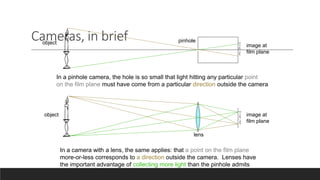
Cameras, in brief
In a pinhole camera, the hole is so small that light hitting any particular point
on the film plane must have come from a particular direction outside the camera
In a camera with a lens, the same applies: that a point on the film plane
more-or-less corresponds to a direction outside the camera. Lenses have
the important advantage of collecting more light than the pinhole admits
pinhole
image at
film plane
object
image at
film plane
object
lens
Thank You for Listening

Light - Mirrors and Lenses.pptx

  • 1.
  • 2.
    “How do yousee yourself in a mirror? How do you compare the way you look and the way your imagelook?
  • 3.
    COMPETENCY AND OBJECTIVES 1.Predict the qualitative characteristics like orientation, type, and magnification of images formed by plane and curved mirrors and lenses 2. Compare the angle of reflection and the angle of incidence 3. Understand the laws of reflection and relate it to real life activities
  • 4.
    REFLECTION - is thebouncing of light rays when it hits a surface like a plane mirror
  • 5.
    PLANE MIRROR - apolished or smooth surface (as of glass) that forms images by reflection - exhibits regular reflection where the angle of incidence is equal to the angle of reflection.
  • 6.
    Reflection Vocabulary Real Image– ◦Image is made from “real” light rays that converge at a real focal point so the image is REAL ◦Can be projected onto a screen because light actually passes through the point where the image appears ◦Always inverted
  • 7.
    Virtual Image– ◦“Not Real”because it cannot be projected ◦Image only seems to be there!
  • 8.
    Incident Ray– theray of light approaching the mirror represented by an arrow approaching an optical element element like mirrors Reflected Ray– the ray of light which leaves the mirror and is represented by an arrow pointing away from the mirror Normal Line– an imaginary line that can be drawn perpendicular to the surface of the mirror at the point of of incidence where the ray strikes the mirror 8
  • 9.
    LAW OF REFLECTION 1stLaw of Reflection states that the angle of incidence (angle in), θi , is equal to the angle of reflection (angle out ), θr; Thus, θi=θr. surface normal same angle incident ray exit ray reflected ray
  • 10.
    2nd Law ofReflection states the incident ray, the reflected ray, and the normal line all lie in the same plane. That means, what you see on the mirror is an image which appears to be at the back of the mirror. 10
  • 11.
    Periscope - An opticaldevice consisting of a tube attached to a set of mirrors or prisms, through which an observer (typically in a submerged submarine or behind a high obstacle) can see things that are otherwise out of sight 11
  • 13.
  • 14.
    Lateral inversion It isa phenomenon wherein what is left on the object appears as right on the image and vice versa.
  • 15.
    The number ofimages can be determined using the formula: N = (360/angle between the mirror) – 1 *The lower the angle, the higher the number of images formed. UCSD: PHYSICS 8; 2006 15
  • 16.
    In the activities,you used plane mirrors and located the object distance, p and the image distance, q and found out that p is equal to q. In plane mirrors, the image appears as if it is behind the mirror but it’s not, so the image is virtual. The value therefore of image distance, q is negative. The height of the image, h’ in plane mirrors is always the same as the height of the object, thus its magnification, M is 1. The magnification formula is written as
  • 17.
  • 18.
    1. Specular/Regular Reflection– a reflection of light on smooth surfaces such as mirrors or calm body of water 18
  • 19.
    2. Diffused/Irregular Reflection– a reflection of light on rough surfaces such as clothing, paper, wavy water and the asphalt roadway Spring 2006 19
  • 20.
    20 Choose the letteronly. 1. It is a polished or smooth surface that forms images by reflection. A. Convex Mirror C. Plane Mirror B. Concave Mirror D. Lens 2. It is an optical device consisting of a tube attached to a set of mirrors or prisms, through which an observer can see things that are otherwise out of sight. A. Microscope C. Rearview Mirror B. Camera D. Periscope
  • 21.
    21 3. It refersto the bending of light when passing obliquely from one medium to another. A. Reflection C. Dispersion B. Refraction D. Extraction 4. What is the type of reflection on smooth surfaces? A. Regular Reflection C. Spectacular B. Diffused Reflection D. Irregular
  • 22.
    22 5. How manyimages are formed in two plane mirrors at an angle of 90 degrees? A. 3 B. 4 C. 5 D. 6 6. Which of the following is not a law of reflection? A. The incident ray, the reflected ray, and the normal line all lie in the same plane. B. The angle of incidence is equal to the angle of reflection. C. The normal line, angle of incidence and angle of reflection are equal to each other. D. A and B
  • 23.
    23 7. In themagnification formula, the p refers to. A. Height of object C. Height of image B. Distance of object D. distance of image 8. Which is true about a REAL image? A. It cannot be projected B. Image only seems to be there. C. It is always inverted. D. All of these
  • 24.
    24 c a b d e 9. Basedon the diagram, which letter represents the angle of reflection? 10. Based on the diagram, which letter represents the incident ray?
  • 25.
  • 26.
    REVIEW 1. What isthe Location, Orientation, Size, and Type of image formed in plane mirrors? 2. What are the rays/lines found in the Plane Mirrors?
  • 27.
    READ ALOUD THEOBJECTIVES 1. I will be able to define the types of curved mirrors 2. I will be able to construct ray diagrams to describe the images formed by curved mirrors 3. I will be able to appreciate the importance of curved mirrors
  • 28.
    Get a spoonand observe your image in both sides of the spoon.
  • 29.
  • 30.
    CURVED MIRRORS - areflecting surface in which its surface is a section of sphere; - has two kinds, concave and convex
  • 31.
    CONCAVE MIRRORS -Curves inward;its reflective surface bulges away from the light source -Called converging mirror because the parallel incident rays converge or meet/intersect at a focal point after reflection -Produces real or virtual image
  • 32.
  • 33.
    CONVEX MIRROR -Curves outward;its reflective surface bulges towards the light source -Also called diverging mirrors because the parallel incident rays diverge after reflection -Produces Virtual images
  • 34.
  • 35.
    Points to Considerin Curved Mirrors 1. Center of Curvature (C) – the center of the sphere of which the mirror is part. Its distance from the mirror is known as the radius (R). 2. Vertex (V) – the center of the mirror 3. Focal Point/Focus (F) – the point between the center of curvature and vertex. Its distance from the mirror is known as the focal length (f) 35
  • 37.
    RAY DIAGRAM - determinesthe general location, size, orientation, and type of image formed by concave mirrors - have been a valuable tool for determining the path taken by light from the object to the mirror to our eyes
  • 38.
    The ‘Four PrincipalRays’ in Curved Mirrors 1. P-F Ray
  • 39.
    The ‘Four PrincipalRays’ in Curved Mirrors 2. F-P Ray
  • 40.
    The ‘Four PrincipalRays’ in Curved Mirrors 3. C-C Ray
  • 41.
    The ‘Four PrincipalRays’ in Curved Mirrors 4. V Ray
  • 42.
  • 44.
    Think about this… Meansof Transportation like bus, jeepney, taxi, private cars has designed mirrors. These installed mirrors are what we know as rear view and side mirrors. What do you think are the uses of these mirrors in relation to traffic at the same time to prevent road accidents?
  • 45.
  • 46.
    1. What typeof curved mirror is a diverging mirror? A. Concave C. Plane B. Convex D. Lens 2. It is a curved mirror used by dentists because it gives a magnified reflection of the mouth? A. Concave C. Plane B. Convex D. Lens
  • 47.
    3. What typeof image is an inverted image? A. Virtual C. Real B. Fake D. Illusion 4. In the diagram below, where is the location of the image? A. beyond C B. between C and F C. behind the mirror D. in the vertex
  • 48.
    5. Why domost of the department stores use convex mirrors? A. Convex mirror magnifies the image. B. Convex mirror makes enlarged reflection. C. Convex mirror has converging light rays. D. Convex mirror gives a wider range of view.
  • 49.
    Refraction The bending oflight when it travels from one medium to another of different optical densities. Light also goes through some things like glass, water, eyeball, air
  • 50.
    LENS - a transparentmaterial made of glass or plastic that refracts light rays and focuses them at a point Some devices which use lenses are cameras, binoculars, telescopes and microscopes. It has two kinds: a. Converging lens (convex) which is thicker at the middle than at the edge b. Diverging lens (concave) which is thicker at the edge than at the middle 50
  • 51.
    Convex Lenses - Thickerin the center than edges. - Lens that converges (brings together) light rays. - Forms real images and virtual images depending on position of the object The Magnifier
  • 52.
    Concave Lenses -Lenses thatare thicker at the edges and thinner in the center. -Diverges light rays -All images are erect and reduced. The De-Magnifier
  • 53.
    Points to Considerin Lenses 1. Vertex (V) – the geometric center of the lens 2. Focal Point/Focus (F) – a point where light rays pass though a lens Focal Length - the distance from the principal focus to the center of the 53
  • 54.
    Lenses (a) ConvexLens (b) Concave Lens 54
  • 55.
    Most Useful Raysin Convex and Concave Lenses
  • 57.
    The lens ofyour eye is a convex lens. In certain cases, the image falls in front of the retina because the eyeball is too long. This is called near sightedness. The lens of a near sighted person is too convex. A concave lens is used to correct near sightedness. If the eyeball is too short, the image is focused behind the retina. This condition is called farsightedness. The lens of a farsighted person is not convex enough. The rays of light converge at a point behind the retina. A convex lens is used to correct farsightedness.
  • 58.
    How You See NearSighted – Eyeball is too long and image focuses in front of the retina ◦ Near Sightedness – Concave lenses expand focal length Far Sighted – Eyeball is too short so image is focused behind the retina. ◦ Far Sightedness – Convex lense shortens the focal length.
  • 60.
  • 61.
    Write the letteronly. 1. Lens is a transparent material made of glass or plastic that _______ light rays and focuses them at a point. a. Reflect c. Refracts b. Diffracts d. Distracts 2. It refers to the distance between the Principal focus and vertex. a. Axis c. Focal Point b. Focal length d. Center of curvature UCSD: PHYSICS 8; 2006 61
  • 62.
    3. What typeof lens is a converging lens? a. Concave lens c. Convex lens b. Plane lens d. Glass lens 4. It is a ray of light passing through the exact center of the lens and continues to travel in the same direction. a. P-F Ray c. F-P Ray b. C-C Ray d. V Ray 5. What kind of lens will always form a virtual, erect and smaller image? a. Concave lens c. Convex lens b. Plane lens d. Glass lens 62
  • 63.
    Cameras, in brief Ina pinhole camera, the hole is so small that light hitting any particular point on the film plane must have come from a particular direction outside the camera In a camera with a lens, the same applies: that a point on the film plane more-or-less corresponds to a direction outside the camera. Lenses have the important advantage of collecting more light than the pinhole admits pinhole image at film plane object image at film plane object lens
  • 64.
    Thank You forListening

Editor's Notes