IB Environmental Systems and Societies p. 1
Topic 1: Foundations of environmental systems and societies (16 hours)
1.4 Sustainability
Significant Ideas:
➔ All systems can be viewed through the lens of sustainability.
➔ Sustainable development meets the needs of the present without compromising the ability of future
generations to meet their own needs.
➔ Environmental indicators and ecological footprints can be used to assess development.
➔ Environmental impact assessments (EISs) play an important role in sustainable development.
Knowledge & Understanding: Use these notes to familiarize yourself with ESS terminology and concepts.
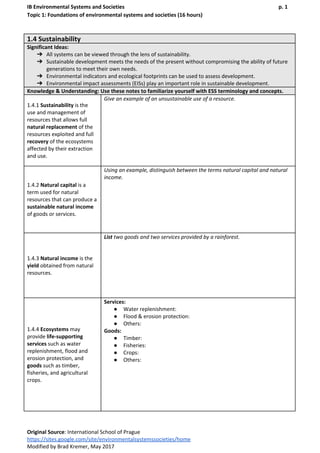
1.4.1 ​Sustainability​ is the
use and management of
resources that allows full
natural replacement​ of the
resources exploited and full
recovery​ of the ecosystems
affected by their extraction
and use.
Give an example of an unsustainable use of a resource.
1.4.2 ​Natural capital​ is a
term used for natural
resources that can produce a
sustainable natural income
of goods or services.
Using an example, distinguish between the terms natural capital and natural
income.
1.4.3 ​Natural income​ is the
yield​ obtained from natural
resources.
List​ two goods and two services provided by a rainforest.
1.4.4 ​Ecosystems​ may
provide ​life-supporting
services​ such as water
replenishment, flood and
erosion protection, and
goods​ such as timber,
fisheries, and agricultural
crops.
Services:
● Water replenishment:
● Flood & erosion protection:
● Others:
Goods:
● Timber:
● Fisheries:
● Crops:
● Others:
Original Source​: International School of Prague
https://sites.google.com/site/environmentalsystemssocieties/home
Modified by Brad Kremer, May 2017
IB Environmental Systems and Societies p. 2
Topic 1: Foundations of environmental systems and societies (16 hours)
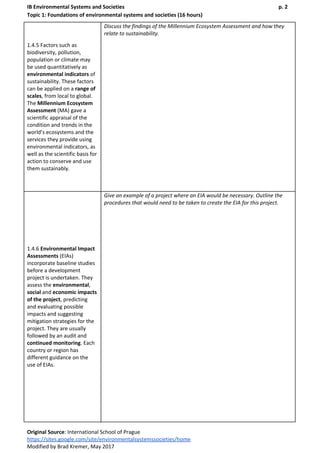
1.4.5 Factors such as
biodiversity, pollution,
population or climate may
be used quantitatively as
environmental indicators​ of
sustainability. These factors
can be applied on a ​range of
scales​, from local to global.
The ​Millennium Ecosystem
Assessment​ (MA) gave a
scientific appraisal of the
condition and trends in the
world’s ecosystems and the
services they provide using
environmental indicators, as
well as the scientific basis for
action to conserve and use
them sustainably.
Discuss the findings of the Millennium Ecosystem Assessment and how they
relate to sustainability.
1.4.6 ​Environmental Impact
Assessments​ (EIAs)
incorporate baseline studies
before a development
project is undertaken. They
assess the ​environmental​,
social​ and ​economic impacts
of the project​, predicting
and evaluating possible
impacts and suggesting
mitigation strategies for the
project. They are usually
followed by an audit and
continued monitoring​. Each
country or region has
different guidance on the
use of EIAs.
Give an example of a project where an EIA would be necessary. Outline the
procedures that would need to be taken to create the EIA for this project.
Original Source​: International School of Prague
https://sites.google.com/site/environmentalsystemssocieties/home
Modified by Brad Kremer, May 2017
IB Environmental Systems and Societies p. 3
Topic 1: Foundations of environmental systems and societies (16 hours)
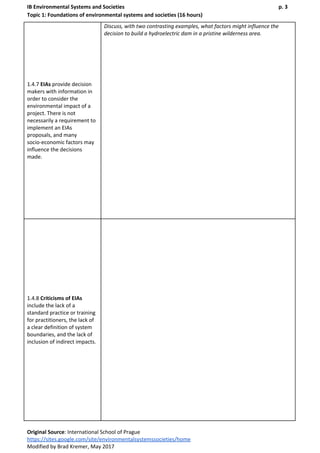
1.4.7 ​EIAs​ provide decision
makers with information in
order to consider the
environmental impact of a
project. There is not
necessarily a requirement to
implement an EIAs
proposals, and many
socio-economic factors may
influence the decisions
made.
Discuss, with two contrasting examples, what factors might influence the
decision to build a hydroelectric dam in a pristine wilderness area.
1.4.8 ​Criticisms of EIAs
include the lack of a
standard practice or training
for practitioners, the lack of
a clear definition of system
boundaries, and the lack of
inclusion of indirect impacts.
Original Source​: International School of Prague
https://sites.google.com/site/environmentalsystemssocieties/home
Modified by Brad Kremer, May 2017
IB Environmental Systems and Societies p. 4
Topic 1: Foundations of environmental systems and societies (16 hours)
1.4.9 An ​ecological footprint
(EF) is the area of land and
water required to
sustainably provide all
resources at the rate at
which they are being
consumed by a given
population. Where the EF is
greater than the area
available to the population,
this is an indication of
unsustainability​.
Compare and contrast the EFs of MEDCs and LEDCs.
Original Source​: International School of Prague
https://sites.google.com/site/environmentalsystemssocieties/home
Modified by Brad Kremer, May 2017
IB Environmental Systems and Societies p. 5
Topic 1: Foundations of environmental systems and societies (16 hours)
Applications & Skills: Treat the following prompts as assessment questions on your IB ESS exam. Use the
terminology and concepts from the notes above to respond to each of these prompts
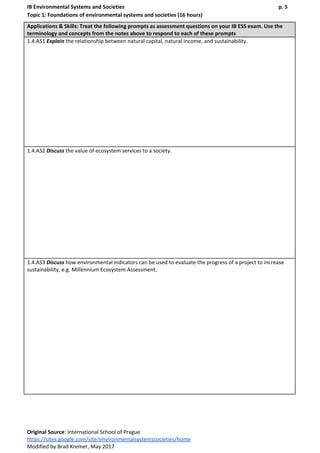
1.4.AS1 ​Explain​ the relationship between natural capital, natural income, and sustainability.
1.4.AS2 ​Discuss​ the value of ecosystem services to a society.
1.4.AS3 ​Discuss​ ​how environmental indicators can be used to evaluate the progress of a project to increase
sustainability, e.g. Millennium Ecosystem Assessment.
Original Source​: International School of Prague
https://sites.google.com/site/environmentalsystemssocieties/home
Modified by Brad Kremer, May 2017
IB Environmental Systems and Societies p. 6
Topic 1: Foundations of environmental systems and societies (16 hours)
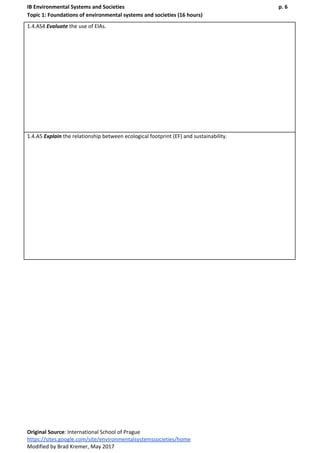
1.4.AS4 ​Evaluate​ ​the use of EIAs.
1.4.A5 ​Explain​ ​the relationship between ecological footprint (EF) and sustainability.
Original Source​: International School of Prague
https://sites.google.com/site/environmentalsystemssocieties/home
Modified by Brad Kremer, May 2017

1.4 sustainability notes

  • 1.
    IB Environmental Systemsand Societies p. 1 Topic 1: Foundations of environmental systems and societies (16 hours) 1.4 Sustainability Significant Ideas: ➔ All systems can be viewed through the lens of sustainability. ➔ Sustainable development meets the needs of the present without compromising the ability of future generations to meet their own needs. ➔ Environmental indicators and ecological footprints can be used to assess development. ➔ Environmental impact assessments (EISs) play an important role in sustainable development. Knowledge & Understanding: Use these notes to familiarize yourself with ESS terminology and concepts. 1.4.1 ​Sustainability​ is the use and management of resources that allows full natural replacement​ of the resources exploited and full recovery​ of the ecosystems affected by their extraction and use. Give an example of an unsustainable use of a resource. 1.4.2 ​Natural capital​ is a term used for natural resources that can produce a sustainable natural income of goods or services. Using an example, distinguish between the terms natural capital and natural income. 1.4.3 ​Natural income​ is the yield​ obtained from natural resources. List​ two goods and two services provided by a rainforest. 1.4.4 ​Ecosystems​ may provide ​life-supporting services​ such as water replenishment, flood and erosion protection, and goods​ such as timber, fisheries, and agricultural crops. Services: ● Water replenishment: ● Flood & erosion protection: ● Others: Goods: ● Timber: ● Fisheries: ● Crops: ● Others: Original Source​: International School of Prague https://sites.google.com/site/environmentalsystemssocieties/home Modified by Brad Kremer, May 2017
  • 2.
    IB Environmental Systemsand Societies p. 2 Topic 1: Foundations of environmental systems and societies (16 hours) 1.4.5 Factors such as biodiversity, pollution, population or climate may be used quantitatively as environmental indicators​ of sustainability. These factors can be applied on a ​range of scales​, from local to global. The ​Millennium Ecosystem Assessment​ (MA) gave a scientific appraisal of the condition and trends in the world’s ecosystems and the services they provide using environmental indicators, as well as the scientific basis for action to conserve and use them sustainably. Discuss the findings of the Millennium Ecosystem Assessment and how they relate to sustainability. 1.4.6 ​Environmental Impact Assessments​ (EIAs) incorporate baseline studies before a development project is undertaken. They assess the ​environmental​, social​ and ​economic impacts of the project​, predicting and evaluating possible impacts and suggesting mitigation strategies for the project. They are usually followed by an audit and continued monitoring​. Each country or region has different guidance on the use of EIAs. Give an example of a project where an EIA would be necessary. Outline the procedures that would need to be taken to create the EIA for this project. Original Source​: International School of Prague https://sites.google.com/site/environmentalsystemssocieties/home Modified by Brad Kremer, May 2017
  • 3.
    IB Environmental Systemsand Societies p. 3 Topic 1: Foundations of environmental systems and societies (16 hours) 1.4.7 ​EIAs​ provide decision makers with information in order to consider the environmental impact of a project. There is not necessarily a requirement to implement an EIAs proposals, and many socio-economic factors may influence the decisions made. Discuss, with two contrasting examples, what factors might influence the decision to build a hydroelectric dam in a pristine wilderness area. 1.4.8 ​Criticisms of EIAs include the lack of a standard practice or training for practitioners, the lack of a clear definition of system boundaries, and the lack of inclusion of indirect impacts. Original Source​: International School of Prague https://sites.google.com/site/environmentalsystemssocieties/home Modified by Brad Kremer, May 2017
  • 4.
    IB Environmental Systemsand Societies p. 4 Topic 1: Foundations of environmental systems and societies (16 hours) 1.4.9 An ​ecological footprint (EF) is the area of land and water required to sustainably provide all resources at the rate at which they are being consumed by a given population. Where the EF is greater than the area available to the population, this is an indication of unsustainability​. Compare and contrast the EFs of MEDCs and LEDCs. Original Source​: International School of Prague https://sites.google.com/site/environmentalsystemssocieties/home Modified by Brad Kremer, May 2017
  • 5.
    IB Environmental Systemsand Societies p. 5 Topic 1: Foundations of environmental systems and societies (16 hours) Applications & Skills: Treat the following prompts as assessment questions on your IB ESS exam. Use the terminology and concepts from the notes above to respond to each of these prompts 1.4.AS1 ​Explain​ the relationship between natural capital, natural income, and sustainability. 1.4.AS2 ​Discuss​ the value of ecosystem services to a society. 1.4.AS3 ​Discuss​ ​how environmental indicators can be used to evaluate the progress of a project to increase sustainability, e.g. Millennium Ecosystem Assessment. Original Source​: International School of Prague https://sites.google.com/site/environmentalsystemssocieties/home Modified by Brad Kremer, May 2017
  • 6.
    IB Environmental Systemsand Societies p. 6 Topic 1: Foundations of environmental systems and societies (16 hours) 1.4.AS4 ​Evaluate​ ​the use of EIAs. 1.4.A5 ​Explain​ ​the relationship between ecological footprint (EF) and sustainability. Original Source​: International School of Prague https://sites.google.com/site/environmentalsystemssocieties/home Modified by Brad Kremer, May 2017