GOOD
MORNING!
At the end of the lesson the learner will able
to:
a) Define what is mutation;
b)Identify the two categories of mutations.
c) Make an essay regarding the advantage and disadvantages
of mutations.
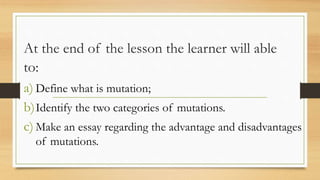
WHAT IS
MUTATION?
WHAT IS MUTATION?
• mutations are changes made to an orgasnism’s
genetic material.
• changes may be due to errors in replication, errors
during transcription, radiation, viruses and many
other things.
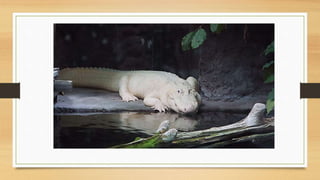
IS MUTATION CAN
BE GOOD AND
BAD?
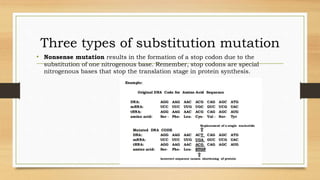
Three types of substitution mutation
• Nonsense mutation results in the formation of a stop codon due to the
substitution of one nitrogenous base. Remember, stop codons are special
nitrogenous bases that stop the translation stage in protein synthesis.
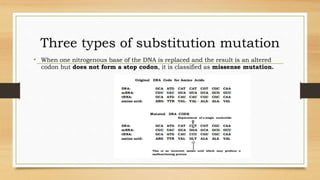
Three types of substitution mutation
• When one nitrogenous base of the DNA is replaced and the result is an altered
codon but does not form a stop codon, it is classified as missense mutation.
Three types of substitution mutation
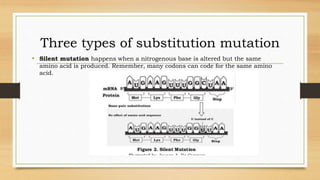
• Silent mutation happens when a nitrogenous base is altered but the same
amino acid is produced. Remember, many codons can code for the same amino
acid.
MUTAGENS- are agents that cause alteration in the
DNA and can lead to permanent mutations in the
DNA sequence depending on the ability of an
organism to repair the damage.
Example: Toxic chemicals, harmful radiation, and
infectious agents.
TWO MAJOR CATEGORIES OF MUTATIONS:
Germline Mutations- Germline Mutations occur in gametes. These
mutations are especially significant because they can be transmitted to
offspring and every cell in the offspring will have the mutation.
Somatic Mutations- Somatic mutations occur in other cells of the
body. These mutations may have little effect on the organism because
they are confined to just one cell and its daughter cells. Somatic
mutations cannot be passed on to offspring.
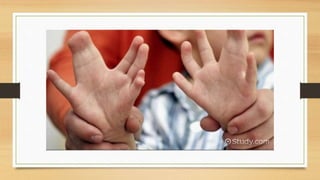
Some mutations in the body cells known to
cause cancer. While mutations in
reproductive cells cause birth defects and
if the mutation is severe, embryo may not
be developing.
3 TYPES OF GENE MUTATIONS:
• BASE SUBSTITUTION- the simplest type of gene mutation because only
one base in the sequence is substituted/replace by another, so only one
codon is affected.
• DELETION- there is one or more base deleted in the sequence. A deletion
of one or more codons results in a protein missing one or more amino
acids.
• INSERTION- happened when a base is added in the sequence.
CHROMOSOMAL MUTATIONS
• Chromosomal alterations are mutations that change chromosome
structure. Normally, Zygote carries 46 chromosomes, 23
chromosomes from the sperm cell and 23 from the egg cell. Any
excess or lack of this number may result to changes in structure
and function of a protein. In most cases these problems may
cause problems in the development and function of the body
system.
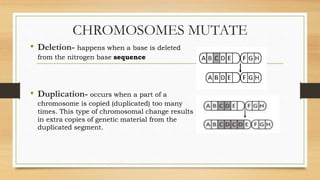
CHROMOSOMES MUTATE
• Deletion- happens when a base is deleted
from the nitrogen base sequence
• Duplication- occurs when a part of a
chromosome is copied (duplicated) too many
times. This type of chromosomal change results
in extra copies of genetic material from the
duplicated segment.
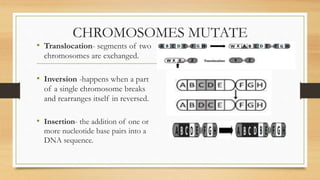
CHROMOSOMES MUTATE
• Translocation- segments of two
chromosomes are exchanged.
• Inversion -happens when a part
of a single chromosome breaks
and rearranges itself in reversed.
• Insertion- the addition of one or
more nucleotide base pairs into a
DNA sequence.
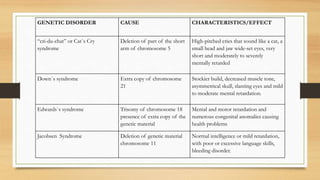
GENETIC DISORDER CAUSE CHARACTERISTICS/EFFECT
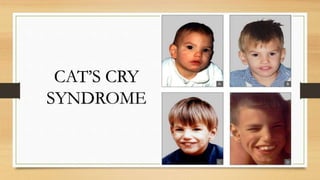
“cri-du-chat” or Cat`s Cry
syndrome
Deletion of part of the short
arm of chromosome 5
High-pitched cries that sound like a cat, a
small head and jaw wide-set eyes, very
short and moderately to severely
mentally retarded
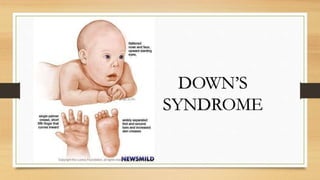
Down`s syndrome Extra copy of chromosome
21
Stockier build, decreased muscle tone,
asymmetrical skull, slanting eyes and mild
to moderate mental retardation.
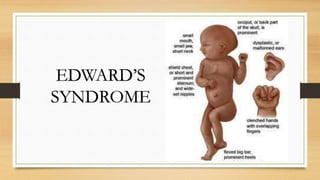
Edwards`s syndrome Trisomy of chromosome 18
presence of extra copy of the
genetic material
Mental and motor retardation and
numerous congenital anomalies causing
health problems
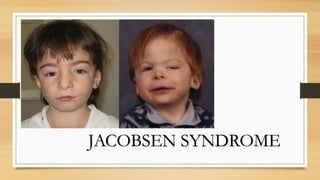
Jacobsen Syndrome Deletion of genetic material
chromosome 11
Normal intelligence or mild retardation,
with poor or excessive language skills,
bleeding disorder.
EDWARD’S
SYNDROME
JACOBSEN SYNDROME
CAT’S CRY
SYNDROME
DOWN’S
SYNDROME
SUMMARY!
• Some mutations have a positive effect on the organism in which they occur.
They are called beneficial mutations. They lead to new versions of proteins
that help organisms adapt to changes in their environment. Beneficial
mutations are essential for evolution to occur. They increase an organism’s
changes of surviving or reproducing, so they are likely to become more
common over time.
• Harmful mutations may cause genetic disorders or cancer.
ACTIVITY TIME!
• 1-2 Give the two major categories of mutation.
• 3-5 Give the three types of gene mutation
• 6-9 Give the four types of Chromosomal
mutation
• 10 Give at least one chromosomal disorder

This is lesson about Mutation in science 10

  • 1.
  • 2.
    At the endof the lesson the learner will able to: a) Define what is mutation; b)Identify the two categories of mutations. c) Make an essay regarding the advantage and disadvantages of mutations.
  • 6.
  • 7.
    WHAT IS MUTATION? •mutations are changes made to an orgasnism’s genetic material. • changes may be due to errors in replication, errors during transcription, radiation, viruses and many other things.
  • 8.
    IS MUTATION CAN BEGOOD AND BAD?
  • 9.
    Three types ofsubstitution mutation • Nonsense mutation results in the formation of a stop codon due to the substitution of one nitrogenous base. Remember, stop codons are special nitrogenous bases that stop the translation stage in protein synthesis.
  • 10.
    Three types ofsubstitution mutation • When one nitrogenous base of the DNA is replaced and the result is an altered codon but does not form a stop codon, it is classified as missense mutation.
  • 11.
    Three types ofsubstitution mutation • Silent mutation happens when a nitrogenous base is altered but the same amino acid is produced. Remember, many codons can code for the same amino acid.
  • 12.
    MUTAGENS- are agentsthat cause alteration in the DNA and can lead to permanent mutations in the DNA sequence depending on the ability of an organism to repair the damage. Example: Toxic chemicals, harmful radiation, and infectious agents.
  • 13.
    TWO MAJOR CATEGORIESOF MUTATIONS: Germline Mutations- Germline Mutations occur in gametes. These mutations are especially significant because they can be transmitted to offspring and every cell in the offspring will have the mutation. Somatic Mutations- Somatic mutations occur in other cells of the body. These mutations may have little effect on the organism because they are confined to just one cell and its daughter cells. Somatic mutations cannot be passed on to offspring.
  • 14.
    Some mutations inthe body cells known to cause cancer. While mutations in reproductive cells cause birth defects and if the mutation is severe, embryo may not be developing.
  • 15.
    3 TYPES OFGENE MUTATIONS: • BASE SUBSTITUTION- the simplest type of gene mutation because only one base in the sequence is substituted/replace by another, so only one codon is affected. • DELETION- there is one or more base deleted in the sequence. A deletion of one or more codons results in a protein missing one or more amino acids. • INSERTION- happened when a base is added in the sequence.
  • 16.
    CHROMOSOMAL MUTATIONS • Chromosomalalterations are mutations that change chromosome structure. Normally, Zygote carries 46 chromosomes, 23 chromosomes from the sperm cell and 23 from the egg cell. Any excess or lack of this number may result to changes in structure and function of a protein. In most cases these problems may cause problems in the development and function of the body system.
  • 17.
    CHROMOSOMES MUTATE • Deletion-happens when a base is deleted from the nitrogen base sequence • Duplication- occurs when a part of a chromosome is copied (duplicated) too many times. This type of chromosomal change results in extra copies of genetic material from the duplicated segment.
  • 18.
    CHROMOSOMES MUTATE • Translocation-segments of two chromosomes are exchanged. • Inversion -happens when a part of a single chromosome breaks and rearranges itself in reversed. • Insertion- the addition of one or more nucleotide base pairs into a DNA sequence.
  • 19.
    GENETIC DISORDER CAUSECHARACTERISTICS/EFFECT “cri-du-chat” or Cat`s Cry syndrome Deletion of part of the short arm of chromosome 5 High-pitched cries that sound like a cat, a small head and jaw wide-set eyes, very short and moderately to severely mentally retarded Down`s syndrome Extra copy of chromosome 21 Stockier build, decreased muscle tone, asymmetrical skull, slanting eyes and mild to moderate mental retardation. Edwards`s syndrome Trisomy of chromosome 18 presence of extra copy of the genetic material Mental and motor retardation and numerous congenital anomalies causing health problems Jacobsen Syndrome Deletion of genetic material chromosome 11 Normal intelligence or mild retardation, with poor or excessive language skills, bleeding disorder.
  • 20.
  • 21.
  • 22.
  • 23.
  • 24.
    SUMMARY! • Some mutationshave a positive effect on the organism in which they occur. They are called beneficial mutations. They lead to new versions of proteins that help organisms adapt to changes in their environment. Beneficial mutations are essential for evolution to occur. They increase an organism’s changes of surviving or reproducing, so they are likely to become more common over time. • Harmful mutations may cause genetic disorders or cancer.
  • 25.
    ACTIVITY TIME! • 1-2Give the two major categories of mutation. • 3-5 Give the three types of gene mutation • 6-9 Give the four types of Chromosomal mutation • 10 Give at least one chromosomal disorder

Editor's Notes

  • #8 MUTATIONS ARE THE RESULTS OF FAILING TO COPY THE CORRECT DNA SEQUENCE DURING REPLICATION
  • #9 Yes they can be good or bad for the bad mutations the lead to diseases like cancer or chronic disease on the other hand the good mutations it can allow organism readily adapt to its environemnt
  • #14 SOMATIC NOT PASSED FROM PARENTS TO CHILDREN, PARENTS HAVE IT BUT IT AFFECTS ONLY THE CHILDREN THEY HAVE