IB Environmental Systems and Societies p. 1
Topic 2: Ecosystems and Ecology (25 hours)
2.5 Investigating Ecosystems
Significant Ideas:
➔ The description and investigation of ecosystems allows for comparisons to be made between different
ecosystems and for them to be monitored, modeled, and evaluated over time, measuring both natural
change and human impacts.
➔ Ecosystems can be better understood through the investigation and quantification of their
components.
Knowledge & Understanding: Use these notes to familiarize yourself with ESS terminology and concepts.
2.5.1 The study of an
ecosystem requires that it
be ​named and located​, for
example Deinikerwald in
Baar, Switzerland – a mixed
deciduous – coniferous
managed woodland.
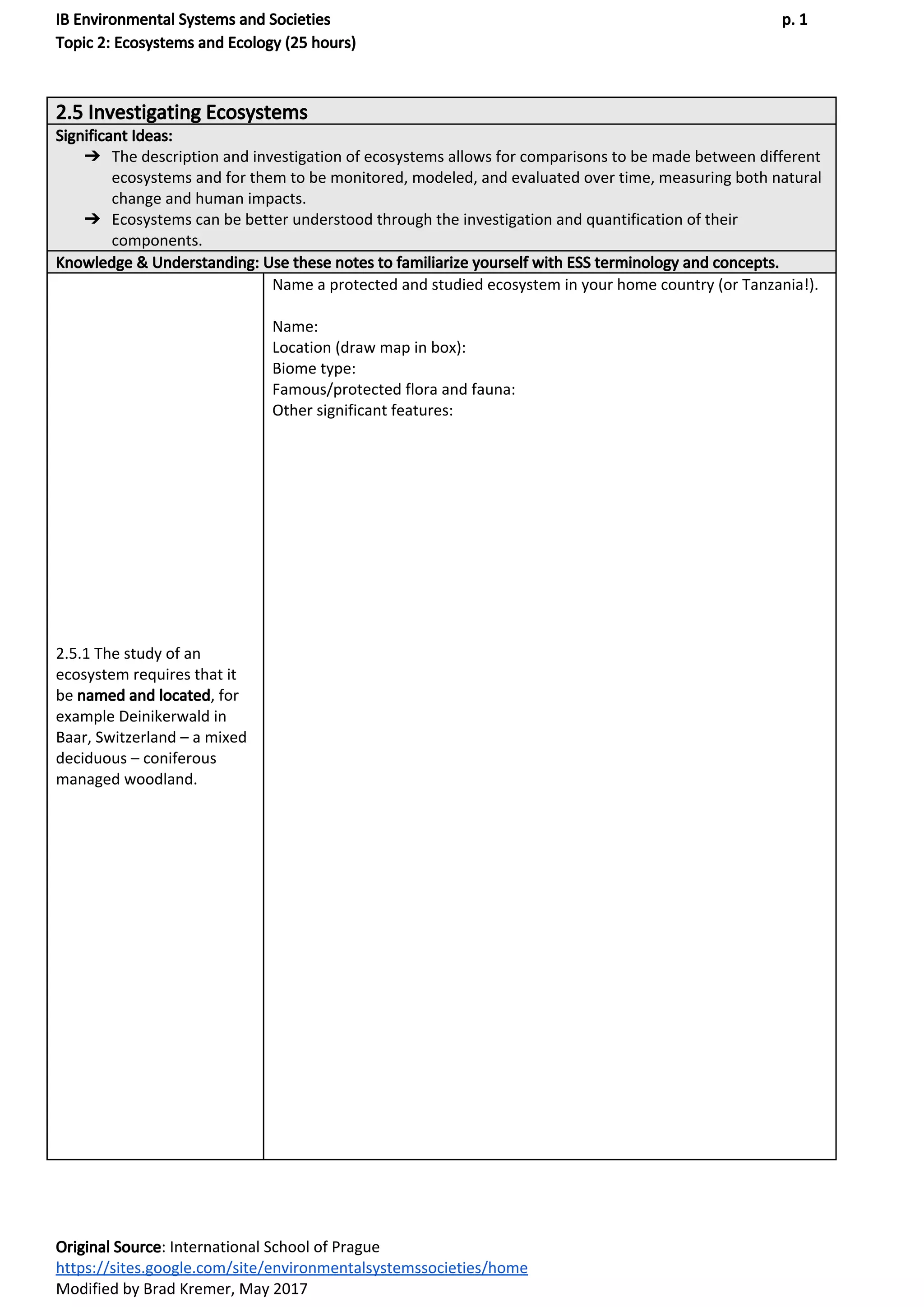
Name a protected and studied ecosystem in your home country (or Tanzania!).
Name:
Location (draw map in box):
Biome type:
Famous/protected flora and fauna:
Other significant features:
Original Source​: International School of Prague
https://sites.google.com/site/environmentalsystemssocieties/home
Modified by Brad Kremer, May 2017
IB Environmental Systems and Societies p. 2
Topic 2: Ecosystems and Ecology (25 hours)
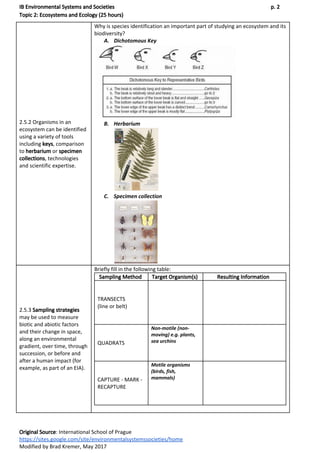
2.5.2 Organisms in an
ecosystem can be identified
using a variety of tools
including ​keys​, comparison
to ​herbarium​ or ​specimen
collections​, technologies
and scientific expertise.
Why is species identification an important part of studying an ecosystem and its
biodiversity?
A. Dichotomous Key
B. Herbarium
C. Specimen collection
2.5.3 ​Sampling strategies
may be used to measure
biotic and abiotic factors
and their change in space,
along an environmental
gradient, over time, through
succession, or before and
after a human impact (for
example, as part of an EIA).
Briefly fill in the following table:
Sampling Method Target Organism(s) Resulting Information
TRANSECTS
(line or belt)
QUADRATS
Non-motile (non-
moving) e.g. plants,
sea urchins
CAPTURE - MARK -
RECAPTURE
Motile organisms
(birds, fish,
mammals)
Original Source​: International School of Prague
https://sites.google.com/site/environmentalsystemssocieties/home
Modified by Brad Kremer, May 2017
IB Environmental Systems and Societies p. 3
Topic 2: Ecosystems and Ecology (25 hours)
2.5.4 Measurements should
be repeated to increase
reliability of data​. The
number of repetitions
required depends on the
factor being measured.
Using the targets below as a metaphor for experimental data, use the terms
valid/invalid and reliable/not reliable to describe each set of “data”. [​hint​: valid
is how close the data comes to the true value (also called accuracy) and reliable
is how repeatable each data point is (also called precision)]
2.5.5 Methods for
estimating the biomass and
energy​ of trophic levels in a
community include
measurement of dry mass,
controlled combustion and
extrapolation from samples.
Data from these methods
can be used to construct
ecological pyramids.
Explain the reason behind the inverted biomass pyramid from the English
Channel.
Original Source​: International School of Prague
https://sites.google.com/site/environmentalsystemssocieties/home
Modified by Brad Kremer, May 2017
IB Environmental Systems and Societies p. 4
Topic 2: Ecosystems and Ecology (25 hours)
2.5.6 ​Methods for
estimating​ the abundance
of non-motile organisms
include the use of ​quadrats
for making actual counts,
measuring population
density, ​percentage cover
and ​percentage​ frequency.
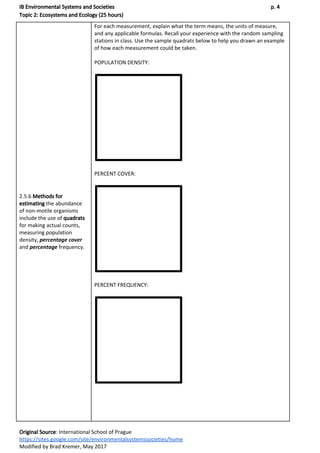
For each measurement, explain what the term means, the units of measure,
and any applicable formulas. Recall your experience with the random sampling
stations in class. Use the sample quadrats below to help you drawn an example
of how each measurement could be taken.
POPULATION DENSITY:
PERCENT COVER:
PERCENT FREQUENCY:
Original Source​: International School of Prague
https://sites.google.com/site/environmentalsystemssocieties/home
Modified by Brad Kremer, May 2017
IB Environmental Systems and Societies p. 5
Topic 2: Ecosystems and Ecology (25 hours)
2.5.7 ​Direct​ and ​indirect
methods​ for estimating the
abundance of motile
organisms can be described
and evaluated.
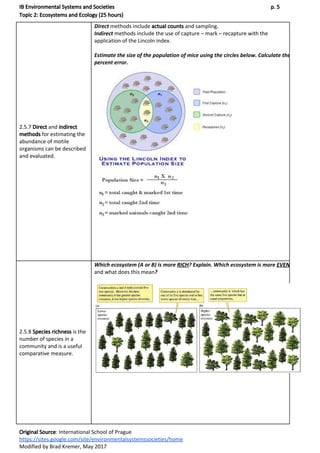
Direct​ methods include ​actual counts​ and sampling.
Indirect​ methods include the use of capture – mark – recapture with the
application of the Lincoln index.
Estimate the size of the population of mice using the circles below. Calculate the
percent error.
2.5.8 ​Species richness​ is the
number of species in a
community and is a useful
comparative measure.
Which ecosystem (A or B) is more ​RICH​? Explain. Which ecosystem is more ​EVEN
and what does this mean​?
Original Source​: International School of Prague
https://sites.google.com/site/environmentalsystemssocieties/home
Modified by Brad Kremer, May 2017
IB Environmental Systems and Societies p. 6
Topic 2: Ecosystems and Ecology (25 hours)
2.5.9 ​Species diversity​ is a
function of the ​number of
species​ and their ​relative
abundance​ and can be
compared using an index.
Students are only expected
to be able to apply and
evaluate the result of the
Simpson diversity index​.
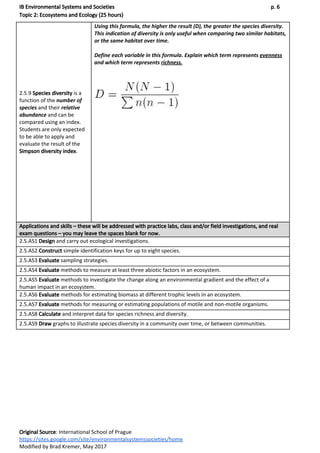
Using this formula, the higher the result (D), the greater the species diversity.
This indication of diversity is only useful when comparing two similar habitats,
or the same habitat over time.
Define each variable in this formula. Explain which term represents ​evenness
and which term represents ​richness.
Applications and skills – these will be addressed with practice labs, class and/or field investigations, and real
exam questions – you may leave the spaces blank for now.
2.5.AS1 ​Design​ and carry out ecological investigations.
2.5.AS2 ​Construct​ simple identification keys for up to eight species.
2.5.AS3 ​Evaluate ​sampling strategies.
2.5.AS4 ​Evaluate ​methods to measure at least three abiotic factors in an ecosystem.
2.5.AS5 ​Evaluate ​methods to investigate the change along an environmental gradient and the effect of a
human impact in an ecosystem.
2.5.AS6 ​Evaluate ​methods for estimating biomass at different trophic levels in an ecosystem.
2.5.AS7 ​Evaluate ​methods for measuring or estimating populations of motile and non-motile organisms.
2.5.AS8 ​Calculate ​and interpret data for species richness and diversity.
2.5.AS9 ​Draw ​graphs to illustrate species diversity in a community over time, or between communities.
Original Source​: International School of Prague
https://sites.google.com/site/environmentalsystemssocieties/home
Modified by Brad Kremer, May 2017

2.5 investigating ecosystems notes

  • 1.
    IB Environmental Systemsand Societies p. 1 Topic 2: Ecosystems and Ecology (25 hours) 2.5 Investigating Ecosystems Significant Ideas: ➔ The description and investigation of ecosystems allows for comparisons to be made between different ecosystems and for them to be monitored, modeled, and evaluated over time, measuring both natural change and human impacts. ➔ Ecosystems can be better understood through the investigation and quantification of their components. Knowledge & Understanding: Use these notes to familiarize yourself with ESS terminology and concepts. 2.5.1 The study of an ecosystem requires that it be ​named and located​, for example Deinikerwald in Baar, Switzerland – a mixed deciduous – coniferous managed woodland. Name a protected and studied ecosystem in your home country (or Tanzania!). Name: Location (draw map in box): Biome type: Famous/protected flora and fauna: Other significant features: Original Source​: International School of Prague https://sites.google.com/site/environmentalsystemssocieties/home Modified by Brad Kremer, May 2017
  • 2.
    IB Environmental Systemsand Societies p. 2 Topic 2: Ecosystems and Ecology (25 hours) 2.5.2 Organisms in an ecosystem can be identified using a variety of tools including ​keys​, comparison to ​herbarium​ or ​specimen collections​, technologies and scientific expertise. Why is species identification an important part of studying an ecosystem and its biodiversity? A. Dichotomous Key B. Herbarium C. Specimen collection 2.5.3 ​Sampling strategies may be used to measure biotic and abiotic factors and their change in space, along an environmental gradient, over time, through succession, or before and after a human impact (for example, as part of an EIA). Briefly fill in the following table: Sampling Method Target Organism(s) Resulting Information TRANSECTS (line or belt) QUADRATS Non-motile (non- moving) e.g. plants, sea urchins CAPTURE - MARK - RECAPTURE Motile organisms (birds, fish, mammals) Original Source​: International School of Prague https://sites.google.com/site/environmentalsystemssocieties/home Modified by Brad Kremer, May 2017
  • 3.
    IB Environmental Systemsand Societies p. 3 Topic 2: Ecosystems and Ecology (25 hours) 2.5.4 Measurements should be repeated to increase reliability of data​. The number of repetitions required depends on the factor being measured. Using the targets below as a metaphor for experimental data, use the terms valid/invalid and reliable/not reliable to describe each set of “data”. [​hint​: valid is how close the data comes to the true value (also called accuracy) and reliable is how repeatable each data point is (also called precision)] 2.5.5 Methods for estimating the biomass and energy​ of trophic levels in a community include measurement of dry mass, controlled combustion and extrapolation from samples. Data from these methods can be used to construct ecological pyramids. Explain the reason behind the inverted biomass pyramid from the English Channel. Original Source​: International School of Prague https://sites.google.com/site/environmentalsystemssocieties/home Modified by Brad Kremer, May 2017
  • 4.
    IB Environmental Systemsand Societies p. 4 Topic 2: Ecosystems and Ecology (25 hours) 2.5.6 ​Methods for estimating​ the abundance of non-motile organisms include the use of ​quadrats for making actual counts, measuring population density, ​percentage cover and ​percentage​ frequency. For each measurement, explain what the term means, the units of measure, and any applicable formulas. Recall your experience with the random sampling stations in class. Use the sample quadrats below to help you drawn an example of how each measurement could be taken. POPULATION DENSITY: PERCENT COVER: PERCENT FREQUENCY: Original Source​: International School of Prague https://sites.google.com/site/environmentalsystemssocieties/home Modified by Brad Kremer, May 2017
  • 5.
    IB Environmental Systemsand Societies p. 5 Topic 2: Ecosystems and Ecology (25 hours) 2.5.7 ​Direct​ and ​indirect methods​ for estimating the abundance of motile organisms can be described and evaluated. Direct​ methods include ​actual counts​ and sampling. Indirect​ methods include the use of capture – mark – recapture with the application of the Lincoln index. Estimate the size of the population of mice using the circles below. Calculate the percent error. 2.5.8 ​Species richness​ is the number of species in a community and is a useful comparative measure. Which ecosystem (A or B) is more ​RICH​? Explain. Which ecosystem is more ​EVEN and what does this mean​? Original Source​: International School of Prague https://sites.google.com/site/environmentalsystemssocieties/home Modified by Brad Kremer, May 2017
  • 6.
    IB Environmental Systemsand Societies p. 6 Topic 2: Ecosystems and Ecology (25 hours) 2.5.9 ​Species diversity​ is a function of the ​number of species​ and their ​relative abundance​ and can be compared using an index. Students are only expected to be able to apply and evaluate the result of the Simpson diversity index​. Using this formula, the higher the result (D), the greater the species diversity. This indication of diversity is only useful when comparing two similar habitats, or the same habitat over time. Define each variable in this formula. Explain which term represents ​evenness and which term represents ​richness. Applications and skills – these will be addressed with practice labs, class and/or field investigations, and real exam questions – you may leave the spaces blank for now. 2.5.AS1 ​Design​ and carry out ecological investigations. 2.5.AS2 ​Construct​ simple identification keys for up to eight species. 2.5.AS3 ​Evaluate ​sampling strategies. 2.5.AS4 ​Evaluate ​methods to measure at least three abiotic factors in an ecosystem. 2.5.AS5 ​Evaluate ​methods to investigate the change along an environmental gradient and the effect of a human impact in an ecosystem. 2.5.AS6 ​Evaluate ​methods for estimating biomass at different trophic levels in an ecosystem. 2.5.AS7 ​Evaluate ​methods for measuring or estimating populations of motile and non-motile organisms. 2.5.AS8 ​Calculate ​and interpret data for species richness and diversity. 2.5.AS9 ​Draw ​graphs to illustrate species diversity in a community over time, or between communities. Original Source​: International School of Prague https://sites.google.com/site/environmentalsystemssocieties/home Modified by Brad Kremer, May 2017