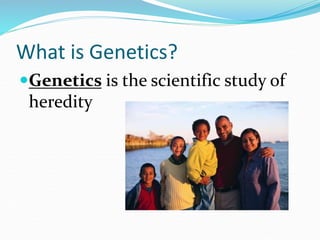
What is Genetics?
Genetics is the scientific study of
heredity
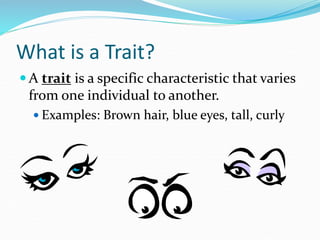
What is a Trait?
 A trait is a specific characteristic that varies
from one individual to another.
 Examples: Brown hair, blue eyes, tall, curly
What is an Allele?
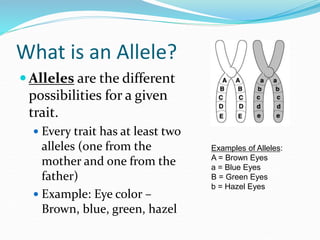
 Alleles are the different
possibilities for a given
trait.
 Every trait has at least two
alleles (one from the
mother and one from the
father)
 Example: Eye color –
Brown, blue, green, hazel
Examples of Alleles:
A = Brown Eyes
a = Blue Eyes
B = Green Eyes
b = Hazel Eyes
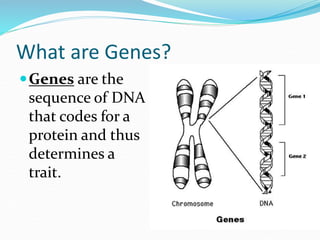
What are Genes?
Genes are the
sequence of DNA
that codes for a
protein and thus
determines a
trait.
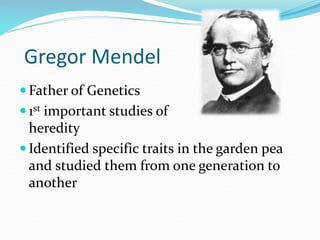
Gregor Mendel
 Father of Genetics
 1st important studies of
heredity
 Identified specific traits in the garden pea
and studied them from one generation to
another
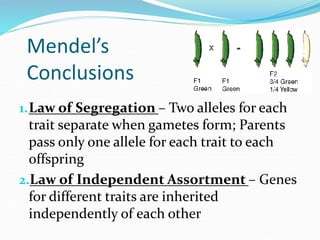
Mendel’s
Conclusions
1.Law of Segregation – Two alleles for each
trait separate when gametes form; Parents
pass only one allele for each trait to each
offspring
2.Law of Independent Assortment – Genes
for different traits are inherited
independently of each other
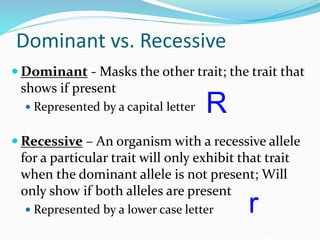
Dominant vs. Recessive
 Dominant - Masks the other trait; the trait that
shows if present
 Represented by a capital letter
 Recessive – An organism with a recessive allele
for a particular trait will only exhibit that trait
when the dominant allele is not present; Will
only show if both alleles are present
 Represented by a lower case letter
R
r
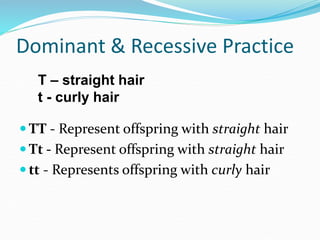
Dominant & Recessive Practice
 TT - Represent offspring with straight hair
 Tt - Represent offspring with straight hair
 tt - Represents offspring with curly hair
T – straight hair
t - curly hair
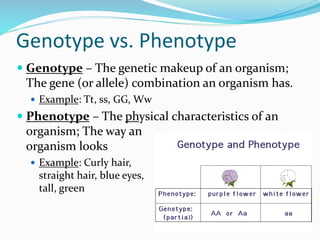
Genotype vs. Phenotype
 Genotype – The genetic makeup of an organism;
The gene (or allele) combination an organism has.
 Example: Tt, ss, GG, Ww
 Phenotype – The physical characteristics of an
organism; The way an
organism looks
 Example: Curly hair,
straight hair, blue eyes,
tall, green
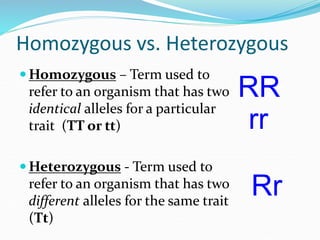
Homozygous vs. Heterozygous
 Homozygous – Term used to
refer to an organism that has two
identical alleles for a particular
trait (TT or tt)
 Heterozygous - Term used to
refer to an organism that has two
different alleles for the same trait
(Tt)
RR
Rr
rr
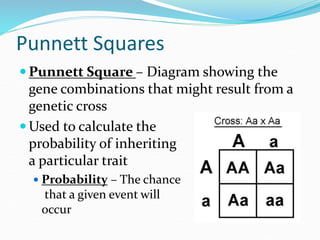
Punnett Squares
 Punnett Square – Diagram showing the
gene combinations that might result from a
genetic cross
 Used to calculate the
probability of inheriting
a particular trait
 Probability – The chance
that a given event will
occur
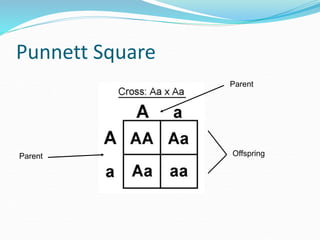
Punnett Square
Parent
Parent Offspring
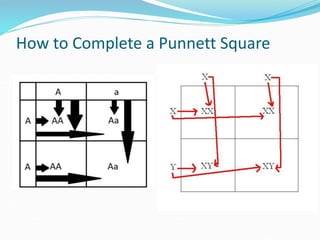
How to Complete a Punnett Square
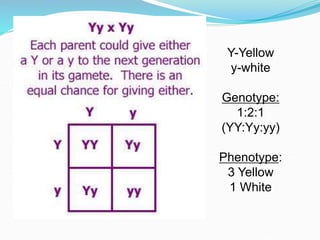
Y-Yellow
y-white
Genotype:
1:2:1
(YY:Yy:yy)
Phenotype:
3 Yellow
1 White
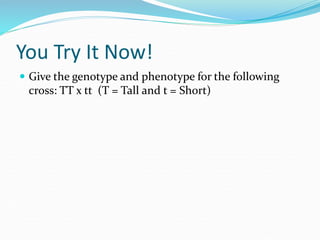
You Try It Now!
 Give the genotype and phenotype for the following
cross: TT x tt (T = Tall and t = Short)
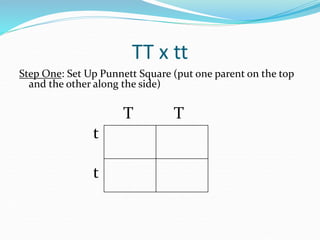
TT x tt
Step One: Set Up Punnett Square (put one parent on the top
and the other along the side)
T T
t
t
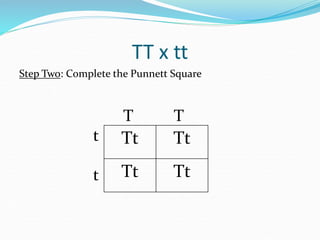
TT x tt
Step Two: Complete the Punnett Square
T T
t
t
Tt Tt
Tt Tt
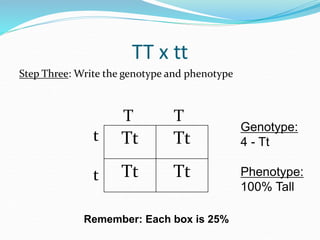
TT x tt
Step Three: Write the genotype and phenotype
T T
t
t
Tt Tt
Tt Tt
Genotype:
4 - Tt
Phenotype:
100% Tall
Remember: Each box is 25%
You Try It Now!
 Give the genotype and phenotype for the following
cross: Tt x tt
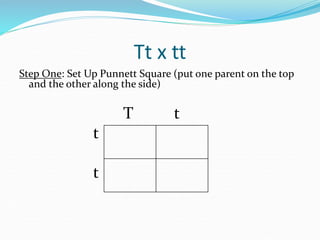
Tt x tt
Step One: Set Up Punnett Square (put one parent on the top
and the other along the side)
T t
t
t
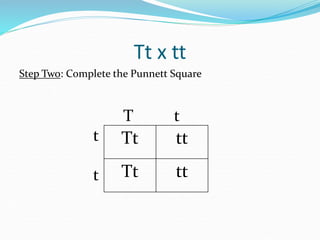
Tt x tt
Step Two: Complete the Punnett Square
T t
t
t
Tt tt
Tt tt
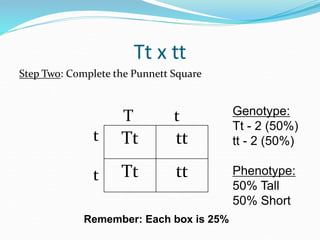
Tt x tt
Step Two: Complete the Punnett Square
T t
t
t
Tt tt
Tt tt
Genotype:
Tt - 2 (50%)
tt - 2 (50%)
Phenotype:
50% Tall
50% Short
Remember: Each box is 25%
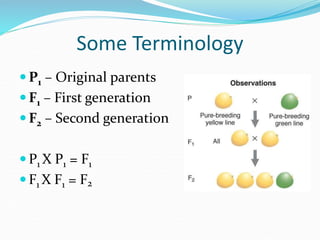
Some Terminology
 P1 – Original parents
 F1 – First generation
 F2 – Second generation
 P1 X P1 = F1
 F1 X F1 = F2
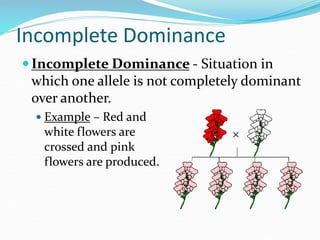
Incomplete Dominance
 Incomplete Dominance - Situation in
which one allele is not completely dominant
over another.
 Example – Red and
white flowers are
crossed and pink
flowers are produced.
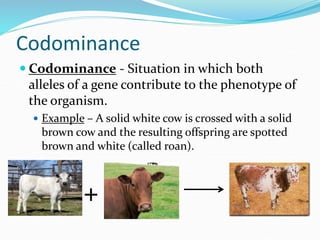
Codominance
 Codominance - Situation in which both
alleles of a gene contribute to the phenotype of
the organism.
 Example – A solid white cow is crossed with a solid
brown cow and the resulting offspring are spotted
brown and white (called roan).
 +
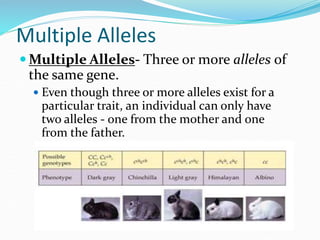
Multiple Alleles
 Multiple Alleles- Three or more alleles of
the same gene.
 Even though three or more alleles exist for a
particular trait, an individual can only have
two alleles - one from the mother and one
from the father.
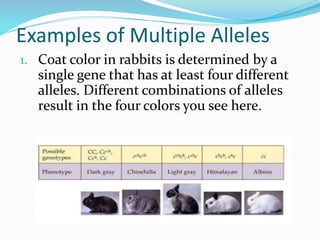
Examples of Multiple Alleles
1. Coat color in rabbits is determined by a
single gene that has at least four different
alleles. Different combinations of alleles
result in the four colors you see here.
Examples of Multiple Alleles
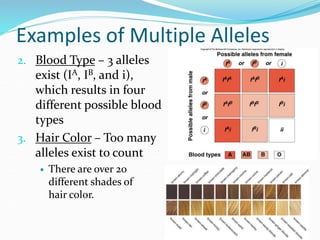
2. Blood Type – 3 alleles
exist (IA, IB, and i),
which results in four
different possible blood
types
3. Hair Color – Too many
alleles exist to count
 There are over 20
different shades of
hair color.
Multiple Alleles
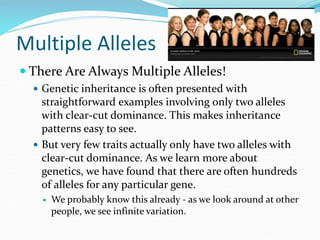
 There Are Always Multiple Alleles!
 Genetic inheritance is often presented with
straightforward examples involving only two alleles
with clear-cut dominance. This makes inheritance
patterns easy to see.
 But very few traits actually only have two alleles with
clear-cut dominance. As we learn more about
genetics, we have found that there are often hundreds
of alleles for any particular gene.
 We probably know this already - as we look around at other
people, we see infinite variation.
Polygenic Trait
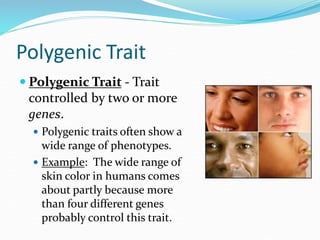
 Polygenic Trait - Trait
controlled by two or more
genes.
 Polygenic traits often show a
wide range of phenotypes.
 Example: The wide range of
skin color in humans comes
about partly because more
than four different genes
probably control this trait.

punnett-square-notes.ppt

  • 2.
    What is Genetics? Geneticsis the scientific study of heredity
  • 3.
    What is aTrait?  A trait is a specific characteristic that varies from one individual to another.  Examples: Brown hair, blue eyes, tall, curly
  • 4.
    What is anAllele?  Alleles are the different possibilities for a given trait.  Every trait has at least two alleles (one from the mother and one from the father)  Example: Eye color – Brown, blue, green, hazel Examples of Alleles: A = Brown Eyes a = Blue Eyes B = Green Eyes b = Hazel Eyes
  • 5.
    What are Genes? Genesare the sequence of DNA that codes for a protein and thus determines a trait.
  • 6.
    Gregor Mendel  Fatherof Genetics  1st important studies of heredity  Identified specific traits in the garden pea and studied them from one generation to another
  • 7.
    Mendel’s Conclusions 1.Law of Segregation– Two alleles for each trait separate when gametes form; Parents pass only one allele for each trait to each offspring 2.Law of Independent Assortment – Genes for different traits are inherited independently of each other
  • 8.
    Dominant vs. Recessive Dominant - Masks the other trait; the trait that shows if present  Represented by a capital letter  Recessive – An organism with a recessive allele for a particular trait will only exhibit that trait when the dominant allele is not present; Will only show if both alleles are present  Represented by a lower case letter R r
  • 9.
    Dominant & RecessivePractice  TT - Represent offspring with straight hair  Tt - Represent offspring with straight hair  tt - Represents offspring with curly hair T – straight hair t - curly hair
  • 10.
    Genotype vs. Phenotype Genotype – The genetic makeup of an organism; The gene (or allele) combination an organism has.  Example: Tt, ss, GG, Ww  Phenotype – The physical characteristics of an organism; The way an organism looks  Example: Curly hair, straight hair, blue eyes, tall, green
  • 11.
    Homozygous vs. Heterozygous Homozygous – Term used to refer to an organism that has two identical alleles for a particular trait (TT or tt)  Heterozygous - Term used to refer to an organism that has two different alleles for the same trait (Tt) RR Rr rr
  • 12.
    Punnett Squares  PunnettSquare – Diagram showing the gene combinations that might result from a genetic cross  Used to calculate the probability of inheriting a particular trait  Probability – The chance that a given event will occur
  • 13.
  • 14.
    How to Completea Punnett Square
  • 15.
  • 16.
    You Try ItNow!  Give the genotype and phenotype for the following cross: TT x tt (T = Tall and t = Short)
  • 17.
    TT x tt StepOne: Set Up Punnett Square (put one parent on the top and the other along the side) T T t t
  • 18.
    TT x tt StepTwo: Complete the Punnett Square T T t t Tt Tt Tt Tt
  • 19.
    TT x tt StepThree: Write the genotype and phenotype T T t t Tt Tt Tt Tt Genotype: 4 - Tt Phenotype: 100% Tall Remember: Each box is 25%
  • 20.
    You Try ItNow!  Give the genotype and phenotype for the following cross: Tt x tt
  • 21.
    Tt x tt StepOne: Set Up Punnett Square (put one parent on the top and the other along the side) T t t t
  • 22.
    Tt x tt StepTwo: Complete the Punnett Square T t t t Tt tt Tt tt
  • 23.
    Tt x tt StepTwo: Complete the Punnett Square T t t t Tt tt Tt tt Genotype: Tt - 2 (50%) tt - 2 (50%) Phenotype: 50% Tall 50% Short Remember: Each box is 25%
  • 24.
    Some Terminology  P1– Original parents  F1 – First generation  F2 – Second generation  P1 X P1 = F1  F1 X F1 = F2
  • 25.
    Incomplete Dominance  IncompleteDominance - Situation in which one allele is not completely dominant over another.  Example – Red and white flowers are crossed and pink flowers are produced.
  • 26.
    Codominance  Codominance -Situation in which both alleles of a gene contribute to the phenotype of the organism.  Example – A solid white cow is crossed with a solid brown cow and the resulting offspring are spotted brown and white (called roan).  +
  • 27.
    Multiple Alleles  MultipleAlleles- Three or more alleles of the same gene.  Even though three or more alleles exist for a particular trait, an individual can only have two alleles - one from the mother and one from the father.
  • 28.
    Examples of MultipleAlleles 1. Coat color in rabbits is determined by a single gene that has at least four different alleles. Different combinations of alleles result in the four colors you see here.
  • 29.
    Examples of MultipleAlleles 2. Blood Type – 3 alleles exist (IA, IB, and i), which results in four different possible blood types 3. Hair Color – Too many alleles exist to count  There are over 20 different shades of hair color.
  • 30.
    Multiple Alleles  ThereAre Always Multiple Alleles!  Genetic inheritance is often presented with straightforward examples involving only two alleles with clear-cut dominance. This makes inheritance patterns easy to see.  But very few traits actually only have two alleles with clear-cut dominance. As we learn more about genetics, we have found that there are often hundreds of alleles for any particular gene.  We probably know this already - as we look around at other people, we see infinite variation.
  • 31.
    Polygenic Trait  PolygenicTrait - Trait controlled by two or more genes.  Polygenic traits often show a wide range of phenotypes.  Example: The wide range of skin color in humans comes about partly because more than four different genes probably control this trait.