

CELL SIGNALLING
BIOC 142
LECTURER:
MR. W. KABISWA
PRESENTATION BY:
MUUNDA MUDENDA
15/BSB/BU/R/0004
TOPIC;
“DISCUSS G-PROTEIN
RECEPTORS”
To understand what g-proteins
are, i.e. Their structure and
mechanism of functioning in
relation to cell signaling.
Signaling pathways are initiated when a
signaling molecule (or ligand) binds to
the receptor (s) of the cell membrane to
form a ligand-receptor complex.
There are basically two classes
of receptors.
1. Intracellular receptors, and
2. Cell surface receptors.
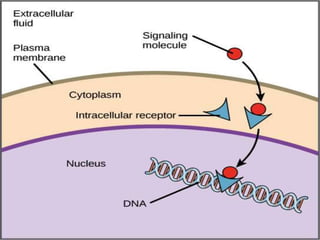
These are found inside the cell,
i.e. the cytoplasm or Nucleus.
Continued…
The ligands of intracellular
receptors are usually;
1.Small
2.Hydrophobic
Examples of Ligands
Sex hormones such as;
1.Estradiol (an estrogen), and
2.Testosterone
When, for example, a hormone
enters the cell, and binds to the
receptor, it causes the receptor
to change shape. The change in
shape allows the hormone-receptor
complex to enter the nucleus and
regulate gene activity.
These are membrane-anchored
proteins that bind to ligands on
the outside of surface of the
cell.
Continued…
The ligands of these receptors can
either be; small or hydrophilic
(water-loving).
Typical cell-surface receptors
have three domains, (or protein
parts). These are;
Extracellular domain (outside the
cell) – for ligand binding.
Hydrophobic domain – extends
through the membrane.
Intracellular domain (inside of
cell) – transmits a signal.
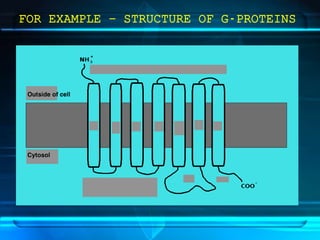
FOR EXAMPLE – STRUCTURE OF G-PROTEINS
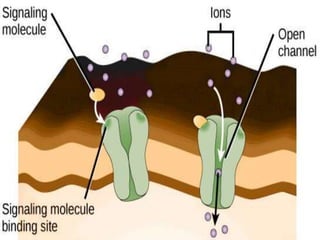
 LIGAND-GATED ION CHANNEL
RECEPTORS
These are ion channels that can
open in response to the binding
ligand.
e.g.
Neurons or nerve cells have
ligand-gated channels that are
bound by neurotransmitters.
 RECEPTOR TYROSINE KINASES
OR PROTEIN KINASES
These are also called enzyme-
linked receptors.
Definition: Receptor tyrosine
kinases are a class of enzyme-
linked receptors that transfer
phosphate groups to the amino
acid tyrosine.
Examples of RTKs are GF (Growth
Factors) such as;
1.PDGF (Platelet Derived Growth
Factors.)
2.NGF (Nerve Growth Factors.)
• Note: Growth factors are
responsible for activities such
as cell division and survival.
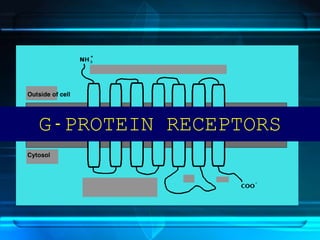
G-PROTEIN RECEPTORS
G-Protein
receptors are the
largest family of
cell-surface
receptors that
are coupled with
a G-protein.
These receptors
are called G-
Protein Coupled
Receptors
(GPCRs).
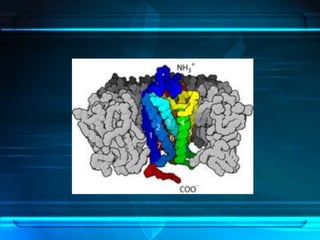
 Seven (7) Trans-membrane domain
proteins – 7TM
 Serpentine Receptors
 G Protein-Linked Receptors (GPLR)
 Heptahelical Receptors
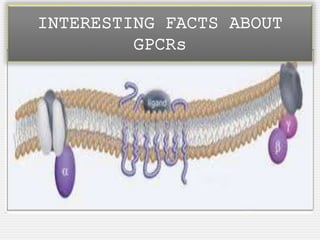
INTERESTING FACTS ABOUT
GPCRs
They are the largest family of
cell surface receptors.
They are the target for most of
the available drugs on the
market.
They have various types of
ligands – odorants, hormones,
pheromones, electromagnetic
signals, ect.
They are found in eukaryotic
cells.
Continued…
There are numerous different types
of GPCRs—some 1,000 types are
encoded by the human genome alone—
and as a group they respond to a
diverse range of substances,
including light, hormones, amines,
neurotransmitters, and lipids.
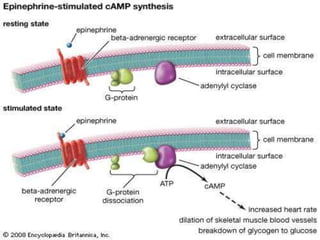
Some examples of GPCRs include;
beta-adrenergic receptors, which
bind epinephrine;
prostaglandin E2 receptors, which
bind inflammatory substances
called prostaglandins; and
rhodopsin, which contains a
photoreactive chemical called
retinal that responds to light
signals received by rod cells in
the eye.
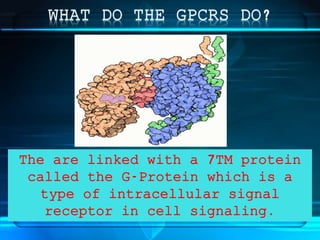
The are linked with a 7TM protein
called the G-Protein which is a
type of intracellular signal
receptor in cell signaling.
In-short, GPCRs are called thus
because of the presence of the G-
protein.
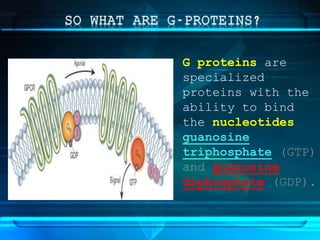
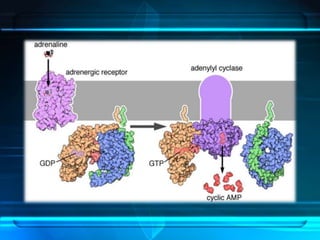
G proteins are
specialized
proteins with the
ability to bind
the nucleotides
guanosine
triphosphate (GTP)
and guanosine
diphosphate (GDP).
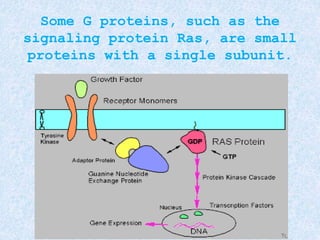
Some G proteins, such as the
signaling protein Ras, are small
proteins with a single subunit.
However, the G proteins that
associate with GPCRs are
heterotrimeric, meaning they have
three different subunits: an alpha
subunit, a beta subunit, and a
gamma subunit.
Continued…
A diverse set of ligands bind to
this type of receptor, including;
• peptide hormones,
• neurotransmitters, and
• odor molecules.
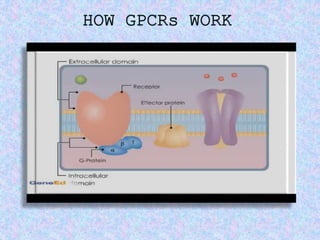
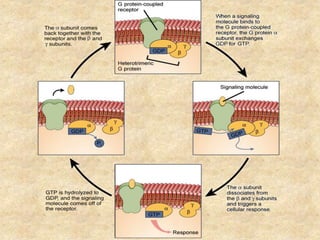
HOW GPCRs WORK
NOTE:
The G protein system plays a
central role in many signaling
tasks, making it a sensitive
target for drugs and toxins.
Many of the drugs that are
currently on the market, such as
Claritin and Prozac, as well as a
number of drugs of abuse, such as
heroin, cocaine and marijuana, act
at G-protein-coupled receptors in
these signaling chains.
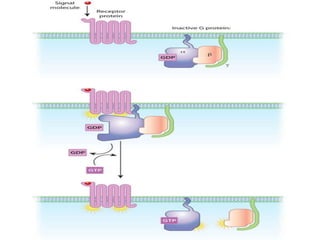
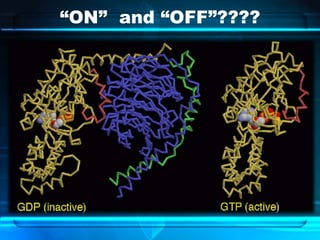
“ON” and “OFF”????
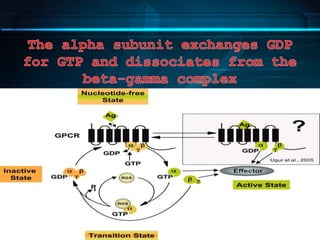
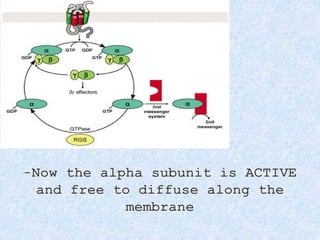
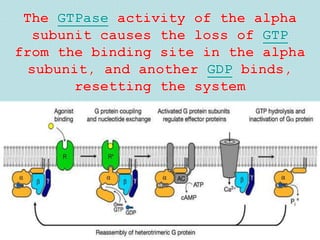
HOW DOES THE GDP to GTP
exchange occur?
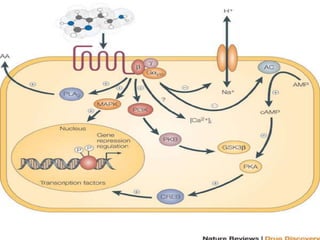
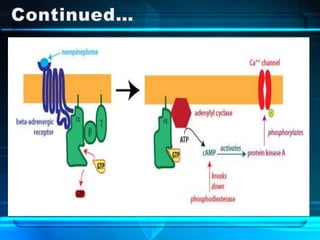
There are two principal signal
transduction pathways involving
the G protein–coupled receptors:
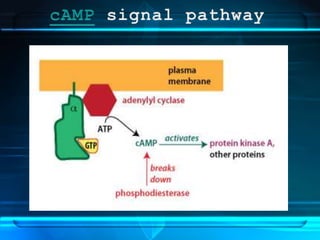
• the cAMP signal pathway and
• the phosphatidylinositol signal
pathway.
The cAMP pathways has an advantage
in that it amplifies signals
through the enzyme adenylyl
cyclase. This means even weak
signals from outside the cell can
be detected by the cell.
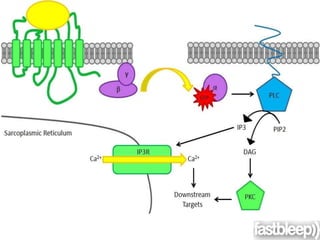
Ca2+
cyclic AMP [cAMP],
diacylglycerol [DAG], and
inositol 1, 4, 5-triphosphate
[IP3]
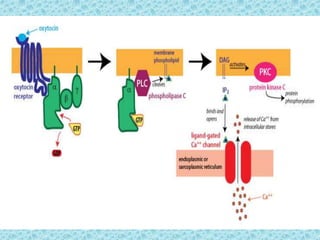
Phospholipase C is another common
target of activated G proteins.
This membrane-associated enzyme
catalyzes the synthesis of not
one, but two second messengers —
DAG and IP3 — from the membrane
lipid phosphatidyl inositol.
This particular pathway is
critical to a wide variety of
human bodily processes. For
instance, thrombin receptors in
platelets use this pathway to
promote blood clotting.
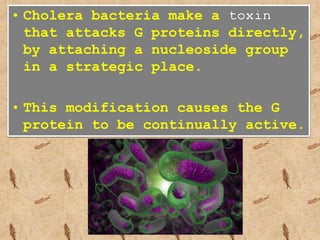
An example is Cholera.
• Cholera bacteria make a
that attacks G proteins directly,
by attaching a nucleoside group
in a strategic place.
• This modification causes the G
protein to be continually active.
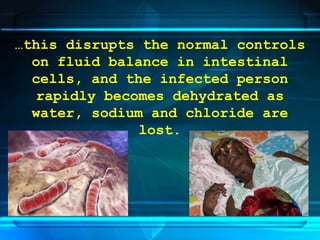
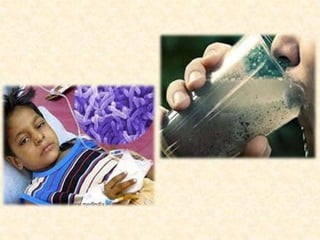
…this disrupts the normal controls
on fluid balance in intestinal
cells, and the infected person
rapidly becomes dehydrated as
water, sodium and chloride are
lost.
 Whooping Cough
 Night Blindness
 Cholera
 Alzheimer’s Disease
 Hypertension
 Cancers
 Etc…
 Khanacedemy (2017). Ligand and Receptors. Retrieved from:
https://www.khanacademy.org/science/biology/cell-signaling/mechanisms-of-cell
 Kara Rogers (2017). G protein-coupled receptor. Encyclopedia Britannica. Retrieved from:
https://www.britannica.com/science/G-protein-coupled-receptor
 Wikipedia (2017). G protein-coupled receptor. Retrieved from:
https://en.wikipedia.org/wiki/G_protein%E2%80%93coupled_receptor
 Interpro (2017). G protein. Retrieved from:
https://www.ebi.ac.uk/interpro/potm/2004_10/Page2.htm
 Nature (2017). GPCR. Retrieved from: http://www.nature.com/scitable/topicpage/gpcr-
14047471
 S. R. Sprang (1997) G protein mechanisms: insights from structural analysis. Annual
Review of Biochemistry 66, 639-678.
 H. R. Bourne (1997) How receptors talk to trimeric G proteins. Current Opinion in Cell
Biology 9, 134-142.

G-protein receptors - BUGEMA UNIVERSITY

  • 1.
  • 2.
  • 3.
  • 4.
  • 5.
    To understand whatg-proteins are, i.e. Their structure and mechanism of functioning in relation to cell signaling.
  • 6.
    Signaling pathways areinitiated when a signaling molecule (or ligand) binds to the receptor (s) of the cell membrane to form a ligand-receptor complex.
  • 7.
    There are basicallytwo classes of receptors. 1. Intracellular receptors, and 2. Cell surface receptors.
  • 8.
    These are foundinside the cell, i.e. the cytoplasm or Nucleus.
  • 9.
    Continued… The ligands ofintracellular receptors are usually; 1.Small 2.Hydrophobic
  • 10.
    Examples of Ligands Sexhormones such as; 1.Estradiol (an estrogen), and 2.Testosterone
  • 12.
    When, for example,a hormone enters the cell, and binds to the receptor, it causes the receptor to change shape. The change in shape allows the hormone-receptor complex to enter the nucleus and regulate gene activity.
  • 13.
    These are membrane-anchored proteinsthat bind to ligands on the outside of surface of the cell.
  • 14.
    Continued… The ligands ofthese receptors can either be; small or hydrophilic (water-loving).
  • 15.
    Typical cell-surface receptors havethree domains, (or protein parts). These are; Extracellular domain (outside the cell) – for ligand binding.
  • 16.
    Hydrophobic domain –extends through the membrane. Intracellular domain (inside of cell) – transmits a signal.
  • 17.
    FOR EXAMPLE –STRUCTURE OF G-PROTEINS
  • 18.
     LIGAND-GATED IONCHANNEL RECEPTORS These are ion channels that can open in response to the binding ligand. e.g. Neurons or nerve cells have ligand-gated channels that are bound by neurotransmitters.
  • 20.
     RECEPTOR TYROSINEKINASES OR PROTEIN KINASES These are also called enzyme- linked receptors. Definition: Receptor tyrosine kinases are a class of enzyme- linked receptors that transfer phosphate groups to the amino acid tyrosine.
  • 21.
    Examples of RTKsare GF (Growth Factors) such as; 1.PDGF (Platelet Derived Growth Factors.) 2.NGF (Nerve Growth Factors.)
  • 22.
    • Note: Growthfactors are responsible for activities such as cell division and survival.
  • 24.
  • 25.
    G-Protein receptors are the largestfamily of cell-surface receptors that are coupled with a G-protein. These receptors are called G- Protein Coupled Receptors (GPCRs).
  • 26.
     Seven (7)Trans-membrane domain proteins – 7TM  Serpentine Receptors  G Protein-Linked Receptors (GPLR)  Heptahelical Receptors
  • 27.
  • 28.
    They are thelargest family of cell surface receptors. They are the target for most of the available drugs on the market.
  • 29.
    They have varioustypes of ligands – odorants, hormones, pheromones, electromagnetic signals, ect. They are found in eukaryotic cells.
  • 30.
    Continued… There are numerousdifferent types of GPCRs—some 1,000 types are encoded by the human genome alone— and as a group they respond to a diverse range of substances, including light, hormones, amines, neurotransmitters, and lipids.
  • 31.
    Some examples ofGPCRs include; beta-adrenergic receptors, which bind epinephrine;
  • 33.
    prostaglandin E2 receptors,which bind inflammatory substances called prostaglandins; and
  • 34.
    rhodopsin, which containsa photoreactive chemical called retinal that responds to light signals received by rod cells in the eye.
  • 35.
    The are linkedwith a 7TM protein called the G-Protein which is a type of intracellular signal receptor in cell signaling.
  • 36.
    In-short, GPCRs arecalled thus because of the presence of the G- protein.
  • 37.
    G proteins are specialized proteinswith the ability to bind the nucleotides guanosine triphosphate (GTP) and guanosine diphosphate (GDP).
  • 38.
    Some G proteins,such as the signaling protein Ras, are small proteins with a single subunit.
  • 39.
    However, the Gproteins that associate with GPCRs are heterotrimeric, meaning they have three different subunits: an alpha subunit, a beta subunit, and a gamma subunit.
  • 41.
    Continued… A diverse setof ligands bind to this type of receptor, including; • peptide hormones, • neurotransmitters, and • odor molecules.
  • 43.
  • 47.
    NOTE: The G proteinsystem plays a central role in many signaling tasks, making it a sensitive target for drugs and toxins.
  • 48.
    Many of thedrugs that are currently on the market, such as Claritin and Prozac, as well as a number of drugs of abuse, such as heroin, cocaine and marijuana, act at G-protein-coupled receptors in these signaling chains.
  • 49.
  • 50.
    HOW DOES THEGDP to GTP exchange occur?
  • 54.
    There are twoprincipal signal transduction pathways involving the G protein–coupled receptors: • the cAMP signal pathway and • the phosphatidylinositol signal pathway.
  • 58.
    The cAMP pathwayshas an advantage in that it amplifies signals through the enzyme adenylyl cyclase. This means even weak signals from outside the cell can be detected by the cell.
  • 59.
    Ca2+ cyclic AMP [cAMP], diacylglycerol[DAG], and inositol 1, 4, 5-triphosphate [IP3]
  • 60.
    Phospholipase C isanother common target of activated G proteins. This membrane-associated enzyme catalyzes the synthesis of not one, but two second messengers — DAG and IP3 — from the membrane lipid phosphatidyl inositol.
  • 62.
    This particular pathwayis critical to a wide variety of human bodily processes. For instance, thrombin receptors in platelets use this pathway to promote blood clotting.
  • 64.
    An example isCholera.
  • 66.
    • Cholera bacteriamake a that attacks G proteins directly, by attaching a nucleoside group in a strategic place. • This modification causes the G protein to be continually active.
  • 67.
    …this disrupts thenormal controls on fluid balance in intestinal cells, and the infected person rapidly becomes dehydrated as water, sodium and chloride are lost.
  • 69.
     Whooping Cough Night Blindness  Cholera  Alzheimer’s Disease  Hypertension  Cancers  Etc…
  • 70.
     Khanacedemy (2017).Ligand and Receptors. Retrieved from: https://www.khanacademy.org/science/biology/cell-signaling/mechanisms-of-cell  Kara Rogers (2017). G protein-coupled receptor. Encyclopedia Britannica. Retrieved from: https://www.britannica.com/science/G-protein-coupled-receptor  Wikipedia (2017). G protein-coupled receptor. Retrieved from: https://en.wikipedia.org/wiki/G_protein%E2%80%93coupled_receptor  Interpro (2017). G protein. Retrieved from: https://www.ebi.ac.uk/interpro/potm/2004_10/Page2.htm  Nature (2017). GPCR. Retrieved from: http://www.nature.com/scitable/topicpage/gpcr- 14047471  S. R. Sprang (1997) G protein mechanisms: insights from structural analysis. Annual Review of Biochemistry 66, 639-678.  H. R. Bourne (1997) How receptors talk to trimeric G proteins. Current Opinion in Cell Biology 9, 134-142.